ECU DACIA SANDERO 2013 2.G User Guide
[x] Cancel search | Manufacturer: DACIA, Model Year: 2013, Model line: SANDERO, Model: DACIA SANDERO 2013 2.GPages: 146, PDF Size: 6.4 MB
Page 30 of 146
\
ENG_NU_817-2_NU_Dacia_1
JauneNoirNoir texte
CHILD SAFETY: Fitting a child seat (continued)
Child seat attached usi")
1.26
ENG_UD8389_2Sécurité enfants : installation du siège enfant (B90 - Dacia)\
ENG_NU_817-2_NU_Dacia_1
JauneNoirNoir texte
CHILD SAFETY: Fitting a child seat (continued)
Child seat attached using the ISOFIX fitting
ü = Seat which allows an ISOFIX child seat to be attached.
= The rear seats are fitted with an anchorage point which allows a for- ward-facing ISOFIX child seat with uni- versal approval to be attached. The anchorage points are located on each side of the tailgate.
The size of the ISOFIX child seat is in- dicated by a letter:
– A, B and B1: for forward-facing seats
in group 1 (9 to 18 kg);
– C: rear-facing seats in group 1 (9 to
18 kg);
– D and E: shell seat or rear-facing
seats in group 0 or 0+ (less than
13 kg);
– F and G: cots in group 0 (less than
10 kg).
: Seat not suitable for fitting child seats.
Child seat attached using the belt
U = Seat which allows a seat with “universal” approval to be at- tached;
UD = Seat which allows a rear-facing seat with “universal” approval only to be attached with a seat belt.
Using a child safety system which is not approved for this vehicle will not correctly protect the baby or child. They risk serious or even fatal injury.
Child seat installation
diagram
:
Check the status of the front airbag before fitting a child seat or allow- ing a passenger to use the seat.
R I S K O F D E AT H O R
SERIOUS INJURY: before fitting a rear-facing child seat in the front passen- ger seat, check that the air bag has been deactivated (refer to the infor- mation on “Deactivating the front passenger air bags” at the end of the paragraph).
v ehicles without airbag or with airbag deactivated
Page 31 of 146
\
ENG_NU_817-2_NU_Dacia_1
CHILD SAFETY: Fitting a child seat (continued)
Child seat attached usi")
JauneNoirNoir texte
1.27
ENG_UD8389_2Sécurité enfants : installation du siège enfant (B90 - Dacia)\
ENG_NU_817-2_NU_Dacia_1
CHILD SAFETY: Fitting a child seat (continued)
Child seat attached using the ISOFIX fitting
ü = Seat which allows an ISOFIX child seat to be attached.
= The rear seats are fitted with an anchorage point which allows a for- ward-facing ISOFIX child seat with universal approval to be attached. The anchorage points are located on each side of the tailgate.
The size of the ISOFIX child seat is in- dicated by a letter:
– A, B and B1: for forward-facing seats
in group 1 (9 to 18 kg);
– C: rear-facing seats in group 1 (9 to
18 kg);
– D and E: shell seat or rear-facing
seats in group 0 or 0+ (less than
13 kg);
– F and G: cots in group 0 (less than
10 kg).
Child seat attached using the belt
U = Seat which allows child seats with “universal” approval to be fitted by seat belt.
Using a child safety system which is not approved for this vehicle will not correctly protect the baby or child. They risk serious or even fatal injury.
Child seat installation
diagram
: Seat not suitable for fitting child seats.
R I S K O F D E AT H O R
SERIOUS INJURY: before fitting a rear-facing child seat in the front passen- ger seat, check that the air bag has been deactivated (refer to the infor- mation on “Deactivating the front passenger air bags” at the end of the paragraph).
v ehicles with airbags that cannot be deactivated
Page 32 of 146
\
ENG_NU_817-2_NU_Dacia_1
JauneNoirNoir texte
CHILD SAFETY: Fitting a child seat (continued)
(5) RISK OF DEATH OR SE")
1.28
ENG_UD8389_2Sécurité enfants : installation du siège enfant (B90 - Dacia)\
ENG_NU_817-2_NU_Dacia_1
JauneNoirNoir texte
CHILD SAFETY: Fitting a child seat (continued)
(5) RISK OF DEATH OR SERIOUS INJURY: before fitting a rear-facing child seat on the front passenger seat, check that the airbag has been deactivated (refer to the information on “Deactivating the front passenger airbag” in
Section 1).
(6) RISK OF DEATH OR SERIOUS INJURY: never fit a child seat to this seat.
The table below summarises the information already shown on the diagram on the previous pages, to ensure the regula- tions in force are respected.
Type of child seat w
eight of the childSeat size
Front passenger seat with airbagFront passenger seat without airbag
(1)
Rear side seats
Rear centre seat
wITH deactivation
(1) (5) wITHOUT deactivation
(1) (6)
Carrycot fitted across the vehicleGroup 0< 10 kgF - GXXXU - IL (2)U
Shell seat/Rear-facing seatGroup 0, 0+ and 1
< 13 kg
9 kg to 18 kgE, DUXUU - IL (3)U
Rear-facing seat
Group 0+ and 1< 13 kg
9 kg to 18 kg CUXUU - IL (3)U
Forward-facing seatGroup 19 kg to 18 kgB, B1XXXU - IUF - IL
(4)U
Forward-facing seatGroup 19 kg to 18 kgAXXXU (4)U
Booster seatGroup 2 and 3
15 to 25 kg
and 22 to 36 kg–XXXU (4)U
Page 33 of 146
\
ENG_NU_817-2_NU_Dacia_1
CHILD SAFETY: Fitting a child seat (continued)
X = Seat not suitable")
JauneNoirNoir texte
1.29
ENG_UD8389_2Sécurité enfants : installation du siège enfant (B90 - Dacia)\
ENG_NU_817-2_NU_Dacia_1
CHILD SAFETY: Fitting a child seat (continued)
X = Seat not suitable for fitting child seats.
U = Seat allowing a child seat with “Universal” approval to be attached by seat belt; check that it can be fitted correctly.
IUF =
Seat which, on equipped vehicles, allows forward facing child seats with “Universal” approval to be attached by the ISOFIX system; check that it can be fitted.IL =
Seat which, on equipped vehicles, allows child seats with “Semi-Universal” or “Specific to vehicle” approval to be attached by the ISOFIX device; check that it can be fitted.
Refer to the brochure “Child safety equipment” available from the Network to choose the seat suited to your child and recommended for your vehicle.
(1)
Only a rear-facing child seat can be fitted in this seat: position the vehicle seat as far back as possible, and gently tilt the seat- back (approximately 25°).(2)
A carrycot can be installed across the vehicle and will take up two seats. Position the child with his or her feet nearest the door.
(3)
Move the front seat as far forward as possible to install a rear-facing child seat, then move back the seat or seats in front in accordance with the child seat instructions.(4)
Forward-facing child seat; position the seatback of the child seat in contact with the seatback of the vehicle seat. Adjust the headrest, or remove it if necessary. Do not push the seat in front of the child more than halfway back on its runners and do not recline the seatback more than 25°.
Page 34 of 146
air bagdeactivating the front passenger air bags ........(current page)front passenger air bag deactivation .....................(current page)
1.30
ENG_UD6854_1Sécurité enfants : désactivation/activation airbag passager ava\
nt (B90 - Dacia)ENG_NU_817-2_NU_Dacia_1
JauneNoirNoir texte
désactivation / activation de l’airbag passager avant
CHILD SAFETY : Deactivating/activating the front passenger airbag
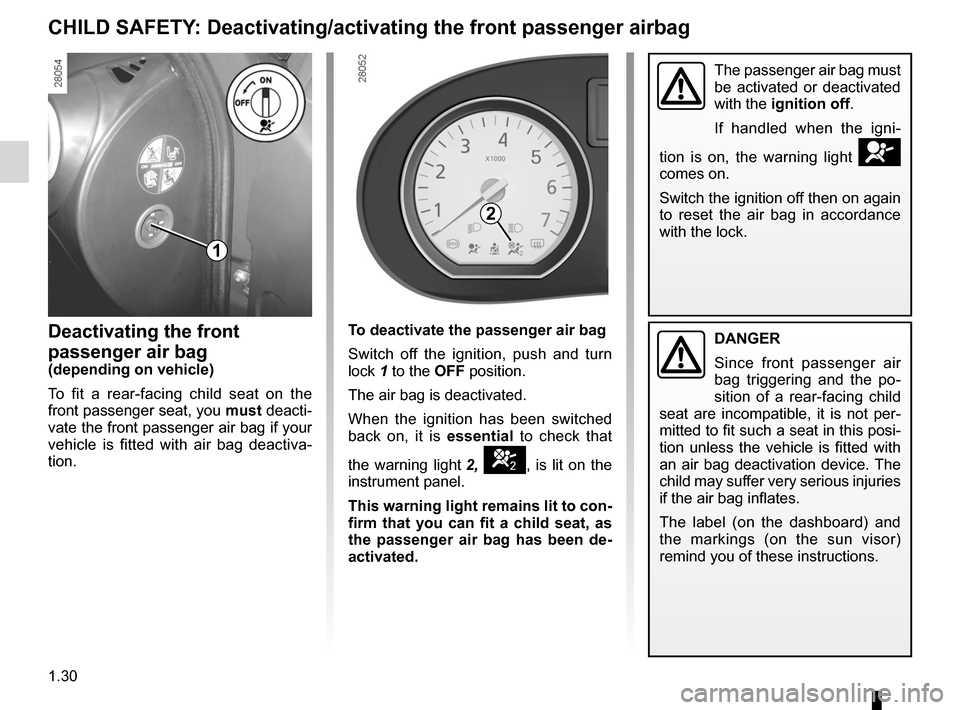
The passenger air bag must be activated or deactivated with the ignition off.
If handled when the igni-
tion is on, the warning light å comes on.
Switch the ignition off then on again to reset the air bag in accordance with the lock.
To deactivate the passenger air bag
Switch off the ignition, push and turn
lock 1 to the OFF position.
The air bag is deactivated.
When the ignition has been switched back on, it is essential to check that
the warning light
2, ], is lit on the instrument panel.
This warning light remains lit to con- firm that you can fit a child seat, as the passenger air bag has been de- activated.
Deactivating the front
passenger air bag(depending on vehicle)
To fit a rear-facing child seat on the front passenger seat, you must deacti- vate the front passenger air bag if your vehicle is fitted with air bag deactiva- tion.
DANGER
Since front passenger air bag triggering and the po- sition of a rear-facing child seat are incompatible, it is not per- mitted to fit such a seat in this posi- tion unless the vehicle is fitted with an air bag deactivation device. The child may suffer very serious injuries if the air bag inflates.
The label (on the dashboard) and the markings (on the sun visor) remind you of these instructions.
1
2
Page 35 of 146

JauneNoirNoir texte
1.31
ENG_UD6854_1Sécurité enfants : désactivation/activation airbag passager ava\
nt (B90 - Dacia)ENG_")
air bagactivating the front passenger air bags ............(current page)
JauneNoirNoir texte
1.31
ENG_UD6854_1Sécurité enfants : désactivation/activation airbag passager ava\
nt (B90 - Dacia)ENG_NU_817-2_NU_Dacia_1
CHILD SAFETY : Deactivating/activating the front passenger airbag (continued)
Operating faults
It is forbidden to fit a rear-facing child seat to the front passenger seat if the air bag activation/deactivation system is faulty.
Allowing any other passenger to sit in that seat is not recommended.
Contact your approved dealer as soon as possible.
The passenger air bag must be activated or deactivated with the ignition off.
If handled when the igni-
tion is on, the warning light å comes on.
Switch the ignition off then on again to reset the air bag in accordance with the lock.
DANGER
Since front passenger air bag triggering and the po- sition of a rear-facing child seat are incompatible, it is not per- mitted to fit such a seat in this posi- tion unless the vehicle is fitted with an air bag deactivation device. The child may suffer very serious injuries if the air bag inflates.
The label (on the dashboard) and the markings (on the sun visor) remind you of these instructions.
Activation of the front
passenger air bag(depending on vehicle)
You should reactivate the air bag as soon as you remove the child seat from the front passenger seat to ensure the protection of your front passenger in the event of an impact.
To reactivate the airbag: switch off
the ignition, push and turn the lock 1 to the ON position.
With the ignition on, it is essential to
check that the warning light
2, ], is off. The front passenger airbag has
been activated.
1
2
Page 93 of 146
filteroil filter .............................................................(current page)oil change ..............................................................(current page)
JauneNoirNoir texte
4.5
ENG_UD5591_1Niveau huile moteur/Vidange moteur (B90 - Dacia)ENG_NU_817-2_NU_Dacia_4
Vidange moteur
ENGINE OIL LEVEL (continued)/OIL CHANGE
Oil change
S e r v i c e i n t e r v a l : r e f e r t o t h e Maintenance Service Booklet for your vehicle.
Average capacities for oil change oil filter included.(for information)
1.4 engine : 3.30 litres1.6 engine : 3.30 litres1.6 16V engine: 4.80 litres
1.5 dCi engine : 4.10 litres
Engine oil grade
Refer to the Maintenance Service Booklet for your vehicle for information regarding which grade of oil to use.
Filling: take care when topping up the oil that no oil drips onto engine components - risk of fire. Remember to refit the cap securely as there is a risk of fire if oil splashes onto hot engine components.
Engine oil change: if you are changing the oil when the engine is hot, be careful not to scald yourself if the oil overflows.
Never run the engine in an enclosed space as exhaust gases are poisonous.
The engine may be hot during operations in close proximity. In addition, the engine cooling fan may come on at any moment.
Risk of injury.
Consult your approved dealer at once if you notice an abnormal or repeated drop in any of the fluid levels.
Page 99 of 146
JauneNoirNoir texte
4.11
ENG_UD5594_1Entretien de la carrosserie (B90 - Dacia)ENG_NU_817-2_NU_Dacia_4
BODYWORK MAINTENANCE (continued)
You should
– Wash your car frequently, with the engine off, with cleaning products recommended by the manufacturer (never use abrasive products) and be sure to jet-rinse off:
– spots of tree resin and industrial grime;
– bird droppings, which contain chemicals that rapidly discolour paintwork and may cause the paint to peel off;
Wash the vehicle immediately to
remove these marks since it is im- possible to remove them by pol- ishing;
– salt deposited in the wheel arches and underneath the body after driving in areas where the roads are chemically treated;
– mud in the wheel arches and un- derneath the body which form damp patches. –
Keep well away from the vehicle in
front when driving on gravelled sur- faces to prevent paint damage.
– Repair or have repaired quickly
patches where the paint has been damaged to prevent corrosion spreading.
– Remember to visit the body shop pe
- riodically in order to maintain your anti-corrosion warranty. Refer to the Maintenance Service Booklet.
– Respect local regulations about
washing vehicles (e.g. do not wash your vehicle on a public highway). –
Before using a roller type car wash,
put the windscreen wiper stalk in Park position (refer information on the “Windscreen wash/wipe” in Section 1), check that the external accessories, additional lights, and mirrors are securely fitted and that the wiper blades and radio aerial are taped down.
If your vehicle has a car phone and radio, remove the aerials.
– Spray mechanical components,
hinges, etc. with products approved by the Technical Department to protect them after they have been cleaned.
We have selected special products to care for your vehicle and you can obtain these from approved dealer accessory outlets.
Page 107 of 146
practical advice .....................................(up to the end of the DU)tyres ......................................................(up to the end of the DU)emergency spare wheel .......................(up to the end of the DU)
5.7
ENG_UD5513_1Pneumatiques (U90 - Dacia)ENG_NU_817-2_NU_Dacia_5
Pneumatiques (sécurité pneumatiques, roues, utilisation hivernale\
)
TYRES
Tyre and wheel safety
The tyres are the only contact between the vehicle and the road, so it is essen- tial to keep them in good condition.
You must make sure that your tyres con- form to local road traffic regulations.
When they need to be re- placed, only tyres of the same make, size, type and profile should be used.
Tyres fitted to the vehicle should either be identical to those fitted originally or conform to those recommended by your approved dealer.
Maintaining the tyres
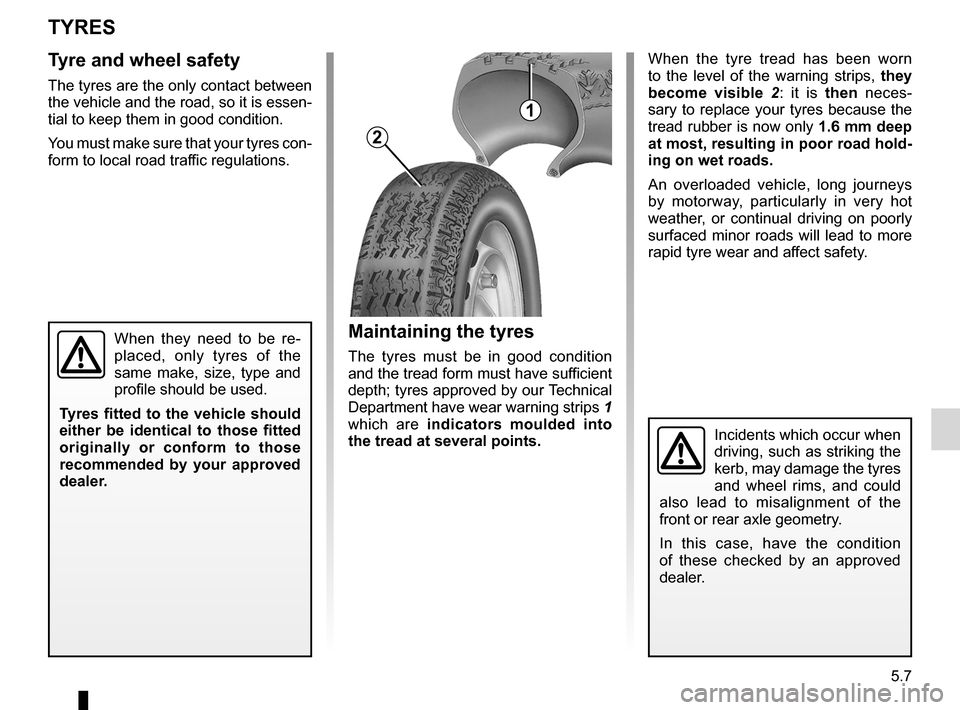
The tyres must be in good condition and the tread form must have sufficient depth; tyres approved by our Technical
Department have wear warning strips 1 which are indicators moulded into the tread at several points.
When the tyre tread has been worn to the level of the warning strips, they become visible 2: it is then neces- sary to replace your tyres because the tread rubber is now only 1.6 mm deep at most, resulting in poor road hold- ing on wet roads.
An overloaded vehicle, long journeys by motorway, particularly in very hot weather, or continual driving on poorly surfaced minor roads will lead to more rapid tyre wear and affect safety.
Incidents which occur when driving, such as striking the kerb, may damage the tyres and wheel rims, and could also lead to misalignment of the front or rear axle geometry.
In this case, have the condition of these checked by an approved dealer.
1
2
Page 130 of 146
operating faults .....................................(up to the end of the DU)practical advice .....................................(up to the end of the DU)faultsoperating faults ...............................(up to the end of the DU)
5.30
ENG_UD5616_1Anomalies de fonctionnement (B90 - Dacia)ENG_NU_817-2_NU_Dacia_5
JauneNoirNoir texte
Anomalies de fonctionnement
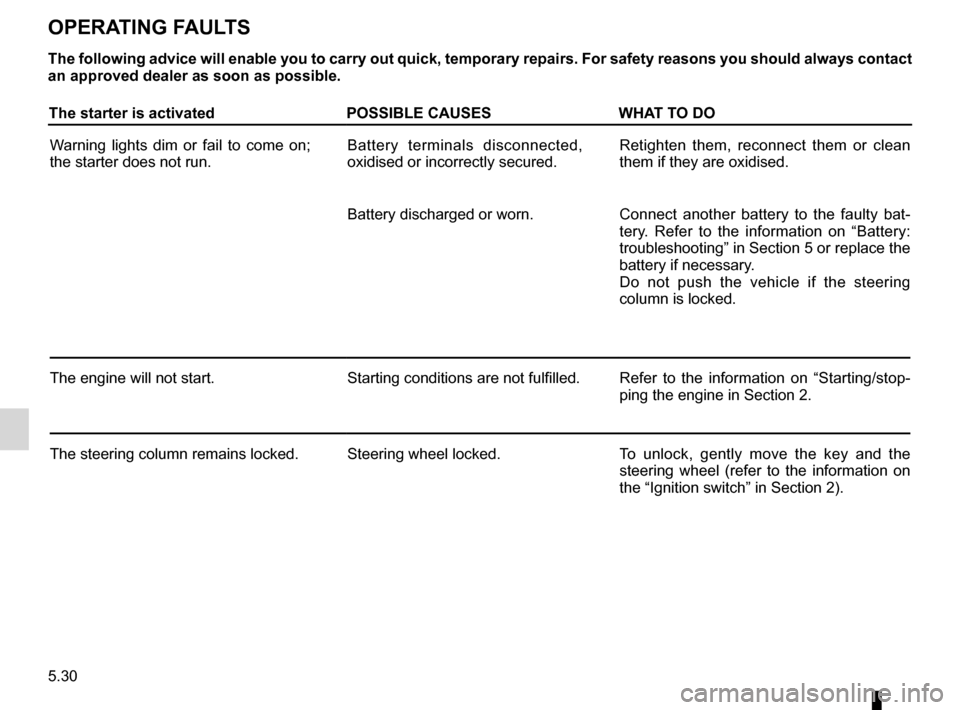
OPERATING FAULTS
The following advice will enable you to carry out quick, temporary repairs. For safety reasons you should always contact an approved dealer as soon as possible.
The starter is activatedPOSSIBLE CAUSESWHAT TO DO
Warning lights dim or fail to come on; the starter does not run.Battery terminals disconnected, oxidised or incorrectly secured.Retighten them, reconnect them or clean them if they are oxidised.
Battery discharged or worn.Connect another battery to the faulty bat- tery. Refer to the information on “Battery: troubleshooting” in Section 5 or replace the battery if necessary.Do not push the vehicle if the steering column is locked.
The engine will not start.Starting conditions are not fulfilled.Refer to the information on “Starting/stop- ping the engine in Section 2.
The steering column remains locked.Steering wheel locked.To unlock, gently move the key and the steering wheel (refer to the information on the “Ignition switch” in Section 2).