change wheel DAEWOO NUBIRA 2004 Service Owner's Manual
[x] Cancel search | Manufacturer: DAEWOO, Model Year: 2004, Model line: NUBIRA, Model: DAEWOO NUBIRA 2004Pages: 2643, PDF Size: 80.54 MB
Page 970 of 2643

2E – 8ITIRES AND WHEELS
DAEWOO V–121 BL4
TIRE AND WHEEL
MATCH–MOUNTING
The tires and wheels are match–mounted at the assembly
plant. Match–mounting aligns the radially stiffest part of
the tire, or high spot, to the smallest radius, or low spot, of
the wheel.
The high spot of the tire is originally marked by a red paint
mark or an adhesive label on the outboard sidewall.
The low spot of the wheel will be at the location of the valve
stem.
Before dismounting a tire from its wheel, scribe a line on
the tire at the valve stem to assure that it is remounted in
the same position.
Replacement tires that are of original equipment quality
will have their high and low spot marked in the same man-
ner.
TIRE MOUNTING AND DISMOUNTING
Notice : Use a tire–changing machine to mount or dis-
mount the tires. Follow the equipment manufacturer’s in-
structions. Do not use hand tools or tire irons to change
tires. These tools may damage the beads or the wheel rim.
1. Clean the rim bead seats with a wire brush or
coarse steel wool to remove lubricants, old rubber,
and light rust. Before mounting or dismounting a
tire, lubricate the bead area well with an approved
tire lubricant.
CAUTION : To avoid serious injury, do not stand over
the tire when inflating it, because the bead may break
when it snaps over the safety hump. Do not exceed
275 kPa (40 psi) of air pressure in any tire if the beads
are not seated. If 275 kPa (40 psi) of air pressure will
not seat the beads, deflate the tire. Relubricate the
bead and reinflate the tire. Overinflation may cause
the bead to break and cause serious injury.
2. fter mounting the tire, inflate it until the beads are
seated. Never exceed 275 kPa (40 psi) to seat the
beads.
3. Install the valve core and inflate the tire to the prop-
er pressure. Make sure the locating ring outside of
the bead of the tire shows around the rim flanges of
the wheel on both sides. This positioning of the tire
will insure that the bead of the tire is seated.
Page 1103 of 2643

4F – 22IANTILOCK BRAKE SYSTEM
DAEWOO V–121 BL4
SELF–DIAGNOSTICS
Important : The electronic brake control module (EBCM)
turns the valve relay off when a diagnostic trouble code
(DTC) is set. The scan tool will indicate that the valve relay
is off when it is used to monitor the data list. This is normal
and should not be considered a malfunction.
Important : For safety reasons it is recommended that the
vehicle not be driven with test equipment connected. Ex-
ception : for testing of wheel speeds provided the test reg-
ulations are met.
The EBCM performs system self–diagnostics and can de-
tect and often isolate system malfunctions. When it de-
tects a malfunction, the EBCM sets a DTC that represents
the malfunction, turns ON the ABS and/or the EBD indica-
tors in most instances, and may disable the ABS and/or
the EBD functions as necessary for the duration of the igni-
tion cycle.
Once each ignition cycle, the EBCM performs an automat-
ic test when the vehicle speed > 6 km/h and the brake ped-
al is not actuated or when the vehicle speed > 15 km/h and
the brake pedal is actuated. In the course of this test, the
system cycles each valve solenoid and the pump motor,
along with the necessary relays, to check component op-
eration. If the EBCM detects any malfunctions, it will set
a DTC as described above.
DISPLAYING DTCS
Tools Required
Scan Tool
DTCs can be read through the use of the scan tool.
CLEARING DTCS
Tools Required
Scan Tool
The diagnostic trouble codes (DTCs) in the electronic
brake control module (EBCM) memory are erased:S Use the scan tool ”Clear DTCs” selection.
The method is detailed below. Be sure to verify proper sys-
tem operation and absence of DTCs when the clearing
procedure is completed.
The EBCM will not permit DTC clearing until all DTCs have
been displayed. Also, DTCs cannot be cleared by discon-
necting the EBCM, disconnecting the battery cables, or
turning the ignition switch to LOCK.
Scan Tool Method
The scan tool can clear ABS system DTCs using the mass
storage cartridge.
1. Install the scan tool and the mass storage cartridge.
2. Select ”Fault Memory.”
3. Select ”Clear Fault Memory.”
Clearing the fault memory cannot reset a valve relay which
was shut down when the fault was recognized. Changes
are possible only after the fault has been eliminated and
the next ignition cycle has begun.
INTERMITTENTS AND POOR
CONNECTIONS
As with most electronic systems, intermittent malfunctions
may be difficult to diagnose accurately. The following is a
method to try to isolate an intermittent malfunction, espe-
cially in wheel speed circuitry.
If an ABS malfunction occurs, the ABS indicator will illumi-
nate during the ignition cycle in which the malfunction was
detected. If it is an intermittent problem which seems to
have corrected itself (ABS indicator off), a history DTC will
be stored. Also stored will be the history data of the DTC
at the time the malfunction occurred. Use the scan tool
modular diagnostic system to read ABS history data.
Most intermittents are caused by faulty electrical connec-
tions or wiring, although a sticking relay or solenoid can oc-
casionally be at fault.
Page 1132 of 2643

ANTILOCK BRAKE SYSTEM 4F – 51
DAEWOO V–121 BL4
Diagnostic Aids
DTC C0245 may be set by running the scan tool auto test
if the throttle angle readings are not updating while in the
data list mode. If this is the case, clear the DTCs, discon-
nect the scan tool, and road test the vehicle to at least 12
km/h (7 mph) to see if the DTC resets.
Check the toothed wheels for any large grooves, gouges,
marks, etc. that might influence the tooth’s signal at the
wheel speed sensor. Also check for a buildup of foreignmaterial in the gaps between teeth in the toothed wheel,
this material may cause this malfunction.
A badly worn hub/bearing assembly may cause this mal-
function. The wheel speed sensor–to–toothed wheel air
gap may change excessively due to bearing play.
If an improper rear hub assembly or front outer constant
velocity joint is installed, one with a toothed wheel contain-
ing the incorrect number of teeth, this DTC can set. Be
sure that the front and the rear toothed wheel have 47 and
29 teeth.
DTC C0245 – Wheel Speed Sensor Frequency Error
StepActionValue(s)YesNo
1Visually inspect the wiring for the front wheel speed
sensors.
Is there any damage?–Go to Step 2Go to Step 3
2Check that the correct outer constant velocity (CV)
joints are installed on the vehicle. The front speed
rings have 47 teeth and the rear speed rings have 29
theeth.
Is the repair complete?–System OK–
3Check fuse EF2 in the engine fuse block.
Is one of these incorrect?–Go to Step 4Go to Step 5
4Replace the incorrect outer CV joint with the proper
unit.
Is the repair complete?–System OK–
51. Disconnect the wheel speed sensor harnesses
from the wheel speed sensor connectors.
2. Measure the wheel speed sensor resistance at
the wheel speed sensor connector terminals.
Does the resistance fall within the specified values
for both wheel speed sensors?1280–1920 WGo to Step 7Go to Step 6
6Replace the faulty wheel speed sensor.
Is the repair complete?–System OK–
71. Disconnect ABS control module connector.
2. Check each wheel speed sensor harness for a
short circuit between its wires with a digital
ohmmeter attached to the two terminals at the
harness side of the wheel speed sensor con-
nector.
3. Also check each wheel speed sensor harness
wire for a short to ground from the connector
terminals.
Is there any short circuit in either wheel speed sen-
sor harness?–Go to Step 8Go to Step 9
8Repair the short circuit in the wiring or from a wiring
harness to ground.
Is the repair complete?–System OK–
Page 1650 of 2643

5A2 – 60IAISIN AUTOMATIC TRANSAXLE
DAEWOO V–121 BL4
DTC P0722 Output Shaft Speed (OSS) sensor Circuit No Signal
StepActionValue(s)YesNo
11. Turn the ignition OFF.
2. Install the Scan tool.
3. With the engine OFF, turn the ignition switch to
the ON position.
4. Select Store Freeze Frame/Failure Records
from the Diagnostic Trouble Codes Information
menu.
5. Store Freeze Frame/Failure Records.
6. Select Clear DTC Information from the Diag-
nostic Trouble Codes Information menu.
7. Clear DTC Information.
8. Perform one vehicle drive cycle.
Is the Malfunction Indicator Lamp (MIL) ON?–Go to Step 2Repair the tem-
porary connec-
tion failure of
connector (Re-
fer to ”Wiring
Harness and
Connector In-
spection” in this
section.)
21. Select Request DTC by Status from the Diag-
nostic Trouble Codes Information menu.
2. Request DTC by Status.
Is DTC P0722 displayed?–Go to Step 3Repair the tem-
porary connec-
tion failure of
connector (Re-
fer to ”Wiring
Harness and
Connector In-
spection” in this
section.)
31. Turn the ignition OFF.
2. Inspect the voltage between vehicle harness
and the Output Shaft Speed (OSS) sensor.
3. Disconnect the connector (X–1) of the vehicle
harness.
4. Connect the voltmeter to monitor the voltage
between terminal B25 and ground.
5. Turn ignition ON and lift up the vehicle.
6. Check the voltage change from approximately
0 v to 12 v when the wheel is turned slowly.
Does the measurement change within the specified
value?0–12 vGo to Step 4Go to Step 5
41. Estimate the failure of between the vehicle wir-
ing harness connector and TCM.
2. Inspect the connector. Refer to ”Wiring Har-
ness and Connector Inspection” in this section.
3. Inspect the connection condition between the
connectors (C–1).
Is the connection condition OK?–Go to Step 6Repair the wir-
ing harness
connectors.
51. Estimate the failure of T/M wire or between the
connectors of OSS sensor.
2. Inspect the OSS sensor. Refer to ”Unit Inspec-
tion” in this section
Is the condition of OSS sensor OK?–Go to Step 7Replace the
OSS sensor
Page 1904 of 2643

POWER STEERING SYSTEM 6A – 3
DAEWOO V–121 BL4
MAINTENANCE AND REPAIR
ON–VEHICLE SERVICE
BLEEDING THE POWER STEERING
SYSTEM
If the power steering hydraulic system has been serviced,
an accurate fluid level reading cannot be obtained until the
air is bled from the system. Follow these steps to bleed the
air from the system.
1. Turn the wheels all the way to the left and add the
power steering fluid to the MIN mark on the fluid
level indicator.
Notice : When adding fluid or making a complete fluid
change, always use DEXRON®–II or III power steering
fluid. Failure to use the proper fluid will cause hose and
seal damage and fluid leaks.
2. Start the engine. With the engine running at fast
idle, recheck the fluid level. If necessary, add fluid
to bring the level up to the MIN mark.
3. Bleed the system by turning the wheels from side to
side without reaching the stop at either end. Keep
the fluid level at the MIN mark. The air must be
eliminated from the fluid before normal steering ac-
tion can be obtained.
4. Return the wheels to the center position. Continue
running the engine for 2 to 3 minutes.
5. Road test the car to be sure the steering functions
normally and is free from noise.
6. Recheck the fluid level as described in steps 1 and
2. Make sure the fluid level is at the MAX mark af-
ter the system has stabilized at its normal operating
temperature. Add fluid as needed.
CHECKING AND ADDING FLUID
Notice : When adding fluid or making a complete fluid
change, always use DEXRON®–II or III power steering
fluid. Failure to use the proper fluid will cause hose and
seal damage and fluid leaks.
1. The power steering fluid level is indicated either by
marks on a see–through fluid reservoir or by marks
on a fluid level indicator on the fluid reservoir cap.
2. If the fluid is warmed up to 66°C (150°F), the fluid
level should be between the MAX and MIN marks.
Add fluid as needed.
3. If the fluid is cool, 21°C (70°F), the fluid level
should be at the MIN mark. Add fluid as needed.
Page 1931 of 2643
6C – 14IPOWER STEERING GEAR
DAEWOO V–121 BL4
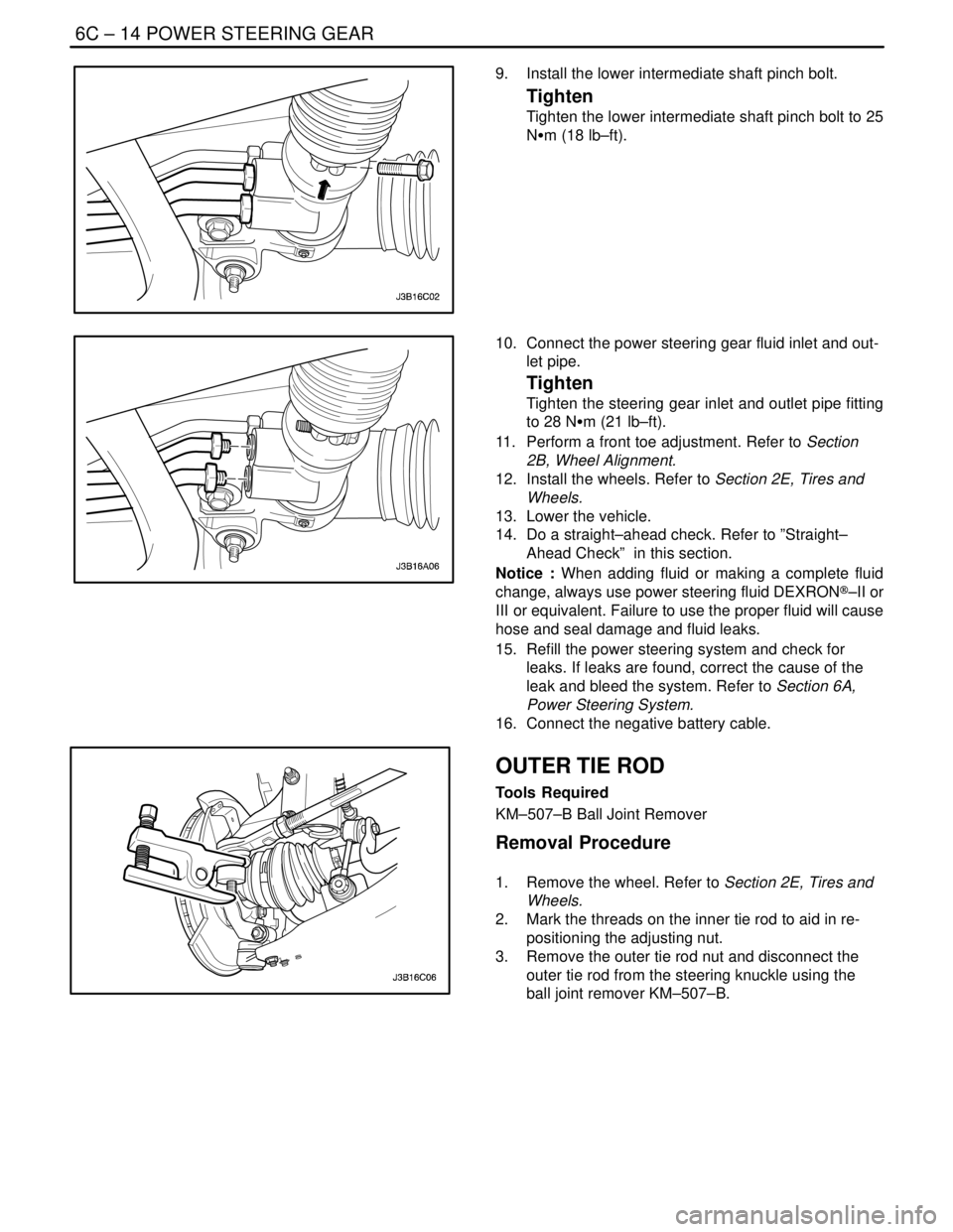
9. Install the lower intermediate shaft pinch bolt.
Tighten
Tighten the lower intermediate shaft pinch bolt to 25
NSm (18 lb–ft).
10. Connect the power steering gear fluid inlet and out-
let pipe.
Tighten
Tighten the steering gear inlet and outlet pipe fitting
to 28 NSm (21 lb–ft).
11. Perform a front toe adjustment. Refer to Section
2B, Wheel Alignment.
12. Install the wheels. Refer to Section 2E, Tires and
Wheels.
13. Lower the vehicle.
14. Do a straight–ahead check. Refer to ”Straight–
Ahead Check” in this section.
Notice : When adding fluid or making a complete fluid
change, always use power steering fluid DEXRON®–II or
III or equivalent. Failure to use the proper fluid will cause
hose and seal damage and fluid leaks.
15. Refill the power steering system and check for
leaks. If leaks are found, correct the cause of the
leak and bleed the system. Refer to Section 6A,
Power Steering System.
16. Connect the negative battery cable.
OUTER TIE ROD
Tools Required
KM–507–B Ball Joint Remover
Removal Procedure
1. Remove the wheel. Refer to Section 2E, Tires and
Wheels.
2. Mark the threads on the inner tie rod to aid in re-
positioning the adjusting nut.
3. Remove the outer tie rod nut and disconnect the
outer tie rod from the steering knuckle using the
ball joint remover KM–507–B.
Page 1950 of 2643

POWER STEERING GEAR 6C – 33
DAEWOO V–121 BL4
GENERAL DESCRIPTION
AND SYSTEM OPERATION
POWER RACK AND PINION
The power rack and pinion steering system has a rotary
control valve that directs hydraulic fluid coming from the
hydraulic pump to one side or the other side of the rack pis-
ton. The integral rack piston is attached to the rack. The
rack piston converts hydraulic pressure to a linear force
that moves the rack left or right. That force is then trans-
mitted through the tie rods to the steering knuckles, which
turn the wheels.
If power rack and pinion steering is not available, manual
rack and pinion control is used; however, with this system,
more steering effort is required. The movement of the
steering wheel is transferred to the pinion. The rotary
movement of the pinion is then transferred through the pin-
ion threads, which mesh with teeth on the rack, thereby
causing the rack to move in a linear direction.
A vane–type of hydraulic pump provides hydraulic pres-
sure for both steering systems.
SPEED SENSITIVE POWER
STEERING SYSTEM
The speed sensitive power steering (SSPS) system varies
the driver effort required to steer as the vehicle speed
changes. At low speeds, the system provides maximum
power assist for easy turning and parking maneuvers. At
higher speeds, the steering power is reduced to provide
the driver with firmer steering and directional stability. The
SSPS system accomplishes this by reducing the amount
of power steering fluid flow from the power steering pump
to the power steering gear as the vehicle speed increases.
When the vehicle is stationary, the SSPS system provides
maximum fluid flow to the steering gear. As the vehicle
speed increases, the fluid flow to the steering gear is de-
creased.
Control Module
The SSPS control module processes the vehicle speed in-
formation from the engine control module (ECM) and uses
the steering wheel rotation sensor to provide a control sig-
nal to the electronic variable orifice (EVO) actuator located
on the power steering pump.
Electronic Variable Orifice (EVO) Actuator
The electronic variable orifice (EVO) actuator is located on
the power steering pump and contains a solenoid– oper-
ated pintle valve. Fluid leaving the pump passes through
an orifice in the actuator tip. When the EVO actuator is
powered by the SSPS control module, the pintle moves
into the orifice and reduces the power steering fluid flow.As the vehicle speed increases, current from the SSPS
control module increases, and the pintle blocks more and
more of the orifice.
Steering Wheel Rotation Sensor
The steering wheel rotation sensor is located at the end of
the steering column housing and is used to send a signal
to the controller when abrupt or evasive steering maneu-
vers are needed.
Power Steering Pressure Hose
SSPS vehicles have a specific pressure hose assembly
which includes an in–line check valve in the rack and pin-
ion assembly. This reduces the amount of steering wheel
”kick” when driving over irregular road surfaces while oper-
ating at speeds with reduced flow rate and pressure.
Power Rack and Pinion
Except for differences in valve machining, the design of
the SSPS power rack and pinion assembly is the same as
for the a non–SSPS system. The steering wheel move-
ment is transferred to the pinion via the intermediate shaft.
The pinion moves the rack left or right through meshing the
pinion and the rack teeth. The force is then transmitted
through the tie rods and steering knuckle to steer the
wheels.
The power rack and pinion steering system has a rotary
control valve which directs the hydraulic fluid from the
power steering pump to one side or the other side of the
rack piston. The piston is attached to the rack and uses hy-
draulic pressure to move the rack left or right. The rotary
control valve regulates the degree of assist by responding
to the driver’s torque input.
If hydraulic assist is not available, manual control is main-
tained. However, under this condition, more steering effort
is required.
Power Steering Pump
The standard vane–type pump, which provides hydraulic
pressure for the system, incorporates a special discharge
fitting to hold the EVO actuator.
System Operation
System operation originates with input from the vehicle
speed sensor via the engine control module to the SSPS
control module. The SSPS control module sends a signal
to the SSPS actuator to vary the rate of fluid flow output
by the power steering pump.
Circuit Operation
The SSPS system uses inputs from the speed sensor and
steering wheel rotation sensor to the SSPS controller to
determine the desired amount of power steering assist.
The SSPS control module constantly compares the
amount of current flowing through the EVO actuator to the
desired current it has calculated. The EVO actuator has a
pintle that moves in and out of an orifice, regulating power
Page 1951 of 2643
6C – 34IPOWER STEERING GEAR
DAEWOO V–121 BL4
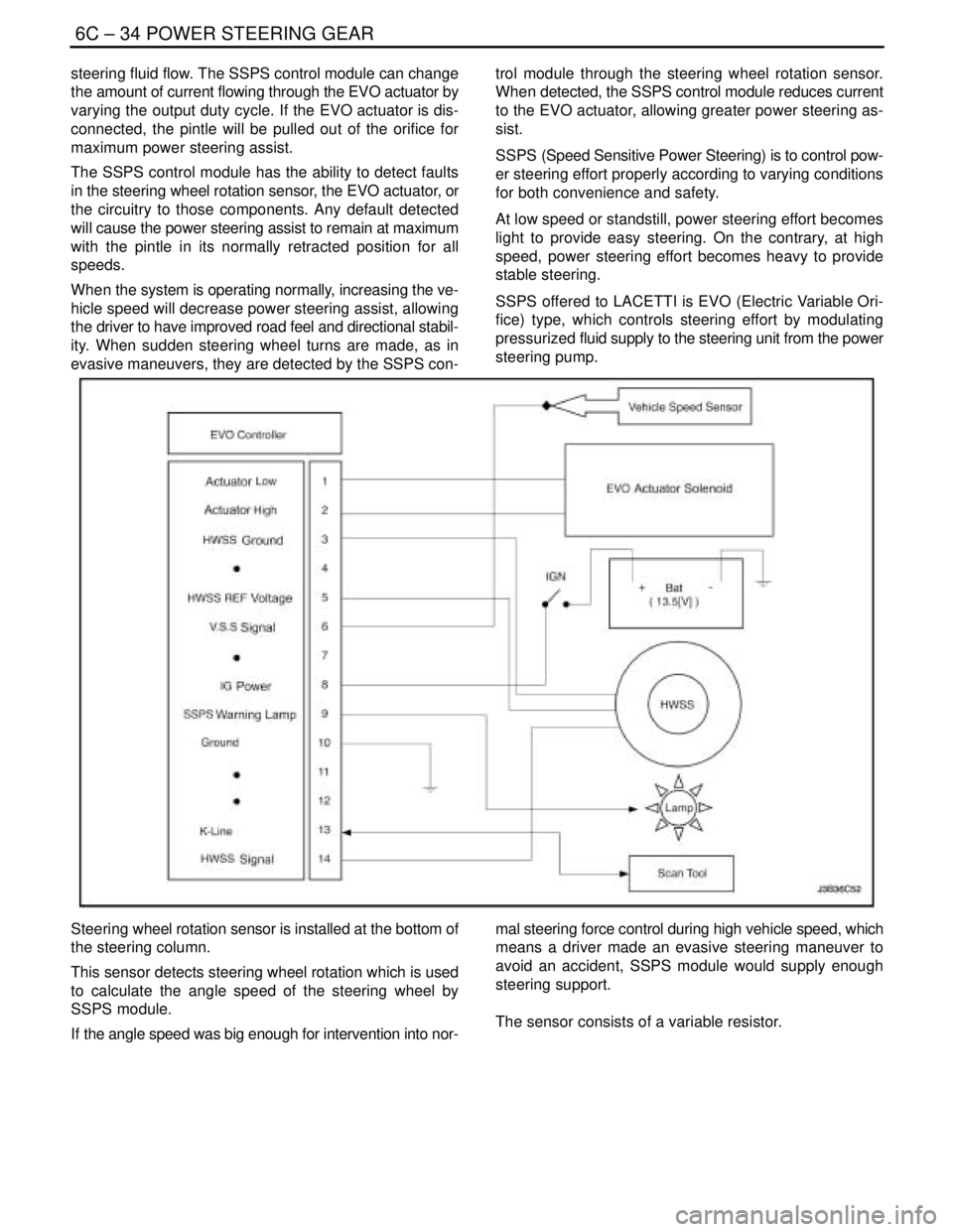
steering fluid flow. The SSPS control module can change
the amount of current flowing through the EVO actuator by
varying the output duty cycle. If the EVO actuator is dis-
connected, the pintle will be pulled out of the orifice for
maximum power steering assist.
The SSPS control module has the ability to detect faults
in the steering wheel rotation sensor, the EVO actuator, or
the circuitry to those components. Any default detected
will cause the power steering assist to remain at maximum
with the pintle in its normally retracted position for all
speeds.
When the system is operating normally, increasing the ve-
hicle speed will decrease power steering assist, allowing
the driver to have improved road feel and directional stabil-
ity. When sudden steering wheel turns are made, as in
evasive maneuvers, they are detected by the SSPS con-trol module through the steering wheel rotation sensor.
When detected, the SSPS control module reduces current
to the EVO actuator, allowing greater power steering as-
sist.
SSPS (Speed Sensitive Power Steering) is to control pow-
er steering effort properly according to varying conditions
for both convenience and safety.
At low speed or standstill, power steering effort becomes
light to provide easy steering. On the contrary, at high
speed, power steering effort becomes heavy to provide
stable steering.
SSPS offered to LACETTI is EVO (Electric Variable Ori-
fice) type, which controls steering effort by modulating
pressurized fluid supply to the steering unit from the power
steering pump.
Steering wheel rotation sensor is installed at the bottom of
the steering column.
This sensor detects steering wheel rotation which is used
to calculate the angle speed of the steering wheel by
SSPS module.
If the angle speed was big enough for intervention into nor-mal steering force control during high vehicle speed, which
means a driver made an evasive steering maneuver to
avoid an accident, SSPS module would supply enough
steering support.
The sensor consists of a variable resistor.
Page 1960 of 2643

6E – 6ISTEERING WHEEL AND COLUMN
DAEWOO V–121 BL4
Turn Signal/Dimmer Switch
Turn Signal Will Not Stay in the Turn Position
ChecksAction
Check the turn signal switch for an improper installation.Remove and inspect the turn signal switch. Reinstall the
switch.
Check the cancelling mechanism for broken or missing
components.Replace the cancelling mechanism.
Check the turn signal switch housing for foreign material.Remove any foreign material.
Turn Signal Will Not Cancel
ChecksAction
Check the cancelling mechanism for broken or missing
components.Replace the cancelling mechanism.
Turn Signal/Dimmer Switch Difficult to Operate
ChecksAction
Check the turn signal/dimmer switch and turn signal/dim-
mer switch lever for improper installation.Remove and inspect the turn signal/dimmer switch and
signal/dimmer switch lever. Reinstall the signal/dimmer
switch and signal/dimmer switch lever.
Check the signal/dimmer switch housing for foreign mate-
rial.Remove any foreign material.
Turn Signal Will Not Indicate Lane Change
ChecksAction
Check for a broken lane change pressure pad or a broken
spring hanger.Replace the lane change pressure pad or the spring hang-
er.
Check for improper functioning of the lane change spring.Replace the lane change spring.
Check the turn signal switch for improper installation.Replace the turn signal switch.
No Turn Signal Lights
ChecksAction
Check for an inoperative turn signal flasher.Replace the turn signal flasher.
Check for a faulty turn signal switch.Replace the turn signal switch.
Check the chassis–to–column connector for an improper
connection.Reconnect the chassis–to–column connector.
Turn Indicator Lights On, but Not Flashing
ChecksAction
Check for an inoperative turn signal flasher.Replace the turn signal flasher.
Check for a faulty turn signal switch.Replace the turn signal switch.
Check the chassis–to–column connector for an improper
connection.Reconnect the chassis–to–column connector.
Page 2205 of 2643
SUPPLEMENTAL INFLATABLE RESTRAINTS (SIR) 8B – 101
DAEWOO V–121 BL4
FRONT SEAT BELT
PRETENSIONERS
CAUTION : Tempering with seat belt pretensioner
creates the risk of an injury from unexpected deploy-
ment. Therefore, the driver airbag module should
never be disassembled.
The seat belt pretensioners(with load limiter for some ve-
hicles) are assembled with each front seat belt retractors
to retract the seat belt webbing when accounted frontal
collision. The seat belt pretensioners are controlled by
sensing and diagnostic module(SDM). The seat belt pre-
tensioner contains an igniter charge and a gas generator
to pull the seat belt webbing. The seat belt pretensioner
must be replaced after an accident that causes its activa-
tion.
The seat belt pretensioner also contains a shorting bar to
prevent current from travelling through the seat belt pre-
tensioner during servicing. The shorting bar is disengaged
when the connector is connected.
SENSING AND DIAGNOSTIC
MODULE (SDM)
CAUTION : During the service procedures, be careful
when handling the SDM. Never shake or jar the SDM.
Never apply power to SIR when the SDM is not rigidly
attached to the vehicle. All SDM mounting bolts and
grounding nuts must be fully tightened. Failure to fol-
low these precautions could cause deployment and
result in personal injury.
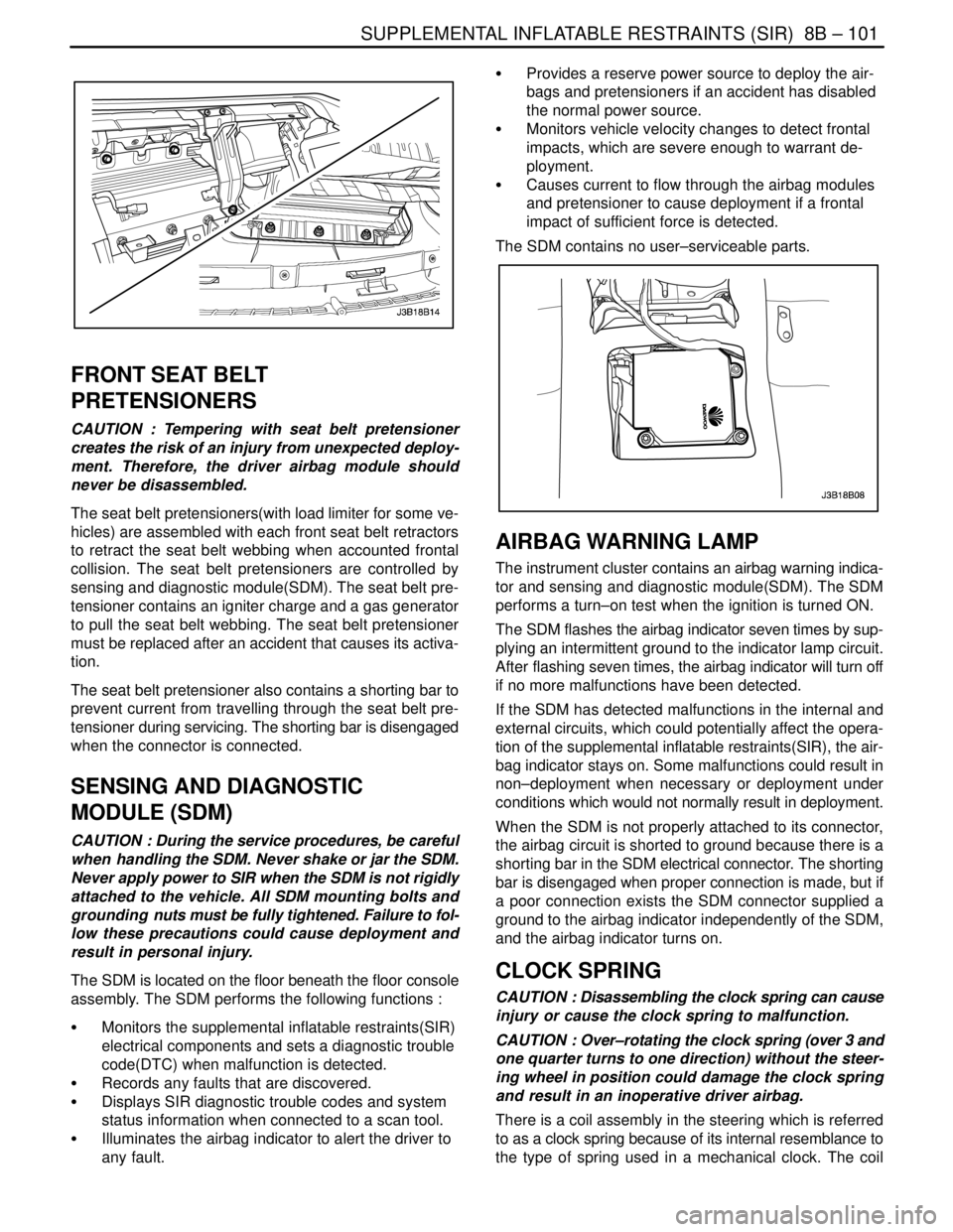
The SDM is located on the floor beneath the floor console
assembly. The SDM performs the following functions :
S Monitors the supplemental inflatable restraints(SIR)
electrical components and sets a diagnostic trouble
code(DTC) when malfunction is detected.
S Records any faults that are discovered.
S Displays SIR diagnostic trouble codes and system
status information when connected to a scan tool.
S Illuminates the airbag indicator to alert the driver to
any fault.S Provides a reserve power source to deploy the air-
bags and pretensioners if an accident has disabled
the normal power source.
S Monitors vehicle velocity changes to detect frontal
impacts, which are severe enough to warrant de-
ployment.
S Causes current to flow through the airbag modules
and pretensioner to cause deployment if a frontal
impact of sufficient force is detected.
The SDM contains no user–serviceable parts.
AIRBAG WARNING LAMP
The instrument cluster contains an airbag warning indica-
tor and sensing and diagnostic module(SDM). The SDM
performs a turn–on test when the ignition is turned ON.
The SDM flashes the airbag indicator seven times by sup-
plying an intermittent ground to the indicator lamp circuit.
After flashing seven times, the airbag indicator will turn off
if no more malfunctions have been detected.
If the SDM has detected malfunctions in the internal and
external circuits, which could potentially affect the opera-
tion of the supplemental inflatable restraints(SIR), the air-
bag indicator stays on. Some malfunctions could result in
non–deployment when necessary or deployment under
conditions which would not normally result in deployment.
When the SDM is not properly attached to its connector,
the airbag circuit is shorted to ground because there is a
shorting bar in the SDM electrical connector. The shorting
bar is disengaged when proper connection is made, but if
a poor connection exists the SDM connector supplied a
ground to the airbag indicator independently of the SDM,
and the airbag indicator turns on.
CLOCK SPRING
CAUTION : Disassembling the clock spring can cause
injury or cause the clock spring to malfunction.
CAUTION : Over–rotating the clock spring (over 3 and
one quarter turns to one direction) without the steer-
ing wheel in position could damage the clock spring
and result in an inoperative driver airbag.
There is a coil assembly in the steering which is referred
to as a clock spring because of its internal resemblance to
the type of spring used in a mechanical clock. The coil