crankshaft position sensor wiring DAEWOO NUBIRA 2004 Service Repair Manual
[x] Cancel search | Manufacturer: DAEWOO, Model Year: 2004, Model line: NUBIRA, Model: DAEWOO NUBIRA 2004Pages: 2643, PDF Size: 80.54 MB
Page 294 of 2643

1F – 48IENGINE CONTROLS
DAEWOO V–121 BL4
StepNo Yes Value(s) Action
11Compare the Engine Coolant Temperature (ECT)
with the Intake Air Temperature (IAT).
Is the ECT relatively close to the IAT?–Go to Step 12Go to ”DTC
P0118 Engine
Coolant Tem-
perature High
Voltage
121. Check if the Manifold Absolute Pressure (MAP)
sensor reading is over the specified reading.
2. Crank the engine while watching the MAP sen-
sor reading.
Does the MAP sensor read above the specified val-
ue and then change while cranking the engine?4 vGo to Step 13Go to Step 14
13Crank the engine.
Does the Crankshaft Position (CKP) Active Counter
increment while cranking?–Go to Step 16Go to Step 18
14Check the scan data for serial data.
Was serial data lost while cranking the engine?–Go to Step 15Go to ”MAP
Sensor Output
Check”
15Repair voltage loss to the engine control module
(ECM) from the ignition switch.
Is the repair complete?–System OK–
16Check for the presence of spark from all of the igni-
tion wires while cranking the engine.
Is spark present from all of the ignition wires?–Go to Step 41Go to Step 17
171. Measure the resistance of the ignition wires.
2. Replace any of the ignition wire(s) with a resist-
ance above the value specified.
3. Check for the presence of spark from all of the
ignition wires.
Is spark present from all of the ignition wires?30,000 WGo to Step 3Go to Step 18
181. Turn the ignition OFF.
2. Disconnect the Crankshaft Position (CKP) sen-
sor connector.
3. Measure the voltage between the CKP connec-
tor terminals 1 and 3.
4. Repair the wiring as needed.
Does the voltage measure near the value specified?1.4 v (2.5 v)*Go to Step 19Go to Step 20
19Measure the voltage between the CKP connector
terminals 2 and 3.
Does the voltage measure near the value specified1.4 v (2.5 v)*Go to Step 26Go to Step 21
20Measure the voltage between the CKP connector
terminals 1 and ground.
Does the voltage measure near the value specified?1.4 v (2.5 v)*Go to Step 22Go to Step 23
21Measure the voltage between the CKP connector
terminals 2 and ground.
Does the voltage measure near the value specified?1.4 v (2.5 v)*Go to Step 22Go to Step 24
22Check for an open or short in the wire between the
CKP connector terminal 3 and ground.
Is the problem found?–Go to Step 25Go to Step 40
23Check for an open or short in the wire between the
CKP connector terminal 1 and the ECM connector
terminal M21
Is the problem found?–Go to Step 25Go to Step 40
Page 331 of 2643

ENGINE CONTROLS 1F – 85
DAEWOO V–121 BL4
IGNITION SYSTEM CHECK (1.4L/1.6L DOHC)
Circuit Description
The Electronic Ignition (EI) system uses a waste spark
method of spark distribution. In this type of EI system, the
Crankshaft Position (CKP) sensor is mounted to the oil
pump near a slotted wheel that is a part of the crankshaft
pulley. The CKP sensor sends reference pulses to the en-
gine control module (ECM). The ECM then triggers the EI
system ignition coil. Once the ECM triggers the EI system
ignition coil, both of the connected spark plugs fire at the
same time. One cylinder is on its compression stroke at
the same time that the other is on the exhaust stroke, re-
sulting in lower energy needed to fire the spark plug in the
cylinder on its exhaust stroke.
This leaves the remainder of the high voltage to be used
to fire the spark plug in the cylinder on its compression
stroke. Since the CKP sensor is in a fixed position, timing
adjustments are not possible or needed.
Test Description
The number(s) below refer to step(s) on the diagnostictable.
2. It is important to check for the presence of spark to
all of the cylinders to isolate the problem to either
EI system ignition coil inputs or outputs.
5. In checking the ECM outputs for the electronic
spark timing signal, it recommended to use an os-
cilloscope to view the varying voltage signals. In
measuring these outputs with a voltmeter, intermit-
tent errors may occur that cannot be seen by a volt-
meter.
6. After confirming ECM inputs for the electronic spark
timing to the EI system ignition coil are OK, it can
be determined that a faulty EI system ignition coil is
at fault.
11. After confirming proper CKP sensor inputs to the
ECM and no wiring problems present, it can be de-
termined that the ECM is at fault.
24. This step, along with step 25, checks for battery
voltage and a ground to the EI system ignition coil.
Ignition System Check (1.4L/1.6L DOHC)
CAUTION : Use only electrically insulated pliers when handling ignition wires with the engine running to prevent
an electrical shock.
Step
ActionValue(s)YesNo
11. Remove the spark plugs.
2. Inspect for wet spark plugs, cracks, wear, im-
proper gap, burned electrodes, or heavy de-
posits.
3. Replace the spark plugs as needed.
Is the repair complete?–System OKGo to Step 2
2Check for the presence of spark from all of the igni-
tion wires while cranking the engine.
Is spark present from all of the ignition wires?–System OKGo to Step 3
31. Measure the resistance of the ignition wires.
2. Replace any ignition wire(s) with a resistance
above the value specified.
3. Check for the presence of spark from all of the
ignition wires.
Is spark present from all of the ignition wires?30,000 WSystem OKGo to Step 4
4Is spark present from at least one of the ignition
wires, but not all of the ignition wires?–Go to Step 5Go to Step 12
51. Turn the ignition OFF.
2. Disconnect the Electronic Ignition (EI) system
ignition coil connector.
3. While cranking the engine, measure the volt-
age at the EI system ignition coil connector
terminal 1.
Does the voltage fluctuate within the values speci-
fied?0.2–2.0 vGo to Step 6Go to Step 7
Page 332 of 2643

1F – 86IENGINE CONTROLS
DAEWOO V–121 BL4
StepNo Yes Value(s) Action
6While cranking the engine, measure the voltage at
the EI system ignition coil connector terminal 1.
Does the voltage fluctuate within the values speci-
fied?0.2–2.0 vGo to Step 10Go to Step 8
7Check for an open in the wire from the EI system
ignition coil connector terminal 1 to the engine con-
trol module (ECM) connector terminal 31.
Is the problem found?–Go to Step 9Go to Step 11
8Check for an open in the wire from the EI system
ignition coil connector terminal 1 to the ECM connec-
tor terminal 32.
Is the problem found?–Go to Step 9Go to Step 11
91. Repair the wiring as needed.
2. Connect the EI system ignition coil connector.
3. Check for the presence of spark from all of the
ignition wires.
Is spark present from all of the ignition wires?–System OK–
101. Turn the ignition OFF.
2. Replace the electronic ignition system ignition
coil.
3. Connect the EI system ignition coil connector.
4. Check for the presence of spark from all of the
ignition wires.
Is spark present from all of the ignition wires?–System OK–
111. Turn the ignition OFF.
2. Replace the ECM.
3. Connect the EI system ignition coil connector.
4. Check for the presence of spark from all of the
ignition wires.
Is spark present from all of the ignition wires?–System OK–
121. Turn the ignition OFF.
2. Disconnect the Crankshaft Position (CKP) sen-
sor connector.
3. Measure the resistance between the CKP sen-
sor terminals 1 and 2.
Is the resistance within the value specified?400–600 WGo to Step 13Go to Step 28
131. Measure the resistance between the CKP sen-
sor terminals 1 and 3.
2. Measure the resistance between the CKP sen-
sor terminals 2 and 3.
3. Is the resistance infinite (open circuit)?
Is the repair complete?–Go to Step 14Go to Step 28
141. Turn the ignition ON.
2. Measure the voltage between the CKP sensor
connector terminals 1 and 3.
Is the voltage within the value specified?1.3–1.5 v
(2.4–2.7 v)*Go to Step 20Go to Step 15
15Measure the voltage between the CKP sensor con-
nector terminal 1 and ground.
Is the voltage within the value specified?1.3–1.5 v
(2.4–2.7 v)*Go to Step 17Go to Step 16
Page 334 of 2643
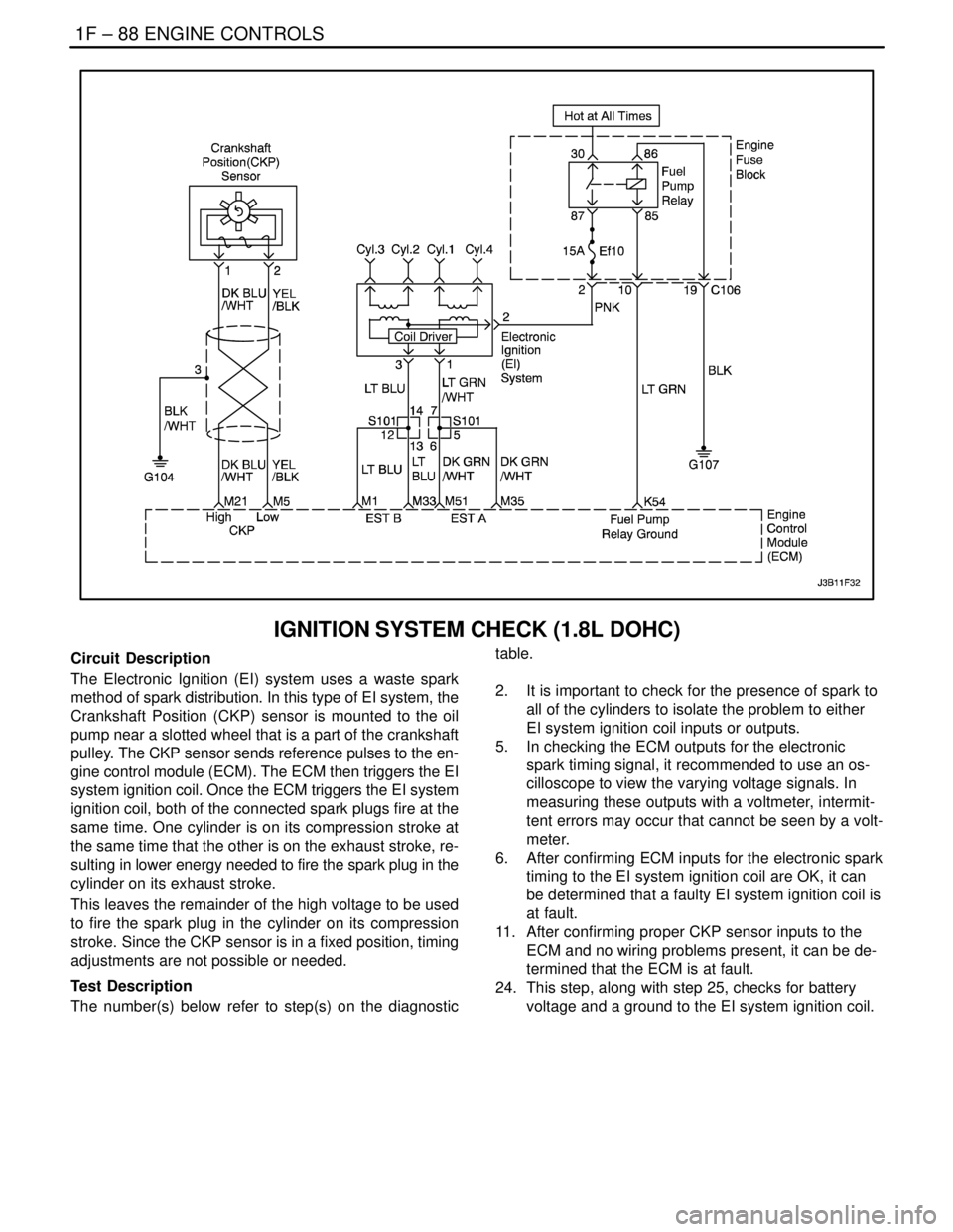
1F – 88IENGINE CONTROLS
DAEWOO V–121 BL4
IGNITION SYSTEM CHECK (1.8L DOHC)
Circuit Description
The Electronic Ignition (EI) system uses a waste spark
method of spark distribution. In this type of EI system, the
Crankshaft Position (CKP) sensor is mounted to the oil
pump near a slotted wheel that is a part of the crankshaft
pulley. The CKP sensor sends reference pulses to the en-
gine control module (ECM). The ECM then triggers the EI
system ignition coil. Once the ECM triggers the EI system
ignition coil, both of the connected spark plugs fire at the
same time. One cylinder is on its compression stroke at
the same time that the other is on the exhaust stroke, re-
sulting in lower energy needed to fire the spark plug in the
cylinder on its exhaust stroke.
This leaves the remainder of the high voltage to be used
to fire the spark plug in the cylinder on its compression
stroke. Since the CKP sensor is in a fixed position, timing
adjustments are not possible or needed.
Test Description
The number(s) below refer to step(s) on the diagnostictable.
2. It is important to check for the presence of spark to
all of the cylinders to isolate the problem to either
EI system ignition coil inputs or outputs.
5. In checking the ECM outputs for the electronic
spark timing signal, it recommended to use an os-
cilloscope to view the varying voltage signals. In
measuring these outputs with a voltmeter, intermit-
tent errors may occur that cannot be seen by a volt-
meter.
6. After confirming ECM inputs for the electronic spark
timing to the EI system ignition coil are OK, it can
be determined that a faulty EI system ignition coil is
at fault.
11. After confirming proper CKP sensor inputs to the
ECM and no wiring problems present, it can be de-
termined that the ECM is at fault.
24. This step, along with step 25, checks for battery
voltage and a ground to the EI system ignition coil.
Page 447 of 2643

ENGINE CONTROLS 1F – 201
DAEWOO V–121 BL4
DIAGNOSTIC TROUBLE CODE (DTC) P0335
MAGNETIC CRANKSHAFT POSITION SENSOR
ELECTRICAL ERROR
Circuit Description
The 58X reference signal is produced by the crankshaft
position (CKP) sensor. During one crankshaft revolution,
58 crankshaft pulses will be produced. The transaxle con-
trol module(TCM)/engine control module(ECM) uses the
58X reference signal to calculate engine rpm and CKP.
The ECM constantly monitors the number of pulses on the
58X reference circuit and compares them to the number
of camshaft position (CKP) signal pulses being received.
If the ECM receive and incorrect number of pulses on the
58X reference circuit, DTC P0335 will set.
Conditions for Setting the DTC
S The magnetic crankshaft position sensor is greater
than 0.2V.
Or
S The minimum value of magnetic crankshaft position
sensor is less than 1.5V.
Or
S The maximum value of magnetic crankshaft posi-
tion sensor is higher than 2.2V.
Action Taken When the DTC Sets
S The Malfunction Indicator Lamp (MIL) will illuminate
after three consecutive trip with a fail.
S The ECM will record operating conditions at the
time the diagnostic fail. This information will be
stored in the Freeze Frame and Failure Records
buffers.S A history DTC is stored.
Conditions for Clearing the MIL/DTC
S The MIL will turn off after four consecutive ignition
cycles in which the diagnostic runs without a fault.
S A history DTC will clear after 40 consecutive warm–
up cycles without a fault.
S DTC(s) can be cleared by using the scan tool.
S Disconnecting the ECM battery feed for more than
10 seconds.
Diagnostic Aids
An intermittent may be caused by a poor connection,
rubbed–through wire insulation or a wire broken inside the
insulation. Check for :
Poor connection – inspect the ECM harness and connec-
tors for improper mating, broken locks, improperly formed
or damaged terminals, and poor terminal–to–wire connec-
tion.
Damaged harness – inspect the wiring harness for dam-
age. If the harness appears to be OK, disconnect the
ECM, turn the ignition ON and observe a voltmeter con-
nected to the 58X reference circuit at the ECM harness
connector while moving the connectors and the wiring har-
ness related to the ECM. A change in voltage will indicate
the location of the fault.
Review the failure records vehicle mileage since the diag-
nostic test failed may help determine how often the condi-
tion that caused the DTC to be set occurs. This may assist
in diagnosing the condition.
Page 450 of 2643

1F – 204IENGINE CONTROLS
DAEWOO V–121 BL4
DIAGNOSTIC TROUBLE CODE (DTC) P0336
58X CRANKSHAFT POSITION SENSOR NO PLAUSIBLE
SIGNAL
Circuit Description
The 58X reference signal is produced by the crankshaft
position (CKP) sensor. During one crankshaft revolution,
58 crankshaft pulses will be produced. The transaxle con-
trol module(TCM)/engine control module(ECM) uses the
58X reference signal to calculate engine rpm and CKP.
The ECM constantly monitors the number of pulses on the
58X reference circuit and compares them to the number
of camshaft position (CKP) signal pulses being received.
If the ECM receive and incorrect number of pulses on the
58X reference circuit, DTC P0336 will set.
Conditions for Setting the DTC
S This DTC can be stored in ”key–on” status.
S Detected number of teeth is differs by 3 or higher.
Action Taken When the DTC Sets
S The Malfunction Indicator Lamp (MIL) will illuminate
after three consecutive trip with a fail.
S The ECM will record operating conditions at the
time the diagnostic fail. This information will be
stored in the Freeze Frame and Failure Records
buffers.
S A history DTC is stored.
Conditions for Clearing the MIL/DTCS The MIL will turn off after four consecutive ignition
cycles in which the diagnostic runs without a fault.
S A history DTC will clear after 40 consecutive warm–
up cycles without a fault.
S DTC(s) can be cleared by using the scan tool.
S Disconnecting the ECM battery feed for more than
10 seconds.
Diagnostic Aids
An intermittent may be caused by a poor connection,
rubbed–through wire insulation or a wire broken inside the
insulation. Check for :
Poor connection – inspect the ECM harness and connec-
tors for improper mating, broken locks, improperly formed
or damaged terminals, and poor terminal–to–wire connec-
tion.
Damaged harness – inspect the wiring harness for dam-
age. If the harness appears to be OK, disconnect the
ECM, turn the ignition ON and observe a voltmeter con-
nected to the 58X reference circuit at the ECM harness
connector while moving the connectors and the wiring har-
ness related to the ECM. A change in voltage will indicate
the location of the fault.
Review the failure records vehicle mileage since the diag-
nostic test failed may help determine how often the condi-
tion that caused the DTC to be set occurs. This may assist
in diagnosing the condition.
Page 453 of 2643

ENGINE CONTROLS 1F – 207
DAEWOO V–121 BL4
DIAGNOSTIC TROUBLE CODE (DTC) P0337
58X CRANKSHAFT POSITION SENSOR NO SIGNAL
Circuit Description
The 58X reference signal is produced by the crankshaft
position (CKP) sensor. During one crankshaft revolution,
58 crankshaft pulses will be produced. The transaxle con-
trol module(TCM)/engine control module(ECM) uses the
58X reference signal to calculate engine rpm and CKP.
The ECM constantly monitors the number of pulses on the
58X reference circuit and compares them to the number
of camshaft position (CKP) signal pulses being received.
If the ECM receive and incorrect number of pulses on the
58X reference circuit, DTC P0336 will set.
Conditions for Setting the DTC
S This DTC can be stored in ”key–on” status.
S No crankshaft teeth detected.
Action Taken When the DTC Sets
S The Malfunction Indicator Lamp (MIL) will illuminate
after three consecutive trip with a fail.
S The ECM will record operating conditions at the
time the diagnostic fail. This information will be
stored in the Freeze Frame and Failure Records
buffers.
S A history DTC is stored.
Conditions for Clearing the MIL/DTCS The MIL will turn off after four consecutive ignition
cycles in which the diagnostic runs without a fault.
S A history DTC will clear after 40 consecutive warm–
up cycles without a fault.
S DTC(s) can be cleared by using the scan tool.
S Disconnecting the ECM battery feed for more than
10 seconds.
Diagnostic Aids
An intermittent may be caused by a poor connection,
rubbed–through wire insulation or a wire broken inside the
insulation. Check for :
Poor connection – inspect the ECM harness and connec-
tors for improper mating, broken locks, improperly formed
or damaged terminals, and poor terminal–to–wire connec-
tion.
Damaged harness – inspect the wiring harness for dam-
age. If the harness appears to be OK, disconnect the
ECM, turn the ignition ON and observe a voltmeter con-
nected to the 58X reference circuit at the ECM harness
connector while moving the connectors and the wiring har-
ness related to the ECM. A change in voltage will indicate
the location of the fault.
Review the failure records vehicle mileage since the diag-
nostic test failed may help determine how often the condi-
tion that caused the DTC to be set occurs. This may assist
in diagnosing the condition.
Page 456 of 2643

1F – 210IENGINE CONTROLS
DAEWOO V–121 BL4
DIAGNOSTIC TROUBLE CODE (DTC) P0341
CAMSHAFT POSITION SENSOR RATIONALITY
Circuit Description
The Camshaft Position Sensor is used to detect Camshaft
position and to have correlation with Crankshaft position
so that the ECM can determine which cylinder is ready to
be fueled by the injector. The polarity of camshaft sensor
signal must be changed only once per crankshaft position.
Conditions for Setting the DTC
S No traction of CMP signal between teeth 25 and 33
but change in polarity.
Action Taken When the DTC Sets
S The Malfunction Indicator Lamp (MIL) will illuminate
after three consecutive trip with a fail.
S The ECM will record operating conditions at the
time the diagnostic fail. This information will be
stored in the Freeze Frame and Failure Records
buffers.
S A history DTC is stored.
Conditions for Clearing the MIL/DTCS The MIL will turn off after four consecutive ignition
cycles in which the diagnostic runs without a fault.
S A history DTC will clear after 40 consecutive warm–
up cycles without a fault.
S DTC(s) can be cleared by using the scan tool.
S Disconnecting the ECM battery feed for more than
10 seconds.
Diagnostic Aids
Check and correct any abnormal engine noise before us-
ing the diagnostic table.
Any circuitry that is suspected as causing engine noise
complaint should be thoroughly checked for the following
conditions :
S Backed–out terminals
S Improper mating
S Broken locks
S Improperly formed
S Damaged terminals
S Poor terminal–to–wire connection
S Physical damage to the wiring harness
Page 458 of 2643

1F – 212IENGINE CONTROLS
DAEWOO V–121 BL4
DIAGNOSTIC TROUBLE CODE (DTC) P0342
CAMSHAFT POSITION SENSOR SIGNAL
Circuit Description
The Camshaft Position Sensor is used to detect Camshaft
position and to have correlation with Crankshaft position
so that the ECM can determine which cylinder is ready to
be fueled by the injector. The polarity of camshaft sensor
signal must be changed only once per crankshaft position.
Conditions for Setting the DTC
S No traction of CMP signal between teeth 25 and 33
but change in polarity.
Action Taken When the DTC Sets
S The Malfunction Indicator Lamp (MIL) will illuminate
after three consecutive trip with a fail.
S The ECM will record operating conditions at the
time the diagnostic fail. This information will be
stored in the Freeze Frame and Failure Records
buffers.
S A history DTC is stored.
Conditions for Clearing the MIL/DTCS The MIL will turn off after four consecutive ignition
cycles in which the diagnostic runs without a fault.
S A history DTC will clear after 40 consecutive warm–
up cycles without a fault.
S DTC(s) can be cleared by using the scan tool.
S Disconnecting the ECM battery feed for more than
10 seconds.
Diagnostic Aids
Check and correct any abnormal engine noise before us-
ing the diagnostic table.
Any circuitry that is suspected as causing engine noise
complaint should be thoroughly checked for the following
conditions :
S Backed–out terminals
S Improper mating
S Broken locks
S Improperly formed
S Damaged terminals
S Poor terminal–to–wire connection
S Physical damage to the wiring harness
Page 541 of 2643

ENGINE CONTROLS 1F – 295
DAEWOO V–121 BL4
DIAGNOSTIC TROUBLE CODE (DTC) P1320
CRANKSHAFT SEGMENT PERIOD SEGMENT
ADAPTATION AT LIMIT
Circuit Description
The 58X reference signal is produced by the Crankshaft
Position (CKP) sensor. During one crankshaft revolution,
58 crankshaft pulses will be produced. The Engine Control
Module (ECM) uses the 58X reference signal to calculate
engine rpm and CKP. The ECM constantly monitors the
number of pulses on the 58X reference circuit and
compares them to the number of Camshaft Position
(CMP) signal pulses being received. If the ECM receives
and incorrect number of pulses on the 58X reference cir-
cuit, Diagnostic Trouble Code (DTC) P1320 will set.
Conditions for Setting the DTC
S Segment adaptation valve at the limit.
Action Taken When the DTC Sets
S The Malfunction Indicator Lamp (MIL) will illuminate
after three consecutive trip with a fail.
S The ECM will record operating conditions at the
time the diagnostic fail. This information will be
stored in the Freeze Frame and Failure Records
buffers.
S A history DTC is stored.
Conditions for Clearing the MIL/DTC
S The MIL will turn off after four consecutive ignition
cycles in which the diagnostic runs without a fault.S A history DTC will clear after 40 consecutive warm–
up cycles without a fault.
S DTC(s) can be cleared by using the scan tool.
S Disconnecting the ECM battery feed for more than
10 seconds.
Diagnostic Aids
An intermittent may be caused by a poor connection,
rubbed–through wire insulation or a wire broken inside the
insulation. Check for:
S Poor connection – Inspect the ECM harness and
connectors for improper mating, broken locks, im-
properly formed or damaged terminals, and poor
terminal–to–wire connections.
S Damaged harness – Inspect the wiring harness for
damage. If the harness appears to be OK, discon-
nect the ECM, turn the ignition ON and observe a
voltmeter connected to the 58X reference circuit at
the ECM harness connector while moving the con-
nectors and the wiring harnesses related to the
ECM. A change in voltage will indicate the location
of the fault.
S Reviewing the Failure Records vehicle mileage
since the diagnostic test last failed may help deter-
mine how often the condition that caused the DTC
to be set occurs. This may assist in diagnosing the
condition.
DTC P1320 – Crankshaft Segment Period Segment Adaptation at
Limit
StepActionValue(s)YesNo
1Perform an Euro On–Board Diagnostic (EOBD)
System Check.
Was the check performed?–Go to Step 2Go to
”On–Board
Diagnostic Sys-
tem Check”
2Attempt to start the engine.
Does the engine start?–Go to Step 3Refer to
”Engine Cranks
But Will Not
Run”
31. Turn the ignition OFF.
2. Install a scan tool to the Data Link Connector
(DLC).
3. Turn the ignition ON, with the engine OFF.
4. Review and record Failure Records informa-
tion.
5. Clear the Diagnostic Trouble Codes (DTCs).
6. Start the engine and idle for 1 minute.
Is DTC P1320 set?–Go to Step 4Go to
”Diagnostic
Aids”