ECU DATSUN B110 1973 Service User Guide
[x] Cancel search | Manufacturer: DATSUN, Model Year: 1973, Model line: B110, Model: DATSUN B110 1973Pages: 513, PDF Size: 28.74 MB
Page 69 of 513
CHASSIS
Mureover
excessive
sleeve
yoke
spline
ta
transmission
main
spline
lash
and
wear
of
both
front
and
rear
universal
joints
will
cause
vibrations
affecting
riding
comfort
REMOVAL
Disconnect
the
flange
yoke
and
the
pinion
flange
by
removing
bolts
at
the
rear
end
of
the
propeller
shaft
In
this
case
draw
out
the
sleeve
yoke
from
the
end
of
transmission
holding
the
disconnected
rear
end
of
the
propeller
shaft
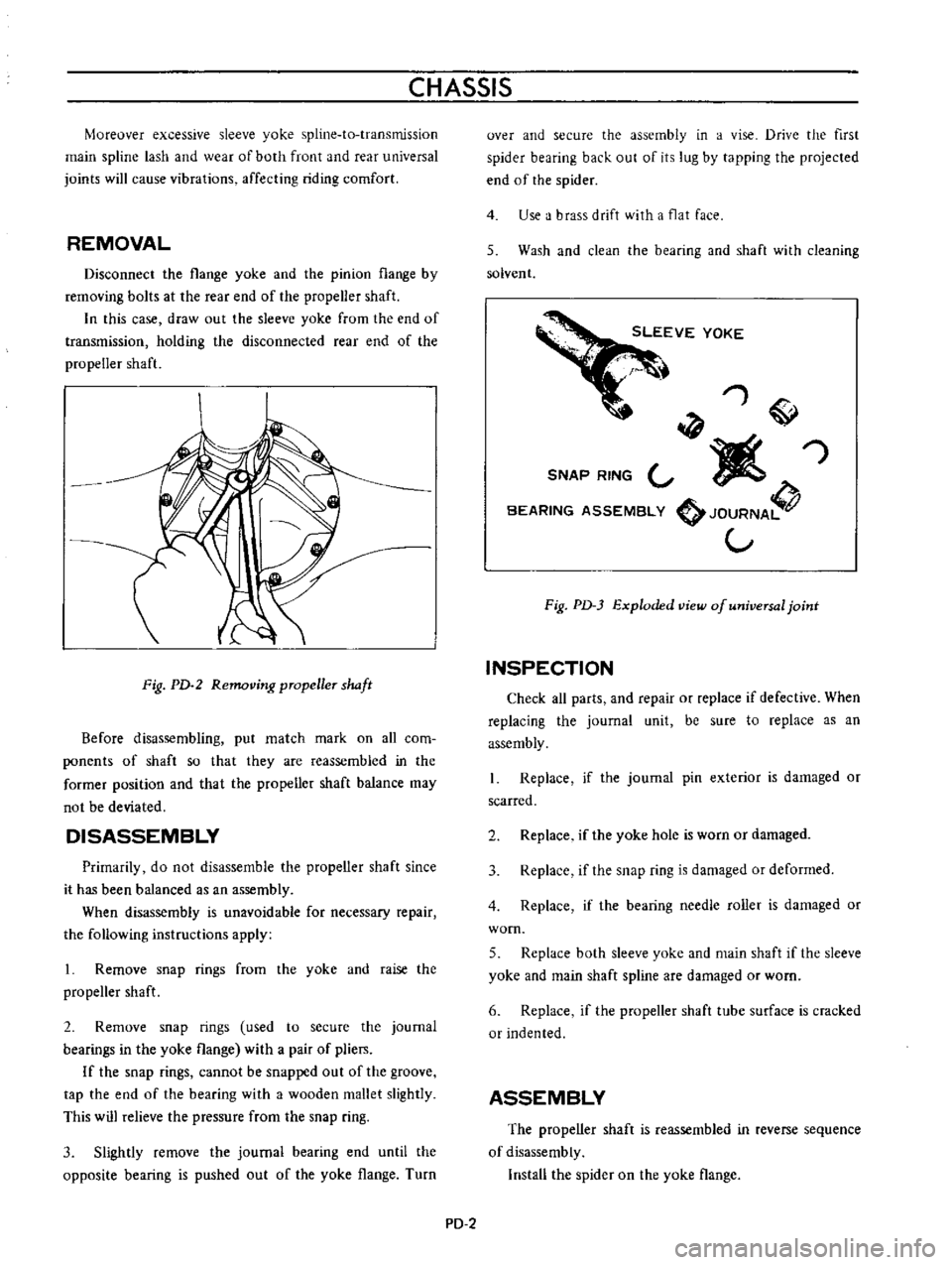
Fig
PD
2
Removing
pmpeller
shaft
Before
disassembling
put
match
mark
on
all
com
ponents
of
shaft
so
that
they
are
reassembled
in
the
former
position
and
that
the
propeller
shaft
balance
may
not
be
deviated
DISASSEMBLY
Primarily
do
not
disassemble
the
propeller
shaft
since
it
has
been
balanced
as
an
assembly
When
disassembly
is
unavoidable
for
necessary
repair
the
following
instructions
apply
1
Remove
snap
rings
from
the
yoke
and
raise
the
propeller
shaft
2
Remove
snap
rings
used
to
secure
the
journal
bearings
in
the
yoke
flange
with
a
pair
of
pliers
If
the
snap
rings
cannot
be
snapped
out
of
the
groove
tap
the
end
of
the
bearing
with
a
wooden
mallet
slightly
This
will
relieve
the
pressure
from
the
snap
ring
3
Slightly
remove
the
journal
bearing
end
until
the
opposite
bearing
is
pushed
out
of
the
yoke
flange
Turn
over
and
secure
the
assembly
in
a
vise
Drive
the
first
spider
bearing
back
out
of
its
lug
by
tapping
the
projected
end
of
the
spider
4
Use
a
brass
drift
with
a
flat
face
5
Wash
and
clean
the
bearing
and
shaft
with
cleaning
solvent
1
W
SNAP
RING
V
I
1Iiff
BEARING
ASSEMBLY
JOURNA
V
Fig
PD
3
Exploded
view
of
universal
joint
INSPECTION
Check
all
parts
and
repair
or
replace
if
defective
When
replacing
the
journal
unit
be
sure
to
replace
as
an
assembly
Replace
if
the
journal
pin
exterior
is
damaged
or
scarred
2
Replace
if
the
yoke
hole
is
worn
or
damaged
3
Replace
if
the
snap
ring
is
damaged
or
deformed
4
Replace
if
the
bearing
needle
roller
is
damaged
or
worn
5
Replace
both
sleeve
yoke
and
main
shaft
if
the
sleeve
yoke
and
main
shaft
spline
are
damaged
or
worn
6
Replace
if
the
propeller
shaft
tube
surface
is
cracked
or
Indented
ASSEMBLY
The
propeller
shaft
is
reassembled
in
reverse
sequence
of
disassembly
Install
the
spider
on
the
yoke
flange
PD
2
Page 70 of 513
PROPELLER
SHAFT
DIFFERENTIAL
CARRIER
Insert
the
journal
into
the
yoke
flange
Tap
the
journal
bearing
into
the
yoke
flange
using
a
brass
drift
smaller
than
the
hole
in
the
yoke
Tap
the
other
bearing
into
the
opposite
end
of
the
yoke
flange
until
the
bearing
is
in
line
with
the
snap
ring
grooves
With
a
pair
of
pliers
install
the
snap
rings
on
both
ends
of
the
yoke
flange
Insert
the
flange
assembly
in
the
sleeve
yoke
Place
the
other
yoke
bearing
into
the
opposite
end
of
the
yoke
and
tap
this
bearing
into
the
yoke
until
the
bearing
is
in
line
with
the
snap
ring
grooves
Install
the
snap
rings
on
both
ends
of
the
yoke
When
all
parts
are
assembled
check
the
spider
and
surroundings
for
tightness
When
the
clearance
is
excessive
adjust
with
over
size
snap
rings
as
follows
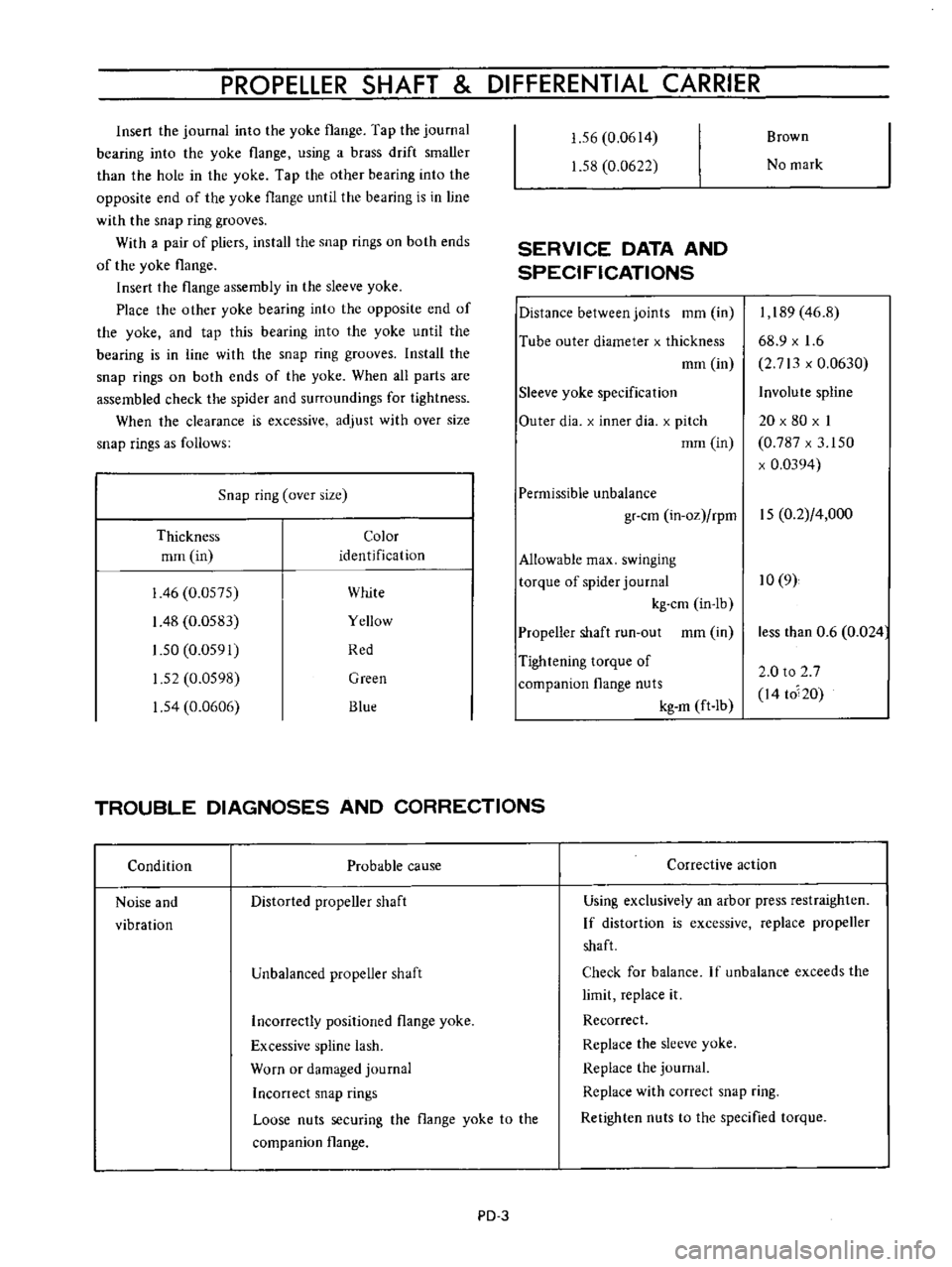
Snap
ring
over
size
Thickness
Color
mrn
in
identification
I
46
0
0575
White
I
48
0
0583
Yellow
1
50
0
0591
Red
1
52
0
0598
Green
1
54
0
0606
Blue
1
56
0
0614
1
58
0
0622
SERVICE
DATA
AND
SPECIFICATIONS
Distance
between
joints
mm
in
Tube
outer
diameter
x
thickness
mm
in
Sleeve
yoke
specification
Outer
dia
x
inner
dia
x
pitch
mm
in
Brown
No
mark
I
189
46
8
68
9
x
1
6
2
713
x
0
0630
Involute
spline
20
x
80
x
I
0
787
x
3
150
x
0
0394
Permissible
unbalance
gr
cm
in
oz
rpm
15
0
2
4
000
Allowable
max
swinging
torque
of
spider
journal
10
9
kg
cm
in
lb
Propeller
shaft
run
out
mm
in
Tightening
torque
of
companion
flange
nuts
kg
m
ft
Ib
TROUBLE
DIAGNOSES
AND
CORRECTIONS
Condition
Probable
cause
Noise
and
vibration
Distorted
propeller
shaft
Unbalanced
propeller
shaft
Corrective
action
less
than
0
6
0
024
2
0
to
2
7
I4
to
20
Using
exclusively
an
arbor
press
restraighten
If
distortion
is
excessive
replace
propeller
shaft
Check
for
balance
If
unbalance
exceeds
the
limit
replace
it
Recorrect
Replace
the
sleeve
yoke
Replace
the
journal
Replace
with
correct
snap
ring
Retighten
nuts
to
the
specified
torque
Incorrectly
positioned
flange
yoke
Excessive
spline
lash
Worn
or
damaged
journal
Inconect
snap
rings
Loose
nuts
securing
the
flange
yoke
to
the
companion
flange
PD
3
Page 89 of 513
FRONT
AXLE
FRONT
SUSPENSION
FRONT
AXLE
AND
SUSPENSION
ASSEMBLY
Removal
1
Jack
up
the
vehicle
and
support
the
vehicle
with
stands
See
the
Section
GL
2
Remove
the
hub
nuts
and
remOve
the
wheel
3
Remove
the
splash
board
4
Loosen
the
brake
tube
connecting
nut
remove
the
brake
hose
locking
spring
withdraw
the
plate
and
remOve
the
brake
hose
from
the
strul
assembly
bracket
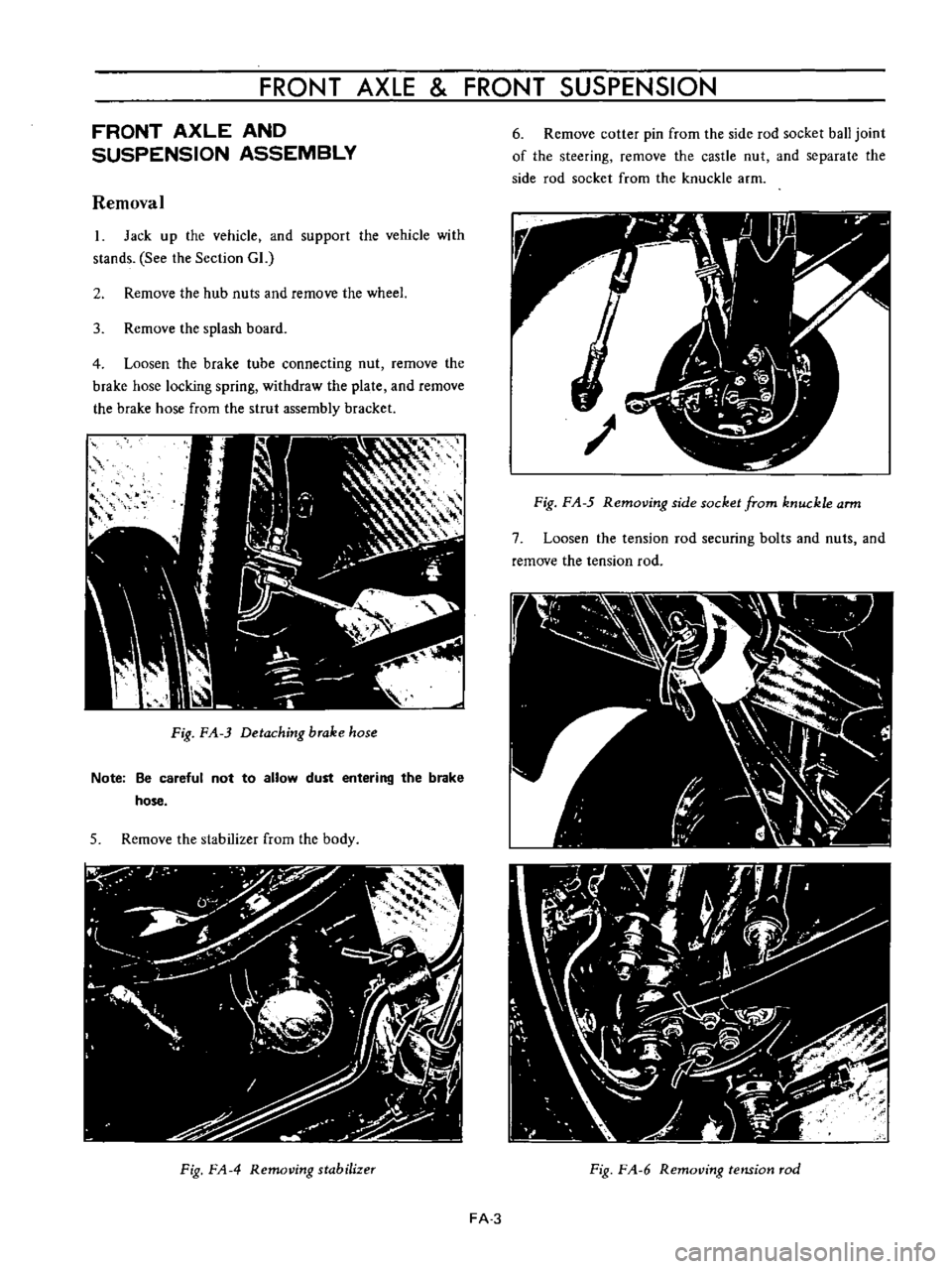
Fig
FA
3
Detaching
brake
hose
Note
Be
careful
not
to
allow
dust
entering
the
brake
hose
5
Remove
the
stabilizer
from
the
body
Fig
FA
4
Removing
stabilizer
6
Remove
cotter
pin
from
the
side
rod
socket
ball
joint
of
the
steering
remove
the
castle
nut
and
separate
the
side
rod
socket
from
the
knuckle
arm
Fig
F
A
5
Removing
side
socket
from
knuckle
arm
7
Loosen
the
tension
rod
securing
bolts
and
nuts
and
remove
the
tension
rod
Fig
F
A
6
RemotJing
tension
rod
FA
3
Page 91 of 513
FRONT
AXLE
FRONT
SUSPENSION
Reinstalla
tion
First
check
rubber
parts
such
as
tension
rod
mount
ing
bushing
stabilizer
bar
bushing
etc
for
deterioration
crack
and
other
defective
conditions
and
replace
as
required
2
Reinstall
the
front
axle
and
suspension
assembly
in
reverse
sequence
of
removal
noting
the
following
matters
1
Tighten
the
transverse
link
mounting
bolts
and
stabilizer
bar
body
side
installation
bolt
to
the
raled
tightening
torque
under
the
unladen
vehicle
2
Install
the
stabilizer
bar
so
that
the
white
paint
identification
mark
on
the
stabilizer
bar
is
faced
to
the
left
side
of
the
vehicle
Tighten
the
stabilizer
connecting
rod
with
tightening
torque
from
0
9
to
1
2
kg
m
6
5
to
8
7
ft
lb
through
bushings
The
same
tightening
torque
0
9
to
1
2
kg
m
6
5
to
8
7
ft
Ib
also
applies
the
frame
side
installation
bolt
Two
types
of
transverse
link
side
installation
bolts
length
below
neck
35
mm
1
378
in
and
25
mm
0
984
in
are
used
and
for
both
types
the
tightening
torque
is
2
2
to
3
0
kg
m
15
9
to
217
ft
lb
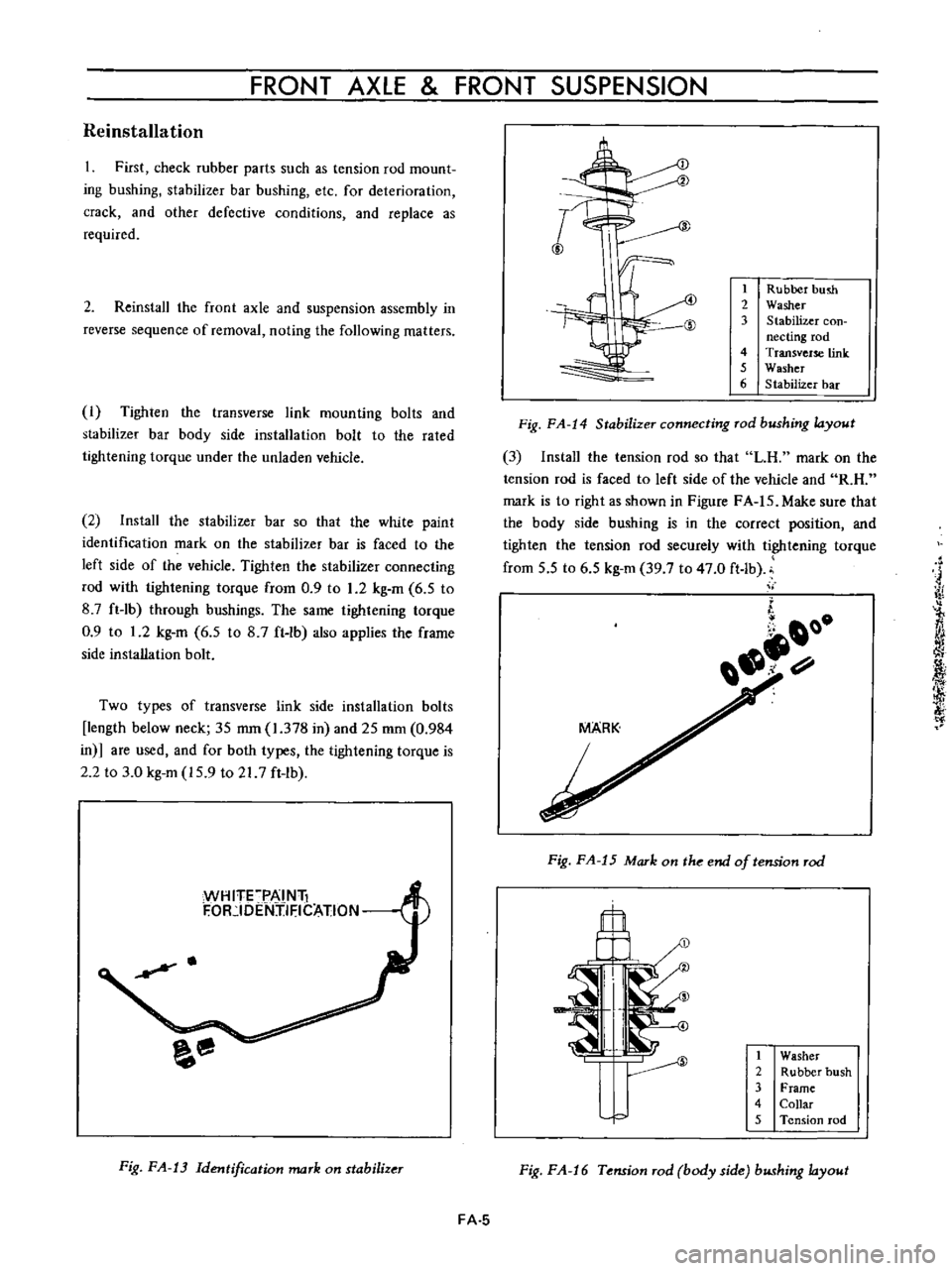
WH
ITFPAI
Nli
F
OR
IDENjIFICATION
H
Fig
FA
13
Identification
mark
on
stabilizer
I
J
1
Rubber
hush
2
Washer
3
Stabilizer
con
necting
rod
4
Transverse
link
5
Washer
6
Stabilizer
bar
Fig
FA
14
Stabilizer
connecting
rod
bushing
layout
3
Install
the
tension
rod
so
that
LH
mark
on
the
tension
rod
is
faced
to
left
side
of
the
vehicle
and
R
H
mark
is
to
right
as
shown
in
Figure
FA
IS
Make
sure
that
the
body
side
bushing
is
in
the
correct
position
and
tighten
the
tension
rod
securely
with
tightening
torque
from
5
5
to
6
5
kg
m
39
7
to
47
0
ft
lb
ii
j
iY
l
fj
i
f
i
Of
1
0
Fig
FA
15
Mark
on
the
end
of
tension
rod
il
1
Washer
2
Rubber
bush
3
Frame
4
Collar
5
Tension
rod
Fig
FA
16
Tension
rod
body
side
bushing
layout
FA
5
Page 92 of 513
CHASSIS
Tightening
torque
of
front
suspension
cross
member
and
body
is
3
2
to
4
0
kg
m
23
1
to
28
9
ft
Ib
5
Tightening
torque
of
bolt
used
to
secure
the
upper
portion
of
the
strut
assembly
on
the
body
is
1
6
to
2
1
kg
m
11
6
to
15
2ft
lb
FRONT
AXLE
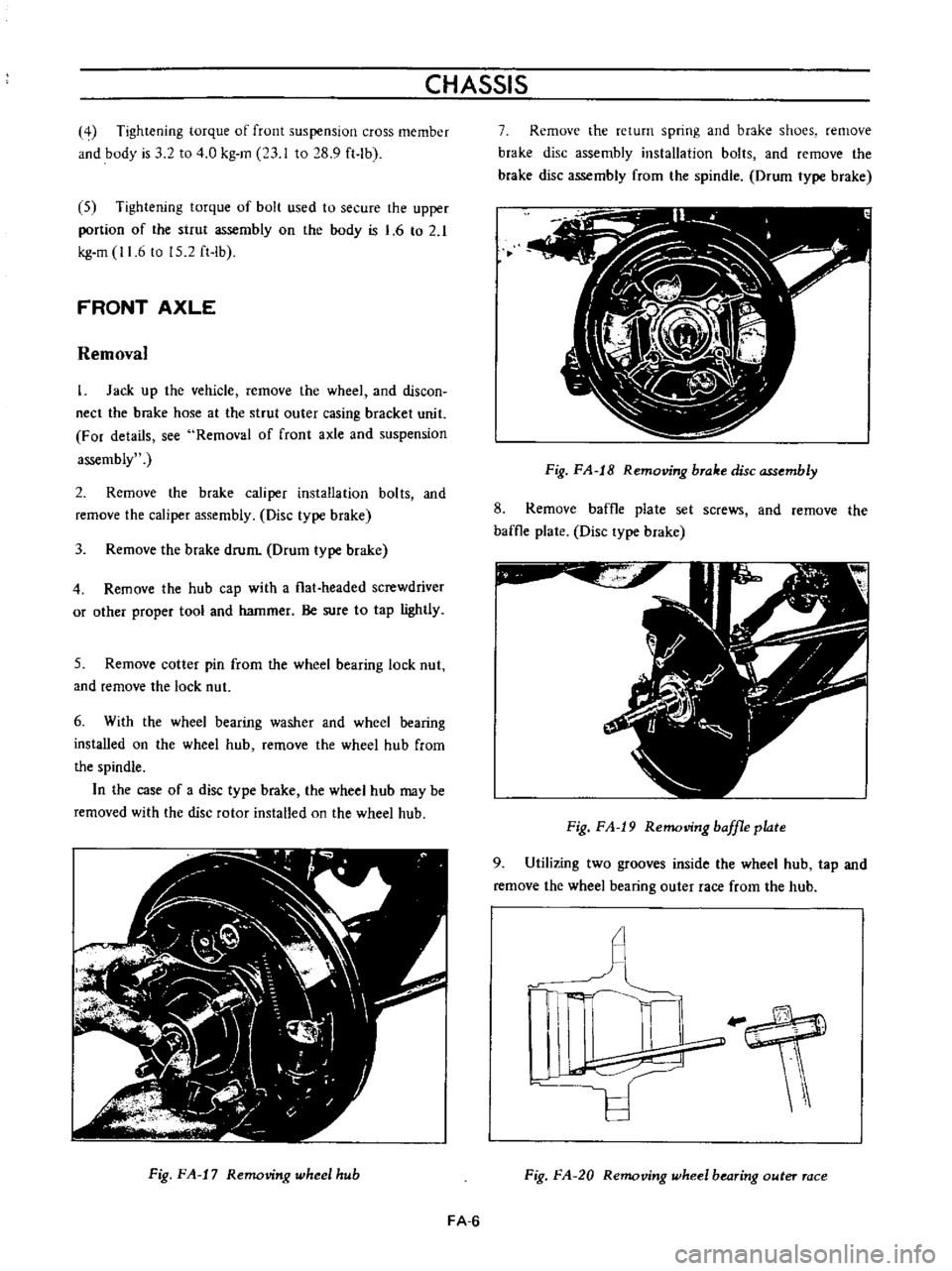
Removal
I
Jack
up
the
vehicle
remove
the
wheel
and
discon
nect
the
brake
hose
at
the
strut
outer
casing
bracket
unit
For
details
see
Removal
of
front
axle
and
suspension
assembly
2
Remove
the
brake
caliper
installation
bolts
and
remove
the
caliper
assembly
Disc
type
brake
3
Remove
the
brake
druOL
Drum
type
brake
4
Remove
the
hub
cap
with
a
flal
headed
screwdriver
or
other
proper
tool
and
hammer
Be
sure
to
tap
lightly
5
Remove
cotter
pin
from
the
wheel
bearing
lock
nut
and
remove
the
lock
nut
6
With
the
wheel
bearing
washer
and
wheel
bearing
installed
on
the
wheel
hub
remove
the
wheel
hub
from
the
spindle
In
the
case
of
a
disc
type
brake
the
wheel
hub
may
be
removed
with
the
disc
rotor
installed
on
the
wheel
hub
Fig
FA
17
Removing
wheel
hub
7
Remove
the
return
spring
and
brake
shoes
remove
brake
disc
assembly
installation
bolts
and
remove
the
brake
disc
assembly
from
the
spindle
Drum
type
brake
Fig
FA
IS
Removing
brake
disc
a
ssembly
8
Remove
baffle
plate
set
screws
and
remove
the
baffle
plate
Disc
type
brake
Fig
FA
19
Removingbaffleplate
9
Utilizing
two
grooves
inside
the
wheel
hub
tap
and
remove
the
wheel
bearing
outer
race
from
the
hub
Fig
FA
20
Removing
wheel
bearing
outer
race
FA
6
Page 97 of 513
FRONT
AXLE
FRONT
SUSPENSION
t
t
Fig
FA
26
Returning
wheel
bearing
lock
nut
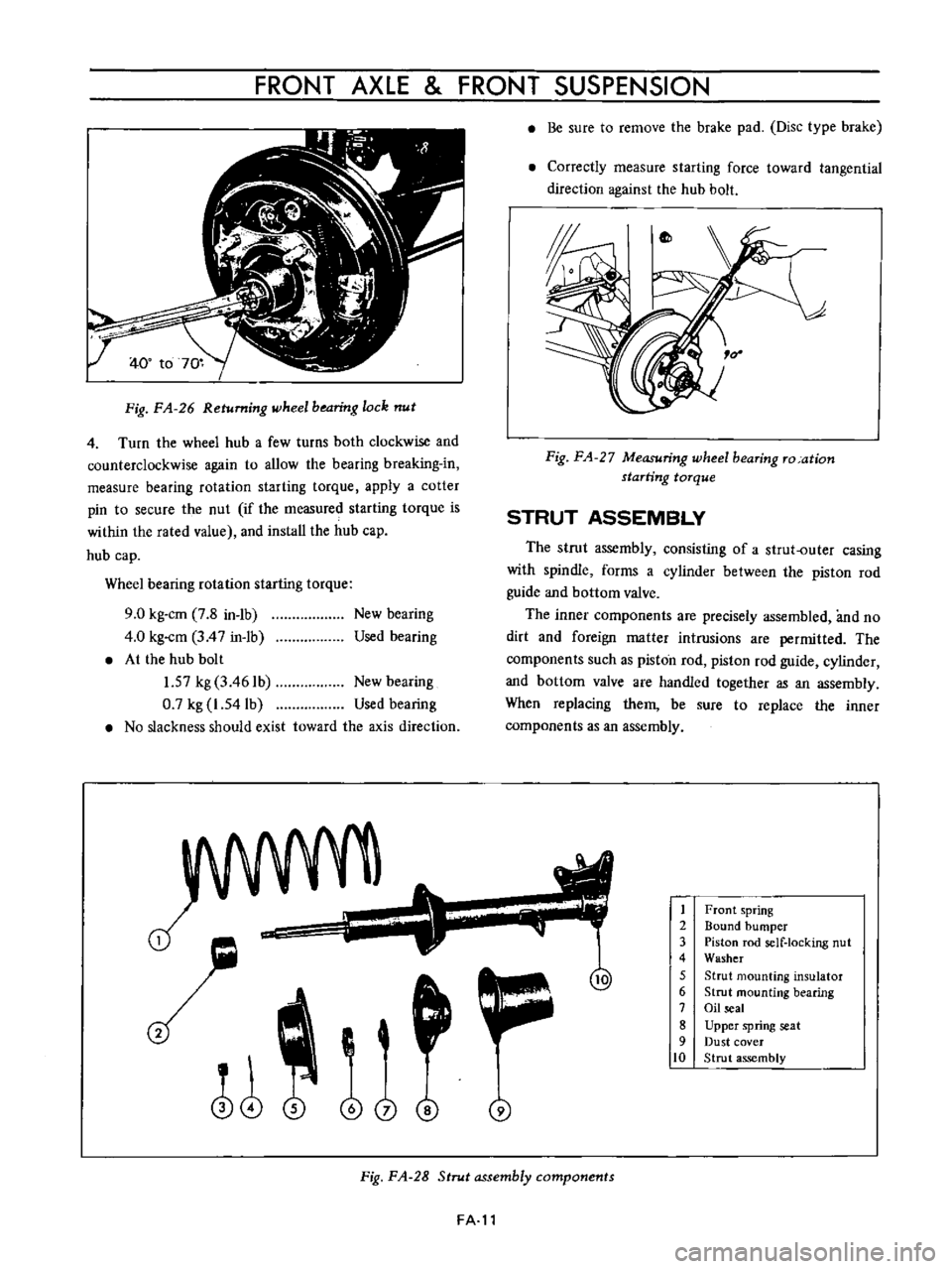
4
Turn
the
wheel
hub
a
few
turns
both
clockwise
and
counterclockwise
again
to
allow
the
bearing
breaking
in
measure
bearing
rotation
starting
torque
apply
a
cotter
pin
to
secure
the
nut
if
the
measured
starting
torque
is
within
the
rated
value
and
install
the
hub
cap
hub
cap
Wheel
bearing
rotation
starting
torque
9
0
kg
cm
7
8
in
1b
4
0
kg
cm
3
4
7
in
1b
At
the
hub
bolt
1
57
kg
3
461b
New
bearing
0
7
kg
1
54lb
Used
bearing
No
slackness
should
exist
toward
the
axis
direction
New
bearing
Used
bearing
J
o
i
@
j
Be
sure
to
remove
the
brake
pad
Disc
type
brake
Correctly
measure
starting
force
toward
tangential
direction
against
the
hub
bolt
Fig
FA
27
Measuring
wheel
bearing
ro
ation
starting
torque
STRUT
ASSEMBLY
The
strut
assembly
consisting
of
a
strut
outer
casing
with
spindle
forms
a
cylinder
between
the
piston
rod
guide
and
bottom
valve
The
inner
components
are
precisely
assembled
and
no
dirt
and
foreign
matter
intrusions
are
permitted
The
components
such
as
piston
rod
piston
rod
guide
cylinder
and
bottom
valve
are
handled
together
as
an
assembly
When
replacing
them
be
sure
to
replace
the
inner
components
as
an
assembly
1
2
3
4
5
6
7
8
9
10
Front
spring
Bound
bumper
Piston
rod
self
locking
nut
Washer
Strut
mounting
insulator
Strut
mounting
bearing
Oil
seal
Upper
spring
seat
Dust
cover
Strut
assembly
Fig
FA
28
Strut
assembly
components
FA
l1
Page 99 of 513
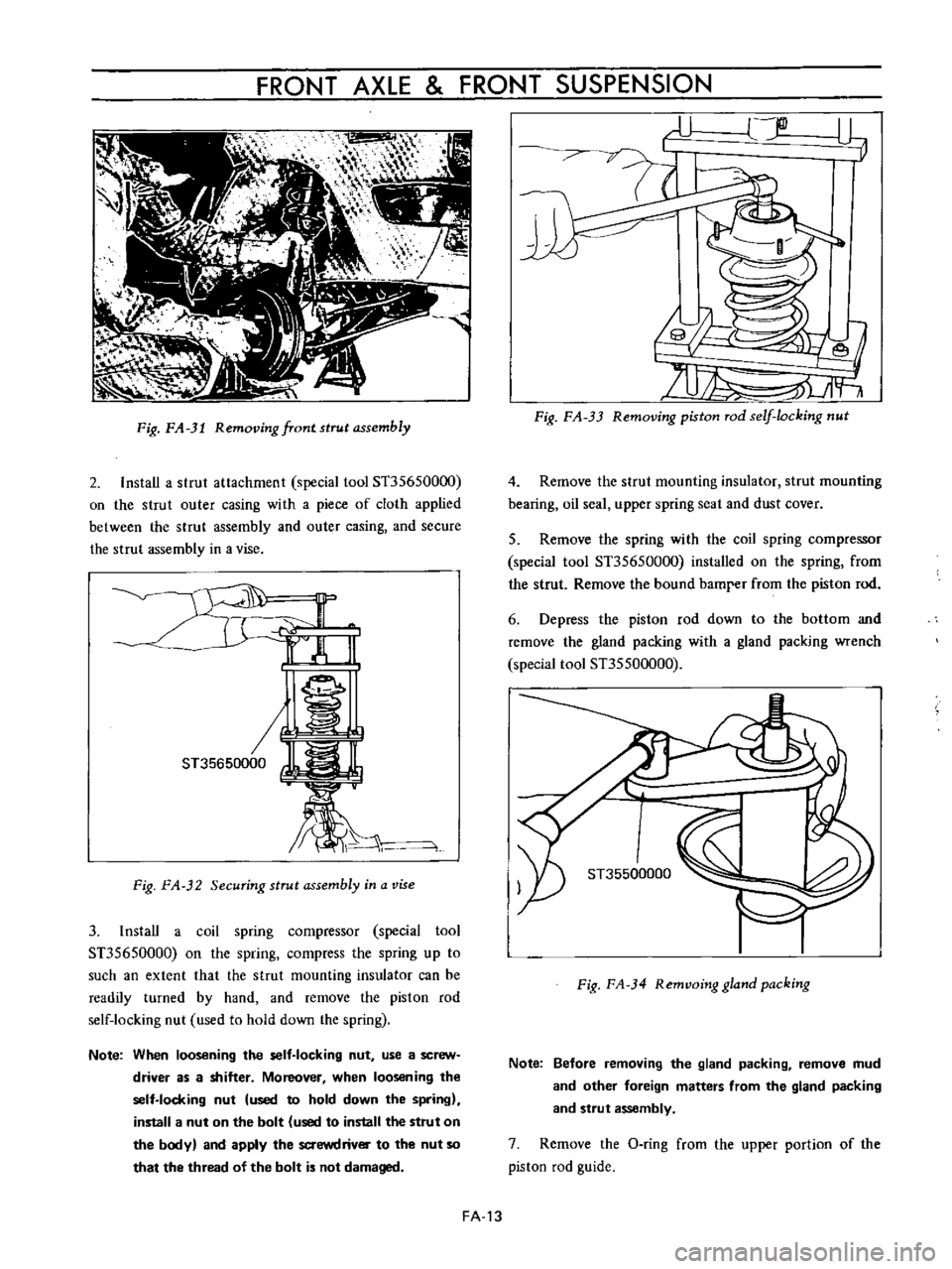
FRONT
AXLE
FRONT
SUSPENSION
Fig
FA
31
Removing
front
strut
assembly
2
InstaU
a
strut
attachment
special
tool
ST35650000
00
the
strut
outer
casing
with
a
piece
of
cloth
applied
between
the
strut
assembly
and
outer
casing
and
secure
the
strut
assembly
in
a
vise
J
1
i
kj
ST35650000
W
lL
bi
Fig
FA
32
Securing
strut
assembly
in
a
vise
3
1nstaU
a
coil
spring
compressor
special
tool
ST35650000
on
the
spring
compress
the
spring
up
to
such
an
extent
that
the
strut
mounting
insulator
can
be
readily
turned
by
hand
and
remove
the
piston
rod
self
locking
nut
used
to
hold
down
the
spring
Note
When
loosening
the
self
locking
nut
use
a
screw
driver
as
a
shitter
Moreover
when
loosening
the
self
locking
nut
used
to
hold
down
the
spring
install
a
nut
on
the
bolt
used
to
install
the
strut
on
the
body
and
apply
the
saewdrivOI
to
the
nut
so
that
the
thread
of
the
bolt
is
not
damaged
r
U
jlD
L1
19
71
it
fr
Fig
FA
33
Removing
piston
rod
self
locking
nut
4
Remove
the
strut
mounting
insulator
strut
mounting
bearing
oil
seal
upper
spring
seat
and
dust
cover
5
Remove
the
spring
with
the
coil
spring
compressor
special
tool
ST35650000
installed
on
the
spring
from
the
strut
Remove
the
bound
bamrer
from
the
piston
rod
6
Depress
the
piston
rod
down
to
the
bottom
and
remove
the
gland
packing
with
a
gland
packing
wrench
special
tool
ST35500000
I
ST35500000
Fig
FA
34
Remvoing
gland
packing
Note
Before
removing
the
gland
packing
remove
mud
and
other
foreign
matters
from
the
gland
packing
and
strut
assembly
7
Remove
the
O
ring
from
the
upper
portion
of
the
piston
rod
guide
FA
13
Page 101 of 513
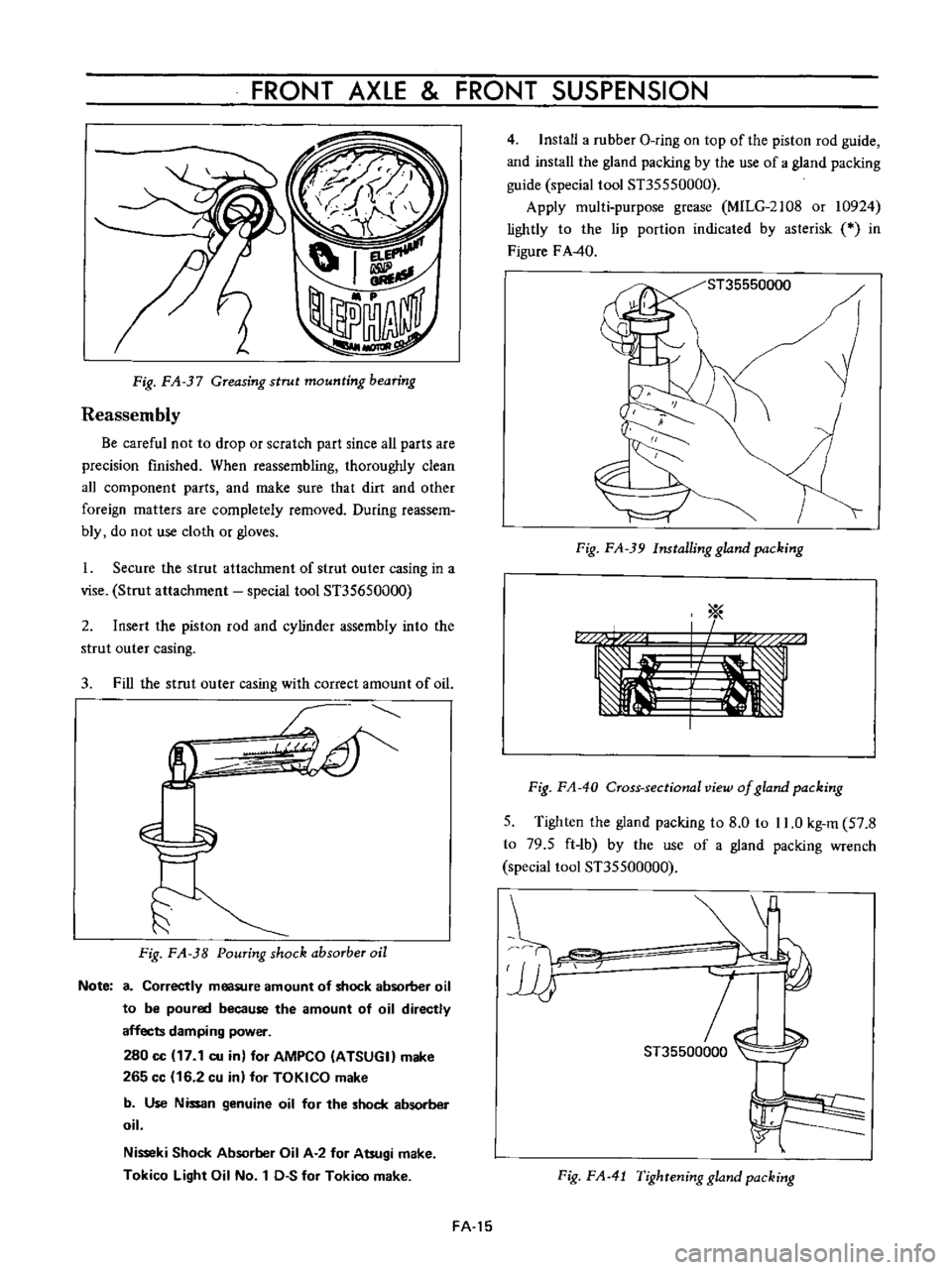
FRONT
AXLE
FRONT
SUSPENSION
I
f
f
ij
Reassembly
Fig
FA
37
Greasing
strut
mounting
bearing
Be
careful
not
to
drop
or
scratch
part
since
all
parts
are
precision
finished
When
reassembling
thoroughly
clean
all
component
parts
and
make
sure
that
dirt
and
other
foreign
matters
are
completely
removed
During
reassem
bly
do
not
use
cloth
or
gloves
I
Secure
the
strut
attachment
of
strut
Quter
casing
in
a
vise
Strut
attachment
special
tool
ST35650000
2
Insert
the
piston
rod
and
cylinder
assembly
into
the
strut
outer
casing
3
Fill
the
strut
outer
casing
with
correct
amount
of
oil
1
Fig
FA
38
Pouring
shock
absorber
oil
Note
a
Correctly
measure
amount
of
shock
absorber
oil
to
be
poured
because
the
amount
of
oil
directly
affects
damping
power
280
cc
17
1
cu
in
for
AMPCO
ATSUGI
make
265
cc
16
2
cu
in
for
TOKICO
make
b
Use
Nissan
genuine
oil
for
the
shock
absorber
oil
Nisseki
Shock
Absorber
Oil
A
2
for
Atsugi
make
Tokico
light
Oil
No
1
D
S
for
Tokico
make
FA
15
4
Install
a
rubber
O
ring
on
top
of
the
piston
rod
guide
and
install
the
gland
packing
by
the
use
of
a
gland
packing
guide
special
tool
ST35550000
Apply
multi
purpose
grease
MILG
2108
or
10924
lightly
to
the
lip
portion
indicated
by
asterisk
0
in
Figure
F
A40
ST35550000
1
Fig
FA
39
Installing
gland
packing
a
1
c
I
Fig
FA
40
Cross
sectional
view
of
gland
packing
5
Tighten
the
gland
packing
to
8
0
to
11
0
kg
m
57
8
to
79
5
ft
1b
by
the
use
of
a
gland
packing
wrench
special
tool
ST35500000
ST35500000
Fig
FA
41
Tighrening
gland
packing
Page 102 of 513
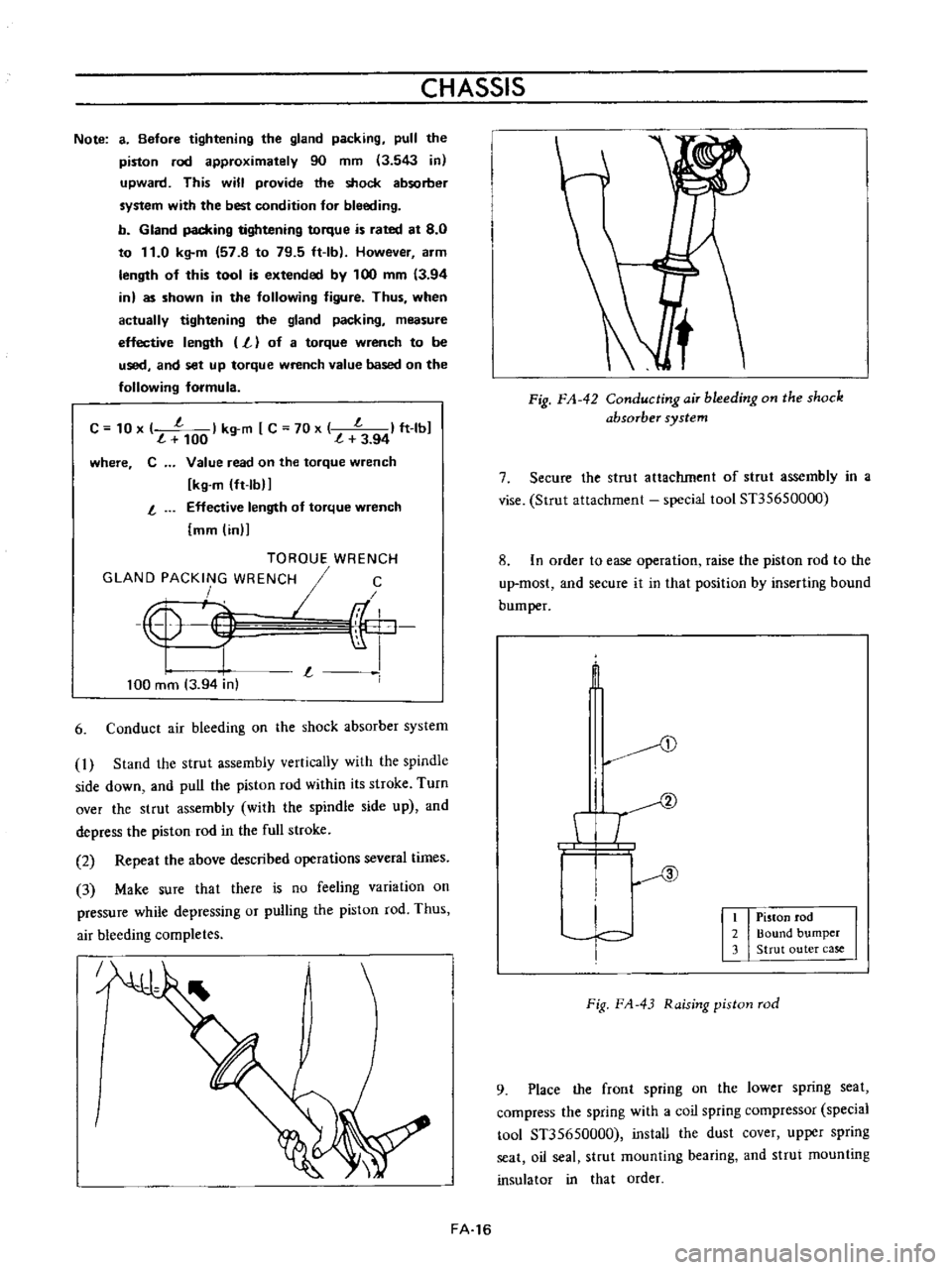
CHASSIS
Note
a
Before
tightening
the
gland
packing
pull
the
piston
rod
approximately
90
mm
3
543
in
upward
This
will
provide
the
shock
absorber
system
with
the
best
condition
for
bleeding
b
Gland
packing
tightening
torque
is
rated
at
8
0
to
11
0
kg
m
57
8
to
79
5
ft
Ib
However
arm
length
of
this
tool
is
extended
by
100
mm
3
94
in
as
shown
in
the
following
figure
Thus
when
actually
tightening
the
gland
packing
measure
effective
length
L
of
a
torque
wrench
to
be
used
and
set
up
torque
wrench
value
based
on
the
following
formula
C
10
x
l
I
kg
m
C
70
x
l
I
ft
lbJ
100
l
3
94
where
C
Value
read
on
the
torque
wrench
kg
m
ft
lbIJ
Effective
length
of
torque
wrench
mm
in
l
TOROUE
WRENCH
GLAND
PACKING
WRENCH
I
C
4
F
r
I
L
I
100
mm
3
94
in
6
Conduct
air
bleeding
on
the
shock
absorber
system
1
Stand
the
strut
assembly
vertically
with
the
spindle
side
down
and
pull
the
piston
rod
within
its
stroke
Turn
over
the
strut
assembly
with
the
spindle
side
up
and
depress
the
piston
rod
in
the
full
stroke
2
Repeat
the
above
described
operations
several
times
3
Make
sure
that
there
is
no
feeling
variation
on
pressure
while
depressing
or
pulling
the
piston
rod
Thus
air
bleeding
completes
J
FA
16
Fig
FA
42
ConductingaiT
bleeding
on
the
shock
absorber
system
7
Secure
the
strut
attachment
of
strut
assembly
in
a
vise
Strut
attachment
special
tool
Sn5650000
8
In
order
to
ease
operation
raise
the
piston
rod
to
the
up
most
and
secure
it
in
that
position
by
inserting
bound
bum
per
t
D
I
T
I
c
I
Piston
rod
2
Bound
bumper
3
Strut
outer
case
Fig
FA
43
Raising
piston
rod
9
Place
the
front
spring
on
the
lower
spring
seat
compress
the
spring
with
a
coil
spring
compressor
special
tool
Sn5650000
install
the
dust
cover
upper
spring
seat
oil
seal
strut
mounting
bearing
and
strut
mounting
insulator
in
that
order
Page 117 of 513
CHASSIS
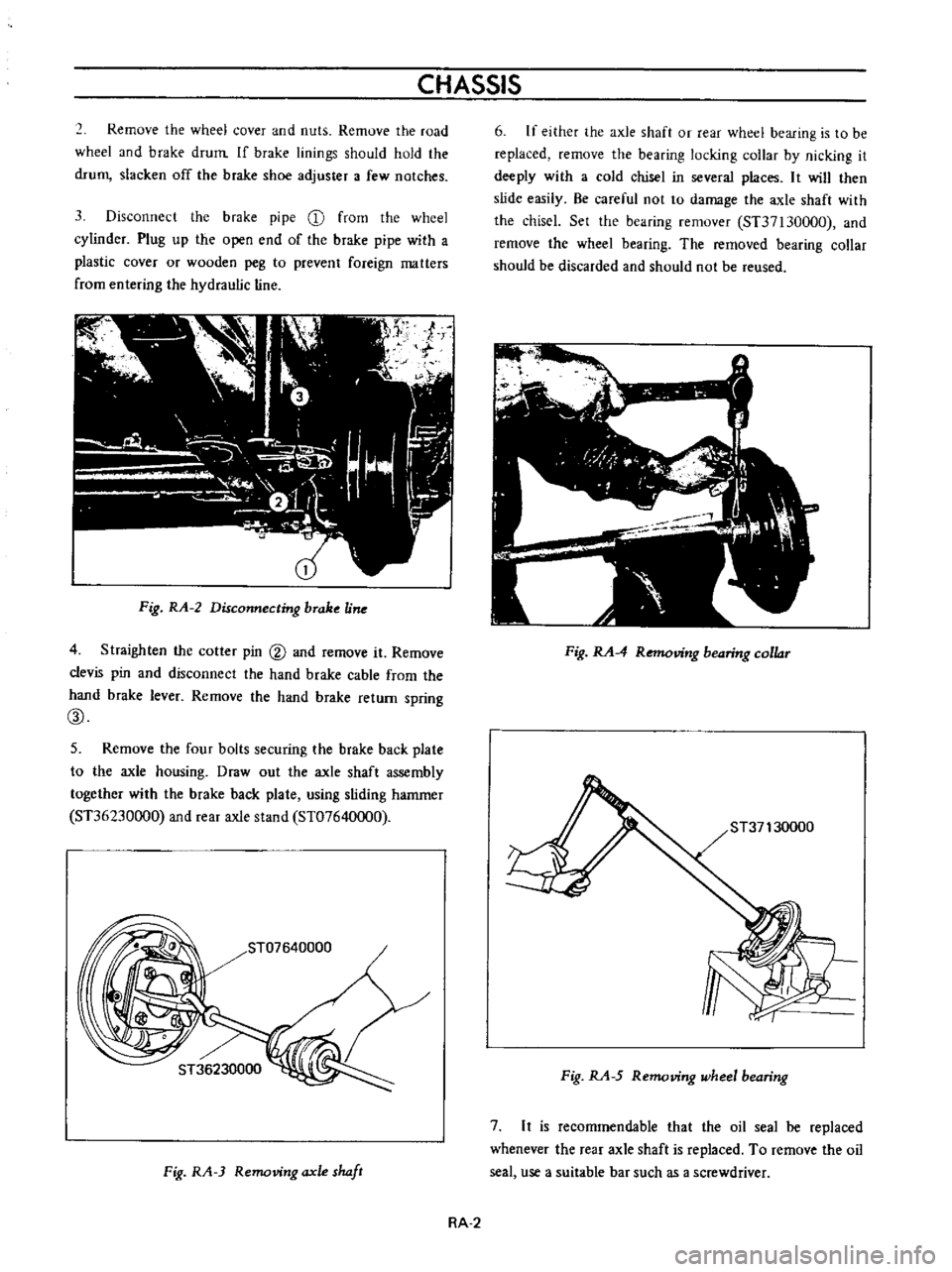
2
Remove
the
wheel
cover
and
nuts
Remove
the
road
wheel
and
b
rake
drum
If
brake
linings
should
hold
the
drum
slacken
off
the
brake
shoe
adjuster
a
few
notches
3
Disconnect
the
brake
pipe
CD
from
the
wheel
cylinder
Plug
up
the
open
end
of
the
brake
pipe
with
a
plastic
cover
or
wooden
peg
to
prevent
foreign
matters
from
entering
the
hydraulic
line
Fig
RA
2
Disconnecting
brake
Une
4
Straighten
the
cotler
pin
@
and
remove
it
Remove
clevis
pin
and
disconnect
the
hand
brake
cable
from
the
hand
brake
lever
Remove
the
hand
brake
return
spring
CID
5
Remove
the
four
bolts
securing
the
brake
back
plate
to
the
axle
housing
Draw
out
the
axle
shaft
assembly
together
with
the
brake
back
plate
using
sliding
hammer
ST36230000
and
rear
axle
stand
ST07640000
ST07640000
I
Fig
RA
3
Removing
axle
shaft
6
If
either
the
axle
shaft
or
rear
wheel
bearing
is
to
be
replaced
remove
the
bearing
locking
collar
by
nicking
it
deeply
with
a
cold
chisel
in
several
places
It
will
then
slide
easily
Be
careful
not
to
damage
the
axle
shaft
with
the
chiscl
Set
the
bearing
remover
ST37130000
and
remove
the
wheel
bearing
The
removed
bearing
collar
should
be
discarded
and
should
not
be
reused
Fig
RA
4
Removing
bearing
collar
Fig
RA
5
Removing
wheel
bearing
7
It
is
recommendable
that
the
oil
seal
be
replaced
whenever
the
rear
axle
shaft
is
replaced
To
remove
the
oil
seal
use
a
suitable
bar
such
as
a
screwdriver
RA
2