boot DATSUN B110 1973 Service Repair Manual
[x] Cancel search | Manufacturer: DATSUN, Model Year: 1973, Model line: B110, Model: DATSUN B110 1973Pages: 513, PDF Size: 28.74 MB
Page 134 of 513
CHASSIS
Fig
BR
19
Greasing
points
on
brake
disc
3
Tighten
the
brake
disc
installation
bolt
to
2
7
to
3
7
kg
m
19
5
to
26
7
ft
lb
4
Adjust
brake
shoe
clearance
and
perform
air
bleeding
on
the
hydraulic
system
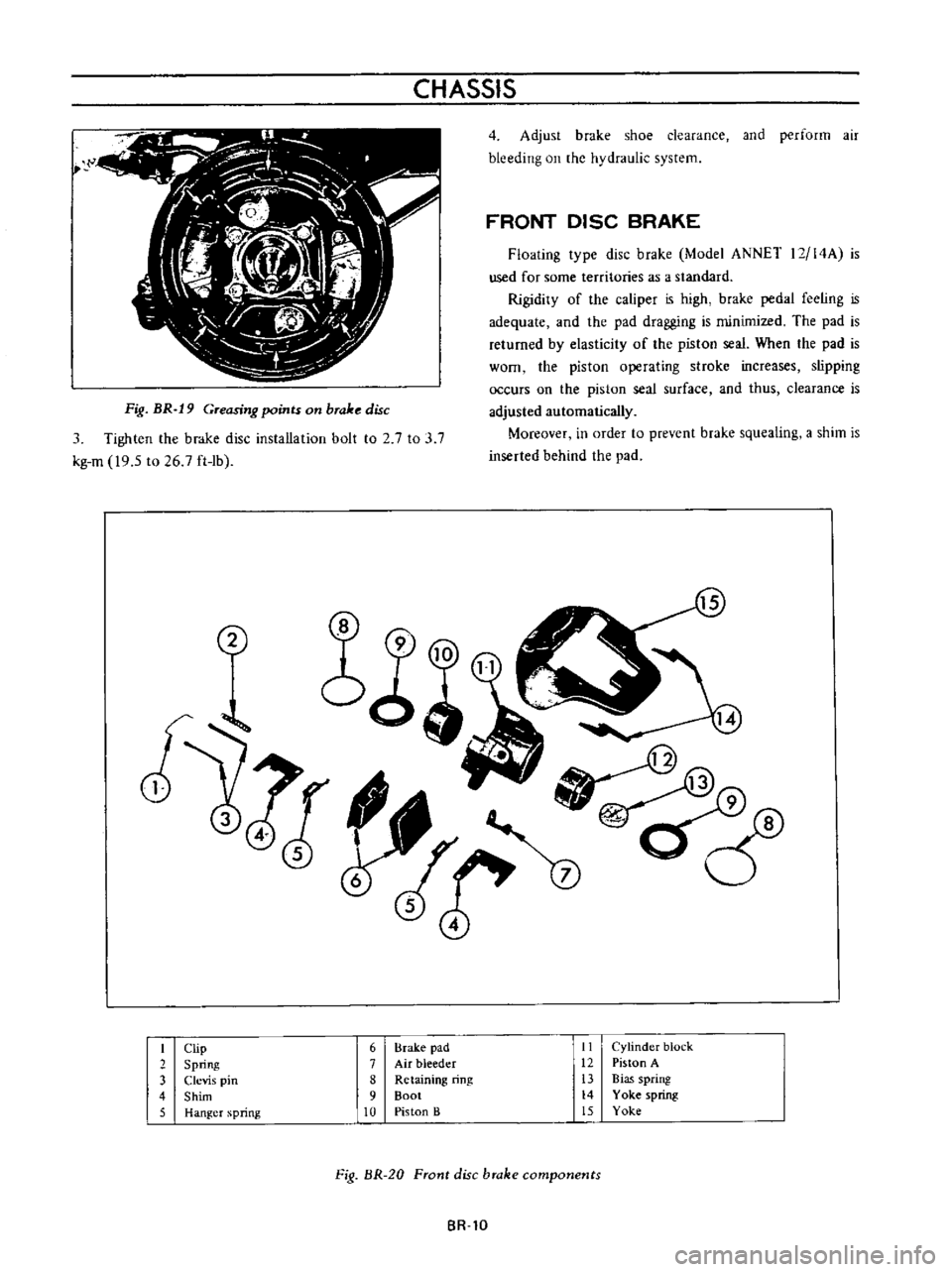
FRONT
DISC
BRAKE
Floating
type
disc
brake
Model
ANNET
12
14A
is
used
for
some
territories
as
a
standard
Rigidity
of
the
caliper
is
high
brake
pedal
feeling
is
adequate
and
the
pad
dragging
is
minimized
The
pad
is
returned
by
elasticity
of
the
piston
seal
When
the
pad
is
worn
the
piston
operating
stroke
increases
slipping
occurs
on
the
piston
seal
surface
and
thus
clearance
is
adjusted
automatically
Moreover
in
order
to
prevent
brake
squealing
a
shim
is
inserted
behind
the
pad
2
I
Clip
6
Brake
pad
II
Cylinder
block
2
Spring
7
Air
bleeder
12
Piston
A
3
Clevis
pin
8
Retaining
ring
13
Bias
spring
4
Shim
9
Boot
14
Yoke
spring
5
Hanger
spring
10
Piston
B
15
Yoke
Fig
BR
20
Front
disc
brake
components
BR
lO
Page 137 of 513
BRAKE
Fig
BR
27
Removing
strut
assembly
and
knuckle
arm
installation
bolt
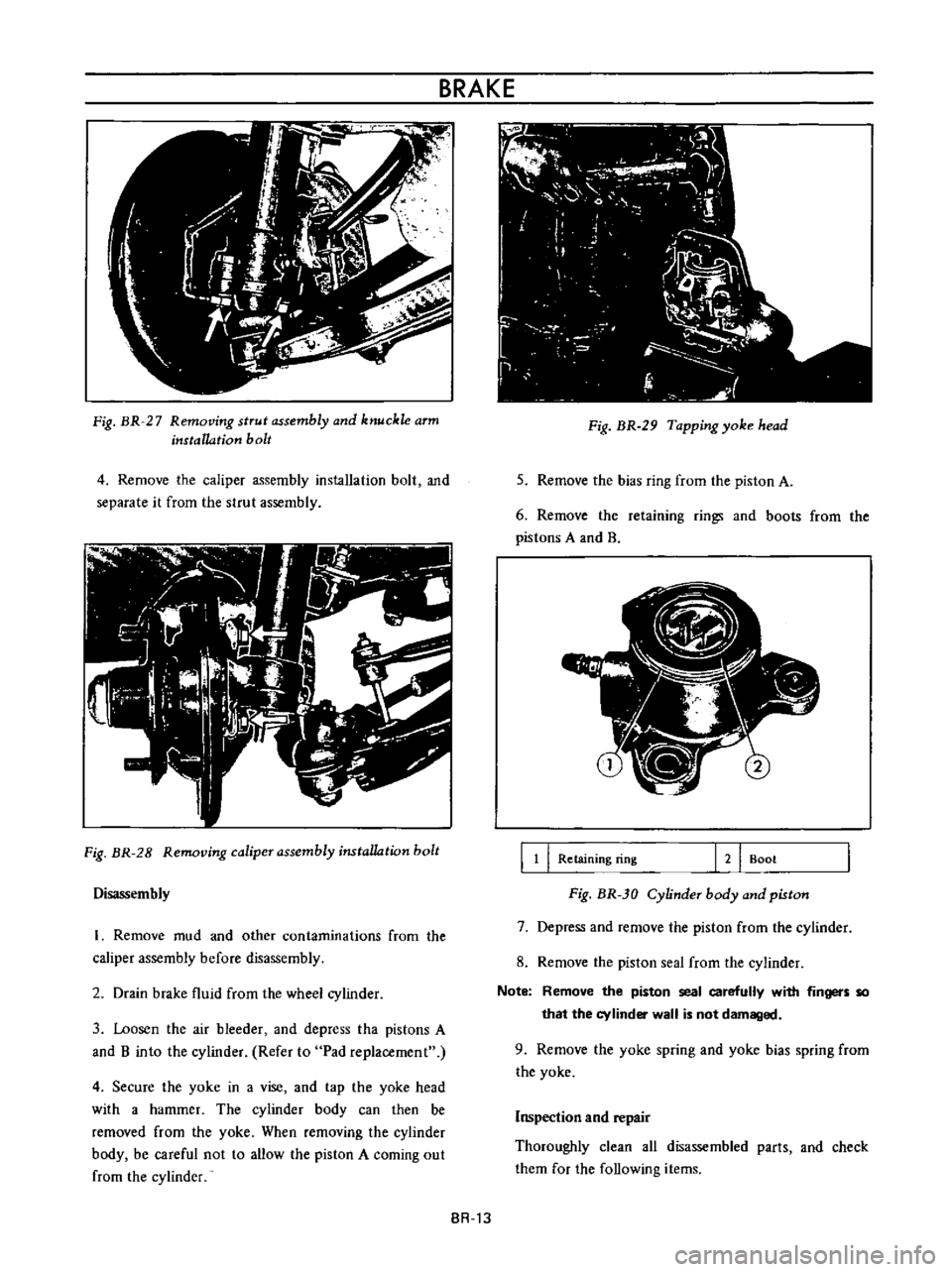
4
Remove
the
caliper
assembly
installation
bolt
and
separate
it
from
the
strut
assembly
Fig
BR
28
Removing
caliper
assembly
instaUation
bolt
Disassembly
I
Remove
mud
and
other
contaminations
from
the
caliper
assembly
before
disassembly
2
Drain
brake
fluid
from
the
wheel
cylinder
3
Loosen
the
air
bleeder
and
depress
tha
pistons
A
and
B
into
the
cylinder
Refer
to
Pad
replacement
4
Secure
the
yoke
in
a
vise
and
tap
the
yoke
head
with
a
hammer
The
cylinder
body
can
then
be
removed
from
the
yoke
When
removing
the
cylinder
body
be
careful
not
to
allow
the
piston
A
coming
out
from
the
cylinder
BR
13
i
c
J
l
l
7
I
0
I
I
i
I
f
1
1
J
t
1
Fig
BR
29
Tapping
yoke
head
5
Remove
the
bias
ring
from
the
piston
A
6
Remove
the
retaining
rings
and
boots
from
the
pistons
A
and
B
J
l
lj
7
fI
II
l
j
B
11
I
Retaining
ring
121
Boot
Fig
BR
30
Cylinder
body
and
piston
7
Depress
and
remove
the
piston
from
the
cylinder
8
Remove
the
pislon
seal
from
the
cylinder
Note
Remove
the
piston
seal
carefully
with
fingers
so
that
the
cylinder
wall
is
not
damaged
9
Remove
the
yoke
spring
and
yoke
bias
spring
from
the
yoke
Inspection
and
repair
Thoroughly
clean
all
disassembled
parIs
and
check
them
for
the
following
items
Page 139 of 513
BRAKE
i
f
F
PISTON
A
PISTON
S
Fig
BR
33
Piston
A
and
B
3
Apply
rubber
grease
lightly
to
the
sliding
portion
of
piston
and
insert
the
piston
into
the
cylinder
Note
When
inserting
the
piston
be
careful
not
to
insert
too
far
4
1
nstaU
the
boot
and
retaining
ring
Fig
BR
34
Installing
boot
5
Install
so
that
the
yoke
groove
of
bias
ring
of
piston
A
coincides
with
the
yoke
groove
of
cylinder
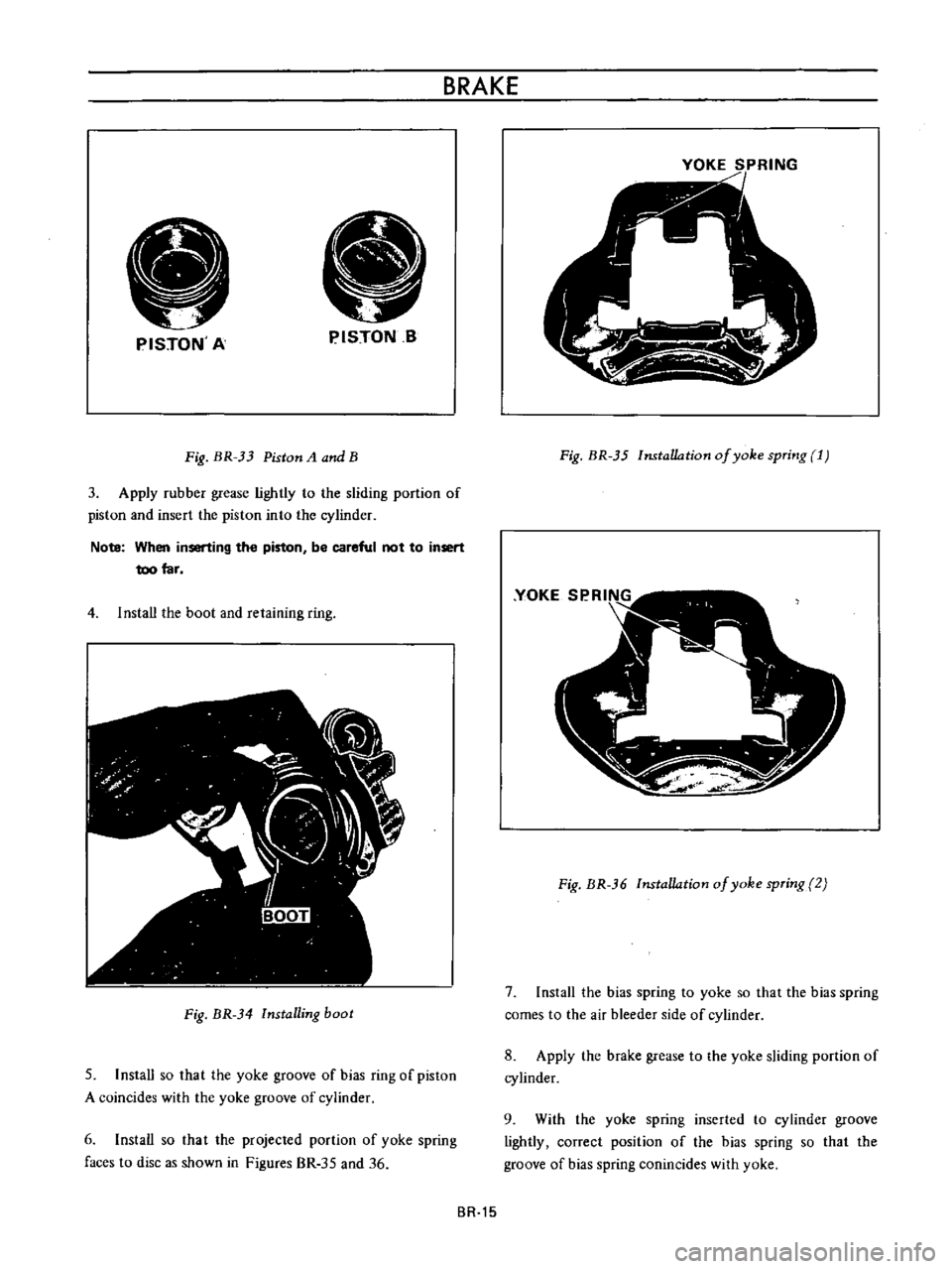
6
Install
so
that
the
projected
portion
of
yoke
spring
faces
to
disc
as
shown
in
Figures
BR
35
and
36
BR
15
YOKE
SPRING
Fig
BR
35
Installation
of
yoke
spring
1
Fig
BR
36
Installation
of
yoke
spring
2
7
Install
the
bias
spring
to
yoke
so
that
the
bias
spring
comes
to
the
air
bleeder
side
of
cylinder
8
Apply
the
brake
grease
to
the
yoke
sliding
portion
of
cylinder
9
With
the
yoke
spring
inserted
to
cylinder
groove
lightly
correct
position
of
the
bias
spring
so
that
the
groove
of
bias
spring
conincides
with
yoke
Page 457 of 513
ENGINE
ElECTRICAL
SYSTEM
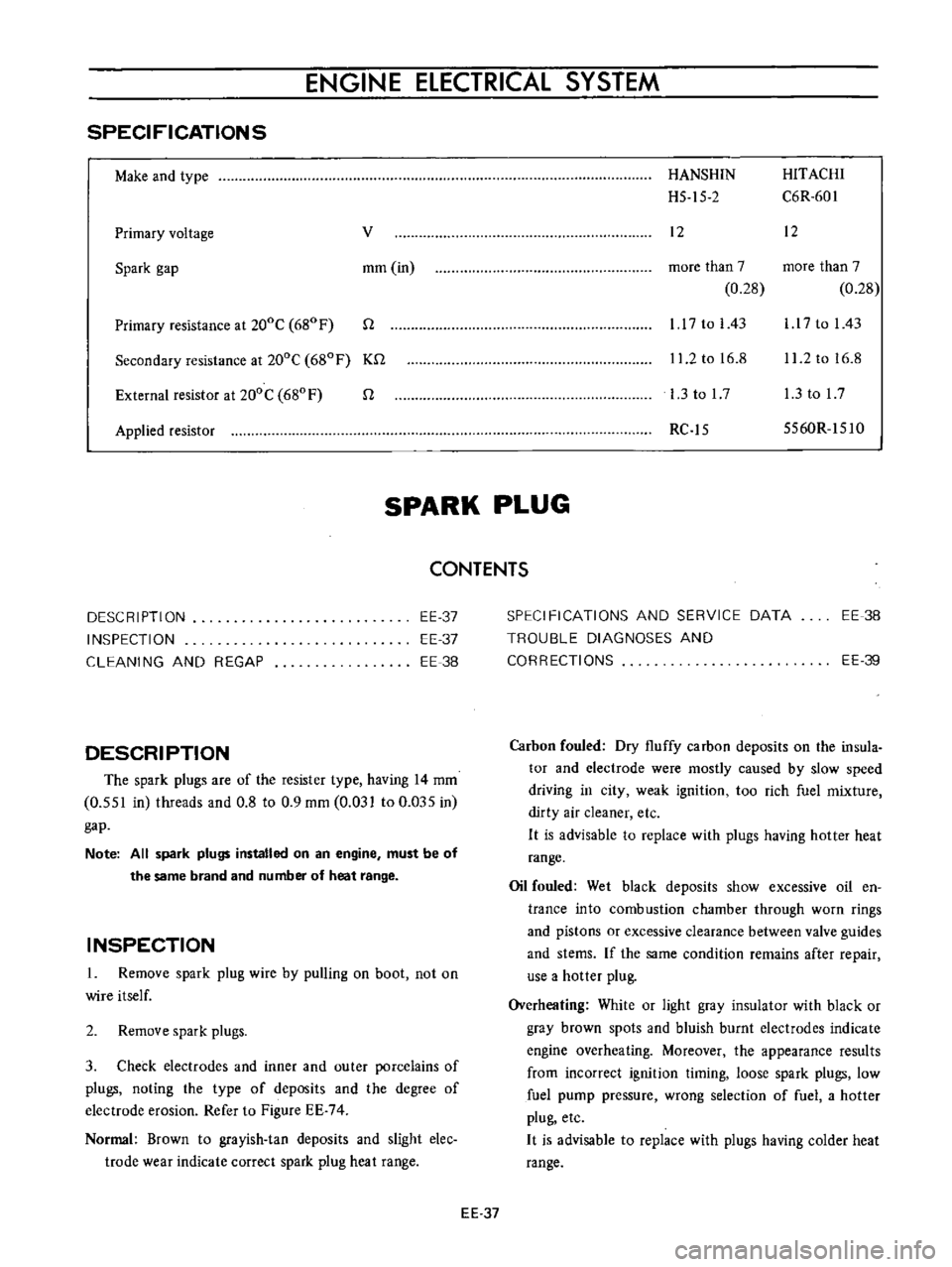
SPECIFICATIONS
Make
and
type
Primary
voltage
v
Spark
gap
mm
in
Primary
resistance
at
200C
680
F
n
Secondary
resistance
at
200C
680F
Kn
External
resistor
at
200C
680
F
n
Applied
resistor
HANSHIN
HITACHI
H5
15
2
C6R
601
12
12
more
than
7
more
than
7
0
28
0
28
1
17
to
I
43
l
l
7
to
I
43
11
2
to
16
8
11
2
to
16
8
l
3tol7
l
3tol7
RC
15
5560R
151O
SPARK
PLUG
CONTENTS
DESCRIPTION
INSPECTION
CLEANING
AND
REGAP
EE
37
EE
37
EE
38
DESCRIPTION
The
spark
plugs
are
of
the
resister
type
having
14
mm
0
551
in
threads
and
0
8
to
0
9
mm
0
031
to
0
Q35
in
gap
Note
All
spark
plugs
installed
on
an
engine
must
be
of
the
same
brand
and
number
of
heat
range
INSPECTION
1
Remove
spark
plug
wire
by
pulling
on
boot
not
on
wire
itself
2
Remove
spark
plugs
3
Check
electrodes
and
inner
and
outer
porcelains
of
plugs
noting
the
type
of
deposits
and
the
degree
of
electrode
erosion
Refer
to
Figure
EE
74
Normal
Brown
to
grayish
tan
deposits
and
slight
elec
trode
wear
indicate
correct
spark
plug
heat
range
SPECIFICATIONS
AND
SERVICE
DATA
TROUBLE
DIAGNOSES
AND
CORRECTIONS
EE
38
EE
39
Carbon
fouled
Dry
fluffy
carbon
deposits
on
the
insula
tor
and
electrode
were
mostly
caused
by
slow
speed
driving
in
city
weak
ignition
too
rich
fuel
mixture
dirty
air
cleaner
etc
H
is
advisable
to
replace
with
plugs
having
hotter
heat
range
Oil
fouled
Wet
black
deposits
show
excessive
oil
en
trance
into
combustion
chamber
through
worn
rings
and
pistons
or
excessive
clearance
between
valve
guides
and
stems
If
the
same
condition
remains
after
repair
use
a
hotter
plug
Overheating
White
or
light
gray
insulator
with
black
or
gray
brown
spots
and
bluish
burnt
electrodes
indicate
engine
overheating
Moreover
the
appearance
results
from
incorrect
ignition
timing
loose
spark
plugs
low
fuel
pump
pressure
wrong
selection
of
fuel
a
hotter
plug
etc
H
is
advisable
to
replace
with
plugs
having
colder
heat
range
EE
37
Page 468 of 513
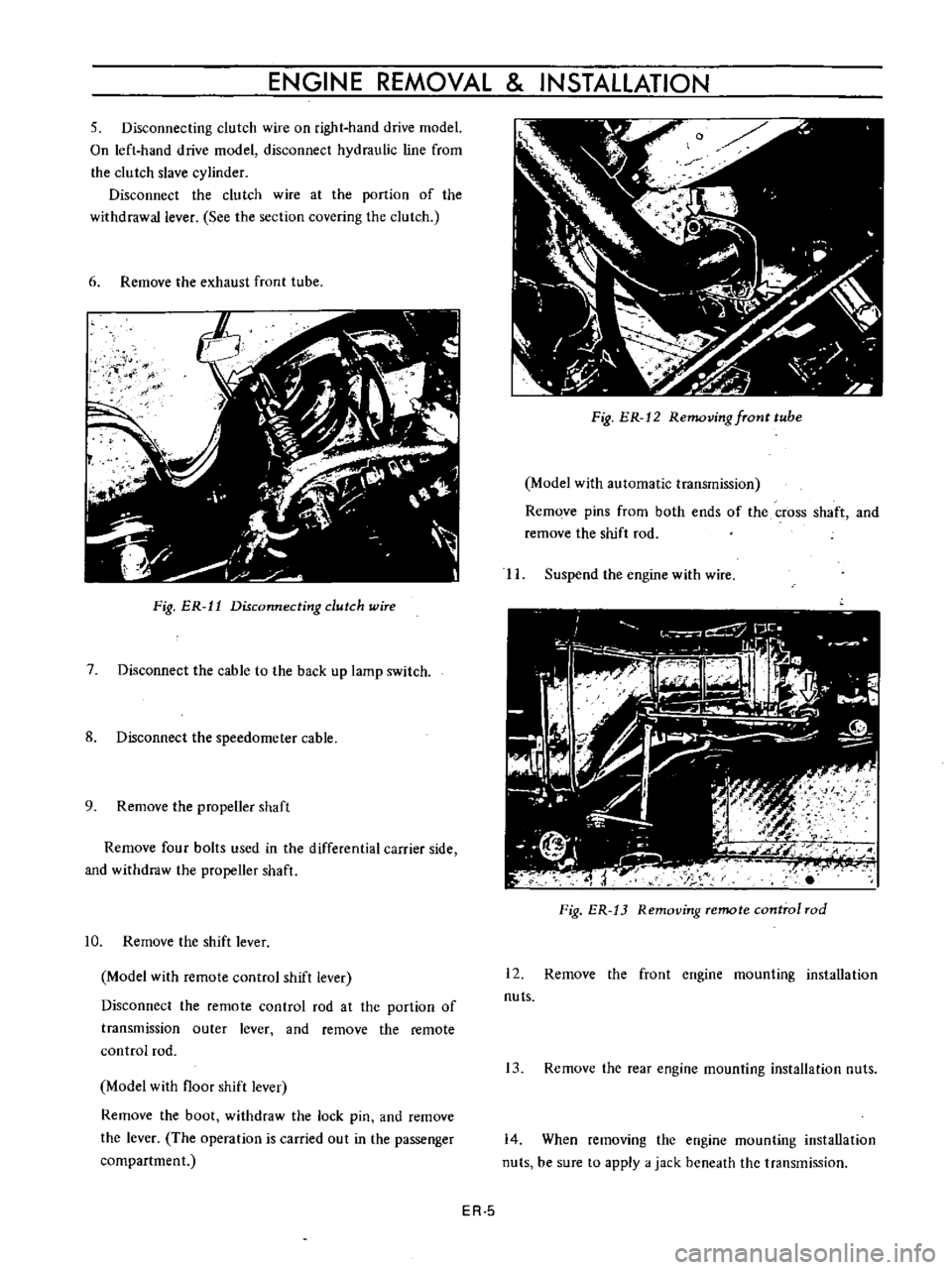
ENGINE
REMOVAL
INSTAllATION
5
Disconnecting
clutch
wire
on
right
hand
drive
model
On
left
hand
drive
model
disconnect
hydraulic
line
from
the
clutch
slave
cylinder
Disconnect
the
clutch
wire
at
the
portion
of
the
withdrawal
lever
See
the
section
covering
the
clutch
6
Remove
the
exhaust
front
tube
ij
f
I
Fig
ER
11
Disconnecting
dutch
wire
7
Disconnect
the
cable
to
the
back
up
lamp
switch
8
Disconnect
the
speedometer
cable
9
Remove
the
propeller
shaft
Remove
four
bolts
used
in
the
differential
carrier
side
and
withdraw
the
propeller
shaft
10
Remove
the
shift
lever
Model
with
remote
control
shift
lever
Disconnect
the
remote
control
rod
at
the
portion
of
transmission
outer
lever
and
remove
the
remote
control
rod
Model
with
floor
shift
lever
Remove
the
boot
withdraw
the
lock
pin
and
remove
the
lever
The
operation
is
carried
out
in
the
passenger
compartment
Fig
ER
12
Removing
fTont
tube
Model
with
automatic
transmission
Remove
pins
from
both
ends
of
the
cross
shaft
and
remove
the
shift
rod
II
Suspend
the
engine
with
wire
Fig
ER
13
Removing
remote
control
rod
12
Remove
the
front
engine
mounting
installation
nuts
13
Remove
the
rear
engine
mounting
installation
nuts
14
When
removing
the
engine
mounting
installation
nuts
be
sure
to
apply
a
jack
beneath
the
transmission
ER
5