maintenance schedule DODGE AVENGER 2008 User Guide
[x] Cancel search | Manufacturer: DODGE, Model Year: 2008, Model line: AVENGER, Model: DODGE AVENGER 2008Pages: 467, PDF Size: 7.16 MB
Page 385 of 467
WARNING!² Use only refrigerants and compressor lubricants
approved by the manufacturer for your air condi-
tioning system. Some unapproved refrigerants are
flammable and can explode, injuring you. Other
unapproved refrigerants or lubricants can cause
the system to fail, requiring costly repairs. Refer to
Section 3 of the Warranty Information book for
further warranty information.
² The air conditioning system contains refrigerant
under high pressure. To avoid risk of personal
injury or damage to the system, adding refrigerant
or any repair requiring lines to be disconnected
should be done by an experienced technician. Refrigerant Recovery and Recycling
R-134a Air Conditioning Refrigerant is a hydrofluoro-
carbon (HFC) that is endorsed by the Environmental
Protection Agency and is an ozone-saving product. How-
ever, the manufacturer recommends that air conditioning
service be performed by authorized dealers or other
service facilities using recovery and recycling equipment.
NOTE: Use only manufacturer approved A/C System
Sealers, Stop Leak Products, Seal Conditioners, Compres-
sor Oil, and Refrigerants.
A/C AIR FILTER Ð IF EQUIPPED
Refer to the ªMaintenance Scheduleº in Section 8 of this
manual for A/C Air Filter service intervals.
WARNING!Do not remove the A/C Air Filter while the blower is
operating or personal injury may result. MAINTAINING YOUR VEHICLE 383
7
Page 391 of 467
Coolant Checks
Check engine coolant (antifreeze) protection every 12
months (before the onset of freezing weather, where
applicable). If coolant is dirty or rusty in appearance, the
system should be drained, flushed, and refilled with
fresh coolant. Check the front of the A/C condenser for
any accumulation of bugs, leaves, etc. If dirty, clean by
gently spraying water from a garden hose vertically
down the face of the condenser.
Check the coolant recovery bottle tubing for brittle rub-
ber, cracking, tears, cuts, and tightness of the connection
at the bottle and radiator. Inspect the entire system for
leaks. Cooling System Ð Drain, Flush, and Refill
The system should be drained, flushed, and refilled at the
intervals shown in the ªMaintenance Scheduleº in Sec-
tion 8 of this manual.
If the solution is dirty or contains a considerable amount
of sediment, clean and flush with a reliable cooling
system cleaner. Follow with a thorough rinsing to remove
all deposits and chemicals. Properly dispose of old
antifreeze solution.
Selection Of Coolant
Use only the manufacturer's recommended coolant, refer
to ªFluids, Lubricants, and Genuine Partsº for correct
coolant type. MAINTAINING YOUR VEHICLE 389
7
Page 397 of 467
WARNING!Riding the brakes can lead to brake failure and
possibly an accident. Driving with your foot resting
or riding on the brake pedal can result in abnormally
high brake temperatures, excessive lining wear, and
possible brake damage. You wouldn't have your full
braking capacity in an emergency.
Brake And Power Steering Hoses
When servicing the vehicle for scheduled maintenance,
inspect the surface of the hoses and nylon tubing for
evidence of heat and mechanical damage. Hard and
brittle rubber, cracking, tears, cuts, abrasions, and exces-
sive swelling suggest deterioration of the rubber. Particu-
lar attention should be made to examining those hose
surfaces nearest to high heat sources, such as the exhaust
manifold. Ensure nylon tubing in these areas has not melted or
collapsed.
Inspect all hose clamps and couplings to make sure they
are secure and no leaks are present.
NOTE:
² Often, fluids such as oil, power steering fluid, and
brake fluid are used during assembly plant operations
to ease the assembly of hoses to couplings. Therefore,
oil wetness at the hose-coupling area is not necessarily
an indication of leakage. Actual dripping of hot fluid
when systems are under pressure (during vehicle
operation) should be noted before a hose is replaced
based on leakage.
² Inspect the brake hoses whenever the brake system is
serviced and at every engine oil change. Inspect hy-
draulic brake hoses for surface cracking, scuffing, or
worn spots. If there is any evidence of cracking,
scuffing, or worn spots, the hose should be replaced MAINTAINING YOUR VEHICLE 395
7
Page 401 of 467
CAUTION!² Using a transmission fluid other than the manu-
facturer's recommended fluid may cause deterio-
ration in transmission shift quality and/or torque
converter shudder. Using a transmission fluid
other than that recommended by the manufacturer
will result in more frequent fluid and filter
changes. Refer to ªFluids, Lubricants, and Genu-
ine Partsº for the correct fluid type.
² Dirt and water in the transaxle can cause serious
damage. To prevent dirt and water from entering
the transaxle after checking or replenishing fluid,
make certain that the dipstick cap is re-seated
properly. Transmission Fluid and Filter Changes
Change the automatic transaxle fluid and filter at the
intervals shown in the ªMaintenance Scheduleº in this
manual.
In addition, change the fluid and filter if the transaxle is
disassembled for any reason.
Special Additives
Automatic Transmission Fluid (ATF) is an engineered
product and its performance may be impaired by supple-
mental additives. Therefore, do not add any fluid addi-
tives to the transaxle. The only exception to this policy is
the use of special dyes to aid in detecting fluid leaks. In
addition, avoid using transmission sealers as they may
adversely affect seals. MAINTAINING YOUR VEHICLE 399
7
Page 427 of 467
MAINTENANCE SCHEDULESCONTENTS m Emissions Control System Maintenance .......426
m Maintenance Schedule ...................426 N Required Maintenance Intervals ...........429
8 M
A
I
N
T
E
N
A
N
C
E
S
C
H
E
D
U
L
E
S
Page 428 of 467
EMISSIONS CONTROL SYSTEM MAINTENANCE
The Scheduled Maintenance services listed in bold type,
must be done at the times or mileages specified to ensure
the continued proper functioning of the Emissions Con-
trol System. These, and all other maintenance services
included in this manual, should be done to provide best
vehicle performance and reliability. More frequent main-
tenance may be needed for vehicles in severe operating
conditions, such as dusty areas and very short trip
driving.
Inspection and service should also be done anytime a
malfunction is suspected.
NOTE: Maintenance, replacement, or repair of the emis-
sions control devices and systems on your vehicle may be
performed by any automotive repair establishment or
individual using any automotive part that has been
certified pursuant to U.S. EPA or in the State of Califor-
nia, California Air Resources Board regulations. MAINTENANCE SCHEDULE
The oil change indicator system will remind you that it is
time to take your vehicle in for scheduled maintenance.
On Electronic Vehicle Information Center (EVIC)
equipped vehicles, ªOil Change Requiredº will be dis-
played in the EVIC and a single chime will sound,
indicating that an oil change is necessary.
On Non-EVIC equipped vehicles, ªChange Oilº will flash
in the instrument cluster odometer and a single chime
will sound, indicating that an oil change is necessary.
Based on engine operation conditions, the oil change
indicator message will illuminate which means service is
required for your vehicle. Have your vehicle serviced as
soon as possible, within the next 500 mi (805 km).
NOTE:
² The oil change indicator message will not monitor the
time since the last oil change. Change your vehicle's426 MAINTENANCE SCHEDULES
8 M
A
I
N
T
E
N
A
N
C
E
S
C
H
E
D
U
L
E
S
Page 429 of 467
oil if it has been six months since your last oil change
even if the oil change indicator message is NOT
illuminated.
² Change your engine oil more often if you drive your
vehicle off-road for an extended period of time.
² Under no circumstances should oil change intervals
exceed 6,000 mi (10 000 km) or six months, whichever
comes first.
Your authorized dealer will reset the oil change indicator
message after completing the scheduled oil change. If a
scheduled oil change is performed by someone other
than your authorized dealer, the message can be reset by
referring to the steps described under ªOil Change
Requiredº under ªElectronic Vehicle Information Center
(EVIC)º in Section 4 or under ªOdometer/Trip Odom-
eterº under ªInstrument Cluster Descriptionsº in Section
4. At Each Stop for Fuel
² Check the engine oil level about five minutes after a
fully warmed engine is shut off. Checking the oil level
while the vehicle is on level ground will improve the
accuracy of the oil level reading. Add oil only when
the level is at or below the SAFE or MIN mark.
² Check the windshield washer solvent and add if
required.
Once a Month
² Check tire pressure and look for unusual wear or
damage.
² Inspect the battery and clean and tighten the terminals
as required.
² Check the fluid levels of coolant reservoir, brake
master cylinder, power steering, and automatic trans-
axle, and add fluid as needed. MAINTENANCE SCHEDULES 427
8 M
A
I
N
T
E
N
A
N
C
E
S
C
H
E
D
U
L
E
S
Page 430 of 467
NOTE: Six-speed AutoStick t Transaxle, if equipped, is
sealed therefore, checking the fluid level can only be
done by a certified dealership service center.
² Check all lights and other electrical items for correct
operation. At Each Oil Change
² Change the engine oil filter.
² Inspect the brake hoses and lines.
CAUTION!Failure to perform the required maintenance items
may result in damage to the vehicle.428 MAINTENANCE SCHEDULES
8 M
A
I
N
T
E
N
A
N
C
E
S
C
H
E
D
U
L
E
S
Page 431 of 467
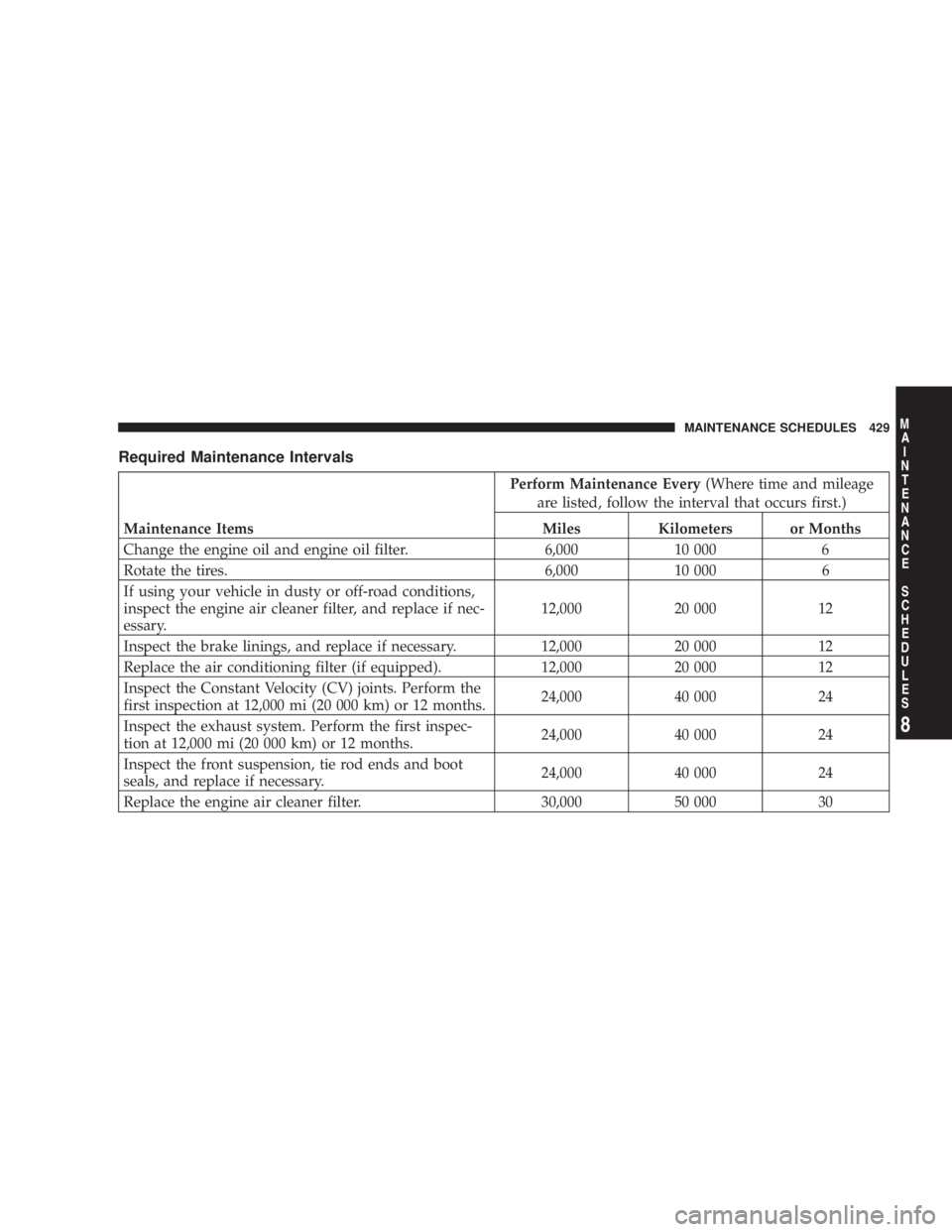
Required Maintenance Intervals
Perform Maintenance Every (Where time and mileage
are listed, follow the interval that occurs first.)
Maintenance Items Miles Kilometers or Months
Change the engine oil and engine oil filter. 6,000 10 000 6
Rotate the tires. 6,000 10 000 6
If using your vehicle in dusty or off-road conditions,
inspect the engine air cleaner filter, and replace if nec-
essary. 12,000 20 000 12
Inspect the brake linings, and replace if necessary. 12,000 20 000 12
Replace the air conditioning filter (if equipped). 12,000 20 000 12
Inspect the Constant Velocity (CV) joints. Perform the
first inspection at 12,000 mi (20 000 km) or 12 months. 24,000 40 000 24
Inspect the exhaust system. Perform the first inspec-
tion at 12,000 mi (20 000 km) or 12 months. 24,000 40 000 24
Inspect the front suspension, tie rod ends and boot
seals, and replace if necessary. 24,000 40 000 24
Replace the engine air cleaner filter. 30,000 50 000 30 MAINTENANCE SCHEDULES 429
8 M
A
I
N
T
E
N
A
N
C
E
S
C
H
E
D
U
L
E
S
Page 432 of 467
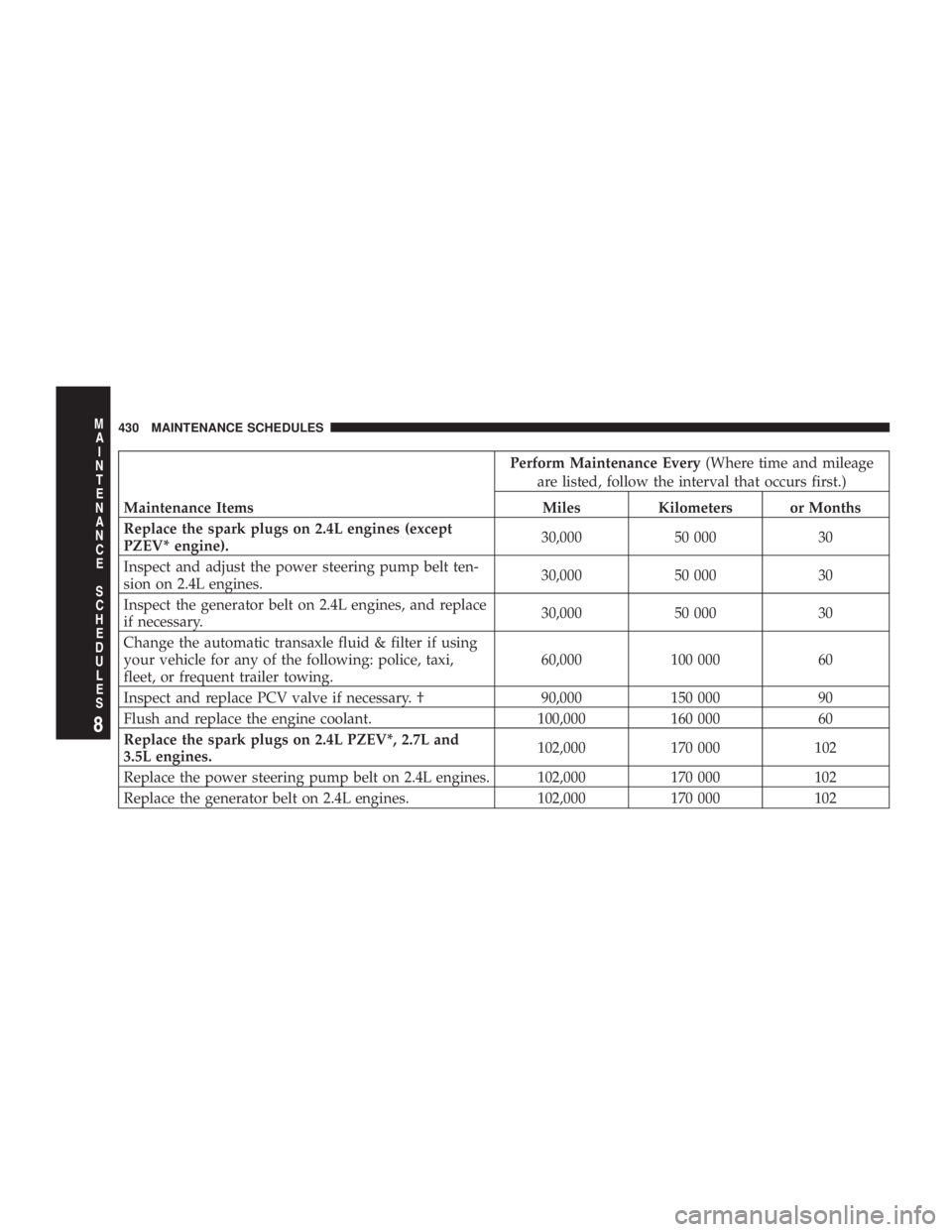
Perform Maintenance Every (Where time and mileage
are listed, follow the interval that occurs first.)
Maintenance Items Miles Kilometers or Months
Replace the spark plugs on 2.4L engines (except
PZEV* engine). 30,000 50 000 30
Inspect and adjust the power steering pump belt ten-
sion on 2.4L engines. 30,000 50 000 30
Inspect the generator belt on 2.4L engines, and replace
if necessary. 30,000 50 000 30
Change the automatic transaxle fluid & filter if using
your vehicle for any of the following: police, taxi,
fleet, or frequent trailer towing. 60,000 100 000 60
Inspect and replace PCV valve if necessary. ² 90,000 150 000 90
Flush and replace the engine coolant. 100,000 160 000 60
Replace the spark plugs on 2.4L PZEV*, 2.7L and
3.5L engines. 102,000 170 000 102
Replace the power steering pump belt on 2.4L engines. 102,000 170 000 102
Replace the generator belt on 2.4L engines. 102,000 170 000 102 430 MAINTENANCE SCHEDULES
8 M
A
I
N
T
E
N
A
N
C
E
S
C
H
E
D
U
L
E
S