load capacity DODGE AVENGER 2008 Owners Manual
[x] Cancel search | Manufacturer: DODGE, Model Year: 2008, Model line: AVENGER, Model: DODGE AVENGER 2008Pages: 467, PDF Size: 7.16 MB
Page 298 of 467
Loading
The vehicle maximum load on the tire must not exceed
the load carrying capacity of the tire on your vehicle. You
will not exceed the tire's load carrying capacity if you
adhere to the loading conditions, tire size, and cold tire
inflation pressures specified on the Tire and Loading
Information placard and in the ªVehicle Loadingº section
of this manual.
NOTE: Under a maximum loaded vehicle condition,
gross axle weight ratings (GAWRs) for the front and rear
axles must not be exceeded. For further information on
GAWRs, vehicle loading, and trailer towing, refer to
ªVehicle Loadingº in this section.
To determine the maximum loading conditions of your
vehicle, locate the statement, ªThe combined weight of
occupants and cargo should never exceed XXX kg or XXX
lbs.º on the Tire and Loading Information placard. The combined weight of occupants, cargo/luggage and
trailer tongue weight (if applicable) should never exceed
the weight referenced here.
Steps for Determining Correct Load Limit
1. Locate the statement, ªThe combined weight of occu-
pants and cargo should never exceed XXX kg or XXX lbsº
on your vehicle's placard.
2. Determine the combined weight of the driver and
passengers that will be riding in your vehicle.
3. Subtract the combined weight of the driver and pas-
sengers from XXX kg or XXX lbs.
4. The resulting figure equals the available amount of
cargo and luggage load capacity. For example, if ªXXXº
amount equals 1,400 lbs (635 kg) and there will be five
each 150 lb (68 kg) passengers in your vehicle, the296 STARTING AND OPERATING
Page 299 of 467
![DODGE AVENGER 2008 Owners Manual amount of available cargo and luggage load capacity is
650 lbs (295 kg) (since 5 x 150 = 750, and 1400 ± 750 = 650
lbs [295 kg]).
5. Determine the combined weight of luggage and cargo
being loaded on](/img/12/58705/w960_58705-298.png "DODGE AVENGER 2008 Owners Manual amount of available cargo and luggage load capacity is
650 lbs (295 kg) (since 5 x 150 = 750, and 1400 ± 750 = 650
lbs [295 kg]).
5. Determine the combined weight of luggage and cargo
being loaded on")
amount of available cargo and luggage load capacity is
650 lbs (295 kg) (since 5 x 150 = 750, and 1400 ± 750 = 650
lbs [295 kg]).
5. Determine the combined weight of luggage and cargo
being loaded on the vehicle. That weight may not safely
exceed the available cargo and luggage load capacity
calculated in Step 4.
6. If your vehicle will be towing a trailer, load from your
trailer will be transferred to your vehicle. Consult this
manual to determine how this reduces the available
cargo and luggage load capacity of your vehicle. NOTE: The following table shows examples on how to
calculate total load, cargo/luggage, and towing capaci-
ties of your vehicle with varying seating configurations
and number and size of occupants. This table is for
illustration purposes only and may not be accurate for
the seating and load carrying capacity of your vehicle.
NOTE: For the following example, the combined weight
of occupants and cargo should never exceed 865 lbs (392
kg). STARTING AND OPERATING 297
5
Page 301 of 467
WARNING!Overloading of your tires is dangerous. Overloading
can cause tire failure, affect vehicle handling, and
increase your stopping distance. Use tires of the
recommended load capacity for your vehicle. Never
overload them.
TIRES Ð GENERAL INFORMATION
Tire Pressure
Proper tire inflation pressure is essential to the safe and
satisfactory operation of your vehicle. Three primary
areas are affected by improper tire pressure: 1. SafetyÐ
WARNING!² Improperly inflated tires are dangerous and can cause
accidents.
² Under inflation increases tire flexing and can result in
tire failure.
² Over inflation reduces a tire's ability to cushion shock.
Objects on the road and chuckholes can cause damage
that result in tire failure.
² Unequal tire pressures can cause steering problems.
You could lose control of your vehicle.
² Over inflated or under inflated tires can affect vehicle
handling and can fail suddenly, resulting in loss of
vehicle control.
² Unequal tire pressures from one side of the vehicle to
the other can cause the vehicle to drift to the right or left.
² Always drive with each tire inflated to the recom-
mended cold tire inflation pressure. STARTING AND OPERATING 299
5
Page 304 of 467
Tire Pressures for High Speed Operation
The manufacturer advocates driving at safe speeds
within posted speed limits. Where speed limits or condi-
tions are such that the vehicle can be driven at high
speeds, maintaining correct tire inflation pressure is very
important. Increased tire pressure and reduced vehicle
loading may be required for high-speed vehicle opera-
tion. Refer to original equipment or an authorized tire
dealer for recommended safe operating speeds, loading
and cold tire inflation pressures.
WARNING!High speed driving with your vehicle under maxi-
mum load is dangerous. The added strain on your
tires could cause them to fail. You could have a
serious accident. Don't drive a vehicle loaded to the
maximum capacity at continuous speeds above 75
mph (120 km/h). Radial-Ply Tires
WARNING!Combining radial ply tires with other types of tires
on your vehicle will cause your vehicle to handle
poorly. The instability could cause an accident. Al-
ways use radial ply tires in sets of four (or 6, in case
of trucks with dual rear wheels). Never combine
them with other types of tires.
Cuts and punctures in radial tires are repairable only in
the tread area because of sidewall flexing. Consult your
authorized tire dealer for radial tire repairs.302 STARTING AND OPERATING
Page 310 of 467
WARNING!² Never use a tire with a smaller load index or
capacity, other than what was originally equipped
on your vehicle. Using a tire with a smaller load
index could result in tire overloading and failure.
You could lose control and have an accident.
² Failure to equip your vehicle with tires having
adequate speed capability can result in sudden tire
failure and loss of vehicle control.
CAUTION!Replacing original tires with tires of a different size
may result in false speedometer and odometer
readings. Alignment And Balance
Poor suspension alignment may result in:
² Fast tire wear.
² Uneven tire wear, such as feathering and one-sided
wear.
² Vehicle pull to right or left.
Tires may also cause the vehicle to pull to the left or right.
Alignment will not correct this condition. See your dealer
for proper diagnosis.
Improper alignment will not cause vehicle vibration.
Vibration may be a result of tire and wheel out-of-
balance. Proper balancing will reduce vibration and
avoid tire cupping and spotty wear.308 STARTING AND OPERATING
Page 333 of 467
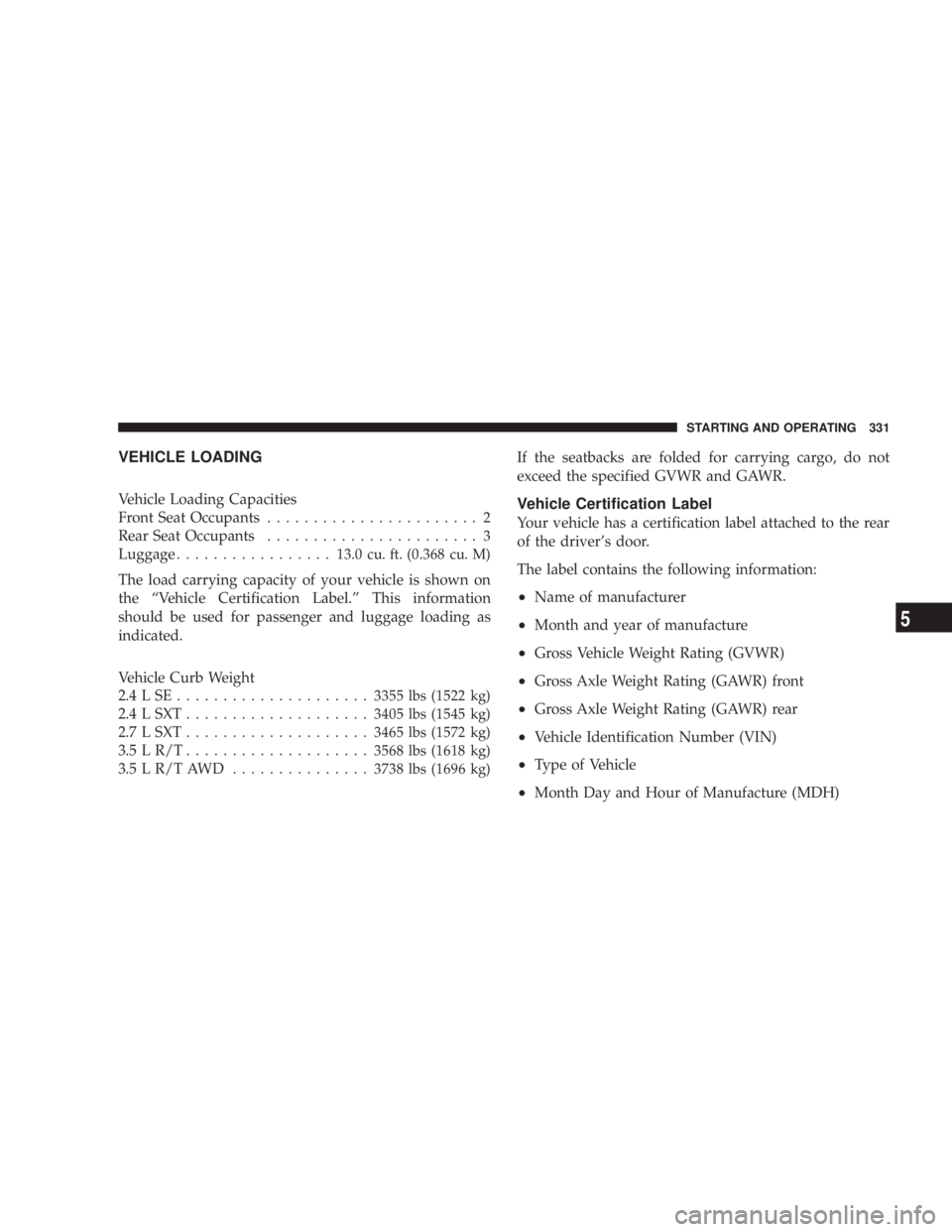
VEHICLE LOADING
Vehicle Loading Capacities
Front Seat Occupants ....................... 2
Rear Seat Occupants ....................... 3
Luggage ................. 13.0 cu. ft. (0.368 cu. M)
The load carrying capacity of your vehicle is shown on
the ªVehicle Certification Label.º This information
should be used for passenger and luggage loading as
indicated.
Vehicle Curb Weight
2.4 L SE ..................... 3355 lbs (1522 kg)
2.4 L SXT .................... 3405 lbs (1545 kg)
2.7 L SXT .................... 3465 lbs (1572 kg)
3.5 L R/T .................... 3568 lbs (1618 kg)
3.5 L R/T AWD ............... 3738 lbs (1696 kg) If the seatbacks are folded for carrying cargo, do not
exceed the specified GVWR and GAWR.
Vehicle Certification Label
Your vehicle has a certification label attached to the rear
of the driver's door.
The label contains the following information:
² Name of manufacturer
² Month and year of manufacture
² Gross Vehicle Weight Rating (GVWR)
² Gross Axle Weight Rating (GAWR) front
² Gross Axle Weight Rating (GAWR) rear
² Vehicle Identification Number (VIN)
² Type of Vehicle
² Month Day and Hour of Manufacture (MDH) STARTING AND OPERATING 331
5
Page 334 of 467
The bar code allows a computer scanner to read the
Vehicle Identification Number (VIN).
Gross Vehicle Weight Rating (GVWR)
The GVWR is the total allowable weight of your vehicle.
This includes driver, passengers, and cargo. The total
load must be limited so that you do not exceed the
GVWR.
Gross Axle Weight Rating (GAWR)
The GAWR is the maximum capacity of the front and rear
axles. Distribute the load over the front and rear axles
evenly. Make sure that you do not exceed either front or
rear GAWR. WARNING!Because the front wheels steer the vehicle, it is
important that you do not exceed the maximum front
or rear GAWR. A dangerous driving condition can
result if either rating is exceeded. You could lose
control of the vehicle and have an accident.
Overloading
The load carrying components (axle, springs, tires,
wheels, etc.) of your vehicle will provide satisfactory
service as long as you do not exceed the GVWR and front
and rear GAWR.
The best way to figure out the total weight of your
vehicle is to weigh it when it is fully loaded and ready for
operation. Weigh it on a commercial scale to insure that it
is not over the GVWR.332 STARTING AND OPERATING
Page 337 of 467
Gross Axle Weight Rating (GAWR)
The GAWR is the maximum capacity of the front and rear
axles. Distribute the load over the front and rear axles
evenly. Make sure that you do not exceed either front or
rear GAWR.
WARNING!It is important that you do not exceed the maximum
front or rear GAWR. A dangerous driving condition
can result if either rating is exceeded. You could lose
control of the vehicle and have an accident. Trailer Tongue Weight (TW)
Tongue Weight is the downward force exerted on the
hitch ball by the trailer. In most cases it should not be less
than or more than 10% of the trailer load. You must
consider this as part of the load on your vehicle.
Frontal Area
Frontal Area is the maximum height and maximum
width of the front of a trailer and its cargo.
Weight-Carrying Hitch
A weight-carrying hitch supports the trailer tongue
weight, just as if it were luggage located at a hitch ball or
some other connecting point of the truck. These kinds of
hitches are the most popular on the market today and
they're commonly used to tow small- and medium-sized
trailers. STARTING AND OPERATING 335
5
Page 343 of 467
4. Trailer tongue weight rating for the trailer hitch
utilized (This requirement may limit the ability to
always achieve 10% of trailer tongue weight as a
percentage of total trailer weight).
Towing Requirements Ð Tires
² Do not attempt to tow a trailer while using a compact
spare tire.
² Proper tire inflation pressures are essential to the safe
and satisfactory operation of your vehicle. Refer to the
ªTires Ð General Informationº in this section for
information on tire pressures and for proper tire
inflation procedures.
² Also, check the trailer tires for proper tire inflation
pressures before trailer usage.
² Check for signs of tire wear or visible tire damage
before towing a trailer. Refer to ªTires Ð General Informationº in this section for information on tread
wear indicators and for proper inspection procedure.
² When replacing tires, refer to ªTires Ð General Infor-
mationº in this section for information on replacement
tires and for proper tire replacement procedures. Re-
placing tires with a higher load carrying capacity will
not increase the vehicle's GVWR and GAWR limits.
Towing Requirements Ð Trailer Brakes
² Do not interconnect the hydraulic brake system or
vacuum system of your vehicle with that of the trailer.
This could cause inadequate braking and possible
personal injury.
² An electronically actuated trailer brake controller is
required when towing a trailer with electronically
actuated brakes. When towing a trailer equipped with
a hydraulic surge actuated brake system, an electronic
brake controller is not required. STARTING AND OPERATING 341
5
Page 344 of 467
² Trailer brakes are recommended for trailers over 1,000
lbs (450 kg) and required for trailers in excess of 2,000
lbs (907 kg).
CAUTION!If the trailer weighs more than 1,000 lbs (450 kg)
loaded, it should have its own brakes with adequate
braking capacity. Failure to do this could lead to
accelerated brake lining wear, higher brake pedal
effort, and longer stopping distances. WARNING!Do not connect trailer brakes to your vehicle's hy-
draulic brake lines. It can overload your brake sys-
tem and cause it to fail. You might not have brakes
when you need them and could have an accident.
Towing any trailer will increase your stopping dis-
tance. When towing, you should allow for additional
space between your vehicle and the vehicle in front
of you. Failure to do so could result in an accident.
Towing Requirements Ð Trailer Lights and Wiring
Whenever you pull a trailer, regardless of the trailer size,
stoplights and turn signals on the trailer are required for
motoring safety.
Use a factory approved trailer harness and connector.342 STARTING AND OPERATING