spare tire DODGE CHALLENGER 2021 Vehicle Warranty
[x] Cancel search | Manufacturer: DODGE, Model Year: 2021, Model line: CHALLENGER, Model: DODGE CHALLENGER 2021Pages: 262, PDF Size: 10.42 MB
Page 4 of 262

TIRES
3
• LT (Light Truck) — Metric tire sizing is based on US design stan -
dards. The size designation for LT-Metric tires is the same as for
P-
Metric tires except for the letters “LT” that are molded into the
sidewall preceding the size designation. Example: LT235/85R16.
• Temporary spare tires are designed for temporary emergency use
o
nly. Temporary high pressure compact spare tires have the letter
“T” or “S” molded into the sidewall preceding the size designation.
Example: T145/80D18 103M.
• High flotation tire sizing is based on US design standards and it
b
egins with the tire diameter molded into the sidewall. Example:
31x10.5 R15 LT.
Tire Sizing Chart
EXAMPLE:
Example Size Designation: P215/65R15XL 95H, 215/65R15 96H, LT235/85R16C,
T1
45/80D18 103M, 31x10.5 R15 LT
P = Passenger car tire size based on U.S. design standards, or
"....blank...." =
Passenger car tire based on European design standards, or
LT = Light Truck tire based on US design standards, or
T
or S = Temporary spare tire or
3
1 = Overall diameter in inches (in)
2
15, 235, 145 =
Section width in millimeters (mm)
65, 85, 80 = Aspect ratio in percent (%)
•
Ratio of section height to section width of tire, or
1
0.5 = Section width in inches (in)
R
= Construction code
• "R" means radial construction, or
•
"D" means diagonal or bias construction
1
5, 16, 18 = Rim diameter in inches (in)
S
ervice Description:
95 = Load Index
•
A numerical code associated with the maximum load a tire can carry
H
= Speed Symbol
• A symbol indicating the range of speeds at which a tire can carry a load corre -
s
ponding to its load index under certain operating conditions
• The maximum speed corresponding to the speed symbol should only be achieved
u
nder specified operating conditions (i.e., tire pressure, vehicle loading, road condi -
tions, and posted speed limits)
Page 7 of 262
TIRES
6
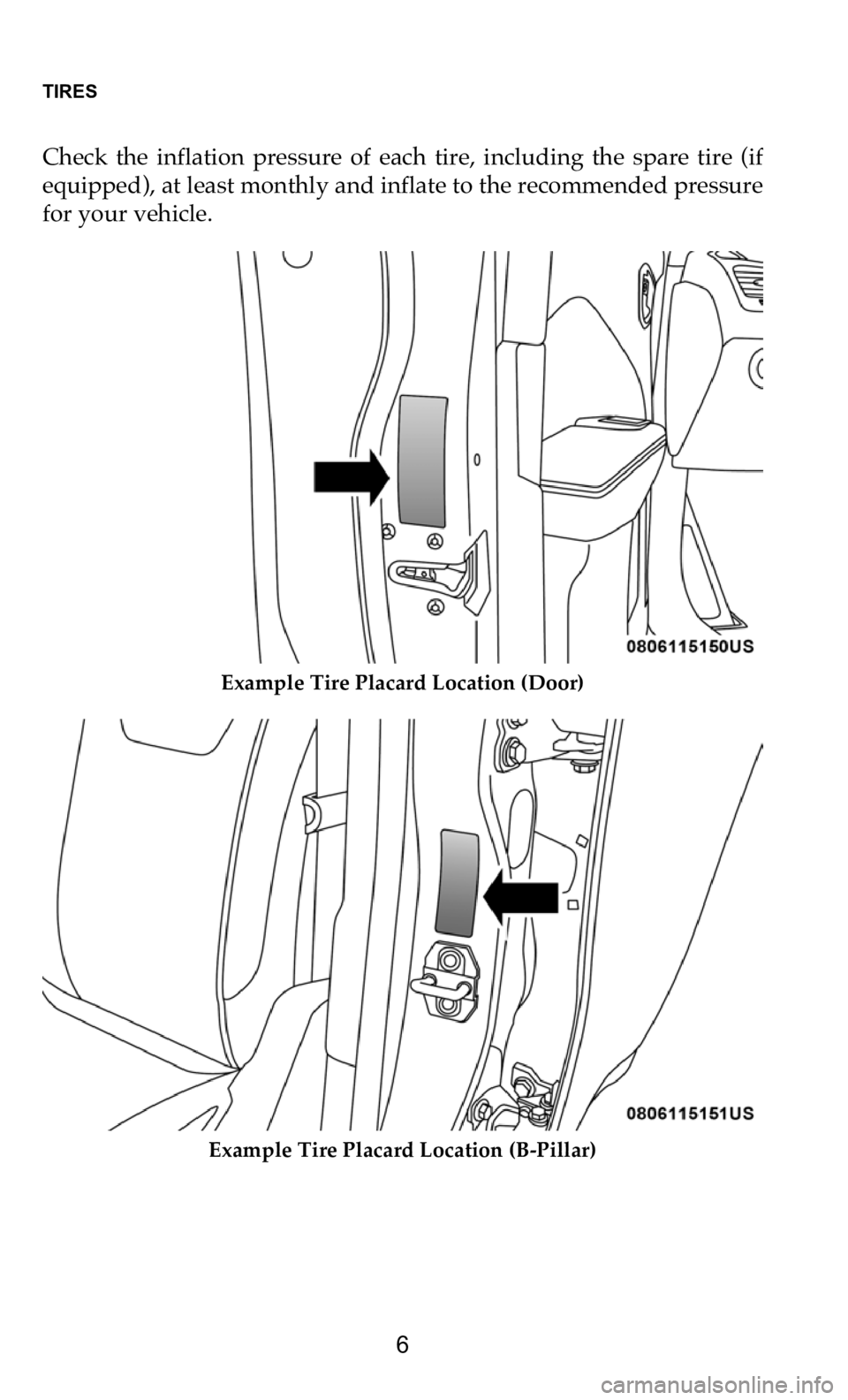
Check the inflation pressure of each tire, including the spare tire (if
equipped), at least monthly and inflate to the recommended pressure
for your vehicle.
Example Tire Placard Location (Door)
Example Tire Placard Location (B-Pillar)
Page 8 of 262
TIRES
7
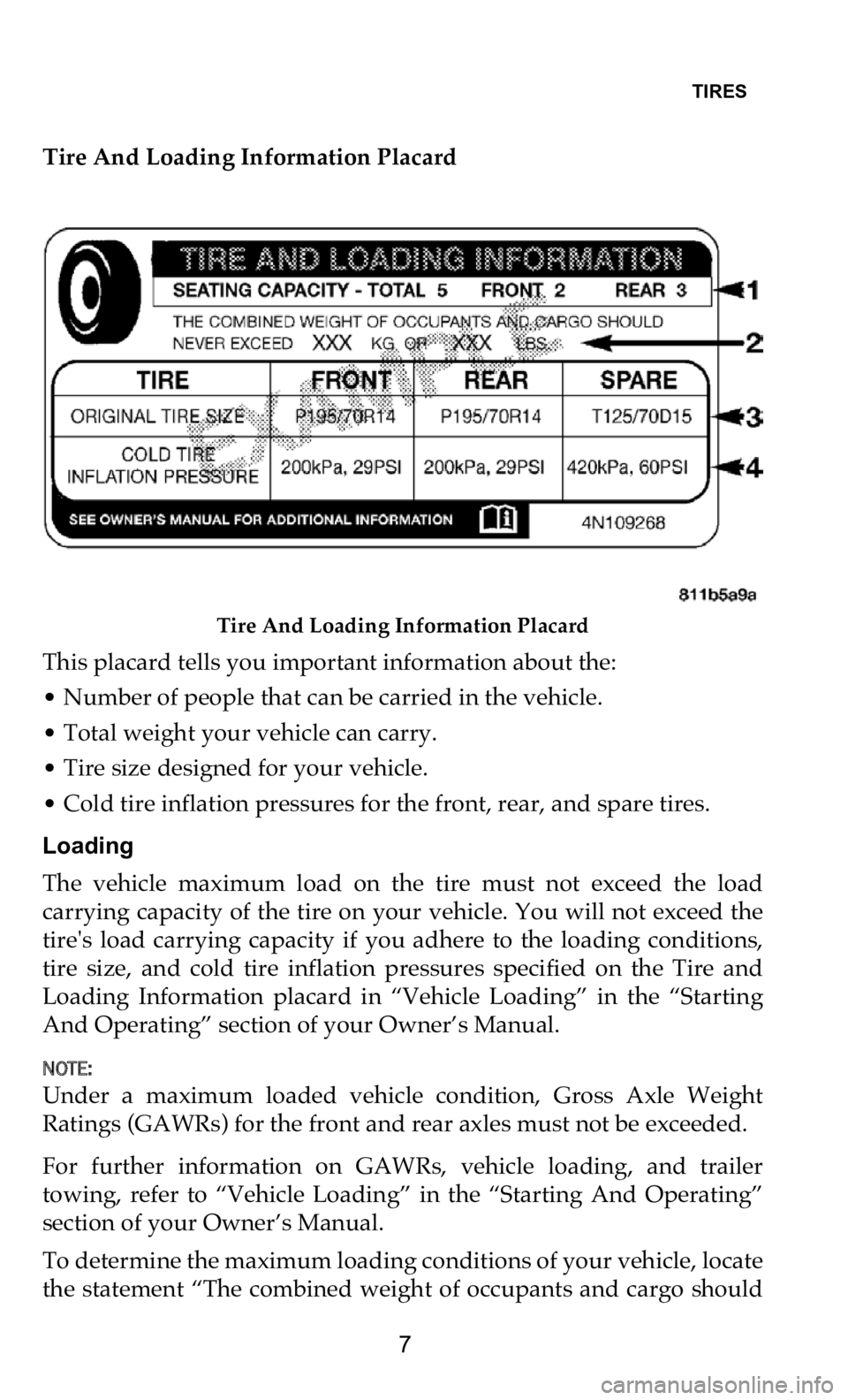
Tire And Loading Information Placard
Tire And Loading Information Placard
This placard tells you important information about the:
• Number of people that can be carried in the vehicle.
•
Total weight your vehicle can carry.
•
Tire size designed for your vehicle.
•
Cold tire inflation pressures for the front, rear, and spare tires.
L
oading
The vehicle maximum load on the tire must not exceed the load
ca
rrying capacity of the tire on your vehicle. You will not exceed the
tire's load carrying capacity if you adhere to the loading conditions,
tire size, and cold tire inflation pressures specified on the Tire and
Loading Information placard in “Vehicle Loading” in the “Starting
And Operating” section of your Owner’s Manual.
NOTE:
Under a maximum loaded vehicle condition, Gross Axle Weight
Ra
tings (GAWRs) for the front and rear axles must not be exceeded.
For further information on GAWRs, vehicle loading, and trailer
to
wing, refer to “Vehicle Loading” in the “Starting And Operating”
section of your Owner’s Manual.
To determine the maximum loading conditions of your vehicle, locate
th
e statement “The combined weight of occupants and cargo should
Page 16 of 262

TIRES
15
Life Of Tire
The service life of a tire is dependent upon varying factors including,
bu
t not limited to:
• Driving style.
•
Tire pressure - Improper cold tire inflation pressures can cause
u
neven wear patterns to develop across the tire tread. These
abnormal wear patterns will reduce tread life, resulting in the need
for earlier tire replacement.
• Distance driven.
•
Performance tires, tires with a speed rating of V or higher, and
S
ummer tires typically have a reduced tread life. Rotation of these
tires per the vehicle scheduled maintenance is highly recom -
mended.
Keep dismounted tires in a cool, dry place with as little exposure to
l i
ght as possible. Protect tires from contact with oil, grease, and
gasoline.
Replacement Tires
The tires on your new vehicle provide a balance of many
ch
aracteristics. They should be inspected regularly for wear and
correct cold tire inflation pressures. FCA US LLC strongly
recommends that you use tires equivalent to the originals in size,
quality and performance when replacement is needed. Refer to the
paragraph on “Tread Wear Indicators” in this section. Refer to the Tire
and Loading Information placard or the Vehicle Certification Label for
the size designation of your tire. The Load Index and Speed Symbol
for your tire will be found on the original equipment tire sidewall.
See the Tire Sizing Chart example found in the “Tire Safety
In
formation” section of this manual for more information relating to
the Load Index and Speed Symbol of a tire.
WARNING!
Tires and the spare tire should be replaced after six years,
re
gardless of the remaining tread. Failure to follow this warning
can result in sudden tire failure. You could lose control and have a
collision resulting in serious injury or death.
Page 19 of 262

TIRES
18
For speeds above 75 mph (120 km/h) refer to original equipment or an
au
thorized tire dealer for recommended safe operating speeds,
loading and cold tire inflation pressures.
While studded tires improve performance on ice, skid and traction
ca
pability on wet or dry surfaces may be poorer than that of
non-studded tires. Some states prohibit studded tires; therefore, local
laws should be checked before using these tire types.
Spare Tires — If Equipped
S
pare Tire Matching Original Equipped Tire And Wheel — If
Eq
uipped
Your vehicle may be equipped with a spare tire and wheel equivalent
in
look and function to the original equipment tire and wheel found
on the front or rear axle of your vehicle. This spare tire may be used in
the tire rotation for your vehicle. If your vehicle has this option, refer
to an authorized tire dealer for the recommended tire rotation pattern.
Compact Spare Tire — If Equipped
The compact spare is for temporary emergency use only. You can
id
entify if your vehicle is equipped with a compact spare by looking
at the spare tire description on the Tire and Loading Information
Placard located on the driver side door opening or on the sidewall of
the tire. Compact spare tire descriptions begin with the letter “T” or
“S” preceding the size designation. Example: T145/80D18 103M.
T, S = Temporary Spare Tire
Since this tire has limited tread life, the original equipment tire should
be
repaired (or replaced) and reinstalled on your vehicle at the first
opportunity.
Do not install a wheel cover or attempt to mount a conventional tire
on
the compact spare wheel, since the wheel is designed specifically
for the compact spare tire. Do not install more than one compact spare
tire and wheel on the vehicle at any given time. CAUTION!
Because of the reduced ground clearance, do not take your vehicle
t h
rough an automatic car wash with a compact or limited use
temporary spare installed. Damage to the vehicle may result.
Page 20 of 262

TIRES
19
Collapsible Spare Tire — If Equipped
The collapsible spare is for temporary emergency use only. You can
id
entify if your vehicle is equipped with a collapsible spare by looking
at the spare tire description on the Tire and Loading Information
Placard located on the driver side door opening or on the sidewall of
the tire.
Collapsible spare tire description example: 165/80-17 101P.
Since this tire has limited tread life, the original equipment tire should
be
repaired (or replaced) and reinstalled on your vehicle at the first
opportunity.
Inflate collapsible tire only after the wheel is properly installed to the
ve
hicle. Inflate the collapsible tire using the electric air pump before
lowering the vehicle.
Do not install a wheel cover or attempt to mount a conventional tire
on
the collapsible spare wheel, since the wheel is designed specifically
for the collapsible spare tire.
WARNING!
Compact and collapsible spares are for temporary emergency use
on
ly. With these spares, do not drive more than 50 mph (80 km/h).
Te
mporary use spares have limited tread life. When the tread is
worn to the tread wear indicators, the temporary use spare tire
needs to be replaced. Be sure to follow the warnings, which apply
to your spare. Failure to do so could result in spare tire failure and
loss of vehicle control.
WARNING!
Compact and Collapsible spares are for temporary emergency use
on
ly. With these spares, do not drive more than 50 mph (80 km/h).
Te
mporary use spares have limited tread life. When the tread is
worn to the tread wear indicators, the temporary use spare tire
needs to be replaced. Be sure to follow the warnings, which apply
to your spare. Failure to do so could result in spare tire failure and
loss of vehicle control.
Page 21 of 262

TIRES
20
Full Size Spare — If Equipped
The full size spare is for temporary emergency use only. This tire may
lo
ok like the originally equipped tire on the front or rear axle of your
vehicle, but it is not. This spare tire may have limited tread life. When
the tread is worn to the tread wear indicators, the temporary use full
size spare tire needs to be replaced. Since it is not the same as your
original equipment tire, replace (or repair) the original equipment tire
and reinstall on the vehicle at the first opportunity.
Limited Use Spare — If Equipped
The limited use spare tire is for temporary emergency use only. This
ti
re is identified by a label located on the limited use spare wheel. This
label contains the driving limitations for this spare. This tire may look
like the original equipped tire on the front or rear axle of your vehicle,
but it is not. Installation of this limited use spare tire affects vehicle
handling. Since it is not the same as your original equipment tire,
replace (or repair) the original equipment tire and reinstall on the
vehicle at the first opportunity.
WARNING!
Limited use spares are for emergency use only. Installation of this
li
mited use spare tire affects vehicle handling. With this tire, do
not drive more than the speed listed on the limited use spare
wheel. Keep inflated to the cold tire inflation pressures listed on
your Tire and Loading Information Placard located on the driver’s
side B-Pillar or the rear edge of the driver’s side door. Replace (or
repair) the original equipment tire at the first opportunity and
reinstall it on your vehicle. Failure to do so could result in loss of
vehicle control.
Page 24 of 262
TIRE WARRANTY
23
Disclaimer:
THE MOST UP-TO-DATE INFORMATION FOR THE TIRE
MA
NUFACTURER’S LIMITED WARRANTY PROGRAM CAN BE
ACCESSED THROUGH THE SPECIFIC TIRE MANUFACTURER’S
WEBSITE.
THE TIRE MANUFACTURER’S LIMITED WARRANTY PROGRAM,
TH
E DETAILS OF WHICH CAN BE FOUND IN THIS MANUAL,
THE TIRE MANUFACTURER’S WEBSITE OR AT ANY
AUTHORIZED SERVICE CENTER ARE IN LIEU OF ALL OTHER
REMEDIES OR WARRANTIES, EXPRESS OR IMPLIED, ARISING BY
LAW OR OTHERWISE, INCLUDING FITNESS FOR A
PARTICULAR PURPOSE OR MERCHANTABILITY. THE TIRE
MANUFACTURER EXPRESSLY DISCLAIMS LIABILITY FOR
INDIRECT, SPECIAL, INCIDENTAL OR CONSEQUENTIAL
DAMAGES, LOST PROFIT, LOSS OF BUSINESS, LOSS OF
GOODWILL, LOSS OF REPUTATION, PUNITIVE OR ANY OTHER
DAMAGE, COST OR LOSS OF ANY KIND. SOME STATES AND
PROVINCES DO NOT ALLOW THE EXCLUSION OR LIMITATION
OF INCIDENTAL OR CONSEQUENTIAL DAMAGES, SO THE
ABOVE LIMITATION OR EXCLUSION MAY NOT APPLY TO YOU.
WARNING!
Refer to the Owner’s Manual online for complete warning
in
formation that could prevent accidents, injuries and even
deaths.
WARNING!
Death, serious injury and/or property damage may result from tire
fa
ilure due to tire damage and/or improper tire maintenance.
• All tires (including spare) should be inspected regularly by a
q
ualified technician for signs of wear, and signs of damage, such
as puncture, impact, improper maintenance, under-inflation or
over-inflation and overloading.
• Only qualified persons should repair tires. See Rubber Manu -
f
acturer’s Association (RMA) established repair procedures at
ww
w.ustires.org for information on proper repair procedures.
• Only specially trained persons should mount tires.
Page 29 of 262

BFGOODRICH® TIRES
28
You should have complete confidence in your new BFGoodrich®
tires. Still it is important to register your tires in the event that we need
to contact you. For online tire registration, visit
https://
www.tireregistration.com
.
TIRE DISABLEMENT SAFETY WARNING
Any tire may fail as a result of an improperly repaired puncture,
i m
pact damage, improper inflation, overloading or other conditions
resulting from use or misuse. Tire failures, such as a rapid air loss or a
tread and belt detachment, may increase risk of injury or death and/
or property damage. To reduce the risk of a tire failure, BFGoodrich®
recommends you thoroughly read and follow the recommendations
in this BFGoodrich® Limited Warranty/Owner’s Manual, the vehicle
Owner’s Manual, tire placard information, and tire sidewall
information regarding safety warnings, proper tire use and
maintenance.
CONTROLLABILITY
CONTROLLING A VEHICLE WHEN A TIRE FAILURE OCCURS
If a tire failure occurs, you may hear a loud noise, feel a vibration,
a n
d/or the vehicle may pull toward the side of the failed tire. If
possible, step on the accelerator momentarily to maintain forward
momentum and ensure vehicle control.
It is important that you DO NOT BRAKE OR ABRUPTLY TURN
TH
E STEERING WHEEL.
Slowly remove your foot from the accelerator and hold the steering
wh
eel firmly while steering to remain in your lane. Once the vehicle
has slowed and is fully under control, apply the brakes gently; safely
pull over to the shoulder and come to a stop. Inspect the tires. If one
or more tires look flat or low, show detachment or other damage,
remove tire assembly and replace it with a properly inflated spare.
Bumps or bulges may indicate detachment within the tire body and
require inspection by a qualified tire technician.
WARNING!
DISREGARDING ANY OF THE SAFETY PRECAUTIONS AND/
OR
INSTRUCTIONS CONTAINED IN THIS MANUAL MAY
RESULT IN TIRE FAILURE OR EXPLOSION CAUSING
SERIOUS PERSONAL INJURY OR DEATH.
Page 30 of 262

BFGOODRICH® TIRES
29
DRIVING ON ANY TIRE THAT DOES NOT HAVE THE CORRECT
INFLATION PRESSURE IS DANGEROUS
Any underinflated tire builds up excessive heat that may result in
su
dden tire destruction. If tires are supplied as original equipment,
refer to the tire decal on the vehicle (check vehicle and/or vehicle
Owner’s Manual for decal location) for the recommended operating
pressures. For replacement tires, the correct inflation pressure will be
provided by your tire retailer; if not, refer to the vehicle decal.
These inflation pressures must be maintained as a minimum.
Ho
wever, do not exceed the maximum pressure rating indicated on
the tire sidewall.
CHECK THE COLD INFLATION PRESSURES IN ALL YOUR
TI
RES, INCLUDING THE SPARE, AT LEAST ONCE EACH
MONTH
Failure to maintain correct inflation may result in improper vehicle
ha
ndling and may cause rapid and irregular tire wear, sudden tire
destruction, loss of vehicle control and serious personal injury.
Therefore, inflation pressures should be checked at least once each
month and always prior to long distance trips. This applies to all tires,
including sealant types, and Self-Supporting tires which are as
susceptible to losing air pressure as any other type of tire if not
properly maintained.
UNDERINFLATION
It is impossible to determine whether tires are properly inflated by
si
mply looking at them. It is almost impossible to “feel or hear” when
a tire is being run underinflated or nearly flat. Tires must be checked
monthly with a tire pressure gauge.
Pressures should be checked when tires are cold, in other words,
be
fore they have been driven on. Driving, even for a short distance,
causes tires to heat up and air pressure to increase.
Checking pressure when tires are hot:
If pressures are checked after tires have been driven for more than
th
ree minutes or more than 1 mile, (1.6 km) the tires become hot and
th
e pressures will increase by approximately 4 psi. Therefore when the
tire pressure is adjusted under these conditions, it should be increased
to a gauge reading of 4 psi greater than the recommended cold
inflation pressure.