flat tire DODGE CHALLENGER 2022 Vehicle Warranty
[x] Cancel search | Manufacturer: DODGE, Model Year: 2022, Model line: CHALLENGER, Model: DODGE CHALLENGER 2022Pages: 200, PDF Size: 6.72 MB
Page 190 of 200
TOYO TIRES® – LIMITED WARRANTY
189
VEHICLES WITH MODIFIED SUSPENSION
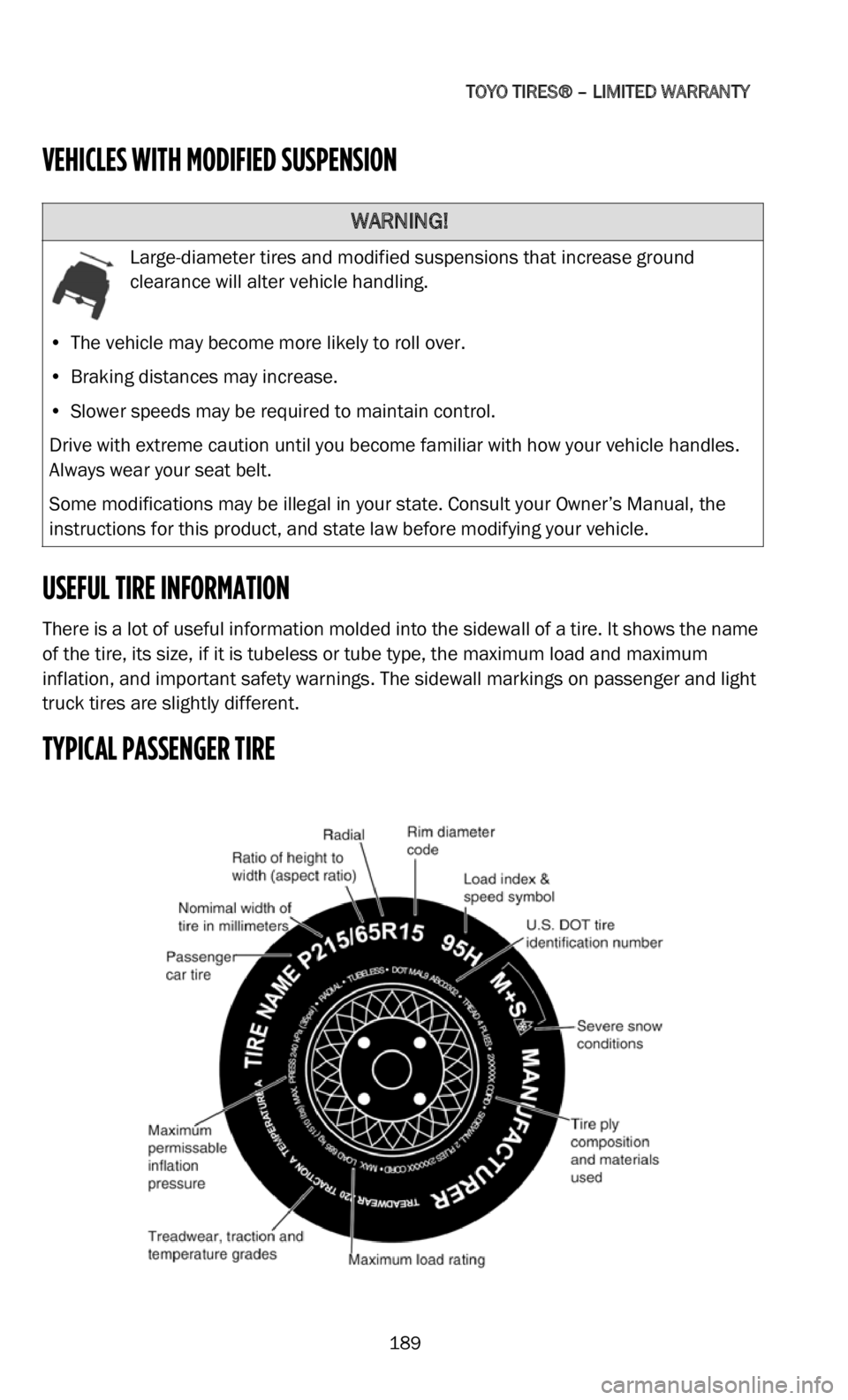
USEFUL TIRE INFORMATION
There is a lot of useful information molded into the sidewall of a tire. It shows the name
of the tire, its size, if it is tubeless or tube type, the maximum load and maximum
inflation, and important safety warnings. The sidewall markings on passenger and light
truck tires are slightly different.
TYPICAL PASSENGER TIRE
WARNING!
Large-diameter tires and modified suspensions that increase ground
clearance will alter vehicle handling.
• The vehicle may become more likely to roll over.
•
Braking distances may increase.
•
Slower speeds may be required to maintain control.
D
rive with extreme caution until you become familiar with how your vehicle handles.
A lw
ays wear your seat belt.
Some modifications may be illegal in your state. Consult your Owner’s Manual, the
i n
structions for this product, and state law before modifying your vehicle.
Page 192 of 200
TOYO TIRES® – LIMITED WARRANTY
191
The relative performance of the tires depends upon the actual conditions of their use
and may vary due to driving habits, service practices, differences in road characteris -
tics, and climate.
• T raction - The traction grades from highest to lowest are AA, A, B, and C, and they
r
epresent the tire’s ability to stop on wet pavement as measured under controlled
conditions on specified government test surfaces of asphalt and concrete.
NOTICE: (TBL IN FINAL PUBLISH)
The traction grade assigned to tires is based on locked braking (straight ahead) traction
te
sts and does not include cornering (turning) traction.
• T emperature - The temperature grades are A (the highest), B, and C, representing the
t
ire’s resistance to the generation of heat and its ability to dissipate heat when tested
under controlled conditions on a specified indoor laboratory test wheel. Sustained
high temperatures can cause the materials of the tire to degenerate and reduce tire
life, and excessive temperature can lead to sudden tire failure. The grade C corre -
sponds to a level of performance that all passenger car tires must meet under the
F e
deral Motor Vehicle Safety Standard No. 139. Grades B and A represent higher
levels of performance on the laboratory test wheel than the minimum required by law.
• D OT Quality Grades - All passenger car tires must conform to federal requirements in
a
ddition to these grades.
WARNING!
The temperature grade is established for a tire that is properly inflated and not
overloaded. Excessive speed, underinflation, or excessive loading either separately or
in combination can cause heat buildup and possible tire failure. This can cause an
accident, which could lead to serious personal injury or death.
Page 195 of 200
194
YOKOHAMA® TIRES — LIMITED WARRANTY
LIMITED WARRANTY FOR ORIGINAL EQUIPMENT TIRES
Passenger Car Light Truck Temporary Spare
YOKOHAMA® LIMITED WARRANTY
Original Equipment Tires for passenger car, temporary spare and light truck tires
As you know, many safety, comfort and performance features went into the design of
you
r new vehicle and your tires. At Yokohama®, every tire we engineer incorporates the
highest safety and comfort features in conjunction with the most enhanced performance
capabilities. And, to ensure your complete satisfaction, Yokohama® has enclosed this
Limited Warranty brochure for your tires. As the original equipment tire manufacturer for
your vehicle, Yokohama® wants to offer its support in helping you properly maintain and
service your tires and ensure you have the correct contact information in the unlikely
event of a tire issue. Please refer to the back panel of this brochure for information on
obtaining customer assistance in your area.
This limited warranty provides for tire replacement under certain specified conditions.
Th i
s policy applies to original equipment tires used in normal highway service displaying
warrantable conditions. Tires that become unserviceable or wear out because of neglect
or mistreatment are excluded from Yokohama® warranty coverage.
1. WARRANTY ELIGIBILITY
This warranty applies to every YOKOHAMA® original equipment passenger car, light
truck, and temporary spare tire bearing the YOKOHAMA® brand name and complete DOT
serial identification number. Eligible tires must be used on the vehicle on which they were
originally equipped in conformance with the vehicle manufacturer’s recommendations.
2. WHAT IS NOT WARRANTED
Tires that have become unserviceable for the following reasons:
• Road hazard injuries or damages, caused to the tire by obstacles and debris such as
cu
ts, punctures (whether repairable or not), snags, bruises, tears, or impact breaks.
• Improper repairs or repairs that have failed.
• Im
proper inflation or other maintenance abuses.
• In
correct mounting of the tire, or tire/wheel imbalance.
• Me
chanical irregularities in the vehicle such as wheel misalignment, worn, or faulty
p a
rts.
• Accident, corrosion, vandalism, fire, or damage caused by nature. • Ti
res used on vehicles in racing or special applications.
• No
n-speed-rated temporary spare tires used over 50 m
ph (80 km/h).
Page 198 of 200

YOKOHAMA® TIRES — LIMITED WARRANTY
197
6. Do not use snow chains on your YOKOHAMA® high pressure spare. This could cause damage to your vehicle.
7. W hen the tread wear indicator appears on the tire, replace it only with the same type
s
pare tire.
8. C heck the tire’s cold inflation pressure monthly and maintain at 60 psi (4.2 kg/cm2)
e
ven when not in use. Do not inflate over 60 psi.
9. T he YOKOHAMA® high pressure spare tire should not be used with any other rim nor
s
hould standard tires, wheel covers, or trim rings be used on the YOKOHAMA® high
pressure spare tire rim on which the YOKOHAMA® high pressure spare tire was orig -
inally installed.
IMPORTANT SAFETY INFORMATION
All tires require owner maintenance regardless of how well a tire is constructed.
Operational damages such as punctures, impact damage, cuts, incorrect inflation, etc.,
may cause tire failure and subsequent personal injury and/or property damage. Simple
operational and maintenance practices, as listed below, will reduce the chances of tire
problems.
Tire Inspection
Visually inspect your tires frequently for any tire damage such as scrapes, bulges, cuts,
nails, irregular wear, etc. resulting from operation. This must be done immediately after
any known or suspected contact with an object in the road, a pothole, road irregularity or
after severe braking. Refer these conditions to a reputable tire service center for repair
or replacement. Never drive on a tire if such conditions appear.
Tire Loading
Never exceed the maximum vehicle load limit listed on the vehicle placard, tire
information label or in the Owner’s Manual. Be aware of the load carrying limits molded
into the tire’s sidewall and do not exceed those limits. Maximum load can only be carried
at the maximum cold inflation pressure indicated on the tire’s sidewall.
Speed Limits
Regardless of the speed capability of your tires, never exceed lawful speeds or speeds
dictated by driving conditions.
Hazards
Objects in the road that could damage your tires should be safely avoided. These objects
include: potholes, glass, metal, rocks, wood debris and the like. Unavoidable contact
should prompt a thorough tire inspection.
Air Pressure
Air pressure maintenance is critical to tire service life. Tire pressures must be checked
frequently when tires are cold (before operation, cool to the touch) and no less than once
Page 199 of 200

YOKOHAMA® TIRES — LIMITED WARRANTY
198
per month and before extended operation. Use a tire gauge to check pressure and
maintain it per the vehicle manufacturer’s recommendations (on vehicle placard or in
Owner’s Manual). Do not reduce pressure when tire is hot and do not inflate a cold tire
higher than limits molded on the tire’s sidewall. Do not overlook spare tire inflation
pressure.
Tire Tread
Tires must be replaced when the depth of the tread reaches 2/32 of an inch (1.6 mm).
YO
KOHAMA® tires are manufactured with tread wear indicators molded into the tire
grooves which indicate tread wearout. As tires wear down to 2/32 of an inch (1.6 mm),
a n
d tread depth is reduced, tire traction is reduced during rainfall and winter road
conditions. Visual tire inspection therefore becomes more crucial as the tires wear out.
Hard Braking
You must inspect your tires after any hard braking situations or after tires have slid on
the pavement. This can cause a flat spot or other damage to the tread of the tire.
Spinning
• Do not allow tires to spin at speeds greater than 35 mph if vehicle becomes stuck.
• D o not stand behind a spinning tire while attempting to push a vehicle. Speed and
f
orce can cause a tire to disintegrate and explode and may cause property damage
and/or personal injury.
USA
For Customer Assistance call: 1-800-722-9888
(available Monday-Friday, 6:00 AM – 4:00 PM PST) Select #1 for the Yokohama® Dealer Locator(available 24 hours a day, 7 days a week)
Yokohama® Tire CorporationCorporate Headquarters
1 MacArthur Place, Suite 800 Santa Ana, California 92707 1-800-423-4544
We want your feedback.
We invite you to complete
our customer satisfaction survey on www.yokohamatire.com