child lock DODGE DURANGO 2004 2.G Owners Manual
[x] Cancel search | Manufacturer: DODGE, Model Year: 2004, Model line: DURANGO, Model: DODGE DURANGO 2004 2.GPages: 386, PDF Size: 6.22 MB
Page 7 of 386

THINGS TO KNOW BEFORE STARTING YOUR VEHICLE
CONTENTS
mA Word About Your Keys.................. 9
NKey-In-Ignition Reminder................ 9
NSentry Key Ð If Equipped................ 9
mIgnition And Steering Lock.................12
NIgnition Accessory Delay Feature...........13
mIlluminated Entry........................13
NVehicles Equipped With Power Door Locks....13
mDoor Locks............................13
NManual Door Locks.....................13NPower Door Locks.....................14
NChild Protection Door Lock...............17
mRemote Keyless Entry.....................19
NTo Unlock The Doors And Liftgate..........19
NTo Lock The Doors And Liftgate............20
NUsing The Panic Alarm..................21
NGeneral Information....................22
NProgramming Additional Transmitters........22
NBattery Replacement....................24
2
Page 8 of 386

mSecurity Alarm System Ð If Equipped.........24
NTo Set The Alarm......................25
NTo Disarm The System...................25
mLiftgate...............................26
mWindows.............................27
NPower Windows.......................27
NAuto Down..........................28
NWindow Lockout Switch.................28
mOccupant Restraints......................28
NLap/Shoulder Belts.....................29
NAdjustable Upper Shoulder Belt Anchorage....34
NSecond Row Center Seat Belt..............34
NSeat Belt Pretensioners...................35NEnhanced Driver Seat Belt Reminder System
(BeltAlert)...........................35
NSeat Belts And Pregnant Women............37
NSeat Belt Extender......................37
NDriver And Right Front Passenger Supplemental
Restraint System (SRS)ÐAirbags...........38
NChild Restraint........................50
mEngine Break-In Recommendations...........62
mSafety Tips............................62
NExhaust System.......................62
NSafety Checks You Should Make Inside The
Vehicle..............................63
NSafety Checks You Should Make Outside The
Vehicle..............................64
8 THINGS TO KNOW BEFORE STARTING YOUR VEHICLE
Page 14 of 386
WARNING!
For personal security and safety in the event of an
accident, lock the vehicle doors as you drive as well
as when you park and leave the vehicle.
WARNING!
When leaving the vehicle always remove the key
from the ignition lock, and lock your vehicle. Do not
leave children unattended in the vehicle, or with
access to an unlocked vehicle. Unsupervised use of
vehicle equipment may cause severe personal inju-
ries and death.
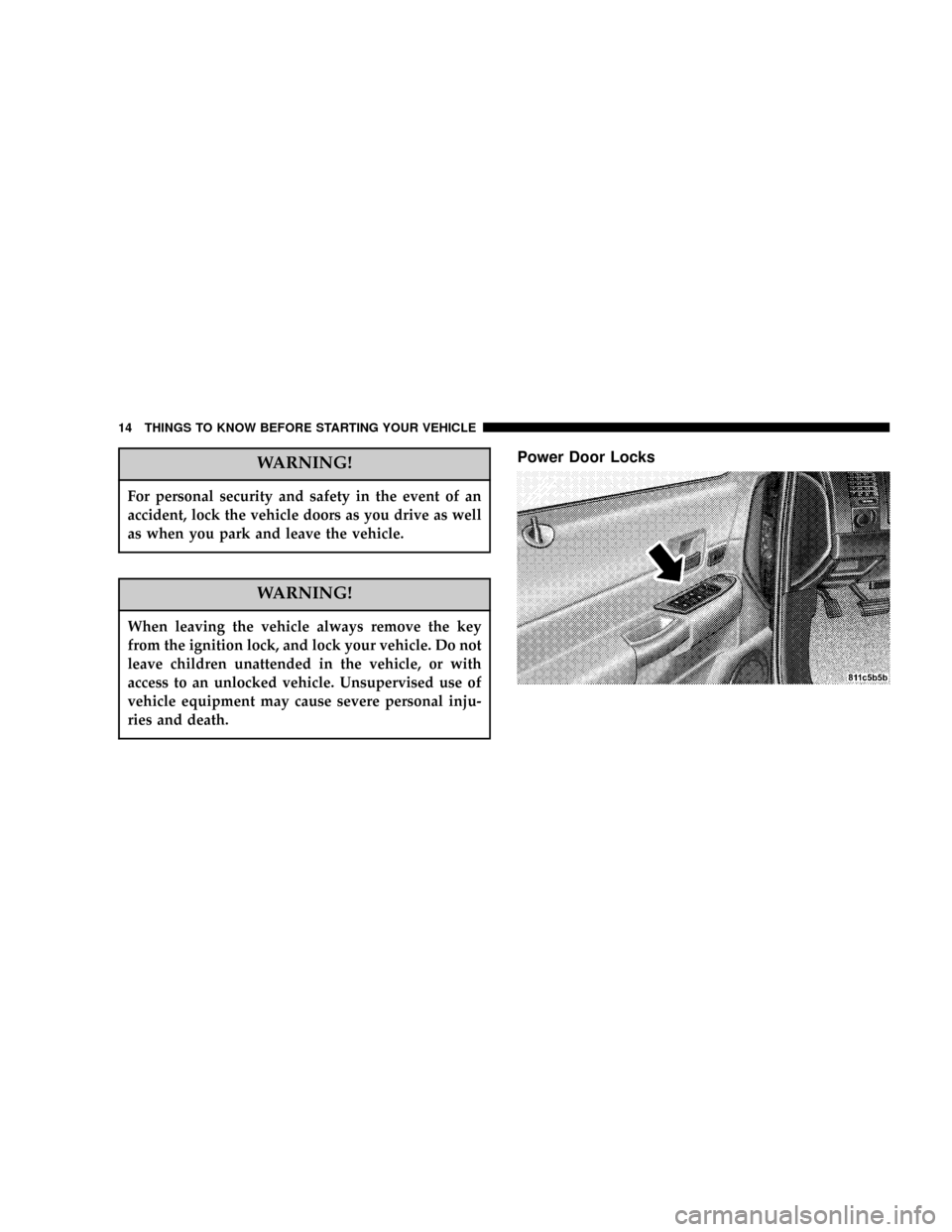
Power Door Locks
14 THINGS TO KNOW BEFORE STARTING YOUR VEHICLE
Page 17 of 386

2. Fasten your seat belt (fastening the seat belt will cancel
any chiming that may be confusing during this program-
ming procedure).
3. Insert the key into the ignition.
4. Within 10 seconds, cycle the key from the OFF position
to the ON position four times ending in the ON position
(do not start the engine).
5. Within 30 seconds, press the driver's door lock switch
in the UNLOCK direction.
6. A single chime will sound to indicate the feature has
been changed.
7. To reactivate the feature, repeat the above steps.
8. If a chime is not heard, program mode was canceled
before the feature could be changed. If necessary repeat
the above procedure.Child Protection Door Lock
To provide a safer environment for children riding in the
rear seat, the rear doors of your vehicle have the child-
protection door lock system.
THINGS TO KNOW BEFORE STARTING YOUR VEHICLE 17
2
Page 18 of 386
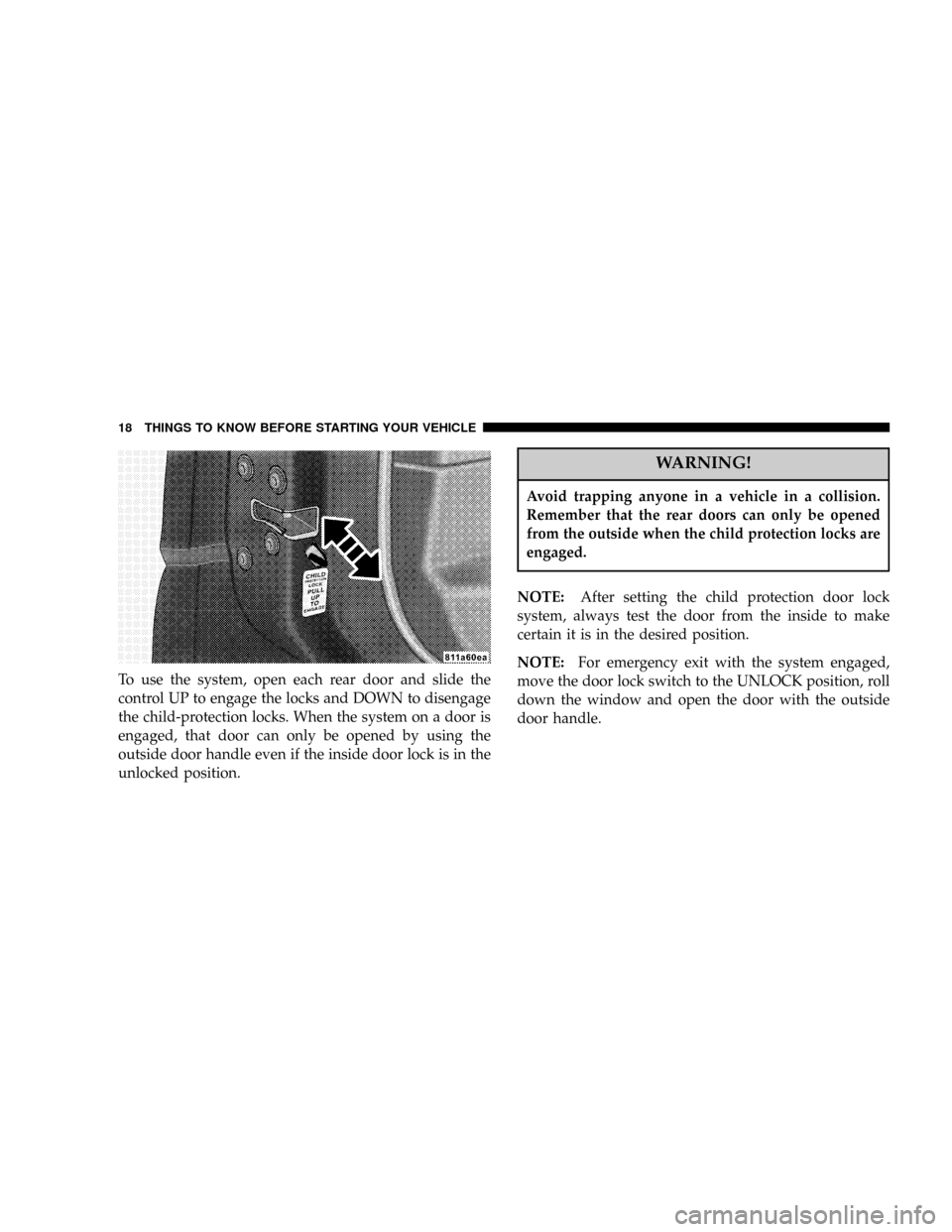
To use the system, open each rear door and slide the
control UP to engage the locks and DOWN to disengage
the child-protection locks. When the system on a door is
engaged, that door can only be opened by using the
outside door handle even if the inside door lock is in the
unlocked position.
WARNING!
Avoid trapping anyone in a vehicle in a collision.
Remember that the rear doors can only be opened
from the outside when the child protection locks are
engaged.
NOTE:After setting the child protection door lock
system, always test the door from the inside to make
certain it is in the desired position.
NOTE:For emergency exit with the system engaged,
move the door lock switch to the UNLOCK position, roll
down the window and open the door with the outside
door handle.
18 THINGS TO KNOW BEFORE STARTING YOUR VEHICLE
Page 29 of 386
window. If you will be carrying children too small for
adult-size seat belts, your seat belts or the LATCH feature
(refer to the Child Restraint section in this manual), can
be used to hold infant and child restraint systems.
Please pay close attention to the information in this
section. It tells you how to use your restraint system
properly to keep you and your passengers as safe as
possible.
WARNING!
In a collision, you and your passengers can suffer
much greater injuries if you are not properly buck-
led up. You can strike the interior of your vehicle or
other passengers, or you can be thrown out of the
vehicle. Always be sure you and others in your
vehicle are buckled up properly.
Buckle up even though you are an excellent driver, even
on short trips. Someone on the road may be a poor driver
and cause a collision that includes you. This can happen
far away from home or on your own street.
Research has shown that seat belts save lives, and that
they can reduce the seriousness of injuries in a collision.
Some of the worst injuries happen when people are
thrown from the vehicle. Seat belts reduce the possibility
of ejection and the risk of injury caused by striking the
inside of the vehicle.Everyonein a motor vehicle should
be belted at all times.
Lap/Shoulder Belts
All seating positions in your vehicle have combination
lap/shoulder belts. The belt webbing retractor is de-
signed to lock during very sudden stops or collisions.
This feature allows the shoulder part of the belt to move
THINGS TO KNOW BEFORE STARTING YOUR VEHICLE 29
2
Page 34 of 386

Adjustable Upper Shoulder Belt Anchorage
In the front and second row outboard seats, the shoulder
belt can be adjusted upward or downward to help
position the belt away from your neck. Push in on the
anchorage release button to release the anchorage, and
then move it up or down to the position that serves you
best.As a guide, if you are shorter than average, you will
prefer a lower position, and if you are taller than average,
you'll prefer a higher position. When you release the
anchorage, try to move it up or down to make sure that
it is locked in the desired position.
Second Row Center Seat Belt
The center seating position in the second row has a seat
belt assembly that can be converted from the normal
emergency locking mode to the automatic locking mode.
The seat belt should only be used in the automatic
locking mode when a child seat is installed at this seating
location.
When sitting in this seating location, ensure the seatback
is fully engaged with the seatback latch by pushing
rearward on the center seatback until you hear a click
that signals latch engagement.
34 THINGS TO KNOW BEFORE STARTING YOUR VEHICLE
Page 35 of 386

Automatic Locking Mode
To convert from the normal emergency locking mode to
the automatic locking mode, grasp the shoulder belt
portion and pull all of the webbing out of the retractor.
Allow some of the webbing to retract into the retractor, as
the belt retracts you will hear a clicking sound to indicate
the seat belt is now in the automatic locking mode. Once
the automatic locking mode has been activated, you will
not be able pull the webbing back out of the retractor. To
disengage the automatic locking mode, simply allow the
seat belt to retract fully into the retractor to return the seat
belt to the normal emergency locking mode.
Seat Belt Pretensioners
The seat belts for both front seating positions are
equipped with pretensioning devices that are designed to
remove any slack from the seat belt system in the event of
a collision. These devices improve the performance of the
seat belt by assuring that the belt is tight about theoccupant early in a collision. Pretensioners work for all
size occupants, including those in child restraints.
NOTE:These devices are not a substitute for proper seat
belt placement by the occupant. The seat belt still must be
worn snugly and positioned properly.
The pretensioners are triggered by the Occupant Re-
straint Controller (ORC). Like the airbags, the pretension-
ers are single use items. After a collision that is severe
enough to deploy the airbags and pretensioners, both
must be replaced.
Enhanced Driver Seat Belt Reminder System
(BeltAlert)
If the driver's seat belt has not been buckled within 60
seconds of starting the vehicle and if the vehicle speed is
greater than 5 mph (8 km/h), the Enhanced Warning
System (BeltAlert) will alert the driver to buckle their seat
belt. The driver should also instruct all other occupants to
buckle their seat belts. Once the warning is triggered, the
THINGS TO KNOW BEFORE STARTING YOUR VEHICLE 35
2
Page 39 of 386
WARNING!
²Do not put anything on or around the front airbag
covers or attempt to manually open them. You may
damage the airbags and you could be injured be-
cause the airbags are not there to protect you. These
protective covers for the airbag cushions are de-
signed to open only when the airbags are inflating.
²If your vehicle is equipped with window bags, do
not stack luggage or other cargo up high enough to
block the location of the window bag. The area
where the window bag is located should remain free
from any obstructions.
²If your vehicle is equipped with window bags, do
not have any accessory items installed which will
alter the roof, including adding a sunroof to your
vehicle. Do not add roof racks that require perma-
nent attachments (bolts or screws) for installation on
the vehicle roof. Do not drill into the roof of the
vehicle for any reason.
Along with the seat belts, front airbags work with the
instrument panel knee bolsters to provide improved
protection for the driver and front passenger. Window
bags also work with seat belts to improve occupant
protection.
The seat belts are designed to protect you in many types
of collisions. The front airbags deploy in moderate to
severe frontal collisions.
NOTE:The passenger front airbag may not deploy even
when the driver front airbag has if the Occupant Classi-
fication System (refer to9Occupant Classification System9
in this section) has determined the passenger seat is
empty or is occupied by someone that is classified in the
9small child9category.
If your vehicle is so equipped, the window bag on the
crash side of the vehicle is triggered in moderate to
severe side collisions. But even in collisions where the
THINGS TO KNOW BEFORE STARTING YOUR VEHICLE 39
2
Page 50 of 386

Enhanced Accident Response System
If the airbags deploy after an impact and the electrical
system remains functional, vehicles equipped with
power door locks will unlock automatically. In addition,
approximately 5 seconds after the vehicle has stopped
moving, the interior lights will light until the ignition
switch is turned off.
Airbag Light
You will want to have the airbags ready to
inflate for your protection in an impact. While
the airbag system is designed to be mainte-
nance free, if any of the following occurs, have
an authorized dealer service the system promptly:
²The airbag light does not come on or flickers during
the 6 to 8 seconds when the ignition switch is first
turned on.
²The light remains on or flickers after the 6 to 8 second
interval.
²The light flickers or comes on and remains on while
driving.
NOTE:If the speedometer, tachometer or any engine
related gauges are not working, the airbag control mod-
ule may also be disabled. The airbags may not be ready
to inflate for your protection. Promptly check fuse block
for blown fuses. Refer to the label located on the inside of
the fuse block cover for the proper airbag fuses. See your
dealer if the fuse is good.
Child Restraint
Everyone in your vehicle needs to be buckled up all the
time - babies and children, too. Every state in the United
States and all Canadian provinces require that small
children ride in proper restraint systems. This is the law,
and you can be prosecuted for ignoring it. Children 12
years and under should ride properly buckled up in a
rear seat, if available. According to crash statistics, chil-
dren are safer when properly restrained in the rear seats
rather than in the front.
50 THINGS TO KNOW BEFORE STARTING YOUR VEHICLE