lock DODGE DURANGO 2014 3.G Owners Manual
[x] Cancel search | Manufacturer: DODGE, Model Year: 2014, Model line: DURANGO, Model: DODGE DURANGO 2014 3.GPages: 664, PDF Size: 4.79 MB
Page 538 of 664
WARNING!(Continued)
•Turn on the Hazard Warning flasher.
• Block the wheel diagonally opposite the wheel to
be raised.
• Set the parking brake firmly and set the automatic
transmission in PARK.
• Never start or run the engine with the vehicle on a
jack.
• Do not let anyone sit in the vehicle when it is on a
jack.
• Do not get under the vehicle when it is on a jack. If
you need to get under a raised vehicle, take it to a
service center where it can be raised on a lift.
• Only use the jack in the positions indicated and for
lifting this vehicle during a tire change.
• If working on or near a roadway, be extremely
careful of motor traffic.
(Continued)
WARNING! (Continued)
•To assure that spare tires, flat or inflated, are
securely stowed, spares must be stowed with the
valve stem facing the ground.
CAUTION!
Do not attempt to raise the vehicle by jacking on
locations other than those indicated in the Jacking
Instructions for this vehicle.
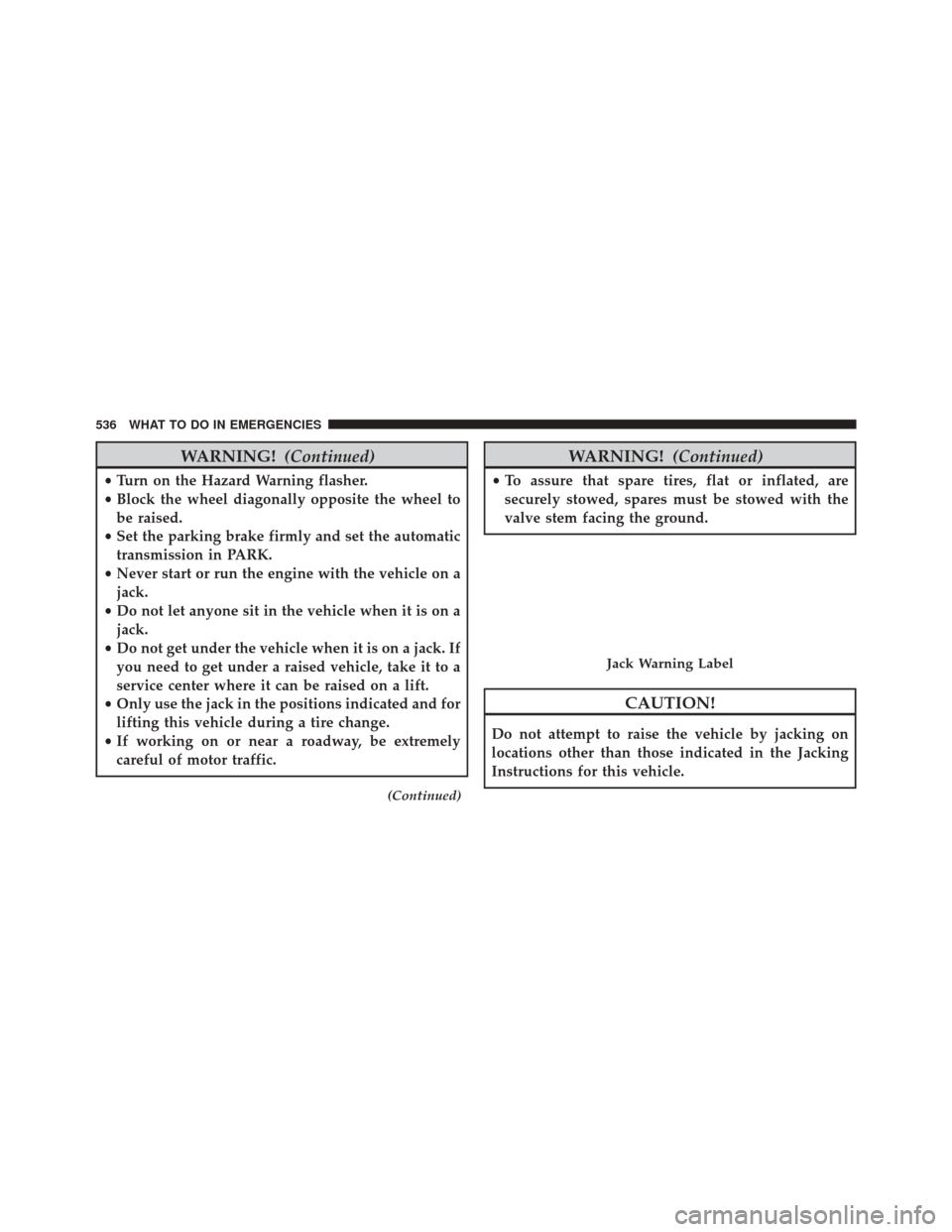
Jack Warning Label
536 WHAT TO DO IN EMERGENCIES
Page 541 of 664
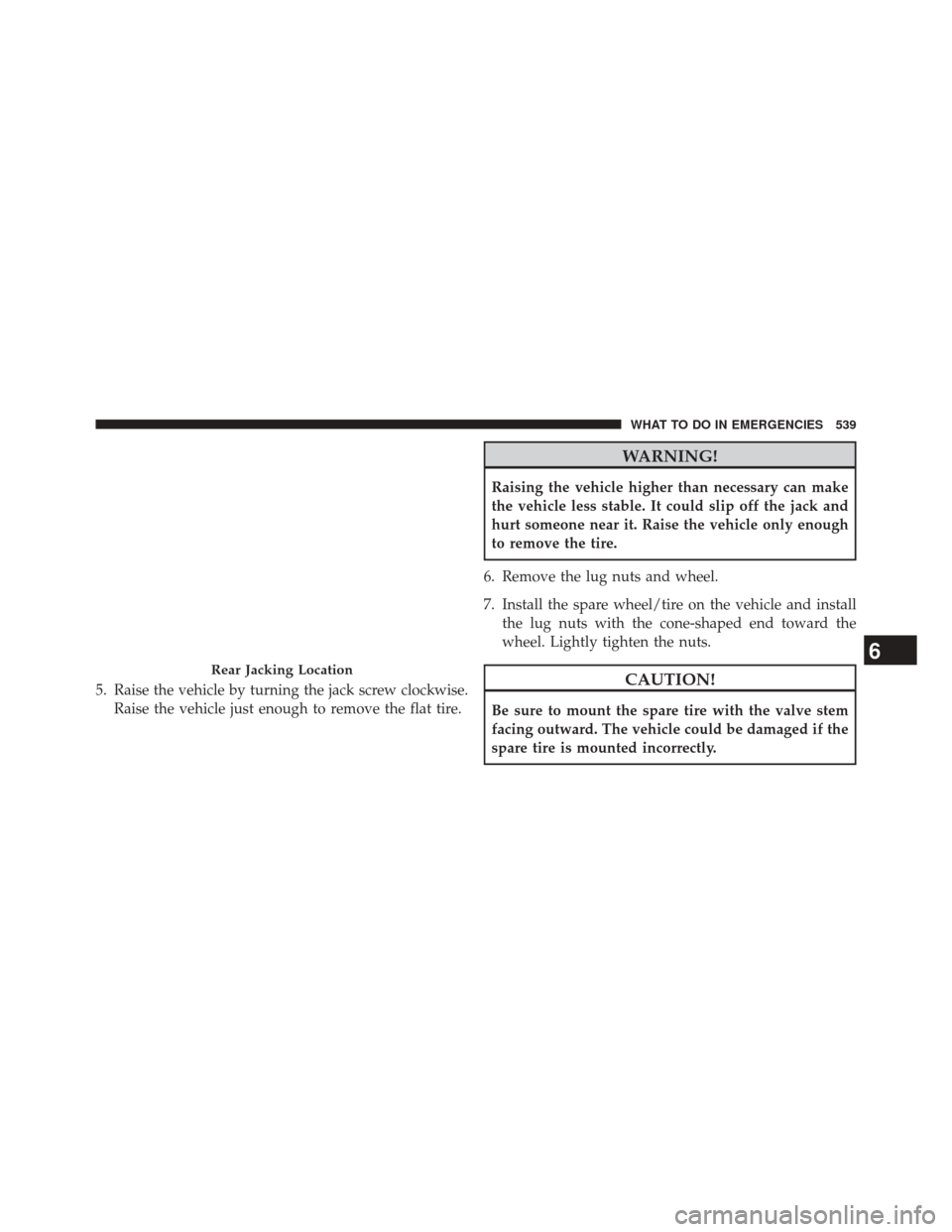
5. Raise the vehicle by turning the jack screw clockwise.Raise the vehicle just enough to remove the flat tire.
WARNING!
Raising the vehicle higher than necessary can make
the vehicle less stable. It could slip off the jack and
hurt someone near it. Raise the vehicle only enough
to remove the tire.
6. Remove the lug nuts and wheel.
7. Install the spare wheel/tire on the vehicle and install the lug nuts with the cone-shaped end toward the
wheel. Lightly tighten the nuts.
CAUTION!
Be sure to mount the spare tire with the valve stem
facing outward. The vehicle could be damaged if the
spare tire is mounted incorrectly.
Rear Jacking Location6
WHAT TO DO IN EMERGENCIES 539
Page 542 of 664
WARNING!
To avoid the risk of forcing the vehicle off the jack,
do not fully tighten the lug nuts until the vehicle has
been lowered. Failure to follow this warning may
result in personal injury.8. Lower the vehicle by turning the jack screw counter-
clockwise, and remove the jack and wheel blocks.
9. Finish tightening the lug nuts. Push down on the wrench while at the end of the handle for increased
leverage. Tighten the lug nuts in a star pattern until
each nut has been tightened twice. Refer to Torque
Specifications in this section for proper lug nut torque.
If in doubt about the correct tightness, have them
checked with a torque wrench by your authorized
dealer or at a service station.
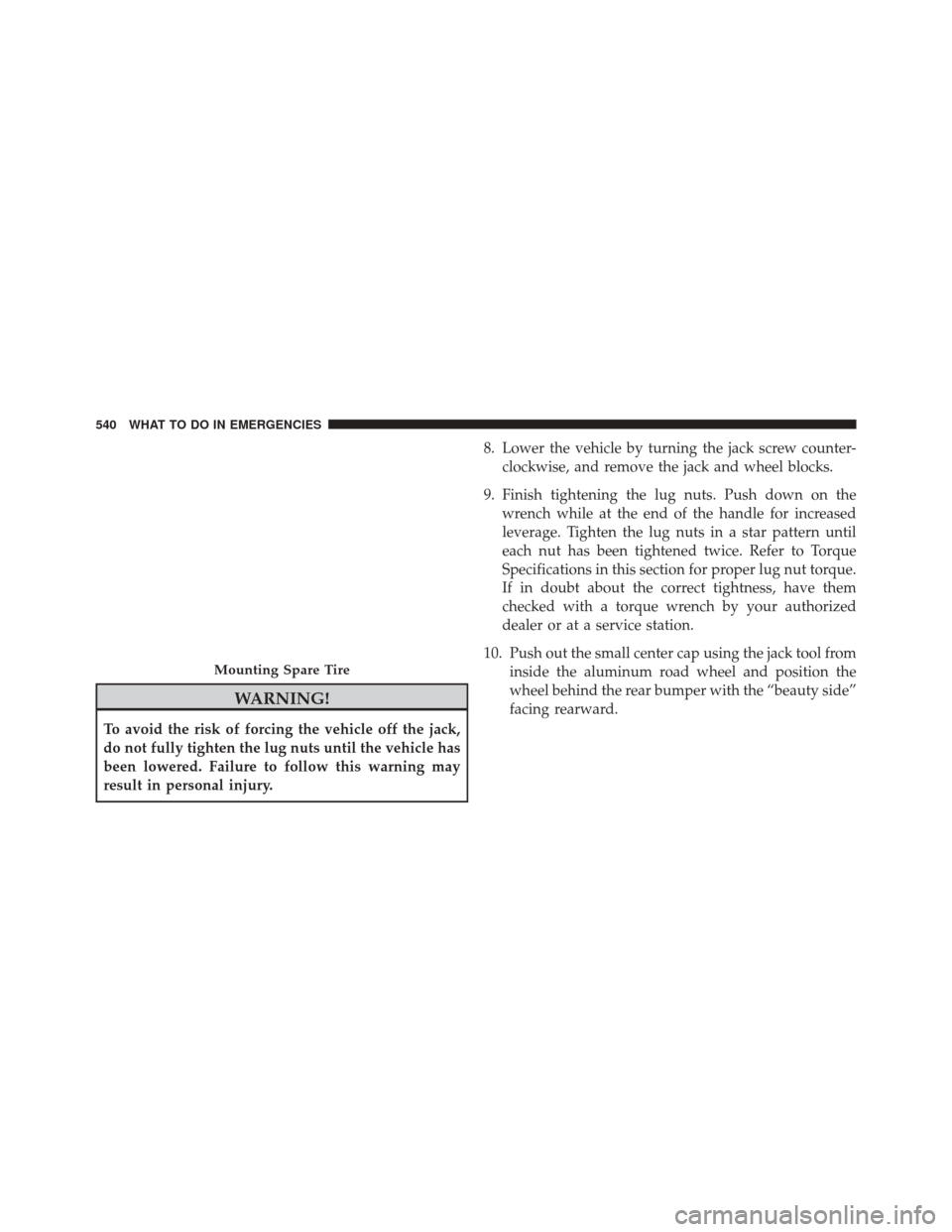
10. Push out the small center cap using the jack tool from inside the aluminum road wheel and position the
wheel behind the rear bumper with the “beauty side”
facing rearward.
Mounting Spare Tire
540 WHAT TO DO IN EMERGENCIES
Page 544 of 664
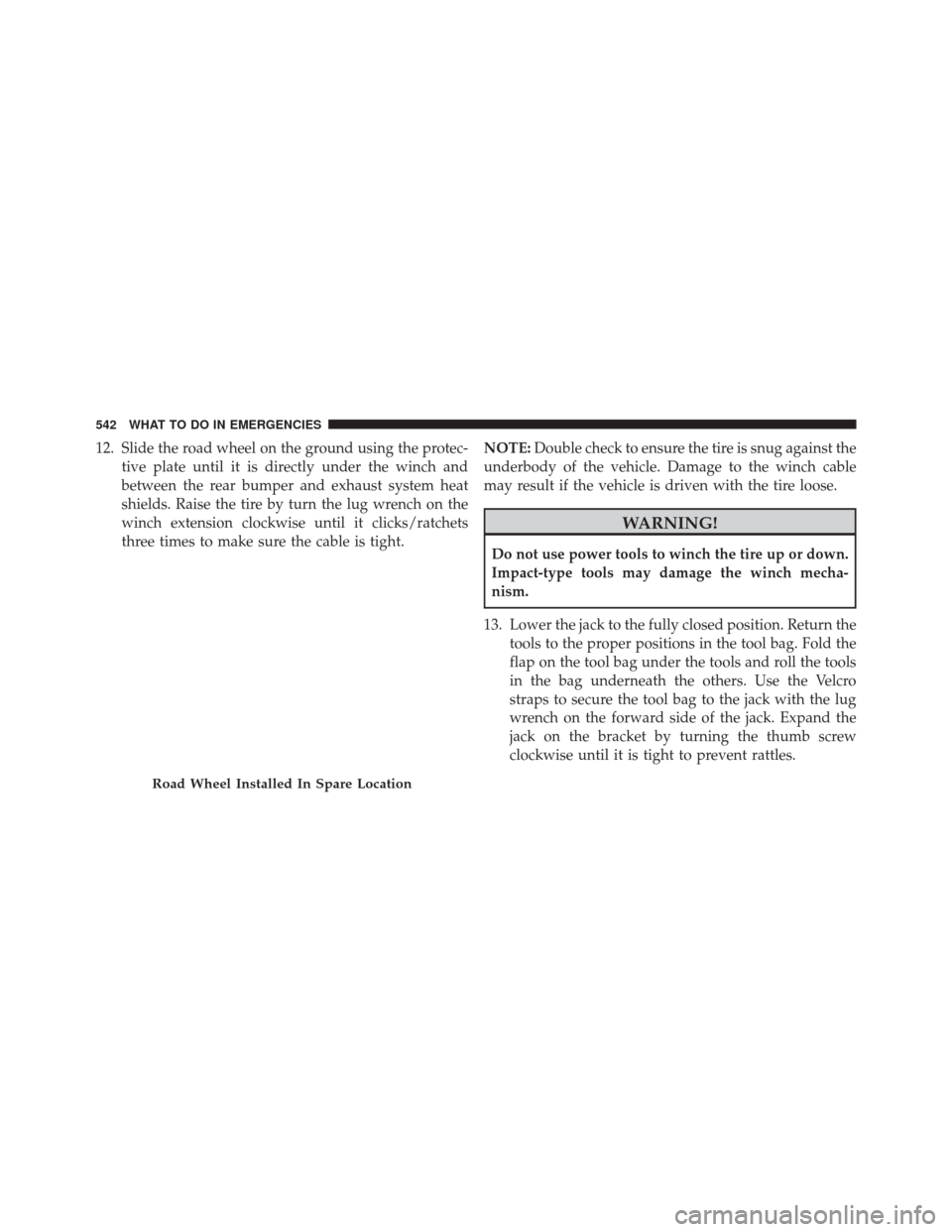
12. Slide the road wheel on the ground using the protec-tive plate until it is directly under the winch and
between the rear bumper and exhaust system heat
shields. Raise the tire by turn the lug wrench on the
winch extension clockwise until it clicks/ratchets
three times to make sure the cable is tight. NOTE:
Double check to ensure the tire is snug against the
underbody of the vehicle. Damage to the winch cable
may result if the vehicle is driven with the tire loose.
WARNING!
Do not use power tools to winch the tire up or down.
Impact-type tools may damage the winch mecha-
nism.
13. Lower the jack to the fully closed position. Return the tools to the proper positions in the tool bag. Fold the
flap on the tool bag under the tools and roll the tools
in the bag underneath the others. Use the Velcro
straps to secure the tool bag to the jack with the lug
wrench on the forward side of the jack. Expand the
jack on the bracket by turning the thumb screw
clockwise until it is tight to prevent rattles.
Road Wheel Installed In Spare Location
542 WHAT TO DO IN EMERGENCIES
Page 545 of 664
14. Reinstall the plastic plug into the floor of the cargoarea. Roll up and store the Jack, Tool Kit and Tire
Changing Instructions. Reinstall the cover for the jack
in the rear storage bin.
15. Have the aluminum road wheel and tire repaired as soon as possible and properly secure the spare tire,
jack and tool kit.
WARNING!
A loose tire or jack thrown forward in a collision or
hard stop could endanger the occupants of the ve-
hicle. Always stow the jack parts and the spare tire in
the places provided.
Road Tire Installation
1. Mount the road tire on the axle. 2. Install the remaining lug nuts with the cone shaped
end of the nut toward the wheel. Lightly tighten the
lug nuts.
WARNING!
To avoid the risk of forcing the vehicle off the jack,
do not tighten the lug nuts fully until the vehicle has
been lowered. Failure to follow this warning may
result in personal injury.
3. Lower the vehicle to the ground by turning the jack handle counterclockwise.
4. Refer to Torque Table for proper lug nut torque.
5. After 25 miles (40 km) check the lug nut torque with a torque wrench to ensure that all lug nuts are properly
seated against the wheel.
6
WHAT TO DO IN EMERGENCIES 543
Page 549 of 664
1. Set the parking brake, shift the automatic transmissioninto PARK and turn the ignition to LOCK.
2. Turn off the heater, radio, and all unnecessary electri- cal accessories.
3. Remove the protective cover over the remote positive (+) battery post. Pull upward on the cover to remove
it.
4. If using another vehicle to jump-start the battery, park the vehicle within the jumper cables reach, set the
parking brake and make sure the ignition is OFF.
WARNING!
Do not allow vehicles to touch each other as this
could establish a ground connection and personal
injury could result.
Jump-Starting Procedure
WARNING!
Failure to follow this jump-starting procedure could
result in personal injury or property damage due to
battery explosion.
CAUTION!
Failure to follow these procedures could result in
damage to the charging system of the booster vehicle
or the discharged vehicle.
NOTE: Make sure at all times that unused ends of
jumper cables are not contacting each other or either
vehicle while making connections.
6
WHAT TO DO IN EMERGENCIES 547
Page 556 of 664
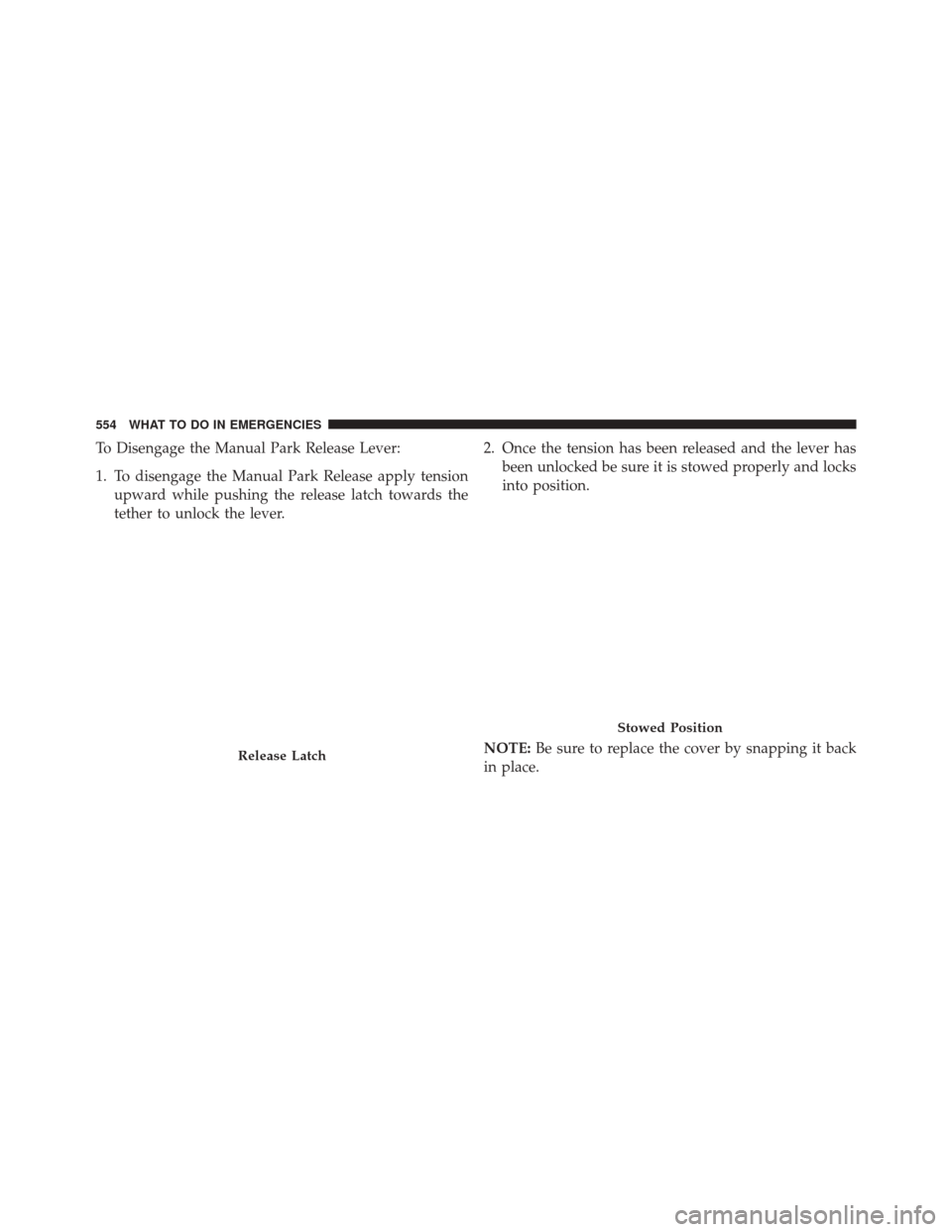
To Disengage the Manual Park Release Lever:
1. To disengage the Manual Park Release apply tensionupward while pushing the release latch towards the
tether to unlock the lever. 2. Once the tension has been released and the lever has
been unlocked be sure it is stowed properly and locks
into position.
NOTE: Be sure to replace the cover by snapping it back
in place.
Release Latch
Stowed Position
554 WHAT TO DO IN EMERGENCIES
Page 580 of 664
9. Push the door to the near closed position to reengagethe glove compartment travel stops.
NOTE: Ensure the glove compartment door hinges and
glove compartment travel stops are fully engaged.
Body Lubrication
Locks and all body pivot points, including such items as
seat tracks, door hinge pivot points and rollers, liftgate,
tailgate, decklid, sliding doors and hood hinges, should
be lubricated periodically with a lithium based grease,
such as MOPAR® Spray White Lube to assure quiet, easy
operation and to protect against rust and wear. Prior to
the application of any lubricant, the parts concerned
should be wiped clean to remove dust and grit; after
lubricating excess oil and grease should be removed.
Particular attention should also be given to hood latching
components to ensure proper function. When performing
other underhood services, the hood latch, release mecha-
nism and safety catch should be cleaned and lubricated. The external lock cylinders should be lubricated twice a
year, preferably in the Fall and Spring. Apply a small
amount of a high quality lubricant, such as MOPAR®
Lock Cylinder Lubricant directly into the lock cylinder.
Windshield Wiper Blades
Clean the rubber edges of the wiper blades and the
windshield periodically with a sponge or soft cloth and a
mild nonabrasive cleaner. This will remove accumula-
tions of salt or road film.
Operation of the wipers on dry glass for long periods
may cause deterioration of the wiper blades. Always use
washer fluid when using the wipers to remove salt or dirt
from a dry windshield.
Avoid using the wiper blades to remove frost or ice from
the windshield. Keep the blade rubber out of contact with
petroleum products such as engine oil, gasoline, etc.
578 MAINTAINING YOUR VEHICLE
Page 606 of 664
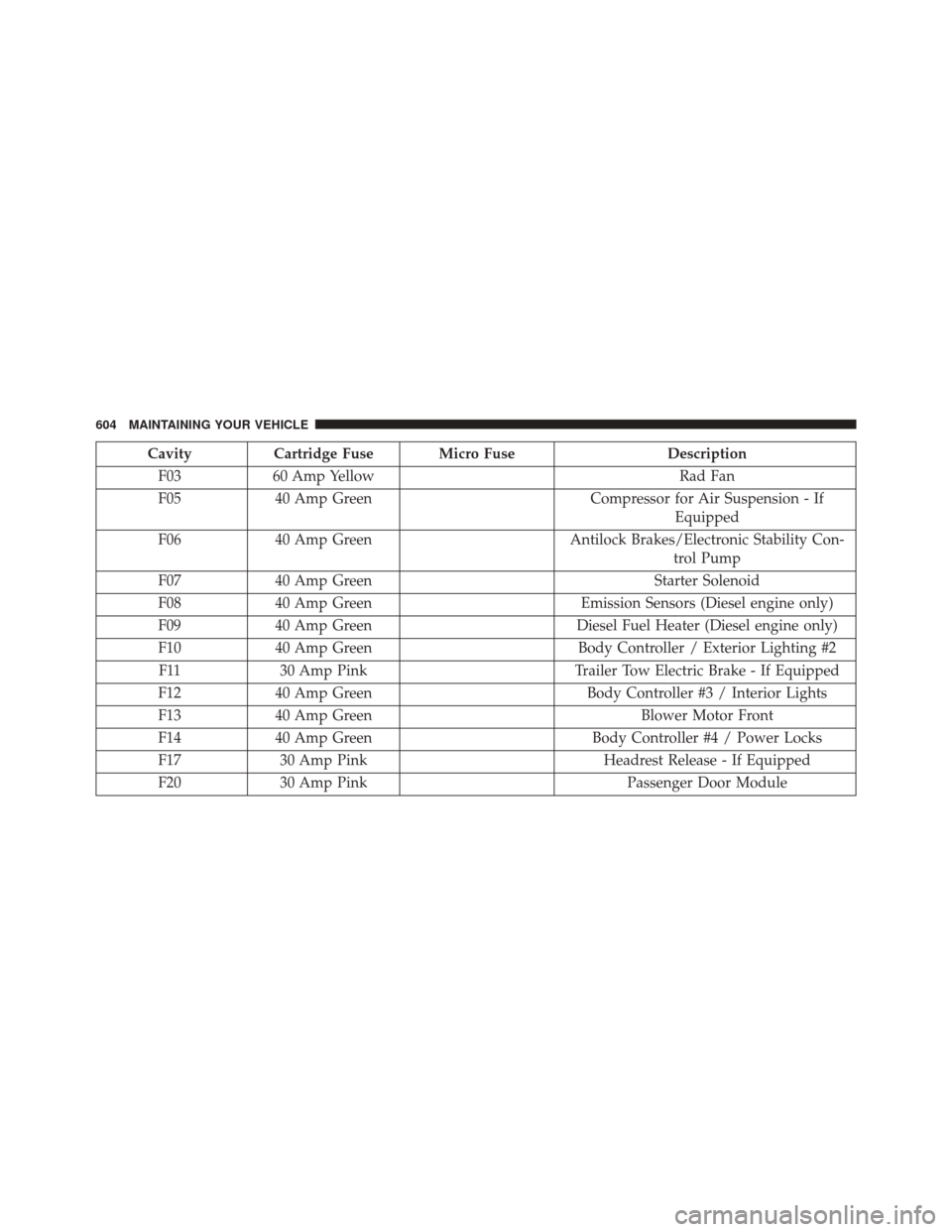
CavityCartridge Fuse Micro Fuse Description
F03 60 Amp Yellow Rad Fan
F05 40 Amp Green Compressor for Air Suspension - If
Equipped
F06 40 Amp Green Antilock Brakes/Electronic Stability Con-
trol Pump
F07 40 Amp Green Starter Solenoid
F08 40 Amp Green Emission Sensors (Diesel engine only)
F09 40 Amp Green Diesel Fuel Heater (Diesel engine only)
F10 40 Amp Green Body Controller / Exterior Lighting #2
F11 30 Amp Pink Trailer Tow Electric Brake - If Equipped
F12 40 Amp Green Body Controller #3 / Interior Lights
F13 40 Amp Green Blower Motor Front
F14 40 Amp Green Body Controller #4 / Power Locks
F17 30 Amp Pink Headrest Release - If Equipped
F20 30 Amp Pink Passenger Door Module
604 MAINTAINING YOUR VEHICLE
Page 607 of 664
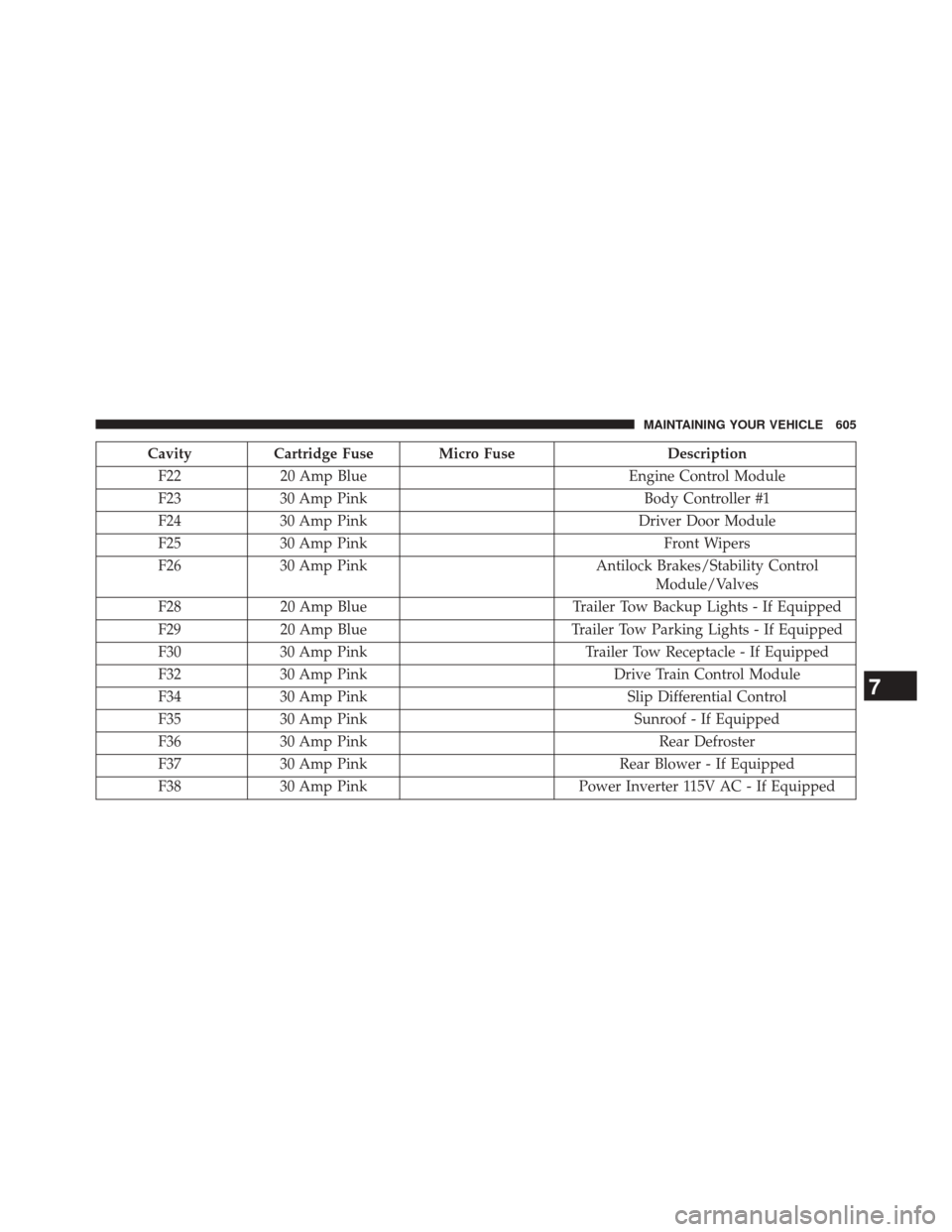
CavityCartridge Fuse Micro Fuse Description
F22 20 Amp Blue Engine Control Module
F23 30 Amp Pink Body Controller #1
F24 30 Amp Pink Driver Door Module
F25 30 Amp Pink Front Wipers
F26 30 Amp Pink Antilock Brakes/Stability Control
Module/Valves
F28 20 Amp Blue Trailer Tow Backup Lights - If Equipped
F29 20 Amp Blue Trailer Tow Parking Lights - If Equipped
F30 30 Amp Pink Trailer Tow Receptacle - If Equipped
F32 30 Amp Pink Drive Train Control Module
F34 30 Amp Pink Slip Differential Control
F35 30 Amp Pink Sunroof - If Equipped
F36 30 Amp Pink Rear Defroster
F37 30 Amp Pink Rear Blower - If Equipped
F38 30 Amp Pink Power Inverter 115V AC - If Equipped
7
MAINTAINING YOUR VEHICLE 605