heating DODGE DURANGO 2017 3.G User Guide
[x] Cancel search | Manufacturer: DODGE, Model Year: 2017, Model line: DURANGO, Model: DODGE DURANGO 2017 3.GPages: 584, PDF Size: 5.14 MB
Page 429 of 584
WARNING!
Overloading of your tires is dangerous. Overloading
can cause tire failure, affect vehicle handling, and
increase your stopping distance. Use tires of the rec-
ommended load capacity for your vehicle. Never over-
load them.
TIRES — GENERAL INFORMATION
Tire Pressure
Proper tire inflation pressure is essential to the safe and
satisfactory operation of your vehicle. Four primary areas
are affected by improper tire pressure:
•Safety and Vehicle Stability
• Economy
• Tread Wear
• Ride Comfort
Safety
WARNING!
•Improperly inflated tires are dangerous and can
cause collisions.
• Underinflation increases tire flexing and can result
in overheating and tire failure.
• Overinflation reduces a tire’s ability to cushion
shock. Objects on the road and chuckholes can cause
damage that result in tire failure.
• Overinflated or underinflated tires can affect vehicle
handling and can fail suddenly, resulting in loss of
vehicle control.
• Unequal tire pressures can cause steering problems.
You could lose control of your vehicle.
• Unequal tire pressures from one side of the vehicle
to the other can cause the vehicle to drift to the right
or left.
• Always drive with each tire inflated to the recom-
mended cold tire inflation pressure.
Both under-inflation and over-inflation affect the stability
of the vehicle and can produce a feeling of sluggish
response or over responsiveness in the steering.
5
STARTING AND OPERATING 427
Page 476 of 584
HAZARD WARNING FLASHERS
The Hazard Warning flasher switch is located on the switch
bank just above the climate controls.Push the switch to turn on the Hazard Warning
flasher. When the switch is activated, all directional
turn signals will flash on and off to warn oncoming traffic
of an emergency. Push the switch a second time to turn off
the Hazard Warning flashers.
This is an emergency warning system and it should not be
used when the vehicle is in motion. Use it when your
vehicle is disabled and it is creating a safety hazard for
other motorists.
When you must leave the vehicle to seek assistance, the
Hazard Warning flashers will continue to operate even
though the ignition is placed in the OFF position.
NOTE: With extended use, the Hazard Warning flashers
may discharge the battery.
IF YOUR ENGINE OVERHEATS
In any of the following situations, you can reduce the
potential for overheating by taking the appropriate action.
• On the highways — slow down. •
In city traffic — while stopped, place the transmission in
NEUTRAL, but do not increase the engine idle speed
while preventing vehicle motion with the brakes.
NOTE: There are steps that you can take to slow down an
impending overheat condition:
• If your air conditioner (A/C) is on, turn it off. The A/C
system adds heat to the engine cooling system and
turning the A/C off can help remove this heat.
• You can also turn the temperature control to maximum
heat, the mode control to floor and the blower control to
high. This allows the heater core to act as a supplement
to the radiator and aids in removing heat from the
engine cooling system.
WARNING!
You or others can be badly burned by hot engine
coolant (antifreeze) or steam from your radiator. If you
see or hear steam coming from under the hood, do not
open the hood until the radiator has had time to cool.
Never try to open a cooling system pressure cap when
the radiator or coolant bottle is hot.
474 WHAT TO DO IN EMERGENCIES
Page 494 of 584
CAUTION!
•Racing the engine or spinning the wheels may lead
to transmission overheating and failure. Allow the
engine to idle with the transmission in NEUTRAL
for at least one minute after every five rocking-
motion cycles. This will minimize overheating and
reduce the risk of transmission failure during pro-
longed efforts to free a stuck vehicle.
• When “rocking” a stuck vehicle by shifting between
DRIVE and REVERSE, do not spin the wheels faster
than 15 mph (24 km/h), or drivetrain damage may
result.
• Revving the engine or spinning the wheels too fast
may lead to transmission overheating and failure. It
can also damage the tires. Do not spin the wheels
above 30 mph (48 km/h) while in gear (no transmis-
sion shifting occurring).
EMERGENCY TOW HOOKS — IF EQUIPPED
If your vehicle is equipped with tow hooks, there will be
one in the rear and two mounted on the front of the vehicle.
The rear hook will be located on the driver’s side of the
vehicle. NOTE:
For off-road recovery, it is recommended to use
both of the front tow hooks to minimize the risk of damage
to the vehicle.
WARNING!
• Do not use a chain for freeing a stuck vehicle. Chains
may break, causing serious injury or death.
• Stand clear of vehicles when pulling with tow hooks.
Tow straps may become disengaged, causing serious
injury.
CAUTION!
Tow hooks are for emergency use only, to rescue a
vehicle stranded off road. Do not use tow hooks for
tow truck hookup or highway towing. You could
damage your vehicle.
492 WHAT TO DO IN EMERGENCIES
Page 522 of 584
Under normal operating conditions, the catalytic converter
will not require maintenance. However, it is important to
keep the engine properly tuned to assure proper catalyst
operation and prevent possible catalyst damage.
NOTE:Intentional tampering with emissions control sys-
tems can result in civil penalties being assessed against
you.
In unusual situations involving grossly malfunctioning
engine operation, a scorching odor may suggest severe and
abnormal catalyst overheating. If this occurs, stop the
vehicle, turn off the engine and allow it to cool. Service,
including a tune-up to manufacturer’s specifications,
should be obtained immediately.
To minimize the possibility of catalytic converter damage:
• Do not shut off the engine or interrupt the ignition,
when the transmission is in gear and the vehicle is in
motion.
• Do not try to start the engine by pushing or towing the
vehicle.
• Do not idle the engine with any spark plug wires
disconnected or removed, such as when diagnostic
testing, or for prolonged periods during very rough idle
or malfunctioning operating conditions.Cooling System
WARNING!
You or others can be badly burned by hot engine
coolant (antifreeze) or steam from your radiator. If you
see or hear steam coming from under the hood, do not
open the hood until the radiator has had time to cool.
Never try to open a cooling system pressure cap when
the radiator or coolant bottle is hot.
Engine Coolant Checks
Check the engine coolant (antifreeze) protection every 12
months (before the onset of freezing weather, where appli-
cable). If the engine coolant (antifreeze) is dirty, the system
should be drained, flushed, and refilled with fresh OAT
coolant (conforming to MS.90032) by an authorized dealer.
Check the front of the A/C condenser for any accumula-
tion of bugs, leaves, etc. If dirty, clean by gently spraying
water from a garden hose vertically down the face of the
condenser.
Check the engine cooling system hoses for brittle rubber,
cracking, tears, cuts, and tightness of the connection at the
coolant recovery bottle and radiator. Inspect the entire
system for leaks.
520 MAINTAINING YOUR VEHICLE
Page 572 of 584
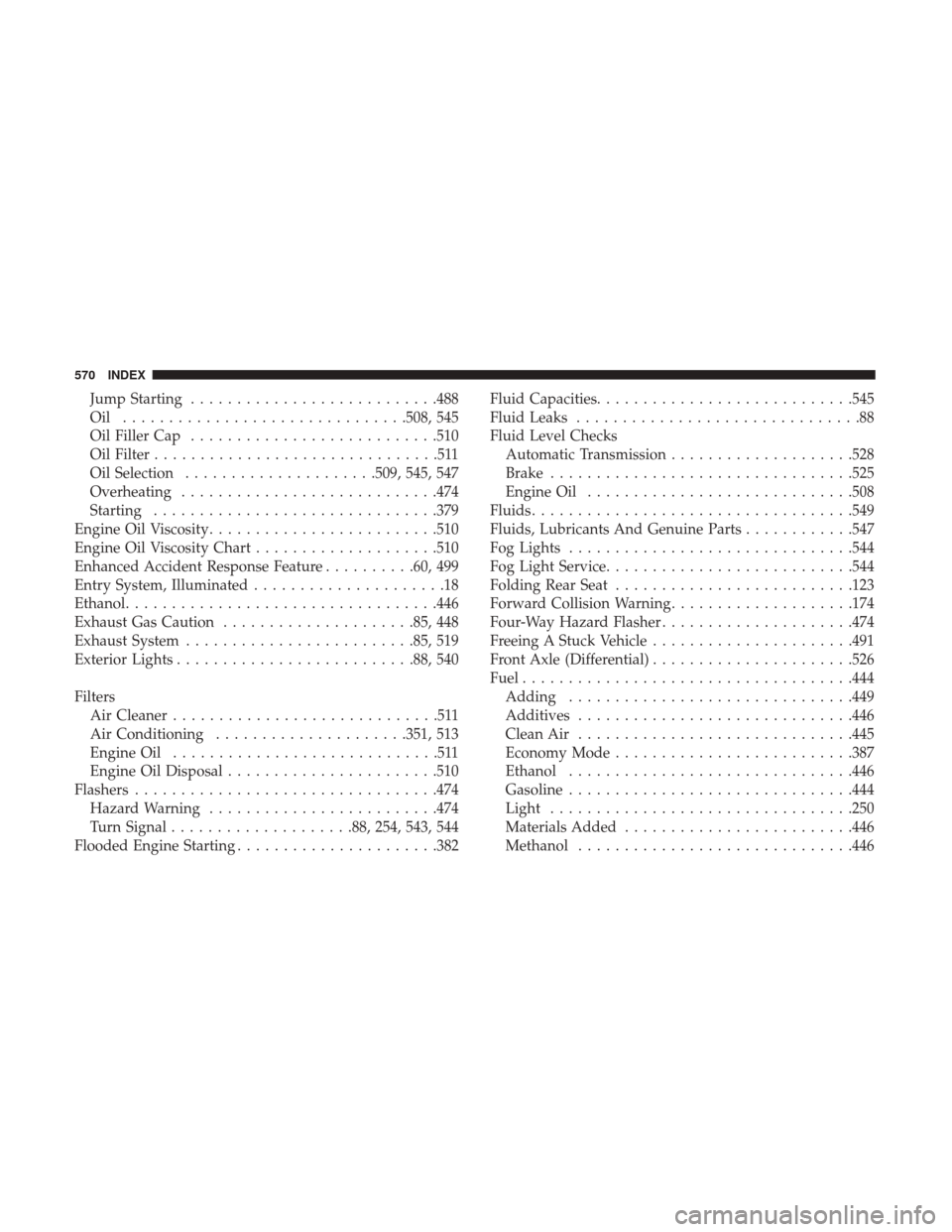
Jump Starting.......................... .488
Oil .............................. .508, 545
Oil Filler Cap .......................... .510
Oil Filter ...............................511
Oil Selection .....................509, 545, 547
Overheating ........................... .474
Starting .............................. .379
Engine Oil Viscosity ........................ .510
Engine Oil Viscosity Chart ....................510
Enhanced Accident Response Feature ..........60, 499
Entry System, Illuminated .....................18
Ethanol ................................. .446
Exhaust Gas Caution .....................85, 448
Exhaust System ........................ .85, 519
Exterior Lights ......................... .88, 540
Filters Air Cleaner .............................511
Air Conditioning .....................351, 513
Engine Oil .............................511
Engine Oil Disposal ...................... .510
Flashers ................................ .474
Hazard Warning ........................ .474
Turn Signal ....................88, 254, 543, 544
Flooded Engine Starting ..................... .382Fluid Capacities
........................... .545
Fluid Leaks ...............................88
Fluid Level Checks Automatic Transmission ....................528
Brake ................................ .525
Engine Oil ............................ .508
Fluids .................................. .549
Fluids, Lubricants And Genuine Parts ............547
Fog Lights .............................. .544
Fog Light Service .......................... .544
Folding Rear Seat ......................... .123
Forward Collision Warning ....................174
Four-Way Hazard Flasher .....................474
Freeing A Stuck Vehicle ..................... .491
Fr
ont Axle (Differential) ..................... .526
Fuel ................................... .444
Adding .............................. .449
Additives ............................. .446
Clean Air ............................. .445
Economy Mode ......................... .387
Ethanol .............................. .446
Gasoline .............................. .444
Light ................................ .250
Materials Added ........................ .446
Methanol ............................. .446
570 INDEX
Page 576 of 584
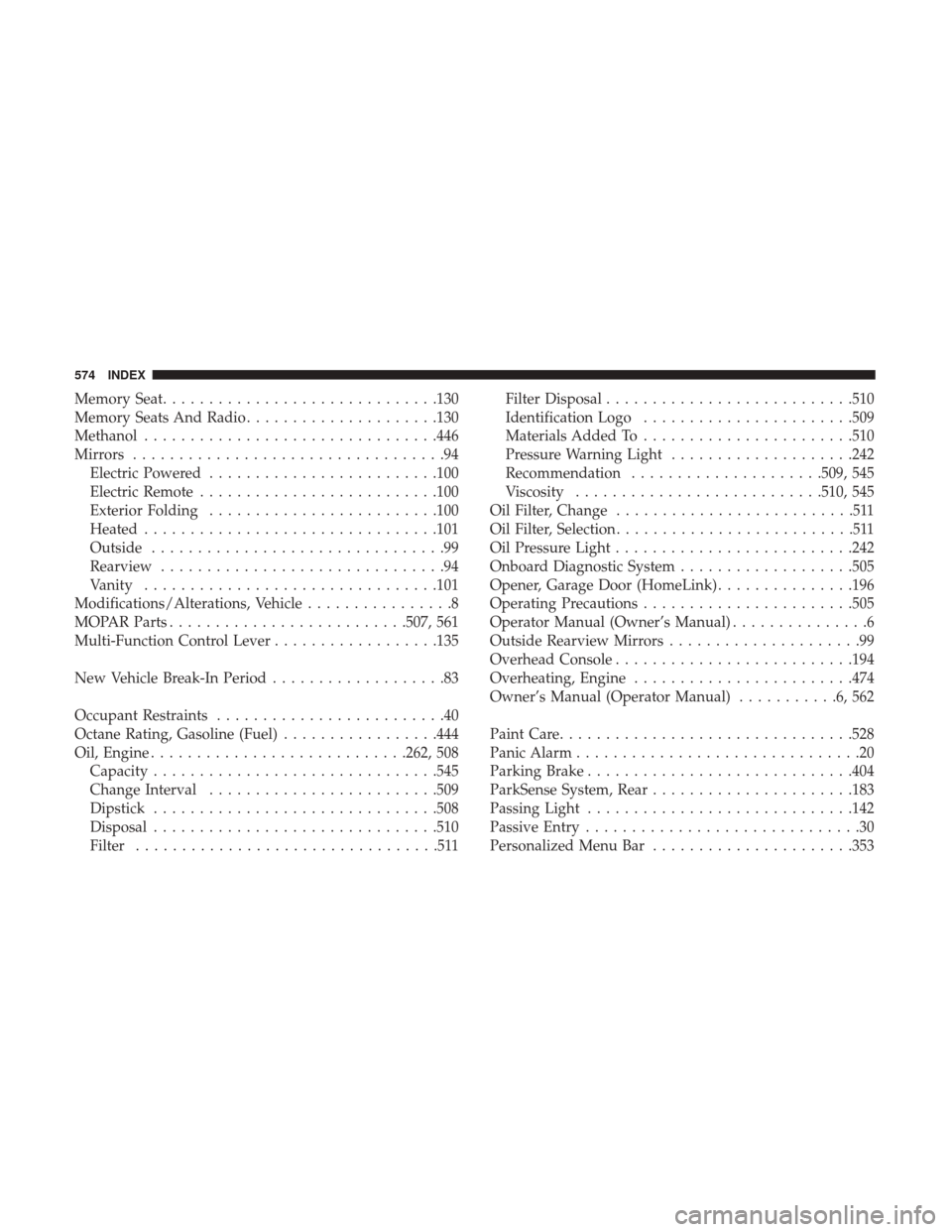
Memory Seat............................. .130
Memory Seats And Radio .....................130
Methanol ............................... .446
Mirrors ..................................94
Electric Powered ........................ .100
Electric Remote ......................... .100
Exterior Folding ........................ .100
Heated ............................... .101
Outside ................................99
Rearview ...............................94
Vanity ............................... .101
Modifications/Alterations, Vehicle ................8
MOPAR Parts ......................... .507, 561
Multi-Function Control Lever ..................135
New Vehicle Break-In Period ...................83
Occupant Restraints .........................40
Octane Rating, Gasoline (Fuel) .................444
Oil, Engine ........................... .262, 508
Capacity .............................. .545
Change Interval ........................ .509
Dipstick .............................. .508
Disposal .............................. .510
Filter .................................511 Filter Disposal
.......................... .510
Identification Logo ...................... .509
Materials Added To ...................... .510
Pressure Warning Light ....................242
Recommendation .....................509, 545
Viscosity .......................... .510, 545
Oil Filter, Change ..........................511
Oil Filter, Selection ..........................511
Oil Pressure Light ......................... .242
Onboard Diagnostic System ...................505
Opener, Garage Door (HomeLink) ...............196
Operating Precautions ...................... .505
Operator Manual (Owner’s Manual) ...............6
Outside Rearview Mirrors .....................99
Overhead Console ......................... .194
Over
heating, Engine ....................... .474
Owner’s Manual (Operator Manual) ...........6,562
Paint Care ............................... .528
Panic Alarm ...............................20
Parking Brake ............................ .404
ParkSense System, Rear ..................... .183
Passing Light ............................ .142
Passive Entry ..............................30
Personalized Menu Bar ..................... .353
574 INDEX