heating DODGE GRAND CARAVAN 2009 5.G Owners Manual
[x] Cancel search | Manufacturer: DODGE, Model Year: 2009, Model line: GRAND CARAVAN, Model: DODGE GRAND CARAVAN 2009 5.GPages: 535, PDF Size: 18.61 MB
Page 94 of 535
SAFETY TIPS
Transporting
Passengers
NEVER TRANSPORT PASSENGERS IN THE CARGO
AREA. WARNING!
It is extremely dangerous to ride in a cargo area,
inside or outside of a vehicle. In a collision, people
riding in these areas are more likely to be seri-
ously injured or killed.
Do not allow people to ride in any area of your
vehicle that is not equipped with seats and seat
belts.
Be sure everyone in your vehicle is in a seat and
using a seat belt properly.
Exhaust Gas WARNING!
Exhaust gases can injure or kill. They contain carbon
monoxide (CO), which is colorless and odorless.
Breathing it can make you unconscious and can
eventually poison you. To avoid breathing (CO)
follow these safety tips:
Do not run the engine in a closed garage or in confined
areas any longer than needed to move your vehicle in or
out of the area.
If it is necessary to sit in a parked vehicle with the engine
running, adjust your heating or cooling controls to force
outside air into the vehicle. Set the blower at high speed.
92 THINGS TO KNOW BEFORE STARTING YOUR VEHICLE
Page 152 of 535
Heated Seats — If EquippedThis feature heats the front driver and passenger seats.
The controls for front heated seats are located on the
center instrument panel area.
After turning the ignition ON, you can choose from High,
Low, or Off heat settings. Amber indicator lights in each
switch indicate the level of heat in use. Two indicator
lights will illuminate for High, one for Low, and none for
Off.
Press the switch once to select High-level heat-
ing. Press the switch a second time to select
Low-level heating. Press the switch a third time
to shut the heating elements Off. Second row heated seat switches are located in the
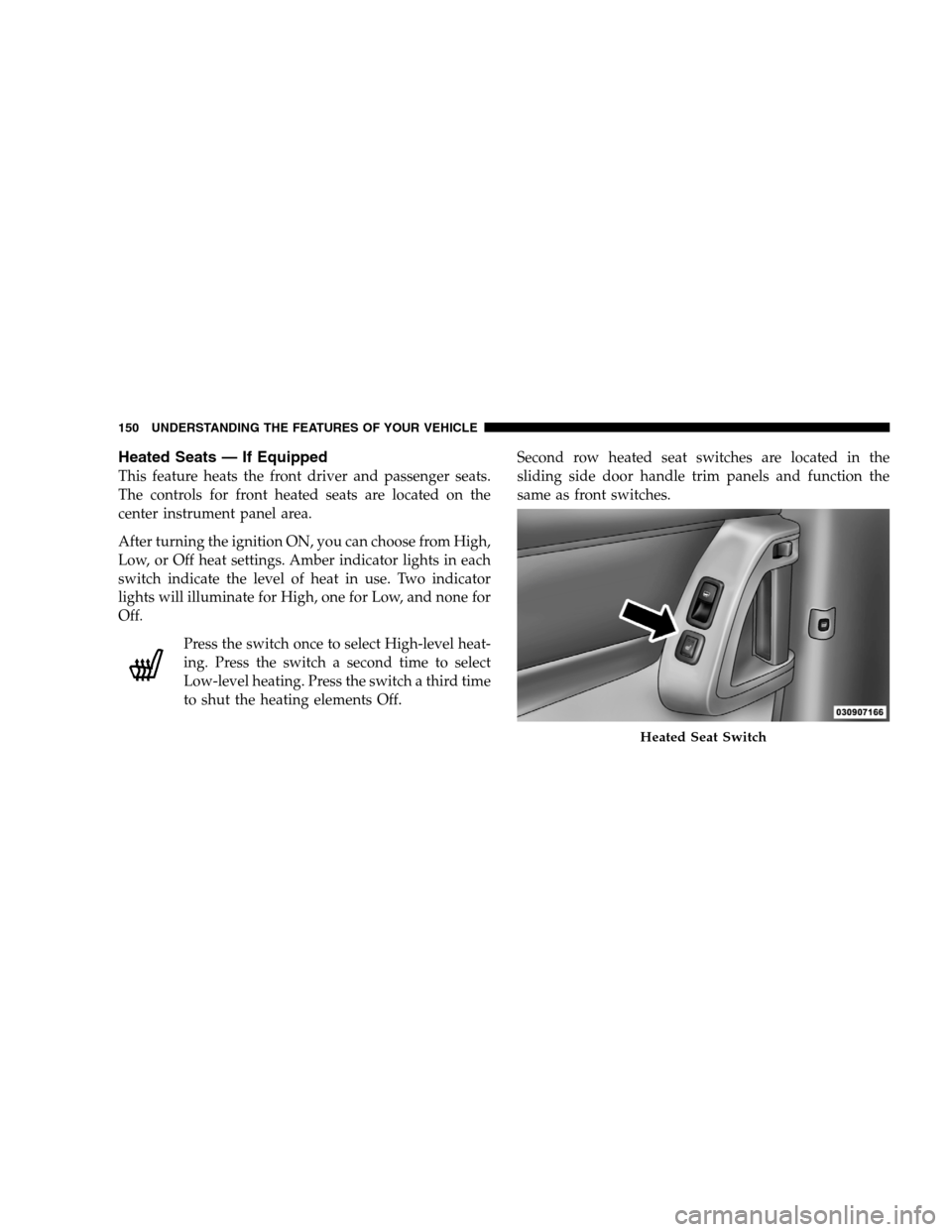
sliding side door handle trim panels and function the
same as front switches. Heated Seat Switch
150 UNDERST
ANDING THE FEATURES OF YOUR VEHICLE
Page 208 of 535
Gate Operator/Canadian ProgrammingCanadian radio frequency laws require transmitter sig-
nals to time-out (or quit) after several seconds of trans-
mission – which may not be long enough for HomeLinkt
to pick up the signal during programming. Similar to this
Canadian law, some U.S. gate operators are designed to
time-out in the same manner.
It may be helpful to unplug the device during the cycling
process to prevent possible overheating of the garage
door or gate motor.
If you are having difficulties programming a garage door
opener or a gate operator, replace “Programming
HomeLinkt” Step 3, with the following:
3. Continue to press and hold the HomeLinkt
button
while you press and release - every two seconds
(“cycle”) your hand-held transmitter until HomeLinkt has successfully accepted the frequency signal. The
indicator light will flash slowly and then rapidly when
fully trained.
If you unplugged the device for training, plug it back in
at this time.
Then proceed with Step 4 under “Programming
HomeLinkt,” earlier in this section.
Security
It is advised to erase all channels before you sell or turn
in your vehicle.
To do this, press and hold the two outside buttons for
20 seconds until the red indicator flashes. Note that all
channels will be erased. Individual channels cannot be
erased.
The HomeLinkt
Universal Transceiver is disabled when
the Vehicle Security Alarm is active.
206 UNDERSTANDING THE FEATURES OF YOUR VEHICLE
Page 229 of 535
NOTE:
You can turn off the heated mirror feature at anytime
by pressing the rear window defroster switch a second
time.
To prevent excessive battery drain, use the rear win-
dow defroster only when the engine is operating.CAUTION!
Failure to follow these cautions can cause damage to
the heating elements:
Use care when washing the inside of the rear
window. Do not use abrasive window cleaners on
the interior surface of the window. Use a soft cloth
and a mild washing solution, wiping parallel to
the heating elements. Labels can be peeled off
after soaking with warm water.
(Continued) CAUTION! (Continued)
Do not use scrapers, sharp instruments, or abra-
sive window cleaners on the interior surface of the
window.
Keep all objects a safe distance from the window.
LOAD-LEVELING SYSTEM
The automatic load-leveling system will provide a level
riding vehicle under most passenger and cargo loading
conditions.
A hydraulic pump contained within the shock absorbers
raises the rear of the vehicle to the correct height. It takes
approximately 1 mile (1.6 km) of driving for the leveling
to complete depending on road surface conditions.
If the leveled vehicle is not moved for approximately
15 hours, the leveling system will bleed itself down. The
vehicle must be driven to reset the system.
UNDERSTANDING THE FEATURES OF YOUR VEHICLE 227 3
Page 238 of 535
mClimate Controls . . . . . . . . . . . . . . . . . . . . . 305
▫ Manual Heating And Air Conditioning
System . . . . . . . . . . . . . . . . . . . . . . . . . . . . 305
▫ Rear Manual Climate Control — If
Equipped . . . . . . . . . . . . . . . . . . . . . . . . . . 311
▫ Automatic Temperature Control (ATC) — If
Equipped . . . . . . . . . . . . . . . . . . . . . . . . . . 314
▫ Summer Operation . . . . . . . . . . . . . . . . . . 322 ▫
Winter Operation . . . . . . . . . . . . . . . . . . . 323
▫ Vacation/Storage . . . . . . . . . . . . . . . . . . . 323
▫ Window Fogging . . . . . . . . . . . . . . . . . . . 323
▫ Outside Air Intake . . . . . . . . . . . . . . . . . . 323
▫ Operating Tips . . . . . . . . . . . . . . . . . . . . . 324
▫ A/C Air Filter— If Equipped . . . . . . . . . . . 324
236 UNDERSTANDING YOUR INSTRUMENT PANEL
Page 249 of 535
the ON position before engine start. If the bulb does not
come on when turning the key from OFF to ON, have the
condition checked promptly.
Certain conditions such as a loose or missing gas cap,
poor fuel quality, etc., may illuminate the MIL after
engine start. The vehicle should be serviced if the light
stays on through several of your typical driving cycles. In
most situations, the vehicle will drive normally and will
not require towing.
The MIL flashes to alert to serious conditions that could
lead to immediate loss of power or severe catalytic
converter damage. The vehicle should be serviced at an
authorized dealer as soon as possible if this occurs.
16. Engine Temperature Warning LightThis light warns of an overheated engine condi-
tion. As temperatures rise and the gauge ap-
proaches H,this indicator will illuminate and a
single chime will sound after reaching a set threshold. Further overheating will cause the temperature gauge to
pass
H,the indicator will continuously flash and a
continuous chime will occur until the engine is allowed
to cool.
If the light turns on while driving, safely pull over and
stop the vehicle. If the A/C system is on, turn it off. Also,
shift the transmission into NEUTRAL and idle the ve-
hicle. If the temperature reading does not return to
normal, turn the engine off immediately and call for
service. Refer to “If Your Engine Overheats” in Section 6
for more information.
17. Electronic Throttle Control (ETC) Light This light informs you of a problem with the
Electronic Throttle Control (ETC) system. The
light will come on when the ignition is first
turned ON and remain on briefly as a bulb
check. If the light does not come on during starting, have
the system checked by an authorized dealer. UNDERSTANDING YOUR INSTRUMENT PANEL 247
4
Page 307 of 535
RADIO OPERATION AND CELLULAR PHONESUnder certain conditions, the cellular phone being on in
your vehicle can cause erratic or noisy performance from
your radio. This condition may be lessened or eliminated
by relocating the cellular phone antenna. This condition
is not harmful to the radio. If your radio performance
does not satisfactorily “clear” by the repositioning of the
antenna, it is recommended that the radio volume be
turned down or off during cellular phone operation.
CLIMATE CONTROLS
The Climate Control System allows you to regulate the
temperature, amount, and direction of air circulating
throughout the vehicle. The controls are located on the
instrument panel, below the radio.
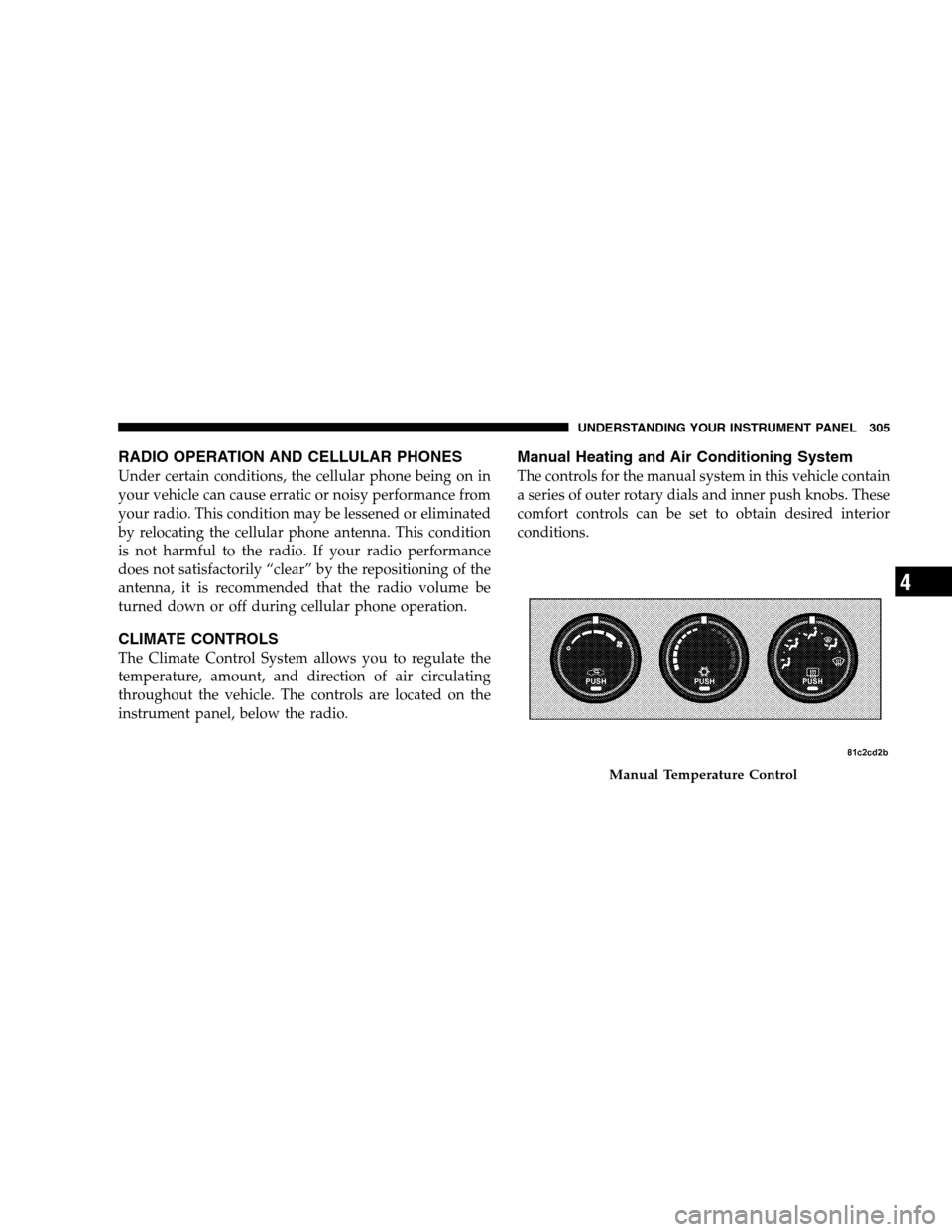
Manual Heating and Air Conditioning System
The controls for the manual system in this vehicle contain
a series of outer rotary dials and inner push knobs. These
comfort controls can be set to obtain desired interior
conditions.
Manual Temperature Control
UNDERSTANDING
YOUR INSTRUMENT PANEL 305 4
Page 313 of 535
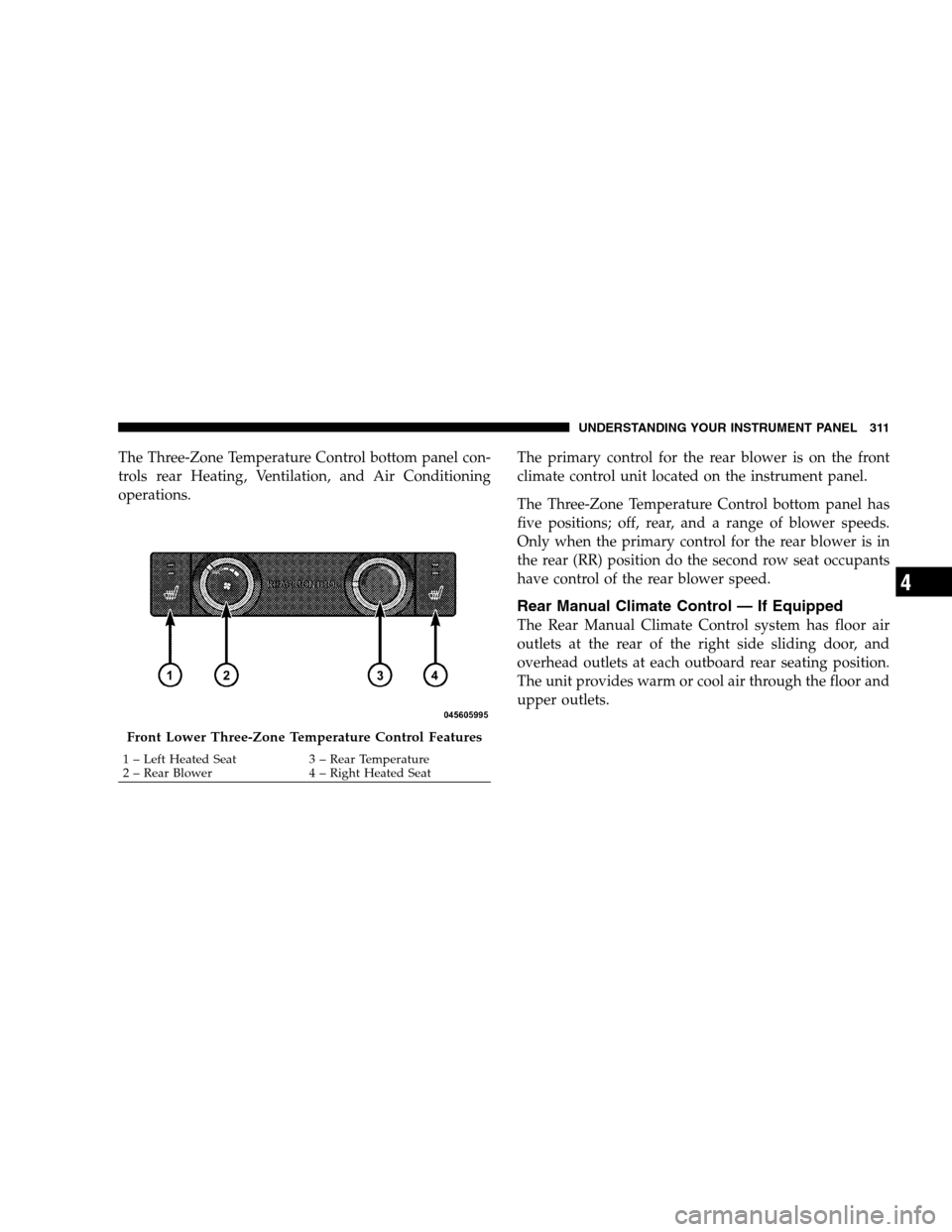
The Three-Zone Temperature Control bottom panel con-
trols rear Heating, Ventilation, and Air Conditioning
operations.The primary control for the rear blower is on the front
climate control unit located on the instrument panel.
The Three-Zone Temperature Control bottom panel has
five positions; off, rear, and a range of blower speeds.
Only when the primary control for the rear blower is in
the rear (RR) position do the second row seat occupants
have control of the rear blower speed.
Rear Manual Climate Control — If Equipped
The Rear Manual Climate Control system has floor air
outlets at the rear of the right side sliding door, and
overhead outlets at each outboard rear seating position.
The unit provides warm or cool air through the floor and
upper outlets.Front Lower Three-Zone Temperature Control Features
1 – Left Heated Seat
3 – Rear Temperature
2 –
Rear Blower 4 – Right Heated Seat UNDERSTANDING YOUR INSTRUMENT PANEL 311 4
Page 324 of 535
When rear controls are locked by the front system, the
LOCK symbol on the temperature knob is illuminated
and any rear overhead adjustments are ignored.
Rear Mode Control
Auto Mode
The rear system automatically maintains the correct
mode and comfort level desired by the rear seat occu-
pants.
Headliner ModeAir comes from the outlets in the headliner. Each of
these outlets can be individually adjusted to direct
the flow of air. Moving the air vanes of the outlets to one
side will shut off the airflow.
Bi-Level Mode Air comes from both the headliner outlets and the
floor outlets. NOTE:
In many temperature positions, the BI-LEVEL
mode is designed to provide cooler air out of the head-
liner outlets and warmer air from the floor outlets.
Floor Mode Air comes from the floor outlets.
Summer Operation
The engine cooling system in air conditioned vehicles
must be protected with a high-quality antifreeze coolant
to provide proper corrosion protection and to protect
against engine overheating. A solution of 50% ethylene
glycol antifreeze coolant and 50% water is recommended.
Refer to “Maintenance Procedures” in Section 7 of this
manual for proper coolant selection. 322 UNDERSTANDING YOUR INSTRUMENT PANEL
Page 338 of 535
DRIVE — Six-Speed TransaxleThis range should be used for most city and highway
driving. It provides the smoothest upshifts, downshifts,
and best fuel economy. However, use the Electronic
Range Select (ERS) mode by moving the lever — / + and
select the “5” range when frequent transaxle shifting
occurs while using the DRIVE range, such as when
operating the vehicle under heavy loading conditions,
(i.e., in hilly terrain, traveling into strong head winds or
while towing heavy trailers). Under these conditions,
using the “5” range will improve performance and
extend transaxle life by reducing excessive shifting and
heat buildup.
DRIVE — Four-Speed Transaxle
This range should be used for most city and highway
driving. It provides the smoothest upshifts, downshifts,
and best fuel economy. However, select the “3” range
when frequent transaxle shifting occurs while using the
DRIVE range, such as when operating the vehicle under
heavy loading conditions, (i.e., in hilly terrain, traveling
into strong head winds or while towing heavy trailers).
Under these conditions, using the “3” range will improve
performance and extend transaxle life by reducing exces-
sive shifting and heat buildup. CAUTION!
If the transaxle operating temperature exceeds ac-
ceptable limits, the vehicle computer will override
DRIVE and select “5” range (on six-speed transaxles)
or “3” range (on four-speed transaxles) by changing
shift points. This is done to prevent transaxle damage
due to overheating.
Electronic Range Select (ERS) Operation
The Electronic Range Select (ERS) shift control allows
you to move the shift lever to the left (-) or right (+) when
the shift lever is in the DRIVE position, this allows the
selection of the desired top gear. For example, if you shift
336 STARTING AND OPERATING