warning DODGE NITRO 2008 1.G Owner's Guide
[x] Cancel search | Manufacturer: DODGE, Model Year: 2008, Model line: NITRO, Model: DODGE NITRO 2008 1.GPages: 434, PDF Size: 6.2 MB
Page 67 of 434
Infants and Child Restraints
²
Safety experts recommend that children ride
rearward-facing in the vehicle until they are at least
one year oldandweigh at least 20 lbs (9 kg). Two types
of child restraints can be used rearward-facing: infant
carriers and ªconvertibleº child seats.
²The infant carrier is only used rearward-facing in the
vehicle. It is recommended for children who weigh up
to about 20 lbs (9 kg). ªConvertibleº child seats often
have a higher weight limit in the rearward-facing
direction than infant carriers do, so they can be used
rearward-facing by children who weigh more than 20
lbs (9 kg) but are less than one year old. Both types of
child restraints are held in the vehicle by the lap/
shoulder belt or the LATCH child restraint anchorage
system (Refer to LATCH Ð Child Seat Anchorage
System in this section.)
²Rearward-facing child seats mustNEVERbe used in
the front seat of a vehicle with the front passenger
airbag unless the airbag is turned off. An airbag
deployment could cause severe injury or death to
infants in this position.
WARNING!
²Improper installation can lead to failure of an
infant or child restraint. It could come loose in a
collision. The child could be badly injured or
killed. Follow the manufacturer's directions ex-
actly when installing an infant or child restraint.
²A rearward facing infant restraint should only be
used in a rear seat. A rearward facing infant
restraint in the front seat may be struck by a
deploying passenger airbag which may cause se-
vere or fatal injury to the infant.
THINGS TO KNOW BEFORE STARTING YOUR VEHICLE 67
2
Page 73 of 434
hook for attachment to the tether strap anchorage and a
means of adjusting the tension of the strap.
You will first loosen the adjusters on the lower straps and
on the tether strap so that you can more easily attach the
hooks or connectors to the vehicle anchorages. Next
attach the lower hooks or connectors over the top of the
anchorage bars, pushing aside the seat cover material.
Then, locate the tether anchorage directly behind the seat
where you are placing the child restraint and attach the
tether strap to the anchorage, being careful to route the
tether strap to provide the most direct path between the
anchor and the child restraint. Finally, tighten all three
straps as you push the child restraint rearward and
downward into the seat, removing slack in the straps
according to the child restraint manufacturer's instruc-
tions.WARNING!
Improper installation of a child restraint to the
LATCH anchorages can lead to failure of an infant or
child restraint. The child could be badly injured or
killed. Follow the manufacturer's directions exactly
when installing an infant or child restraint.
Installing Child Restraints Using the Vehicle Seat
Belt
The passenger seat belts are equipped with either cinch-
ing latch plates or automatic locking retractors, which are
designed to keep the lap portion tight around the child
restraint so that it is not necessary to use a locking clip. If
the seat belt has a cinching latch plate, pulling up on the
shoulder portion of the lap/shoulder belt will tighten the
THINGS TO KNOW BEFORE STARTING YOUR VEHICLE 73
2
Page 75 of 434
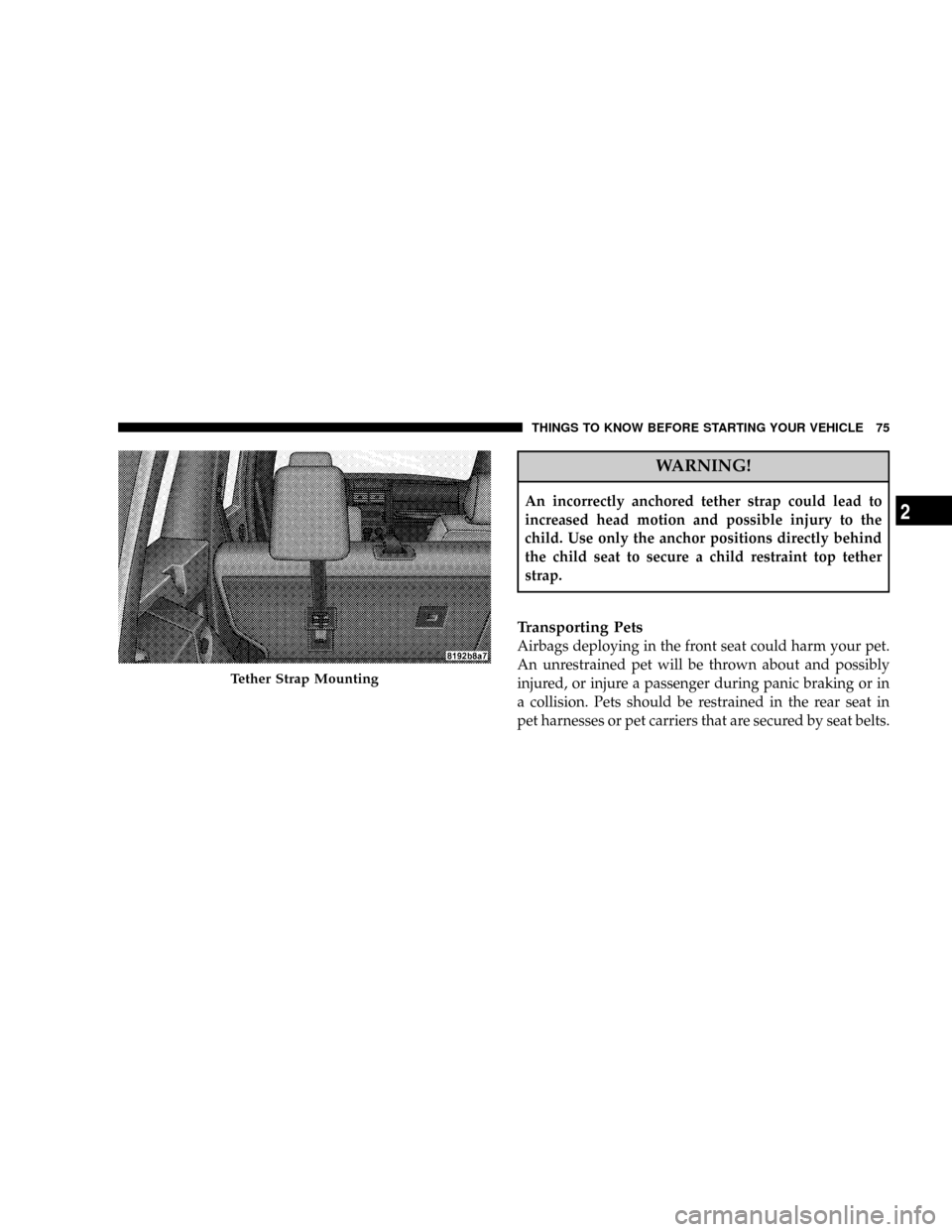
WARNING!
An incorrectly anchored tether strap could lead to
increased head motion and possible injury to the
child. Use only the anchor positions directly behind
the child seat to secure a child restraint top tether
strap.
Transporting Pets
Airbags deploying in the front seat could harm your pet.
An unrestrained pet will be thrown about and possibly
injured, or injure a passenger during panic braking or in
a collision. Pets should be restrained in the rear seat in
pet harnesses or pet carriers that are secured by seat belts.
Tether Strap Mounting
THINGS TO KNOW BEFORE STARTING YOUR VEHICLE 75
2
Page 76 of 434
ENGINE BREAK-IN RECOMMENDATIONS
A long break-in period is not required for the engine in
your new vehicle.
Drive moderately during the first 300 miles (500 km).
After the initial 60 miles (100 km), speeds up to 50 or 55
mph (80 or 90 km/h) are desirable.
While cruising, brief full-throttle acceleration, within the
limits of local traffic laws, contributes to a good break-in.
Wide-open throttle acceleration in low gear can be detri-
mental and should be avoided.
The engine oil installed in the engine at the factory is a
high quality energy conserving type lubricant. Oil
changes should be consistent with anticipated climate
conditions under which vehicle operations will occur.
The recommended viscosity and quality grades are
shown in Section 7 of this manual. NON-DETERGENT
OR STRAIGHT MINERAL OILS MUST NEVER BE
USED.A new engine may consume some oil during its first few
thousand miles (kilometers) of operation. This should be
considered as a normal part of the break-in and not
interpreted as an indication of difficulty.
SAFETY TIPS
Exhaust Gas
WARNING!
Exhaust gases can injure or kill. They contain carbon
monoxide (CO) which is colorless and odorless.
Breathing it can make you unconscious and can
eventually poison you. To avoid breathing (CO)
follow the safety tips below.
76 THINGS TO KNOW BEFORE STARTING YOUR VEHICLE
Page 77 of 434

²Do not inhale exhaust gases. They contain carbon
monoxide, a colorless and odorless gas which can kill.
Never run the engine in a closed area, such as a
garage, and never sit in a parked vehicle with the
engine running for a extended period. If the vehicle is
stopped in an open area with engine running for more
than a short period, adjust the ventilation system to
force fresh, outside air into the vehicle.
²Guard against carbon monoxide with proper mainte-
nance. Have the exhaust system inspected every time
the vehicle is raised. Have any abnormal conditions
repaired promptly. Until repaired, drive with all side
windows fully open.
²Always run the climate control in panel or floor mode
when driving with any windows open, even if only
slightly, to help keep fresh air circulating inside ve-
hicle. Otherwise poisonous gases could be drawn into
the vehicle.
Safety Checks You Should Make Inside The
Vehicle
Seat Belts
Inspect the belt system periodically, checking for cuts,
frays and loose parts. Damaged parts must be replaced
immediately. Do not disassemble or modify the system.
Seat belt assemblies must be replaced after an accident if
they have been damaged (bent retractor, torn webbing,
etc.). If there is any question regarding belt or retractor
condition, replace the belt.
Airbag Warning Light
The light should come on and remain on for 6 to 8
seconds as a bulb check when the ignition switch is first
turned on. If the bulb is not lit during starting, have it
replaced. If the light stays on or comes on while driving,
have the system checked by an authorized dealer.
THINGS TO KNOW BEFORE STARTING YOUR VEHICLE 77
2
Page 81 of 434

NElectronic Speed Control Operation........128
NTo Activate..........................128
NTo Set At A Desired Speed...............129
NTo Deactivate........................129
NTo Resume Speed.....................129
NTo Vary The Speed Setting...............129
NManual Transmission..................130
NTo Accelerate For Passing...............130
mElectronic Brake Control System............131
NABS (Anti-Lock Brake System)............131
NTCS (Traction Control System)............132
NBAS (Brake Assist System)...............132
NERM (Electronic Roll Mitigation)..........133NESP (Electronic Stability Program).........134
NESP/BAS Warning Lamp................137
mGarage Door Opener Ð If Equipped.........137
NProgramming HomeLinkt...............139
NGate Operator/Canadian Programming.....141
NUsing HomeLinkt.....................142
NReprogramming a Single HomeLinktButton . . 142
NSecurity............................143
NTroubleshooting Tips...................143
NGeneral Information...................143
mPower Sunroof Ð If Equipped.............144
NOpening Sunroof - Express..............145
NClosing Sunroof - Express...............145
UNDERSTANDING THE FEATURES OF YOUR VEHICLE 81
3
Page 85 of 434
WARNING!
Vehicles and other objects seen in the right side
convex mirror will look smaller and farther away
than they really are. Relying too much on your right
side mirror could cause you to collide with another
vehicle or other object. Use your inside mirror when
judging the size or distance of a vehicle seen in the
right side mirror.
Exterior Mirrors Folding Feature
Folding exterior mirrors are hinged and may be moved
either forward or rearward to resist damage.
Power Remote Control Mirrors
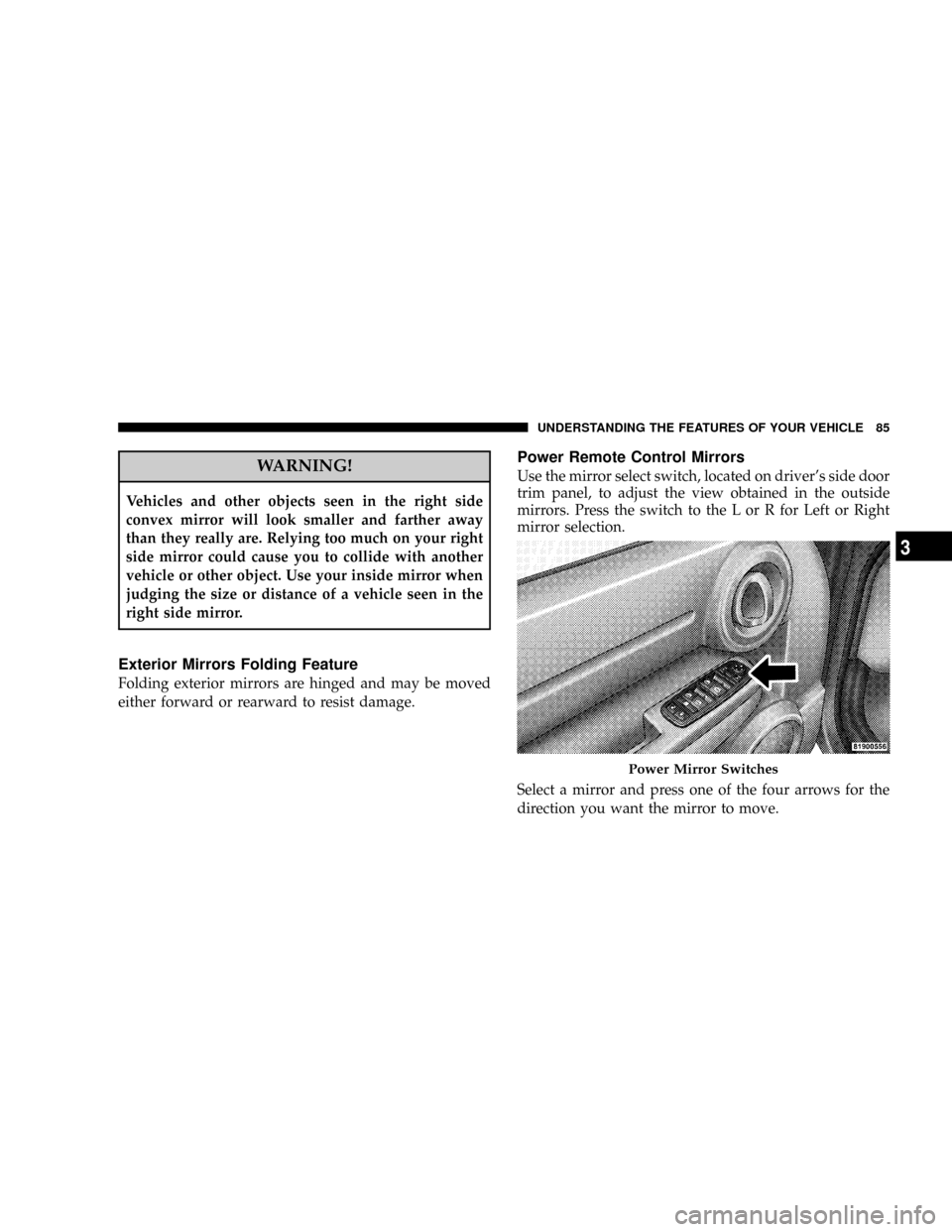
Use the mirror select switch, located on driver's side door
trim panel, to adjust the view obtained in the outside
mirrors. Press the switch to the L or R for Left or Right
mirror selection.
Select a mirror and press one of the four arrows for the
direction you want the mirror to move.
Power Mirror Switches
UNDERSTANDING THE FEATURES OF YOUR VEHICLE 85
3
Page 114 of 434
WARNING!
Adjusting a seat while the vehicle is moving is
dangerous. The sudden movement of the seat could
cause you to lose control. The seat belt might not be
properly adjusted and you could be injured. Adjust
any seat only while the vehicle is parked.
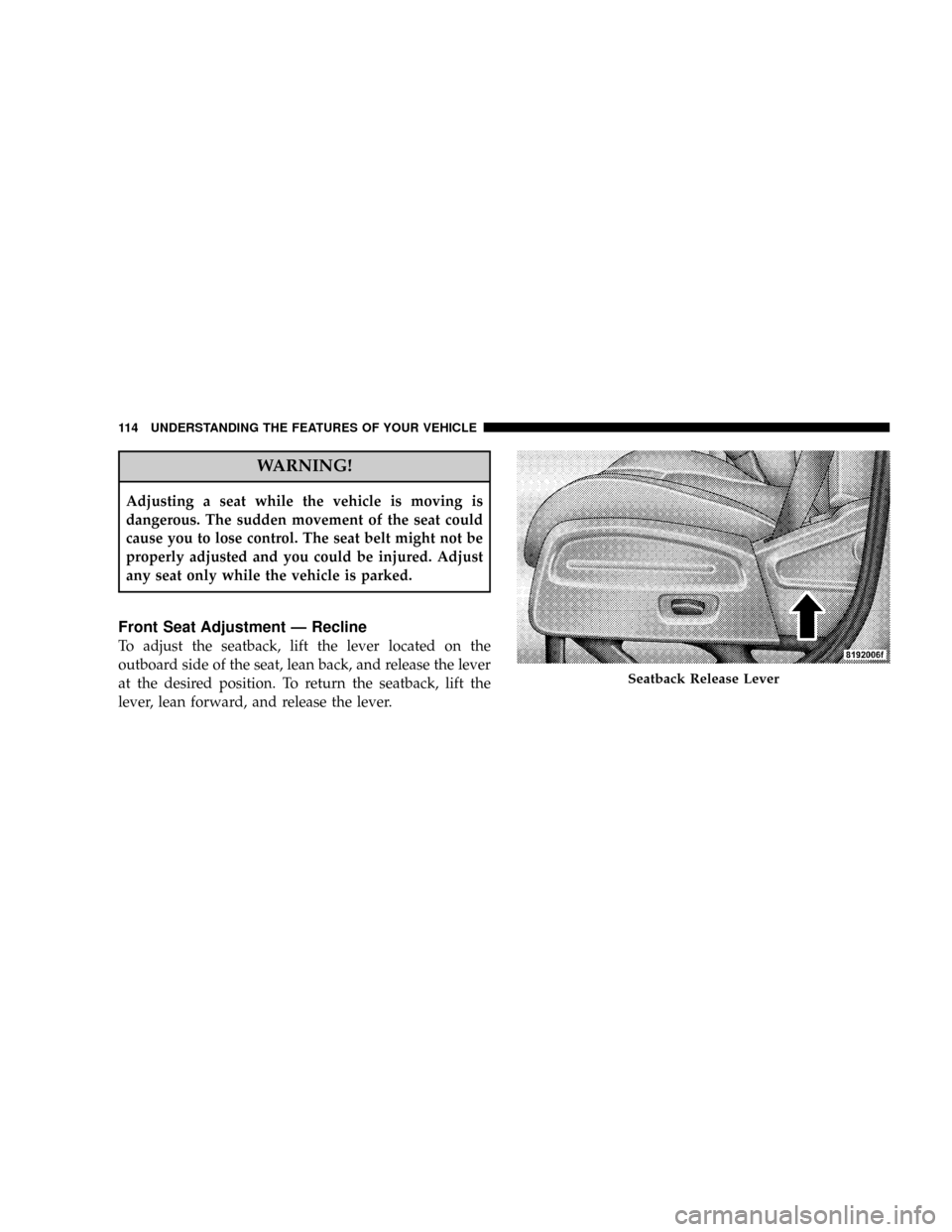
Front Seat Adjustment Ð Recline
To adjust the seatback, lift the lever located on the
outboard side of the seat, lean back, and release the lever
at the desired position. To return the seatback, lift the
lever, lean forward, and release the lever.
Seatback Release Lever
114 UNDERSTANDING THE FEATURES OF YOUR VEHICLE
Page 115 of 434
WARNING!
Do not ride with the seatback reclined so that the seat
belt is no longer resting against your chest. In a
collision you could slide under the seat belt and be
seriously or even fatally injured. Use the recliner
only when the vehicle is parked.
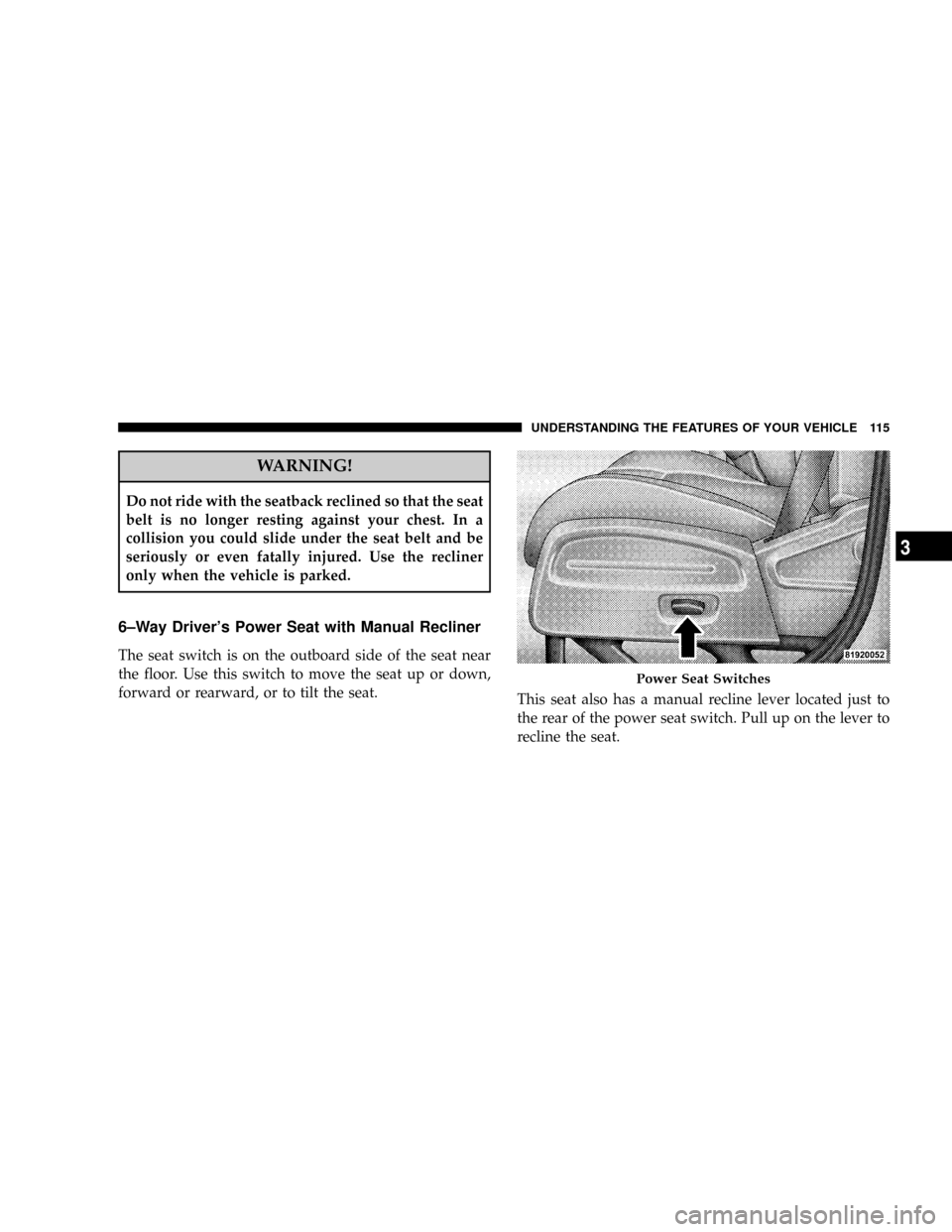
6±Way Driver's Power Seat with Manual Recliner
The seat switch is on the outboard side of the seat near
the floor. Use this switch to move the seat up or down,
forward or rearward, or to tilt the seat.
This seat also has a manual recline lever located just to
the rear of the power seat switch. Pull up on the lever to
recline the seat.
Power Seat Switches
UNDERSTANDING THE FEATURES OF YOUR VEHICLE 115
3
Page 118 of 434
WARNING!
Persons who are unable to feel pain to the skin
because of advanced age, chronic illness, diabetes,
spinal cord injury, medication, alcohol use, exhaus-
tion or other physical condition must exercise care
when using the seat heater. It may cause burns even
at low temperatures, especially if used for long
periods of time.
Do not place anything on the seat that insulates
against heat, such as a blanket or cushion. This may
cause the seat heater to overheat.
60/40 Split Folding Rear Seat with Fold Flat
Feature
To provide additional storage area, each rear seat can be
folded flat to allow for extended cargo space and still
maintain some rear seating room.
The rear seatback also reclines for additional passenger
comfort. Pull the release strap while sitting in the rear
seat to recline the seatback.
118 UNDERSTANDING THE FEATURES OF YOUR VEHICLE