Ball joint DODGE RAM 1500 1998 2.G User Guide
[x] Cancel search | Manufacturer: DODGE, Model Year: 1998, Model line: RAM 1500, Model: DODGE RAM 1500 1998 2.GPages: 2627
Page 58 of 2627
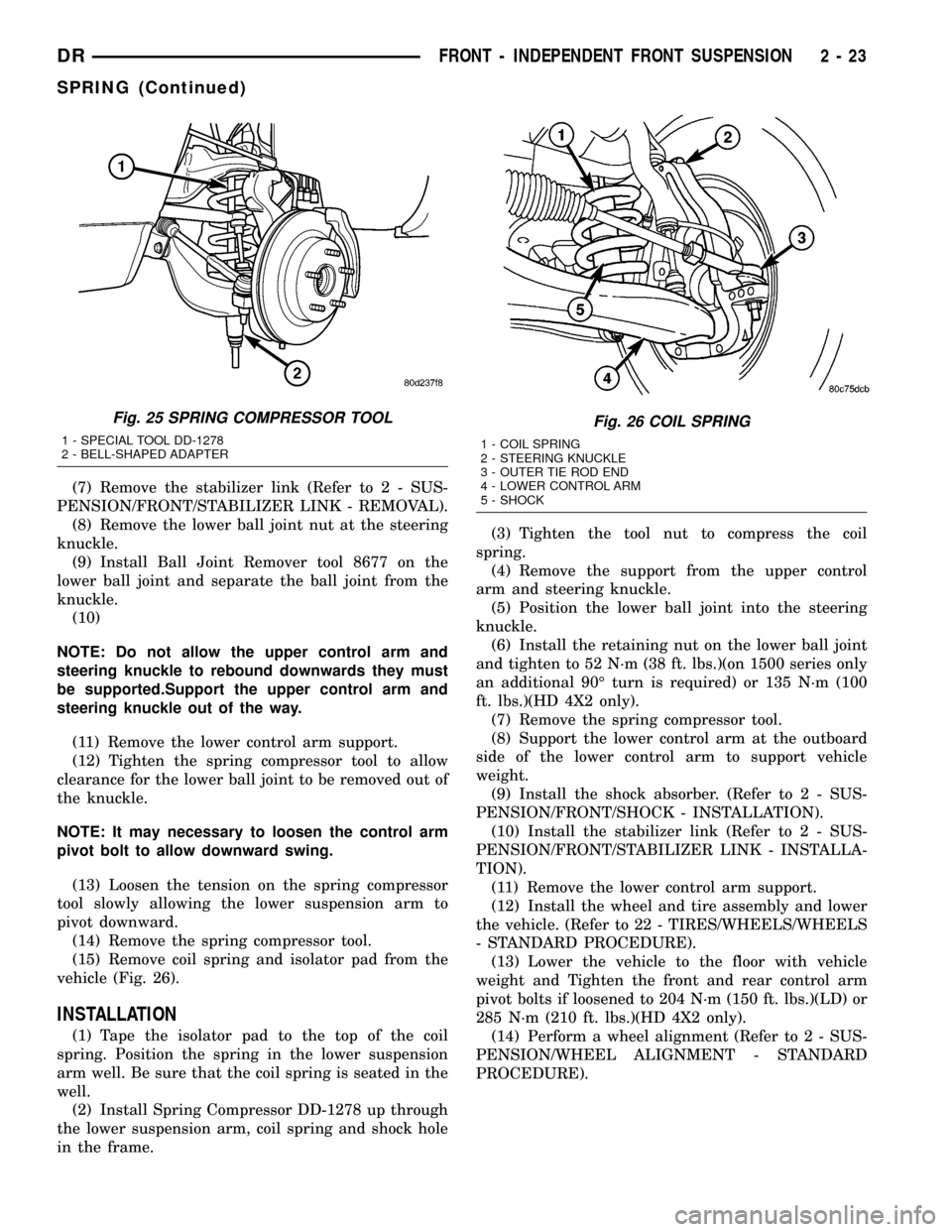
(7) Remove the stabilizer link (Refer to 2 - SUS-
PENSION/FRONT/STABILIZER LINK - REMOVAL).
(8) Remove the lower ball joint nut at the steering
knuckle.
(9) Install Ball Joint Remover tool 8677 on the
lower ball joint and separate the ball joint from the
knuckle.
(10)
NOTE: Do not allow the upper control arm and
steering knuckle to rebound downwards they must
be supported.Support the upper control arm and
steering knuckle out of the way.
(11) Remove the lower control arm support.
(12) Tighten the spring compressor tool to allow
clearance for the lower ball joint to be removed out of
the knuckle.
NOTE: It may necessary to loosen the control arm
pivot bolt to allow downward swing.
(13) Loosen the tension on the spring compressor
tool slowly allowing the lower suspension arm to
pivot downward.
(14) Remove the spring compressor tool.
(15) Remove coil spring and isolator pad from the
vehicle (Fig. 26).
INSTALLATION
(1) Tape the isolator pad to the top of the coil
spring. Position the spring in the lower suspension
arm well. Be sure that the coil spring is seated in the
well.
(2) Install Spring Compressor DD-1278 up through
the lower suspension arm, coil spring and shock hole
in the frame.(3) Tighten the tool nut to compress the coil
spring.
(4) Remove the support from the upper control
arm and steering knuckle.
(5) Position the lower ball joint into the steering
knuckle.
(6) Install the retaining nut on the lower ball joint
and tighten to 52 N´m (38 ft. lbs.)(on 1500 series only
an additional 90É turn is required) or 135 N´m (100
ft. lbs.)(HD 4X2 only).
(7) Remove the spring compressor tool.
(8) Support the lower control arm at the outboard
side of the lower control arm to support vehicle
weight.
(9) Install the shock absorber. (Refer to 2 - SUS-
PENSION/FRONT/SHOCK - INSTALLATION).
(10) Install the stabilizer link (Refer to 2 - SUS-
PENSION/FRONT/STABILIZER LINK - INSTALLA-
TION).
(11) Remove the lower control arm support.
(12) Install the wheel and tire assembly and lower
the vehicle. (Refer to 22 - TIRES/WHEELS/WHEELS
- STANDARD PROCEDURE).
(13) Lower the vehicle to the floor with vehicle
weight and Tighten the front and rear control arm
pivot bolts if loosened to 204 N´m (150 ft. lbs.)(LD) or
285 N´m (210 ft. lbs.)(HD 4X2 only).
(14) Perform a wheel alignment (Refer to 2 - SUS-
PENSION/WHEEL ALIGNMENT - STANDARD
PROCEDURE).
Fig. 25 SPRING COMPRESSOR TOOL
1 - SPECIAL TOOL DD-1278
2 - BELL-SHAPED ADAPTER
Fig. 26 COIL SPRING
1 - COIL SPRING
2 - STEERING KNUCKLE
3 - OUTER TIE ROD END
4 - LOWER CONTROL ARM
5 - SHOCK
DRFRONT - INDEPENDENT FRONT SUSPENSION 2 - 23
SPRING (Continued)
Page 62 of 2627
INSTALLATION
CAUTION: The left and right side torsion bars are
NOT interchangeable. The bars are identified and
stamped R or L, for right or left. The bars do not
have a front or rear end and can be installed with
either end facing forward.
(1) Insert torsion bar ends into anchor and suspen-
sion arm.
(2) Position the anchor in the frame crossmember.
(3) Install Special Tool - 8686 to the anchor and
the crossmember (Fig. 30).
(4) Increase the tension on the anchor in order to
load the torsion bar.
(5) Install the adjustment bolt and the adjuster
nut.
(6) Turn adjustment bolt clockwise the recorded
amount of turns.
(7) Remove tool - 8686 from the torsion bar cross-
member (Fig. 30).
(8) Install the transfer case skid plate (Refer to 13
- FRAME & BUMPERS/FRAME/TRANSFER CASE
SKID PLATE - INSTALLATION).
(9) Lower vehicle and adjust the front suspension
height (Refer to 2 - SUSPENSION/WHEEL ALIGN-
MENT - STANDARD PROCEDURE).
(10) Perform a wheel alignment (Refer to 2 - SUS-
PENSION/WHEEL ALIGNMENT - STANDARD
PROCEDURE).
UPPER BALL JOINT
DIAGNOSIS AND TESTING - UPPER BALL
JOINT
NOTE: If the ball joint is equipped with a lubrication
fitting, grease the joint then road test the vehicle
before performing test.
(1) Raise the front of the vehicle. Place safety floor
stands under both lower control arms as far outboard
as possible. Lower the vehicle to allow the stands to
support some or all of the vehicle weight.
(2) Remove the front tires.(3) Mount a dial indicator solidly to the frame and
then zero the dial indicator.
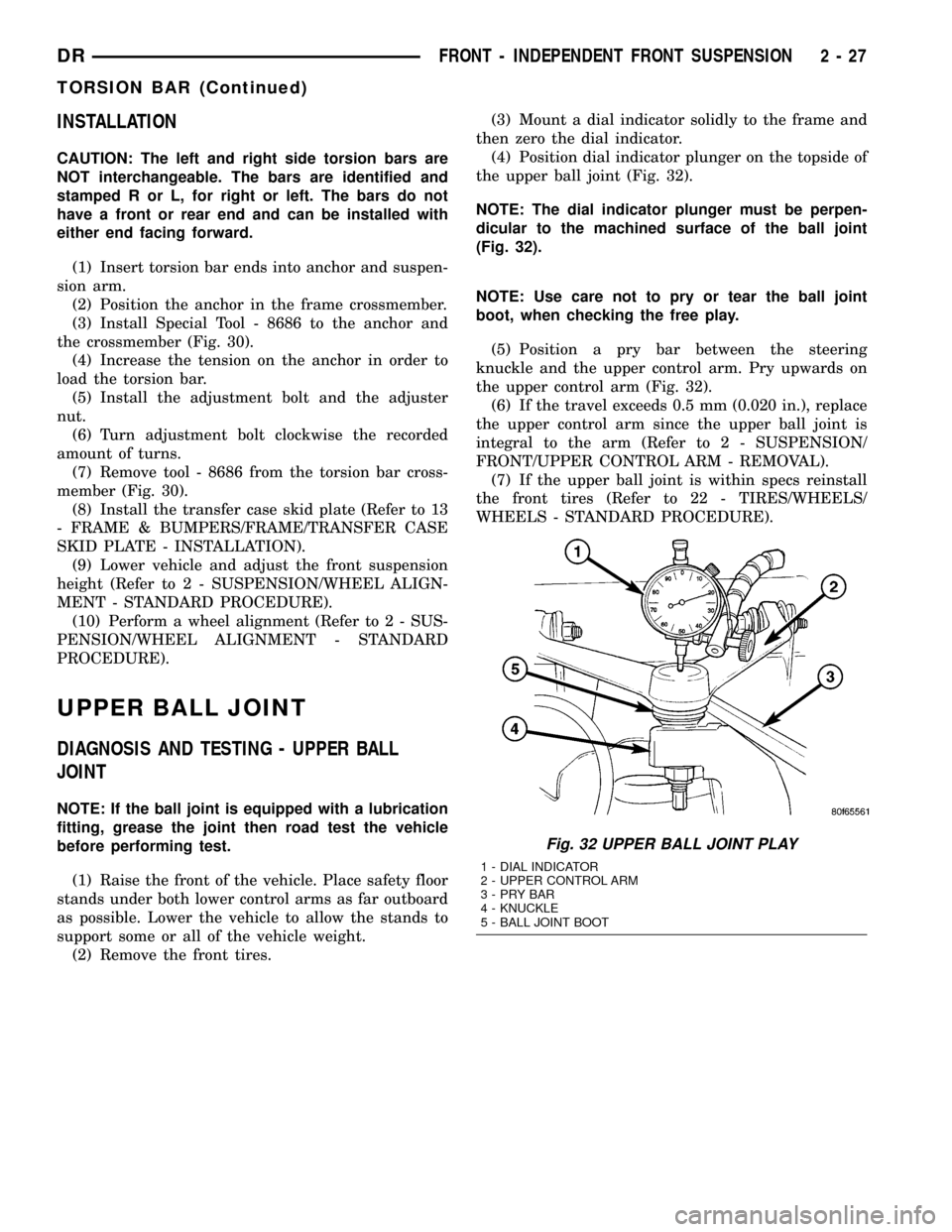
(4) Position dial indicator plunger on the topside of
the upper ball joint (Fig. 32).
NOTE: The dial indicator plunger must be perpen-
dicular to the machined surface of the ball joint
(Fig. 32).
NOTE: Use care not to pry or tear the ball joint
boot, when checking the free play.
(5) Position a pry bar between the steering
knuckle and the upper control arm. Pry upwards on
the upper control arm (Fig. 32).
(6) If the travel exceeds 0.5 mm (0.020 in.), replace
the upper control arm since the upper ball joint is
integral to the arm (Refer to 2 - SUSPENSION/
FRONT/UPPER CONTROL ARM - REMOVAL).
(7) If the upper ball joint is within specs reinstall
the front tires (Refer to 22 - TIRES/WHEELS/
WHEELS - STANDARD PROCEDURE).
Fig. 32 UPPER BALL JOINT PLAY
1 - DIAL INDICATOR
2 - UPPER CONTROL ARM
3-PRYBAR
4 - KNUCKLE
5 - BALL JOINT BOOT
DRFRONT - INDEPENDENT FRONT SUSPENSION 2 - 27
TORSION BAR (Continued)
Page 63 of 2627
UPPER CONTROL ARM
REMOVAL
(1) Raise and support vehicle.
(2) Remove wheel and tire assembly.
(3) Remove the nut from upper ball joint.
(4) Separate upper ball joint from the steering
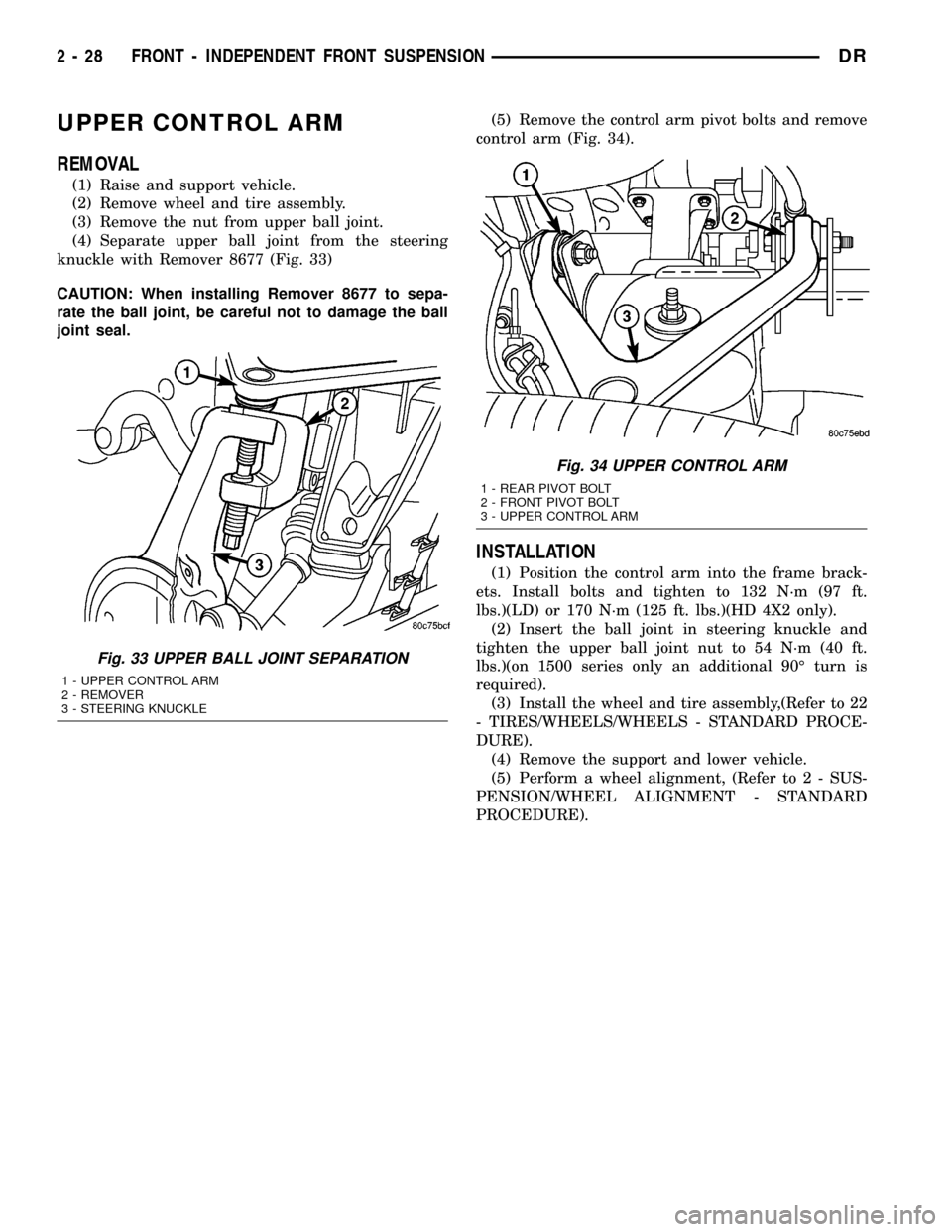
knuckle with Remover 8677 (Fig. 33)
CAUTION: When installing Remover 8677 to sepa-
rate the ball joint, be careful not to damage the ball
joint seal.(5) Remove the control arm pivot bolts and remove
control arm (Fig. 34).
INSTALLATION
(1) Position the control arm into the frame brack-
ets. Install bolts and tighten to 132 N´m (97 ft.
lbs.)(LD) or 170 N´m (125 ft. lbs.)(HD 4X2 only).
(2) Insert the ball joint in steering knuckle and
tighten the upper ball joint nut to 54 N´m (40 ft.
lbs.)(on 1500 series only an additional 90É turn is
required).
(3) Install the wheel and tire assembly,(Refer to 22
- TIRES/WHEELS/WHEELS - STANDARD PROCE-
DURE).
(4) Remove the support and lower vehicle.
(5) Perform a wheel alignment, (Refer to 2 - SUS-
PENSION/WHEEL ALIGNMENT - STANDARD
PROCEDURE).
Fig. 33 UPPER BALL JOINT SEPARATION
1 - UPPER CONTROL ARM
2 - REMOVER
3 - STEERING KNUCKLE
Fig. 34 UPPER CONTROL ARM
1 - REAR PIVOT BOLT
2 - FRONT PIVOT BOLT
3 - UPPER CONTROL ARM
2 - 28 FRONT - INDEPENDENT FRONT SUSPENSIONDR
Page 64 of 2627
FRONT - LINK/COIL
TABLE OF CONTENTS
page page
FRONT - LINK/COIL
SPECIFICATIONS
TORQUE CHART......................29
SPECIAL TOOLS
91/4AA ............................30
HUB / BEARING
REMOVAL.............................31
INSTALLATION.........................32
LOWER BALL JOINT
DIAGNOSIS AND TESTING - LOWER BALL
JOINT..............................34
REMOVAL.............................35
INSTALLATION.........................35
UPPER BALL JOINT
DIAGNOSIS AND TESTING - UPPER BALL
JOINT..............................36
REMOVAL.............................36
INSTALLATION.........................36
KNUCKLE
REMOVAL.............................37
INSTALLATION.........................37UPPER SUSPENSION ARM
REMOVAL
REMOVAL - LEFT.....................37
REMOVAL - RIGHT....................37
INSTALLATION
INSTALLATION - LEFT..................37
INSTALLATION - RIGHT................37
LOWER SUSPENSION ARM
REMOVAL.............................38
INSTALLATION.........................38
SHOCK
DIAGNOSIS AND TESTING - SHOCK........38
REMOVAL.............................38
INSTALLATION.........................38
SPRING
REMOVAL.............................39
INSTALLATION.........................39
STABILIZER BAR
REMOVAL.............................39
INSTALLATION.........................40
FRONT - LINK/COIL
SPECIFICATIONS
TORQUE CHART
TORQUE SPECIFICATIONS
DESCRIPTION N´m Ft. Lbs. In. Lbs.
Shock Absorber
Upper Nut54 40 Ð
Shock Absorber
Lower Bolt136 100 Ð
Lower Suspension Arm
Frame Nuts217 160 Ð
Lower Suspension Arm
Axle Nut217 160 Ð
Upper Suspension Arm
Frame Nuts149 110 Ð
Upper Suspension Arm
Axle Nut149 110 Ð
DRFRONT - LINK/COIL 2 - 29
Page 65 of 2627
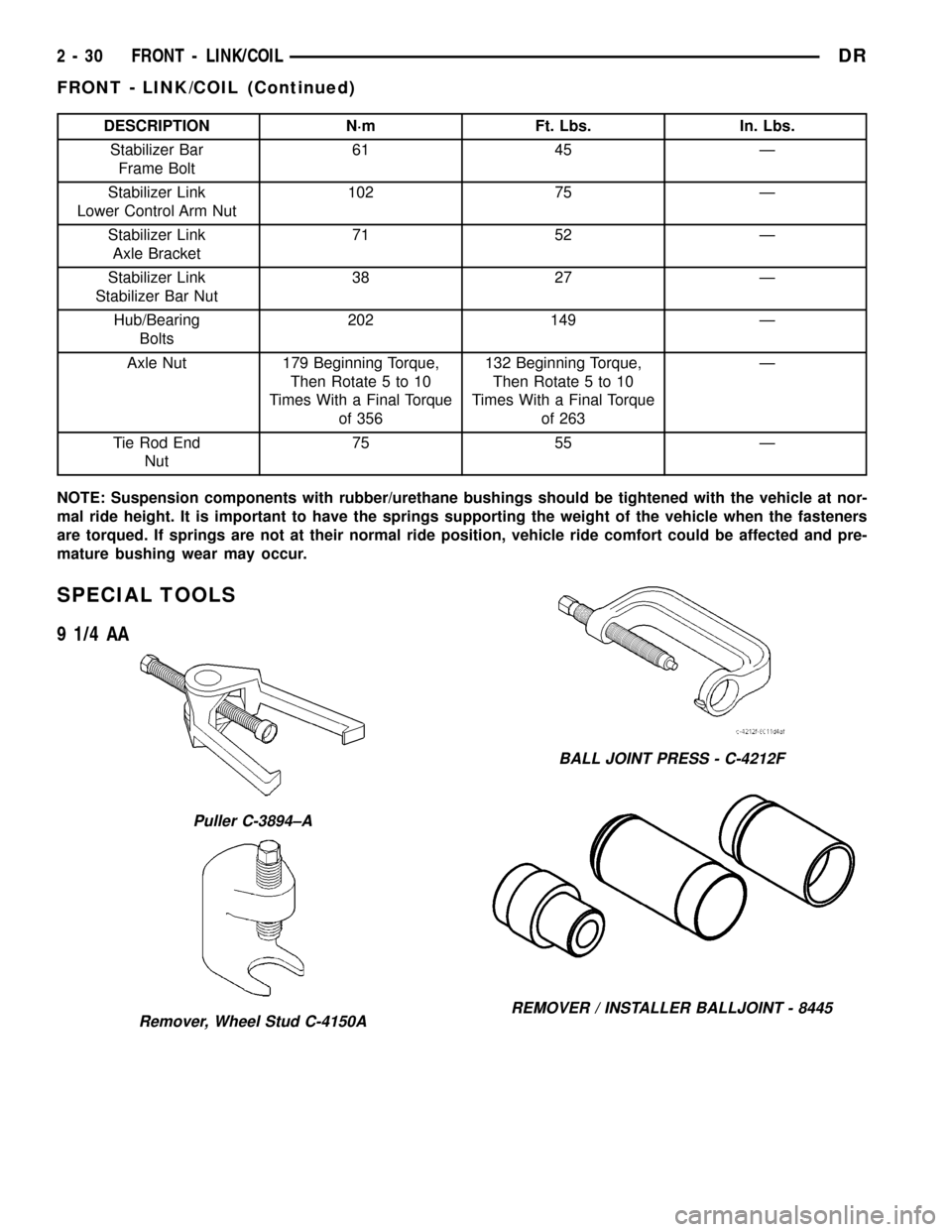
DESCRIPTION N´m Ft. Lbs. In. Lbs.
Stabilizer Bar
Frame Bolt61 45 Ð
Stabilizer Link
Lower Control Arm Nut102 75 Ð
Stabilizer Link
Axle Bracket71 52 Ð
Stabilizer Link
Stabilizer Bar Nut38 27 Ð
Hub/Bearing
Bolts202 149 Ð
Axle Nut 179 Beginning Torque,
Then Rotate 5 to 10
Times With a Final Torque
of 356132 Beginning Torque,
Then Rotate 5 to 10
Times With a Final Torque
of 263Ð
Tie Rod End
Nut75 55 Ð
NOTE: Suspension components with rubber/urethane bushings should be tightened with the vehicle at nor-
mal ride height. It is important to have the springs supporting the weight of the vehicle when the fasteners
are torqued. If springs are not at their normal ride position, vehicle ride comfort could be affected and pre-
mature bushing wear may occur.
SPECIAL TOOLS
9 1/4 AA
Puller C-3894±A
Remover, Wheel Stud C-4150A
BALL JOINT PRESS - C-4212F
REMOVER / INSTALLER BALLJOINT - 8445
2 - 30 FRONT - LINK/COILDR
FRONT - LINK/COIL (Continued)
Page 66 of 2627
HUB / BEARING
REMOVAL
(1) Raise and support the vehicle.
(2) Remove the wheel and tire assembly.
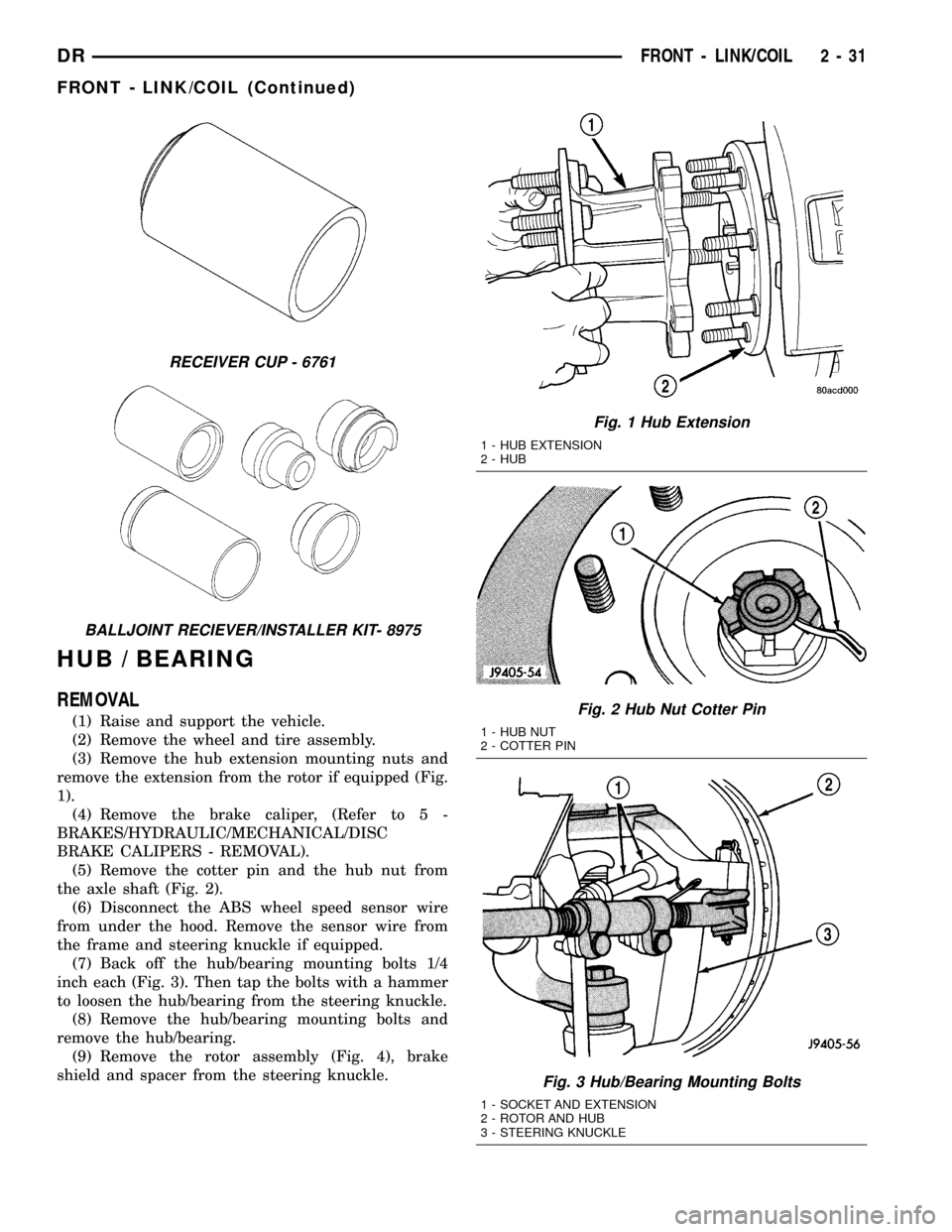
(3) Remove the hub extension mounting nuts and
remove the extension from the rotor if equipped (Fig.
1).
(4) Remove the brake caliper, (Refer to 5 -
BRAKES/HYDRAULIC/MECHANICAL/DISC
BRAKE CALIPERS - REMOVAL).
(5) Remove the cotter pin and the hub nut from
the axle shaft (Fig. 2).
(6) Disconnect the ABS wheel speed sensor wire
from under the hood. Remove the sensor wire from
the frame and steering knuckle if equipped.
(7) Back off the hub/bearing mounting bolts 1/4
inch each (Fig. 3). Then tap the bolts with a hammer
to loosen the hub/bearing from the steering knuckle.
(8) Remove the hub/bearing mounting bolts and
remove the hub/bearing.
(9) Remove the rotor assembly (Fig. 4), brake
shield and spacer from the steering knuckle.
RECEIVER CUP - 6761
BALLJOINT RECIEVER/INSTALLER KIT- 8975
Fig. 1 Hub Extension
1 - HUB EXTENSION
2 - HUB
Fig. 2 Hub Nut Cotter Pin
1 - HUB NUT
2 - COTTER PIN
Fig. 3 Hub/Bearing Mounting Bolts
1 - SOCKET AND EXTENSION
2 - ROTOR AND HUB
3 - STEERING KNUCKLE
DRFRONT - LINK/COIL 2 - 31
FRONT - LINK/COIL (Continued)
Page 69 of 2627
LOWER BALL JOINT
DIAGNOSIS AND TESTING - LOWER BALL
JOINT
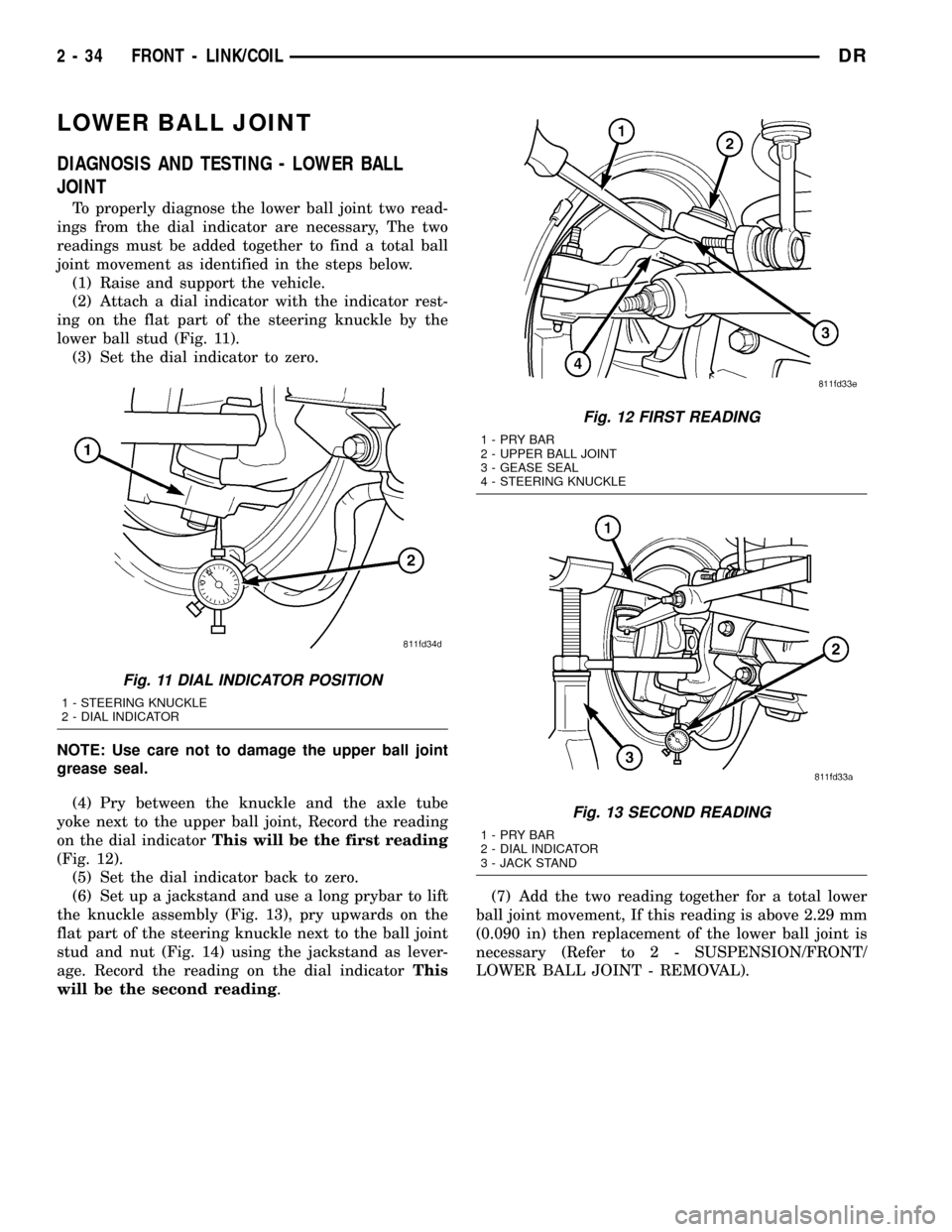
To properly diagnose the lower ball joint two read-
ings from the dial indicator are necessary, The two
readings must be added together to find a total ball
joint movement as identified in the steps below.
(1) Raise and support the vehicle.
(2) Attach a dial indicator with the indicator rest-
ing on the flat part of the steering knuckle by the
lower ball stud (Fig. 11).
(3) Set the dial indicator to zero.
NOTE: Use care not to damage the upper ball joint
grease seal.
(4) Pry between the knuckle and the axle tube
yoke next to the upper ball joint, Record the reading
on the dial indicatorThis will be the first reading
(Fig. 12).
(5) Set the dial indicator back to zero.
(6) Set up a jackstand and use a long prybar to lift
the knuckle assembly (Fig. 13), pry upwards on the
flat part of the steering knuckle next to the ball joint
stud and nut (Fig. 14) using the jackstand as lever-
age. Record the reading on the dial indicatorThis
will be the second reading.(7) Add the two reading together for a total lower
ball joint movement, If this reading is above 2.29 mm
(0.090 in) then replacement of the lower ball joint is
necessary (Refer to 2 - SUSPENSION/FRONT/
LOWER BALL JOINT - REMOVAL).
Fig. 11 DIAL INDICATOR POSITION
1 - STEERING KNUCKLE
2 - DIAL INDICATOR
Fig. 12 FIRST READING
1-PRYBAR
2 - UPPER BALL JOINT
3 - GEASE SEAL
4 - STEERING KNUCKLE
Fig. 13 SECOND READING
1-PRYBAR
2 - DIAL INDICATOR
3 - JACK STAND
2 - 34 FRONT - LINK/COILDR
Page 70 of 2627
REMOVAL
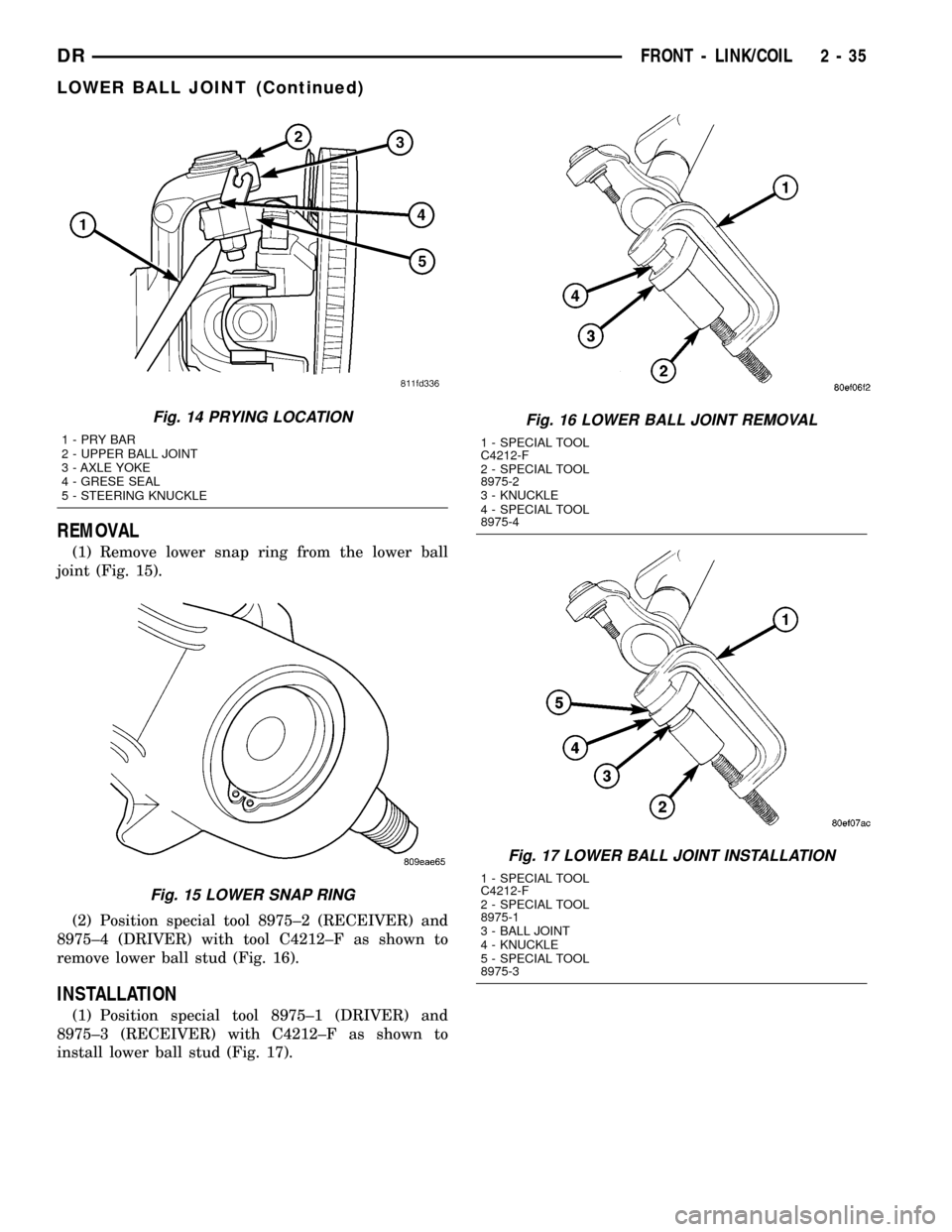
(1) Remove lower snap ring from the lower ball
joint (Fig. 15).
(2) Position special tool 8975±2 (RECEIVER) and
8975±4 (DRIVER) with tool C4212±F as shown to
remove lower ball stud (Fig. 16).
INSTALLATION
(1) Position special tool 8975±1 (DRIVER) and
8975±3 (RECEIVER) with C4212±F as shown to
install lower ball stud (Fig. 17).
Fig. 14 PRYING LOCATION
1-PRYBAR
2 - UPPER BALL JOINT
3 - AXLE YOKE
4 - GRESE SEAL
5 - STEERING KNUCKLE
Fig. 15 LOWER SNAP RING
Fig. 16 LOWER BALL JOINT REMOVAL
1 - SPECIAL TOOL
C4212-F
2 - SPECIAL TOOL
8975-2
3 - KNUCKLE
4 - SPECIAL TOOL
8975-4
Fig. 17 LOWER BALL JOINT INSTALLATION
1 - SPECIAL TOOL
C4212-F
2 - SPECIAL TOOL
8975-1
3 - BALL JOINT
4 - KNUCKLE
5 - SPECIAL TOOL
8975-3
DRFRONT - LINK/COIL 2 - 35
LOWER BALL JOINT (Continued)
Page 71 of 2627
UPPER BALL JOINT
DIAGNOSIS AND TESTING - UPPER BALL
JOINT
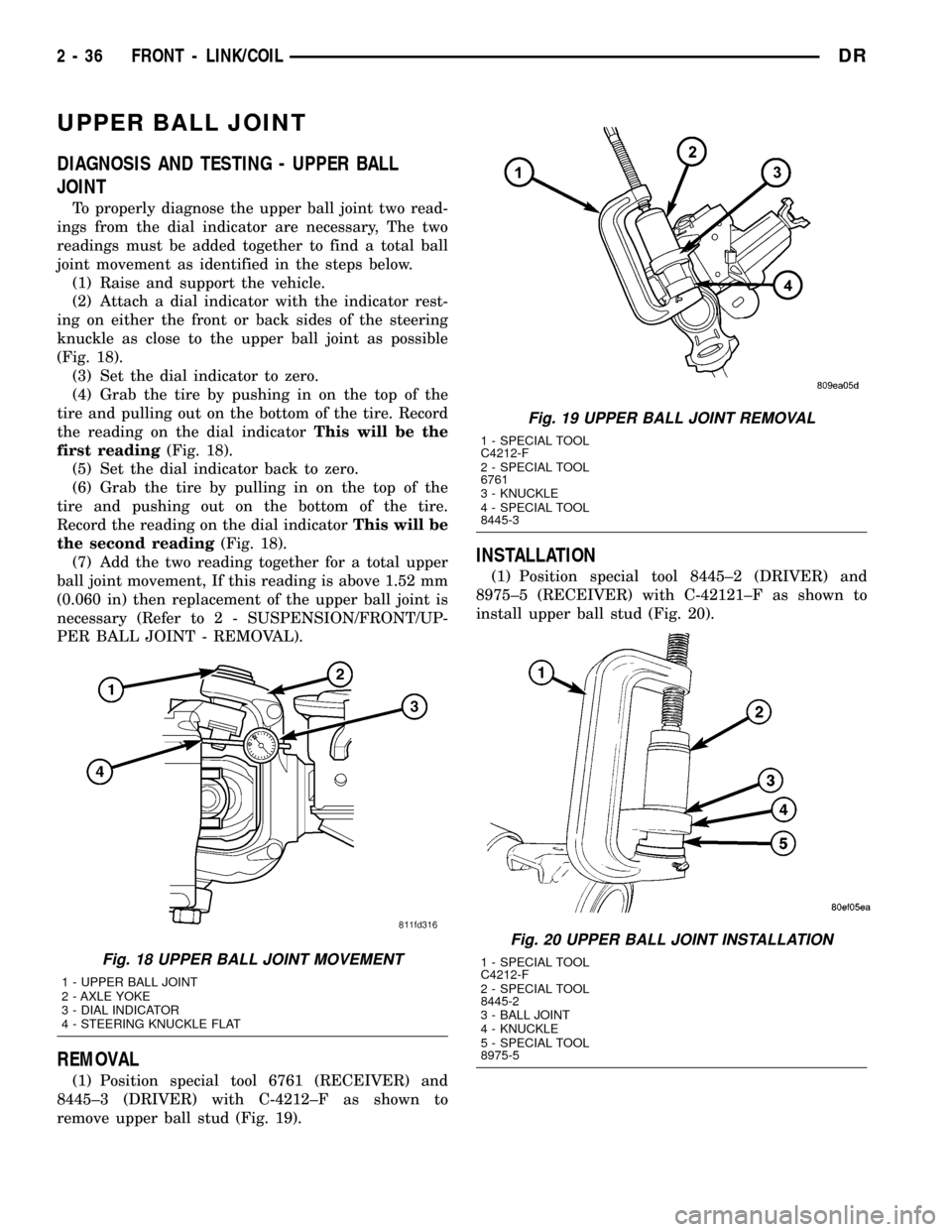
To properly diagnose the upper ball joint two read-
ings from the dial indicator are necessary, The two
readings must be added together to find a total ball
joint movement as identified in the steps below.
(1) Raise and support the vehicle.
(2) Attach a dial indicator with the indicator rest-
ing on either the front or back sides of the steering
knuckle as close to the upper ball joint as possible
(Fig. 18).
(3) Set the dial indicator to zero.
(4) Grab the tire by pushing in on the top of the
tire and pulling out on the bottom of the tire. Record
the reading on the dial indicatorThis will be the
first reading(Fig. 18).
(5) Set the dial indicator back to zero.
(6) Grab the tire by pulling in on the top of the
tire and pushing out on the bottom of the tire.
Record the reading on the dial indicatorThis will be
the second reading(Fig. 18).
(7) Add the two reading together for a total upper
ball joint movement, If this reading is above 1.52 mm
(0.060 in) then replacement of the upper ball joint is
necessary (Refer to 2 - SUSPENSION/FRONT/UP-
PER BALL JOINT - REMOVAL).
REMOVAL
(1) Position special tool 6761 (RECEIVER) and
8445±3 (DRIVER) with C-4212±F as shown to
remove upper ball stud (Fig. 19).
INSTALLATION
(1) Position special tool 8445±2 (DRIVER) and
8975±5 (RECEIVER) with C-42121±F as shown to
install upper ball stud (Fig. 20).
Fig. 18 UPPER BALL JOINT MOVEMENT
1 - UPPER BALL JOINT
2 - AXLE YOKE
3 - DIAL INDICATOR
4 - STEERING KNUCKLE FLAT
Fig. 19 UPPER BALL JOINT REMOVAL
1 - SPECIAL TOOL
C4212-F
2 - SPECIAL TOOL
6761
3 - KNUCKLE
4 - SPECIAL TOOL
8445-3
Fig. 20 UPPER BALL JOINT INSTALLATION
1 - SPECIAL TOOL
C4212-F
2 - SPECIAL TOOL
8445-2
3 - BALL JOINT
4 - KNUCKLE
5 - SPECIAL TOOL
8975-5
2 - 36 FRONT - LINK/COILDR
Page 101 of 2627
HALF SHAFT
TABLE OF CONTENTS
page page
HALF SHAFT
CAUTION.............................20
DIAGNOSIS AND TESTING................20
REMOVAL.............................20
INSTALLATION.........................21
SPECIFICATIONS.......................21
SPECIAL TOOLS.......................21CV JOINT-OUTER
REMOVAL.............................22
INSTALLATION.........................23
CV JOINT-INNER
REMOVAL.............................25
INSTALLATION.........................25
HALF SHAFT
CAUTION
CAUTION:: Never grasp half shaft assembly by the
boots. This may cause the boot to pucker or crease
and reduce the service life of the boot.
Avoid over angulating or stroking the C/V joints
when handling the half shaft.
Half shafts exposed to battery acid, transmission
fluid, brake fluid, differential fluid or gasoline may
cause the boots to deteriorate. Failure to heed cau-
tion may result in damage.
DIAGNOSIS AND TESTING
Check inboard and outboard C/V joint for leaking
grease. This is a sign of boot or boot clamp damage.
NOISE/VIBRATION IN TURNS
A clicking noise or vibration in turns could be
caused by a damaged outer C/V or inner tripod joint
seal boot or seal boot clamps. This will result in the
loss/contamination of the joint grease, resulting in
inadequate lubrication of the joint. Noise could also
be caused by another component of the vehicle com-
ing in contact with the half shafts.
CLUNKING NOISE DURING ACCELERATION
This noise may be a damaged or worn C/V joint. A
torn boot or loose/missing clamp on the inner/outer
joint which has allowed the grease to be lost will
damage the C/V joint.
SHUDDER/VIBRATION DURING ACCELERATION
This could be a worn/damaged inner tripod joint or
a sticking tripod joint. Improper wheel alignment
may also cause a shudder or vibration.
VIBRATION AT HIGHWAY SPEEDS
This problem could be a result of out of balance
front tires or tire/wheel runout. Foreign material
(mud, etc.) packed on the backside of the wheel(s)
will also cause a vibration.
REMOVAL
(1) With vehicle in neutral, position vehicle on
hoist.
(2) Remove half shaft hub nut.
(3) Remove brake caliper and rotor.
(4) Position hydraulic jack under lower suspension
arm and raise jack to unload rebound bumper.
(5) Remove lower shock absorber bolt.
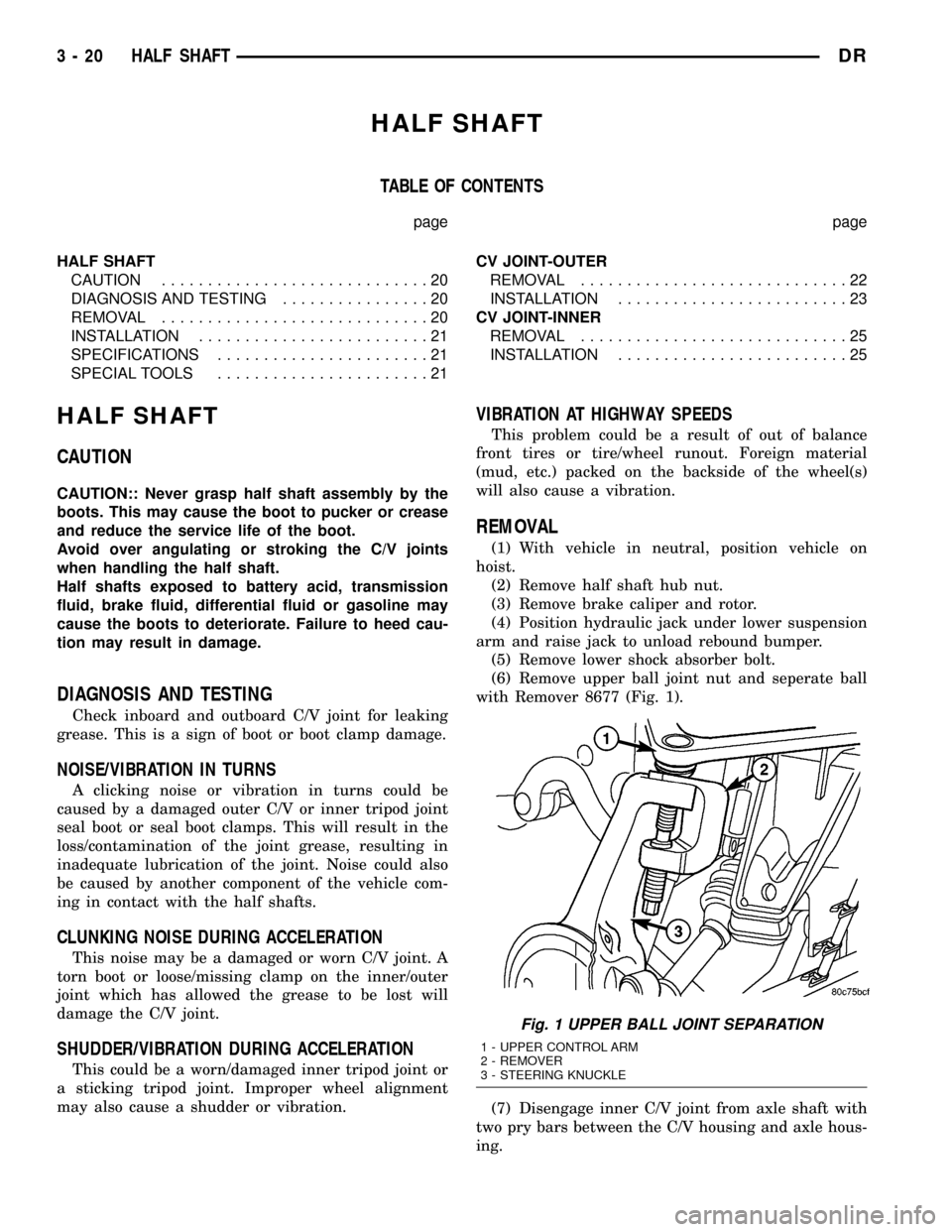
(6) Remove upper ball joint nut and seperate ball
with Remover 8677 (Fig. 1).
(7) Disengage inner C/V joint from axle shaft with
two pry bars between the C/V housing and axle hous-
ing.
Fig. 1 UPPER BALL JOINT SEPARATION
1 - UPPER CONTROL ARM
2 - REMOVER
3 - STEERING KNUCKLE
3 - 20 HALF SHAFTDR