service DODGE RAM 2003 Service Repair Manual
[x] Cancel search | Manufacturer: DODGE, Model Year: 2003, Model line: RAM, Model: DODGE RAM 2003Pages: 2895, PDF Size: 83.15 MB
Page 2823 of 2895
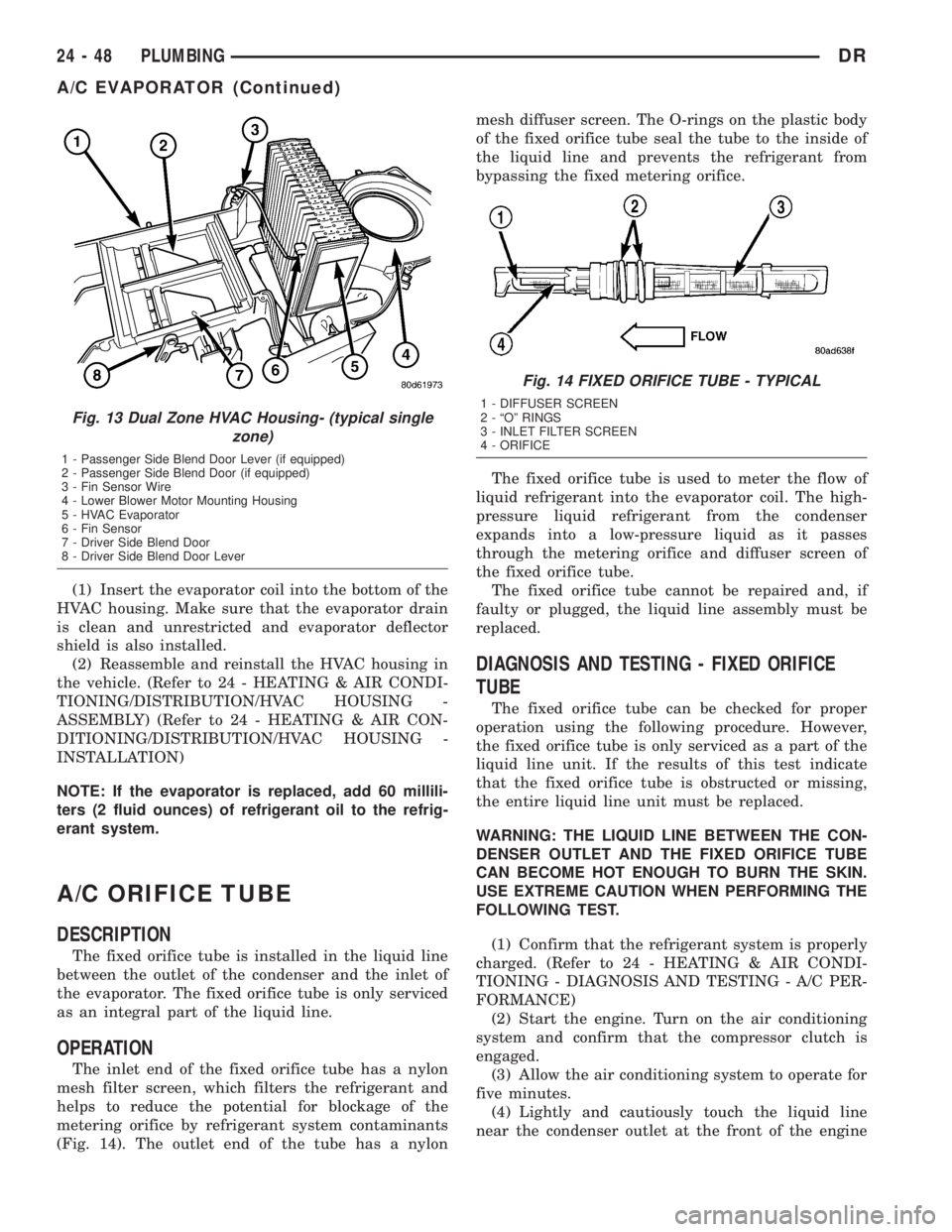
(1) Insert the evaporator coil into the bottom of the
HVAC housing. Make sure that the evaporator drain
is clean and unrestricted and evaporator deflector
shield is also installed.
(2) Reassemble and reinstall the HVAC housing in
the vehicle. (Refer to 24 - HEATING & AIR CONDI-
TIONING/DISTRIBUTION/HVAC HOUSING -
ASSEMBLY) (Refer to 24 - HEATING & AIR CON-
DITIONING/DISTRIBUTION/HVAC HOUSING -
INSTALLATION)
NOTE: If the evaporator is replaced, add 60 millili-
ters (2 fluid ounces) of refrigerant oil to the refrig-
erant system.
A/C ORIFICE TUBE
DESCRIPTION
The fixed orifice tube is installed in the liquid line
between the outlet of the condenser and the inlet of
the evaporator. The fixed orifice tube is only serviced
as an integral part of the liquid line.
OPERATION
The inlet end of the fixed orifice tube has a nylon
mesh filter screen, which filters the refrigerant and
helps to reduce the potential for blockage of the
metering orifice by refrigerant system contaminants
(Fig. 14). The outlet end of the tube has a nylonmesh diffuser screen. The O-rings on the plastic body
of the fixed orifice tube seal the tube to the inside of
the liquid line and prevents the refrigerant from
bypassing the fixed metering orifice.
The fixed orifice tube is used to meter the flow of
liquid refrigerant into the evaporator coil. The high-
pressure liquid refrigerant from the condenser
expands into a low-pressure liquid as it passes
through the metering orifice and diffuser screen of
the fixed orifice tube.
The fixed orifice tube cannot be repaired and, if
faulty or plugged, the liquid line assembly must be
replaced.
DIAGNOSIS AND TESTING - FIXED ORIFICE
TUBE
The fixed orifice tube can be checked for proper
operation using the following procedure. However,
the fixed orifice tube is only serviced as a part of the
liquid line unit. If the results of this test indicate
that the fixed orifice tube is obstructed or missing,
the entire liquid line unit must be replaced.
WARNING: THE LIQUID LINE BETWEEN THE CON-
DENSER OUTLET AND THE FIXED ORIFICE TUBE
CAN BECOME HOT ENOUGH TO BURN THE SKIN.
USE EXTREME CAUTION WHEN PERFORMING THE
FOLLOWING TEST.
(1) Confirm that the refrigerant system is properly
charged. (Refer to 24 - HEATING & AIR CONDI-
TIONING - DIAGNOSIS AND TESTING - A/C PER-
FORMANCE)
(2) Start the engine. Turn on the air conditioning
system and confirm that the compressor clutch is
engaged.
(3) Allow the air conditioning system to operate for
five minutes.
(4) Lightly and cautiously touch the liquid line
near the condenser outlet at the front of the engine
Fig. 13 Dual Zone HVAC Housing- (typical single
zone)
1 - Passenger Side Blend Door Lever (if equipped)
2 - Passenger Side Blend Door (if equipped)
3 - Fin Sensor Wire
4 - Lower Blower Motor Mounting Housing
5 - HVAC Evaporator
6 - Fin Sensor
7 - Driver Side Blend Door
8 - Driver Side Blend Door Lever
Fig. 14 FIXED ORIFICE TUBE - TYPICAL
1 - DIFFUSER SCREEN
2 - ªOº RINGS
3 - INLET FILTER SCREEN
4 - ORIFICE
24 - 48 PLUMBINGDR
A/C EVAPORATOR (Continued)
Page 2826 of 2895
small amount of R-12 added to an R-134a refrigerant
system will cause compressor failure, refrigerant oil
sludge or poor air conditioning system performance.
In addition, the PolyAlkylene Glycol (PAG) synthetic
refrigerant oils used in an R-134a refrigerant system
are not compatible with the mineral-based refriger-
ant oils used in an R-12 refrigerant system.
R-134a refrigerant system service ports, service
tool couplers and refrigerant dispensing bottles have
all been designed with unique fittings to ensure that
an R-134a system is not accidentally contaminated
with the wrong refrigerant (R-12). There are also
labels posted in the engine compartment of the vehi-
cle and on the compressor identifying to service tech-
nicians that the air conditioning system is equipped
with R-134a.
DIAGNOSIS AND TESTING- REFRIGERANT
SYSTEM LEAKS
WARNING: (Refer to 24 - HEATING & AIR CONDI-
TIONING/PLUMBING - WARNING) and (Refer to 24 -
HEATING & AIR CONDITIONING/PLUMBING - CAU-
TION).
If the air conditioning system does not cool prop-
erly, the A/C system performance should be tested.
See A/C Performance in the Diagnosis and Testing
section of this group for the procedures. If the A/C
system refrigerant fill is found to be low or if the sys-
tem is empty; a leak at a refrigerant line, connector
fitting, component, or component seal is likely.
An electronic leak detector designed for R-134a
refrigerant, or a fluorescent R-134a leak detection
dye and a black light are recommended for locating
and confirming refrigerant system leaks. Refer to the
operating instructions supplied by the equipment
manufacturer for the proper care and use of this
equipment.
An oily residue on or near refrigerant system lines,
connector fittings, components, or component seals
can indicate the general location of a possible refrig-
erant leak. However, the exact leak location should
be confirmed with an electronic leak detector prior to
component repair or replacement.
To detect a leak in the refrigerant system with an
electronic leak detector, perform one of the following
procedures:
SYSTEM EMPTY
(1) Evacuate the refrigerant system (Refer to 24 -
HEATING & AIR CONDITIONING/PLUMBING/RE-
FRIGERANT - STANDARD PROCEDURE).
(2) Connect and dispense 0.283 kilograms (0.625
pounds or 10 ounces) of R-134a refrigerant into the
evacuated refrigerant system (Refer to 24 - HEAT-ING & AIR CONDITIONING/PLUMBING/REFRIG-
ERANT - STANDARD PROCEDURE).
(3) Position the vehicle in a wind-free work area.
This will aid in detecting small leaks.
(4) With the engine not running, use a electronic
R-134a leak detector and search for leaks. Because
R-134a refrigerant is heavier than air, the leak detec-
tor probe should be moved slowly along the bottom
side of all refrigerant lines, connector fittings and
components.
(5) To inspect the evaporator coil for leaks, insert
the electronic leak detector probe into the center
instrument panel outlet and the floor duct outlet. Set
the blower motor switch to the lowest speed position,
and the mode control switch in the recirculation
mode (Max-A/C).
SYSTEM LOW
(1) Position the vehicle in a wind-free work area.
This will aid in detecting small leaks.
(2) Bring the refrigerant system up to operating
temperature and pressure. This is done by allowing
the engine to run with the air conditioning system
turned on for five minutes.
(3) With the engine not running, use a electronic
R-134a leak detector and search for leaks. Because
R-134a refrigerant is heavier than air, the leak detec-
tor probe should be moved slowly along the bottom
side of all refrigerant lines, connector fittings and
components.
(4) To inspect the evaporator coil for leaks, insert
the electronic leak detector probe into the center
instrument panel outlet and the floor duct outlet. Set
the blower motor switch to the lowest speed position,
and the mode control switch in the recirculation
mode (Max-A/C).
STANDARD PROCEDURE
STANDARD PROCEDURE - REFRIGERANT
SYSTEM EVACUATE
WARNING: (Refer to 24 - HEATING & AIR CONDI-
TIONING/PLUMBING - WARNING) AND (Refer to 24 -
HEATING & AIR CONDITIONING/PLUMBING - CAU-
TION) BEFORE PERFORMING THE FOLLOWING
OPERATION.
If the refrigerant system has been open to the
atmosphere, it must be evacuated before the system
can be charged. If moisture and air enters the system
and becomes mixed with the refrigerant, the com-
pressor head pressure will rise above acceptable
operating levels. This will reduce the performance of
the air conditioner and could damage the compressor.
Evacuating the refrigerant system will remove the
DRPLUMBING 24 - 51
REFRIGERANT (Continued)
Page 2827 of 2895
air and boil the moisture out of the system at near
room temperature. To evacuate the refrigerant sys-
tem, use the following procedure:
(1) Connect a R-134a refrigerant recovery/recy-
cling/charging station that meets SAE Standard
J2210 and a manifold gauge set (if required) to the
refrigerant system of the vehicle and recover refrig-
erant.
(2) Open the low and high side valves and start
the charging station vacuum pump. When the suc-
tion gauge reads 88 kPa (26 in. Hg.) vacuum or
greater, close all of the valves and turn off the vac-
uum pump.
(a) If the refrigerant system fails to reach the
specified vacuum, the system has a leak that must
be corrected. See Refrigerant System Leaks in the
Diagnosis and Testing section of this group for the
procedures.
(b) If the refrigerant system maintains the spec-
ified vacuum for five minutes, restart the vacuum
pump, open the suction and discharge valves and
evacuate the system for an additional ten minutes.
(3) Close all of the valves, and turn off the charg-
ing station vacuum pump.
(4) The refrigerant system is now ready to be
charged with R-134a refrigerant(Refer to 24 - HEAT-
ING & AIR CONDITIONING/PLUMBING/REFRIG-
ERANT - STANDARD PROCEDURE).
STANDARD PROCEDURE- REFRIGERANT
RECOVERY
WARNING: (Refer to 24 - HEATING & AIR CONDI-
TIONING/PLUMBING - WARNING) AND (Refer to 24 -
HEATING & AIR CONDITIONING/PLUMBING - CAU-
TION) BEFORE PERFORMING THE FOLLOWING
OPERATION.
A R-134a refrigerant recovery/recycling/charging
station that meets SAE Standard J2210 must be
used to recover the refrigerant from an R-134a refrig-
erant system. Refer to the operating instructions sup-
plied by the equipment manufacturer for the proper
care and use of this equipment.
STANDARD PROCEDURE- REFRIGERANT
SYSTEM CHARGE
WARNING: (Refer to 24 - HEATING & AIR CONDI-
TIONING/PLUMBING - WARNING) AND (Refer to 24 -
HEATING & AIR CONDITIONING/PLUMBING - CAU-
TION) BEFORE PERFORMING THE FOLLOWING
OPERATION.
After the refrigerant system has been tested for
leaks and evacuated, a refrigerant charge can beinjected into the system. See Refrigerant Charge
Capacity in the Service Procedures section of this
group for the proper amount of the refrigerant
charge, this fill level can also be found on a label
attached under the hood of the vehicle..
A R-134a refrigerant recovery/recycling/charging
station that meets SAE Standard J2210 must be
used to charge the refrigerant system with R-134a
refrigerant. Refer to the operating instructions sup-
plied by the equipment manufacturer for the proper
care and use of this equipment.
The R-134a refrigerant system charge capacity for
this vehicle is:
²If equipped with a 3.7L or a 4.7L engine charge
to 0.6804 Kg. (24 oz.).
²If equipped with a 5.9L engine charge to 0.7371
Kg. ( 26 oz.).
REFRIGERANT LINE COUPLER
DESCRIPTION
Spring-lock type refrigerant line couplers are used
to connect many of the refrigerant lines and other
components to the refrigerant system. These couplers
require a special tool for disengaging the two coupler
halves.
OPERATION
The spring-lock coupler is held together by a garter
spring inside a circular cage on the male half of the
fitting (Fig. 16). When the two coupler halves are
connected, the flared end of the female fitting slips
behind the garter spring inside the cage on the male
fitting. The garter spring and cage prevent the flared
end of the female fitting from pulling out of the cage.
Three O-rings on the male half of the fitting are
used to seal the connection. These O-rings are com-
patible with R-134a refrigerant and must be replaced
with O-rings made of the same material.
Secondary clips are installed over the two con-
nected coupler halves at the factory for added blowoff
protection.
REMOVAL
WARNING: (Refer to 24 - HEATING & AIR CONDI-
TIONING/PLUMBING - WARNING) (Refer to 24 -
HEATING & AIR CONDITIONING/PLUMBING - CAU-
TION) BEFORE PERFORMING THE FOLLOWING
OPERATION.
(1) Recover the refrigerant from the refrigerant
system(Refer to 24 - HEATING & AIR CONDITION-
ING/PLUMBING/REFRIGERANT - STANDARD
PROCEDURE).
24 - 52 PLUMBINGDR
REFRIGERANT (Continued)
Page 2829 of 2895
(7) Ensure that the spring-lock coupler is fully
engaged by trying to separate the two coupler halves.
This is done by pulling the refrigerant lines on either
side of the coupler away from each other.
(8) Reinstall the secondary clip over the spring-
lock coupler cage.
REFRIGERANT OIL
DESCRIPTION
The refrigerant oil used in R-134a refrigerant sys-
tems is a synthetic-based, PolyAlkylene Glycol (PAG),
wax-free lubricant. Mineral-based R-12 refrigerant
oils are not compatible with PAG oils, and should
never be introduced to an R-134a refrigerant system.
There are different PAG oils available, and each
contains a different additive package. The SD±7 com-
pressor used in this vehicle is designed to use an
SP-15 PAG refrigerant oil. Use only refrigerant oil of
this same type to service the refrigerant system.
OPERATION
After performing any refrigerant recovery or recy-
cling operation, always replenish the refrigerant sys-
tem with the same amount of the recommended
refrigerant oil as was removed. Too little refrigerant
oil can cause compressor damage, and too much can
reduce air conditioning system performance.
PAG refrigerant oil is much more hygroscopic than
mineral oil, and will absorb any moisture it comes
into contact with, even moisture in the air. The PAG
oil container should always be kept tightly capped
until it is ready to be used. After use, recap the oil
container immediately to prevent moisture contami-
nation.
STANDARD PROCEDURE - REFRIGERANT OIL
LEVEL
When an air conditioning system is assembled at
the factory, all components except the compressor are
refrigerant oil free. After the refrigerant system hasbeen charged and operated, the refrigerant oil in the
compressor is dispersed throughout the refrigerant
system. The accumulator, evaporator, condenser, and
compressor will each retain a significant amount of
the needed refrigerant oil.
It is important to have the correct amount of oil in
the refrigerant system. This ensures proper lubrica-
tion of the compressor. Too little oil will result in
damage to the compressor. Too much oil will reduce
the cooling capacity of the air conditioning system.
It will not be necessary to check the oil level in the
compressor or to add oil, unless there has been an oil
loss. An oil loss may occur due to a rupture or leak
from a refrigerant line, a connector fitting, a compo-
nent, or a component seal. If a leak occurs, add 30
milliliters (1 fluid ounce) of refrigerant oil to the
refrigerant system after the repair has been made.
Refrigerant oil loss will be evident at the leak point
by the presence of a wet, shiny surface around the
leak.
Refrigerant oil must be added when a accumulator,
evaporator coil or condenser are replaced. See the
Refrigerant Oil Capacities chart. When a compressor
is replaced, the refrigerant oil must be drained from
the old compressor and measured. Drain all of the
refrigerant oil from the new compressor, then fill the
new compressor with the same amount of refrigerant
oil that was drained out of the old compressor.
Refrigerant Oil Capacities
Component ml fl oz
Complete A/C System 180 6
Accumulator 60 2
Condenser 30 1
Evaporator 60 2
Compressordrain and measure
the oil from the old
compressor - see
text.
24 - 54 PLUMBINGDR
REFRIGERANT LINE COUPLER (Continued)
Page 2843 of 2895
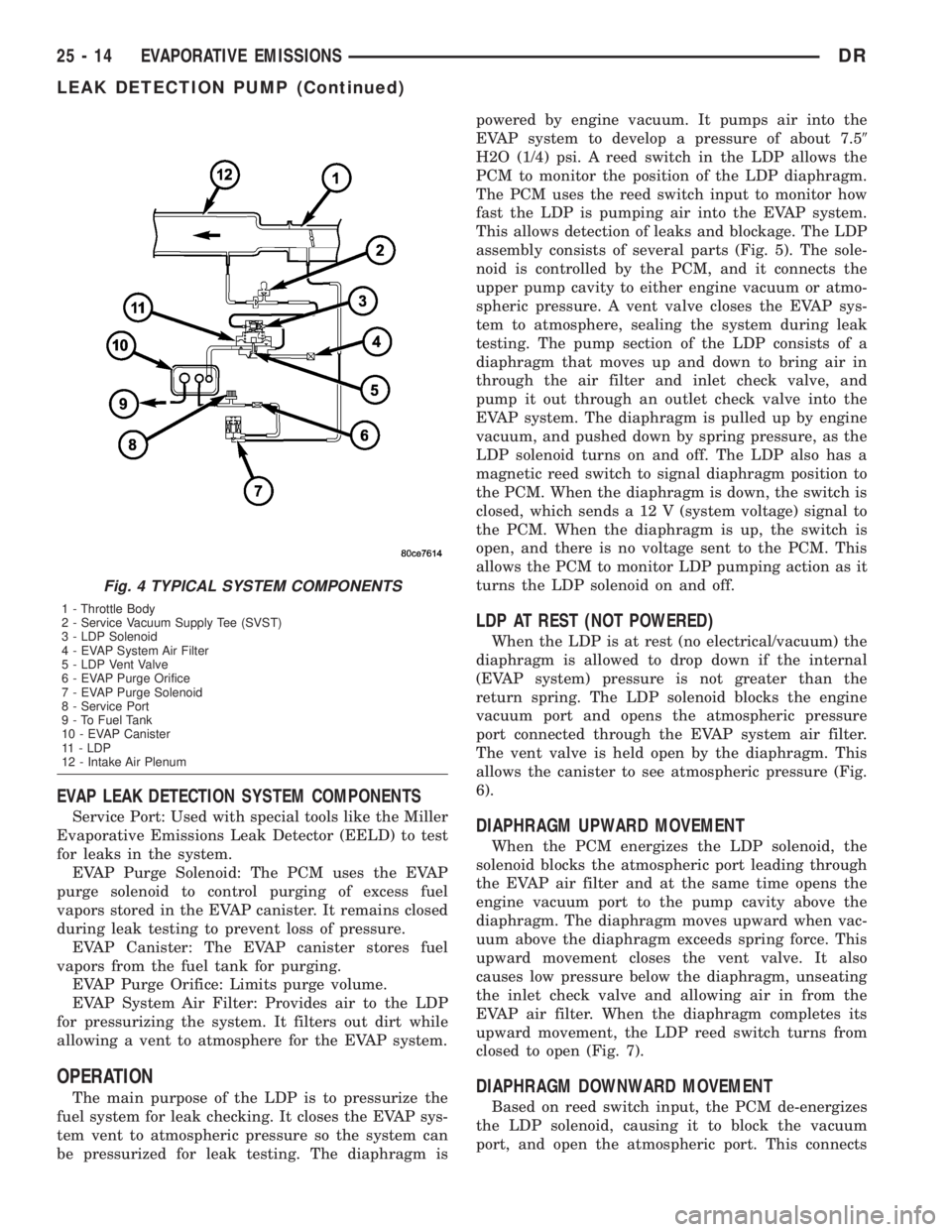
EVAP LEAK DETECTION SYSTEM COMPONENTS
Service Port: Used with special tools like the Miller
Evaporative Emissions Leak Detector (EELD) to test
for leaks in the system.
EVAP Purge Solenoid: The PCM uses the EVAP
purge solenoid to control purging of excess fuel
vapors stored in the EVAP canister. It remains closed
during leak testing to prevent loss of pressure.
EVAP Canister: The EVAP canister stores fuel
vapors from the fuel tank for purging.
EVAP Purge Orifice: Limits purge volume.
EVAP System Air Filter: Provides air to the LDP
for pressurizing the system. It filters out dirt while
allowing a vent to atmosphere for the EVAP system.
OPERATION
The main purpose of the LDP is to pressurize the
fuel system for leak checking. It closes the EVAP sys-
tem vent to atmospheric pressure so the system can
be pressurized for leak testing. The diaphragm ispowered by engine vacuum. It pumps air into the
EVAP system to develop a pressure of about 7.59
H2O (1/4) psi. A reed switch in the LDP allows the
PCM to monitor the position of the LDP diaphragm.
The PCM uses the reed switch input to monitor how
fast the LDP is pumping air into the EVAP system.
This allows detection of leaks and blockage. The LDP
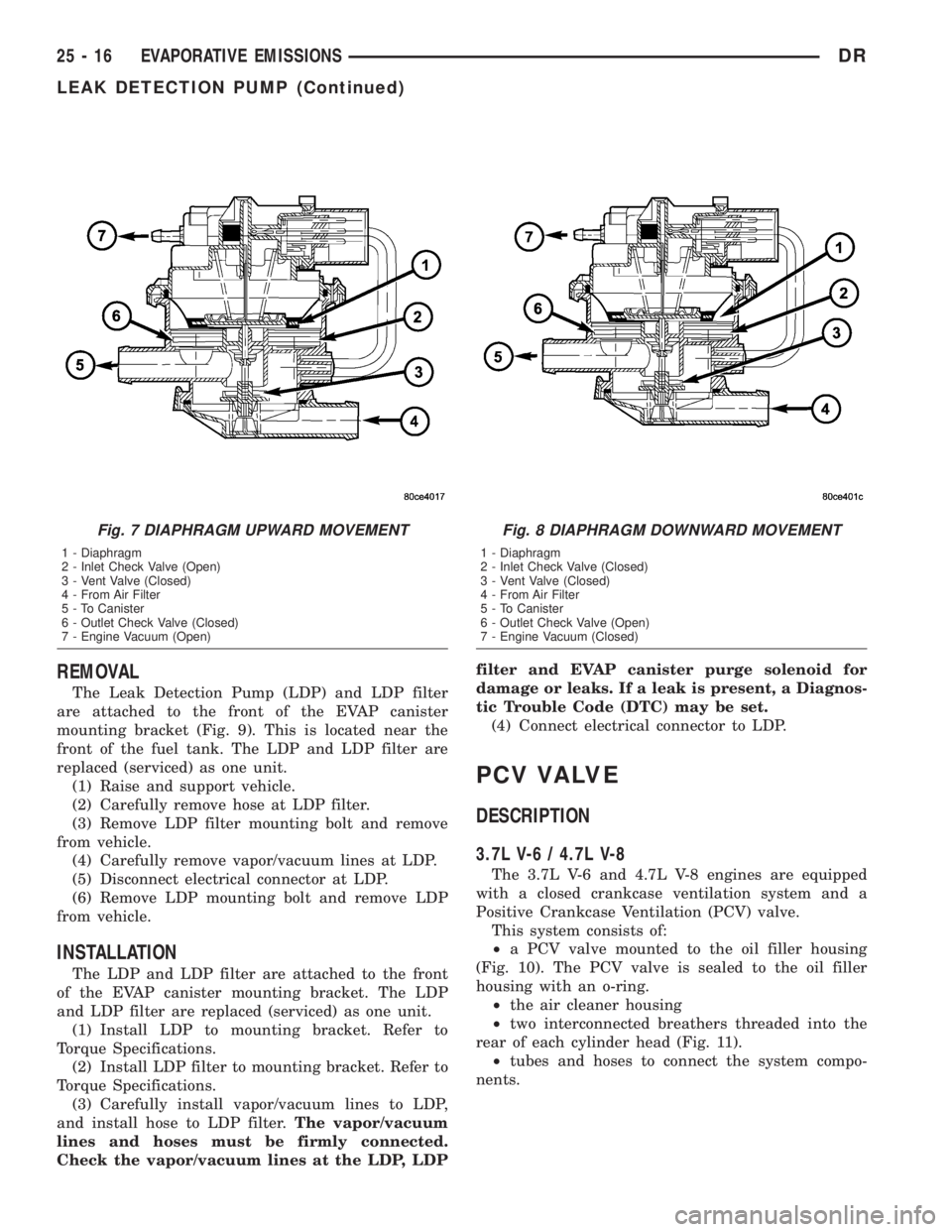
assembly consists of several parts (Fig. 5). The sole-
noid is controlled by the PCM, and it connects the
upper pump cavity to either engine vacuum or atmo-
spheric pressure. A vent valve closes the EVAP sys-
tem to atmosphere, sealing the system during leak
testing. The pump section of the LDP consists of a
diaphragm that moves up and down to bring air in
through the air filter and inlet check valve, and
pump it out through an outlet check valve into the
EVAP system. The diaphragm is pulled up by engine
vacuum, and pushed down by spring pressure, as the
LDP solenoid turns on and off. The LDP also has a
magnetic reed switch to signal diaphragm position to
the PCM. When the diaphragm is down, the switch is
closed, which sends a 12 V (system voltage) signal to
the PCM. When the diaphragm is up, the switch is
open, and there is no voltage sent to the PCM. This
allows the PCM to monitor LDP pumping action as it
turns the LDP solenoid on and off.
LDP AT REST (NOT POWERED)
When the LDP is at rest (no electrical/vacuum) the
diaphragm is allowed to drop down if the internal
(EVAP system) pressure is not greater than the
return spring. The LDP solenoid blocks the engine
vacuum port and opens the atmospheric pressure
port connected through the EVAP system air filter.
The vent valve is held open by the diaphragm. This
allows the canister to see atmospheric pressure (Fig.
6).
DIAPHRAGM UPWARD MOVEMENT
When the PCM energizes the LDP solenoid, the
solenoid blocks the atmospheric port leading through
the EVAP air filter and at the same time opens the
engine vacuum port to the pump cavity above the
diaphragm. The diaphragm moves upward when vac-
uum above the diaphragm exceeds spring force. This
upward movement closes the vent valve. It also
causes low pressure below the diaphragm, unseating
the inlet check valve and allowing air in from the
EVAP air filter. When the diaphragm completes its
upward movement, the LDP reed switch turns from
closed to open (Fig. 7).
DIAPHRAGM DOWNWARD MOVEMENT
Based on reed switch input, the PCM de-energizes
the LDP solenoid, causing it to block the vacuum
port, and open the atmospheric port. This connects
Fig. 4 TYPICAL SYSTEM COMPONENTS
1 - Throttle Body
2 - Service Vacuum Supply Tee (SVST)
3 - LDP Solenoid
4 - EVAP System Air Filter
5 - LDP Vent Valve
6 - EVAP Purge Orifice
7 - EVAP Purge Solenoid
8 - Service Port
9 - To Fuel Tank
10 - EVAP Canister
11 - LDP
12 - Intake Air Plenum
25 - 14 EVAPORATIVE EMISSIONSDR
LEAK DETECTION PUMP (Continued)
Page 2845 of 2895
REMOVAL
The Leak Detection Pump (LDP) and LDP filter
are attached to the front of the EVAP canister
mounting bracket (Fig. 9). This is located near the
front of the fuel tank. The LDP and LDP filter are
replaced (serviced) as one unit.
(1) Raise and support vehicle.
(2) Carefully remove hose at LDP filter.
(3) Remove LDP filter mounting bolt and remove
from vehicle.
(4) Carefully remove vapor/vacuum lines at LDP.
(5) Disconnect electrical connector at LDP.
(6) Remove LDP mounting bolt and remove LDP
from vehicle.
INSTALLATION
The LDP and LDP filter are attached to the front
of the EVAP canister mounting bracket. The LDP
and LDP filter are replaced (serviced) as one unit.
(1) Install LDP to mounting bracket. Refer to
Torque Specifications.
(2) Install LDP filter to mounting bracket. Refer to
Torque Specifications.
(3) Carefully install vapor/vacuum lines to LDP,
and install hose to LDP filter.The vapor/vacuum
lines and hoses must be firmly connected.
Check the vapor/vacuum lines at the LDP, LDPfilter and EVAP canister purge solenoid for
damage or leaks. If a leak is present, a Diagnos-
tic Trouble Code (DTC) may be set.
(4) Connect electrical connector to LDP.
PCV VALVE
DESCRIPTION
3.7L V-6 / 4.7L V-8
The 3.7L V-6 and 4.7L V-8 engines are equipped
with a closed crankcase ventilation system and a
Positive Crankcase Ventilation (PCV) valve.
This system consists of:
²a PCV valve mounted to the oil filler housing
(Fig. 10). The PCV valve is sealed to the oil filler
housing with an o-ring.
²the air cleaner housing
²two interconnected breathers threaded into the
rear of each cylinder head (Fig. 11).
²tubes and hoses to connect the system compo-
nents.
Fig. 7 DIAPHRAGM UPWARD MOVEMENT
1 - Diaphragm
2 - Inlet Check Valve (Open)
3 - Vent Valve (Closed)
4 - From Air Filter
5 - To Canister
6 - Outlet Check Valve (Closed)
7 - Engine Vacuum (Open)
Fig. 8 DIAPHRAGM DOWNWARD MOVEMENT
1 - Diaphragm
2 - Inlet Check Valve (Closed)
3 - Vent Valve (Closed)
4 - From Air Filter
5 - To Canister
6 - Outlet Check Valve (Open)
7 - Engine Vacuum (Closed)
25 - 16 EVAPORATIVE EMISSIONSDR
LEAK DETECTION PUMP (Continued)
Page 2853 of 2895
detection of very small leaks, this system has the
capability of detecting medium as well as large evap-
orative system leaks.
A vent valve seals the canister vent during engine
off conditions. If the vapor system has a leak of less
than the failure threshold, the evaporative system
will be pulled into a vacuum, either due to the cool
down from operating temperature or diurnal ambient
temperature cycling. The diurnal effect is considered
one of the primary contributors to the leak determi-
nation by this diagnostic. When the vacuum in the
system exceeds about 19H2O (0.25 KPA), a vacuum
switch closes. The switch closure sends a signal to
the NGC. The NGC, via appropriate logic strategies,
utilizes the switch signal, or lack thereof, to make a
determination of whether a leak is present.
The NVLD device is designed with a normally open
vacuum switch, a normally closed solenoid, and a
seal, which is actuated by both the solenoid and a
diaphragm. The NVLD is located on the atmospheric
vent side of the canister. The NVLD assembly may
be mounted on top of the canister outlet, or in-line
between the canister and atmospheric vent filter. The
normally open vacuum switch will close with about 19
H2O (0.25 KPA) vacuum in the evaporative system.
The diaphragm actuates the switch. This is above the
opening point of the fuel inlet check valve in the fill
tube so cap off leaks can be detected. Submerged fill
systems must have recirculation lines that do not
have the in-line normally closed check valve that pro-
tects the system from failed nozzle liquid ingestion,
in order to detect cap off conditions.
The normally closed valve in the NVLD is intended
to maintain the seal on the evaporative system dur-
ing the engine off condition. If vacuum in the evapo-
rative system exceeds 39to 69H2O (0.75 to 1.5 KPA),
the valve will be pulled off the seat, opening the seal.
This will protect the system from excessive vacuum
as well as allowing sufficient purge flow in the event
that the solenoid was to become inoperative.
The solenoid actuates the valve to unseal the can-
ister vent while the engine is running. It also will be
used to close the vent during the medium and large
leak tests and during the purge flow check. This sole-
noid requires initial 1.5 amps of current to pull the
valve open but after 100 ms. will be duty cycled down
to an average of about 150 mA for the remainder of
the drive cycle.
Another feature in the device is a diaphragm that
will open the seal in the NVLD with pressure in the
evaporative system. The device will9blow off9at
about 0.59H2O (0.12 KPA) pressure to permit the
venting of vapors during refueling. An added benefit
to this is that it will also allow the tank to9breathe9
during increasing temperatures, thus limiting the
pressure in the tank to this low level. This is benefi-cial because the induced vacuum during a subse-
quent declining temperature will achieve the switch
closed (pass threshold) sooner than if the tank had to
decay from a built up pressure.
The device itself has 3 wires: Switch sense, sole-
noid driver and ground. It also includes a resistor to
protect the switch from a short to battery or a short
to ground. The NGC utilizes a high-side driver to
energize and duty-cycle the solenoid.
REMOVAL
The NVLD pump and filter are attached to the
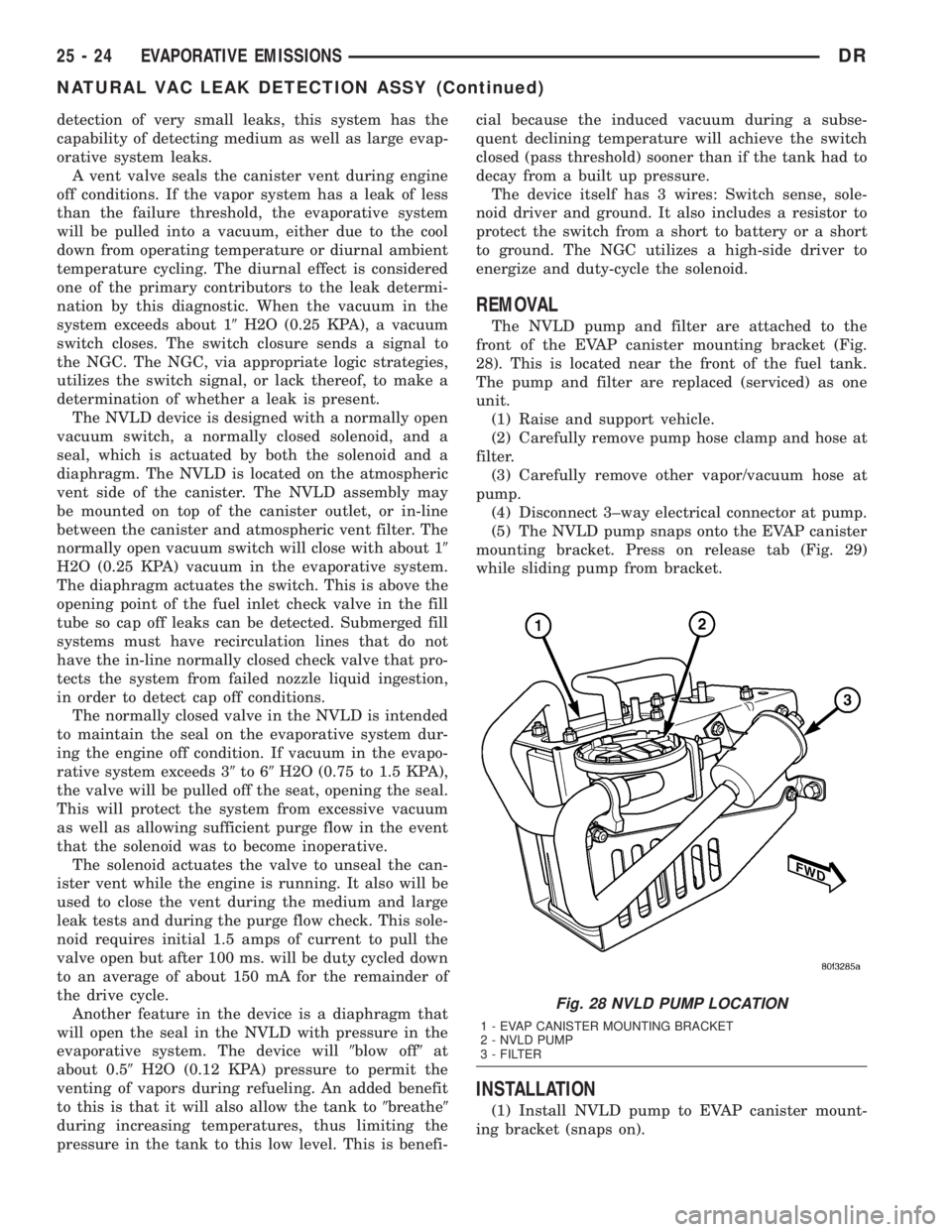
front of the EVAP canister mounting bracket (Fig.
28). This is located near the front of the fuel tank.
The pump and filter are replaced (serviced) as one
unit.
(1) Raise and support vehicle.
(2) Carefully remove pump hose clamp and hose at
filter.
(3) Carefully remove other vapor/vacuum hose at
pump.
(4) Disconnect 3±way electrical connector at pump.
(5) The NVLD pump snaps onto the EVAP canister
mounting bracket. Press on release tab (Fig. 29)
while sliding pump from bracket.
INSTALLATION
(1) Install NVLD pump to EVAP canister mount-
ing bracket (snaps on).
Fig. 28 NVLD PUMP LOCATION
1 - EVAP CANISTER MOUNTING BRACKET
2 - NVLD PUMP
3 - FILTER
25 - 24 EVAPORATIVE EMISSIONSDR
NATURAL VAC LEAK DETECTION ASSY (Continued)
Page 2856 of 2895
ABS - DESCRIPTION, BRAKES...........5-39
ABS - OPERATION, BRAKES.............5-39
ABS BRAKE BLEEDING - STANDARD
PROCEDURE.........................5-40
ABS INDICATOR - DESCRIPTION.........8J-17
ABS INDICATOR - OPERATION..........8J-17
A/C APPLICATION TABLE,
SPECIFICATIONS......................24-7
A/C COMPRESSOR CLUTCH -
DESCRIPTION........................24-9
A/C COMPRESSOR CLUTCH -
INSPECTION........................24-12
A/C COMPRESSOR CLUTCH -
INSTALLATION.......................24-12
A/C COMPRESSOR CLUTCH -
OPERATION..........................24-9
A/C COMPRESSOR CLUTCH - REMOVAL . . 24-10
A/C COMPRESSOR CLUTCH BREAK-IN -
STANDARD PROCEDURE...............24-10
A/C COMPRESSOR CLUTCH COIL -
DIAGNOSIS AND TESTING.............24-10
A/C COMPRESSOR CLUTCH RELAY -
DESCRIPTION.......................24-13
A/C COMPRESSOR CLUTCH RELAY -
INSTALLATION.......................24-14
A/C COMPRESSOR CLUTCH RELAY -
OPERATION.........................24-13
A/C COMPRESSOR CLUTCH RELAY -
REMOVAL..........................24-14
A/C COMPRESSOR NOISE - DIAGNOSIS
AND TESTING.......................24-36
A/C CONDENSER - DESCRIPTION.........24-39
A/C CONDENSER - OPERATION..........24-39
A/C EVAPORATOR - DESCRIPTION.......24-47
A/C EVAPORATOR - INSTALLATION......24-47
A/C EVAPORATOR - OPERATION.........24-47
A/C EVAPORATOR - REMOVAL..........24-47
A/C HEATER CONTROL - DESCRIPTION . . . 24-14
A/C HEATER CONTROL - INSTALLATION . . . 24-15
A/C HEATER CONTROL - REMOVAL......24-14
A/C ORIFICE TUBE - DESCRIPTION.......24-48
A/C ORIFICE TUBE - INSTALLATION......24-49
A/C ORIFICE TUBE - OPERATION........24-48
A/C ORIFICE TUBE - REMOVAL..........24-49
A/C PERFORMANCE - DIAGNOSIS AND
TESTING............................24-2
A/C PRESSURE TRANSDUCER -
DESCRIPTION.......................24-15
A/C PRESSURE TRANSDUCER -
DIAGNOSIS AND TESTING.............24-15
A/C PRESSURE TRANSDUCER -
INSTALLATION.......................24-16
A/C PRESSURE TRANSDUCER -
OPERATION.........................24-15
A/C PRESSURE TRANSDUCER -
REMOVAL..........................24-16
ACCELERATOR PEDAL - INSTALLATION . . . 14-24
ACCELERATOR PEDAL - REMOVAL.......14-24
ACCELERATOR PEDAL POSITION
SENSOR - DESCRIPTION...............14-25
ACCELERATOR PEDAL POSITION
SENSOR - INSTALLATION..............14-25
ACCELERATOR PEDAL POSITION
SENSOR - OPERATION................14-25
ACCELERATOR PEDAL POSITION
SENSOR - REMOVAL..................14-25
ACCESSORY DRIVE BELT - DIAGNOSIS
AND TESTING................7-25,7-28,7-31
ACCUMULATOR - DESCRIPTION.........24-49
ACCUMULATOR - DESCRIPTION
. . 21-191,21-372
ACCUMULATOR - INSPECTION
. . . 21-192,21-373
ACCUMULATOR - INSTALLATION
........24-50
ACCUMULATOR - OPERATION
..........24-49
ACCUMULATOR - OPERATION
....21-192,21-373
ACCUMULATOR - REMOVAL
............24-49
ACM COVER - INSTALLATION
............8O-9
ACM COVER - REMOVAL
...............8O-9
ACTUATION TEST MODE - DESCRIPTION,
CIRCUIT
.............................25-1
ACTUATOR - DESCRIPTION, BLEND
DOOR
.............................24-16
ACTUATOR - DESCRIPTION, FUEL
CONTROL
..........................14-85
ACTUATOR - DESCRIPTION, MODE
DOOR
.............................24-20
ACTUATOR - DESCRIPTION,
RECIRCULATION DOOR
................24-22ACTUATOR - INSTALLATION, BLEND
DOOR.............................24-17
ACTUATOR - INSTALLATION, FLOOR -
DEFROST DOOR.....................24-20
ACTUATOR - INSTALLATION, FUEL
CONTROL..........................14-85
ACTUATOR - INSTALLATION, INSIDE
HANDLE.......................23-22,23-32
ACTUATOR - INSTALLATION, MODE
DOOR.............................24-22
ACTUATOR - INSTALLATION,
RECIRCULATION DOOR................24-23
ACTUATOR - OPERATION, BLEND DOOR . . 24-16
ACTUATOR - OPERATION, FUEL
CONTROL..........................14-85
ACTUATOR - OPERATION, MODE DOOR . . . 24-21
ACTUATOR - OPERATION,
RECIRCULATION DOOR................24-22
ACTUATOR - REMOVAL, BLEND DOOR....24-17
ACTUATOR - REMOVAL, FLOOR -
DEFROST DOOR.....................24-19
ACTUATOR - REMOVAL, FUEL CONTROL . . 14-85
ACTUATOR - REMOVAL, INSIDE HANDLE . 23-22,
23-31
ACTUATOR - REMOVAL, MODE DOOR....24-21
ACTUATOR - REMOVAL, RECIRCULATION
DOOR.............................24-22
ADAPTER HOUSING SEAL -
INSTALLATION...........21-127,21-539,21-83
ADAPTER HOUSING SEAL - REMOVAL . . 21-127,
21-539,21-83
ADAPTER MOUNT - INSTALLATION, DISC
BRAKE CALIPER......................5-17
ADDING ADDITIONAL COOLANT -
STANDARD PROCEDURE................7-19
ADDITIONAL COOLANT - STANDARD
PROCEDURE, ADDING..................7-19
ADHESIVE LOCATIONS -
SPECIFICATIONS, STRUCTURAL........23-113
ADJUSTABLE PEDAL MOTOR -
DESCRIPTION........................5-24
ADJUSTABLE PEDAL MOTOR -
INSTALLATION........................5-24
ADJUSTABLE PEDAL MOTOR - REMOVAL . . 5-24
ADJUSTABLE PEDAL SWITCH -
INSTALLATION.........................5-6
ADJUSTABLE PEDAL SWITCH -
REMOVAL............................5-6
ADJUSTER - DIAGNOSIS AND TESTING,
HYDRAULIC LASH................9-124,9-31
ADJUSTER - INSTALLATION, SEAT BELT
TURNING LOOP.....................8O-50
ADJUSTER - REMOVAL, SEAT BELT
TURNING LOOP.....................8O-50
ADJUSTER ASSEMBLY - DESCRIPTION,
ROCKER ARM.......................9-124
ADJUSTER ASSEMBLY - INSTALLATION,
ROCKER ARM..................9-124,9-249
ADJUSTER ASSEMBLY - REMOVAL,
ROCKER ARM..................9-124,9-249
ADJUSTER ASSY - CLEANING, ROCKER
ARM
..............................9-310
ADJUSTER ASSY - DESCRIPTION,
ROCKER ARM
.......................9-310
ADJUSTER ASSY - INSPECTION,
ROCKER ARM
.......................9-311
ADJUSTER ASSY - INSTALLATION,
ROCKER ARM
.............9-198,9-312,9-379
ADJUSTER ASSY - REMOVAL, ROCKER
ARM
....................9-198,9-310,9-379
ADJUSTING TOOL - ADJUSTMENT, WITH
. . . 5-36
AFTER A SUPPLEMENTAL RESTRAINT
DEPLOYMENT - STANDARD
PROCEDURE, SERVICE
.................8O-7
AIR CHECKING TRANSMISSION CLUTCH
OPERATION - DIAGNOSIS AND
TESTING
..........................21-494
AIR CLEANER ELEMENT - INSTALLATION
. 9-105,
9-20,9-242,9-298,9-370
AIR CLEANER ELEMENT - REMOVAL
. 9-105,9-20,
9-242,9-297,9-370
AIR CONDITIONER - DESCRIPTION,
HEATER
.............................24-1
AIR CONDITIONER - OPERATION,
HEATER
.............................24-1
AIR CONDITIONING - INSTALLATION,
WATER PUMP BYPASS HOSE WITH
.......7-70AIR CONDITIONING - INSTALLATION,
WATER PUMP BYPASS HOSE
WITHOUT............................7-70
AIR CONDITIONING - REMOVAL, WATER
PUMP BYPASS HOSE WITH.............7-68
AIR CONDITIONING - REMOVAL, WATER
PUMP BYPASS HOSE WITHOUT..........7-69
AIR CONTROL MOTOR - DESCRIPTION,
IDLE...............................14-33
AIR CONTROL MOTOR - INSTALLATION,
IDLE...............................14-35
AIR CONTROL MOTOR - OPERATION,
IDLE...............................14-33
AIR CONTROL MOTOR - REMOVAL, IDLE . . 14-34
AIR COOLER AND PLUMBING -
CLEANING, CHARGE..................11-16
AIR COOLER AND PLUMBING -
DESCRIPTION, CHARGE...............11-15
AIR COOLER AND PLUMBING -
INSPECTION, CHARGE.................11-16
AIR COOLER AND PLUMBING -
INSTALLATION, CHARGE...............11-16
AIR COOLER AND PLUMBING -
OPERATION, CHARGE.................11-15
AIR COOLER AND PLUMBING -
REMOVAL, CHARGE..................11-15
AIR COOLER SYSTEM - LEAKS -
DIAGNOSIS AND TESTING, CHARGE......11-15
AIR DAM - INSTALLATION, FRONT........13-2
AIR DAM - REMOVAL, FRONT...........13-2
AIR HEATER - DESCRIPTION, INTAKE.....14-91
AIR HEATER - INSTALLATION, INTAKE....14-91
AIR HEATER - OPERATION, INTAKE......14-91
AIR HEATER - REMOVAL, INTAKE........14-91
AIR HEATER RELAY - DESCRIPTION,
INTAKE ............................14-92
AIR HEATER RELAY - INSTALLATION,
INTAKE ............................14-93
AIR HEATER RELAY - OPERATION,
INTAKE ............................14-92
AIR HEATER RELAY - REMOVAL, INTAKE . . 14-93
AIR INTAKE SYSTEM - INSTALLATION....9-194
AIR INTAKE SYSTEM - REMOVAL........9-194
AIR TEMPERATURE SENSOR -
DESCRIPTION, INTAKE................14-36
AIR TEMPERATURE SENSOR -
INSTALLATION, INTAKE................14-38
AIR TEMPERATURE SENSOR -
OPERATION, INTAKE..................14-36
AIR TEMPERATURE SENSOR -
REMOVAL, INTAKE...................14-36
AIR TEMPERATURE SENSOR/MAP
SENSOR - DESCRIPTION, INTAKE........14-93
AIR TEMPERATURE SENSOR/MAP
SENSOR - INSTALLATION, INTAKE.......14-94
AIR TEMPERATURE SENSOR/MAP
SENSOR - OPERATION, INTAKE.........14-93
AIR TEMPERATURE SENSOR/MAP
SENSOR - REMOVAL, INTAKE...........14-93
AIR TEMPERATURE SENSOR/PRESSURE
SENSOR - DESCRIPTION, INLET.........14-90
AIR TEMPERATURE SENSOR/PRESSURE
SENSOR - INSTALLATION, INLET........14-90
AIR TEMPERATURE SENSOR/PRESSURE
SENSOR - OPERATION, INLET..........14-90
AIR TEMPERATURE SENSOR/PRESSURE
SENSOR - REMOVAL, INLET............14-90
AIR TESTING TRANSMISSION CLUTCH
AND BAND OPERATION - DIAGNOSIS
AND TESTING................21-143,21-324
AIR TO OIL COOLER - INSTALLATION.....7-75
AIR TO OIL COOLER - REMOVAL.........7-74
AIRBAG - DESCRIPTION, DRIVER........8O-22
AIRBAG - DESCRIPTION, PASSENGER....8O-34
AIRBAG - DESCRIPTION, SIDE CURTAIN . . 8O-51
AIRBAG - INSTALLATION, DRIVER.......8O-24
AIRBAG - INSTALLATION, PASSENGER . . . 8O-37
AIRBAG - INSTALLATION, SIDE CURTAIN . . 8O-53
AIRBAG - OPERATION, DRIVER.........8O-23
AIRBAG - OPERATION, PASSENGER......8O-35
AIRBAG - OPERATION, SIDE CURTAIN....8O-51
AIRBAG - REMOVAL, DRIVER
...........8O-23
AIRBAG - REMOVAL, PASSENGER
.......8O-35
AIRBAG - REMOVAL, SIDE CURTAIN
.....8O-52
AIRBAG CONTROL MODULE -
DESCRIPTION
.......................8O-10
AIRBAG CONTROL MODULE -
DESCRIPTION, SIDE IMPACT
...........8O-53
DRINDEX 1
Description Group-Page Description Group-Page Description Group-Page
Page 2861 of 2895
CARDAN UNIVERSAL JOINTS -
DISASSEMBLY, SINGLE..................3-9
CARGO BOX - INSTALLATION...........23-37
CARGO BOX - REMOVAL...............23-37
CARGO BOX - TIE DOWN -
INSTALLATION.......................23-37
CARGO BOX - TIE DOWN - REMOVAL....23-37
CARGO LAMP INDICATOR -
DESCRIPTION.......................8J-20
CARGO LAMP INDICATOR - OPERATION . . 8J-20
CARPETS AND FLOOR MATS -
INSTALLATION.......................23-66
CARPETS AND FLOOR MATS - REMOVAL . 23-66
CASCADE OVERFLOW VALVE -
DESCRIPTION.......................14-77
CASCADE OVERFLOW VALVE -
OPERATION.........................14-77
CASE - NV241 GENII - ASSEMBLY,
TRANSFER.........................21-604
CASE - NV241 GENII - CLEANING,
TRANSFER.........................21-602
CASE - NV241 GENII - DESCRIPTION,
TRANSFER............................0-4
CASE - NV241 GENII - DESCRIPTION,
TRANSFER.........................21-591
CASE - NV241 GENII - DIAGNOSIS AND
TESTING, TRANSFER.................21-592
CASE - NV241 GENII - DISASSEMBLY,
TRANSFER.........................21-593
CASE - NV241 GENII - INSPECTION,
TRANSFER.........................21-602
CASE - NV241 GENII - INSTALLATION,
TRANSFER.........................21-614
CASE - NV241 GENII - OPERATION,
TRANSFER.........................21-591
CASE - NV241 GENII - REMOVAL,
TRANSFER.........................21-593
CASE - NV243 - ASSEMBLY, TRANSFER . . 21-670
CASE - NV243 - CLEANING, TRANSFER . . 21-668
CASE - NV243 - DESCRIPTION,
TRANSFER............................0-4
CASE - NV243 - DESCRIPTION,
TRANSFER.........................21-658
CASE - NV243 - DIAGNOSIS AND
TESTING, TRANSFER.................21-659
CASE - NV243 - DISASSEMBLY,
TRANSFER.........................21-660
CASE - NV243 - INSPECTION, TRANSFER . 21-668
CASE - NV243 - INSTALLATION,
TRANSFER.........................21-679
CASE - NV243 - OPERATION, TRANSFER . 21-659
CASE - NV243 - REMOVAL, TRANSFER . . 21-660
CASE - NV271 - ASSEMBLY, TRANSFER . . 21-637
CASE - NV271 - CLEANING, TRANSFER . . 21-635
CASE - NV271 - DESCRIPTION,
TRANSFER............................0-4
CASE - NV271 - DESCRIPTION,
TRANSFER.........................21-623
CASE - NV271 - DIAGNOSIS AND
TESTING, TRANSFER.................21-624
CASE - NV271 - DISASSEMBLY,
TRANSFER.........................21-625
CASE - NV271 - INSPECTION, TRANSFER . 21-635
CASE - NV271 - INSTALLATION,
TRANSFER.........................21-649
CASE - NV271 - OPERATION, TRANSFER . 21-623
CASE - NV271 - REMOVAL, TRANSFER . . 21-625
CASE - NV273 - ASSEMBLY, TRANSFER . . 21-701
CASE - NV273 - CLEANING, TRANSFER . . 21-698
CASE - NV273 - DESCRIPTION,
TRANSFER............................0-4
CASE - NV273 - DESCRIPTION,
TRANSFER.........................21-687
CASE - NV273 - DIAGNOSIS AND
TESTING, TRANSFER.................21-688
CASE - NV273 - DISASSEMBLY,
TRANSFER.........................21-689
CASE - NV273 - INSPECTION, TRANSFER . 21-699
CASE - NV273 - INSTALLATION,
TRANSFER.........................21-713
CASE - NV273 - OPERATION, TRANSFER
. 21-688
CASE - NV273 - REMOVAL, TRANSFER
. . 21-689
CASE BEARINGS - INSTALLATION,
DIFFERENTIAL
......3-121,3-148,3-39,3-65,3-94
CASE BEARINGS - REMOVAL,
DIFFERENTIAL
......3-121,3-148,3-39,3-64,3-93
CASE CONTROL MODULE -
DESCRIPTION, TRANSFER
.............8E-15CASE CONTROL MODULE - OPERATION,
TRANSFER..........................8E-15
CASE, NV241 GENII - TRANSFER.......21-614
CASE, NV241/NV243 - TRANSFER......21-615,
21-680
CASE, NV243 - TRANSFER............21-680
CASE, NV271 - TRANSFER............21-649
CASE NV271/NV273, SPECIAL TOOLS -
TRANSFER...................21-650,21-714
CASE, NV273 - TRANSFER............21-713
CASE SKID PLATE - INSTALLATION,
TRANSFER..........................13-26
CASE SKID PLATE - REMOVAL,
TRANSFER..........................13-26
CASTER ADJUSTMENT - STANDARD
PROCEDURE, CAMBER..................2-4
CASTER AND TOE ADJUSTMENT -
STANDARD PROCEDURE, CAMBER........2-4
CATALYTIC CONVERTER - DESCRIPTION . . . 11-4
CATALYTIC CONVERTER - OPERATION.....11-4
CATCH - INSTALLATION, LATCH STRIKER
/ SECONDARY.......................23-48
CATCH - REMOVAL, LATCH STRIKER /
SECONDARY........................23-48
CAUSES OF BURNT FLUID - DIAGNOSIS
AND TESTING..........21-201,21-381,21-541
CAUTION - SERVICE CAUTIONS.........24-33
CAUTION, HALF SHAFT.................3-11
CAUTION, INTERIOR..................23-63
CAUTION, REFRIGERANT HOSES/LINES/
TUBES PRECAUTIONS..................24-33
CAUTIONS, CAUTION - SERVICE.........24-33
CENTER - DESCRIPTION, ELECTRONIC
VEHICLE INFO.......................8M-7
CENTER - DIAGNOSIS AND TESTING,
ELECTRONIC VEHICLE INFORMATION.....8M-8
CENTER - INSTALLATION, ELECTRONIC
VEHICLE INFO......................8M-10
CENTER & LEFT OUTBOARD -
INSTALLATION......................8O-45
CENTER & LEFT OUTBOARD - REMOVAL . . 8O-43
CENTER - OPERATION, ELECTRONIC
VEHICLE INFO.......................8M-8
CENTER - REMOVAL, ELECTRONIC
VEHICLE INFO......................8M-10
CENTER ANCHOR & RIGHT OUTBOARD -
INSTALLATION......................8O-45
CENTER ANCHOR & RIGHT OUTBOARD -
REMOVAL..........................8O-43
CENTER ARMREST / SEAT BACK -
INSTALLATION.......................23-78
CENTER ARMREST / SEAT BACK -
REMOVAL..........................23-77
CENTER BEARING - ADJUSTMENTS........3-8
CENTER BEARING - INSTALLATION........3-8
CENTER BEARING - REMOVAL............3-8
CENTER BEZEL - INSTALLATION,
INSTRUMENT PANEL..................23-58
CENTER BEZEL - REMOVAL,
INSTRUMENT PANEL..................23-58
CENTER HIGH MOUNTED STOP LAMP -
INSTALLATION.......................8L-10
CENTER HIGH MOUNTED STOP LAMP -
REMOVAL..........................8L-10
CENTER HIGH MOUNTED STOP LAMP
UNIT - INSTALLATION.................8L-10
CENTER HIGH MOUNTED STOP LAMP
UNIT - REMOVAL
....................8L-10
CENTER PROGRAMMING - STANDARD
PROCEDURE, ELECTRONIC VEHICLE
INFORMATION
.......................8M-8
CENTER SEAT - INSTALLATION
..........23-77
CENTER SEAT - REMOVAL
.............23-76
CENTER SEAT BACK HINGE -
INSTALLATION
.......................23-80
CENTER SEAT BACK HINGE - REMOVAL
. . . 23-79
CENTER SEAT BACK INERTIA HINGE
COVER - INSTALLATION
...............23-78
CENTER SEAT BACK INERTIA HINGE
COVER - REMOVAL
...................23-78
CENTER SEAT BACK LID - INSTALLATION
. 23-80
CENTER SEAT BACK LID - REMOVAL
.....23-80
CENTER SEAT BELT - INSTALLATION,
FRONT
.............................8O-27
CENTER SEAT BELT - REMOVAL, FRONT
. . 8O-26
CENTER SEAT BELT & RETRACTOR -
INSTALLATION, FRONT
................8O-26CENTER SEAT BELT & RETRACTOR -
INSTALLATION, REAR.................8O-40
CENTER SEAT BELT & RETRACTOR -
REMOVAL, FRONT....................8O-25
CENTER SEAT BELT & RETRACTOR -
REMOVAL, REAR....................8O-39
CENTER SEAT CUSHION - INSTALLATION . . 23-80
CENTER SEAT CUSHION - REMOVAL.....23-80
CENTER SEAT CUSHION COVER -
INSTALLATION.......................23-81
CENTER SEAT CUSHION COVER -
REMOVAL..........................23-81
CENTERING - STANDARD PROCEDURE,
CLOCKSPRING......................8O-19
CERTIFICATION LABEL - DESCRIPTION,
VEHICLE SAFETY...................Intro.-1
CHAIN COVER(S) - INSTALLATION,
TIMING BELT..........9-169,9-278,9-404,9-81
CHAIN COVER(S) - REMOVAL, TIMING
BELT ................9-168,9-278,9-404,9-80
CHAIN STRETCH - INSPECTION,
MEASURING TIMING.............9-279,9-405
CHAIN WEAR - STANDARD PROCEDURE,
MEASURING TIMING..................9-165
CHAIN WEAR, STANDARD PROCEDURE -
MEASURING TIMING...................9-76
CHAIN/TENSIONER - DESCRIPTION,
TIMING............................9-222
CHAIN/TENSIONER - OPERATION,
TIMING............................9-222
CHANNEL - INSTALLATION, GLASS RUN . . 23-21,
23-31
CHANNEL - REMOVAL, GLASS RUN . . 23-21,23-30
CHARGE - STANDARD PROCEDURE,
REFRIGERANT SYSTEM..........24-35,24-52
CHARGE AIR COOLER AND PLUMBING -
CLEANING..........................11-16
CHARGE AIR COOLER AND PLUMBING -
DESCRIPTION.......................11-15
CHARGE AIR COOLER AND PLUMBING -
INSPECTION........................11-16
CHARGE AIR COOLER AND PLUMBING -
INSTALLATION.......................11-16
CHARGE AIR COOLER AND PLUMBING -
OPERATION.........................11-15
CHARGE AIR COOLER AND PLUMBING -
REMOVAL..........................11-15
CHARGE AIR COOLER SYSTEM - LEAKS
- DIAGNOSIS AND TESTING............11-15
CHARGE CAPACITY - SPECIFICATIONS....24-35
CHARGING - DESCRIPTION.............8F-19
CHARGING - OPERATION..............8F-19
CHARGING - STANDARD PROCEDURE,
BATTERY............................8F-8
CHARGING SYSTEM - DIAGNOSIS AND
TESTING...........................8F-19
CHARGING SYSTEM - SPECIFICATIONS,
TORQUE - GENERATOR................8F-20
CHART - SPECIFICATIONS, TORQUE........5-6
CHART, SPECIFICATIONS - TORQUE.......5-40
CHART, SPECIFICATIONS - TORQUE.....19-18,
19-22,19-34,19-41
CHART, SPECIFICATIONS - TORQUE . . 2-10,2-28,
2-39
CHART, SPECIFICATIONS - TORQUE......22-13
CHARTS - DIAGNOSIS AND TESTING,
DIAGNOSIS..................21-144,21-325
CHARTS - DIAGNOSIS AND TESTING,
SMOKE DIAGNOSIS
...................9-285
CHECK - STANDARD PROCEDURE,
COOLANT LEVEL
......................7-17
CHECK - STANDARD PROCEDURE, FLUID
LEVEL
................21-201,21-381,21-542
CHECK - STANDARD PROCEDURE, OIL
PUMP VOLUME
.....................21-563
CHECK CABLE - INSTALLATION
.........23-15
CHECK CABLE - REMOVAL
.............23-15
CHECK GAUGES INDICATOR -
DESCRIPTION
.......................8J-21
CHECK GAUGES INDICATOR -
OPERATION
.........................8J-21
CHECK VALVE - DESCRIPTION
...........8R-8
CHECK VALVE - INSTALLATION
..........8R-9
CHECK VALVE - OPERATION
.............8R-8
CHECK VALVE - REMOVAL
..............8R-8
CHECKING - STANDARD PROCEDURE,
POWER STEERING FLUID LEVEL
........19-42
6 INDEXDR
Description Group-Page Description Group-Page Description Group-Page
Page 2865 of 2895
CUSHION / COVER - FRONT -
INSTALLATION, SEAT.................23-83
CUSHION / COVER - FRONT -
INSTALLATION, SEAT BACK............23-83
CUSHION / COVER - FRONT - REMOVAL,
SEAT ..............................23-83
CUSHION / COVER - FRONT - REMOVAL,
SEAT BACK.........................23-83
CUSHION / COVER - REAR -
INSTALLATION, SEAT.................23-85
CUSHION / COVER - REAR -
INSTALLATION, SEAT BACK............23-85
CUSHION / COVER - REAR - REMOVAL,
SEAT ..............................23-85
CUSHION / COVER - REAR - REMOVAL,
SEAT BACK.........................23-85
CUSHION - INSTALLATION, CENTER
SEAT ..............................23-80
CUSHION - REMOVAL, CENTER SEAT.....23-80
CUSHION COVER - INSTALLATION,
CENTER SEAT.......................23-81
CUSHION COVER - REMOVAL, CENTER
SEAT ..............................23-81
CUSHION FRAME - REAR -
INSTALLATION, SEAT.................23-85
CUSHION FRAME - REAR - REMOVAL,
SEAT ..............................23-85
CUSTOMER PREFERENCES - STANDARD
PROCEDURE, RKE TRANSMITTER........8N-9
CV JOINT-INNER - INSTALLATION........3-16
CV JOINT-INNER - REMOVAL............3-16
CV JOINT-OUTER - INSTALLATION........3-13
CV JOINT-OUTER - REMOVAL............3-13
CYLINDER - DESCRIPTION, MASTER......5-19
CYLINDER - DIAGNOSIS AND TESTING,
IGNITION SWITCH AND KEY LOCK.......19-11
CYLINDER - INSTALLATION, KEY........19-12
CYLINDER - INSTALLATION, LOAD
FLOOR SUPPORT....................23-73
CYLINDER - INSTALLATION, LOCK.......23-24
CYLINDER - INSTALLATION, SUPPORT....23-49
CYLINDER - OPERATION, MASTER........5-20
CYLINDER - REMOVAL, KEY............19-12
CYLINDER - REMOVAL, LOAD FLOOR
SUPPORT..........................23-73
CYLINDER - REMOVAL, LOCK...........23-24
CYLINDER - REMOVAL, SUPPORT.......23-48
CYLINDER BLEEDING - STANDARD
PROCEDURE, MASTER.................5-20
CYLINDER BLOCK REFACING -
STANDARD PROCEDURE...............9-312
CYLINDER BORE - DE-GLAZE -
STANDARD PROCEDURE...............9-313
CYLINDER BORE HONING - STANDARD
PROCEDURE..........9-126,9-233,9-360,9-37
CYLINDER BORE REPAIR - STANDARD
PROCEDURE........................9-313
CYLINDER COMBUSTION PRESSURE
LEAKAGE - DIAGNOSIS AND TESTING....9-182,
9-231,9-359,9-8,9-92
CYLINDER COMPRESSION PRESSURE -
DIAGNOSIS AND TESTING . . . 9-182,9-231,9-359,
9-8,9-92
CYLINDER COMPRESSION/LEAKAGE
TESTS - DIAGNOSIS AND TESTING......9-288
CYLINDER HEAD - CLEANING . 9-195,9-300,9-372
CYLINDER HEAD - DESCRIPTION . . 9-106,9-243,
9-298,9-370
CYLINDER HEAD - INSPECTION....9-195,9-301,
9-372
CYLINDER HEAD - INSTALLATION . . 9-195,9-372
CYLINDER HEAD - INSTALLATION, LEFT . . 9-110
CYLINDER HEAD - INSTALLATION,
RIGHT.............................9-111
CYLINDER HEAD - LEFT - INSTALLATION . . . 9-23
CYLINDER HEAD - LEFT - REMOVAL......9-21
CYLINDER HEAD - OPERATION.....9-194,9-243
CYLINDER HEAD - REMOVAL . 9-195,9-298,9-371
CYLINDER HEAD - REMOVAL, LEFT......9-106
CYLINDER HEAD - REMOVAL, RIGHT.....9-108
CYLINDER HEAD - RIGHT -
INSTALLATION
........................9-32
CYLINDER HEAD - RIGHT - REMOVAL
.....9-32
CYLINDER HEAD COVER -
INSTALLATION
.......................9-304
CYLINDER HEAD COVER - REMOVAL
.....9-304
CYLINDER HEAD COVER GASKET -
DESCRIPTION
.......................9-243CYLINDER HEAD COVER GASKET -
OPERATION.........................9-243
CYLINDER HEAD COVER(S) - CLEANING . . 9-245,
9-374
CYLINDER HEAD COVER(S) -
DESCRIPTION..............9-121,9-26,9-373
CYLINDER HEAD COVER(S) -
INSPECTION...................9-245,9-374
CYLINDER HEAD COVER(S) -
INSTALLATION....9-196,9-245,9-27,9-36,9-374
CYLINDER HEAD COVER(S) - REMOVAL . . 9-196,
9-245,9-26,9-35,9-373
CYLINDER HEAD GASKET - DIAGNOSIS
AND TESTING........................9-20
CYLINDER HEAD GASKET FAILURE -
DIAGNOSIS AND TESTING . . . 9-194,9-243,9-370
CYLINDER/POWER BOOSTER -
DIAGNOSIS AND TESTING, MASTER......5-20
DAM - INSTALLATION, FRONT AIR........13-2
DAM - REMOVAL, FRONT AIR...........13-2
DAMAGED OR WORN THREADS -
STANDARD PROCEDURE, REPAIR . . 9-186,9-232,
9-289,9-361,9-9,9-93
DAMPER - INSPECTION, VIBRATION.....9-335
DAMPER - INSTALLATION..............19-35
DAMPER - INSTALLATION, VIBRATION . . . 9-142,
9-209,9-263,9-335,9-392,9-55
DAMPER - REMOVAL.................19-35
DAMPER - REMOVAL, VIBRATION . . 9-141,9-209,
9-263,9-335,9-392,9-54
DATA LINK CONNECTOR - DESCRIPTION . . . 8E-3
DATA LINK CONNECTOR - OPERATION......8E-3
DATA PLATE - DESCRIPTION, ENGINE....9-297
DAY / NIGHT MIRROR - DESCRIPTION,
AUTOMATIC........................8N-12
DAY / NIGHT MIRROR - DIAGNOSIS AND
TESTING, AUTOMATIC................8N-12
DAY / NIGHT MIRROR - OPERATION,
AUTOMATIC........................8N-12
DAY / NIGHT MIRROR - REMOVAL,
AUTOMATIC........................8N-13
DEFINITION - DESCRIPTION, TRIP........25-4
DEFROST DOOR - INSTALLATION........24-27
DEFROST DOOR - INSTALLATION, FLOOR . 24-30
DEFROST DOOR - REMOVAL...........24-27
DEFROST DOOR - REMOVAL, FLOOR.....24-30
DEFROST DOOR ACTUATOR -
INSTALLATION, FLOOR................24-20
DEFROST DOOR ACTUATOR - REMOVAL,
FLOOR.............................24-19
DEGAS CONTAINER-3.7L/4.7L -
DESCRIPTION, COOLANT...............7-38
DEGAS CONTAINER-3.7L/4.7L -
INSTALLATION, COOLANT...............7-39
DEGAS CONTAINER-3.7L/4.7L -
OPERATION, COOLANT.................7-38
DEGAS CONTAINER-3.7L/4.7L -
REMOVAL, COOLANT..................7-39
DE-GLAZE - STANDARD PROCEDURE,
CYLINDER BORE.....................9-313
DEMAGNETIZING - STANDARD
PROCEDURE, COMPASS...............8M-4
DEPLOYMENT - STANDARD
PROCEDURE, SERVICE AFTER A
SUPPLEMENTAL RESTRAINT
............8O-7
DETECTION ASSY - DESCRIPTION,
NATURAL VAC LEAK
..................25-23
DETECTION ASSY - INSTALLATION,
NATURAL VAC LEAK
..................25-24
DETECTION ASSY - OPERATION,
NATURAL VAC LEAK
..................25-23
DETECTION ASSY - REMOVAL, NATURAL
VAC LEAK
..........................25-24
DETECTION PUMP - DESCRIPTION, LEAK
. 25-13
DETECTION PUMP - INSTALLATION,
LEAK
..............................25-16
DETECTION PUMP - OPERATION, LEAK
. . . 25-14
DETECTION PUMP - REMOVAL, LEAK
....25-16
DEVICES - STANDARD PROCEDURE,
ELECTROSTATIC DISCHARGE (ESD)
SENSITIVE
........................8W-01-8
DIAGNOSTIC TROUBLE CODES -
DESCRIPTION
........................25-1
DIAGNOSTICS (OBD) - DIAGNOSIS AND
TESTING, ON-BOARD
...................7-5
DIAGRAMS - DESCRIPTION, HOW TO
USE WIRING
......................8W-01-1DIAGRAMS - HYDRAULIC SCHEMATICS,
SCHEMATICS...........21-175,21-355,21-513
DIESEL - CLEANING, RADIATOR - 5.9L....7-60
DIESEL - CLEANING, RADIATOR FAN -
5.9L................................7-41
DIESEL - CLEANING, WATER PUMP -
5.9L................................7-67
DIESEL - DESCRIPTION...............14-73
DIESEL - DESCRIPTION, 5.9L............11-2
DIESEL - DESCRIPTION, BELT
TENSIONERS - 5.9L...................7-24
DIESEL - DESCRIPTION, COOLING
SYSTEM FLOW - 5.9L...................7-2
DIESEL - DESCRIPTION, ENGINE 5.9L....9-282
DIESEL - DESCRIPTION, ENGINE BLOCK
HEATER - 5.9L........................7-43
DIESEL - DESCRIPTION, ENGINE
COOLANT THERMOSTAT - 5.9L...........7-52
DIESEL - DESCRIPTION, FAN DRIVE
VISCOUS CLUTCH - 5.9L...............7-55
DIESEL - DESCRIPTION, RADIATOR -
5.9L................................7-59
DIESEL - DESCRIPTION, TRANS COOLER
- 5.9L..............................7-73
DIESEL - DESCRIPTION, WATER PUMP -
5.9L................................7-67
DIESEL - FUEL INJECTOR FIRING ORDER . 14-60
DIESEL - FUEL SYSTEM PRESSURE......14-60
DIESEL - INSPECTION, RADIATOR - 5.9L . . . 7-60
DIESEL - INSPECTION, RADIATOR FAN -
5.9L................................7-41
DIESEL - INSPECTION, TAILPIPE - 5.9L....11-9
DIESEL - INSPECTION, WATER PUMP -
5.9L................................7-68
DIESEL - INSTALLATION...............14-74
DIESEL - INSTALLATION.....19-25,19-30,19-41
DIESEL - INSTALLATION, BELT
TENSIONERS - 5.9L...................7-25
DIESEL - INSTALLATION, DRIVE BELTS -
5.9L................................7-34
DIESEL - INSTALLATION, ENGINE BLOCK
HEATER - 5.9L........................7-44
DIESEL - INSTALLATION, ENGINE
COOLANT THERMOSTAT - 5.9L...........7-53
DIESEL - INSTALLATION, EXCEPT........14-22
DIESEL - INSTALLATION, MUFFLER -
5.9L................................11-9
DIESEL - INSTALLATION, RADIATOR -
5.9L................................7-60
DIESEL - INSTALLATION, RADIATOR FAN
- 5.9L..............................7-41
DIESEL - INSTALLATION, TAILPIPE - 5.9L . . 11-9
DIESEL - INSTALLATION, WATER PUMP -
5.9L................................7-68
DIESEL - OPERATION, BELT
TENSIONERS - 5.9L...................7-24
DIESEL - OPERATION, ENGINE BLOCK
HEATER - 5.9L........................7-43
DIESEL - OPERATION, ENGINE COOLANT
THERMOSTAT - 5.9L...................7-52
DIESEL - OPERATION, FAN DRIVE
VISCOUS CLUTCH - 5.9L...............7-55
DIESEL - OPERATION, RADIATOR - 5.9L . . . 7-59
DIESEL - OPERATION, TRANS COOLER -
5.9L................................7-74
DIESEL - OPERATION, WATER PUMP -
5.9L................................7-67
DIESEL - REMOVAL...................14-73
DIESEL - REMOVAL.........19-24,19-30,19-40
DIESEL - REMOVAL, BELT TENSIONERS -
5.9L................................7-25
DIESEL - REMOVAL, DRIVE BELTS - 5.9L . . 7-34
DIESEL - REMOVAL, ENGINE BLOCK
HEATER - 5.9L........................7-43
DIESEL - REMOVAL, ENGINE COOLANT
THERMOSTAT - 5.9L...................7-53
DIESEL - REMOVAL, EXCEPT...........14-20
DIESEL - REMOVAL, MUFFLER - 5.9L.....11-9
DIESEL - REMOVAL, RADIATOR - 5.9L.....7-59
DIESEL - REMOVAL, RADIATOR FAN -
5.9L
................................7-41
DIESEL - REMOVAL, TAILPIPE - 5.9L
......11-9
DIESEL - REMOVAL, WATER PUMP -
5.9L
................................7-67
DIESEL ENGINE - DESCRIPTION, FUEL
REQUIREMENTS
.......................0-1
DIESEL ENGINE - DIAGNOSIS AND
TESTING
............................11-3
10 INDEXDR
Description Group-Page Description Group-Page Description Group-Page