wheel bolt torque DODGE SPRINTER 2005 1.G Owners Manual
[x] Cancel search | Manufacturer: DODGE, Model Year: 2005, Model line: SPRINTER, Model: DODGE SPRINTER 2005 1.GPages: 288, PDF Size: 27.89 MB
Page 174 of 288
174 STARTING AND OPERATING
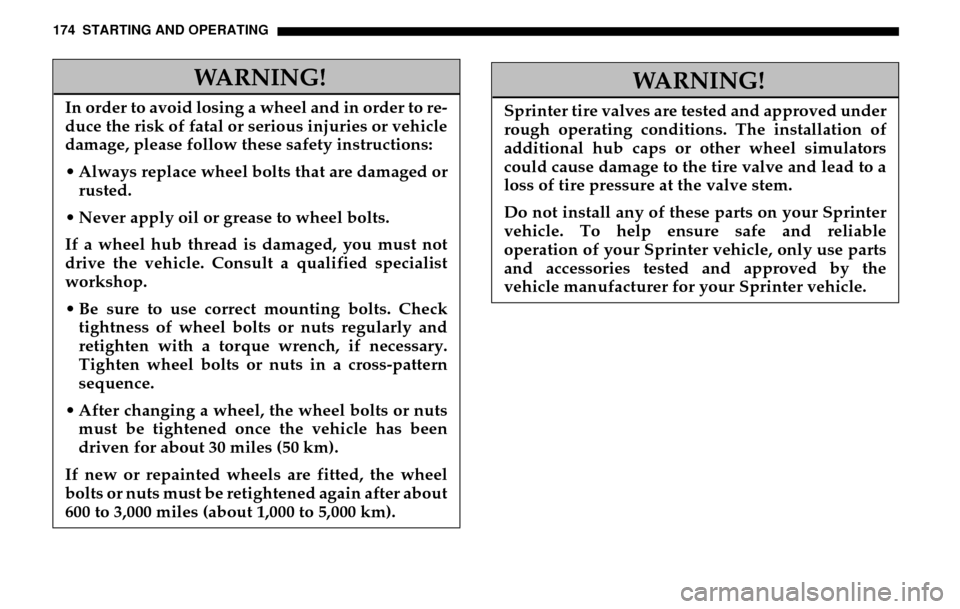
WARNING!
In order to avoid losing a wheel and in order to re-
duce the risk of fatal or serious injuries or vehicle
damage, please follow these safety instructions:
Always replace wheel bolts that are damaged or rusted.
Never apply oil or grease to wheel bolts.
If a wheel hub thread is damaged, you must not
drive the vehicle. Consult a qualified specialist
workshop.
Be sure to use correct mounting bolts. Check tightness of wheel bolts or nuts regularly and
retighten with a torque wrench, if necessary.
Tighten wheel bolts or nuts in a cross-pattern
sequence.
After changing a wheel, the wheel bolts or nuts must be tightened once the vehicle has been
driven for about 30 miles (50 km).
If new or repainted wheels are fitted, the wheel
bolts or nuts must be retightened again after about
600 to 3,000 miles (about 1,000 to 5,000 km).
WARNING!
Sprinter tire valves are tested and approved under
rough operating conditions. The installation of
additional hub caps or other wheel simulators
could cause damage to the tire valve and lead to a
loss of tire pressure at the valve stem.
Do not install any of these parts on your Sprinter
vehicle. To help ensure safe and reliable
operation of your Sprinter vehicle, only use parts
and accessories tested and approved by the
vehicle manufacturer for your Sprinter vehicle.
Page 199 of 288

WHAT TO DO IN EMERGENCIES 199
6
Procedure:
1. Park the vehicle on a firm, level, non-slippery surface.
2. Switch on the hazard warning flasher switch, apply the parking brake, and place the transmission
selector in "P".
3. Everyone must leave the vehicle before you jack it up.
4. Everyone must leave the danger zone, before jacking the vehicle. 5. The vehicle must be safeguarded in accordance
with legal regulations (such as using a warning
triangle).
6. Prevent vehicle from rolling away by blocking wheels with wheel chocks (not supplied with
vehicle) or sizable wood block or stone.
On a level road, place one chock in front of and one
behind the wheel that is diagonally opposite to the
wheel being changed.
When changing a wheel on mild uphill or downhill
grades, place chocks on the downhill side blocking
both wheels of the other axle.
Do not jack the vehicle up more than 1.2 in (30
mm) between the tire and the surface. Otherwise,
the vehicle may tip over and may cause serious
injury or death to you or others.
Precautions when changing a wheel:
For the torque, refer to
"Installing a wheel ";
Do not damage, grease or oil wheel bolts or their
threads.
WARNING!
Do not change wheels on either steep uphill or
downhill grades. The vehicle may begin to move
and fall from the jack which could cause personal
injury and property damage.
Page 208 of 288
208 WHAT TO DO IN EMERGENCIESCentering wheels with wheel bolts
If dual assemblies are used, before placement the inner wheel should be inspected to ensure that all
ball bearing rings are in proper position.
Install the wheel and snug the wheel bolts.
Slightly tighten wheel bolts.
Slowly open jack release va lve to lower vehicle until
tire is resting on ground.
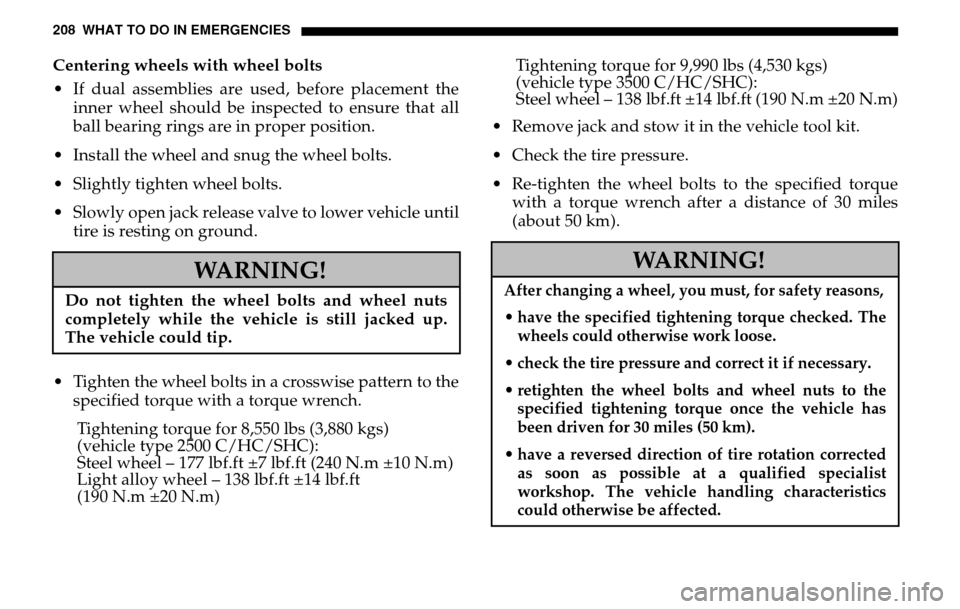
Tighten the wheel bolts in a crosswise pattern to the specified torque with a torque wrench.
Tightening torque for 8,550 lbs (3,880 kgs)
(vehicle type 2500 C/HC/SHC):
Steel wheel – 177 lbf.ft ±7 lbf.ft (240 N.m ±10 N.m)
Light alloy wheel – 138 lbf.ft ±14 lbf.ft
(190 N.m ±20 N.m) Tightening torque for 9,990 lbs (4,530 kgs)
(vehicle type 3500 C/HC/SHC):
Steel wheel – 138lbf.ft ±14lbf.ft (190N.m ±20N.m)
Remove jack and stow it in the vehicle tool kit.
Check the tire pressure.
Re-tighten the wheel bolts to the specified torque with a torque wrench after a distance of 30 miles
(about 50 km).
WARNING!
Do not tighten the wheel bolts and wheel nuts
completely while the vehicle is still jacked up.
The vehicle could tip.
WARNING!
After changing a wheel, you must, for safety reasons, have the specified tightening torque checked. The
wheels could otherwise work loose.
check the tire pressure and correct it if necessary.
retighten the wheel bolts and wheel nuts to the specified tightening torque once the vehicle has
been driven for 30 miles (50 km).
have a reversed direction of tire rotation corrected as soon as possible at a qualified specialist
workshop. The vehicle handling characteristics
could otherwise be affected.