fuel DODGE SPRINTER 2007 2.G User Guide
[x] Cancel search | Manufacturer: DODGE, Model Year: 2007, Model line: SPRINTER, Model: DODGE SPRINTER 2007 2.GPages: 393, PDF Size: 7.61 MB
Page 174 of 393
173
4 Operation
The first 1000 miles (1,500 km) ......... 174
Driving tips ......... 175
Electronic equipment ......... 183
Refueling ......... 184
Engine ......... 185
Battery ......... 195
Battery isolating switch* ......... 197
Tires and wheels ......... 199
Winter driving ......... 234
Maintenance and servicing ......... 237
Cleaning and care of the vehicle ......... 241
Page 181 of 393
180 OperationDriving tips
4
If you plan to operate your vehicle in for-
eign countries, please be aware that:
\4service facilities or replacement parts
may not be readily available,
\4unleaded gasoline for vehicles with cat-
alytic converters may not be available;
the use of leaded fuels will damage the
catalysts,
\4gasoline may have a considerably low-
er octane rating, and improper fuel can
cause engine damage.
You will find information about gasoline /
diesel in the “Technical data” section
(\2page 358).You can permanently limit the maximum
speed of your vehicle to 75 mph
(120 km/h).
The manufacturer recommends that you
have the maximum speed programmed at
an authorized Sprinter Dealer. This has the
necessary specialist knowledge and tools
to carry out the required work.Operating the vehicle outside the
USA or Canada
iIf you are traveling in countries where
vehicles are driven on the opposite side
of the road to that in which the vehicle
is registered, you must have the head-
lamps:
\4partially masked (halogen head-
lamps)
\4switched over (bi-xenon head-
lamps)
Relevant information can be obtained
at an authorized Sprinter Dealer.
Programmed maximum speed Warning
G
Exceeding the permissible maximum speed
can cause tire damage, which could lead to
loss of control of the vehicle.
As the driver, you must find out about the
maximum speed of the vehicle and the re-
sulting permissible maximum speed of the
tires (tire and tire pressure).
Never exceed the speed limit for your tires
under any circumstances (\2page 222).
Page 182 of 393
181 Operation
Driving tips
4
Check regularly, e.g. weekly or when refu-
eling:
\4the vehicle lighting
\4the condition of the tires (\2page 201)
and the tire pressures (\2page 210)
\4the engine oil level (\2page 187)
\4the brake fluid level (\2page 192)
\4the fluid level in the windshield washer
system / headlamp cleaning system
reservoir (\2page 193)
\4the contamination level of the rear air-
conditioning air cleaner (\2page 240)
Your vehicle is equipped with monolithic-
type catalytic converters, an important el-
ement in conjunction with the oxygen sen-
sors to achieve substantial control of the
pollutants in the exhaust emissions. Keep
your vehicle in proper operating condition
by following our recommended mainte-
nance instructions as outlined in your Ser-
vice Booklet.Your vehicle is equipped with an oxidation
catalyst, an important element in conjunc-
tion with the oxygen sensors to achieve
substantial control of the pollutants in the
exhaust emissions. Keep your vehicle in
proper operating condition by following
our recommended maintenance instruc-
tions as outlined in your Service Booklet.Regular checksCatalytic converter (gasoline engine)
!
CAUTION
To prevent damage to the catalytic con-
verters, only use premium unleaded
gasoline in this vehicle.
Any noticeable irregularities in engine
operation should be repaired promptly.
Otherwise, excessive unburned fuel
may reach the catalytic converter,
causing it to overheat and potentially
start a fire.
Warning
G
As with any vehicle, do not idle, park or op-
erate this vehicle in areas where combusti-
ble materials such as grass, hay, or leaves
can come into contact with the hot exhaust
system, as these materials could be ignited
and cause a vehicle fire.
Oxidation catalyst (diesel engine)Warning
G
As with any vehicle, do not idle, park or op-
erate this vehicle in areas where combusti-
ble materials such as grass, hay, or leaves
can come into contact with the hot exhaust
system, as these materials could be ignited
and cause a vehicle fire.
Page 185 of 393
184 OperationRefueling
4
\3 Refueling
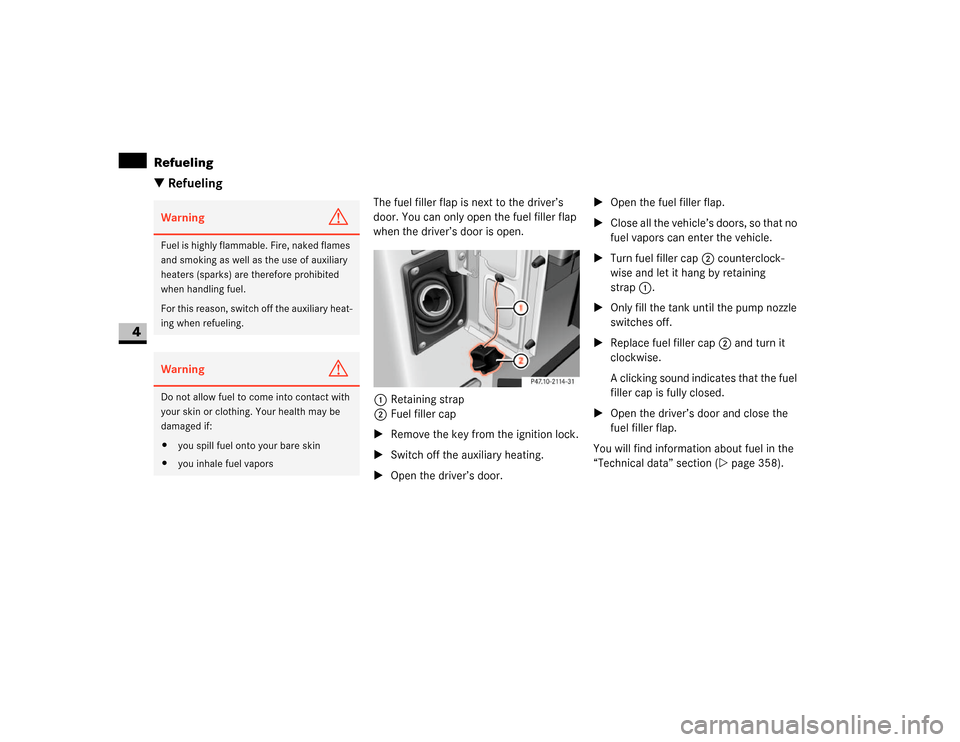
The fuel filler flap is next to the driver’s
door. You can only open the fuel filler flap
when the driver’s door is open.
1Retaining strap
2Fuel filler cap
\1Remove the key from the ignition lock.
\1Switch off the auxiliary heating.
\1Open the driver’s door.\1Open the fuel filler flap.
\1Close all the vehicle’s doors, so that no
fuel vapors can enter the vehicle.
\1Turn fuel filler cap2 counterclock-
wise and let it hang by retaining
strap1.
\1Only fill the tank until the pump nozzle
switches off.
\1Replace fuel filler cap2 and turn it
clockwise.
A clicking sound indicates that the fuel
filler cap is fully closed.
\1Open the driver’s door and close the
fuel filler flap.
You will find information about fuel in the
“Technical data” section (\2page 358).
Warning
G
Fuel is highly flammable. Fire, naked flames
and smoking as well as the use of auxiliary
heaters (sparks) are therefore prohibited
when handling fuel.
For this reason, switch off the auxiliary heat-
ing when refueling.Warning
G
Do not allow fuel to come into contact with
your skin or clothing. Your health may be
damaged if:
\4you spill fuel onto your bare skin
\4you inhale fuel vapors
Page 188 of 393
187 Operation
Engine
4
If the hood can be raised slightly, it
is not properly engaged.
\1Open it again and allow it to drop from
a slightly greater height.
Mechanical elements and the lubricants
used for them must be carefully matched.
For this reason, only brands tested and ap-
proved by the manufacturer should be
used. Please contact your Sprinter Dealer
to obtain the necessary information. No lu-
bricant additives should be used.
The use of such additives could affect your
warranty rights. Information is available
from any authorized Sprinter Dealer.
For specifications of engine oils, coolant
and brake fluid, see "Service products and
capacities" (\2page 355) and contact your
authorized Sprinter Dealer.The vehicle consumes a maximum of
1 US qt (1.0 l) oil per 620 miles (1000 km),
depending on your driving style.
Engine oil consumption may even be high-
er if:
\4the vehicle is new
\4you mainly operate the vehicle under
arduous operating conditions
\4you often drive at high engine speeds
The engine oil consumption can only be
judged after a lengthy distance has been
covered.Check the engine oil level on a regular ba-
sis, for example weekly or each time you
refuel.!
CAUTION
Do not use your hands to push the
hood down. Doing so could damage it.
Service products
Warning
G
If handled incorrectly, service products can
constitute a health risk f o r p e o p l e a n d a n e n -
vironmental hazard.
Always observe relevant guidelines for han-
dling, storing and disposing of service prod-
ucts.Engine oil
iIf the oil level exceeds the maximum
level several times during operation,
have the malfunction rectified immedi-
ately at an authorized Sprinter Dealer.
Page 193 of 393
192 OperationEngine
4
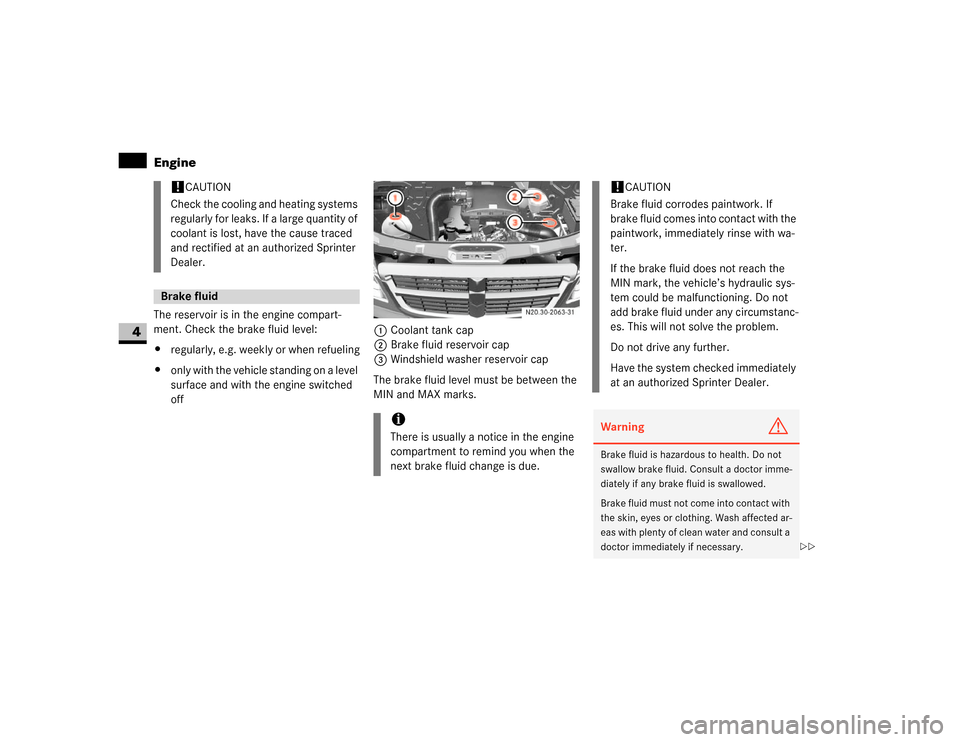
The reservoir is in the engine compart-
ment. Check the brake fluid level:
\4regularly, e.g. weekly or when refueling
\4only with the vehicle standing on a level
surface and with the engine switched
off1Coolant tank cap
2Brake fluid reservoir cap
3Windshield washer reservoir cap
The brake fluid level must be between the
MIN and MAX marks.
!
CAUTION
Check the cooling and heating systems
regularly for leaks. If a large quantity of
coolant is lost, have the cause traced
and rectified at an authorized Sprinter
Dealer.
Brake fluid
iThere is usually a notice in the engine
compartment to remind you when the
next brake fluid change is due.
N20.30-2063-31
!
CAUTION
Brake fluid corrodes paintwork. If
brake fluid comes into contact with the
paintwork, immediately rinse with wa-
ter.
If the brake fluid does not reach the
MIN mark, the vehicle’s hydraulic sys-
tem could be malfunctioning. Do not
add brake fluid under any circumstanc-
es. This will not solve the problem.
Do not drive any further.
Have the system checked immediately
at an authorized Sprinter Dealer.
Warning
G
Brake fluid is hazardous to health. Do not
swallow brake fluid. Consult a doctor imme-
diately if any brake fluid is swallowed.
Brake fluid must not come into contact with
the skin, eyes or clothing. Wash affected ar-
eas with plenty of clean water and consult a
doctor immediately if necessary.
\2\2
Page 197 of 393
196 OperationBattery
4
The batteries must always be sufficiently
charged so that they achieve their intend-
ed service life.
Have the battery charge status checked
more frequently if you use the vehicle
mainly for short trips or if you leave it
parked up for a long period.
If you intend to leave your vehicle parked
up for a long period, seek advice from an
authorized Sprinter Dealer and switch off
the electrical system at the battery isolat-
ing switch (\2page 197).
You will find further information in the
“Practical hints” section (\2page 335).
!
CAUTION
Switch off the engine and wait for
approximately 20 seconds before you
loosen or disconnect the terminal
clamps. You could otherwise damage
electrical system components.
Care of batteries!
CAUTION
Dirty terminal clamps and battery sur-
faces cause leakage current, leading to
battery discharge. Always keep the ter-
minal clamps and battery surfaces
clean and dry. Lightly grease the termi-
nal clamps, particularly the undersides,
with acid-proof grease.
Cleaning agents containing fuel can
corrode the battery casing. Only clean
with commercially available cleaning
agents and clean the battery casing
with the cell caps screwed in.
Page 200 of 393
199 Operation
Tires and wheels
4
\3 Tires and wheelsThe tires on a new vehicle provide a bal-
ance of many characteristics. They should
be inspected regularly for wear and correct
cold tire inflation pressure. The vehicle
manufacturer strongly recommends using
tires equivalent to the originals in size,
quality and performance when a replace-
ment becomes necessary.
Refer to the tire and loading information
placard on the driver’s door B-pillar
(\2page 373) for the size designation of
your tire.
The service description and load identifica-
tion will be found on the original equip-
ment tire. Failure to use equivalent
replacement tires may adversely affect the
safety, handling, and ride of your Sprinter
vehicle.
Contact an authorized Sprinter Dealer or
an authorized tire dealer with any ques-
tions you may have on tire specifications
or capability.For more information on tire size designa-
tion, load and speed rating, see "Tire label-
ing" (\2page 222).
See an authorized Sprinter Dealer for infor-
mation on tested and recommended rims
and tires for summer and winter operation.
They can also offer advice concerning tire
service and purchase.
!
CAUTION
Only use tires which have been tested
and approved for your Sprinter vehicle
by the vehicle manufacturer. Tires ap-
proved by the vehicle manufacturer are
developed to provide the best possible
performance in conjunction with the
driving safety systems on your Sprinter
vehicle such as ABS, BAS, ASR or
ESP®.
Using tires other than those approved
by the vehicle manufacturer may result
in damage that is not covered by the
Sprinter warranty.
!
CAUTION
Using tires other than those approved
by the vehicle manufacturer can have
detrimental effects, such as
\4poor handling characteristics
\4increased noise
\4increased fuel consumption
Tires and rims not approved by the ve-
hicle manufacturer may, under load,
exhibit dimensional variations and dif-
ferent tire deformation characteristics
that could cause them to come into
contact with the vehicle body or axle
parts. Damage to the tires or the vehi-
cle may be the result.
Page 203 of 393
202 OperationTires and wheels
4
\4When replacing individual tires, you
should mount new tires on the front
wheels first.
The tire inflation pressure should be
checked regularly, i.e. at least each time
you refuel the vehicle. The preferred inter-
val for checking the tire inflation pressure,
however, is before each trip.
For more information on checking tire in-
flation pressure, refer to "Recommended
tire inflation pressure" (\2page 210).Tire inspection
Every time when checking the tire inflation
pressure, the tires should also be inspect-
ed for the following:
\4excessive treadwear, refer to "Tread
depth". the condition of the tread
depths, i.e. uneven tread wear or ex-
cessive treadwear on one side. Turn
the front wheels to full lock if neces-
sary to enable you to check the inner
edge of the front tires more easily. You
must also always check the inside of
the tire tread on the rear wheels.
\4cord or fabric showing through the
tire’s rubber
\4bumps, bulges, cuts, cracks or splits in
the tread or side of the tire
\4foreign objects between the tires
(on vehicles with twin tires)
Replace the tire if any of the above condi-
tions is found.
Also inspect the spare tire periodically for
condition and inflation. Spare tires will age
and become worn over time even if never
used, and thus should be inspected and re-
placed when necessary.Tire damage
Tire damage can be caused
by:
\4the vehicle’s operating conditions
\4tire aging
\4curbs
\4foreign objects
\4insufficient or excessive tire pressures
\4weather and environmental influences
\4contact with oil, grease, fuel, etc.
Tire care and maintenanceWarning
G
Regularly check the tires for damage. Dam-
aged tires can cause tire inflation pressure
loss. As a result, you could lose control of
your vehicle.
Worn, old tires can cause accidents. If the
tire tread is badly worn, or if the tires have
sustained damage, replace them.
Warning
G
Driving over curbs or sharp-edged objects
can cause damage to the tire substructure
which is not visible from the outside.
Damage to the tire substructure cannot be
detected until later and can cause the tire to
burst.
\2\2
Page 206 of 393
205 Operation
Tires and wheels
4
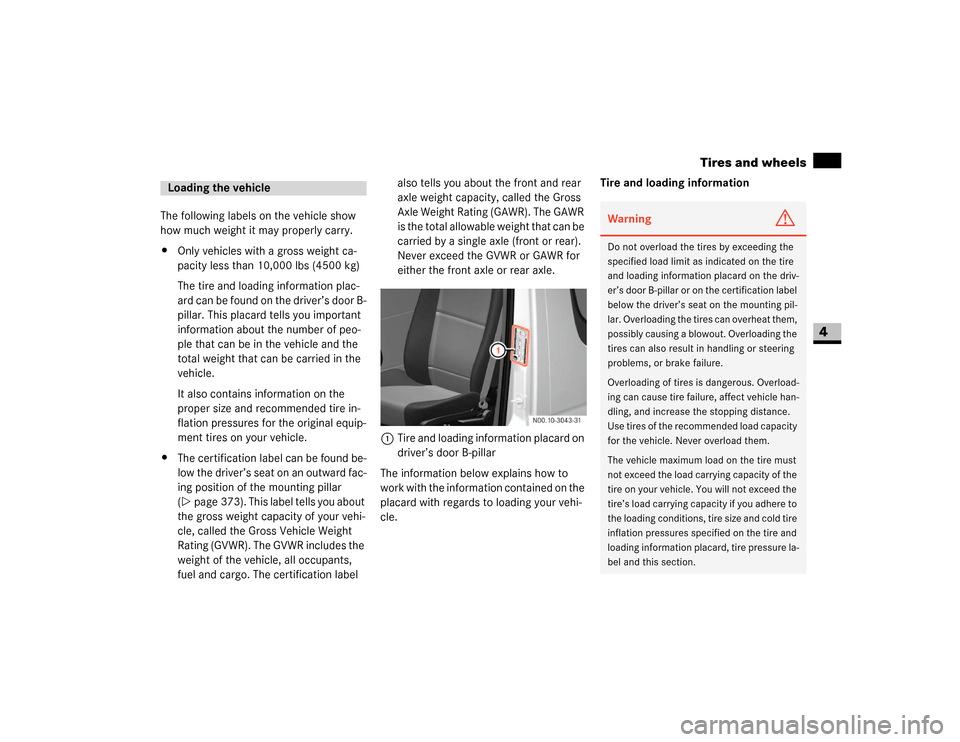
The following labels on the vehicle show
how much weight it may properly carry.
\4Only vehicles with a gross weight ca-
pacity less than 10,000 lbs (4500 kg)
The tire and loading information plac-
ard can be found on the driver’s door B-
pillar. This placard tells you important
information about the number of peo-
ple that can be in the vehicle and the
total weight that can be carried in the
vehicle.
It also contains information on the
proper size and recommended tire in-
flation pressures for the original equip-
ment tires on your vehicle.
\4The certification label can be found be-
low the driver’s seat on an outward fac-
ing position of the mounting pillar
(\2page 373). This label tells you about
the gross weight capacity of your vehi-
cle, called the Gross Vehicle Weight
Rating (GVWR). The GVWR includes the
weight of the vehicle, all occupants,
fuel and cargo. The certification label also tells you about the front and rear
axle weight capacity, called the Gross
Axle Weight Rating (GAWR). The GAWR
is the total allowable weight that can be
carried by a single axle (front or rear).
Never exceed the GVWR or GAWR for
either the front axle or rear axle.
1Tire and loading information placard on
driver’s door B-pillar
The information below explains how to
work with the information contained on the
placard with regards to loading your vehi-
cle.Tire and loading informationLoading the vehicle
Warning
G
Do not overload the tires by exceeding the
specified load limit as indicated on the tire
and loading information placard on the driv-
er’s door B-pillar or on the certification label
below the driver’s seat on the mounting pil-
lar. Overloading the tires can overheat them,
possibly causing a blowout. Overloading the
tires can also result in handling or steering
problems, or brake failure.
Overloading of tires is dangerous. Overload-
ing can cause tire failure, affect vehicle han-
dling, and increase the stopping distance.
Use tires of the recommended load capacity
for the vehicle. Never overload them.
The vehicle maximum load on the tire must
not exceed the load carrying capacity of the
tire on your vehicle. You will not exceed the
tire’s load carrying capacity if you adhere to
the loading conditions, tire size and cold tire
inflation pressures specified on the tire and
loading information placard, tire pressure la-
bel and this section.