air filter FIAT 500 1973 1.G User Guide
[x] Cancel search | Manufacturer: FIAT, Model Year: 1973, Model line: 500, Model: FIAT 500 1973 1.GPages: 128, PDF Size: 9.01 MB
Page 29 of 128
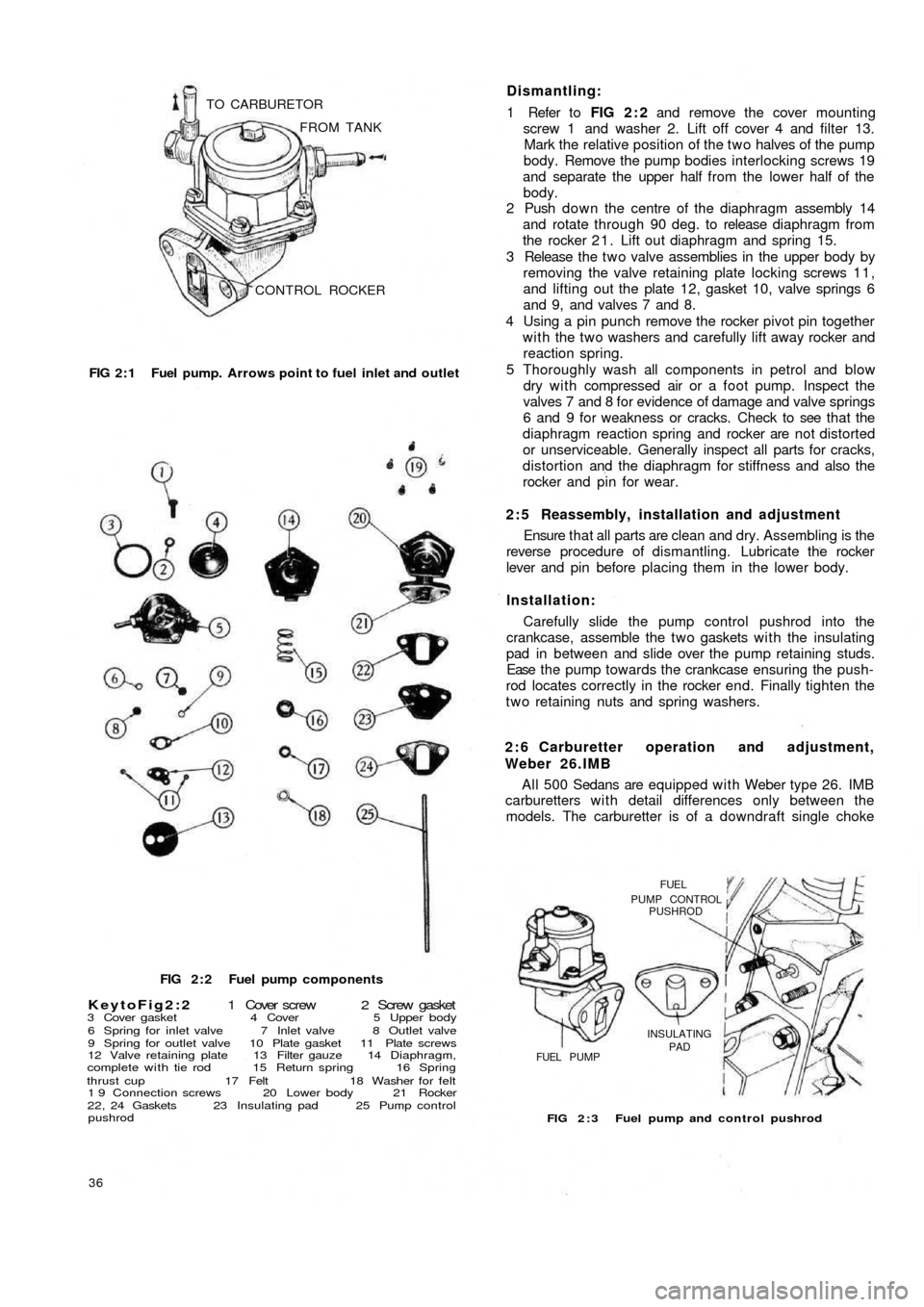
CONTROL ROCKER FROM TANK TO CARBURETOR
FIG 2 : 1 Fuel pump. Arrows point to fuel inlet and outlet
FIG 2 : 2 Fuel pump components
KeytoFig2:2 1 Cover screw 2 Screw gasket3 Cover gasket 4 Cover 5 Upper body
6 Spring for inlet valve 7 Inlet valve 8 Outlet valve
9 Spring for outlet valve 10 Plate gasket 11 Plate screws
12 Valve retaining plate 13 Filter gauze 14 Diaphragm,
complete with tie rod 15 Return spring 16 Spring
thrust cup 17 Felt 18 Washer for felt
1 9 Connection screws 20 Lower body 21 Rocker
22, 24 Gaskets 23 Insulating pad 25 Pump control
pushrod
36
FIG 2 : 3 Fuel pump and control pushrod
FUELPUMP CONTROLPUSHROD
INSULATING
PAD
FUEL PUMP
A l l 500 Sedans are equipped with Weber type 26. IMB
carburetters w i t h detail differences only between the
models. The carburetter is of a downdraft single choke 2 : 6 Carburetter operation and adjustment,
Weber 26.IMB Carefully slide the pump control pushrod into the
crankcase, assemble the t w o gaskets w i t h the insulating
pad in between and slide over the pump retaining studs.
Ease t h e p u m p towards the crankcase ensuring the push-
rod locates correctly in the rocker end. Finally tighten the
two retaining nuts and spring washers. Installation:Ensure t h a t all parts are clean and dry. Assembling is the
reverse procedure of dismantling. Lubricate the rocker
lever and pin before placing them in the lower body. 2 : 5 Reassembly, installation and adjustment 1 Refer to FIG 2 : 2 and remove the cover mounting
screw 1 and washer 2. Lift off cover 4 and filter 13.
Mark the relative position of the two halves of the pump
body. Remove the pump bodies interlocking screws 19
and separate the upper half from the lower half of the
body.
2 Push down the centre of the diaphragm assembly 14
and rotate through 90 deg. to release diaphragm from
the rocker 2 1 . Lift out diaphragm and spring 15.
3 Release the t w o valve assemblies in the upper body by
removing the valve retaining plate locking screws 1 1 ,
and lifting out the plate 12, gasket 10, valve springs 6
and 9, and valves 7 and 8.
4 Using a pin punch remove the rocker pivot pin together
w i t h the t w o washers and carefully lift away rocker and
reaction spring.
5 Thoroughly wash all components in petrol and
blow
dry with compressed air or a foot pump. Inspect the
valves 7 and 8 for evidence of damage and valve springs
6 and 9 for weakness or cracks. Check to see that the
diaphragm reaction spring and rocker are not distorted
or unserviceable. Generally inspect all parts for cracks,
distortion and the diaphragm for stiffness and also the
rocker and pin for wear. Dismantling:
Page 30 of 128
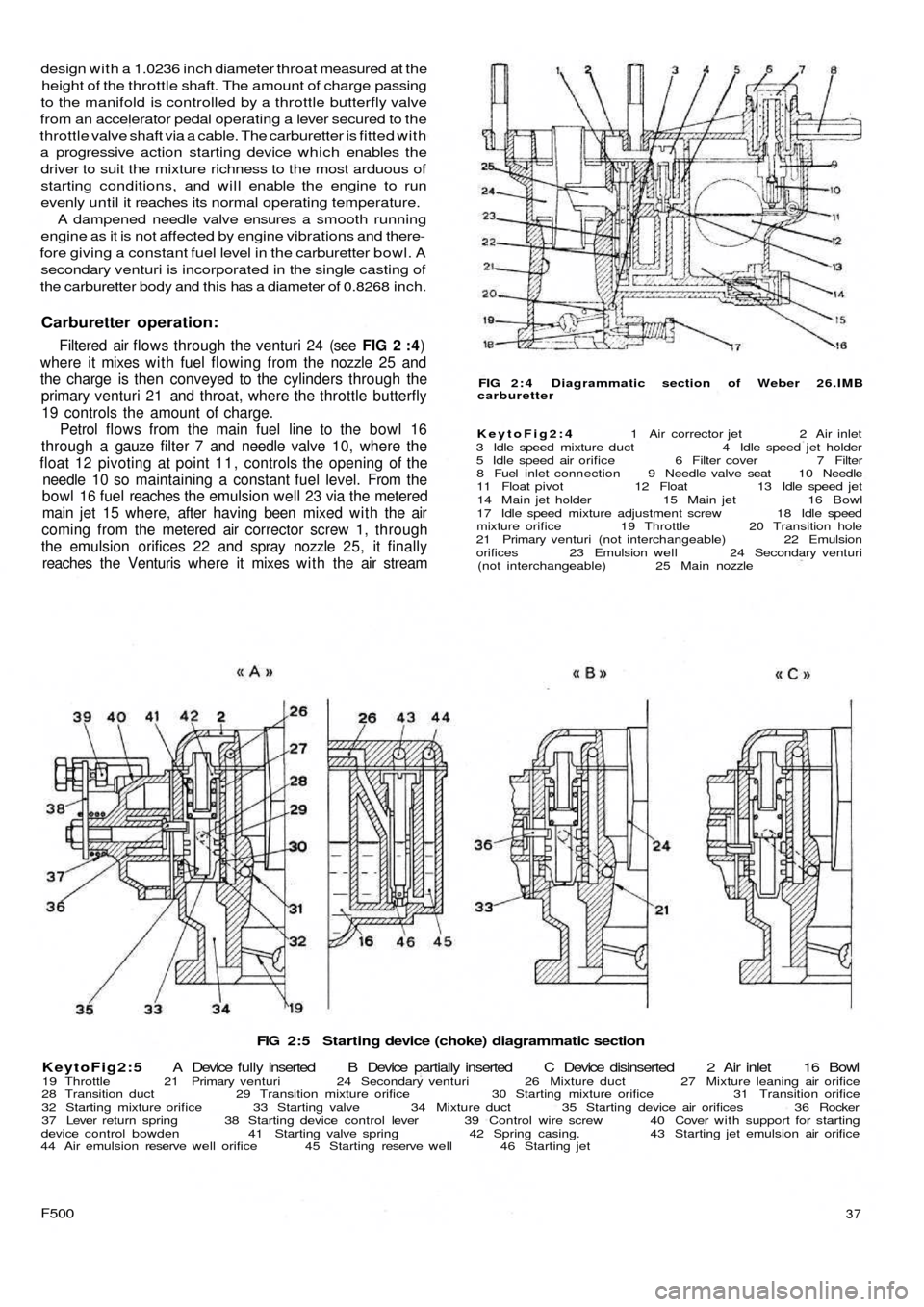
FIG 2:5 Starting device (choke) diagrammatic section
KeytoFig2:5 A Device fully inserted B Device partially inserted C Device disinserted 2 Air inlet 16 Bowl
19 Throttle 21 Primary venturi 24 Secondary venturi 26 Mixture duct 27 Mixture leaning air orifice
28 Transition duct 29 Transition mixture orifice 30 Starting mixture orifice 31 Transition orifice
32 Starting mixture orifice 33 Starting valve 34 Mixture duct 35 Starting device air orifices 36 Rocker
37 Lever return spring 38 Starting device control lever 39 Control wire screw 40 Cover with support for starting
device control bowden 41 Starting valve spring 42 Spring casing. 43 Starting jet emulsion air orifice
44 Air emulsion reserve well orifice 45 Starting reserve well 46 Starting jet
F50037
FIG 2 : 4 Diagrammatic section of Weber 26.IMB
carburetter
KeytoFig2:4 1 Air corrector jet 2 Air inlet
3 Idle speed mixture duct 4 Idle speed jet holder
5 Idle speed air orifice 6 Filter cover 7 Filter
8 Fuel inlet connection 9 Needle valve seat 10 Needle
11 Float pivot 12 Float 13 Idle speed jet
14 Main jet holder 15 Main jet 16 Bowl
17 Idle speed mixture adjustment screw 18 Idle speed
mixture orifice 19 Throttle 20 Transition hole
21 Primary venturi (not interchangeable) 22 Emulsion
orifices 23 Emulsion well 24 Secondary venturi
(not interchangeable) 25 Main nozzle
design with a 1.0236 inch diameter throat measured at the
height of the throttle shaft. The amount of charge passing
to the manifold is controlled by a throttle butterfly valve
from an accelerator pedal operating a lever secured to the
throttle valve shaft via a cable. The carburetter is fitted with
a progressive action starting device which enables the
driver to suit the mixture richness to the most arduous of
starting conditions, and will enable the engine to run
evenly until it reaches its normal operating temperature.
A dampened needle valve ensures a smooth running
engine as it is not affected by engine vibrations and there-
fore giving a constant fuel level in the carburetter bowl. A
secondary venturi is incorporated in the single casting of
the carburetter body and this has a diameter of 0.8268 inch.
Carburetter operation:
Filtered air flows through the venturi 24 (see FIG 2 :4)
where it mixes w i t h fuel flowing from the nozzle 25 and
the charge is then conveyed to the cylinders through the
primary venturi 21 and throat, where the throttle butterfly
19 controls the amount of charge.
Petrol flows from the main fuel line to the bowl 16
through a gauze filter 7 and needle valve 10, where the
float 12 pivoting at point 1 1 , controls the opening of the
needle 10 so maintaining a constant fuel level. From the
bowl 16 fuel reaches the emulsion well 23 via the metered
main jet 15 where, after having been mixed with the air
coming from the metered air corrector screw 1, through
the emulsion orifices 22 and spray nozzle 25, it finally
reaches the Venturis where it mixes w i t h the air stream
Page 33 of 128
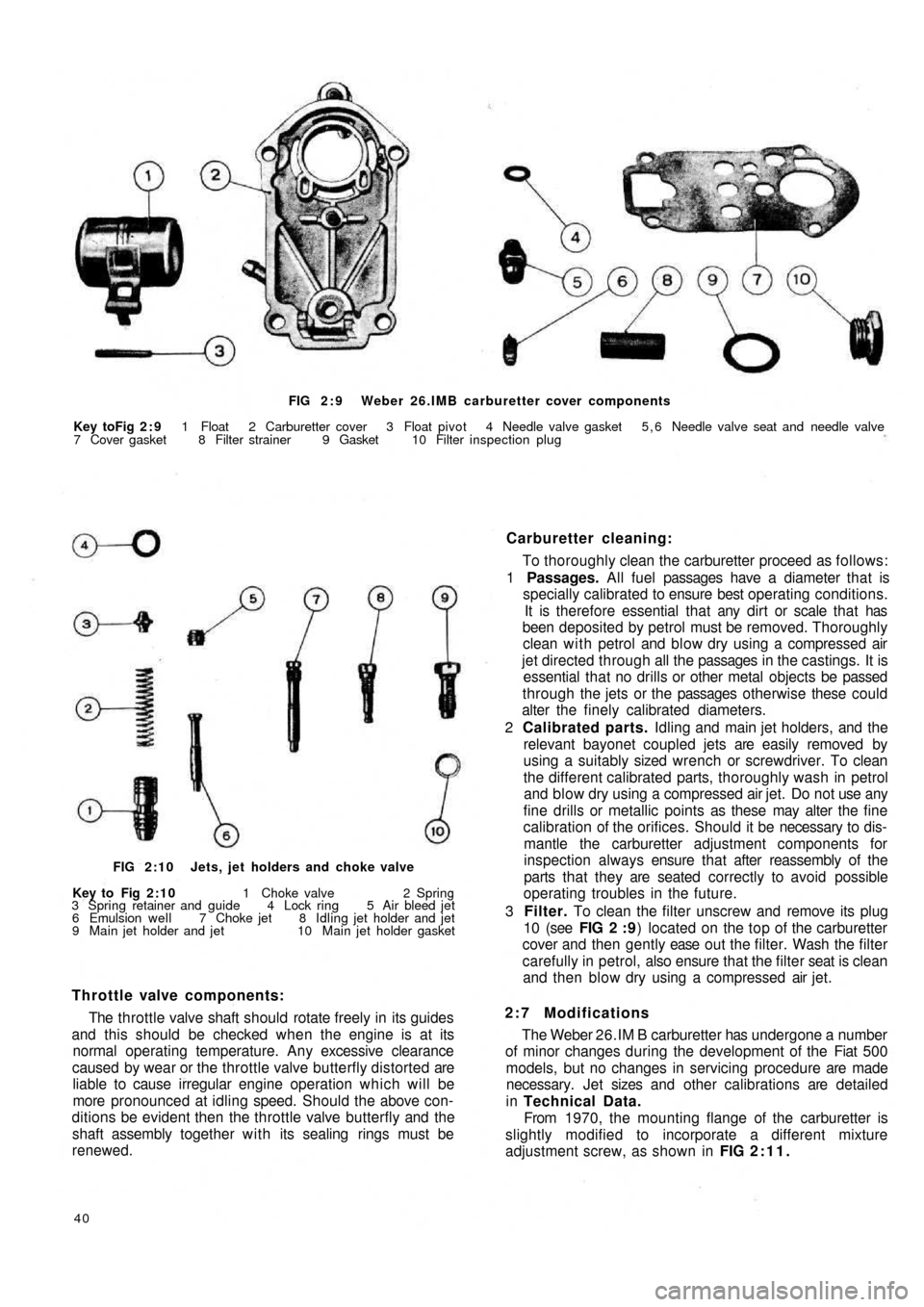
FIG 2 : 9 Weber 26.IMB carburetter cover components
Key toFig 2 : 9 1 Float 2 Carburetter cover 3 Float pivot 4 Needle valve gasket 5 , 6 Needle valve seat and needle valve
7 Cover gasket 8 Filter strainer 9 Gasket 10 Filter inspection plug
Carburetter cleaning:
To thoroughly clean the carburetter proceed as follows:
1 Passages. All fuel passages have a diameter that is
specially calibrated to ensure best operating conditions.
It is therefore essential that any dirt or scale that has
been deposited by petrol must be removed. Thoroughly
clean with petrol and blow dry using a compressed air
jet directed through all the passages in the castings. It is
essential that no drills or other metal objects be passed
through the jets or the passages otherwise these could
alter the finely calibrated diameters.
2 Calibrated parts. Idling and main jet holders, and the
relevant bayonet coupled jets are easily removed by
using a suitably sized wrench or screwdriver. To clean
the different calibrated parts, thoroughly wash in petrol
and blow dry using a compressed air jet. Do not use any
fine drills or metallic points as these may alter the fine
calibration of the orifices. Should it be necessary to dis-
mantle the carburetter adjustment components for
inspection always ensure that after reassembly of the
parts that they are seated correctly to avoid possible
operating troubles in the future.
3 Filter. To clean the filter unscrew and remove its plug
10 (see FIG 2 : 9) located on the top of the carburetter
cover and then gently ease o u t t h e filter. Wash the filter
carefully in petrol, also ensure that the filter seat is clean
and then blow dry using a compressed air jet.
2:7 Modifications
The Weber 26.IM B carburetter has undergone a number
of minor changes during the development of the Fiat 500
models, but no changes in servicing procedure are made
necessary. Jet sizes and other calibrations are detailed
in Technical Data.
From 1970, the mounting flange of the carburetter is
slightly modified to incorporate a different mixture
adjustment screw, as shown in FIG 2:11.
40
Throttle valve components:
The throttle valve shaft should rotate freely in its guides
and this should be checked when the engine is at its
normal operating temperature. Any excessive clearance
caused by wear or the throttle valve butterfly distorted are
liable to cause irregular engine operation which will be
more pronounced at idling speed. Should the above con-
ditions be evident then the throttle valve butterfly and the
shaft assembly together with its sealing rings must be
renewed.
FIG 2:10 Jets, jet holders and choke valve
Key to Fig 2:10 1 Choke valve 2 Spring
3 Spring retainer and guide 4 Lock ring 5 Air bleed jet
6 Emulsion well 7 Choke jet 8 Idling jet holder and jet
9 Main jet holder and jet 10 Main jet holder gasket
Page 35 of 128
3938
28 29 30A3132 33
28 29 30 3.1B28
29 30 31C
34 34
34
37 36 35 23
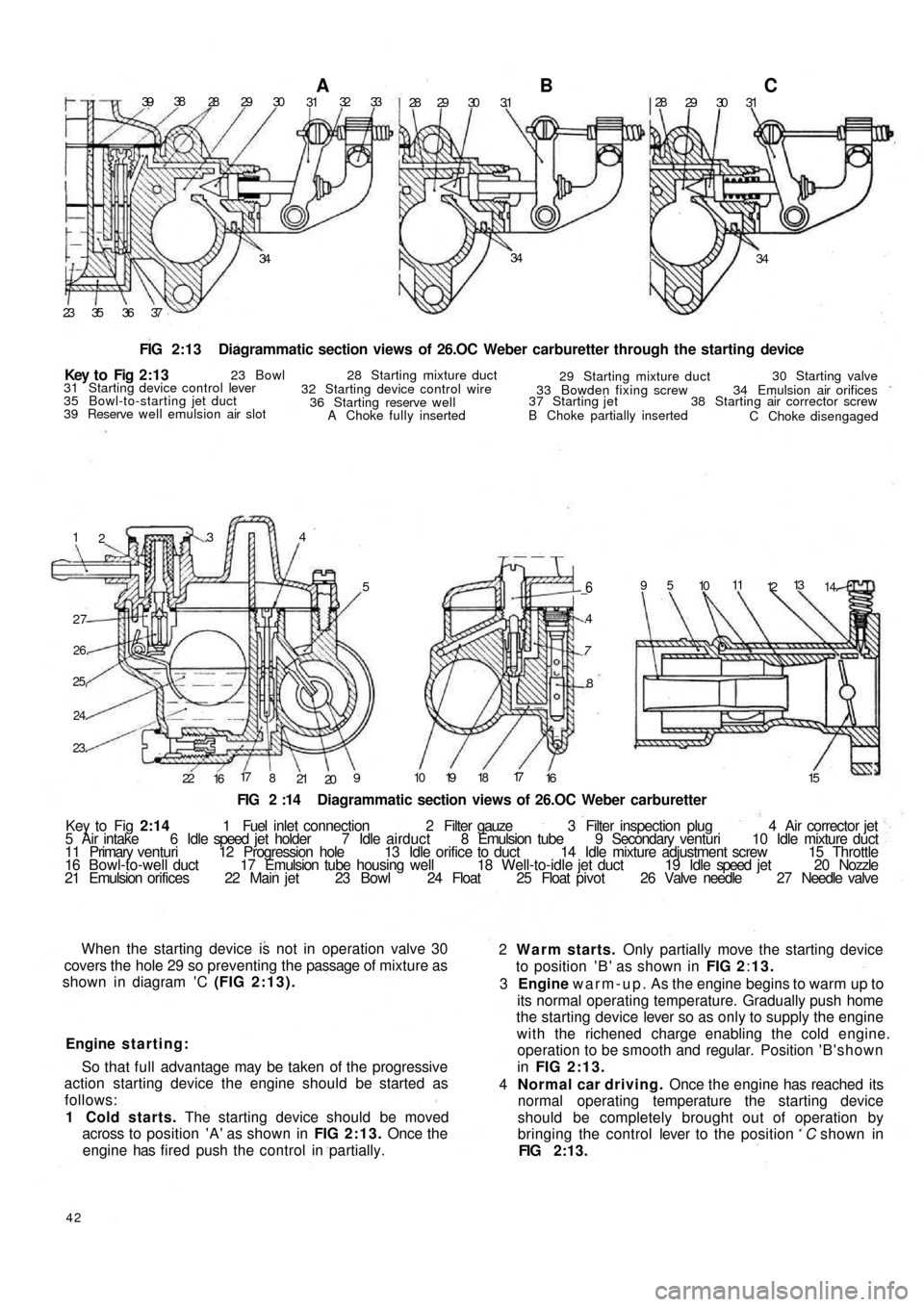
FIG 2:13 Diagrammatic section views of 26.OC Weber carburetter through the starting device
1
2.34
5
27
26.
25,
24.
23.
22
1617
8
21
209
_6
.4
7
.8
10 19 1817
16 1595
1011
1213
14.
FIG 2 :14 Diagrammatic section views of 26.OC Weber carburetter
Key to Fig 2:14 1 Fuel inlet connection 2 Filter gauze 3 Filter inspection plug 4 Air corrector jet
5 Air intake 6 Idle speed jet holder 7 Idle airduct 8 Emulsion tube 9 Secondary venturi 10 Idle mixture duct
11 Primary venturi 12 Progression hole 13 Idle orifice to duct 14 Idle mixture adjustment screw 15 Throttle
16 B o w l - t o - w e l l duct 17 Emulsion tube housing well 18 Well-to-idle jet duct 19 Idle speed jet 20 Nozzle
21 Emulsion orifices 22 Main jet 23 Bowl 24 Float 25 Float pivot 26 Valve needle 27 Needle valve
When the starting device is not in operation valve 30
covers the hole 29 so preventing the passage of mixture as
shown in diagram 'C (FIG 2:13).
Engine starting:
So that full advantage may be taken of the progressive
action starting device the engine should be started as
follows:
1 Cold starts. The starting device should be moved
across to position 'A' as shown in FIG 2:13. Once the
engine has fired push the control in partially.
42
2 Warm starts. Only partially move the starting device
to position ' B ' as shown in FIG 2:13.
3 Engine warm-up. As the engine begins to warm up to
its normal operating temperature. Gradually push home
the starting device lever so as only to supply the engine
with the richened charge enabling the cold engine.
operation to be smooth and regular. Position ' B ' s h o w n
in FIG 2:13.
4 Normal car driving. Once the engine has reached its
normal operating temperature the starting device
should be completely brought out of operation by
bringing the control lever to the position C shown in
FIG 2:13. Key t o Fig 2 : 1 3
23 Bowl 28 Starting mixture duct
29 Starting mixture duct30 Starting valve
34 Emulsion air orifices
38 Starting air corrector screw
C Choke disengaged B Choke partially inserted 37 Starting jet33 Bowden fixing screw
A Choke fully inserted 36 Starting reserve well 32 Starting device control wire 31 Starting device control lever
35 Bowl-to-starting jet duct
39 Reserve well emulsion air slot
Page 36 of 128
1
14,5
7,52 9 48 35
76
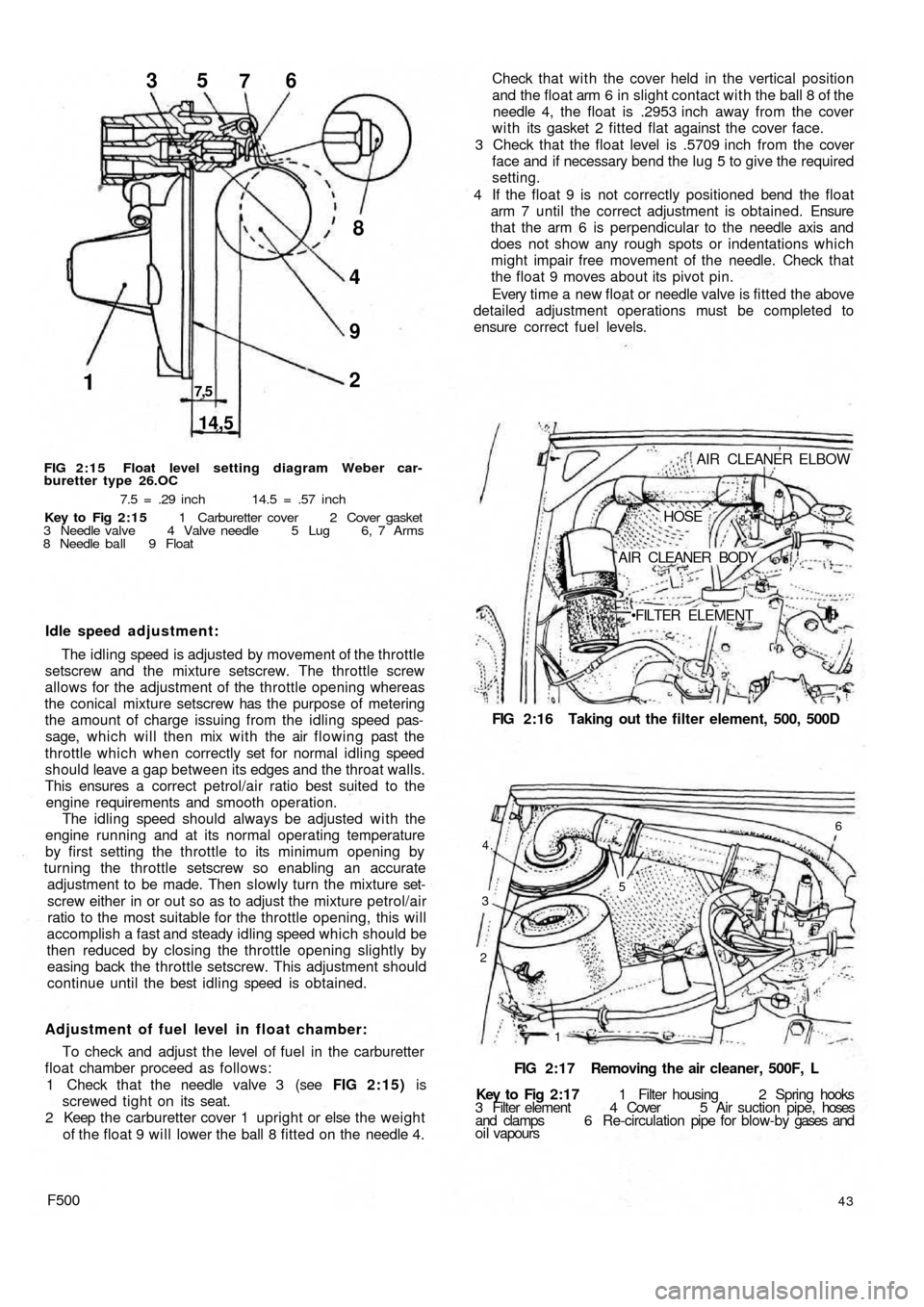
FIG 2:15 Float level setting diagram Weber car-
buretter type 26.OC
7.5 = .29 inch 14.5 = .57 inch
Key to Fig 2:15 1 Carburetter cover 2 Cover gasket
3 Needle valve 4 Valve needle 5 Lug 6, 7 Arms
8 Needle ball 9 Float
Idle speed adjustment:
The idling speed is adjusted by movement of the throttle
setscrew and the mixture setscrew. The throttle screw
allows for the adjustment of the throttle opening whereas
the conical mixture setscrew has the purpose of metering
the amount of charge issuing from the idling speed pas-
sage, which will then mix with the air flowing past the
throttle which when correctly set for normal idling speed
should leave a gap between its edges and the throat walls.
This ensures a correct petrol/air ratio best suited to the
engine requirements and smooth operation.
The idling speed should always be adjusted with the
engine running and at its normal operating temperature
by first setting the throttle to its minimum opening by
turning the throttle setscrew so enabling an accurate
adjustment to be made. Then slowly turn the mixture set-
screw either in or out so as to adjust the mixture petrol/air
ratio to the most suitable for the throttle opening, this will
accomplish a fast and steady idling speed which should be
then reduced by closing the throttle opening slightly by
easing back the throttle setscrew. This adjustment should
continue until the best idling speed is obtained.
Adjustment of fuel level in float chamber:
To check and adjust the level of fuel in the carburetter
float chamber proceed as follows:
1 Check that the needle valve 3 (see FIG 2:15) is
screwed tight on its seat.
2 Keep the carburetter cover 1 upright or else the weight
of the float 9 will lower the ball 8 fitted on the needle 4.
F50043
Key to Fig 2:17 1 Filter housing 2 Spring hooks
3 Filter element 4 Cover 5 Air suction pipe, hoses
and clamps 6 Re-circulation pipe for blow-by gases and
oil vapoursFIG 2:17 Removing the air cleaner, 500F, L
2
1 3
4.
6
5
FIG 2:16 Taking out the filter element, 500, 500D AIR CLEANER ELBOW
HOSE
AIR CLEANER BODY
FILTER ELEMENT Check that with the cover held in the vertical position
and the float arm 6 in slight contact with the ball 8 of the
needle 4, the float is .2953 inch away from the cover
w i t h its gasket 2 fitted flat against the cover face.
3 Check that the float level is .5709 inch from the cover
face and if necessary bend the lug 5 to give the required
setting.
4 If the float 9 is not correctly positioned bend the float
arm 7 until the correct adjustment is obtained. Ensure
that the arm 6 is perpendicular to the needle axis and
does not show any rough spots or indentations which
might impair free movement of the needle. Check that
the float 9 moves about its pivot pin.
Every time a new float or needle valve is fitted the above
detailed adjustment operations must be completed to
ensure correct fuel levels.
Page 37 of 128
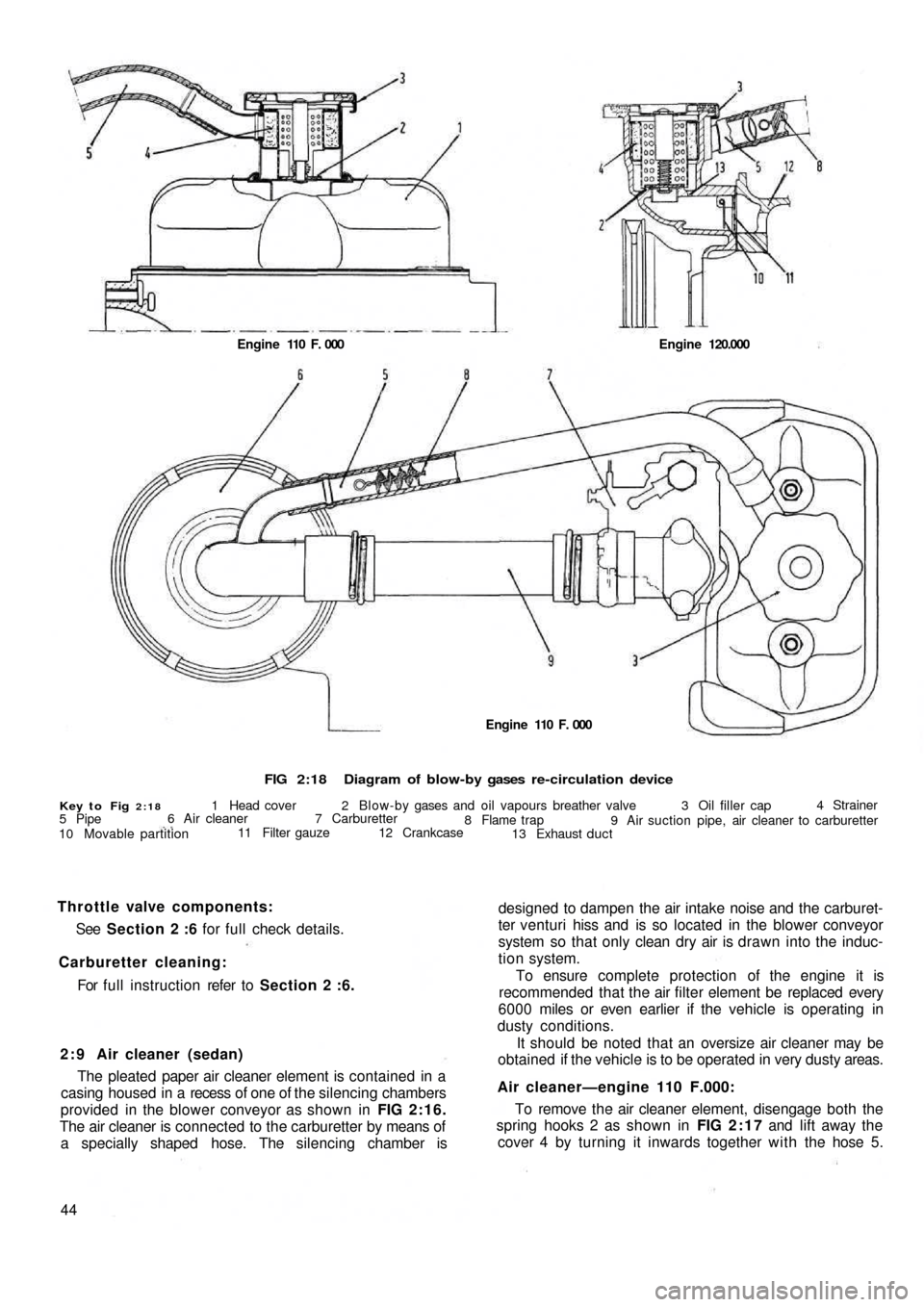
FIG 2:18Diagram of blow-by gases re-circulation device
Key to Fig 2:181 Head cover 2 Blow-by gases and oil vapours breather valve 3 Oil filler cap4 Strainer
9 Air suction pipe, air cleaner to carburetter 8 Flame trap
13 Exhaust duct 12 Crankcase 7 Carburetter 6 Air cleaner
11 Filter gauze
10 Movable partition 5 PipeEngine 110 F. 000 Engine 120.000
designed to dampen the air intake noise and the carburet-
ter venturi hiss and is so located in the blower conveyor
system so that only clean dry air is drawn into the induc-
tion system.
To ensure complete protection of the engine it is
recommended that the air filter element be replaced every
6000 miles or even earlier if the vehicle is operating in
dusty conditions.
It should be noted that an oversize air cleaner may be
obtained if the vehicle is to be operated in very dusty areas.
Air cleaner—engine 110 F.000:
To remove the air cleaner element, disengage both the
spring hooks 2 as shown in FIG 2:17 and lift away the
cover 4 by turning it inwards together with the hose 5. 2 : 9 Air cleaner (sedan)
The pleated paper air cleaner element is contained in a
casing housed in a recess of one of the silencing chambers
provided in the blower conveyor as shown in FIG 2:16.
The air cleaner is connected to the carburetter by means of
a specially shaped hose. The silencing chamber is
44For full instruction refer to Section 2 :6. Carburetter cleaning:See Section 2 :6 for full check details. Throttle valve components:
Engine 110 F. 000
Page 38 of 128
Air cleaner—station wagon:
A pleated paper air cleaner element is housed in a
special air intake chamber connected to the front of the
engine air cooling cowling (see FIG 4 : 2) . This chamber
will be seen located towards the rear of t h e power unit
compartment. Remove the retaining wing nut, lift off the
lid and the element can be withdrawn by lifting upwards.
2:10 Blow-by-gases recirculation device
Engine 110 F.000
All the oil vapours and blow-by-gases that are formed
in the engine crankcase are drawn to the cylinder head
cover recess 1 (see FIG 2:18). From here they travel into
the pipe 5 via a breather valve 2 which is firmly attached to
the oil filler cap 3 and the strainer 4 located in the filler
neck. The oil vapours and gases are then d r a w n back into
the duct 9 from the pipe 5 which connects the air cleaner
6 to the carburetter 7. This ensures a complete closed cir-
cuit circulation.
Engine 120.000:
From engine No. 288156 the oil vapours and blow-by-
gases instead of being exhausted to the atmosphere are
conveyed to the air cleaner and from here they are drawn
back into the combustion chambers. To ensure that an
excessive of oil vapour does not pass along the piping
with the blow-by-gases a diaphragm is fitted in the duct
in front of the breather valve 2 (see FIG 2 :18), the dia-
phragm comprising a filter gauze 11 and moveable parti-
tion 10.
It should be noted that the oil vapour strainer 4 (see
FIG 2:18) and the flame trap 8 can easily be removed
from their seating for cleaning or renewal.
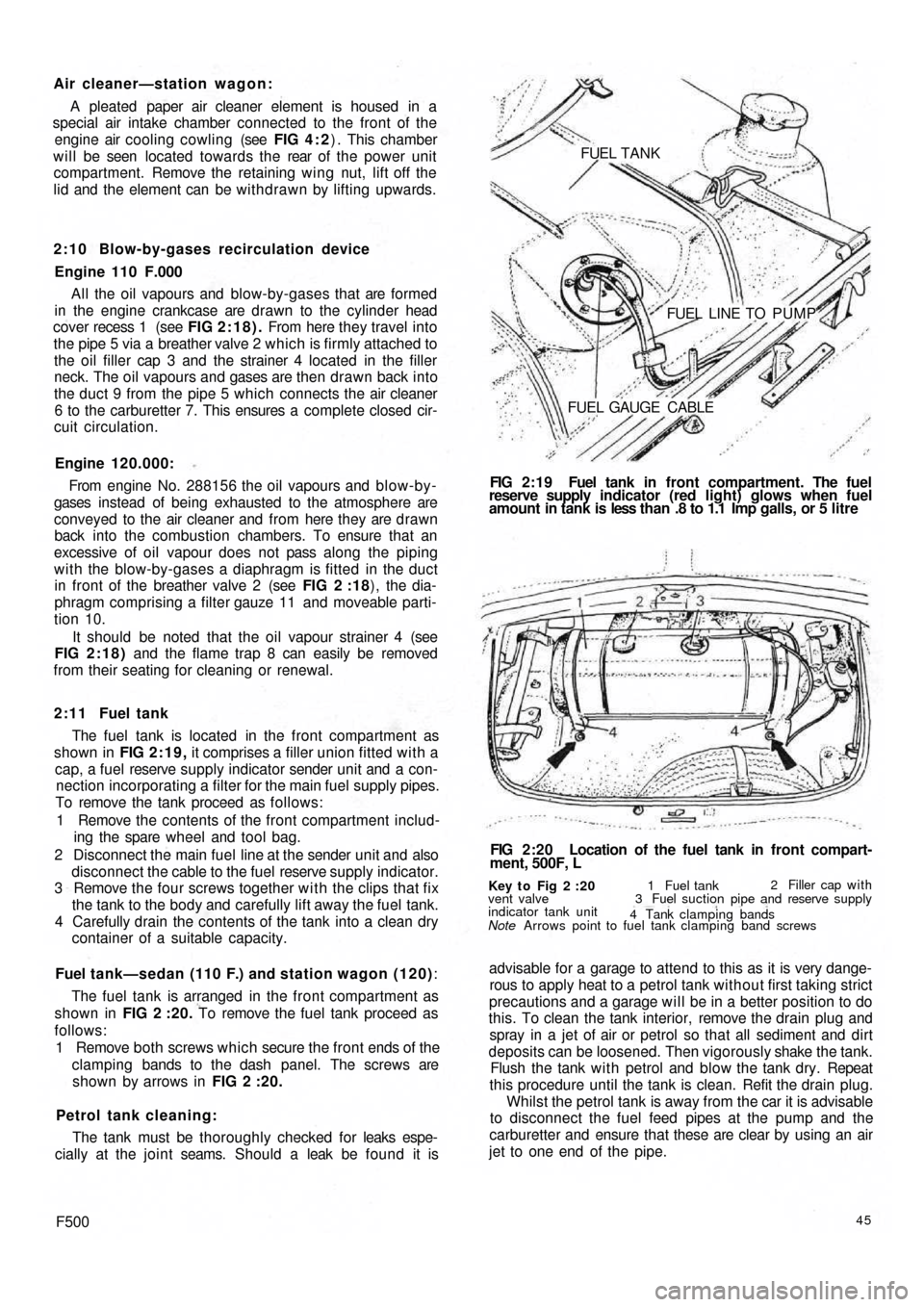
2 : 1 1 Fuel tank
The fuel tank is located in the front compartment as
shown in FIG 2:19, it comprises a filler union fitted with a
cap, a fuel reserve supply indicator sender unit and a con-
nection incorporating a filter for the main fuel supply pipes.
To remove the tank proceed as follows:
1 Remove the contents of the front compartment includ-
ing the spare wheel and tool bag.
2 Disconnect the main fuel line at the sender unit and also
disconnect the cable to the fuel reserve supply indicator.
3 Remove the four screws together w i t h the clips that fix
the tank to the body and carefully lift away the fuel tank.
4 Carefully drain the contents of the tank into a clean dry
container of a suitable capacity.
Fuel tank—sedan (110 F.) and station wagon (120):
The fuel tank is arranged in the front compartment as
shown in FIG 2 :20. To remove the fuel tank proceed as
follows:
1 Remove both screws which secure the front ends of the
clamping bands to the dash panel. The screws are
shown by arrows in FIG 2 :20.
Petrol tank cleaning:
The tank must be thoroughly checked for leaks espe-
cially at the joint seams. Should a leak be found it is
F50045
advisable for a garage to attend to this as it is very dange-
rous to apply heat to a petrol tank without first taking strict
precautions and a garage will be in a better position to do
this. To clean the tank interior, remove the drain plug and
spray in a jet of air or petrol so that all sediment and dirt
deposits can be loosened. Then vigorously shake the tank.
Flush the tank w i t h petrol and blow the tank dry. Repeat
this procedure until the tank is clean. Refit the drain plug.
Whilst the petrol tank is away from the car it is advisable
to disconnect the fuel feed pipes at the pump and the
carburetter and ensure that these are clear by using an air
jet to one end of the pipe.
Key t o Fig 2 :20
Note Arrows point to fuel tank clamping band screws vent valve
indicator tank unit1 Fuel tank2 Filler cap with
3 Fuel suction pipe and reserve supply
4 Tank clamping bands
FIG 2:20 Location of the fuel tank in front compart-
ment, 500F, L FIG 2:19 Fuel tank in front compartment. The fuel
reserve supply indicator (red light) glows when fuel
amount in tank is less than .8 to 1.1 Imp galls, or 5 litre FUEL TANK
FUEL LINE TO PUMP
FUEL GAUGE CABLE
Page 39 of 128
2:12 Fault diagnosis
(a) Leakage or insufficient fuel delivered
1 Air vent in tank restricted
2 Petrol pipes blocked
3 Air leaks at pipe connections
4 Pump or carburetter filters blocked
5 Pump gaskets faulty
6 Pump diaphragm defective
7 Pump valves sticking or seating badly
8 Fuel vapourizing in pipelines due to heat
(b) Excessive fuel consumption
1 Carburetter needs adjusting
2 Fuel leakage
3 Sticking controls or choke device
4 Dirty air cleaner
5 Excessive engine temperature
6 Brakes binding
7 Tyres under-inflated
8 Idling speed too high
9 Car overloaded(c) Idling speed too high
1 Rich fuel mixture
2 Carburetter controls sticking
3 Slow-running screws incorrectly adjusted
4 Worn carburetter butterfly valve
(d) Noisy fuel pump
1 Loose mountings
2 Air leaks on suction side and at diaphragm
3 Obstruction in fuel pipe
4 Clogged pump filter
(e) No fuel delivery
1 Float needle stuck
2 Vent in tank blocked
3 Pipeline obstructed
4 Pump diaphragm stiff or damaged
5 Inlet valve in pump stuck open
6 Bad air leak on suction side of pump
46
Page 72 of 128
CHAPTER 7
REAR SUSPENSION AND WHEELS
7:1
7:2
7:3
7:4Description
Removal of rear suspension assembly
Servicing swinging arms
Coil springs
7:1 Description
The rear wheels are independently sprung by means of
coil springs and V-shaped swinging arms acting on coil
springs and telescopic double acting hydraulic shock
absorbers. The swinging arms are m o u n t e d at their inner
ends on 'estendblocks', the coil spring is fitted at the outer
end of the swinging arm. At the wheel end of the suspen-
sion arm is attached a steel pressing to which the brake
backplate and wheel bearing housing are bolted so
forming a swinging unit to which is attached the road
wheel.
The inner pivots are so located vertical wheel move-
ments do not influence the drive shaft length which
means that there is no need to fit a splined joint at the
wheel end. Two taper roller bearings which are separated
by a specially designed collapsible spacer are located in
the rear wheel bearing housing and this carries the axle
shaft. The outer end of the axle shaft is flanged and it
is to this flange that the brake drum is bolted. The splined
inner end carries a rubber cushioned coupling to which
the drive shaft flange is attached.
7 : 2 Removal of rear suspension assembly
1 Jack-up the vehicle and place on firmly based stands.
Remove the road wheel on the side from which the
suspension unit is to be removed.
F50079 7:5
7:6
7:7
7:8Installation of rear suspension assembly
Checking and adjusting rear wheel toe-in
Modifications
Fault diagnosis
2 Using a garage hydraulic jack support the swinging
arm to facilitate the removal of the upper shock
absorber mounting nut which is located inside the
vehicle on the floor. To gain access to the nut remove
the rear wheel housing linings.
3 Unhook the parking brake shoe control lever return
spring.
4 Remove the three screws securing the drive shaft
flange to the flexible coupling. Pull back the sleeve and
remove the inner spring.
5 Remove the brake fluid reservoir cap, remove the filter
and plug the delivery hole in the brake f l u i d reservoir
and disconnect the flexible brake pipe from the
bracket on the body floor.
6 Disconnect the parking brake control tie rod by first
removing the cotter pin and removing the cable eye
from the pin on the shoe control lever. Release the
cable adjustment nuts and free the cable from the
fairlead on the swinging arm.
7 Using the hydraulic jack carefully lower the swinging
arm, fully retract the shock absorber by pushing in the
outer cylinder and carefully pull out the coil spring
together with its mounting rubber rings.
8 Remove the self-locking nut securing the swinging
arm to the internal support welded on the floor.
Extract the mounting pin and note the number and
arrangement of shims between the bushings and the
bracket. This will facilitate reassembly.
Page 102 of 128
10:9 Brake fluid reservoir
The reservoir is located in the front compartment to the
side of the fuel tank as shown in FIG 10:9. Should it be
necessary to detach the fluid outlet line from the reservoir
the outlet hole must be blanked off using a tapered
wooden peg of suitable length so that the cap may be
replaced to prevent the ingress of foreign matter into
the reservoir and the absorbtion of moisture, oil or petrol
vapours which would alter the properties of the hydraulic
fluid.
A special filter is fitted into the top of the reservoir
through which all fluid used for topping-up the reservoir
must pass to ensure utmost inner cleanliness of the
hydraulic system.
10:10 Bleeding the system
This is not a routine maintenance operation and is only
necessary if air has entered the hydraulic system because
parts have been dismantled or because the f l u i d level in
the reservoir has dropped so low that air has been drawn
into the main feed pipe to the master cylinders.
1 Fill the reservoir w i t h Fiat 'Blue Label' hydraulic fluid.
During the bleeding operation fluid will be used and
constant topping-up of the supply reservoir will be
needed. If this is not done it is possible for air to enter
the master cylinder main feed pipe which will nullify
the operation and necessitate a fresh start.
2 Attach a length of rubber or plastic tubing to the
bleeder screw on the rear wheel cylinder furthermost
from the master cylinder. Immerse the free end of the
tube in a small volume of hydraulic brake fluid in a
clean jar.
3 Open the bleed screw one turn and get a second
operator to press down slowly on the brake pedal. After
a full stroke let the pedal return without assistance,
pause a moment and repeat the d o w n stroke. At first
there will be air bubbles issuing from the bleed tube,
but when fluid alone is ejected, hold the pedal firmly
down on the floor panel and tighten the bleed screw.
Repeat this operation on the other rear brake and then
repeat the operation on the two front brakes.
4 On completion, top-up the fluid in the reservoir to the
correct level. Discard all dirty fluid. If fluid is perfectly
clean, let it stand for twenty four hours to become
clear of air bubbles before using it again.
10:11 Hand parking brake
Normally with the new 500 Sedan model automatic
brake adjusting device, adjustment of the rear brakes
will take up excessive handbrake travel.
If there is excessive travel on the handbrake of the
Sedan model at any time, or in the case of Station Wagon
model even after the rear brakes have been manually
adjusted, suspect worn brake shoe linings or stretched
handbrake cables. Examine the linings and fit replace-
ment shoes if necessary. Check the action of the hand
parking brake again and if there is still too much travel
before the brakes are applied it is permissible to take up as
follows:
1 It is essential to ensure that the rear shoes are correctly
adjusted as described in Section 10:2.
2 Apply the hand parking brake lever until the pawl
engages with the ratchet at the second notch.
F500
FIG 10:11 An exploded view showing the components of
the tandem master cylinder
3 Jack up the rear of t h e vehicle and place on firmly
based stands.
4 Locate the cable adjusting nuts as shown in FIG
10:10 and adjust these until it is just possible to turn
the road wheels by heavy hand pressure. It is important
that both wheels offer the same resistance to turning
to obtain correctly balanced braking.
5 Return the lever to the OFF position and check that
both wheels are quite free to rotate. If a brake tends to
bind, remove the wheel and brake drum and check
the brake shoe pull-off spring is correctly fitted and
that the lever return spring and operating lever are
functioning correctly. Also check for suspected
seizure of the wheel cylinder. When the fault has
been rectified refit the drum. Readjust and recheck.
Removing the hand parking brake cable:
1 Chock the front wheels and release the handbrake.
Raise t h e rear of the vehicle and place on firmly based
stands.
2 Disconnect the cables from the operating levers on
each rear brake unit. Release each cable from its body
mounted bracket.
3 Inside the car, remove the rear seat and the seat belt
fitting from the floor. As necessary, remove the centre
console and the carpet to give access to the cover plate
on the centre tunnel and remove it.
4 Remove the handbrake lever assembly, detach the
cable compensator and pull the cables through the
holes in the box panel.
5 Reassembly is the reverse procedure to removal.
Ensure t h a t the cable is well lubricated and finally
readjust as previously described.
10:12 The dual circuit braking system
This is used on later model cars. A tandem master
cylinder provides t w o entirely separate hydraulic circuits,
one for the front and one for the rear brakes. The
components of the master cylinder are shown in the
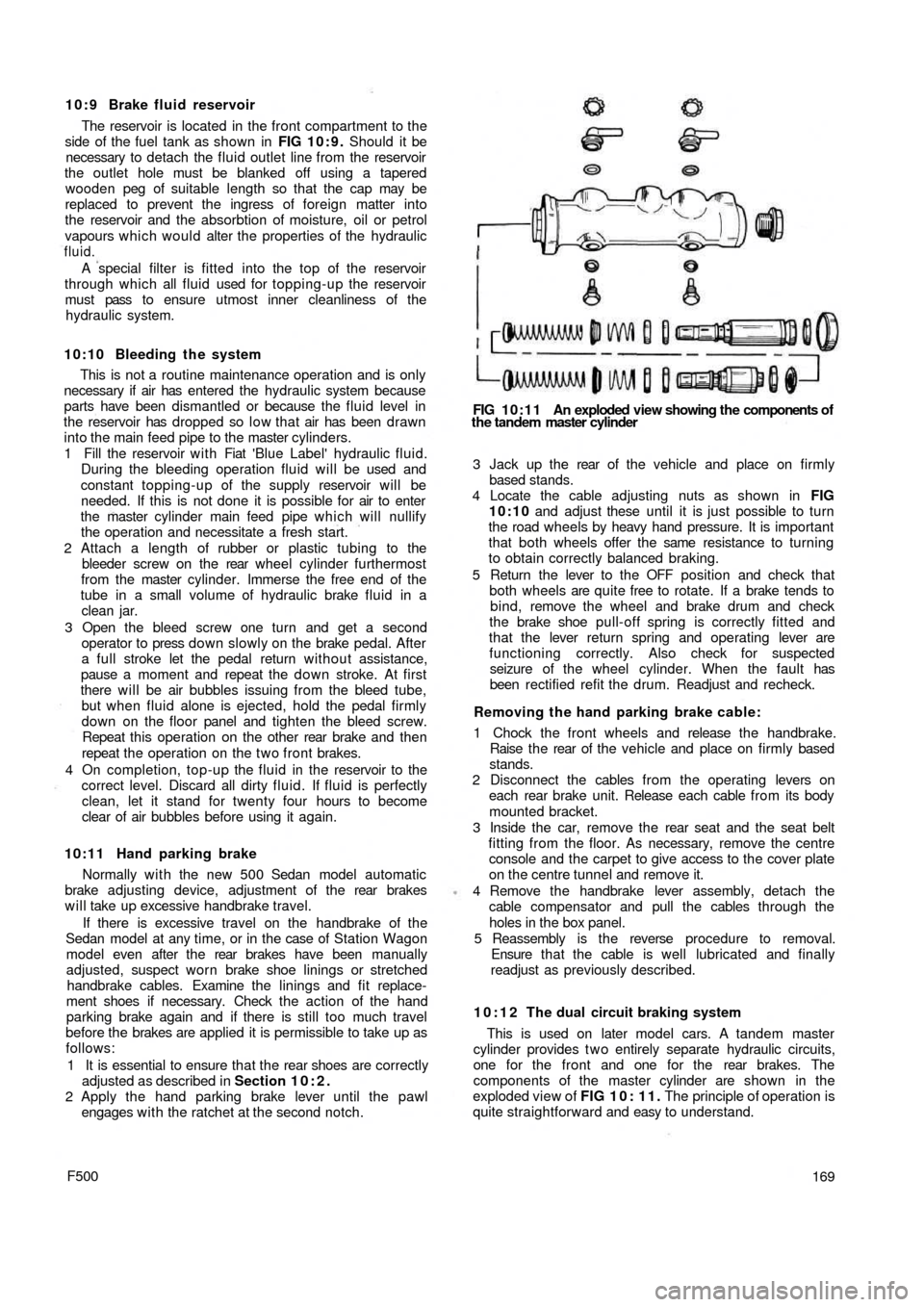
exploded view of FIG 1 0 : 1 1 . The principle of operation is
quite straightforward and easy to understand.
169