fuel FIAT BRAVO 2012 2.G Owner's Manual
[x] Cancel search | Manufacturer: FIAT, Model Year: 2012, Model line: BRAVO, Model: FIAT BRAVO 2012 2.GPages: 299, PDF Size: 5.81 MB
Page 134 of 299
WARNING
Do not bring naked flames or lit
cigarettes near to the fuel tank
opening: fire risk. Keep your face away from
the fuel filler to prevent breathing in harmful
vapours.
PROTECTING THE ENVIRONMENTThe following devices are used for reducing petrol
fuel engine emissions:
❒three-way catalytic converter (catalytic
converter)
❒oxygen sensors
❒evaporation control system.
In addition, do not let the engine run, even for a
test, with one or more spark plugs disconnected.
The following devices are used for reducing diesel
fuel engine emissions:
❒oxidising catalytic converter
❒exhaust gas recirculation system (EGR)
❒particulate filter (DPF).
WARNING
The catalytic converter develops high
temperature during operation. Do
not park the car on grass, dry leaves, pine
needles or other flammable material: fire
hazard.
130GETTING TO
KNOW YOUR CAR
SAFETY
STARTING AND
DRIVING
WARNING LIGHTS
AND MESSAGES
IN AN EMERGENCY
SERVICING AND
MAINTENANCE
TECHNICAL
SPECIFICATIONS
INDEX
Page 160 of 299
HOW TO WARM UP THE ENGINE AFTER
IT HAS JUST STARTED
Proceed as follows:
❒Drive off slowly, letting the engine turn at
medium revs. Do not accelerate abruptly;
❒Do not demand full performance at first. Wait
until the engine coolant temperature gauge
starts moving.
Never jump start the engine by pushing,
towing or coasting downhill.This could
cause fuel to flow into the catalytic
conver ter and damage it beyond repair.
EMERGENCY START-UP
Contact a Fiat Dealership if instrument panel
warning light
(or the symbol on the display)
stays on constantly.STOPPING THE ENGINE
Turn the ignition key to STOP while the engine is
idling.
IMPORTANT After a taxing drive, you should allow
the engine to “catch its breath” before turning it
off by letting it idle to allow the temperature in the
engine compartment to fall.
A quick burst on the accelerator before
turning off the engine serves absolutely
no practical purpose, it wastes fuel and is
damaging especially to turbocharged engines.
156GETTING TO KNOW
YOUR CAR
SAFETYSTARTING AND
DRIVINGWARNING LIGHTS
AND MESSAGES
IN AN EMERGENCY
SERVICING AND
MAINTENANCE
TECHNICAL
SPECIFICATIONS
INDEX
Page 163 of 299
WARNING
Press the clutch pedal fully to change
gears correctly. It is therefore essential
that there is nothing under the pedals: make
sure the mats are lying flat and do not get
in the way of the pedals.Do not drive with your hand resting on
the gear lever as the force exerted,
even if slight , could lead over time to
premature wear on the gearbox internal
components
FUEL SAVINGSHere are some useful tips to save fuel and minimise
harmful emissions of CO
2and other pollutants
(nitric oxides, unburnt hydrocarbons, fine dusts
etc…).
GENERAL CONSIDERATIONS
The general factors that affect fuel consumption are
listed below.
Car maintenance
Have checks and adjustments carried out in
accordance with the “Scheduled Servicing Plan”.
Ty r e s
Check the pressure of the tyres routinely at an
interval of no more than 4 weeks: if the pressure is
too low, consumption levels increase as resistance
to rolling is higher.
Unnecessary loads
Do not travel with an overloaded boot. The weight
of the car (especially when driving in town) and
its ride greatly affects consumption and stability.
Roof rack/ski rack
Remove the roof rack or the ski rack from the roof
after use. These accessories lower aerodynamic
penetration and adversely affect consumption
159GETTING TO KNOW
YOUR CAR
SAFETYSTARTING AND
DRIVINGWARNING LIGHTS
AND MESSAGES
IN AN EMERGENCY
SERVICING AND
MAINTENANCE
TECHNICAL
SPECIFICATIONS
INDEX
Page 164 of 299
levels. When transporting particularly large objects,
use a trailer if possible.
Electric devices
Use electric devices only for the amount of time
needed. The heated rear window, additional
headlights, windscreen wipers and heater fan need a
considerable amount of energy, therefore
increasing fuel consumption (by up to 25% in the
urban cycle).
Climate control system
Air conditioning leads to higher fuel consumption
(on average up to +20%). If the temperature
outside permits, try and use the air vents.
Devices for aerodynamic control
The use of non-certified spoilers may adversely
affect air drag and fuel consumption.
DRIVING STYLE
The main driving styles that affect fuel consumption
are listed below.
Starting
Do not warm the engine with the car at a standstill
or at idle or high speed: under these conditions
the engine warms up much more slowly, increasing
electrical consumption and emissions. It istherefore advisable to move off immediately, slowly,
avoiding high speeds: in this way the engine will
warm faster.
Unnecessary actions
Avoid accelerating when starting at traffic lights or
before switching off the engine. This and also
double declutching is absolutely pointless on
modern cars and also increases consumption and
pollution.
Gear selection
As soon as the conditions of the traffic and road
allow, use a higher gear. Using a low gear for faster
acceleration will increase consumption.
In the same way improper use of a high gear
increases consumption, emissions an engine wear.
Max. speed
Fuel consumption considerably increases as speed
increases. Avoiding unnecessary braking and
acceleration, which cost in terms of both fuel and
emissions.
Acceleration
Accelerating violently severely affects consumption
and emissions: acceleration should be gradual and
should not exceed the maximum torque.
160GETTING TO KNOW
YOUR CAR
SAFETYSTARTING AND
DRIVINGWARNING LIGHTS
AND MESSAGES
IN AN EMERGENCY
SERVICING AND
MAINTENANCE
TECHNICAL
SPECIFICATIONS
INDEX
Page 165 of 299
CONDITIONS OF USE
The main usage conditions that negatively affect
fuel consumption are listed below.
Cold starting
Short journeys and frequent cold starts do not
allow the engine to reach optimum operating
temperature. This results in a significant increase in
consumption levels (from +15 to +30% on the
urban cycle) and emissions.
Traffic and road conditions
Rather high consumption levels are linked to
situations with heavy traffic, for instance when
travelling in queues with frequent use of the lower
gears or in cities with many traffic lights. Winding
mountain roads and rough road surfaces also
adversely affect consumption.
Traffic hold-ups
During prolonged hold-ups (e.g. level crossings) the
engine should be switched off.
TOWING TRAILERSIMPORTANT NOTES
For towing caravans or trailers the car must be
fitted with a certified tow hook and an adequate
electric system. Installation should be carried
out by specialised personnel who will issue the
required papers for travelling on roads.
Install any specific and/or additional rear view
mirrors as specified by the Highway Code.
Remember that when towing a trailer, steep hills
are harder to climb, braking distances increase and
overtaking takes longer depending on the overall
weight.
Engage a low gear when driving downhill, rather
than constantly using the brake.
The weight the trailer exerts on the car tow hook
reduces the car's loading capacity by the same
amount. To make sure that the maximum towable
weight is not exceeded (given in the car registration
document) account should be taken of the fully
laden trailer, including accessories and luggage.
Respect the speed limits specific to each country
for vehicles towing trailers.
In any case, the maximum speed must not exceed
80 km/h.
161GETTING TO KNOW
YOUR CAR
SAFETYSTARTING AND
DRIVINGWARNING LIGHTS
AND MESSAGES
IN AN EMERGENCY
SERVICING AND
MAINTENANCE
TECHNICAL
SPECIFICATIONS
INDEX
Page 176 of 299
GENERIC FAILURE INDICATION
(amber)
Fuel cut-off inertia switch tripped
This warning light (or symbol on the display) comes
on when the fuel cut-off inertia switch is triggered.
The display shows the dedicated message.
Engine oil pressure sensor failure
This warning light (or symbol on the display)
switches on when a failure is detected in the engine
oil pressure sensor.
Start&Stop failure
(for versions/markets, where provided)
(versions with multifunction display)
The warning light comes on when a failure is
detected in the Start&Stop system. The display
shows the dedicated message.
Dusk sensor failure
This warning light (or symbol on the display)
switches on when a failure is detected in the dusk
sensor. The display shows the dedicated message.Preset speed limit exceeded (for Arab
countries only)
This warning light (amber), or symbol on the display
(red), switches on when the preset speed limit of
120 km/h is exceeded.
Rain sensor failure
This warning light (or symbol on the display)
switches on when a failure is detected in the rain
sensor. The display shows the dedicated message.
Parking sensor failure
(for versions/markets, where provided)
The warning light (or symbol on the display)
switches on when a parking sensor failure
is detected.
Tyre pressure monitoring system failure
(for versions/markets, where provided)
This warning light (or symbol on the display)
switches on when a TPMS failure is detected.
Should one or more wheels without a sensor be
fitted, the instrument panel warning light will come
on and stay on until the initial conditions are
restored. The display shows the dedicated message.
NoteIf one of the above mentioned failures
occurs, contact a Fiat Dealership as soon as
possible.
172GETTING TO KNOW
YOUR CAR
SAFETY
STARTING AND
DRIVINGWARNING LIGHTS
AND MESSAGESIN AN EMERGENCY
SERVICING AND
MAINTENANCE
TECHNICAL
SPECIFICATIONS
INDEX
Page 177 of 299
DPF (DIESEL PARTICULATE
FILTER) CLEANING IN PROGRESS
(only diesel versions with DPF)
(amber)
Turning the key to the MAR-ON position the
warning light switches on, but it should switch off
after a few seconds. The warning light (together
with a message and a symbol on the display on
some versions) switches on constantly to notify the
driver that the DPF system needs to eliminate
captured pollutants (particulate) by the
regeneration process.
The warning light does not switch on during every
DPF regeneration, but only when driving conditions
require that the driver is notified. To switch the
warning light off, the car must be kept moving until
the regeneration process is completed.
On average, the process lasts fifteen minutes. The
best conditions to complete the regeneration
process are reached driving the car at about 60
km/h with engine speed over 2000 rpm.
When this warning light switches on, it does not
indicate a fault of the car and it should therefore
not be taken to a workshop. A specific message will
appear on the display when the warning light
comes on (for versions/markets, where provided).
WARNING
The driving speed should always be
suitable to traffic conditions, weather
conditions and the driver should always
comply with traffic regulations.The engine
may be turned off while the DPF light is on;
however, repeated interruption of the
regeneration process may result in premature
degradation of the engine oil. For this reason,
always wait until the warning light switches off
before stopping the engine as described
above. It is not a good idea to complete DPF
regeneration with the car stationar y.FUEL RESERVE (amber)
Turning the key to the MAR-ON position the
warning light switches on, but it should switch off
after a few seconds. The warning light turns on
when 8-10 litres of fuel are left in the tank.
IMPORTANT The warning light will flash to indicate
a system failure. If this is the case, go to the Fiat
Dealership to have the system checked.
173GETTING TO KNOW
YOUR CAR
SAFETY
STARTING AND
DRIVINGWARNING LIGHTS
AND MESSAGESIN AN EMERGENCY
SERVICING AND
MAINTENANCE
TECHNICAL
SPECIFICATIONS
INDEX
Page 178 of 299
EOBD/INJECTION SYSTEM
FAILURE (amber)
In normal conditions, when the ignition key is
turned to MAR-ON the warning light switches on,
but should switch off as soon as the engine is
started.
If the warning light remains on or comes on whilst
driving, it means that the injection system is not
working properly; in particular, if the warning light
comes on constantly, this indicates a malfunction in
the supply/ignition system that could cause
excessive exhaust emissions, a possible loss of
performance, poor driveability and high fuel
consumption.
The display will show the dedicated message.
Under these conditions, you may continue travelling
at moderate speed without demanding excessive
effort from the engine. Prolonged use of the car
with the warning light on may cause damage:
contact a Fiat Dealership as soon as possible.
The warning light goes out after the fault
disappears, but the notification is stored in the
system.
Petrol engines only
If the warning light flashes, this indicates potential
catalytic converter damage.If the light flashes, it is necessary to release the
accelerator pedal to lower the speed of the engine
until the warning light stops flashing; continue
the journey at moderate speed, trying to avoid
driving conditions that may cause further flashing
and contact a Fiat Dealership as soon as possible.
Contact a Fiat Dealership as soon as
possible if the
warning light either
does not switch on when the key is
turned to MAR-ON or if while driving the
warning light switches on either constantly or
flashing (along with a message and a symbol on
the display on some versions).The operation
of warning light
may be checked by the
traffic police using specific devices. Comply with
the laws and regulations of the country where
you are driving.
ESP SYSTEM (amber)
Turning the key to the MAR-ON position the
warning light switches on, but it should switch off
after a few seconds. If the warning light does not go
off or stays on together with the LED on the ASR
button when travelling, contact a Fiat Dealership.
On some versions the display shows the dedicated
message. Flashing of the warning light while driving
indicates the intervention of the ESP system.
174GETTING TO KNOW
YOUR CAR
SAFETY
STARTING AND
DRIVINGWARNING LIGHTS
AND MESSAGESIN AN EMERGENCY
SERVICING AND
MAINTENANCE
TECHNICAL
SPECIFICATIONS
INDEX
Page 179 of 299
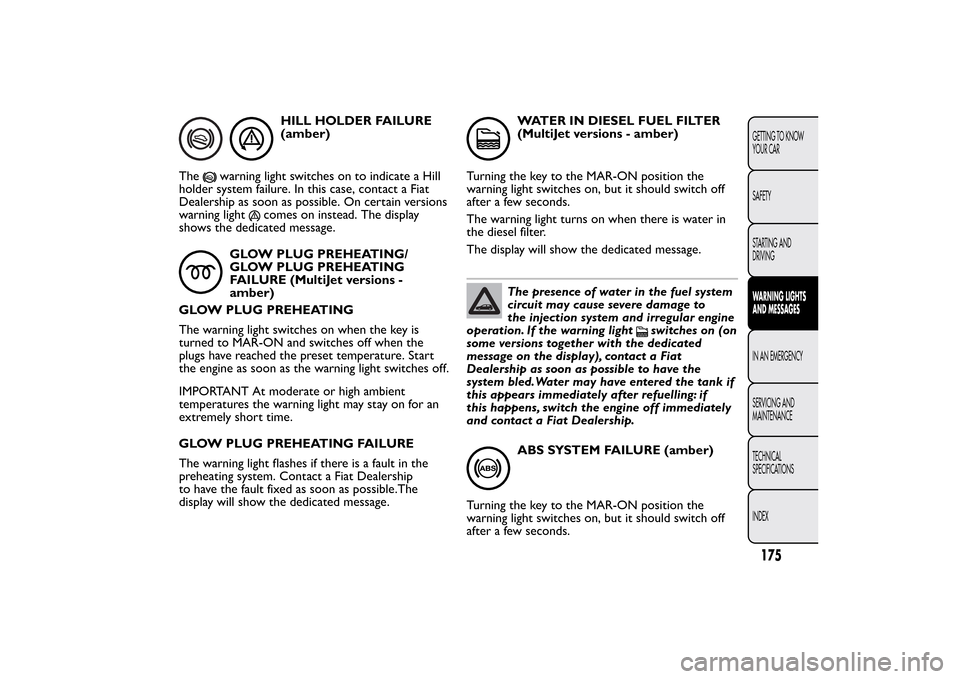
HILL HOLDER FAILURE
(amber)
The
warning light switches on to indicate a Hill
holder system failure. In this case, contact a Fiat
Dealership as soon as possible. On certain versions
warning light
comes on instead. The display
shows the dedicated message.
GLOW PLUG PREHEATING/
GLOW PLUG PREHEATING
FAILURE (MultiJet versions -
amber)
GLOW PLUG PREHEATING
The warning light switches on when the key is
turned to MAR-ON and switches off when the
plugs have reached the preset temperature. Start
the engine as soon as the warning light switches off.
IMPORTANT At moderate or high ambient
temperatures the warning light may stay on for an
extremely short time.
GLOW PLUG PREHEATING FAILURE
The warning light flashes if there is a fault in the
preheating system. Contact a Fiat Dealership
to have the fault fixed as soon as possible.The
display will show the dedicated message.
WATER IN DIESEL FUEL FILTER
(MultiJet versions - amber)
Turning the key to the MAR-ON position the
warning light switches on, but it should switch off
after a few seconds.
The warning light turns on when there is water in
the diesel filter.
The display will show the dedicated message.The presence of water in the fuel system
circuit may cause severe damage to
the injection system and irregular engine
operation. If the warning light
switches on (on
some versions together with the dedicated
message on the display), contact a Fiat
Dealership as soon as possible to have the
system bled.Water may have entered the tank if
this appears immediately after refuelling: if
this happens, switch the engine off immediately
and contact a Fiat Dealership.
ABS SYSTEM FAILURE (amber)
Turning the key to the MAR-ON position the
warning light switches on, but it should switch off
after a few seconds.
175GETTING TO KNOW
YOUR CAR
SAFETY
STARTING AND
DRIVINGWARNING LIGHTS
AND MESSAGESIN AN EMERGENCY
SERVICING AND
MAINTENANCE
TECHNICAL
SPECIFICATIONS
INDEX
Page 181 of 299
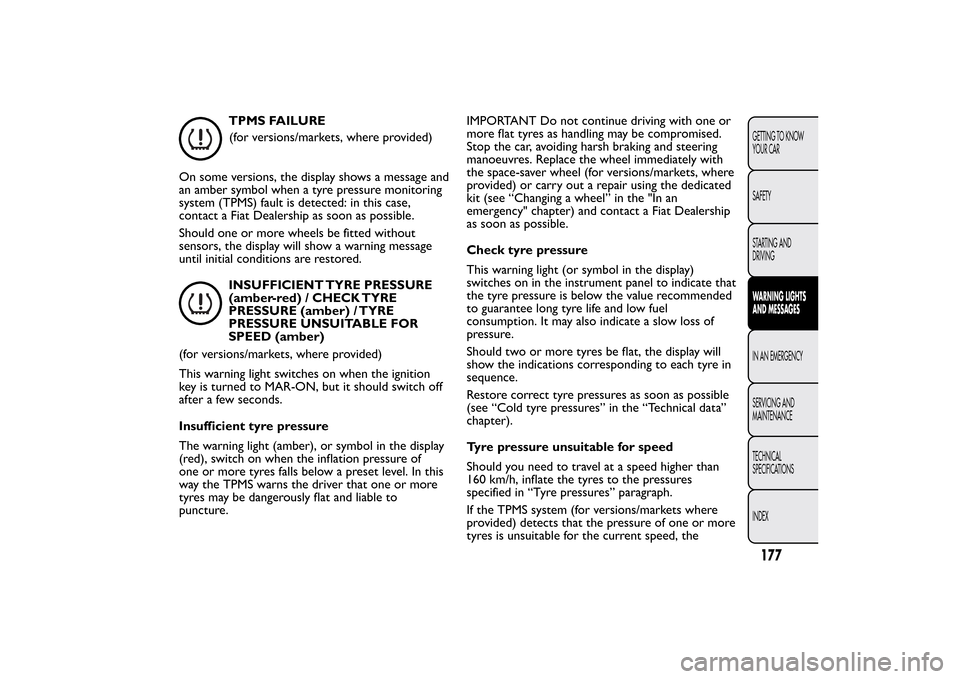
TPMS FAILURE
(for versions/markets, where provided)
On some versions, the display shows a message and
an amber symbol when a tyre pressure monitoring
system (TPMS) fault is detected: in this case,
contact a Fiat Dealership as soon as possible.
Should one or more wheels be fitted without
sensors, the display will show a warning message
until initial conditions are restored.INSUFFICIENT TYRE PRESSURE
(amber-red) / CHECK TYRE
PRESSURE (amber) / TYRE
PRESSURE UNSUITABLE FOR
SPEED (amber)
(for versions/markets, where provided)
This warning light switches on when the ignition
key is turned to MAR-ON, but it should switch off
after a few seconds.
Insufficient tyre pressure
The warning light (amber), or symbol in the display
(red), switch on when the inflation pressure of
one or more tyres falls below a preset level. In this
way the TPMS warns the driver that one or more
tyres may be dangerously flat and liable to
puncture.IMPORTANT Do not continue driving with one or
more flat tyres as handling may be compromised.
Stop the car, avoiding harsh braking and steering
manoeuvres. Replace the wheel immediately with
the space-saver wheel (for versions/markets, where
provided) or carry out a repair using the dedicated
kit (see “Changing a wheel” in the "In an
emergency" chapter) and contact a Fiat Dealership
as soon as possible.
Check tyre pressure
This warning light (or symbol in the display)
switches on in the instrument panel to indicate that
the tyre pressure is below the value recommended
to guarantee long tyre life and low fuel
consumption. It may also indicate a slow loss of
pressure.
Should two or more tyres be flat, the display will
show the indications corresponding to each tyre in
sequence.
Restore correct tyre pressures as soon as possible
(see “Cold tyre pressures” in the “Technical data”
chapter).
Tyre pressure unsuitable for speed
Should you need to travel at a speed higher than
160 km/h, inflate the tyres to the pressures
specified in “Tyre pressures” paragraph.
If the TPMS system (for versions/markets where
provided) detects that the pressure of one or more
tyres is unsuitable for the current speed, the
177GETTING TO KNOW
YOUR CAR
SAFETY
STARTING AND
DRIVINGWARNING LIGHTS
AND MESSAGESIN AN EMERGENCY
SERVICING AND
MAINTENANCE
TECHNICAL
SPECIFICATIONS
INDEX