Part FIAT DOBLO PANORAMA 2016 2.G User Guide
[x] Cancel search | Manufacturer: FIAT, Model Year: 2016, Model line: DOBLO PANORAMA, Model: FIAT DOBLO PANORAMA 2016 2.GPages: 323, PDF Size: 25.46 MB
Page 32 of 323
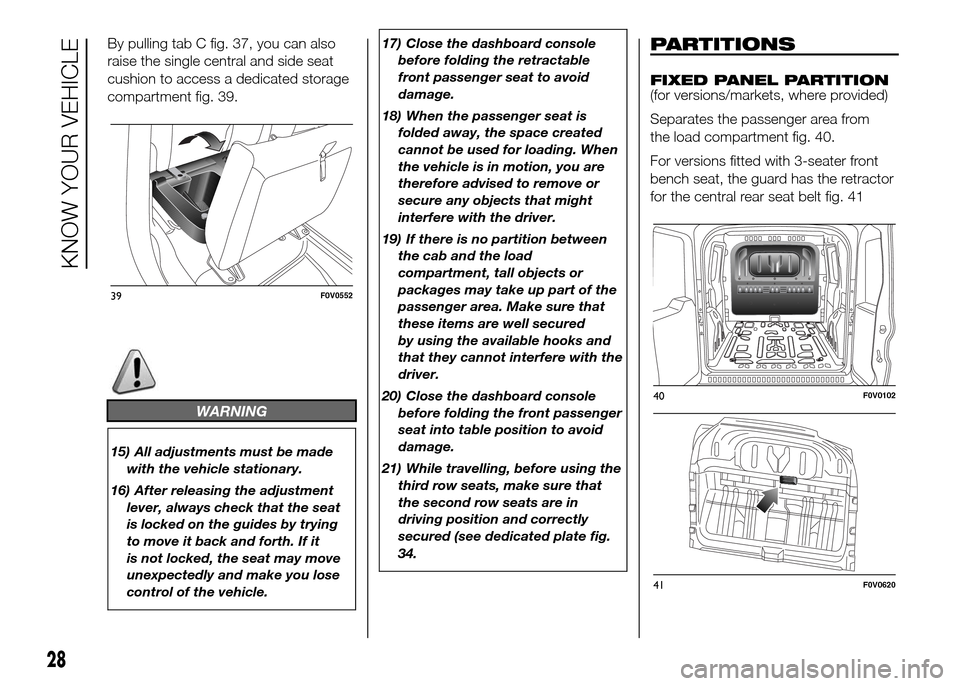
By pulling tab C fig. 37, you can also
raise the single central and side seat
cushion to access a dedicated storage
compartment fig. 39.
WARNING
15) All adjustments must be made
with the vehicle stationary.
16) After releasing the adjustment
lever, always check that the seat
is locked on the guides by trying
to move it back and forth. If it
is not locked, the seat may move
unexpectedly and make you lose
control of the vehicle.17) Close the dashboard console
before folding the retractable
front passenger seat to avoid
damage.
18) When the passenger seat is
folded away, the space created
cannot be used for loading. When
the vehicle is in motion, you are
therefore advised to remove or
secure any objects that might
interfere with the driver.
19) If there is no partition between
the cab and the load
compartment, tall objects or
packages may take up part of the
passenger area. Make sure that
these items are well secured
by using the available hooks and
that they cannot interfere with the
driver.
20) Close the dashboard console
before folding the front passenger
seat into table position to avoid
damage.
21) While travelling, before using the
third row seats, make sure that
the second row seats are in
driving position and correctly
secured (see dedicated plate fig.
34.
PARTITIONS
FIXED PANEL PARTITION
(for versions/markets, where provided)
Separates the passenger area from
the load compartment fig. 40.
For versions fitted with 3-seater front
bench seat, the guard has the retractor
for the central rear seat belt fig. 41
39F0V0552
40F0V0102
41F0V0620
28
KNOW YOUR VEHICLE
Page 33 of 323
FIXED GLAZED
PARTITION
(for versions/markets, where provided)
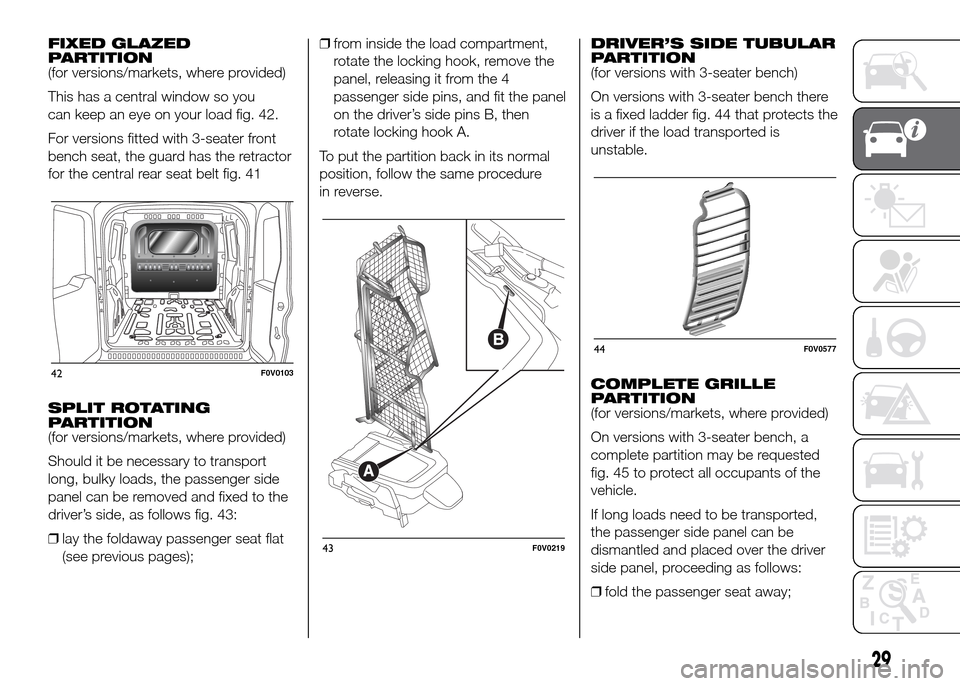
This has a central window so you
can keep an eye on your load fig. 42.
For versions fitted with 3-seater front
bench seat, the guard has the retractor
for the central rear seat belt fig. 41
SPLIT ROTATING
PARTITION
(for versions/markets, where provided)
Should it be necessary to transport
long, bulky loads, the passenger side
panel can be removed and fixed to the
driver’s side, as follows fig. 43:
❒lay the foldaway passenger seat flat
(see previous pages);❒from inside the load compartment,
rotate the locking hook, remove the
panel, releasing it from the 4
passenger side pins, and fit the panel
on the driver’s side pins B, then
rotate locking hook A.
To put the partition back in its normal
position, follow the same procedure
in reverse.DRIVER’S SIDE TUBULAR
PARTITION
(for versions with 3-seater bench)
On versions with 3-seater bench there
is a fixed ladder fig. 44 that protects the
driver if the load transported is
unstable.
COMPLETE GRILLE
PARTITION
(for versions/markets, where provided)
On versions with 3-seater bench, a
complete partition may be requested
fig. 45 to protect all occupants of the
vehicle.
If long loads need to be transported,
the passenger side panel can be
dismantled and placed over the driver
side panel, proceeding as follows:
❒fold the passenger seat away;
42F0V0103
43F0V0219
44F0V0577
29
Page 34 of 323
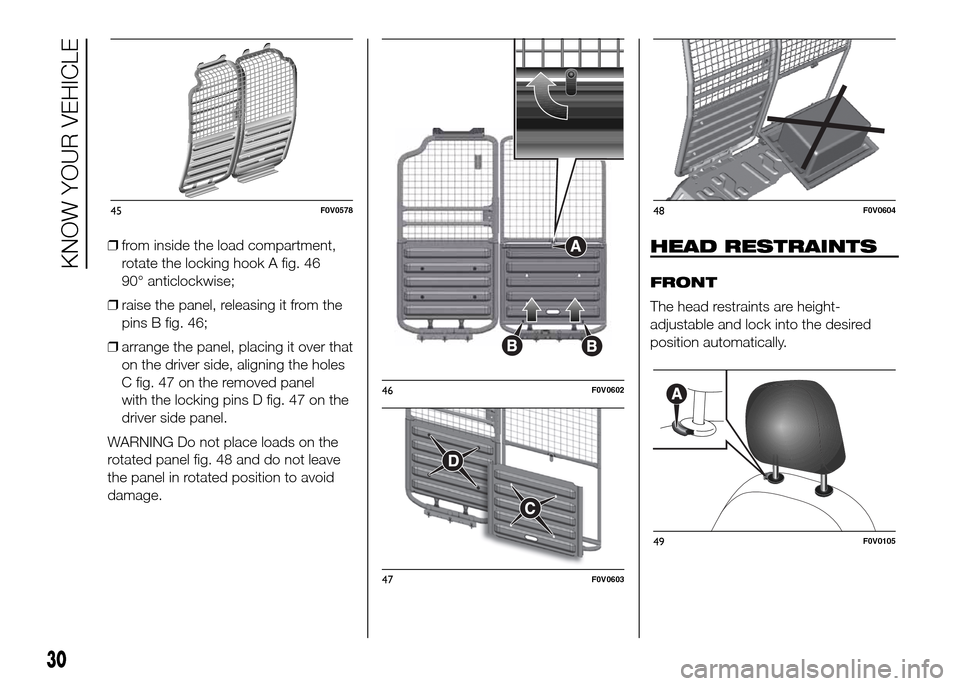
❒from inside the load compartment,
rotate the locking hook A fig. 46
90° anticlockwise;
❒raise the panel, releasing it from the
pins B fig. 46;
❒arrange the panel, placing it over that
on the driver side, aligning the holes
C fig. 47 on the removed panel
with the locking pins D fig. 47 on the
driver side panel.
WARNING Do not place loads on the
rotated panel fig. 48 and do not leave
the panel in rotated position to avoid
damage.
.
HEAD RESTRAINTS
FRONT
The head restraints are height-
adjustable and lock into the desired
position automatically.
45F0V0578
46F0V0602
47F0V0603
48F0V0604
49F0V0105
30
KNOW YOUR VEHICLE
Page 41 of 323
REAR ROOF LIGHT WITH
MOVABLE LENS
(Cargo versions without fixed window)
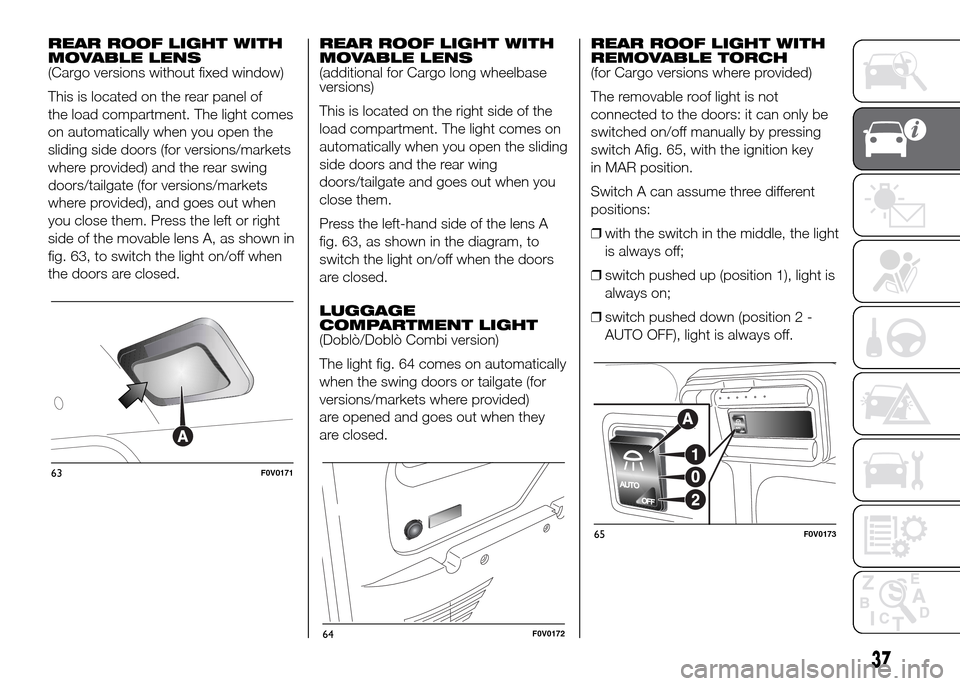
This is located on the rear panel of
the load compartment. The light comes
on automatically when you open the
sliding side doors (for versions/markets
where provided) and the rear swing
doors/tailgate (for versions/markets
where provided), and goes out when
you close them. Press the left or right
side of the movable lens A, as shown in
fig. 63, to switch the light on/off when
the doors are closed.REAR ROOF LIGHT WITH
MOVABLE LENS
(additional for Cargo long wheelbase
versions)
This is located on the right side of the
load compartment. The light comes on
automatically when you open the sliding
side doors and the rear wing
doors/tailgate and goes out when you
close them.
Press the left-hand side of the lens A
fig. 63, as shown in the diagram, to
switch the light on/off when the doors
are closed.
LUGGAGE
COMPARTMENT LIGHT
(Doblò/Doblò Combi version)
The light fig. 64 comes on automatically
when the swing doors or tailgate (for
versions/markets where provided)
are opened and goes out when they
are closed.REAR ROOF LIGHT WITH
REMOVABLE TORCH
(for Cargo versions where provided)
The removable roof light is not
connected to the doors: it can only be
switched on/off manually by pressing
switch Afig. 65, with the ignition key
in MAR position.
Switch A can assume three different
positions:
❒with the switch in the middle, the light
is always off;
❒switch pushed up (position 1), light is
always on;
❒switch pushed down (position 2 -
AUTO OFF), light is always off.
63F0V0171
64F0V0172
65F0V0173
37
Page 42 of 323
For Cargo versions with
fixed window
The light comes on automatically when
you open the sliding side doors and
the rear swing doors/tailgate ; then, it
goes out when you close them.
Press switch A fig. 65 to turn the light
on/off with the doors closed.
Switch A can assume three different
positions:
❒with switch in central position the
light comes on when a rear door
is opened;
❒with the switch pushed up (position
1), the light is always on;
❒switch pushed down (position 2 -
AUTO OFF), bulb is always off.
TORCH FUNCTION
(for Cargo versions where provided)
This is located on the right side of the
load compartment. It is a removable
electric torch.
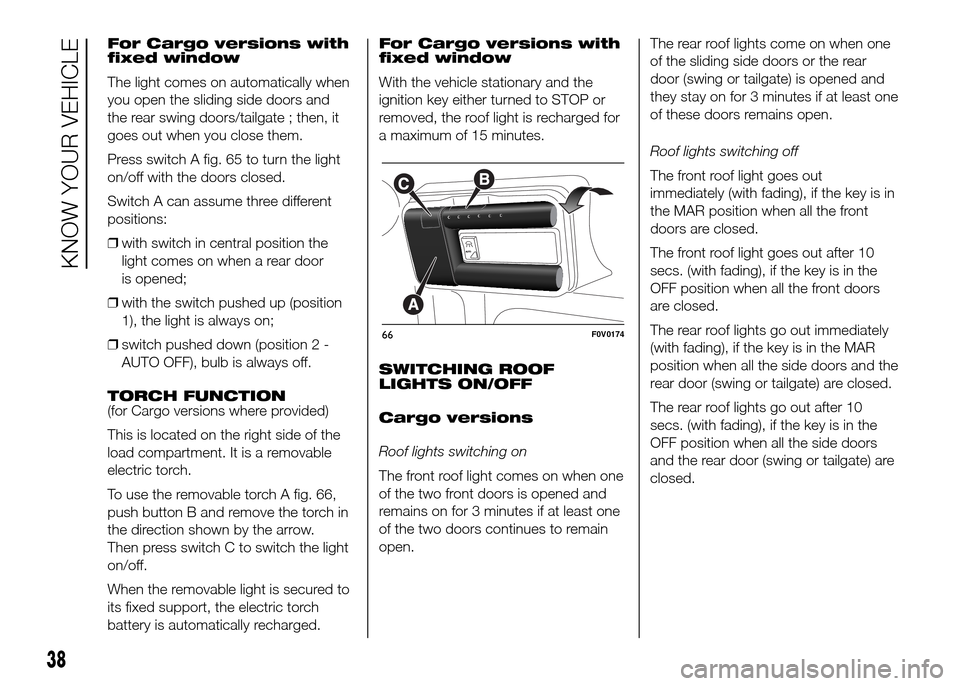
To use the removable torch A fig. 66,
push button B and remove the torch in
the direction shown by the arrow.
Then press switch C to switch the light
on/off.
When the removable light is secured to
its fixed support, the electric torch
battery is automatically recharged.For Cargo versions with
fixed window
With the vehicle stationary and the
ignition key either turned to STOP or
removed, the roof light is recharged for
a maximum of 15 minutes.
SWITCHING ROOF
LIGHTS ON/OFF
Cargo versions
Roof lights switching on
The front roof light comes on when one
of the two front doors is opened and
remains on for 3 minutes if at least one
of the two doors continues to remain
open.The rear roof lights come on when one
of the sliding side doors or the rear
door (swing or tailgate) is opened and
they stay on for 3 minutes if at least one
of these doors remains open.
Roof lights switching off
The front roof light goes out
immediately (with fading), if the key is in
the MAR position when all the front
doors are closed.
The front roof light goes out after 10
secs. (with fading), if the key is in the
OFF position when all the front doors
are closed.
The rear roof lights go out immediately
(with fading), if the key is in the MAR
position when all the side doors and the
rear door (swing or tailgate) are closed.
The rear roof lights go out after 10
secs. (with fading), if the key is in the
OFF position when all the side doors
and the rear door (swing or tailgate) are
closed.
66F0V0174
38
KNOW YOUR VEHICLE
Page 48 of 323
CLIMATIC COMFORT
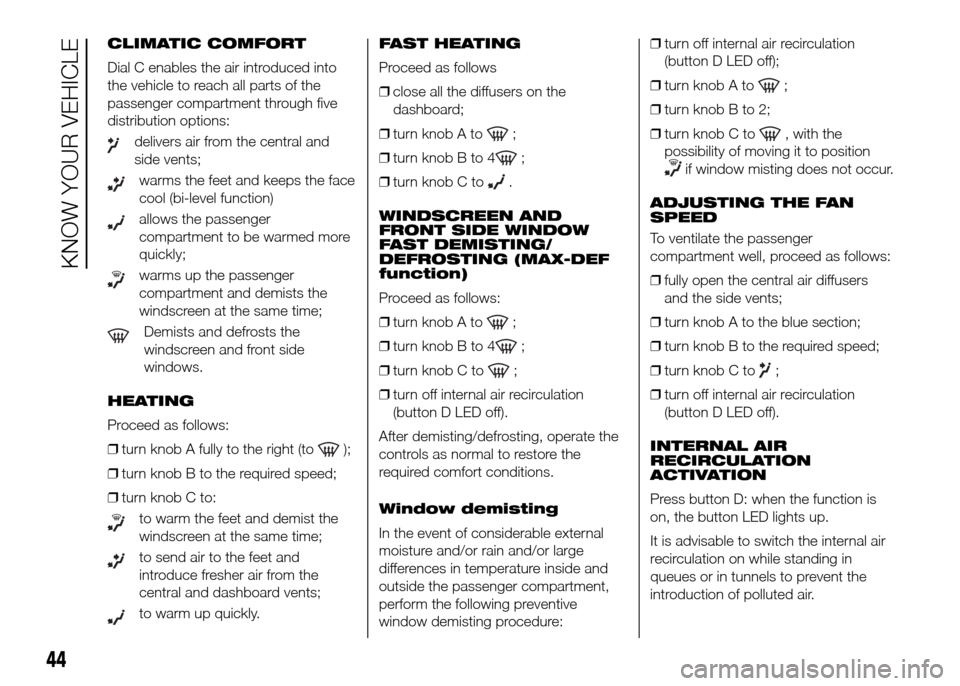
Dial C enables the air introduced into
the vehicle to reach all parts of the
passenger compartment through five
distribution options:
delivers air from the central and
side vents;
warms the feet and keeps the face
cool (bi-level function)
allows the passenger
compartment to be warmed more
quickly;
warms up the passenger
compartment and demists the
windscreen at the same time;
Demists and defrosts the
windscreen and front side
windows.
HEATING
Proceed as follows:
❒turn knob A fully to the right (to
);
❒turn knob B to the required speed;
❒turn knob C to:
to warm the feet and demist the
windscreen at the same time;
to send air to the feet and
introduce fresher air from the
central and dashboard vents;
to warm up quickly.FAST HEATING
Proceed as follows
❒close all the diffusers on the
dashboard;
❒turn knob A to
;
❒turn knob B to 4
;
❒turn knob C to
.
WINDSCREEN AND
FRONT SIDE WINDOW
FAST DEMISTING/
DEFROSTING (MAX-DEF
function)
Proceed as follows:
❒turn knob A to
;
❒turn knob B to 4
;
❒turn knob C to
;
❒turn off internal air recirculation
(button D LED off).
After demisting/defrosting, operate the
controls as normal to restore the
required comfort conditions.
Window demisting
In the event of considerable external
moisture and/or rain and/or large
differences in temperature inside and
outside the passenger compartment,
perform the following preventive
window demisting procedure:❒turn off internal air recirculation
(button D LED off);
❒turn knob A to
;
❒turn knob B to 2;
❒turn knob C to
, with the
possibility of moving it to position
if window misting does not occur.
ADJUSTING THE FAN
SPEED
To ventilate the passenger
compartment well, proceed as follows:
❒fully open the central air diffusers
and the side vents;
❒turn knob A to the blue section;
❒turn knob B to the required speed;
❒turn knob C to
;
❒turn off internal air recirculation
(button D LED off).
INTERNAL AIR
RECIRCULATION
ACTIVATION
Press button D: when the function is
on, the button LED lights up.
It is advisable to switch the internal air
recirculation on while standing in
queues or in tunnels to prevent the
introduction of polluted air.
44
KNOW YOUR VEHICLE
Page 51 of 323
PASSENGER
COMPARTMENT HEATING
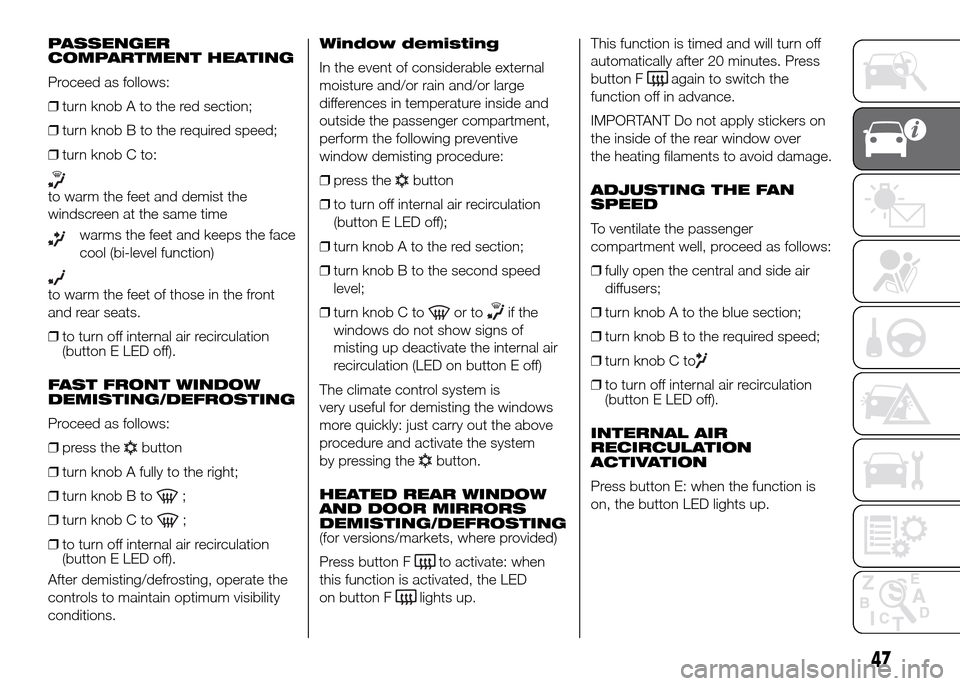
Proceed as follows:
❒turn knob A to the red section;
❒turn knob B to the required speed;
❒turn knob C to:
to warm the feet and demist the
windscreen at the same time
warms the feet and keeps the face
cool (bi-level function)
to warm the feet of those in the front
and rear seats.
❒to turn off internal air recirculation
(button E LED off).
FAST FRONT WINDOW
DEMISTING/DEFROSTING
Proceed as follows:
❒press the
button
❒turn knob A fully to the right;
❒turn knob B to
;
❒turn knob C to
;
❒to turn off internal air recirculation
(button E LED off).
After demisting/defrosting, operate the
controls to maintain optimum visibility
conditions.Window demisting
In the event of considerable external
moisture and/or rain and/or large
differences in temperature inside and
outside the passenger compartment,
perform the following preventive
window demisting procedure:
❒press the
button
❒to turn off internal air recirculation
(button E LED off);
❒turn knob A to the red section;
❒turn knob B to the second speed
level;
❒turn knob C to
or toif the
windows do not show signs of
misting up deactivate the internal air
recirculation (LED on button E off)
The climate control system is
very useful for demisting the windows
more quickly: just carry out the above
procedure and activate the system
by pressing the
button.
HEATED REAR WINDOW
AND DOOR MIRRORS
DEMISTING/DEFROSTING
(for versions/markets, where provided)
Press button F
to activate: when
this function is activated, the LED
on button F
lights up.This function is timed and will turn off
automatically after 20 minutes. Press
button F
again to switch the
function off in advance.
IMPORTANT Do not apply stickers on
the inside of the rear window over
the heating filaments to avoid damage.
ADJUSTING THE FAN
SPEED
To ventilate the passenger
compartment well, proceed as follows:
❒fully open the central and side air
diffusers;
❒turn knob A to the blue section;
❒turn knob B to the required speed;
❒turn knob C to
❒to turn off internal air recirculation
(button E LED off).
INTERNAL AIR
RECIRCULATION
ACTIVATION
Press button E: when the function is
on, the button LED lights up.
47
Page 52 of 323
It is advisable to switch the internal air
recirculation on while standing in
queues or in tunnels to prevent the
introduction of polluted air. Do not use
the function for a long time, particularly
if there are many passengers on board,
to prevent the windows from misting
up.
IMPORTANT The air recirculation
system makes it possible to reach the
required heating or cooling conditions
faster, depending on the selected
mode. It is not advisable to switch the
internal air recirculation on when it is
rainy/cold or the windows might steam
up, especially if the climate control
system is not turned on.
CLIMATE CONTROL
SYSTEM (cooling)
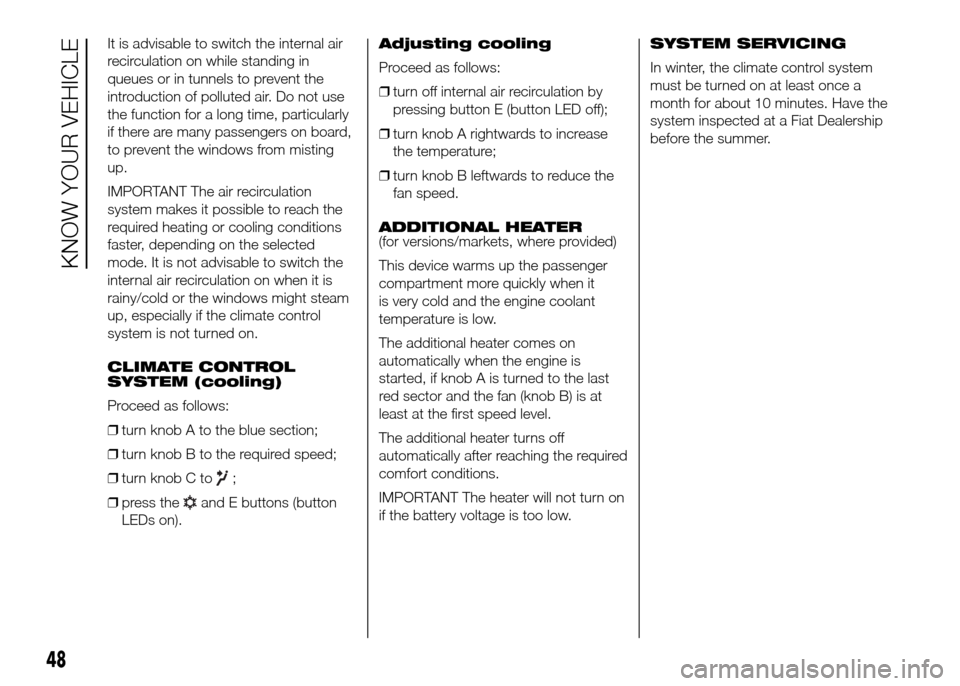
Proceed as follows:
❒turn knob A to the blue section;
❒turn knob B to the required speed;
❒turn knob C to
;
❒press the
and E buttons (button
LEDs on).Adjusting cooling
Proceed as follows:
❒turn off internal air recirculation by
pressing button E (button LED off);
❒turn knob A rightwards to increase
the temperature;
❒turn knob B leftwards to reduce the
fan speed.
ADDITIONAL HEATER
(for versions/markets, where provided)
This device warms up the passenger
compartment more quickly when it
is very cold and the engine coolant
temperature is low.
The additional heater comes on
automatically when the engine is
started, if knob A is turned to the last
red sector and the fan (knob B) is at
least at the first speed level.
The additional heater turns off
automatically after reaching the required
comfort conditions.
IMPORTANT The heater will not turn on
if the battery voltage is too low.SYSTEM SERVICING
In winter, the climate control system
must be turned on at least once a
month for about 10 minutes. Have the
system inspected at a Fiat Dealership
before the summer.
48
KNOW YOUR VEHICLE
Page 54 of 323
INTRODUCTION
The automatic climate control system
adjusts the temperature, the quantity
and the distribution of the air in the
passenger compartment. The
temperature control is based on the
"equivalent temperature": in other
words, the system continuously works
to keep the comfort level inside the
vehicle constant and to compensate for
possible variations in outside
conditions, including the sun's rays
detected by a dedicated sensor. The
automatically controlled parameters
and functions are:
❒air temperature at the vents;
❒air distribution at the vents;
❒fan speed (continuous variation of the
air flow);
❒compressor activation (for cooling/
dehumidifying the air);
❒air recirculation.
All functions may be changed manually.
In other words, you may select one or
more functions and change the
parameters as required. Automatic
control of the manually changed
functions will be suspended: the
system will override your settings only
for safety-related reasons (e.g. risk
of misting).Manual selections will always take
priority over automatic settings and will
be stored until the user switches the
system back to automatic operation by
pressing the AUTO button again except
for the cases in which the system will
intervene for particular, safety-related
reasons. You can adjust one function
manually without affecting the
automatic control of the others.
The temperature of the air sent is
always controlled automatically,
depending on the temperature set in
the display (except when the system is
off or in certain conditions when the
compressor is switched off).
The system allows the following
parameters and functions to be set or
altered manually: air temperature,
fan speed (continuous variation); air
distribution in seven positions;
compressor enablement; fast
defrosting/demisting function; air
recirculation; switching off the system.USING THE CLIMATE
CONTROL SYSTEM
The system can be started in different
ways, but it is advisable to start by
pressing the AUTO button and then
turning the knob to set the temperature
required on the display. The system
will start running automatically in this
way and the set temperature will be
reached as quickly as possible. The
system will adjust the temperature, the
quantity and the distribution of the air
introduced into the passenger
compartment and will manage the
recirculation function and the
compressor engagement. During fully
automatic operation, the only manual
intervention required is the possible
activation of the following functions:
❒
air recirculation, to keep the
function always either on or off;
❒
to speed up demisting/defrosting
of windscreen, rear window and
external rear view mirrors.
During fully automatic system
operation, you can change the set
temperature, air distribution and fan
speed at any time by using the relevant
buttons or knobs: the system will
automatically change its settings to
adjust to the new requirements.
50
KNOW YOUR VEHICLE
Page 55 of 323
During fully automatic operation (FULL
AUTO), the word FULL will disappear
if the air distribution and/or flow rate
and/or engagement of the compressor
and/or recirculation settings are
changed. In this way, the functions will
switch from automatic to manual
control until the AUTO button is
pressed again. With one or more
functions turned on manually,
the adjustment of the intake air
temperature continues to be managed
automatically, except with the
compressor switched off: if this is the
case, the temperature of the air sent
into the passenger compartment
cannot be lower than that of the
outside air.
CONTROLS
Air temperature
adjustment knob (I)
Turn the knob either clockwise or
anticlockwise to increase or lower the
requested temperature in the
passenger compartment.
The set temperature is shown on the
display.Turn the knob either fully to the right or
fully to the left to the extreme HI or
LO position to turn the maximum
heating or maximum cooling functions
on:
❒HI function (maximum heating):
select by turning the temperature knob
clockwise beyond the maximum value
(32°C).
This function may be used to heat up
the passenger compartment exploiting
the system potential to the maximum.
In this condition, the system stops
controlling the temperature
automatically and sets the air mixing to
maximum heating. The air speed and
distribution are fixed.
In particular, if the heating fluid is not
sufficiently hot, the maximum fan speed
does not come on straight away in
order to limit the intake of insufficiently
hot air to the passenger compartment.
All manual settings will be allowed when
this function is on.
To switch the function off, simply turn
the temperature knob anticlockwise
and set the required temperature.
❒LO function (maximum cooling):
select by turning the temperature knob
anticlockwise beyond the minimum
value (16°C).This function may be used to cool
down the passenger compartment by
exploiting the system's potential to
the full. In this condition, the system
stops controlling the temperature
automatically and sets the air mixing to
maximum cooling. The air speed and
distribution are fixed. All manual
settings will be allowed when this
function is on.
To switch the function off, simply turn
the temperature knob clockwise and
set the required temperature.
Air distribution buttons
(B)
By pressing these buttons, it is possible
to set one of the 5 possible air
distributions manually:
Air flow to the windscreen and
front side window vents to demist
or defrost them.
Air flow at central and side
dashboard vents to ventilate the
chest and the face during the hot
season.
51