seats FIAT DUCATO 2016 Owner handbook (in English)
[x] Cancel search | Manufacturer: FIAT, Model Year: 2016, Model line: DUCATO, Model: FIAT DUCATO 2016Pages: 387, PDF Size: 20.76 MB
Page 167 of 387
WARNING
107) The pretensioner may be used
only once. After it is triggered,
have it replaced at a Fiat
Dealership.
108) The belt must not be twisted.
The upper part must pass over
the shoulder and cross the chest
diagonally. The lower part must
adhere to the pelvis (as shown in
fig. 157) rather than the abdomen
of the passenger. Never use
devices (clips, clamps, etc.) that
hold the seat belt away from your
body.
109) For maximum protection, keep
the backrest upright, lean back
into it and make sure the seat belt
fits closely across your chest
and pelvis. Always fasten the seat
belts on both the front and the
rear seats! Travelling without
wearing seat belts will increase
the risk of serious injury and even
death in the event of an accident.110) Removing or otherwise
tampering with seat belt and
pretensioner components is
strictly prohibited. Any operations
on these components must be
performed by qualified and
authorised technicians. Always go
to a Fiat Dealership.
111) If the belt has been subjected
to a high level of stress, for
example after an accident, it must
be completely replaced together
with the attachments, attachment
fixing screws and the
pretensioner. In fact, even if the
belt has no visible defects, it could
have lost its resilience.
112) Each seat belt must be used by
only one person. Never travel with
a child sitting on the passenger's
lap and a single belt to protect
them both fig. 158. In general, do
not place any objects between the
person and the belt.
IMPORTANT
26) Operations which lead to
impacts, vibrations or localised
heating (over 100°C for a
maximum of six hours) in the area
around the pretensioners may
damage or accidentally deploy
them. Contact a Fiat Dealership
should intervention be necessary
on these components.
163
Page 170 of 387
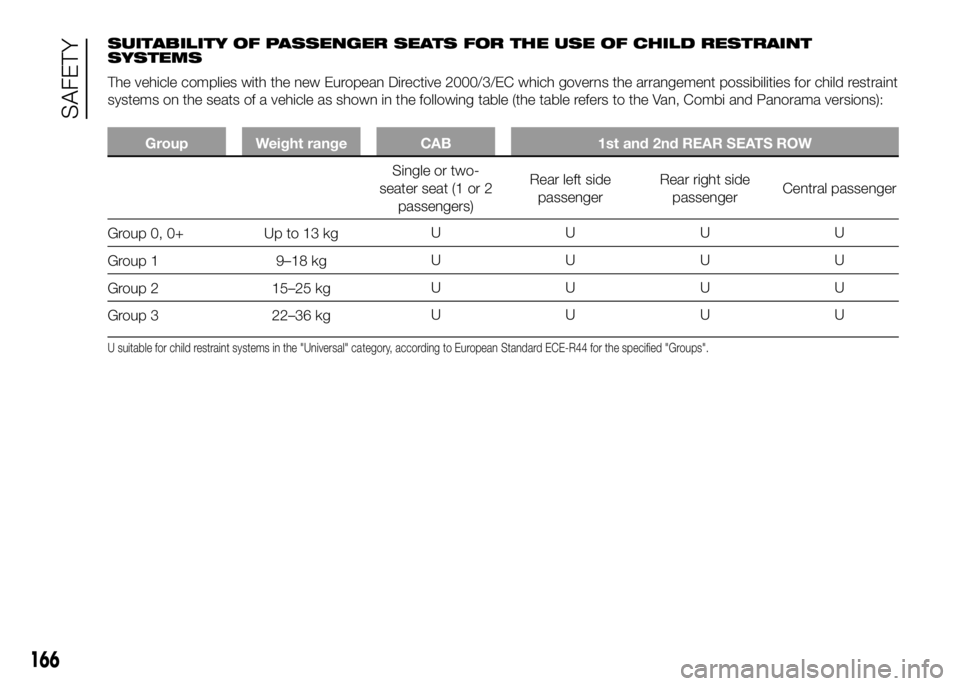
SUITABILITY OF PASSENGER SEATS FOR THE USE OF CHILD RESTRAINT
SYSTEMS
The vehicle complies with the new European Directive 2000/3/EC which governs the arrangement possibilities for child restraint
systems on the seats of a vehicle as shown in the following table (the table refers to the Van, Combi and Panorama versions):
Group Weight range CAB 1st and 2nd REAR SEATS ROW
Single or two-
seaterseat (1 or 2
passengers)Rear left side
passengerRear right side
passengerCentral passenger
Group 0, 0+ Up to 13 kgUUUU
Group 1 9–18 kgUUUU
Group 2 15–25 kgUUUU
Group 3 22–36 kgUUUU
U suitable for child restraint systems in the "Universal" category, according to European Standard ECE-R44 for the specified "Groups".
166
SAFETY
Page 174 of 387
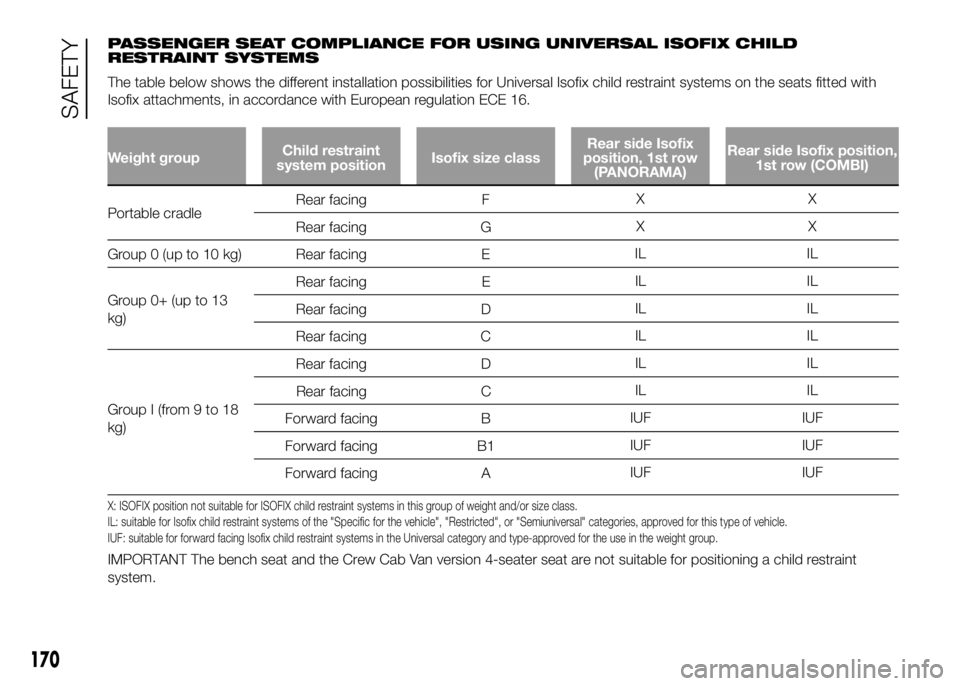
PASSENGER SEAT COMPLIANCE FOR USING UNIVERSAL ISOFIX CHILD
RESTRAINT SYSTEMS
The table below shows the different installation possibilities for Universal Isofix child restraint systems on the seats fitted with
Isofix attachments, in accordance with European regulation ECE 16.
Weight groupChild restraint
system positionIsofix size classRear side Isofix
position, 1st row
(PANORAMA)Rear side Isofix position,
1st row (COMBI)
Portable cradleRear
facing FXX
Rear facing GXX
Group 0 (up to 10 kg) Rear facing EIL IL
Group 0+ (up to 13
kg)Rear facing EIL IL
Rear facing DIL IL
Rear facing CIL IL
Group I (from 9 to 18
kg)Rear facing DIL IL
Rear facing CIL IL
Forward facing BIUF IUF
Forward facing B1IUF IUF
Forward facing AIUF IUF
X: ISOFIX position not suitable for ISOFIX child restraint systems in this group of weight and/or size class.
IL: suitable for Isofix child restraint systems of the "Specific for the vehicle", "Restricted", or "Semiuniversal" categories, approved for this type of vehicle.
IUF: suitable for forward facing Isofix child restraint systems in the Universal category and type-approved for the use in the weight group.
IMPORTANT The bench seat and the Crew Cab Van version 4-seater seat are not suitable for positioning a child restraint
system.
170
SAFETY
Page 176 of 387
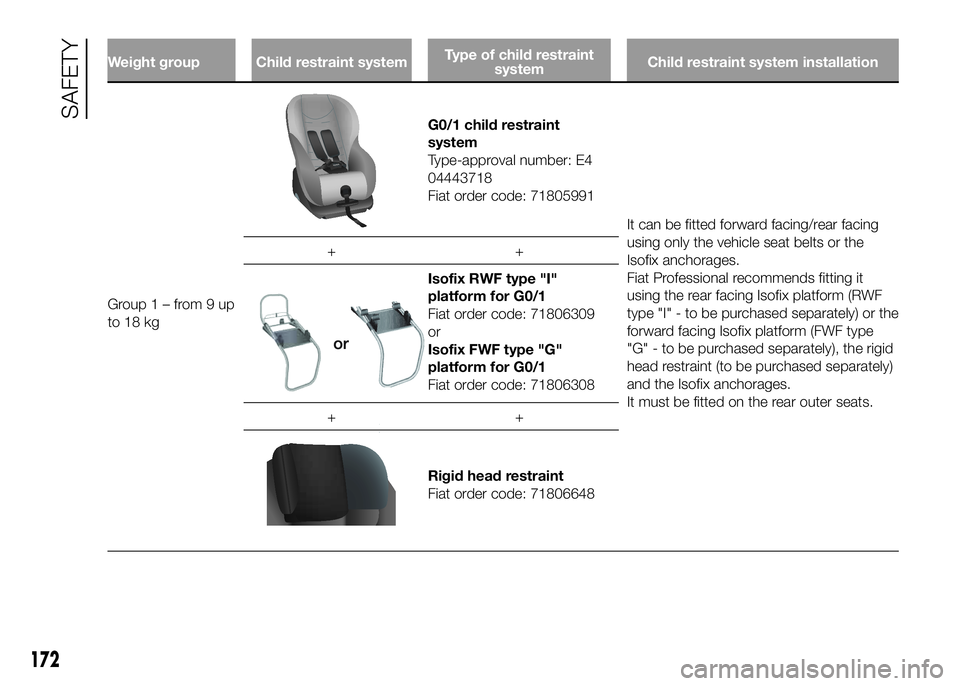
Weight group Child restraint systemType of child restraint
systemChild restraint system installation
Group1–from9up
to 18 kg
G0/1 child restraint
system
Type-approval number: E4
04443718
Fiat order code: 71805991
It can be fitted forward facing/rear facing
using only the vehicle seat belts or the
Isofix anchorages.
Fiat Professional recommends fitting it
using the rear facing Isofix platform (RWF
type "I" - to be purchased separately) or the
forward facing Isofix platform (FWF type
"G" - to be purchased separately), the rigid
head restraint (to be purchased separately)
and the Isofix anchorages.
It must be fitted on the rear outer seats. ++
Isofix RWF type "I"
platform for G0/1
Fiat order code: 71806309
or
Isofix FWF type "G"
platform for G0/1
Fiat order code: 71806308
++
Rigid head restraint
Fiat order code: 71806648
172
SAFETY
Page 182 of 387
WARNING
119) Do not apply stickers or other objects to the steering wheel, the dashboard in the passenger side airbag area and
the seats. Never put objects (e.g. mobile phones) on the passenger side of the dashboard since they could interfere
with correct inflation of the passenger airbag and also cause serious injury to the passengers.
120) When an active passenger airbag is fitted, DO NOT install rear facing child restraint systems on the front seat.
Deployment of the airbag in an accident could cause fatal injuries to the child regardless of the severity of the
impact. Therefore, always deactivate the passenger airbag when a rear facing child restraint system is installed on
the front passenger seat. The front passenger seat must also be positioned back as far as possible in order to prevent
the child restraint system from coming into contact with the dashboard. Immediately reactivate the passenger airbag
as soon as the child restraint system has been removed.
178
SAFETY
Page 183 of 387
SIDE BAGS
121) 122) 123) 124) 125) 126) 127) 128) 129) 130)
131) 132) 133)
The vehicle is fitted with front side bags
for driver and passenger (for versions/
markets where provided) for protecting
the chest and window bags (for
versions/markets where provided) for
protecting front and rear passengers'
heads.
Side bags (for versions/markets where
provided) protect occupants from
side impacts of medium-high severity,
by placing the bag between the
occupant and the internal parts of the
side structure of the vehicle. Non-
activation of side bags in other types of
collisions (front collisions, rear shunts,
roll-overs, etc...) is not a system
malfunction.
An electronic control unit causes the
bags to inflate in the event of a side
impact. The bags inflate
instantaneously placing themselves
between the occupants' bodies and the
structures which could cause injury.
They deflate immediately afterwards.Side bags (for versions/markets where
provided) are not a replacement of
but complementary to the belts, which
you are recommended to always wear,
as specified by law in Europe and
most non-European countries.
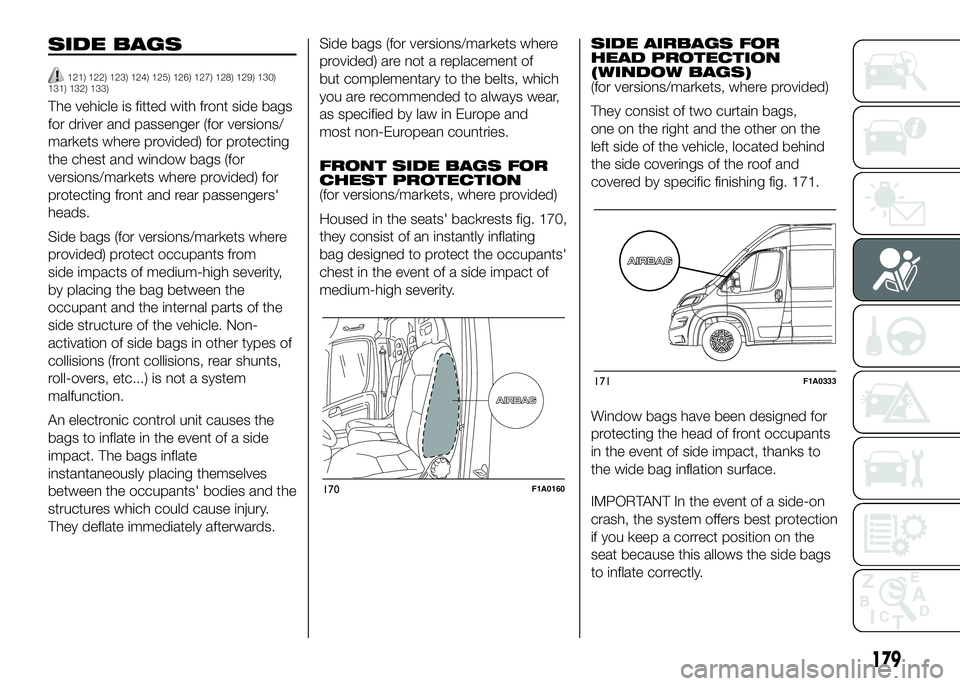
FRONT SIDE BAGS FOR
CHEST PROTECTION
(for versions/markets, where provided)
Housed in the seats' backrests fig. 170,
they consist of an instantly inflating
bag designed to protect the occupants'
chest in the event of a side impact of
medium-high severity.SIDE AIRBAGS FOR
HEAD PROTECTION
(WINDOW BAGS)
(for versions/markets, where provided)
They consist of two curtain bags,
one on the right and the other on the
left side of the vehicle, located behind
the side coverings of the roof and
covered by specific finishing fig. 171.
Window bags have been designed for
protecting the head of front occupants
in the event of side impact, thanks to
the wide bag inflation surface.
IMPORTANT In the event of a side-on
crash, the system offers best protection
if you keep a correct position on the
seat because this allows the side bags
to inflate correctly.
170F1A0160
171F1A0333
179
Page 184 of 387
IMPORTANT The front airbags and/or
side bags may be deployed if the
vehicle is subject to heavy knocks or
accidents involving the underbody area,
such as for example violent shocks,
against steps, kerbs or low obstacles,
vehicle falling into big potholes or
depressions in the road.
IMPORTANT A small amount of dust
will be released when the airbags
are deployed. The dust is not harmful
and does not indicate the beginning of
a fire. Furthermore, the surface of the
deployed bag and the interior of the
vehicle may be covered in a dusty
residue: this may irritate your skin and
eyes. Wash with mild soap and water in
the event of exposure.
IMPORTANT Should an accident occur
in which any of the safety devices are
activated, take the vehicle to a Fiat
Dealership to have the activated
devices replaced and to have the whole
system checked.
Every control, repair and replacement
operation concerning the airbags must
only be carried out at a Fiat Dealership.If you are having the vehicle scrapped,
have the system deactivated at a Fiat
Dealership first. If the vehicle changes
ownership, the new owner must be
informed of how to use the airbags and
the above warnings and also be given
this "Owner Handbook".
IMPORTANT Pretensioners, front
airbags and front side bags are
deployed differently according to the
type of collision. Failure to deploy
of one of the devices does not
necessarily indicate a system
malfunction.
WARNING
121) Never rest your head, arms or
elbows on the doors, on the
windows or in the window bag
area as this could cause injuries
during the inflation phase.
122) Never lean your head, arms and
elbows out of the window.123) If when turning the key to
MAR-ON the warning light
does not turn on or if it stays
on when travelling (together with
the message on the multifunction
display, for versions/markets
where provided), there could be a
fault in the safety systems; in
this event, airbags or
pretensioners may not trigger in
the case of impact or, in a lower
number of cases, they could be
triggered accidentally. Contact a
Fiat Dealership immediately to
have the system checked.
124) Do not cover the backrest of
the front or rear seats with covers
which are not suitable for use
with side bags.
125) Do not travel carrying objects in
your lap, in front of your chest or
between your lips (pipe, pencils,
etc.). They could cause severe
injury if the airbag is deployed.
126) Always drive keeping your
hands on the steering wheel rim
so that the airbag can inflate
freely if necessary. Do not drive
with your body bent forward.
Keep your back straight against
the backrest.
180
SAFETY
Page 185 of 387
127) If the key is inserted and turned
to MAR-ON, airbags may be
deployed if another vehicle
crashes into the vehicle even if
the engine is not running and the
vehicle is stationary. Therefore,
even if the car is stationary, when
an active front passenger airbag
is fitted, DO NOT install rear
facing child restraint systems on
the front passenger seat.
Deployment of the airbag
following an impact could cause
fatal injuries to the child.
Therefore, always deactivate the
passenger airbag when a rear
facing child restraint system is
installed on the front passenger
seat. The front passenger seat
must also be positioned back as
far as possible in order to prevent
the child restraint system from
coming into contact with the
dashboard. Immediately
reactivate the passenger airbag
as soon as the child restraint
system has been removed. Also
remember that, if the key is
turned to STOP, none of the
safety devices (airbags or
pretensioners) will be deployed in
the event of collision. Non-
deployment in such cases does
not indicate a system malfunction.128) If the vehicle has been subject
to theft, attempted theft,
vandalism, or flooding, have the
airbag system inspected at a Fiat
Dealership.
129) When the ignition key is turned
to MAR-ON, the LED on button
on the dashboard blinks for a
few seconds (the number of
seconds may depend on the
market) to check the correct
operation of the LED on the
button.
130) Do not wash the seats with
water or pressurised steam (by
hand or at automatic car seat
washing stations).
131) The front airbag deploys in the
event of more severe collisions
than those required for deploying
the pretensioners. For impacts
whose intensity falls between the
two levels, normally, only the
pretensioners will be activated.
132) Do not affix rigid objects to the
coat hooks or support handles.133) The airbag does not replace
seat belts but increases their
efficiency. Furthermore, since
front airbags are not deployed in
low-speed frontal impacts, side
impacts, rear shunts or roll-overs,
the passengers are protected
only by the seat belts which must
therefore be fastened at all times.
181
Page 235 of 387
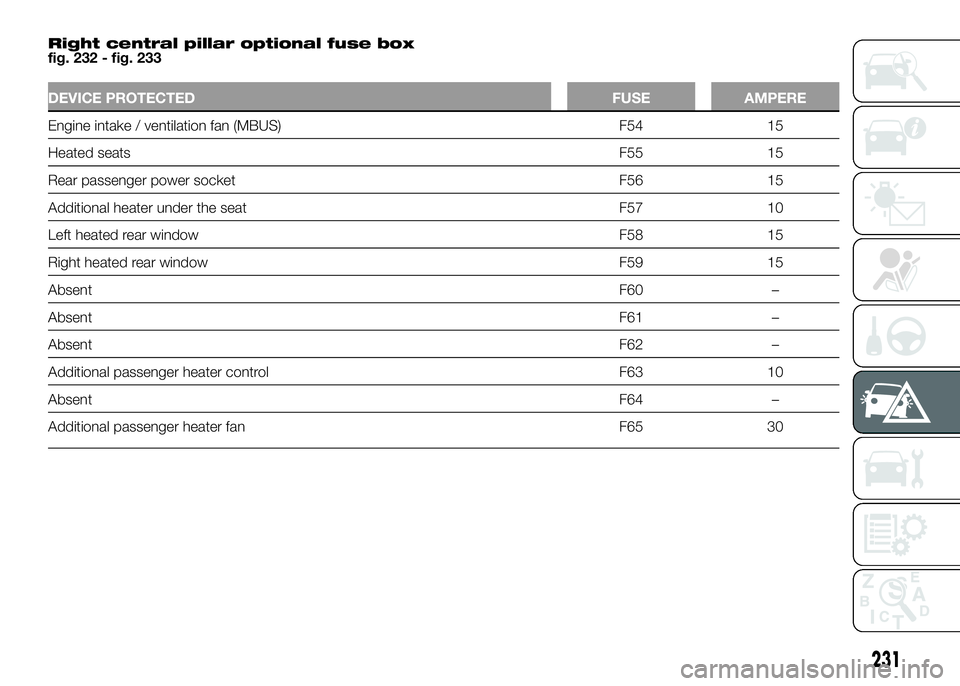
Right central pillar optional fuse box
fig. 232 - fig. 233
DEVICE PROTECTED FUSE AMPERE
Engine intake / ventilation fan (MBUS) F54 15
HeatedseatsF55 15
Rear passenger power socket F56 15
Additional heater under the seat F57 10
Left heated rear window F58 15
Right heated rear window F59 15
AbsentF60 –
AbsentF61 –
AbsentF62 –
Additional passenger heater control F63 10
AbsentF64 –
Additional passenger heater fan F65 30
231
Page 263 of 387
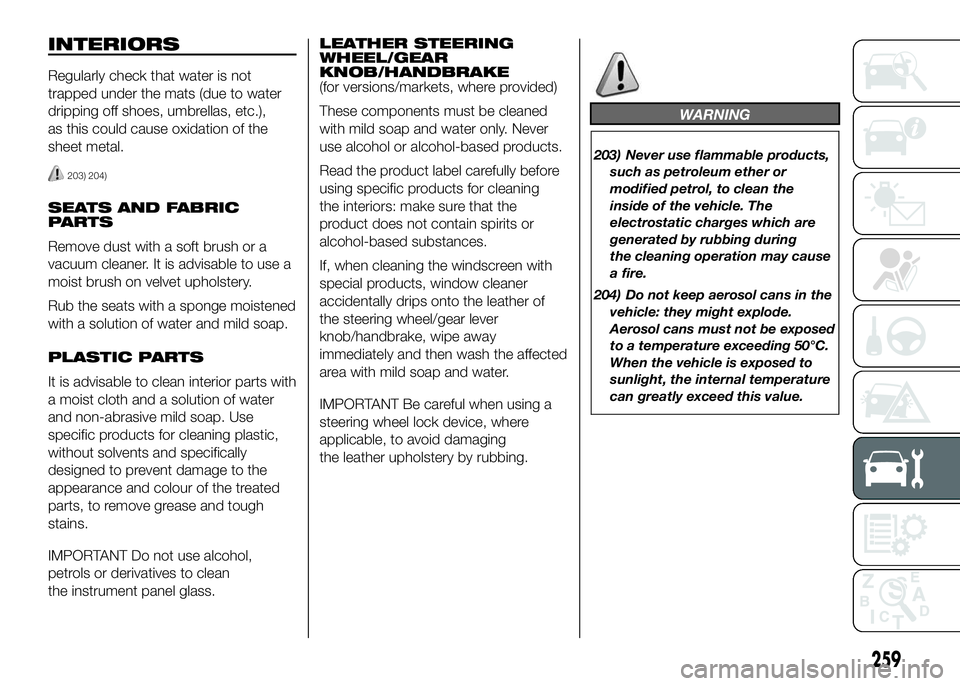
INTERIORS
Regularly check that water is not
trapped under the mats (due to water
dripping off shoes, umbrellas, etc.),
as this could cause oxidation of the
sheet metal.
203) 204)
SEATS AND FABRIC
PARTS
Remove dust with a soft brush or a
vacuum cleaner. It is advisable to use a
moist brush on velvet upholstery.
Rub the seats with a sponge moistened
with a solution of water and mild soap.
PLASTIC PARTS
It is advisable to clean interior parts with
a moist cloth and a solution of water
and non-abrasive mild soap. Use
specific products for cleaning plastic,
without solvents and specifically
designed to prevent damage to the
appearance and colour of the treated
parts, to remove grease and tough
stains.
IMPORTANT Do not use alcohol,
petrols or derivatives to clean
the instrument panel glass.LEATHER STEERING
WHEEL/GEAR
KNOB/HANDBRAKE
(for versions/markets, where provided)
These components must be cleaned
with mild soap and water only. Never
use alcohol or alcohol-based products.
Read the product label carefully before
using specific products for cleaning
the interiors: make sure that the
product does not contain spirits or
alcohol-based substances.
If, when cleaning the windscreen with
special products, window cleaner
accidentally drips onto the leather of
the steering wheel/gear lever
knob/handbrake, wipe away
immediately and then wash the affected
area with mild soap and water.
IMPORTANT Be careful when using a
steering wheel lock device, where
applicable, to avoid damaging
the leather upholstery by rubbing.
WARNING
203) Never use flammable products,
such as petroleum ether or
modified petrol, to clean the
inside of the vehicle. The
electrostatic charges which are
generated by rubbing during
the cleaning operation may cause
a fire.
204) Do not keep aerosol cans in the
vehicle: they might explode.
Aerosol cans must not be exposed
to a temperature exceeding 50°C.
When the vehicle is exposed to
sunlight, the internal temperature
can greatly exceed this value.
259