brake light FIAT DUCATO 2016 Owner handbook (in English)
[x] Cancel search | Manufacturer: FIAT, Model Year: 2016, Model line: DUCATO, Model: FIAT DUCATO 2016Pages: 387, PDF Size: 20.76 MB
Page 211 of 387
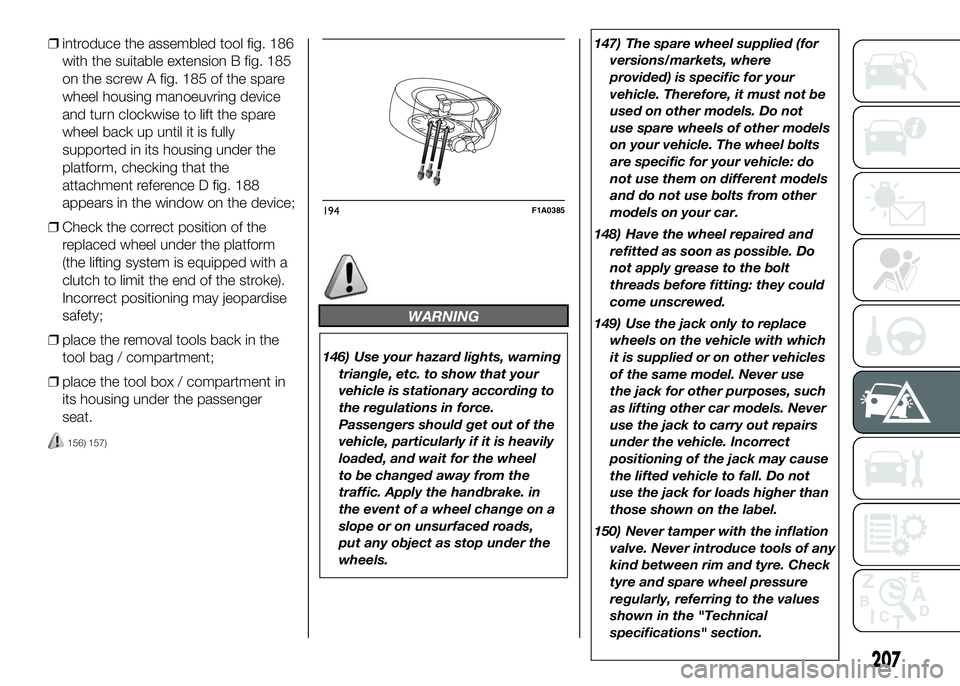
❒introduce the assembled tool fig. 186
with the suitable extension B fig. 185
on the screw A fig. 185 of the spare
wheel housing manoeuvring device
and turn clockwise to lift the spare
wheel back up until it is fully
supported in its housing under the
platform, checking that the
attachment reference D fig. 188
appears in the window on the device;
❒Check the correct position of the
replaced wheel under the platform
(the lifting system is equipped with a
clutch to limit the end of the stroke).
Incorrect positioning may jeopardise
safety;
❒place the removal tools back in the
tool bag / compartment;
❒place the tool box / compartment in
its housing under the passenger
seat.
156) 157)
WARNING
146) Use your hazard lights, warning
triangle, etc. to show that your
vehicle is stationary according to
the regulations in force.
Passengers should get out of the
vehicle, particularly if it is heavily
loaded, and wait for the wheel
to be changed away from the
traffic. Apply the handbrake. in
the event of a wheel change on a
slope or on unsurfaced roads,
put any object as stop under the
wheels.147) The spare wheel supplied (for
versions/markets, where
provided) is specific for your
vehicle. Therefore, it must not be
used on other models. Do not
use spare wheels of other models
on your vehicle. The wheel bolts
are specific for your vehicle: do
not use them on different models
and do not use bolts from other
models on your car.
148) Have the wheel repaired and
refitted as soon as possible. Do
not apply grease to the bolt
threads before fitting: they could
come unscrewed.
149) Use the jack only to replace
wheels on the vehicle with which
it is supplied or on other vehicles
of the same model. Never use
the jack for other purposes, such
as lifting other car models. Never
use the jack to carry out repairs
under the vehicle. Incorrect
positioning of the jack may cause
the lifted vehicle to fall. Do not
use the jack for loads higher than
those shown on the label.
150) Never tamper with the inflation
valve. Never introduce tools of any
kind between rim and tyre. Check
tyre and spare wheel pressure
regularly, referring to the values
shown in the "Technical
specifications" section.
194F1A0385
207
Page 219 of 387
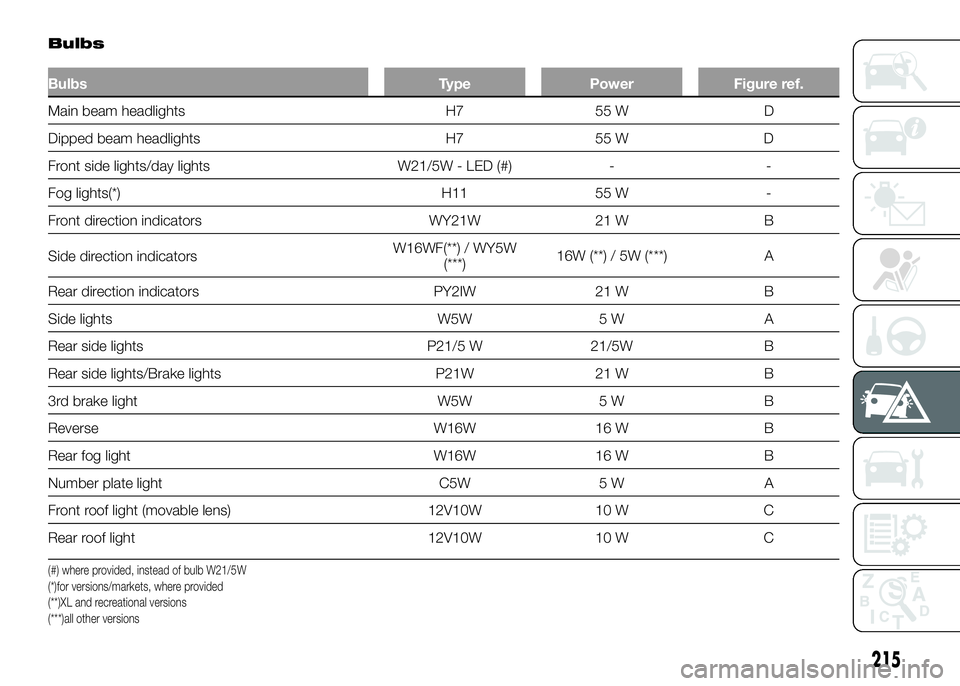
Bulbs
Bulbs Type Power Figure ref.
Main beam headlights H7 55 W D
Dippedbeam headlights H7 55 W D
Front side lights/day lights W21/5W - LED (#) - -
Fog lights(*) H11 55 W -
Front direction indicators WY21W 21 W B
Side direction indicatorsW16WF(**) / WY5W
(***)16W (**) / 5W (***) A
Rear direction indicators PY2IW 21 W B
Side lights W5W 5 W A
Rear side lights P21/5 W 21/5W B
Rear side lights/Brake lights P21W 21 W B
3rd brake light W5W 5 W B
Reverse W16W 16 W B
Rear fog light W16W 16 W B
Number plate light C5W 5 W A
Front roof light (movable lens) 12V10W 10 W C
Rear roof light 12V10W 10 W C
(#) where provided, instead of bulb W21/5W
(*)for versions/markets, where provided
(**)XL and recreational versions
(***)all other versions
215
Page 223 of 387
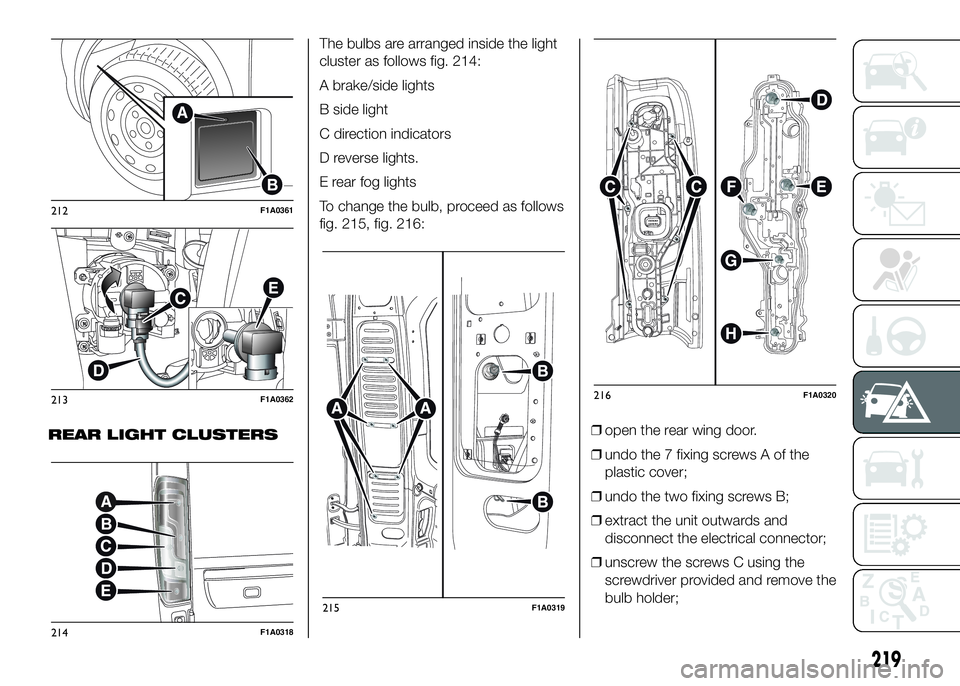
REAR LIGHT CLUSTERSThe bulbs are arranged inside the light
cluster as follows fig. 214:
A brake/side lights
B side light
C direction indicators
D reverse lights.
E rear fog lights
To change the bulb, proceed as follows
fig. 215, fig. 216:
❒open the rear wing door.
❒undo the 7 fixing screws A of the
plastic cover;
❒undo the two fixing screws B;
❒extract the unit outwards and
disconnect the electrical connector;
❒unscrew the screws C using the
screwdriver provided and remove the
bulb holder;
212F1A0361
213F1A0362
214F1A0318
215F1A0319
216F1A0320
219
Page 224 of 387
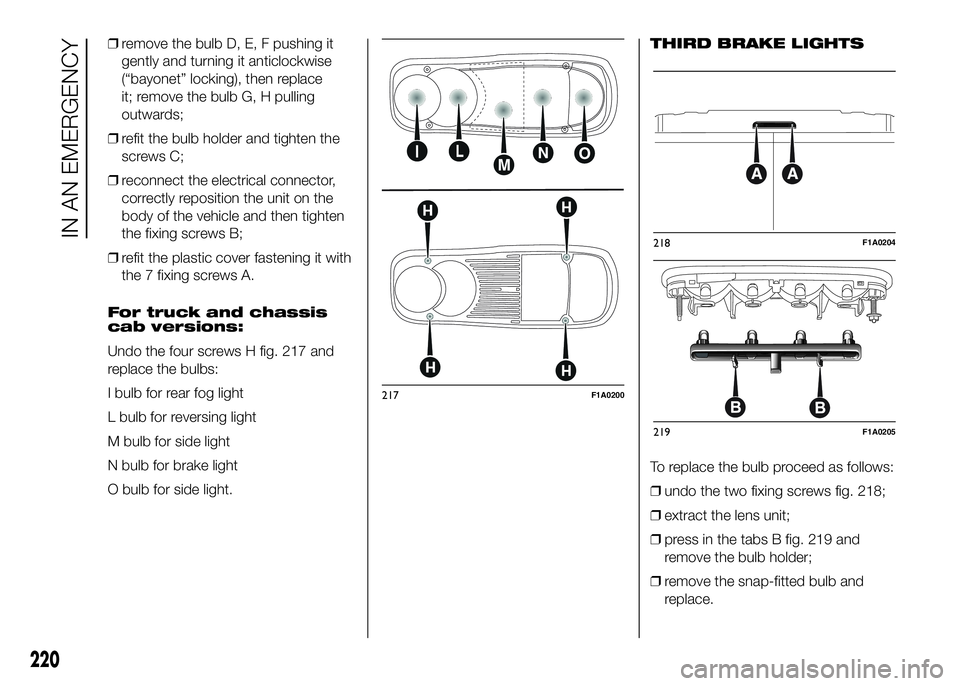
❒remove the bulb D, E, F pushing it
gently and turning it anticlockwise
(“bayonet” locking), then replace
it; remove the bulb G, H pulling
outwards;
❒refit the bulb holder and tighten the
screws C;
❒reconnect the electrical connector,
correctly reposition the unit on the
body of the vehicle and then tighten
the fixing screws B;
❒refit the plastic cover fastening it with
the 7 fixing screws A.
For truck and chassis
cab versions:
Undo the four screws H fig. 217 and
replace the bulbs:
I bulb for rear fog light
L bulb for reversing light
M bulb for side light
N bulb for brake light
O bulb for side light.
.
THIRD BRAKE LIGHTS
To replace the bulb proceed as follows:
❒undo the two fixing screws fig. 218;
❒extract the lens unit;
❒press in the tabs B fig. 219 and
remove the bulb holder;
❒remove the snap-fitted bulb and
replace.
217F1A0200
218F1A0204
219F1A0205
220
IN AN EMERGENCY
Page 230 of 387
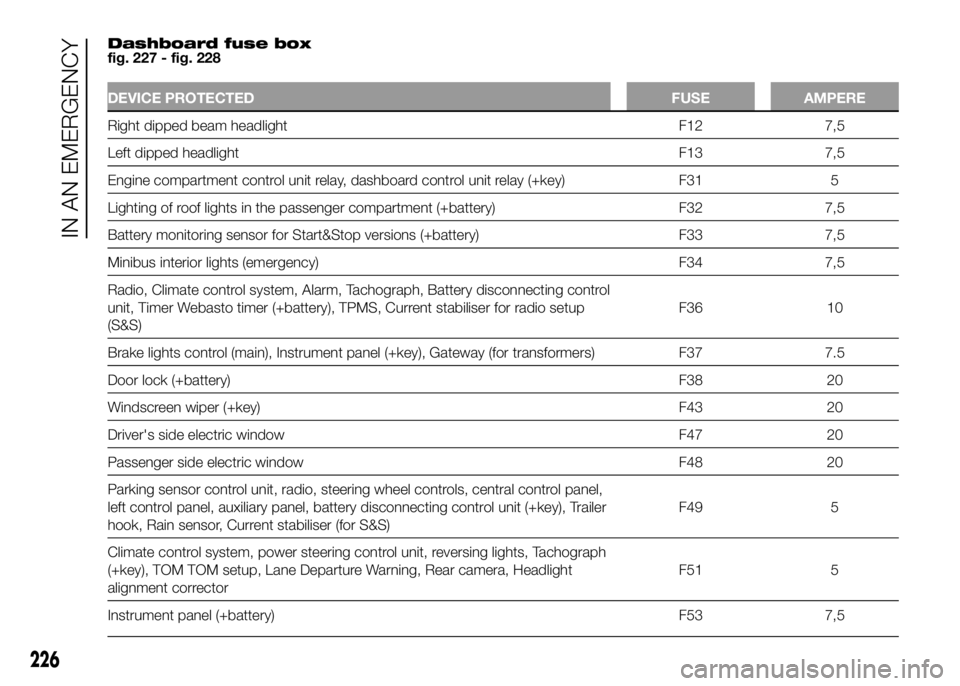
Dashboard fuse box
fig. 227 - fig. 228
DEVICE PROTECTED FUSE AMPERE
Right dipped beam headlight F12 7,5
Leftdipped headlight F13 7,5
Engine compartment control unit relay, dashboard control unit relay (+key) F31 5
Lighting of roof lights in the passenger compartment (+battery) F32 7,5
Battery monitoring sensor for Start&Stop versions (+battery) F33 7,5
Minibus interior lights (emergency) F34 7,5
Radio, Climate control system, Alarm, Tachograph, Battery disconnecting control
unit, Timer Webasto timer (+battery), TPMS, Current stabiliser for radio setup
(S&S)F36 10
Brake lights control (main), Instrument panel (+key), Gateway (for transformers) F37 7.5
Door lock (+battery) F38 20
Windscreen wiper (+key) F43 20
Driver's side electric window F47 20
Passenger side electric window F48 20
Parking sensor control unit, radio, steering wheel controls, central control panel,
left control panel, auxiliary panel, battery disconnecting control unit (+key), Trailer
hook, Rain sensor, Current stabiliser (for S&S)F49 5
Climate control system, power steering control unit, reversing lights, Tachograph
(+key), TOM TOM setup, Lane Departure Warning, Rear camera, Headlight
alignment correctorF51 5
Instrument panel (+battery) F53 7,5
226
IN AN EMERGENCY
Page 243 of 387
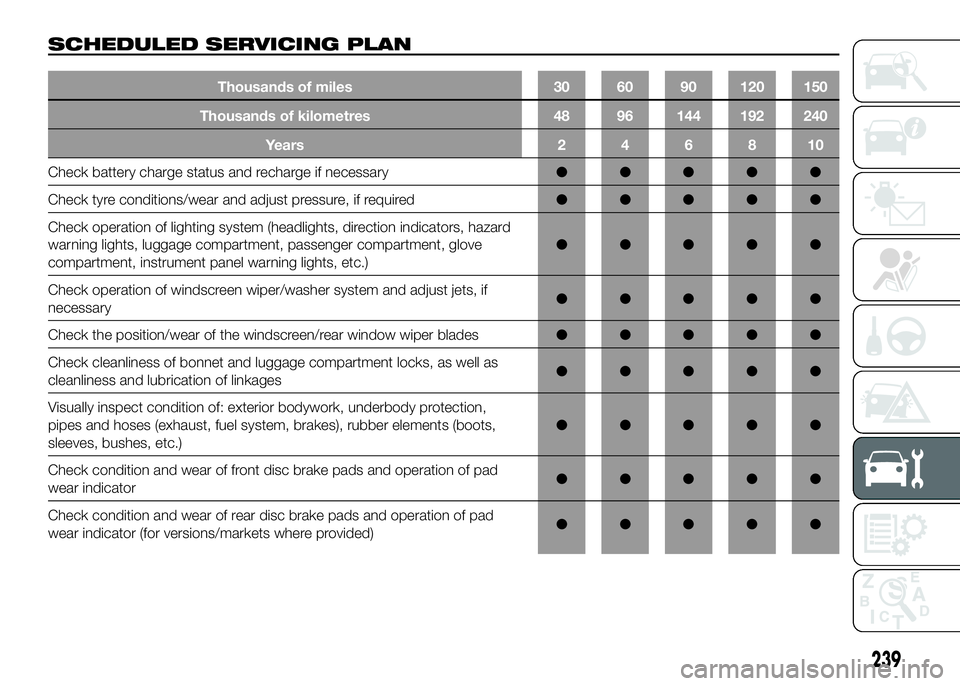
SCHEDULED SERVICING PLAN
Thousands of miles 30 60 90 120 150
Thousands of kilometres 48 96 144 192 240
Years246810
Check battery charge status and recharge if necessary●●●●●
Checktyre conditions/wear and adjust pressure, if required●●●●●
Check operation of lighting system (headlights, direction indicators, hazard
warning lights, luggage compartment, passenger compartment, glove
compartment, instrument panel warning lights, etc.)●●●●●
Check operation of windscreen wiper/washer system and adjust jets, if
necessary●●●●●
Check the position/wear of the windscreen/rear window wiper blades●●●●●
Check cleanliness of bonnet and luggage compartment locks, as well as
cleanliness and lubrication of linkages●●●●●
Visually inspect condition of: exterior bodywork, underbody protection,
pipes and hoses (exhaust, fuel system, brakes), rubber elements (boots,
sleeves, bushes, etc.)●●●●●
Check condition and wear of front disc brake pads and operation of pad
wear indicator●●●●●
Check condition and wear of rear disc brake pads and operation of pad
wear indicator (for versions/markets where provided)●●●●●
239
Page 245 of 387
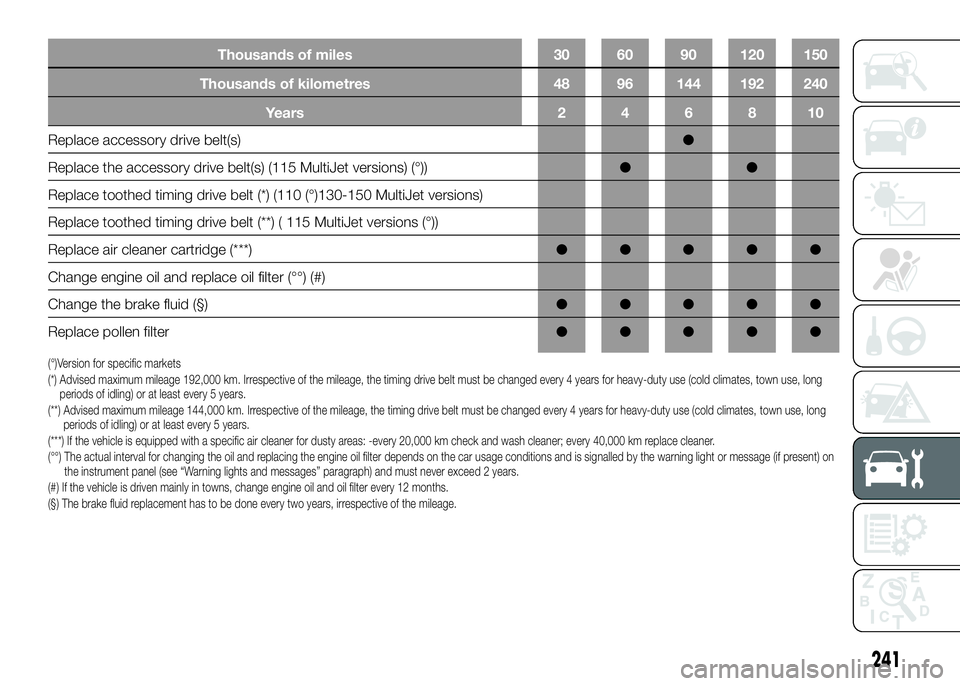
Thousands of miles 30 60 90 120 150
Thousands of kilometres 48 96 144 192 240
Years246810
Replace accessory drive belt(s)●
Replacethe accessory drive belt(s) (115 MultiJet versions) (°))●●
Replace toothed timing drive belt (*) (110 (°)130-150 MultiJet versions)
Replace toothed timing drive belt (**) ( 115 MultiJet versions (°))
Replace air cleaner cartridge (***)●●●●●
Change engine oil and replace oil filter (°°) (#)
Change the brake fluid (§)●●●●●
Replace pollen filter●●●●●
(°)Version for specific markets
(*) Advised maximum mileage 192,000 km. Irrespective of the mileage, the timing drive belt must be changed every 4 years for heavy-duty use (cold climates, town use, long
periods of idling) or at least every 5 years.
(**) Advised maximum mileage 144,000 km. Irrespective of the mileage, the timing drive belt must be changed every 4 years for heavy-duty use (cold climates, town use, long
periods of idling) or at least every 5 years.
(***) If the vehicle is equipped with a specific air cleaner for dusty areas: -every 20,000 km check and wash cleaner; every 40,000 km replace cleaner.
(°°) The actual interval for changing the oil and replacing the engine oil filter depends on the car usage conditions and is signalled by the warning light or message (if present) on
the instrument panel (see “Warning lights and messages” paragraph) and must never exceed 2 years.
(#) If the vehicle is driven mainly in towns, change engine oil and oil filter every 12 months.
(§) The brake fluid replacement has to be done every two years, irrespective of the mileage.
241
Page 246 of 387
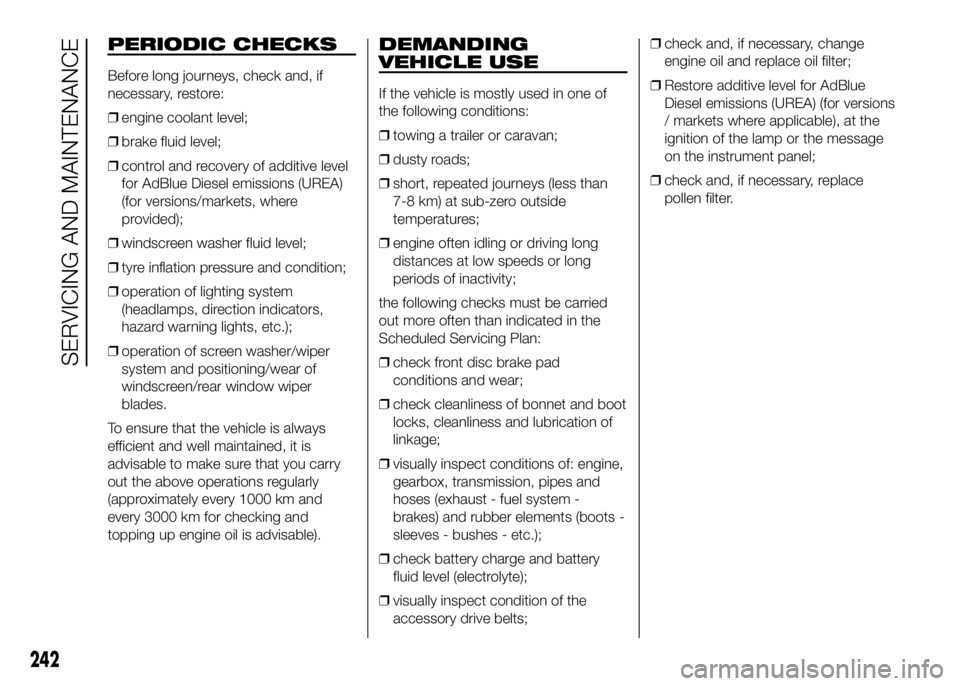
PERIODIC CHECKS
Before long journeys, check and, if
necessary, restore:
❒engine coolant level;
❒brake fluid level;
❒control and recovery of additive level
for AdBlue Diesel emissions (UREA)
(for versions/markets, where
provided);
❒windscreen washer fluid level;
❒tyre inflation pressure and condition;
❒operation of lighting system
(headlamps, direction indicators,
hazard warning lights, etc.);
❒operation of screen washer/wiper
system and positioning/wear of
windscreen/rear window wiper
blades.
To ensure that the vehicle is always
efficient and well maintained, it is
advisable to make sure that you carry
out the above operations regularly
(approximately every 1000 km and
every 3000 km for checking and
topping up engine oil is advisable).
DEMANDING
VEHICLE USE
If the vehicle is mostly used in one of
the following conditions:
❒towing a trailer or caravan;
❒dusty roads;
❒short, repeated journeys (less than
7-8 km) at sub-zero outside
temperatures;
❒engine often idling or driving long
distances at low speeds or long
periods of inactivity;
the following checks must be carried
out more often than indicated in the
Scheduled Servicing Plan:
❒check front disc brake pad
conditions and wear;
❒check cleanliness of bonnet and boot
locks, cleanliness and lubrication of
linkage;
❒visually inspect conditions of: engine,
gearbox, transmission, pipes and
hoses (exhaust - fuel system -
brakes) and rubber elements (boots -
sleeves - bushes - etc.);
❒check battery charge and battery
fluid level (electrolyte);
❒visually inspect condition of the
accessory drive belts;❒check and, if necessary, change
engine oil and replace oil filter;
❒Restore additive level for AdBlue
Diesel emissions (UREA) (for versions
/ markets where applicable), at the
ignition of the lamp or the message
on the instrument panel;
❒check and, if necessary, replace
pollen filter.
242
SERVICING AND MAINTENANCE
Page 263 of 387
INTERIORS
Regularly check that water is not
trapped under the mats (due to water
dripping off shoes, umbrellas, etc.),
as this could cause oxidation of the
sheet metal.
203) 204)
SEATS AND FABRIC
PARTS
Remove dust with a soft brush or a
vacuum cleaner. It is advisable to use a
moist brush on velvet upholstery.
Rub the seats with a sponge moistened
with a solution of water and mild soap.
PLASTIC PARTS
It is advisable to clean interior parts with
a moist cloth and a solution of water
and non-abrasive mild soap. Use
specific products for cleaning plastic,
without solvents and specifically
designed to prevent damage to the
appearance and colour of the treated
parts, to remove grease and tough
stains.
IMPORTANT Do not use alcohol,
petrols or derivatives to clean
the instrument panel glass.LEATHER STEERING
WHEEL/GEAR
KNOB/HANDBRAKE
(for versions/markets, where provided)
These components must be cleaned
with mild soap and water only. Never
use alcohol or alcohol-based products.
Read the product label carefully before
using specific products for cleaning
the interiors: make sure that the
product does not contain spirits or
alcohol-based substances.
If, when cleaning the windscreen with
special products, window cleaner
accidentally drips onto the leather of
the steering wheel/gear lever
knob/handbrake, wipe away
immediately and then wash the affected
area with mild soap and water.
IMPORTANT Be careful when using a
steering wheel lock device, where
applicable, to avoid damaging
the leather upholstery by rubbing.
WARNING
203) Never use flammable products,
such as petroleum ether or
modified petrol, to clean the
inside of the vehicle. The
electrostatic charges which are
generated by rubbing during
the cleaning operation may cause
a fire.
204) Do not keep aerosol cans in the
vehicle: they might explode.
Aerosol cans must not be exposed
to a temperature exceeding 50°C.
When the vehicle is exposed to
sunlight, the internal temperature
can greatly exceed this value.
259
Page 383 of 387
INDEX
A
BS .............................................. 81
Additional heater ............................ 41
Additional rear climate control
(Panorama/Combi) ....................... 47
Additional rear heating
(Panorama/Combi) ....................... 46
Advice for extending battery life...... 252
Air cleaner ...................................... 250
Air suspension ............................... 69
Arrangement possibilities for
Universal Isofix child restraint
system on seats of vehicle ........... 170
Ashtray .......................................... 66
ASR system ................................... 83
ASR (system) ................................. 83
Automatic climate control
system ......................................... 35
Automatic headlight sensor ............ 51
Battery (disconnector) ................... 61
Battery disconnector ...................... 61
Battery
– Replacement ............................. 251
Battery (recharging) ........................ 232
Battery replacement ....................... 251
body paintwork identification
plate............................................. 263
Bodywork
– Advice for preserving the
bodywork .................................. 257– Exterior and underbody
warranty .................................... 257
– Protection from atmospheric
agents ....................................... 257
Bodywork version .......................... 264
Bonnet ........................................... 78
Bottle replacement ......................... 211
Brake fluid ...................................... 249
Brakes
– specifications ............................ 269
Bulbs
– types of bulbs ........................... 214
Bump starting ................................ 202
Cab glove compartment ............... 68
Capucine ....................................... 68
Carrying children safely
– Arrangement possibilities for
child restraint systems ............... 166
– Child restraint systems .............. 164
– Safety regulations ...................... 167
Central locking ............................... 61
Changing a bulb............................. 212
Changing an interior bulb ............... 221
Chassis marking ............................ 262
Checking and restoring pressure .... 210
Checking levels .............................. 243
Cigar lighter.................................... 65
Clutch ............................................ 268
CO2 emissions............................... 345Compartment beneath
passenger side front seat ............. 65
Controls ......................................... 59
Cruise Control ................................ 54
Daytime Running Lights ................ 48
Dead lock ...................................... 72
Demanding vehicle use .................. 242
Desk/Book rest .............................. 67
Diesel particulate filter (DPF) ........... 113
Diffusers ......................................... 29
Dimensions .................................... 274
Dipped headlights .................... 48-217
Direction indicators ................... 50-218
Display
– Standard screen ........................ 122
Door pockets ................................. 64
Doors ............................................. 71
DPF (particulate filter) ..................... 113
Driving Advisor (system) ................. 90
Driving style.................................... 189
Electric windows ........................... 77
Electronic alarm ............................. 14
Engine codes ................................. 264
Engine coolant ............................... 247
Engine coolant temperature
indicator ....................................... 120
Engine............................................ 266
Engine marking .............................. 263
Engine oil ....................................... 247