lock FIAT FIORINO 2018 Owner handbook (in English)
[x] Cancel search | Manufacturer: FIAT, Model Year: 2018, Model line: FIORINO, Model: FIAT FIORINO 2018Pages: 196, PDF Size: 4.99 MB
Page 94 of 196
STARTING THE
ENGINE
The vehicle is fitted with an electronic
engine lock device: if the engine fails to
start, see the paragraph “The Fiat
CODE system” in section “Know your
vehicle”.
90) 91)
22) 23) 27) 28)
PROCEDURE FOR
PETROL VERSIONS
Proceed as follows:
engage the handbrake;
put the gear lever into neutral;
fully depress the clutch pedal
without touching the accelerator;
turn the ignition key to AVV and
release it as soon as the engine starts.
PROCEDURE FOR DIESEL
VERSIONS
Proceed as follows:
engage the handbrake;
put the gear lever into neutral;
turn the ignition key to MAR
position: the
warning light will light
up on instrument panel;
wait for the warning lightsand
to turn off, which will happen faster
the warmer the engine is;
fully depress the clutch pedal
without touching the accelerator;
turn the ignition key to the AVV
position as soon as the warning light
turns off. Waiting too long will waste
the heating work carried out by the
plugs.
Release the key as soon as the engine
starts.
With cold engine, the accelerator must
be entirely released when turning the
ignition key to position AVV.
24)
PROCEDURE FOR
NATURAL POWER
VERSIONS
The engine always starts up on petrol
independently of the previously
selected mode.
25)
PROCEDURE FOR
VERSIONS WITH
COMFORT-MATIC
TRANSMISSION
The system allows the engine to be
started both with a gear engaged and
with the transmission in neutral (N).
Always press the brake pedal with the
gear engaged.It is advisable to place the gear lever in
neutral (N) before starting the engine.
26)
IMPORTANT If the engine does not
start at the first attempt, return the
ignition key to STOP before repeating
the starting procedure. If the warning
light remains on together with warning
light
when the ignition key is at
MAR, turn the key to STOP and then
back to MAR; if the warning light stays
on, try with the other keys provided
with the vehicle. If you still cannot start
the engine, perform an emergency
start (see “Emergency starting” in the
“In an emergency” section) and go to a
Fiat Dealership.
IMPORTANT If start-up is requested
with the gearbox faulty, carry out the
"Delayed start-up" procedure (see
associated messages): turn the key to
the AVV position for at least 7 seconds
with the brake depressed and the
engine will start. The system will be in
recovery mode (maximum permitted
gear: 3
rd, Automatic mode not
available). If the engine does not start,
contact a Fiat Dealership.
92
STARTING AND DRIVING
Page 96 of 196
WARNING
92)Never leave children unattended in the
vehicle. Always remove the ignition key
when leaving the vehicle and take it out
with you.
93)The vehicle should be secured after
several clicks of the lever. If it is not,
contact a Fiat Dealership to have it
adjusted.
94)In the case of parking manoeuvres on
roads on a gradient, the front wheels
must be steered towards the pavement
(when parking downhill), or in the opposite
direction if the vehicle is parked uphill. If
the vehicle is parked on a steep slope, it is
advisable to block the wheels with a wedge
or stone.
WHEN PARKED
95)
Proceed as follows when parking and
leaving the vehicle:
engage a gear (1stgear if facing
uphill or reverse if facing downhill) and
leave the wheels turned;
stop the engine and engage the
handbrake;
always remove the ignition key.
If the vehicle is parked on a steep
slope, it is advisable to block the
wheels with a wedge or stone.
Do not leave the key in the MAR
position to prevent the battery from
running down.
Versions with COMFORT-MATIC
transmission
To park safely, keeping a foot on the
brake pedal, the 1
stor reverse (R) gear
must be engaged and, in case of
parking uphills/downhills, the
handbrake must be engaged.
IMPORTANT NEVER leave the vehicle
with the transmission in neutral (N)
or, on versions equipped with automatic
(Comfort matic) transmission, before
putting the shift lever in thePposition.IMPORTANT NOTES
With the vehicle stationary and a
gear engaged, always keep the brake
pedal pressed until you decide to
set off, then release the brake and
accelerate gently;
during prolonged stops with the
engine running, it is advisable to keep
the gearbox in neutral (N);
In order to safeguard the efficiency
of the clutch, do not use the
accelerator to keep the vehicle
stationary (e.g. when stopped on an
incline);
the clutch could overheat and be
damaged; use the brake pedal and only
operate the accelerator pedal when
you decide to set off;
only use second gear when you
need greater control for starting
manoeuvres on surfaces with poor grip;
if, with reverse gear (R) engaged,
you have to engage first gear or vice
versa, only do this when the vehicle is
completely stationary and with the
brake pedal pressed;
94
STARTING AND DRIVING
Page 101 of 196
SPEED BLOCK
(for 1.3 MultiJet versions with manual
transmission)
The vehicle is equipped with a speed
limitation function that can be set on
the user's request to one of four default
values. 90, 100, 110, 130 km/h.
To activate/deactivate this function,
contact a Fiat Dealership.
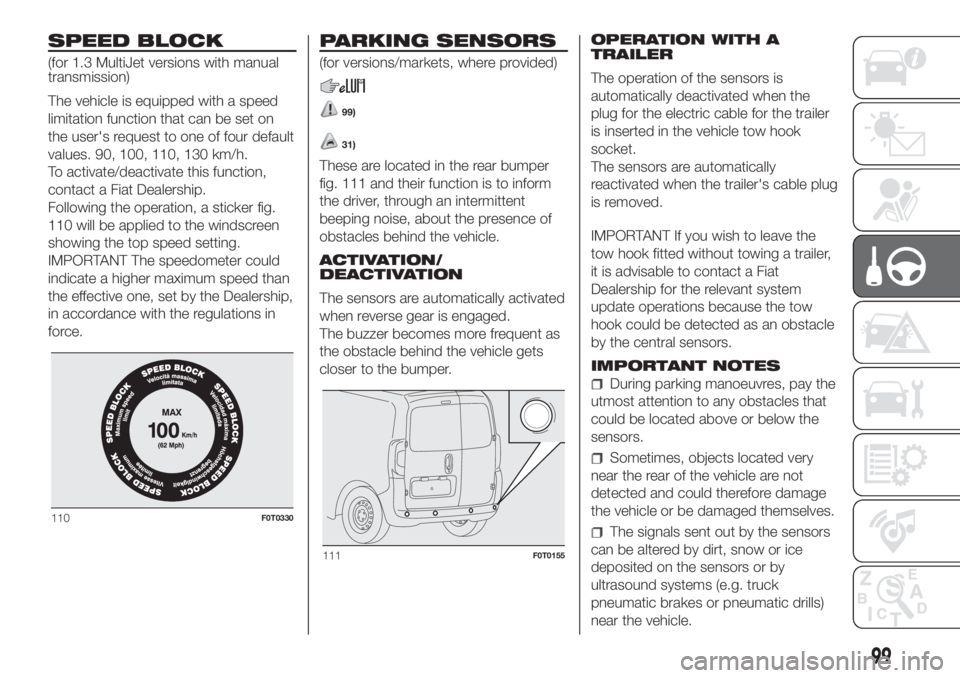
Following the operation, a sticker fig.
110 will be applied to the windscreen
showing the top speed setting.
IMPORTANT The speedometer could
indicate a higher maximum speed than
the effective one, set by the Dealership,
in accordance with the regulations in
force.
PARKING SENSORS
(for versions/markets, where provided)
99)
31)
These are located in the rear bumper
fig. 111 and their function is to inform
the driver, through an intermittent
beeping noise, about the presence of
obstacles behind the vehicle.
ACTIVATION/
DEACTIVATION
The sensors are automatically activated
when reverse gear is engaged.
The buzzer becomes more frequent as
the obstacle behind the vehicle gets
closer to the bumper.OPERATION WITH A
TRAILER
The operation of the sensors is
automatically deactivated when the
plug for the electric cable for the trailer
is inserted in the vehicle tow hook
socket.
The sensors are automatically
reactivated when the trailer's cable plug
is removed.
IMPORTANT If you wish to leave the
tow hook fitted without towing a trailer,
it is advisable to contact a Fiat
Dealership for the relevant system
update operations because the tow
hook could be detected as an obstacle
by the central sensors.
IMPORTANT NOTES
During parking manoeuvres, pay the
utmost attention to any obstacles that
could be located above or below the
sensors.
Sometimes, objects located very
near the rear of the vehicle are not
detected and could therefore damage
the vehicle or be damaged themselves.
The signals sent out by the sensors
can be altered by dirt, snow or ice
deposited on the sensors or by
ultrasound systems (e.g. truck
pneumatic brakes or pneumatic drills)
near the vehicle.110F0T0330
111F0T0155
99
Page 105 of 196
Operation at low temperatures
In order to avoid these problems,
different types of diesel are distributed
according to the season: summer type,
winter type and arctic type (cold/
mountain areas). If refuelling with diesel
whose specifications are not suitable
for the usage temperature, it is
advisable to mix PETRONAS
DURANCE DIESEL ART additive in the
proportions shown on the container
with the fuel. Pour the additive into the
tank before the fuel.
When using or parking the vehicle for a
long time in the mountains or cold
areas, it is advisable to refuel using
locally available diesel fuel.
In this case, it is also advisable to keep
the tank over 50% full.
REFUELLING CAPACITY
To ensure that you fill the tank
completely, top up twice after the first
click of the fuel supply gun. Further
top-ups could cause faults in the fuel
feeding system.
FUEL TANK CAP
Opening
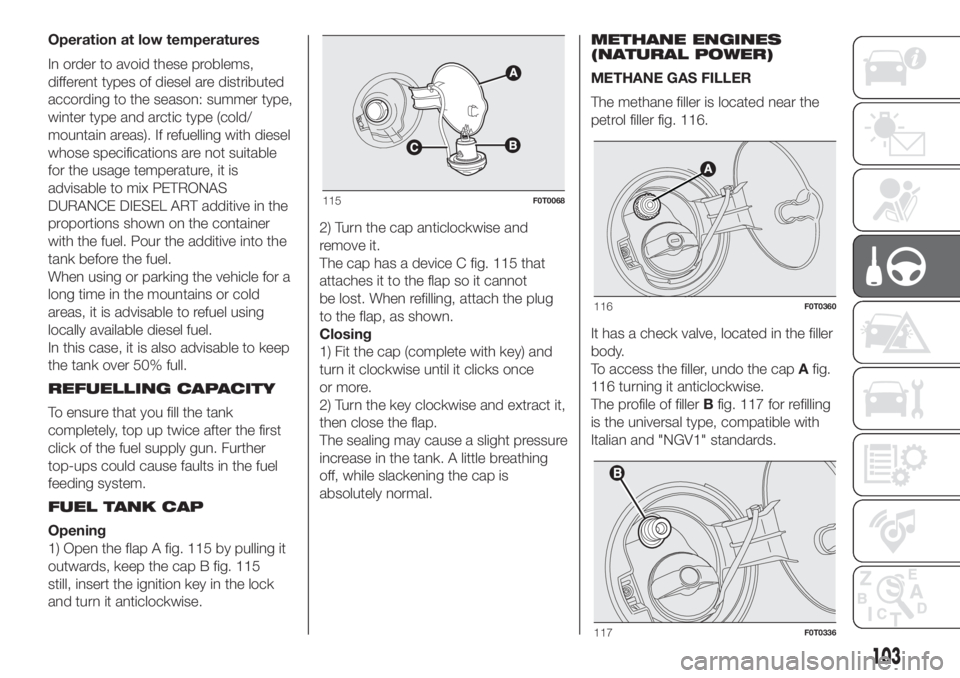
1) Open the flap A fig. 115 by pulling it
outwards, keep the cap B fig. 115
still, insert the ignition key in the lock
and turn it anticlockwise.2) Turn the cap anticlockwise and
remove it.
The cap has a device C fig. 115 that
attaches it to the flap so it cannot
be lost. When refilling, attach the plug
to the flap, as shown.
Closing
1) Fit the cap (complete with key) and
turn it clockwise until it clicks once
or more.
2) Turn the key clockwise and extract it,
then close the flap.
The sealing may cause a slight pressure
increase in the tank. A little breathing
off, while slackening the cap is
absolutely normal.METHANE ENGINES
(NATURAL POWER)
METHANE GAS FILLER
The methane filler is located near the
petrol filler fig. 116.
It has a check valve, located in the filler
body.
To access the filler, undo the capAfig.
116 turning it anticlockwise.
The profile of fillerBfig. 117 for refilling
is the universal type, compatible with
Italian and "NGV1" standards.
115F0T0068
116F0T0360
117F0T0336
103
Page 116 of 196
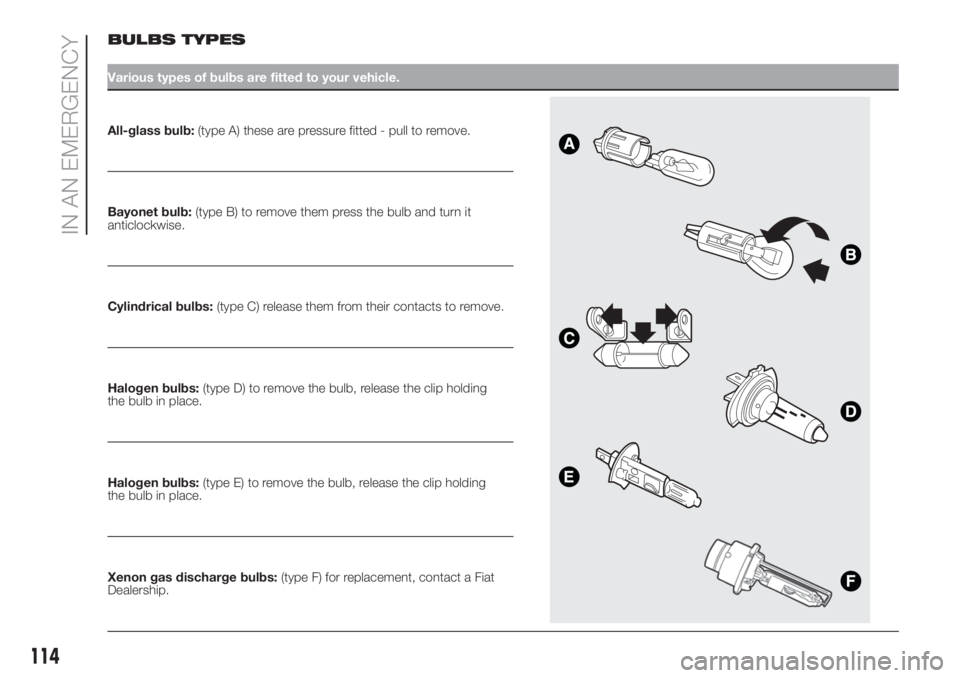
BULBS TYPES
Various types of bulbs are fitted to your vehicle.
All-glass bulb:(type A) these are pressure fitted - pull to remove.
Bayonet bulb:(type B) to remove them press the bulb and turn it
anticlockwise.
Cylindrical bulbs:(type C) release them from their contacts to remove.
Halogen bulbs:(type D) to remove the bulb, release the clip holding
the bulb in place.
Halogen bulbs:(type E) to remove the bulb, release the clip holding
the bulb in place.
Xenon gas discharge bulbs:(type F) for replacement, contact a Fiat
Dealership.
.
114
IN AN EMERGENCY
Page 118 of 196
REPLACING AN
EXTERIOR BULB
For the type of bulb and relevant power
rating, see “Changing a bulb”.
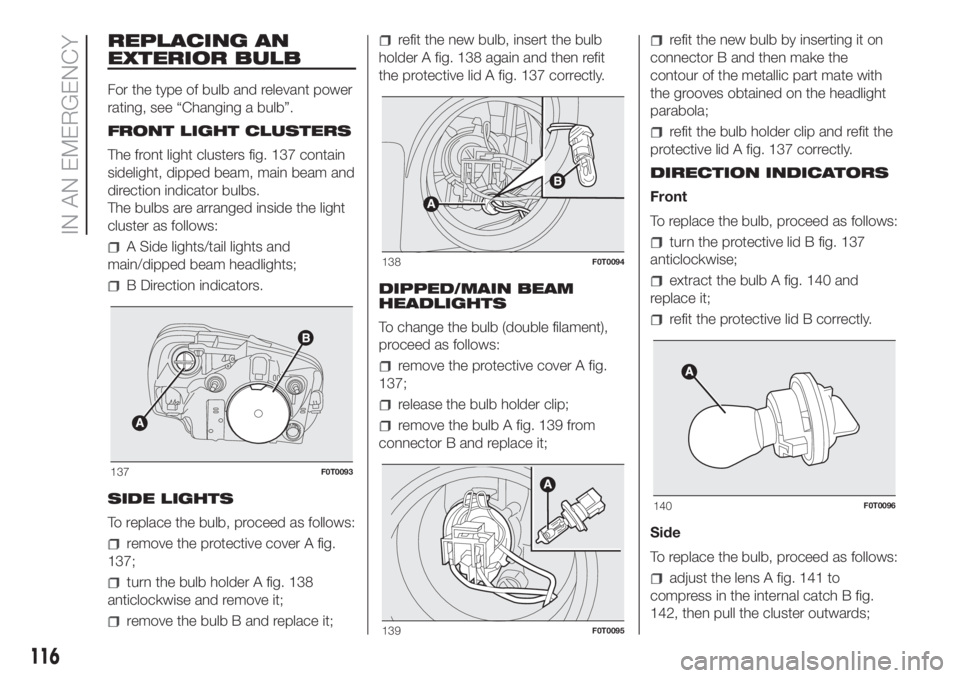
FRONT LIGHT CLUSTERS
The front light clusters fig. 137 contain
sidelight, dipped beam, main beam and
direction indicator bulbs.
The bulbs are arranged inside the light
cluster as follows:
A Side lights/tail lights and
main/dipped beam headlights;
B Direction indicators.
SIDE LIGHTS
To replace the bulb, proceed as follows:
remove the protective cover A fig.
137;
turn the bulb holder A fig. 138
anticlockwise and remove it;
remove the bulb B and replace it;
refit the new bulb, insert the bulb
holder A fig. 138 again and then refit
the protective lid A fig. 137 correctly.
DIPPED/MAIN BEAM
HEADLIGHTS
To change the bulb (double filament),
proceed as follows:
remove the protective cover A fig.
137;
release the bulb holder clip;
remove the bulb A fig. 139 from
connector B and replace it;
refit the new bulb by inserting it on
connector B and then make the
contour of the metallic part mate with
the grooves obtained on the headlight
parabola;
refit the bulb holder clip and refit the
protective lid A fig. 137 correctly.
DIRECTION INDICATORS
Front
To replace the bulb, proceed as follows:
turn the protective lid B fig. 137
anticlockwise;
extract the bulb A fig. 140 and
replace it;
refit the protective lid B correctly.
Side
To replace the bulb, proceed as follows:
adjust the lens A fig. 141 to
compress in the internal catch B fig.
142, then pull the cluster outwards;
137F0T0093
138F0T0094
139F0T0095
140F0T0096
116
IN AN EMERGENCY
Page 119 of 196
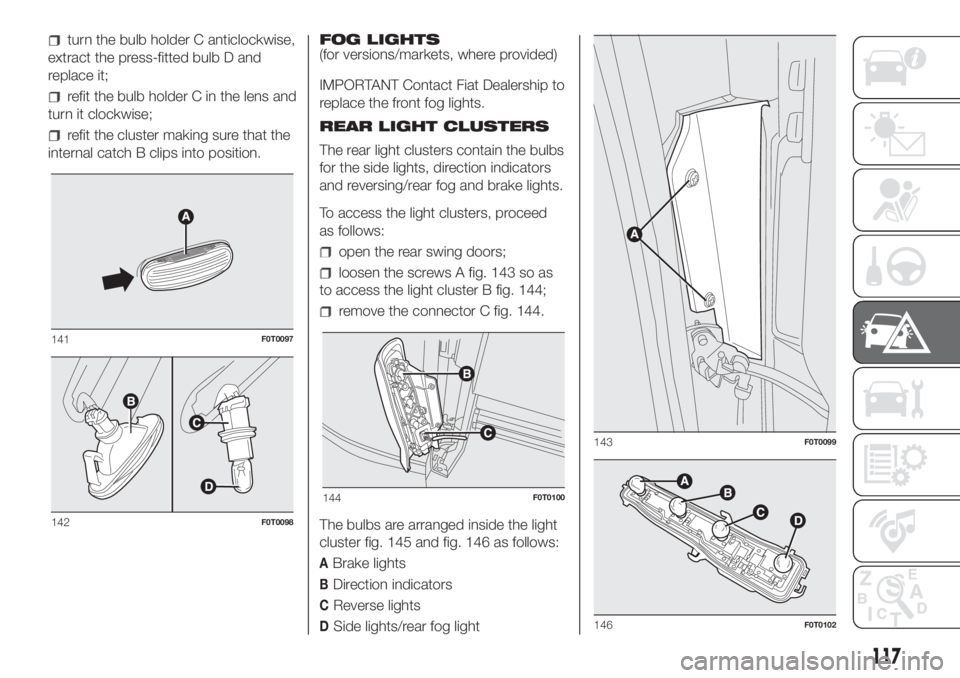
turn the bulb holder C anticlockwise,
extract the press-fitted bulb D and
replace it;
refit the bulb holder C in the lens and
turn it clockwise;
refit the cluster making sure that the
internal catch B clips into position.FOG LIGHTS
(for versions/markets, where provided)
IMPORTANT Contact Fiat Dealership to
replace the front fog lights.
REAR LIGHT CLUSTERS
The rear light clusters contain the bulbs
for the side lights, direction indicators
and reversing/rear fog and brake lights.
To access the light clusters, proceed
as follows:
open the rear swing doors;
loosen the screws A fig. 143 so as
to access the light cluster B fig. 144;
remove the connector C fig. 144.
The bulbs are arranged inside the light
cluster fig. 145 and fig. 146 as follows:
ABrake lights
BDirection indicators
CReverse lights
DSide lights/rear fog light
141F0T0097
142F0T0098
144F0T0100
143F0T0099
146F0T0102
117
Page 120 of 196
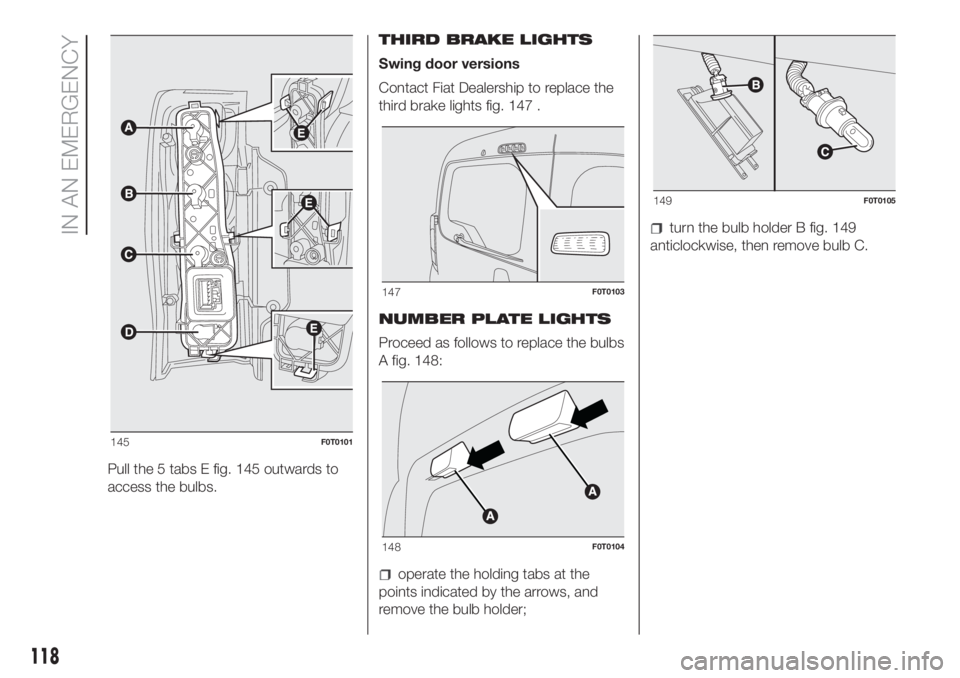
Pull the 5 tabs E fig. 145 outwards to
access the bulbs.THIRD BRAKE LIGHTS
Swing door versions
Contact Fiat Dealership to replace the
third brake lights fig. 147 .
NUMBER PLATE LIGHTS
Proceed as follows to replace the bulbs
A fig. 148:
operate the holding tabs at the
points indicated by the arrows, and
remove the bulb holder;
turn the bulb holder B fig. 149
anticlockwise, then remove bulb C.
145F0T0101
147F0T0103
148F0T0104
149F0T0105
118
IN AN EMERGENCY
Page 121 of 196
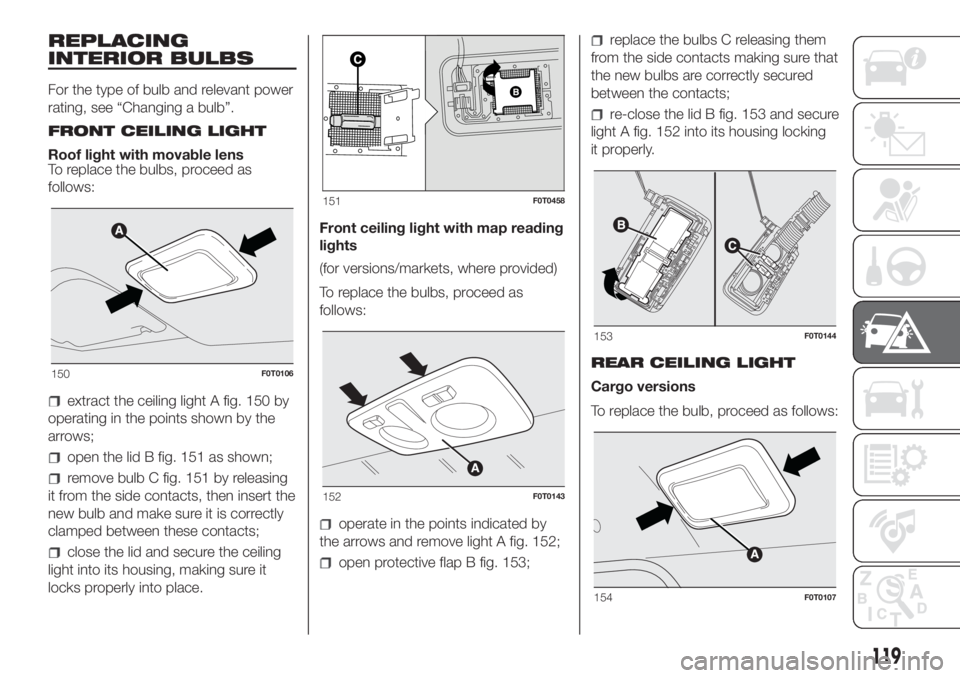
REPLACING
INTERIOR BULBS
For the type of bulb and relevant power
rating, see “Changing a bulb”.
FRONT CEILING LIGHT
Roof light with movable lens
To replace the bulbs, proceed as
follows:
extract the ceiling light A fig. 150 by
operating in the points shown by the
arrows;
open the lid B fig. 151 as shown;
remove bulb C fig. 151 by releasing
it from the side contacts, then insert the
new bulb and make sure it is correctly
clamped between these contacts;
close the lid and secure the ceiling
light into its housing, making sure it
locks properly into place.Front ceiling light with map reading
lights
(for versions/markets, where provided)
To replace the bulbs, proceed as
follows:
operate in the points indicated by
the arrows and remove light A fig. 152;
open protective flap B fig. 153;
replace the bulbs C releasing them
from the side contacts making sure that
the new bulbs are correctly secured
between the contacts;
re-close the lid B fig. 153 and secure
light A fig. 152 into its housing locking
it properly.
REAR CEILING LIGHT
Cargo versions
To replace the bulb, proceed as follows:
150F0T0106
151F0T0458
152F0T0143
153F0T0144
154F0T0107
119
Page 122 of 196
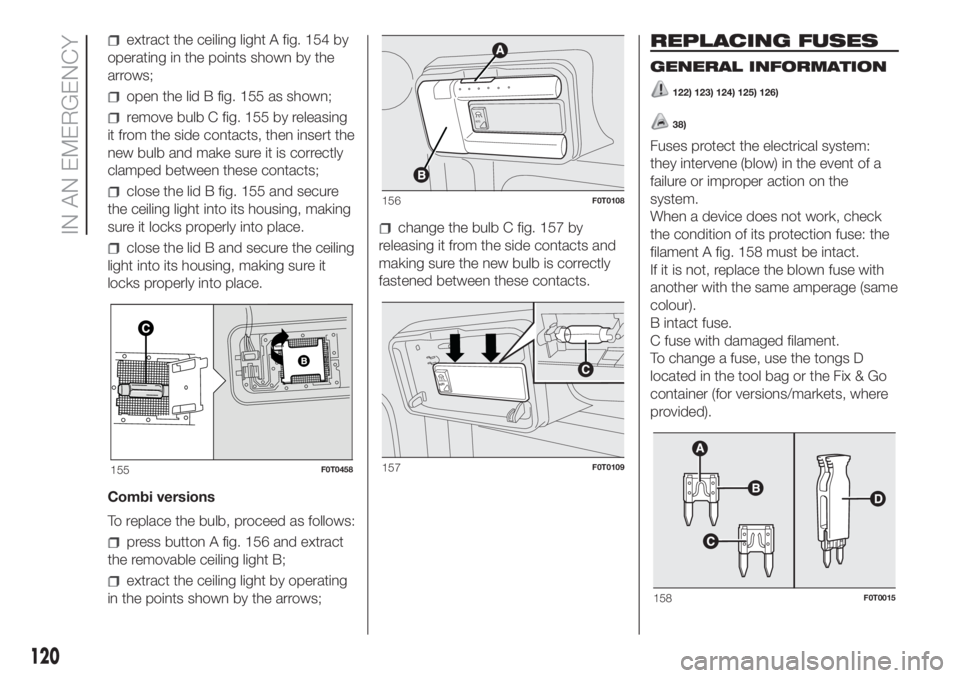
extract the ceiling light A fig. 154 by
operating in the points shown by the
arrows;
open the lid B fig. 155 as shown;
remove bulb C fig. 155 by releasing
it from the side contacts, then insert the
new bulb and make sure it is correctly
clamped between these contacts;
close the lid B fig. 155 and secure
the ceiling light into its housing, making
sure it locks properly into place.
close the lid B and secure the ceiling
light into its housing, making sure it
locks properly into place.
Combi versions
To replace the bulb, proceed as follows:
press button A fig. 156 and extract
the removable ceiling light B;
extract the ceiling light by operating
in the points shown by the arrows;
change the bulb C fig. 157 by
releasing it from the side contacts and
making sure the new bulb is correctly
fastened between these contacts.
REPLACING FUSES
GENERAL INFORMATION
122) 123) 124) 125) 126)
38)
Fuses protect the electrical system:
they intervene (blow) in the event of a
failure or improper action on the
system.
When a device does not work, check
the condition of its protection fuse: the
filament A fig. 158 must be intact.
If it is not, replace the blown fuse with
another with the same amperage (same
colour).
B intact fuse.
C fuse with damaged filament.
To change a fuse, use the tongs D
located in the tool bag or the Fix & Go
container (for versions/markets, where
provided).
155F0T0458
A
U
T
O
156F0T0108
AU
T
O
157F0T0109
158F0T0015
120
IN AN EMERGENCY