instrument panel FIAT FREEMONT 2012 Owner handbook (in English)
[x] Cancel search | Manufacturer: FIAT, Model Year: 2012, Model line: FREEMONT, Model: FIAT FREEMONT 2012Pages: 332, PDF Size: 5.61 MB
Page 196 of 332
Maintaining Your Air Bag System
WARNING!
Modifications to any part of the air
bag system could cause it to fail when
you need it . You could be injured if the air bag
system is not there to protect you. Do not modify
the components or wiring, including adding any
kind of badges or stickers to the steering wheel
hub trim cover or the upper right side of the
instrument panel. Do not modify the front bum-
per, vehicle body structure, or add aftermarket
side steps or running boards.
It is dangerous to try to repair any part of the
air bag system yourself. Be sure to tell anyone
who works on your vehicle that it has an air bag
system.
(Continued)(Continued)
Do not attempt to modify any part of your air
bag system.The air bag may inflate accidentally
or may not function properly if modifications are
made.Take your vehicle to an authorized dealer
for any air bag system service. If your seat includ-
ing your trim cover and cushion needs to be
serviced in any way (including removal or
loosening/tightening of seat attachment bolts),
take the vehicle to your authorized dealer. Only
manufacturer approved seat accessories may be
used. If it is necessary to modify the air bag
system for persons with disabilities, contact your
authorized dealer.
Air Bag Warning Light You will want to have the air bags ready to
inflate for your protection in a collision. The
Air Bag Warning Light monitors the internal
circuits and interconnecting wiring associ-
ated with air bag system electrical components. While
the air bag system is designed to be maintenance free.
If any of the following occurs, have an authorized dealer
service the air bag system immediately.
• The Air Bag Warning Light does not come on during the four to eight seconds when the ignition is first
cycled to the ON/RUN position.
190
KNOWING YOUR
VEHICLESAFETYSTARTING AND
DRIVING
WARNING LIGHTSAND
MESSAGES
IN AN
EMERGENCY
SERVICING AND
CARETECHNICAL
SPECIFICATIONSCONTENTS
Page 200 of 332
(Continued)
Never place or install floor mats or other floor
coverings in the vehicle that cannot be properly
secured to prevent them from moving and inter-
fering with the pedals or the ability to control the
vehicle.
Never put floor mats or other floor coverings
on top of already installed floor mats. Additional
floor mats and other coverings will reduce the
size of the pedal area and interfere with the
pedals.
Check mounting of mats on a regular basis.
Always properly reinstall and secure floor mats
that have been removed for cleaning.
Always make sure that objects cannot fall into
the driver footwell while the vehicle is moving.
Objects can become trapped under the brake
pedal and accelerator pedal causing a loss of
vehicle control.
If required, mounting posts must be properly
installed, if not equipped from the factory.
Failure to properly follow floor mat installation
or mounting can cause interference with the
brake pedal and accelerator pedal operation
causing loss of control of the vehicle. PERIODIC SAFETY CHECKS YOU SHOULD
MAKE OUTSIDE THE VEHICLE
Tires
Examine tires for excessive tread wear and uneven
wear patterns. Check for stones, nails, glass, or other
objects lodged in the tread or sidewall. Inspect the
tread for cuts and cracks. Inspect sidewalls for cuts,
cracks and bulges. Check the wheel nuts for tightness.
Check the tires (including spare) for proper cold infla-
tion pressure.
Lights
Have someone observe the operation of exterior lights
while you work the controls. Check Turn Signal and
High Beam Indicator Lights on the instrument panel.
Door Latches
Check for positive closing, latching, and locking.
Fluid Leaks
Check area under vehicle after overnight parking for
fuel, engine coolant, oil, or other fluid leaks. Also, if
gasoline fumes are detected or if fuel, power steering
fluid, or brake fluid leaks are suspected, the cause
should be located and corrected immediately.
194
KNOWING YOUR
VEHICLESAFETYSTARTING AND
DRIVING
WARNING LIGHTSAND
MESSAGES
IN AN
EMERGENCY
SERVICING AND
CARETECHNICAL
SPECIFICATIONSCONTENTS
Page 206 of 332
PARKING BRAKE
Before leaving the vehicle, make sure that the parking
brake is fully applied. Also, be certain to leave an
automatic transmission in PARK, or manual transmis-
sion in REVERSE or first gear.
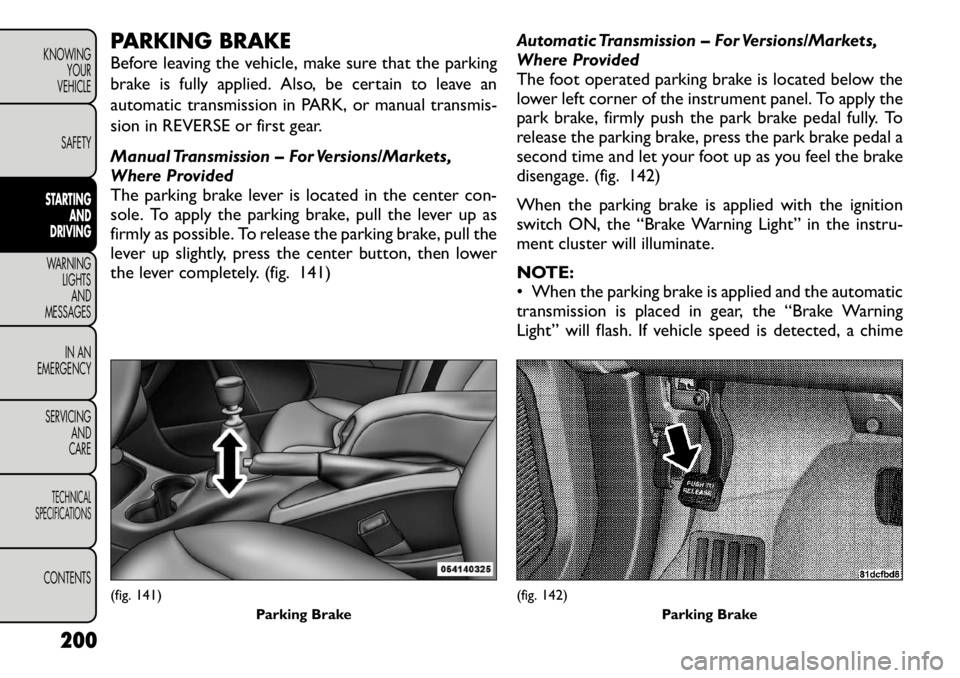
Manual Transmission – For Versions/Markets,
Where Provided
The parking brake lever is located in the center con-
sole. To apply the parking brake, pull the lever up as
firmly as possible. To release the parking brake, pull the
lever up slightly, press the center button, then lower
the lever completely. (fig. 141)Automatic Transmission – For Versions/Markets,
Where Provided
The foot operated parking brake is located below the
lower left corner of the instrument panel. To apply the
park brake, firmly push the park brake pedal fully. To
release the parking brake, press the park brake pedal a
second time and let your foot up as you feel the brake
disengage. (fig. 142)
When the parking brake is applied with the ignition
switch ON, the “Brake Warning Light” in the instru-
ment cluster will illuminate.
NOTE:
• When the parking brake is applied and the automatic
transmission is placed in gear, the “Brake Warning
Light” will flash. If vehicle speed is detected, a chime(fig. 141)
Parking Brake
(fig. 142)Parking Brake
200
KNOWING YOUR
VEHICLE
SAFETYSTARTING AND
DRIVINGWARNING LIGHTSAND
MESSAGES
IN AN
EMERGENCY
SERVICING AND
CARETECHNICAL
SPECIFICATIONSCONTENTS
Page 211 of 332
SIX-SPEED AUTOMATIC TRANSMISSION
The shift lever position display (located in the instru-
ment panel cluster) indicates the transmission gear
range. You must press the brake pedal to move the shift
lever out of the PARK position (refer to “Brake/
Transmission Shift Interlock System” in this section).
To drive, move the shift lever from PARK or NEUTRAL
to the DRIVE position.
The electronically-controlled transmission provides a
precise shift schedule. The transmission electronics are
self-calibrating; therefore, the first few shifts on a new
vehicle may be somewhat abrupt. This is a normal
condition, and precision shifts will develop within a few
hundred kilometers.
Shifting from DRIVE to PARK or REVERSE should be
done only after the accelerator pedal is released and
the vehicle is stopped. Be sure to keep your foot on the
brake pedal when moving the shift lever between thesegears.
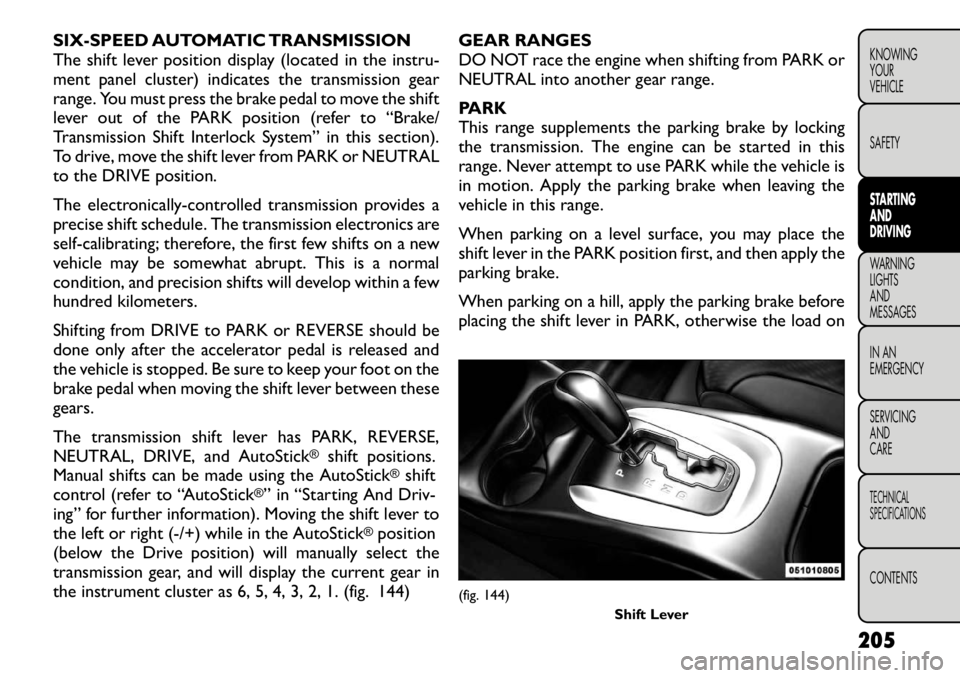
The transmission shift lever has PARK, REVERSE,
NEUTRAL, DRIVE, and AutoStick
®
shift positions.
Manual shifts can be made using the AutoStick
®shift
control (refer to “AutoStick
®” in “Starting And Driv-
ing” for further information). Moving the shift lever to
the left or right (-/+) while in the AutoStick
®position
(below the Drive position) will manually select the
transmission gear, and will display the current gear in
the instrument cluster as 6, 5, 4, 3, 2, 1. (fig. 144) GEAR RANGES
DO NOT race the engine when shifting from PARK or
NEUTRAL into another gear range.
PARK
This range supplements the parking brake by locking
the transmission. The engine can be started in this
range. Never attempt to use PARK while the vehicle is
in motion. Apply the parking brake when leaving the
vehicle in this range.
When parking on a level surface, you may place the
shift lever in the PARK position first, and then apply the
parking brake.
When parking on a hill, apply the parking brake before
placing the shift lever in PARK, otherwise the load on
(fig. 144)
Shift Lever
205
KNOWING
YOURVEHICLE SAFETYSTARTING ANDDRIVINGWARNING LIGHTSAND
MESSAGES
IN AN
EMERGENCY
SERVICING AND
CARETECHNICAL
SPECIFICATIONSCONTENTS
Page 252 of 332
If the sealant (white fluid) does flowthrough the
Sealant Hose (6):
1. Continue to operate the pump until sealant is no longer flowing through hose (typically takes 30 -
70 seconds). As the sealant flows through the Seal-
ant Hose (6), the Pressure Gauge (3) can read as
high as 5 Bar. The Pressure Gauge (3) will decrease
quickly from approximately 5 Bar to the actual tire
pressure when the Sealant Bottle (1) is empty.
2. The pump will start to inject air into the tire immediately after the Sealant Bottle (1) is empty.
Continue to operate the pump and inflate the tire
to the pressure indicated on the tire pressure label
on the driver-side latch pillar (recommended pres-
sure). Check the tire pressure by looking at the
Pressure Gauge (3).
If the tire does not inflate to at least 1.8 Bar
pressure within 15 minutes:
• The tire is too badly damaged. Do not attempt to drive the vehicle further. Call for assistance.
NOTE: If the tire becomes over-inflated, press the
Deflation Button to reduce the tire pressure to the
recommended inflation pressure before continuing.
If the tire inflates to the recommended pres-
sure or is at least 1.8 Bar pressure within
15 minutes:
1. Press the Power Button (4) to turn off the TIREFIT kit. 2. Remove the Speed Limit sticker from the top of the
Sealant Bottle (1) and place the sticker on the
instrument panel.
3. Immediately disconnect the Sealant Hose (6) from the valve stem, reinstall the cap on the fitting at the
end of the hose, and place the TIREFIT kit in the
vehicle storage location. Quickly proceed to (D)
“Drive Vehicle”.
The metal end fitting from Power Plug
(8) may get hot after use, so it should be
handled carefully.
Failure to reinstall the cap on the fitting at the
end of the Sealant Hose (6) can result in sealant
contacting your skin, clothing, and the vehicle’s
interior. It can also result in sealant contacting
internalTIREFIT kit components which may cause
permanent damage to the kit .
(D) Drive Vehicle:
Immediately after injecting sealant and inflating the tire,
drive the vehicle 8 km or 10 minutes to ensure distri-
bution of the TIREFIT Sealant within the tire. Do not
exceed 88 km/h.
246
KNOWING YOUR
VEHICLE
SAFETY
STARTING AND
DRIVING
WARNING LIGHTSAND
MESSAGES
IN AN
EMERGENCY
SERVICING AND
CARETECHNICAL
SPECIFICATIONSCONTENTS
Page 260 of 332

FUSES
INTERIOR FUSES
The interior fuse panel is located on the passenger side
under the instrument panel.Cavity
CartridgeFuse
Mini-Fuse Description
F100 30 Amp
Pink 110V AC Inverter –
For Versions/
Markets, Where
Provided
F101 10 Amp
Red Interior Lights
F102 20 Amp
Yellow Cigar Lighter inInstrument
Panel/Left Rear
Power Outlet
F103 20 Amp
Yellow Power Outlet in
Console Bin/Power
Outlet in Rear ofConsole
F105 20 Amp
Yellow Heated Seats – For
Versions/Markets,
Where Provided
F106 20 Amp
Yellow Rear Power Outlet
F107 10 Amp
Red Rear Camera – For
Versions/Markets,
Where Provided
Cavity
Cartridge
Fuse
Mini-Fuse Description
F108 15 Amp
Blue Instrument Panel
F109 10 Amp
Red Climate
Control/HVAC
F110 10 Amp
Red Occupant Restraint
Controller
F112 10 Amp
Red Spare
F114 20 Amp
Yellow Rear HVAC
Blower/Motor
F115 20 Amp
Yellow Rear Wiper Motor
F116 30 Amp
Pink Rear Defroster (EBL)
F117 10 Amp
Red Heated Mirrors
F118 10 Amp
Red Occupant Restraint
Controller
F119 10 Amp
Red Steering Column
Control Module
F120 10 Amp
Red All Wheel Drive –
For Versions/
Markets, Where
Provided
F121 15 Amp
Blue Wireless IgnitionNode
254
KNOWING YOUR
VEHICLE
SAFETY
STARTING AND
DRIVING
WARNING LIGHTSAND
MESSAGES
IN AN
EMERGENCY
SERVICING AND
CARETECHNICAL
SPECIFICATIONSCONTENTS
Page 261 of 332

Cavity
CartridgeFuse
Mini-Fuse Description
F122 25 Amp
Natural Driver Door Module
F123 25 Amp
Natural Passenger Door Module
F124 10 Amp
Red Mirrors
F125 10 Amp
Red Steering Column
Control Module
F126 10 Amp
Red Audio Amplifier
F127 20 Amp
Yellow Trailer Tow – For
Versions/Markets,
Where Provided
F128 15 Amp
Blue Radio
F129 15 Amp
Blue Video/DVD – For
Versions/Markets,
Where Provided
F130 15 Amp
Blue Climate
Control/InstrumentPanel
F131 10 Amp
Red Passenger
Assistance/Hands
Free System – For
Versions/Markets,
Where Provided
Cavity
Cartridge
Fuse
Mini-Fuse Description
F132 10 Amp
Red Tire Pressure Module
F133 10 Amp
Red Spare
255
KNOWING
YOURVEHICLE SAFETY
STARTING ANDDRIVING
WARNING LIGHTSAND
MESSAGESIN AN
EMERGENCYSERVICING AND
CARETECHNICAL
SPECIFICATIONSCONTENTS
Page 270 of 332
SERVICING AND CARE
MAINTENANCE SCHEDULE
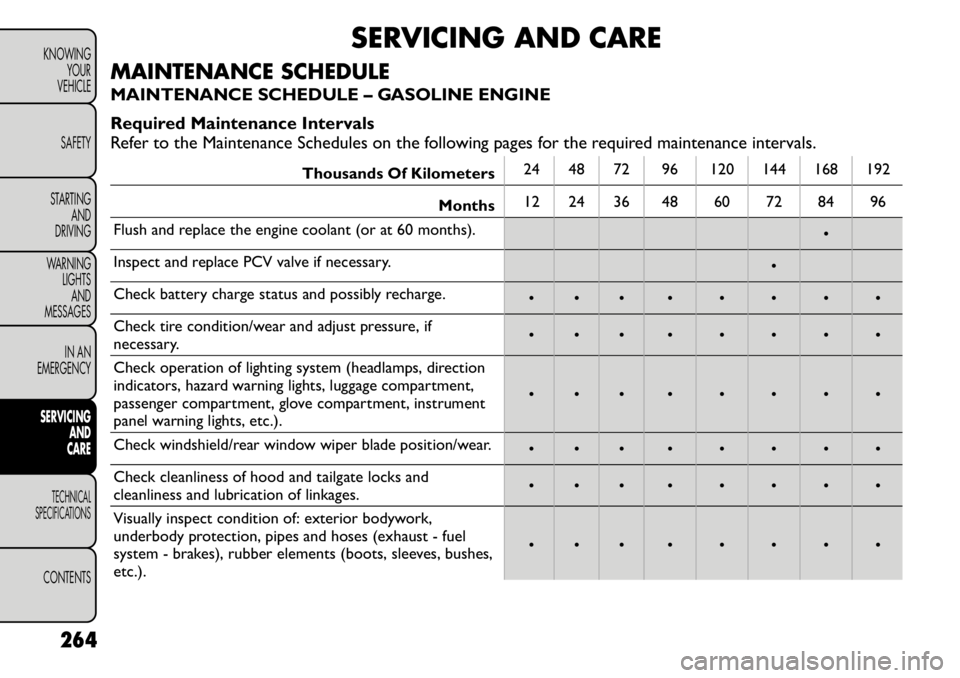
MAINTENANCE SCHEDULE – GASOLINE ENGINE
Required Maintenance Intervals
Refer to the Maintenance Schedules on the following pages for the required maintenance intervals.
Thousands Of Kilometers 24 48 72 96 120 144 168 192
Months 12 24 36 48 60 72 84 96
Flush and replace the engine coolant (or at 60 months). •
Inspect and replace PCV valve if necessary. •
Check battery charge status and possibly recharge. • • • • • • • •
Check tire condition/wear and adjust pressure, if
necessary. • • • • • • • •
Check operation of lighting system (headlamps, direction
indicators, hazard warning lights, luggage compartment,
passenger compartment, glove compartment, instrument
panel warning lights, etc.). • • • • • • • •
Check windshield/rear window wiper blade position/wear. • • • • • • • •
Check cleanliness of hood and tailgate locks and
cleanliness and lubrication of linkages. • • • • • • • •
Visually inspect condition of: exterior bodywork,
underbody protection, pipes and hoses (exhaust - fuel
system - brakes), rubber elements (boots, sleeves, bushes,
etc.). • • • • • • • •
264
KNOWING YOUR
VEHICLE
SAFETY
STARTING AND
DRIVING
WARNING LIGHTS
AND
MESSAGES
IN AN
EMERGENCYSERVICING AND
CARETECHNICAL
SPECIFICATIONSCONTENTS
Page 273 of 332
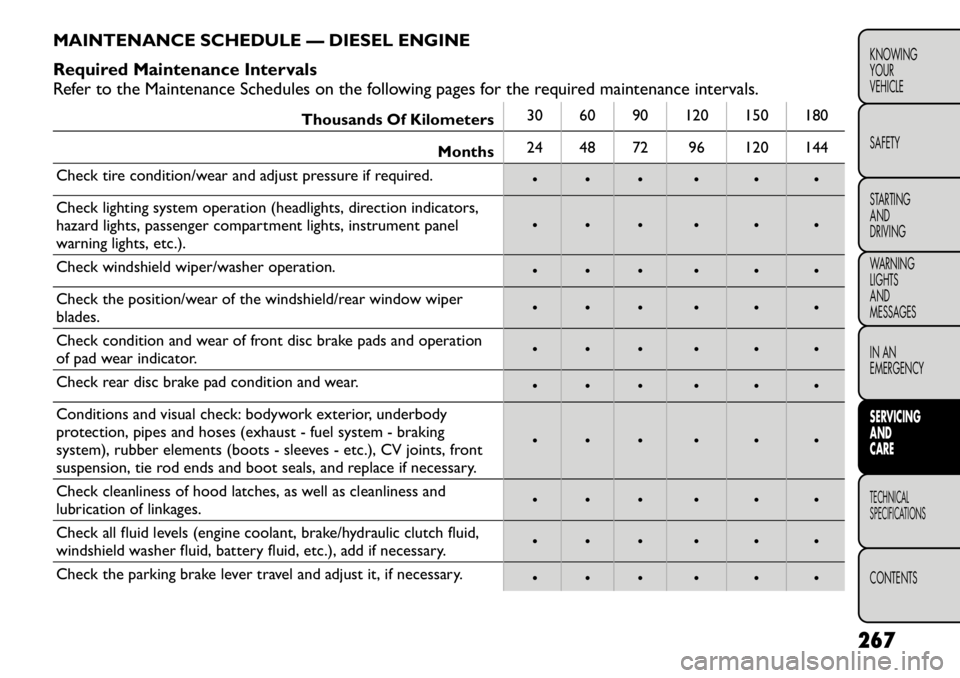
MAINTENANCE SCHEDULE — DIESEL ENGINE
Required Maintenance Intervals
Refer to the Maintenance Schedules on the following pages for the required maintenance intervals.
Thousands Of Kilometers30 60 90 120 150 180
Months 24 48 72 96 120 144
Check tire condition/wear and adjust pressure if required. • • • • • •
Check lighting system operation (headlights, direction indicators,
hazard lights, passenger compartment lights, instrument panel
warning lights, etc.). • • • • • •
Check windshield wiper/washer operation. • • • • • •
Check the position/wear of the windshield/rear window wiper
blades. • • • • • •
Check condition and wear of front disc brake pads and operation
of pad wear indicator. • • • • • •
Check rear disc brake pad condition and wear. • • • • • •
Conditions and visual check: bodywork exterior, underbody
protection, pipes and hoses (exhaust - fuel system - braking
system), rubber elements (boots - sleeves - etc.), CV joints, front
suspension, tie rod ends and boot seals, and replace if necessary. • • • • • •
Check cleanliness of hood latches, as well as cleanliness and
lubrication of linkages. • • • • • •
Check all fluid levels (engine coolant, brake/hydraulic clutch fluid,
windshield washer fluid, battery fluid, etc.), add if necessary. • • • • • •
Check the parking brake lever travel and adjust it, if necessary. • • • • • •
267
KNOWING
YOURVEHICLE SAFETY
STARTING ANDDRIVING
WARNING LIGHTSAND
MESSAGES
IN AN
EMERGENCYSERVICING AND
CARETECHNICAL
SPECIFICATIONSCONTENTS
Page 282 of 332
A/C AIR FILTER (for versions/markets, where
provided)
Refer to the “Maintenance Schedule” for the proper
maintenance intervals.
WARNING!
Do not remove the A/C air filter while
the blower is operating or personal in-
jury may result .
The A/C air filter is located in the fresh air inlet behind
the glove box. Perform the following steps to replace
the filter:
1. Open the glove box and remove all contents.
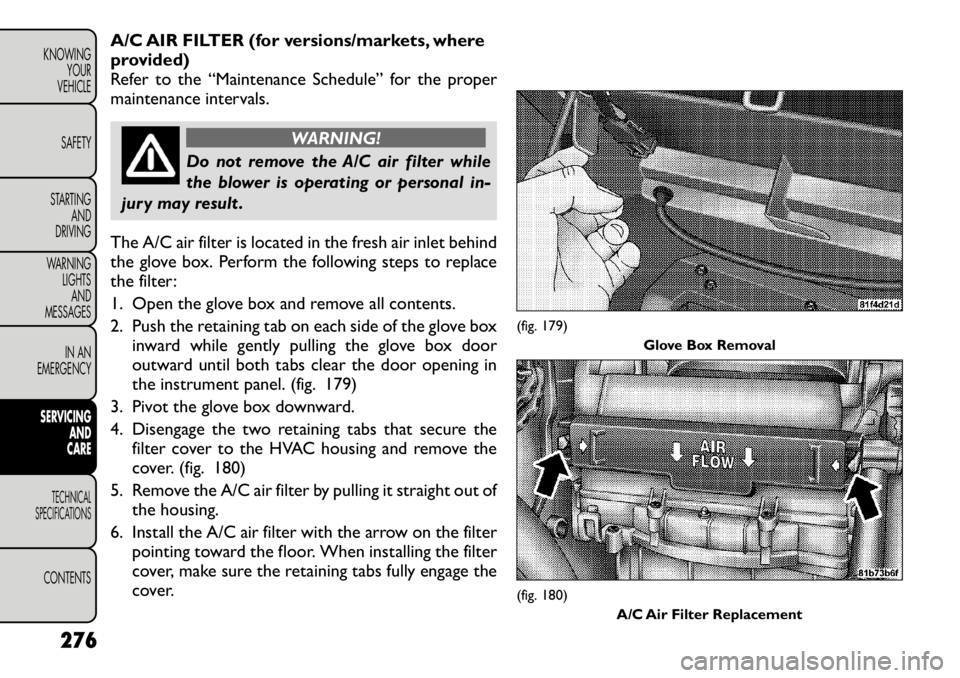
2. Push the retaining tab on each side of the glove box inward while gently pulling the glove box door
outward until both tabs clear the door opening in
the instrument panel. (fig. 179)
3. Pivot the glove box downward.
4. Disengage the two retaining tabs that secure the filter cover to the HVAC housing and remove the
cover. (fig. 180)
5. Remove the A/C air filter by pulling it straight out of the housing.
6. Install the A/C air filter with the arrow on the filter pointing toward the floor. When installing the filter
cover, make sure the retaining tabs fully engage the
cover.
(fig. 179) Glove Box Removal(fig. 180)
A/C Air Filter Replacement
276
KNOWING YOUR
VEHICLE
SAFETY
STARTING AND
DRIVING
WARNING LIGHTSAND
MESSAGES
IN AN
EMERGENCYSERVICING AND
CARETECHNICAL
SPECIFICATIONSCONTENTS