rear window wiper FIAT GRANDE PUNTO 2010 199 / 1.G Owners Manual
[x] Cancel search | Manufacturer: FIAT, Model Year: 2010, Model line: GRANDE PUNTO, Model: FIAT GRANDE PUNTO 2010 199 / 1.GPages: 216, PDF Size: 3.5 MB
Page 50 of 216
49
SAFETY
STARTING
AND DRIVING
WARNING
LIGHTS AND
MESSAGES
IN AN
EMERGENCY
SERVICE
AND CARE
TECHNICAL
SPECIFICATIONS
INDEX
CONTROLS
AND DEVICES
WINDOW WASHING
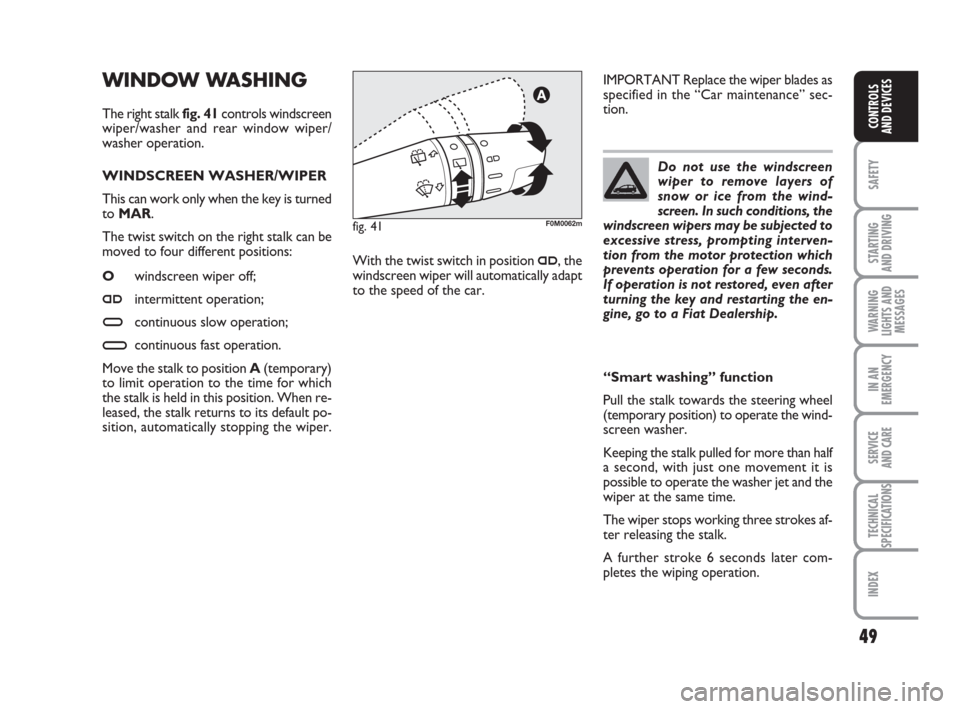
The right stalk fig. 41controls windscreen
wiper/washer and rear window wiper/
washer operation.
WINDSCREEN WASHER/WIPER
This can work only when the key is turned
to MAR.
The twist switch on the right stalk can be
moved to four different positions:
Owindscreen wiper off;
≤intermittent operation;
≥continuous slow operation;
¥continuous fast operation.
Move the stalk to position A(temporary)
to limit operation to the time for which
the stalk is held in this position. When re-
leased, the stalk returns to its default po-
sition, automatically stopping the wiper.Do not use the windscreen
wiper to remove layers of
snow or ice from the wind-
screen. In such conditions, the
windscreen wipers may be subjected to
excessive stress, prompting interven-
tion from the motor protection which
prevents operation for a few seconds.
If operation is not restored, even after
turning the key and restarting the en-
gine, go to a Fiat Dealership.
With the twist switch in position
≤, the
windscreen wiper will automatically adapt
to the speed of the car.IMPORTANT Replace the wiper blades as
specified in the “Car maintenance” sec-
tion.
fig. 41F0M0062m
“Smart washing” function
Pull the stalk towards the steering wheel
(temporary position) to operate the wind-
screen washer.
Keeping the stalk pulled for more than half
a second, with just one movement it is
possible to operate the washer jet and the
wiper at the same time.
The wiper stops working three strokes af-
ter releasing the stalk.
A further stroke 6 seconds later com-
pletes the wiping operation.
033-071 ACTUAL 1ed EN 21-07-2010 14:25 Pagina 49
Page 51 of 216
50
SAFETY
STARTING
AND DRIVING
WARNING
LIGHTS AND
MESSAGES
IN AN
EMERGENCY
SERVICE
AND CARE
TECHNICAL
SPECIFICATIONS
INDEX
CONTROLS
AND DEVICES
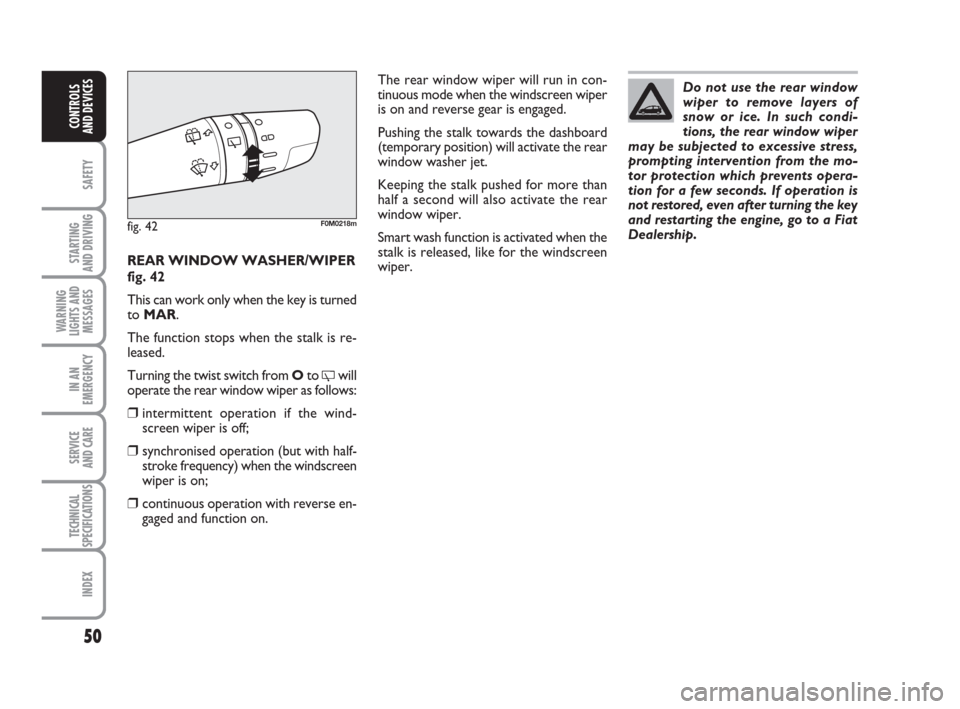
REAR WINDOW WASHER/WIPER
fig. 42
This can work only when the key is turned
to MAR.
The function stops when the stalk is re-
leased.
Turning the twist switch from Oto
'will
operate the rear window wiper as follows:
❒intermittent operation if the wind-
screen wiper is off;
❒synchronised operation (but with half-
stroke frequency) when the windscreen
wiper is on;
❒continuous operation with reverse en-
gaged and function on.Do not use the rear window
wiper to remove layers of
snow or ice. In such condi-
tions, the rear window wiper
may be subjected to excessive stress,
prompting intervention from the mo-
tor protection which prevents opera-
tion for a few seconds. If operation is
not restored, even after turning the key
and restarting the engine, go to a Fiat
Dealership.
The rear window wiper will run in con-
tinuous mode when the windscreen wiper
is on and reverse gear is engaged.
Pushing the stalk towards the dashboard
(temporary position) will activate the rear
window washer jet.
Keeping the stalk pushed for more than
half a second will also activate the rear
window wiper.
Smart wash function is activated when the
stalk is released, like for the windscreen
wiper.
fig. 42F0M0218m
033-071 ACTUAL 1ed EN 21-07-2010 14:25 Pagina 50
Page 118 of 216
117
SAFETY
WARNING
LIGHTS AND
MESSAGES
IN AN
EMERGENCY
SERVICE
AND CARE
TECHNICAL
SPECIFICATIONS
INDEX
CONTROLS
AND DEVICES
STARTING
AND DRIVING
Roof rack/ski rack
Remove the roof rack or ski rack from the
roof after use. These accessories decrease
aerodynamic penetration and have a neg-
ative effect on fuel consumption. It is bet-
ter to use a trailer to transport particu-
larly bulky objects.
Electrical devices
Use electrical devices only for the amount
of time needed. The heated rear window,
auxiliary headlights, windscreen wipers and
fan heater use up a considerable amount
of current, causing increased fuel con-
sumption (up to +25% in the urban cycle).
Air conditioning
Air conditioning leads to higher fuel con-
sumption (on average up to +20%). If the
temperature outside is not too extreme,
try and use the air vents.
Spoilers
The use of non-certified spoilers may ad-
versely affect aerodynamics and fuel con-
sumption.DRIVING STYLE
Starting
Do not warm up the engine at low or high
revs when the vehicle is stationary; this
causes the engine to warm up more slow-
ly, thereby increasing fuel consumption
and emissions. It is advisable to set off im-
mediately and slowly, avoiding high revs:
this allows the engine to warm up more
quickly.
Unnecessary actions
Avoid revving up when stationary at traf-
fic lights or before stopping the engine.
The latter action, like double declutching,
is entirely unnecessary and causes in-
creased fuel consumption and pollution.
Gear selection
Use a higher gear as soon as traffic and
road conditions allow. Using a low gear
for faster acceleration will increase fuel
consumption.
In the same way, improper use of a high
gear increases fuel consumption, emissions
and engine wear.SAVING FUEL
Here are some suggestions which may
help you to save fuel and reduce the
amount of toxic emissions released into
the atmosphere.
GENERAL CONSIDERATIONS
Car maintenance
Have checks and adjustments carried out
in accordance with the “Scheduled Service
Plan”.
Tyres
Check the tyre pressure at least once
every 4 weeks: if the pressure is too low,
consumption levels increase as resistance
to rolling is higher.
Unnecessary loads
Do not travel with an overloaded boot.
The weight of the car (especially when dri-
ving in town) and its arrangement greatly
affect fuel consumption and stability.
111-122 ACTUAL 1ed EN 20-07-2010 16:10 Pagina 117
Page 123 of 216
122
SAFETY
WARNING
LIGHTS AND
MESSAGES
IN AN
EMERGENCY
SERVICE
AND CARE
TECHNICAL
SPECIFICATIONS
INDEX
CONTROLS
AND DEVICES
STARTING
AND DRIVING
CAR INACTIVITY
If the car is to be left inactive for longer
than a month, the following precautions
should be observed:
❒park the car in covered, dry and, if pos-
sible, well-ventilated premises;
❒engage a gear;
❒check that the handbrake is engaged;
❒disconnect the clip for the negative bat-
tery terminal and check battery charge.
Repeat this check once every three
months during storage. Recharge the
battery if the indicator is dark and the
middle area is not green;
❒clean and protect the painted parts us-
ing protective wax;
❒clean and protect the shiny metal parts
using special compounds readily avail-
able;
❒sprinkle talcum powder on the rubber
windscreen and rear window wiper
blades and lift them off the glass;
❒open the windows slightly;
❒cover the car with a fabric or perfo-
rated plastic sheet. Do not use compact
plastic sheets which do not allow hu-
midity to evaporate from the surface of
the car;
❒inflate tyres to a pressure of +0.5 bar
above the normal specified pressure
and check regularly;
❒if you don’t disconnect the battery from
the electrical system, check its charge
every month and recharge it if the in-
dicator shows a dark colour without
the central green area;
❒do not drain the engine cooling system.
IMPORTANT Where relevant, switch off
the car alarm with the remote control.
Keep your speed down when
snow chains are fitted – do
not exceed 50 km/h. Avoid
potholes, steps and pave-
ments and also avoid driving
for long distances on roads
not covered with snow to avoid dam-
aging the car and the road surface.
WARNING
111-122 ACTUAL 1ed EN 20-07-2010 16:10 Pagina 122
Page 168 of 216
167
SAFETY
STARTING
AND DRIVING
WARNING
LIGHTS AND
MESSAGES
IN AN
EMERGENCY
TECHNICAL
SPECIFICATIONS
INDEX
CONTROLS
AND DEVICES
SERVICE
AND CARE
SCHEDULED SERVICING ................................................. 168
SCHEDULED SERVICING PLAN
PETROL VERSIONS ............................................................ 169
SCHEDULED SERVICING PLAN
DIESEL VERSIONS ............................................................... 171
REGULAR CHECKS ............................................................ 173
DEMANDING USE OF THE CAR ................................... 173
CHECKING LEVELS ............................................................ 174
AIR FILTER ............................................................................ 179
POLLEN FILTER ................................................................... 179
BATTERY ............................................................................... 179
WHEELS AND TYRES ........................................................ 181
RUBBER TUBES .................................................................... 182
WINDSCREEN/REAR WINDOW WIPERS .................. 182
BODYWORK ....................................................................... 184
INTERIOR .............................................................................. 186
S S
E E
R R
V V
I I
C C
E E
A A
N N
D D
C C
A A
R R
E E
167-186 ACTUAL 1ed EN 27-07-2010 10:30 Pagina 167
Page 172 of 216
171
SAFETY
STARTING
AND DRIVING
WARNING
LIGHTS AND
MESSAGES
IN AN
EMERGENCY
TECHNICAL
SPECIFICATIONS
INDEX
CONTROLS
AND DEVICES
SERVICE
AND CARE
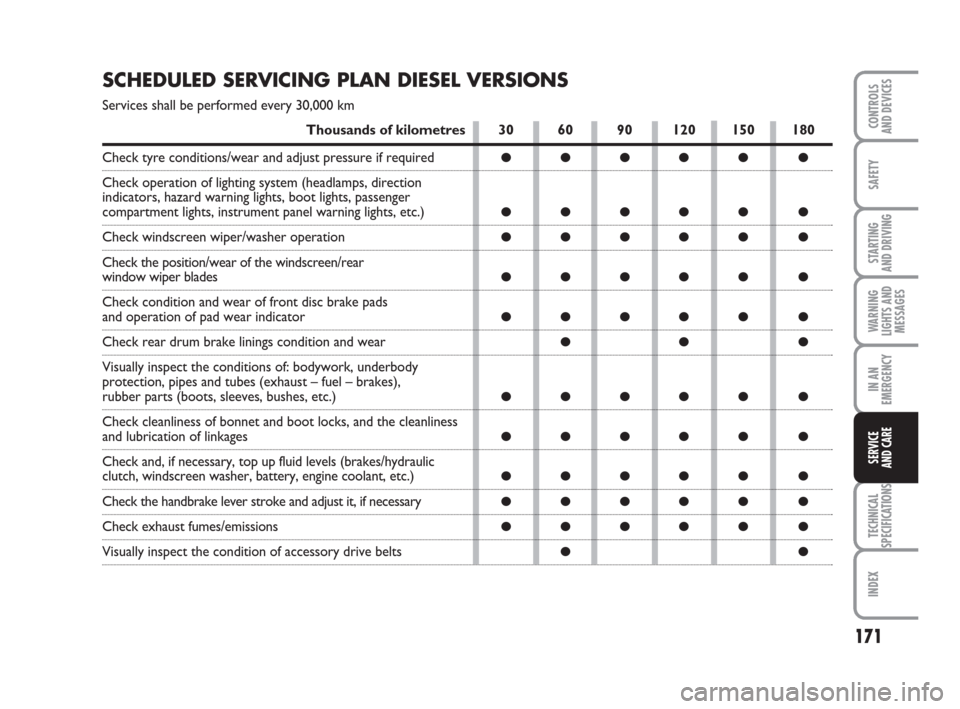
SCHEDULED SERVICING PLAN DIESEL VERSIONS
Services shall be performed every 30,000 km
30 60 90 120 150 180
●●●●● ●
●●●●● ●
●●●●● ●
●●●●● ●
●●●●● ●
●● ●
●●●●● ●
●●●●● ●
●●●●● ●
●●●●● ●
●●●●● ●
●●
Thousands of kilometres
Check tyre conditions/wear and adjust pressure if required
Check operation of lighting system (headlamps, direction
indicators, hazard warning lights, boot lights, passenger
compartment lights, instrument panel warning lights, etc.)
Check windscreen wiper/washer operation
Check the position/wear of the windscreen/rear
window wiper blades
Check condition and wear of front disc brake pads
and operation of pad wear indicator
Check rear drum brake linings condition and wear
Visually inspect the conditions of: bodywork, underbody
protection, pipes and tubes (exhaust – fuel – brakes),
rubber parts (boots, sleeves, bushes, etc.)
Check cleanliness of bonnet and boot locks, and the cleanliness
and lubrication of linkages
Check and, if necessary, top up fluid levels (brakes/hydraulic
clutch, windscreen washer, battery, engine coolant, etc.)
Check the handbrake lever stroke and adjust it, if necessary
Check exhaust fumes/emissions
Visually inspect the condition of accessory drive belts
167-186 ACTUAL 1ed EN 27-07-2010 10:30 Pagina 171
Page 174 of 216
173
SAFETY
STARTING
AND DRIVING
WARNING
LIGHTS AND
MESSAGES
IN AN
EMERGENCY
TECHNICAL
SPECIFICATIONS
INDEX
CONTROLS
AND DEVICES
SERVICE
AND CARE
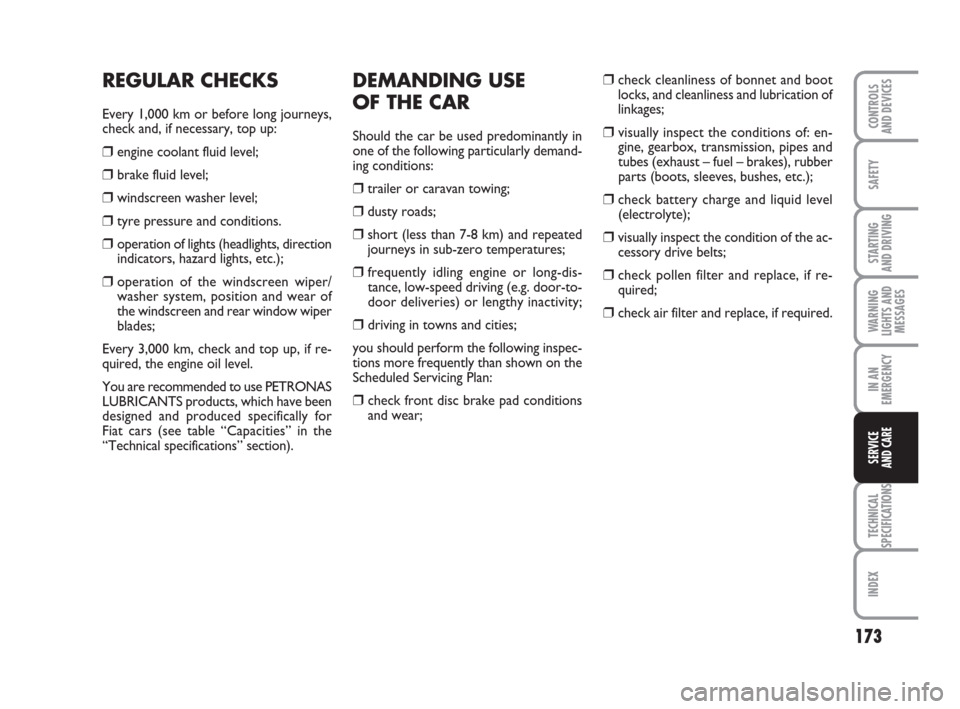
DEMANDING USE
OF THE CAR
Should the car be used predominantly in
one of the following particularly demand-
ing conditions:
❒trailer or caravan towing;
❒dusty roads;
❒short (less than 7-8 km) and repeated
journeys in sub-zero temperatures;
❒ frequently idling engine or long-dis-
tance, low-speed driving (e.g. door-to-
door deliveries) or lengthy inactivity;
❒ driving in towns and cities;
you should perform the following inspec-
tions more frequently than shown on the
Scheduled Servicing Plan:
❒ check front disc brake pad conditions
and wear;
❒check cleanliness of bonnet and boot
locks, and cleanliness and lubrication of
linkages;
❒ visually inspect the conditions of: en-
gine, gearbox, transmission, pipes and
tubes (exhaust – fuel – brakes), rubber
parts (boots, sleeves, bushes, etc.);
❒check battery charge and liquid level
(electrolyte);
❒visually inspect the condition of the ac-
cessory drive belts;
❒check pollen filter and replace, if re-
quired;
❒check air filter and replace, if required.
REGULAR CHECKS
Every 1,000 km or before long journeys,
check and, if necessary, top up:
❒engine coolant fluid level;
❒brake fluid level;
❒windscreen washer level;
❒tyre pressure and conditions.
❒operation of lights (headlights, direction
indicators, hazard lights, etc.);
❒operation of the windscreen wiper/
washer system, position and wear of
the windscreen and rear window wiper
blades;
Every 3,000 km, check and top up, if re-
quired, the engine oil level.
You are recommended to use PETRONAS
LUBRICANTS products, which have been
designed and produced specifically for
Fiat cars (see table “Capacities” in the
“Technical specifications” section).
167-186 ACTUAL 1ed EN 27-07-2010 10:30 Pagina 173
Page 183 of 216
182
SAFETY
STARTING
AND DRIVING
WARNING
LIGHTS AND
MESSAGES
IN AN
EMERGENCY
TECHNICAL
SPECIFICATIONS
INDEX
CONTROLS
AND DEVICES
SERVICE
AND CARE
WINDSCREEN/REAR
WINDOW WIPERS
BLADES
Regularly clean the rubber part using ap-
propriate products; TUTELA PRO-
FESSIONAL SC35is recommended.
Replace the blades if the rubber edge is
misshapen or worn. In any event, it is ad-
visable to replace them approximately
once a year.
A few simple precautions can reduce the
possibility of damage to the blades:
❒make sure that the rubber part is not
frozen to the windscreen in sub-zero
temperatures. Use an antifreeze prod-
uct to release it if required;
❒remove any snow from the glass: in ad-
dition to protecting the blades, this pre-
vents the electric motor from over-
heating;
❒do not operate the windscreen wipers
on dry glass.
Driving with worn wiper
blades is a serious hazard,
because visibility is reduced in bad
weather.
WARNING
RUBBER TUBES
As far as the brake system and fuel rubber
hoses are concerned, stick closely to the
“Scheduled Servicing Plan” in this section.
Ozone, high temperatures and a pro-
longed lack of fluid in the system may
cause hardening and cracking of the tubes,
which could result in leaks. Careful in-
spections are therefore necessary.If the pressure is too low, the
tyre will overheat and could
be seriously damaged.
WARNING
Avoid switching the tyres
from the right side of the ve-
hicle to the left side and vice versa.
WARNING
Do not re-spray alloy wheel
rims at temperatures higher
than 150 °C. The mechanical char-
acteristics of the wheels may be
compromised.
WARNING
167-186 ACTUAL 1ed EN 27-07-2010 10:30 Pagina 182
Page 184 of 216
183
SAFETY
STARTING
AND DRIVING
WARNING
LIGHTS AND
MESSAGES
IN AN
EMERGENCY
TECHNICAL
SPECIFICATIONS
INDEX
CONTROLS
AND DEVICES
SERVICE
AND CARE
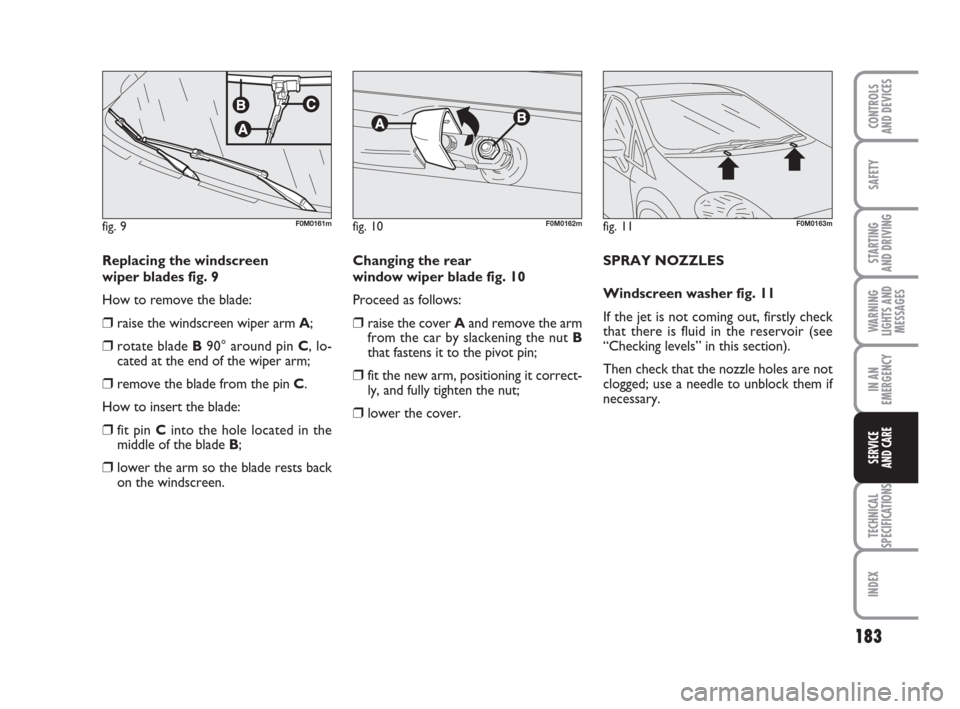
Replacing the windscreen
wiper blades fig. 9
How to remove the blade:
❒raise the windscreen wiper arm A;
❒rotate blade B90° around pin C, lo-
cated at the end of the wiper arm;
❒remove the blade from the pin C.
How to insert the blade:
❒fit pin Cinto the hole located in the
middle of the blade B;
❒lower the arm so the blade rests back
on the windscreen.
fig. 9F0M0161m
Changing the rear
window wiper blade fig. 10
Proceed as follows:
❒raise the cover Aand remove the arm
from the car by slackening the nut B
that fastens it to the pivot pin;
❒fit the new arm, positioning it correct-
ly, and fully tighten the nut;
❒lower the cover.
fig. 10F0M0162m
SPRAY NOZZLES
Windscreen washer fig. 11
If the jet is not coming out, firstly check
that there is fluid in the reservoir (see
“Checking levels” in this section).
Then check that the nozzle holes are not
clogged; use a needle to unblock them if
necessary.
fig. 11F0M0163m
167-186 ACTUAL 1ed EN 27-07-2010 10:30 Pagina 183
Page 186 of 216
185
SAFETY
STARTING
AND DRIVING
WARNING
LIGHTS AND
MESSAGES
IN AN
EMERGENCY
TECHNICAL
SPECIFICATIONS
INDEX
CONTROLS
AND DEVICES
SERVICE
AND CARE
Standard upkeep of the paintwork consists
of washing the vehicle: the frequency de-
pends on the conditions and environment
where the vehicle is used. For example, it
is advisable to wash the car more often in
areas with high atmospheric pollution or
on gritted roads.
To wash the car properly, proceed as fol-
lows:
❒if taking your car through an automat-
ic car wash, remove the aerial from the
roof;
❒wash the body using a low-pressure jet
of water;
❒use a sponge to wipe a slightly soapy so-
lution over the bodywork, frequently
rinsing the sponge;
❒rinse with plenty of water and dry with
a jet of air or a chamois leather.
Take particular care when drying the less
visible parts, such as the door, bonnet and
headlight frames, where water can stagnate
more easily. It is a good idea to leave the
car in the open for a while after washing
it to give time for the water to evaporate.Do not wash the car after it has been left
in the sun or with the bonnet hot: this may
alter the shine of the paintwork.
Exterior plastic parts must be cleaned in
the same way as the rest of the car.
Where possible, do not park under trees;
the resinous substances that fall off many
species give the paint a dull appearance
and increase the possibility of triggering
rust processes.
IMPORTANT Bird droppings should be
washed off immediately and thoroughly
as the acid they contain is particularly
aggressive.Detergents pollute water. The
vehicle should be washed only
in areas equipped for collect-
ing and purifying the liquids
used in the washing process.
Windows
Use specific detergents to clean the win-
dows.
Also use clean cloths to avoid scratching
the glass or altering the transparency.
IMPORTANT Wipe the rear window
gently with a cloth in the direction of the
filaments to avoid damaging the heating
device.
Engine compartment
Wash the engine compartment thor-
oughly at the end of every winter. Be care-
ful not to direct the jet of water onto elec-
tronic control units. Adequately protect
the upper air vents to prevent damage to
the windscreen wiper motor. Have this
operation performed at a specialised
workshop.
IMPORTANT Washing should take place
with a cold engine and with the key at
STOP. After the wash, make sure that
the various protective devices (e.g. rubber
caps and guards) have not been removed
or damaged.
Front headlights
IMPORTANT Never use aromatic sub-
stances (e.g. petrol) or ketenes (e.g. ace-
tone) for cleaning the plastic lenses of the
front headlights.
167-186 ACTUAL 1ed EN 27-07-2010 10:30 Pagina 185