steering wheel FIAT IDEA 2012 1.G Owners Manual
[x] Cancel search | Manufacturer: FIAT, Model Year: 2012, Model line: IDEA, Model: FIAT IDEA 2012 1.GPages: 210, PDF Size: 3.65 MB
Page 5 of 210
4
SAFETY
DEVICES
CORRECT USE
OF THE CAR
WARNING
LIGHTS AND
MESSAGES
IN AN
EMERGENCY
CAR
MAINTENANCE
TECHNICAL
SPECIFICATIONS
INDEX
DASHBOARD
AND CONTROLSDASHBOARD........................................................................ 5
INSTRUMENT PANEL ....................................................... 7
SYMBOLS ............................................................................... 9
THE FIAT CODE SYSTEM ................................................. 9
KEY KIT AND DOOR LOCKING .................................. 10
IGNITION SWITCH ............................................................ 18
INSTRUMENTS ..................................................................... 19
MULTIFUNCTION DISPLAY ........................................... 20
RECONFIGURABLE MULTIFUNCTION DISPLAY ... 23
ADJUSTMENT OF THE WHEEL ...................................... 36
ADJUSTMENT OF THE SEATS ......................................... 36
HEAD RESTRAINTS ............................................................ 41
REARVIEW MIRRORS ......................................................... 42
HEATING/CLIMATE
CONTROL SYSTEM ........................................................... 44
HEATING AND VENTILATION ...................................... 45
MANUAL CLIMATE CONTROL SYSTEM ................... 48
AUTOMATIC TWO-ZONE CLIMATE
CONTROL SYSTEM ........................................................... 51
EXTERNAL LIGHTS............................................................. 58
WINDOW WASHING ....................................................... 60
CRUISE CONTROL ............................................................ 63CEILING LIGHTS ................................................................. 64
LIGHT CONTROL BUTTONS ......................................... 66
INERTIAL FUEL CUT- OFF SWITCH ............................. 67
INTERIOR FITTINGS ......................................................... 68
SMOKERS’ KIT ...................................................................... 71
SUNROOF.............................................................................. 72
POWER WINDOWS ......................................................... 74
REAR WINDOW WINDERS ............................................ 75
BOOT ...................................................................................... 76
BONNET ................................................................................ 80
ROOF RACK/SKI RACK .................................................... 81
HEADLIGHTS ........................................................................ 82
ABS SYSTEM ......................................................................... 83
EOBD SYSTEM ..................................................................... 84
SOUND SYSTEM .................................................................. 85
ACCESSORIES PURCHASED BY THE OWNER ......... 86
“DUALDRIVE” ELECTRIC POWER
STEERING SYSTEM ............................................................. 87
PARKING SENSORS ........................................................... 88
AT THE FILLING STATION ............................................. 90
PROTECTING THE ENVIRONMENT ............................ 92
DD D
A A
S S
H H
B B
O O
A A
R R
D D
A A
N N
D D
C C
O O
N N
T T
R R
O O
L L
S S
001-035 idea GB 1 ed 10-07-2008 8:27 Pagina 4
Page 19 of 210
18
SAFETY
DEVICES
CORRECT USE
OF THE CAR
WARNING
LIGHTS AND
MESSAGES
IN AN
EMERGENCY
CAR
MAINTENANCE
TECHNICAL
SPECIFICATIONS
INDEX
DASHBOARD
AND CONTROLS
IGNITION SWITCH
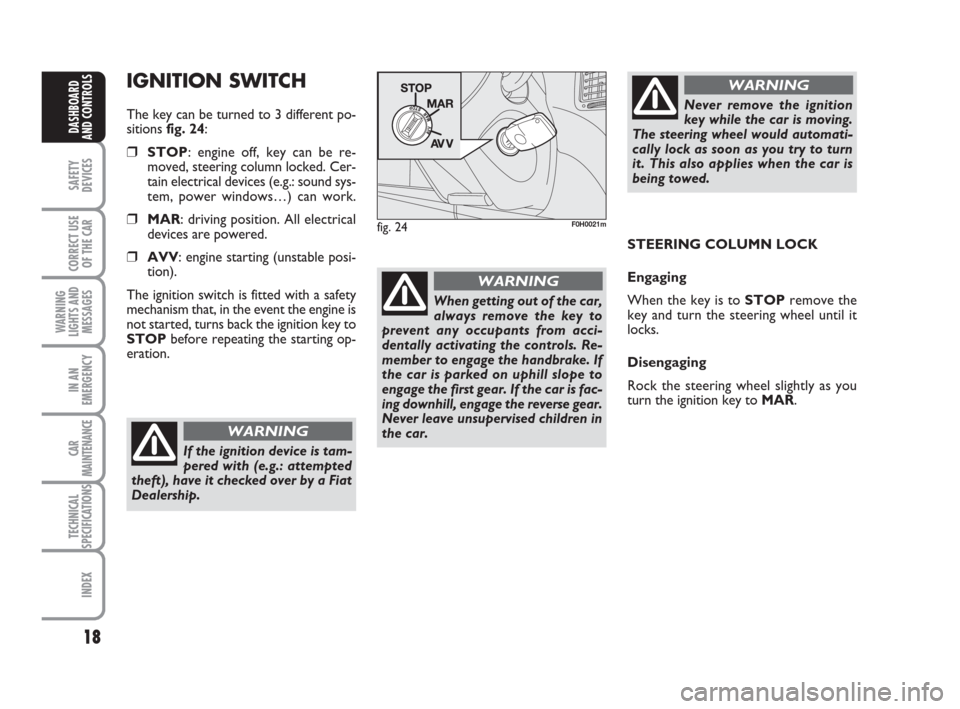
The key can be turned to 3 different po-
sitions fig. 24:
❒STOP: engine off, key can be re-
moved, steering column locked. Cer-
tain electrical devices (e.g.: sound sys-
tem, power windows…) can work.
❒MAR: driving position. All electrical
devices are powered.
❒AVV: engine starting (unstable posi-
tion).
The ignition switch is fitted with a safety
mechanism that, in the event the engine is
not started, turns back the ignition key to
STOPbefore repeating the starting op-
eration.
fig. 24F0H0021m
STEERING COLUMN LOCK
Engaging
When the key is to STOPremove the
key and turn the steering wheel until it
locks.
Disengaging
Rock the steering wheel slightly as you
turn the ignition key to MAR.
If the ignition device is tam-
pered with (e.g.: attempted
theft), have it checked over by a Fiat
Dealership.
WARNING
Never remove the ignition
key while the car is moving.
The steering wheel would automati-
cally lock as soon as you try to turn
it. This also applies when the car is
being towed.
WARNING
When getting out of the car,
always remove the key to
prevent any occupants from acci-
dentally activating the controls. Re-
member to engage the handbrake. If
the car is parked on uphill slope to
engage the first gear. If the car is fac-
ing downhill, engage the reverse gear.
Never leave unsupervised children in
the car.
WARNING
001-035 idea GB 1 ed 10-07-2008 8:27 Pagina 18
Page 37 of 210
36
SAFETY
DEVICES
CORRECT USE
OF THE CAR
WARNING
LIGHTS AND
MESSAGES
IN AN
EMERGENCY
CAR
MAINTENANCE
TECHNICAL
SPECIFICATIONS
INDEX
DASHBOARD
AND CONTROLS
fig. 35F0H0737m
STEERING WHEEL
ADJUSTMENT
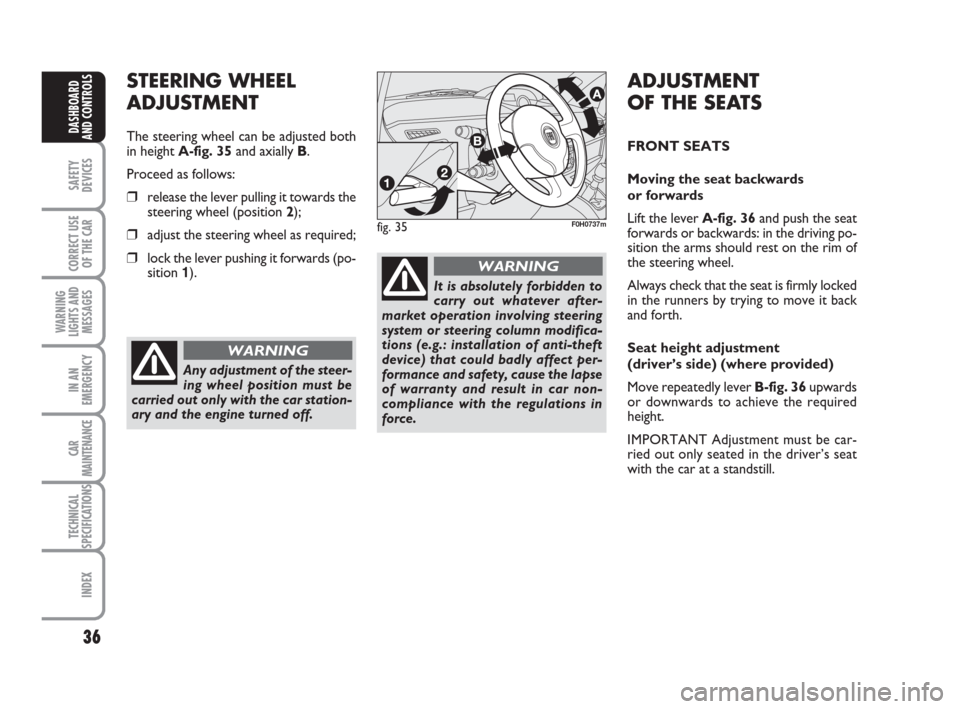
The steering wheel can be adjusted both
in height A-fig. 35and axially B.
Proceed as follows:
❒release the lever pulling it towards the
steering wheel (position 2);
❒adjust the steering wheel as required;
❒lock the lever pushing it forwards (po-
sition 1).
Any adjustment of the steer-
ing wheel position must be
carried out only with the car station-
ary and the engine turned off.
WARNING
It is absolutely forbidden to
carry out whatever after-
market operation involving steering
system or steering column modifica-
tions (e.g.: installation of anti-theft
device) that could badly affect per-
formance and safety, cause the lapse
of warranty and result in car non-
compliance with the regulations in
force.
WARNING
ADJUSTMENT
OF THE SEATS
FRONT SEATS
Moving the seat backwards
or forwards
Lift the lever A-fig. 36and push the seat
forwards or backwards: in the driving po-
sition the arms should rest on the rim of
the steering wheel.
Always check that the seat is firmly locked
in the runners by trying to move it back
and forth.
Seat height adjustment
(driver’s side) (where provided)
Move repeatedly lever B-fig. 36upwards
or downwards to achieve the required
height.
IMPORTANT Adjustment must be car-
ried out only seated in the driver’s seat
with the car at a standstill.
036-092 idea GB 1 ed 10-07-2008 16:12 Pagina 36
Page 59 of 210
58
SAFETY
DEVICES
CORRECT USE
OF THE CAR
WARNING
LIGHTS AND
MESSAGES
IN AN
EMERGENCY
CAR
MAINTENANCE
TECHNICAL
SPECIFICATIONS
INDEX
DASHBOARD
AND CONTROLS
EXTERNAL LIGHTS
The left-hand lever includes the controls
for the external lights.
The external lights can only be switched
on when the ignition key is at MAR.
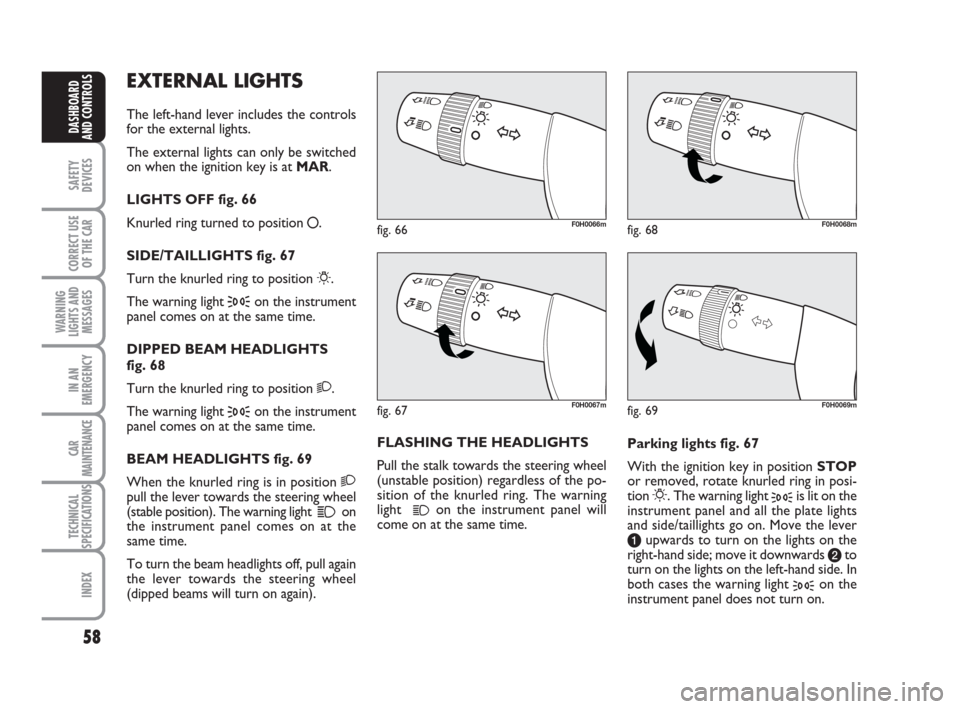
LIGHTS OFF fig. 66
Knurled ring turned to position
å.
SIDE/TAILLIGHTS fig. 67
Turn the knurled ring to position
6.
The warning light
3on the instrument
panel comes on at the same time.
DIPPED BEAM HEADLIGHTS
fig. 68
Turn the knurled ring to position 2.
The warning light
3on the instrument
panel comes on at the same time.
BEAM HEADLIGHTS fig. 69
When the knurled ring is in position 2
pull the lever towards the steering wheel
(stable position). The warning light
1on
the instrument panel comes on at the
same time.
To turn the beam headlights off, pull again
the lever towards the steering wheel
(dipped beams will turn on again).FLASHING THE HEADLIGHTS
Pull the stalk towards the steering wheel
(unstable position) regardless of the po-
sition of the knurled ring. The warning
light
1on the instrument panel will
come on at the same time.Parking lights fig. 67
With the ignition key in position STOP
or removed, rotate knurled ring in posi-
tion 6. The warning light 3is lit on the
instrument panel and all the plate lights
and side/taillights go on. Move the lever
aupwards to turn on the lights on the
right-hand side; move it downwards bto
turn on the lights on the left-hand side. In
both cases the warning light
3on the
instrument panel does not turn on.
fig. 66F0H0066m
fig. 69F0H0069m
fig. 68F0H0068m
fig. 67F0H0067m
036-092 idea GB 1 ed 10-07-2008 16:12 Pagina 58
Page 60 of 210
59
SAFETY
DEVICES
CORRECT USE
OF THE CAR
WARNING
LIGHTS AND
MESSAGES
IN AN
EMERGENCY
CAR
MAINTENANCE
TECHNICAL
SPECIFICATIONS
INDEX
DASHBOARD
AND CONTROLS
fig. 70F0H0071mfig. 71F0H0070mfig. 72F0H0072m
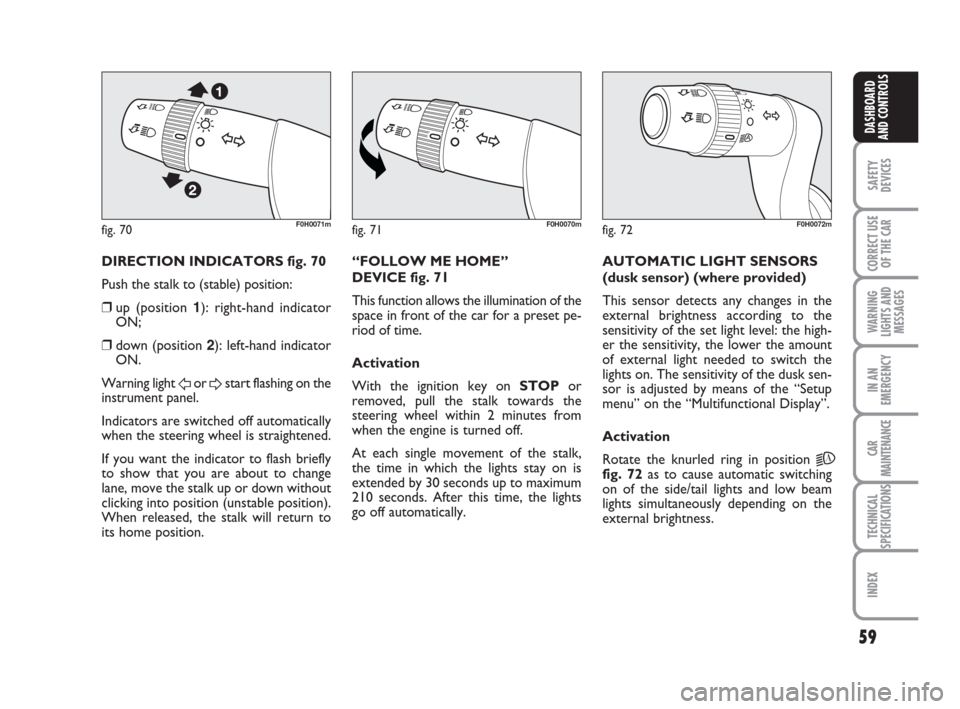
DIRECTION INDICATORS fig. 70
Push the stalk to (stable) position:
❒up (position 1): right-hand indicator
ON;
❒down (position 2): left-hand indicator
ON.
Warning light
For Dstart flashing on the
instrument panel.
Indicators are switched off automatically
when the steering wheel is straightened.
If you want the indicator to flash briefly
to show that you are about to change
lane, move the stalk up or down without
clicking into position (unstable position).
When released, the stalk will return to
its home position.“FOLLOW ME HOME”
DEVICE fig. 71
This function allows the illumination of the
space in front of the car for a preset pe-
riod of time.
Activation
With the ignition key on STOPor
removed, pull the stalk towards the
steering wheel within 2 minutes from
when the engine is turned off.
At each single movement of the stalk,
the time in which the lights stay on is
extended by 30 seconds up to maximum
210 seconds. After this time, the lights
go off automatically. AUTOMATIC LIGHT SENSORS
(dusk sensor) (where provided)
This sensor detects any changes in the
external brightness according to the
sensitivity of the set light level: the high-
er the sensitivity, the lower the amount
of external light needed to switch the
lights on. The sensitivity of the dusk sen-
sor is adjusted by means of the “Setup
menu” on the “Multifunctional Display”.
Activation
Rotate the knurled ring in position
2A
fig. 72as to cause automatic switching
on of the side/tail lights and low beam
lights simultaneously depending on the
external brightness.
036-092 idea GB 1 ed 10-07-2008 16:12 Pagina 59
Page 62 of 210
61
SAFETY
DEVICES
CORRECT USE
OF THE CAR
WARNING
LIGHTS AND
MESSAGES
IN AN
EMERGENCY
CAR
MAINTENANCE
TECHNICAL
SPECIFICATIONS
INDEX
DASHBOARD
AND CONTROLS
Operation in position Eis limited to the
time during which the lever is kept in that
position manually. When released, the
stalk will return to position Aand the
wiper will be automatically stopped.
IMPORTANT Replace wiper blades as
specified in section “Car maintenance”.RAIN SENSOR
(where provided)
The rain sensor is located behind the dri-
ving mirror in contact with the windscreen
and has the purpose of automatically ad-
just the frequency of the windscreen
wiper strokes as to the rain intensity.
IMPORTANT Keep the window clean in
the sensor area.
Activation
Move the right lever down by one click.
The activation of the rain sensor is sig-
nalled by a control acquisition “stroke”.
Turn the knurled ring F-fig. 76to increase
the rain sensor sensitivity.
The increase of the sensitivity of the rain
sensor is signalled by a control and acqui-
sition “stroke”.
By operating the windscreen washer with
the rain sensor enabled, a smart washing
cycle is carried out, without the addition-
al stroke after 5 seconds; once complet-
ed, the sensor resumes its regular auto-
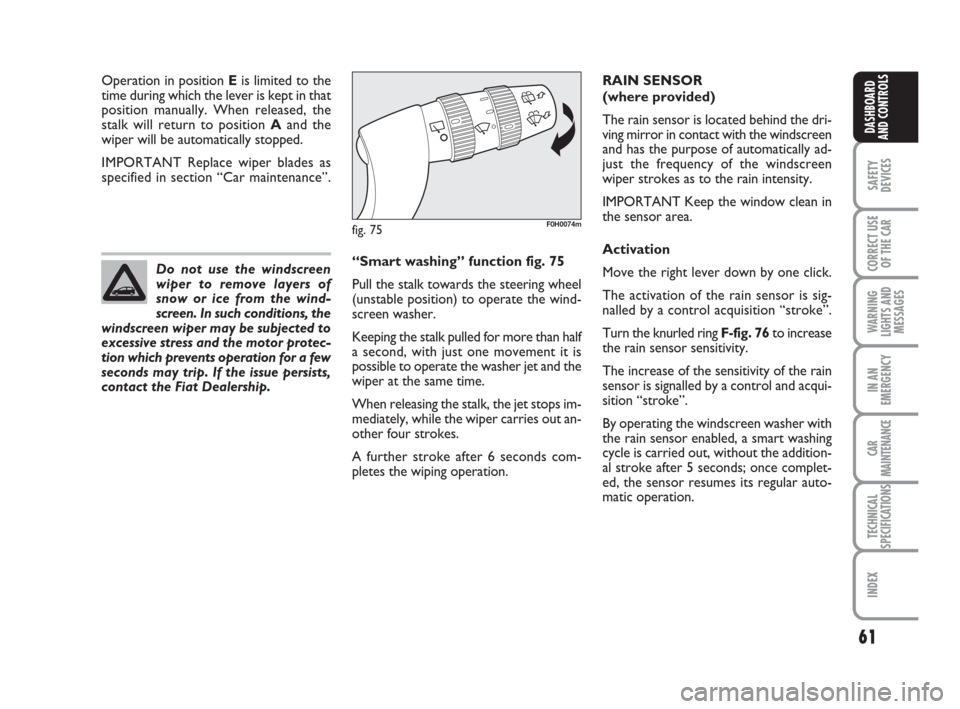
matic operation. “Smart washing” function fig. 75
Pull the stalk towards the steering wheel
(unstable position) to operate the wind-
screen washer.
Keeping the stalk pulled for more than half
a second, with just one movement it is
possible to operate the washer jet and the
wiper at the same time.
When releasing the stalk, the jet stops im-
mediately, while the wiper carries out an-
other four strokes.
A further stroke after 6 seconds com-
pletes the wiping operation. Do not use the windscreen
wiper to remove layers of
snow or ice from the wind-
screen. In such conditions, the
windscreen wiper may be subjected to
excessive stress and the motor protec-
tion which prevents operation for a few
seconds may trip. If the issue persists,
contact the Fiat Dealership.
fig. 75F0H0074m
036-092 idea GB 1 ed 10-07-2008 16:12 Pagina 61
Page 69 of 210
68
SAFETY
DEVICES
CORRECT USE
OF THE CAR
WARNING
LIGHTS AND
MESSAGES
IN AN
EMERGENCY
CAR
MAINTENANCE
TECHNICAL
SPECIFICATIONS
INDEX
DASHBOARD
AND CONTROLS
INTERIOR EQUIPMENT
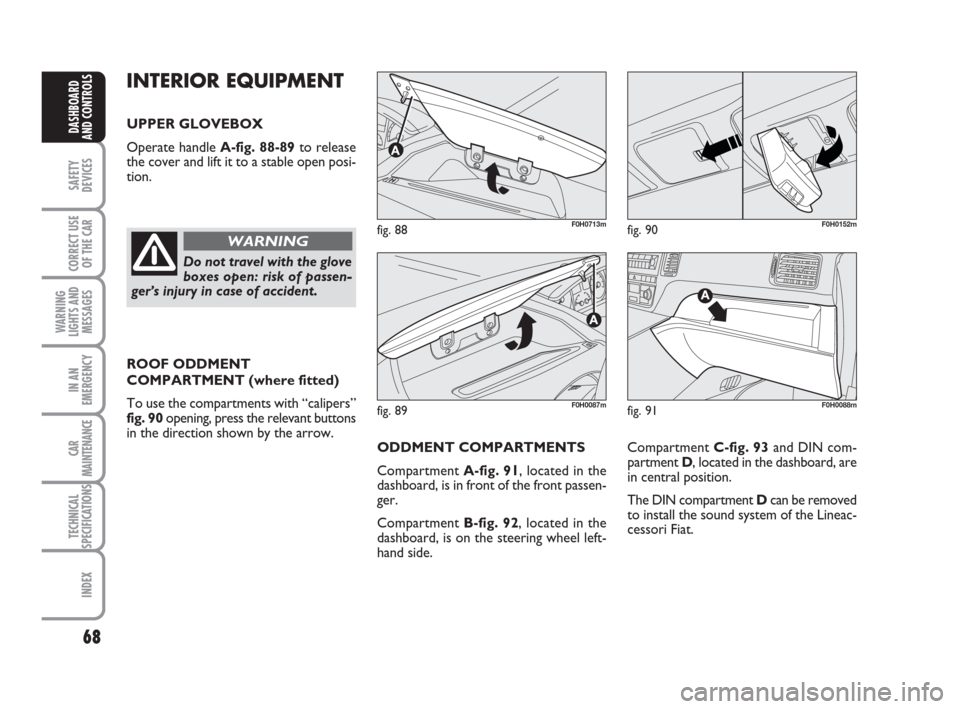
UPPER GLOVEBOX
Operate handle A-fig. 88-89to release
the cover and lift it to a stable open posi-
tion.
ROOF ODDMENT
COMPARTMENT (where fitted)
To use the compartments with “calipers”
fig. 90 opening, press the relevant buttons
in the direction shown by the arrow.
fig. 88F0H0713m
fig. 89F0H0087m
fig. 90F0H0152m
Do not travel with the glove
boxes open: risk of passen-
ger’s injury in case of accident.
WARNING
Compartment C-fig. 93and DIN com-
partment D, located in the dashboard, are
in central position.
The DIN compartment Dcan be removed
to install the sound system of the Lineac-
cessori Fiat.
fig. 91F0H0088m
ODDMENT COMPARTMENTS
Compartment A-fig. 91, located in the
dashboard, is in front of the front passen-
ger.
Compartment B-fig. 92, located in the
dashboard, is on the steering wheel left-
hand side.
036-092 idea GB 1 ed 10-07-2008 16:12 Pagina 68
Page 88 of 210
87
SAFETY
DEVICES
CORRECT USE
OF THE CAR
WARNING
LIGHTS AND
MESSAGES
IN AN
EMERGENCY
CAR
MAINTENANCE
TECHNICAL
SPECIFICATIONS
INDEX
DASHBOARD
AND CONTROLS
“DUALDRIVE” ELECTRIC
POWER STEERING
SYSTEM
The car is fitted with an electrically con-
trolled power steering called “Dualdrive”.
It only works when the ignition key is at
MARand the engine is running and it can
be customised by the driver according to
the driving conditions.
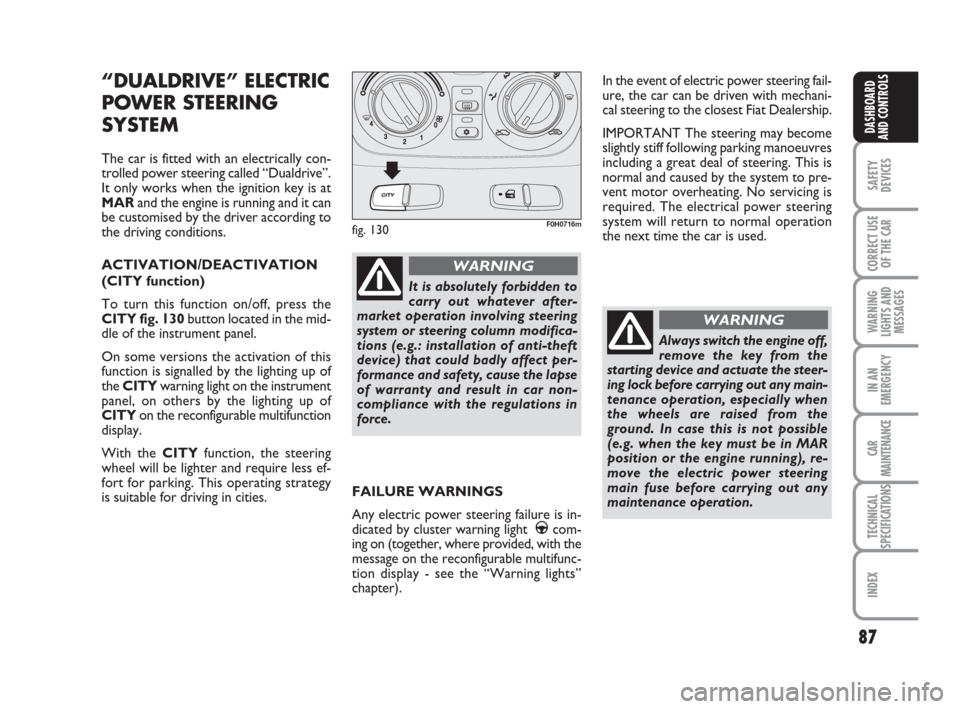
ACTIVATION/DEACTIVATION
(CITY function)
To turn this function on/off, press the
CITY fig. 130button located in the mid-
dle of the instrument panel.
On some versions the activation of this
function is signalled by the lighting up of
the CITYwarning light on the instrument
panel, on others by the lighting up of
CITYon the reconfigurable multifunction
display.
With the CITYfunction, the steering
wheel will be lighter and require less ef-
fort for parking. This operating strategy
is suitable for driving in cities.
fig. 130F0H0716m
It is absolutely forbidden to
carry out whatever after-
market operation involving steering
system or steering column modifica-
tions (e.g.: installation of anti-theft
device) that could badly affect per-
formance and safety, cause the lapse
of warranty and result in car non-
compliance with the regulations in
force.
WARNING
In the event of electric power steering fail-
ure, the car can be driven with mechani-
cal steering to the closest Fiat Dealership.
IMPORTANT The steering may become
slightly stiff following parking manoeuvres
including a great deal of steering. This is
normal and caused by the system to pre-
vent motor overheating. No servicing is
required. The electrical power steering
system will return to normal operation
the next time the car is used.
Always switch the engine off,
remove the key from the
starting device and actuate the steer-
ing lock before carrying out any main-
tenance operation, especially when
the wheels are raised from the
ground. In case this is not possible
(e.g. when the key must be in MAR
position or the engine running), re-
move the electric power steering
main fuse before carrying out any
maintenance operation.
WARNING
FAILURE WARNINGS
Any electric power steering failure is in-
dicated by cluster warning light
gcom-
ing on (together, where provided, with the
message on the reconfigurable multifunc-
tion display - see the “Warning lights”
chapter).
036-092 idea GB 1 ed 10-07-2008 16:12 Pagina 87
Page 107 of 210
106
CORRECT USE
OF THE CAR
WARNING
LIGHTS AND
MESSAGES
IN AN
EMERGENCY
CAR
MAINTENANCE
TECHNICAL
SPECIFICATIONS
INDEX
DASHBOARD
AND CONTROL
SAFETY
DEVICES
FRONT AND SIDE AIR
BAGS
The car is fitted with front air bags for the
driver and for the passenger, and window
bags (head protection system); upon re-
quest the car can be fitted also with front
side bags;
The front air bag (driver and passenger)
has been designed to protect the occu-
pants in the event of head-on crashes of
medium-high severity, by placing the cush-
ion between the occupant and the steer-
ing wheel or dashboard.
Front air bags are designed to protect
car’s occupants in front crashes and there-
fore non-activation in other types of col-
lisions (side collisions, rear shunts, roll-
overs, etc.) is not a system malfunction.
In case of crash, an electronic control unit,
when required, triggers the inflation of the
cushion.
The cushion immediately inflates, placing
itself as a protection between the body
of the front occupants and the structure
that could cause injuries. Immediately af-
ter, the cushion deflates.
The front air bag (driver and passenger) is
not a replacement of but complementary
to the use of belts, which should always
be worn, as specified by law in Europe and
most non European countries.In case of crash, a person not wearing the
seat belt moves forward and may come in-
to contact with the cushion while it is still
inflating. Under this circumstance the pro-
tection offered by the air bag is reduced.
Front air bag may not be activated in the
following situations:
❒in collisions against highly deformable
objects not affecting the vehicle front
surface (e.g. bumper collision against
guard rail, etc.);
❒in case of wedging under other vehi-
cles or protective barriers (for exam-
ple under a truck or guard rail), the air
bag is not triggered as it offers no ad-
ditional protection compared with the
seat belts, consequently it would be
pointless. Therefore, failure to come
into action in the above circumstance
does not mean that the system is not
working properly.
The driver’s and passenger’s front Air bags
have been designed and calibrated to im-
prove the protection of a person wear-
ing seat belts.
At its maximum inflation, its volume fills
most of the space between the dashboard
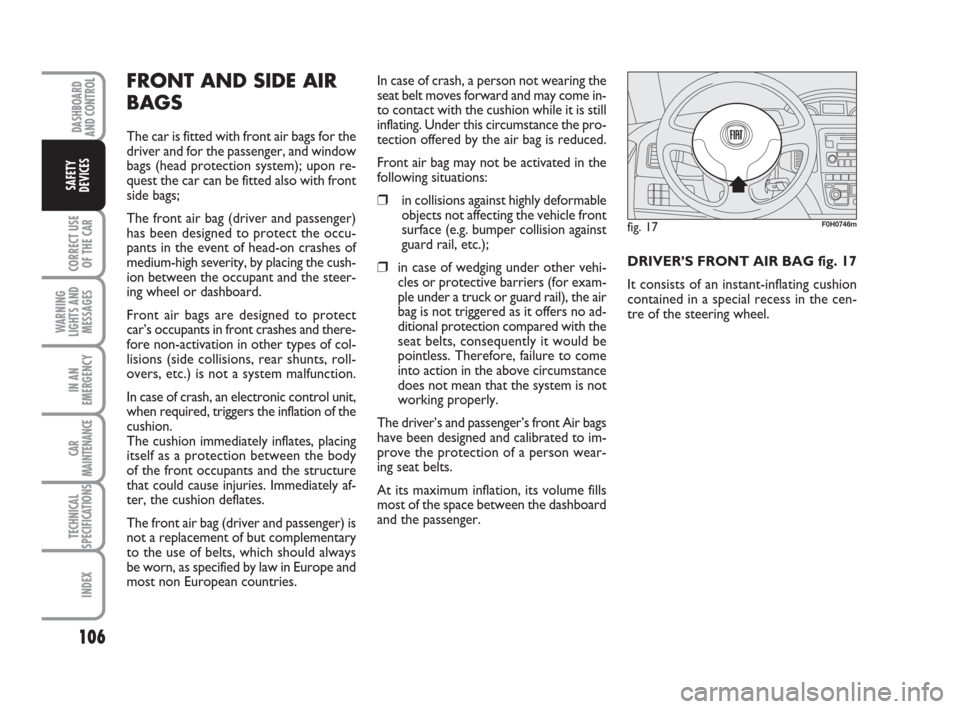
and the passenger.DRIVER’S FRONT AIR BAG fig. 17
It consists of an instant-inflating cushion
contained in a special recess in the cen-
tre of the steering wheel.
fig. 17F0H0746m
093-110 idea GB 1 ed 10-07-2008 8:28 Pagina 106
Page 108 of 210
107
CORRECT USE
OF THE CAR
WARNING
LIGHTS AND
MESSAGES
IN AN
EMERGENCY
CAR
MAINTENANCE
TECHNICAL
SPECIFICATIONS
INDEX
DASHBOARD
AND CONTROLS
SAFETY
DEVICES
fig. 18F0H0145m
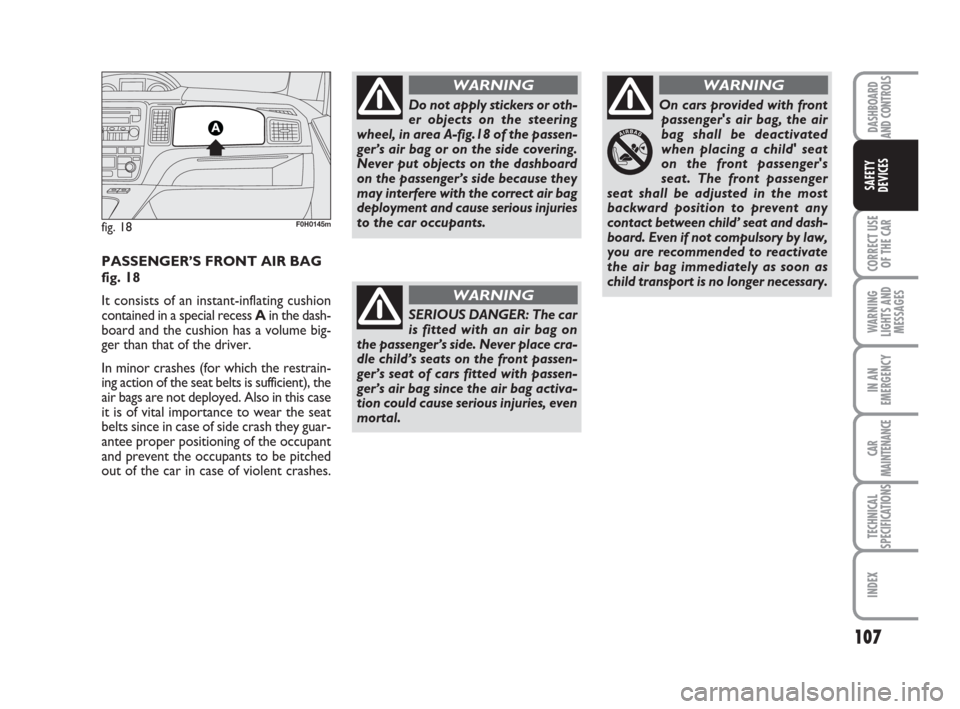
PASSENGER’S FRONT AIR BAG
fig. 18
It consists of an instant-inflating cushion
contained in a special recess Ain the dash-
board and the cushion has a volume big-
ger than that of the driver.
In minor crashes (for which the restrain-
ing action of the seat belts is sufficient), the
air bags are not deployed. Also in this case
it is of vital importance to wear the seat
belts since in case of side crash they guar-
antee proper positioning of the occupant
and prevent the occupants to be pitched
out of the car in case of violent crashes.
Do not apply stickers or oth-
er objects on the steering
wheel, in area A-fig.18 of the passen-
ger’s air bag or on the side covering.
Never put objects on the dashboard
on the passenger’s side because they
may interfere with the correct air bag
deployment and cause serious injuries
to the car occupants.
WARNING
SERIOUS DANGER: The car
is fitted with an air bag on
the passenger’s side. Never place cra-
dle child’s seats on the front passen-
ger’s seat of cars fitted with passen-
ger’s air bag since the air bag activa-
tion could cause serious injuries, even
mortal.
WARNING
On cars provided with front
passenger's air bag, the air
bag shall be deactivated
when placing a child' seat
on the front passenger's
seat. The front passenger
seat shall be adjusted in the most
backward position to prevent any
contact between child’ seat and dash-
board. Even if not compulsory by law,
you are recommended to reactivate
the air bag immediately as soon as
child transport is no longer necessary.
WARNING
093-110 idea GB 1 ed 10-07-2008 8:28 Pagina 107