Pressure FIAT PANDA 2017 319 / 3.G User Guide
[x] Cancel search | Manufacturer: FIAT, Model Year: 2017, Model line: PANDA, Model: FIAT PANDA 2017 319 / 3.GPages: 216, PDF Size: 19.25 MB
Page 68 of 216
Versions equipped with manual
gearbox: at the end of the automatic
braking the engine may stall and turn
off, unless the driver presses the clutch
pedal.
Versions equipped with "Dualogic"
gearbox(for versions/markets, where
provided): at the end of braking the last
gear stored remains engaged.
IMPORTANT Both on versions
equipped with manual gearbox and on
those with "Dualogic" gearbox (for
versions/markets, where provided),
after the vehicle is stopped the brake
calipers may be stuck for about 2
seconds for safety reasons. Make sure
you press the brake pedal if the vehicle
moves slightly forwards.
IMPORTANT The system doesNOT
activate when reverse is engaged. The
system doesNOTactivate if the front
seat belts are not fastened.
Engagement/disengagement
The system can be deactivated (then
reactivated) through the Setup Menu on
the display.Driving in special conditions
In certain driving conditions, such as,
for example:
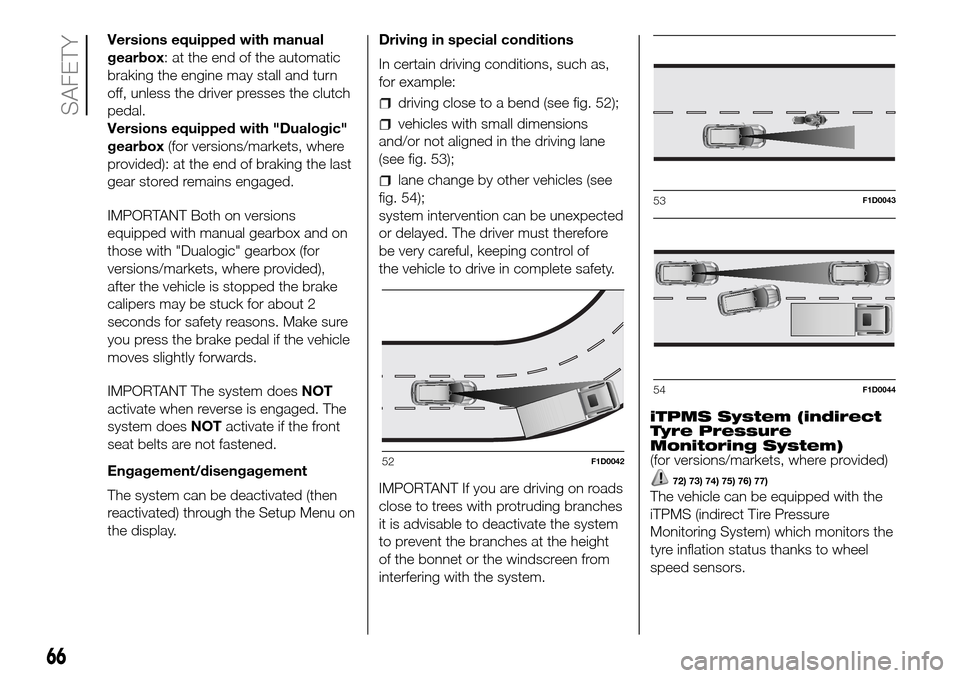
driving close to a bend (see fig. 52);
vehicles with small dimensions
and/or not aligned in the driving lane
(see fig. 53);
lane change by other vehicles (see
fig. 54);
system intervention can be unexpected
or delayed. The driver must therefore
be very careful, keeping control of
the vehicle to drive in complete safety.
IMPORTANT If you are driving on roads
close to trees with protruding branches
it is advisable to deactivate the system
to prevent the branches at the height
of the bonnet or the windscreen from
interfering with the system.iTPMS System (indirect
Tyre Pressure
Monitoring System)
(for versions/markets, where provided)
72) 73) 74) 75) 76) 77)
The vehicle can be equipped with the
iTPMS (indirect Tire Pressure
Monitoring System) which monitors the
tyre inflation status thanks to wheel
speed sensors.
52F1D0042
53F1D0043
54F1D0044
66
SAFETY
Page 69 of 216
The system warns the driver if one or
more tyres are flat by the
warning
light continuously lit on the instrument
panel and a dedicated warning
message on the display.
If one tyre only is flat, the system can
indicate its position: it is in any case
recommended to check the pressure
on all four tyres.
This indication is displayed also when
turning the engine off and on again until
the RESET procedure is carried out.
Reset procedure
The iTPMS needs an initial "self-
learning" phase (with length depending
on the driving style and road conditions:
optimal conditions being driving on a
straight road at 80 km/h for at least 20
minutes) which starts when the Reset
procedure is carried out.
The Reset procedure must be carried
out:
each time tyre pressure is modified;
when even only one tyre is changed;
when tyres are rotated/inverted;
when the space-saver wheel is
fitted.Before carrying out the Reset
procedure, inflate the tyres to the rated
pressure values specified in the inflation
pressure table (see "Wheels" paragraph
in the "Technical specifications"
chapter).
If the Reset procedure is not carried
out, in all above cases, the
warning
light may give false indications on
one or more tyres.
To carry out the RESET procedure, with
the vehicle stopped and the ignition
device at MAR, use the Main Menu as
follows:
briefly press thebutton: the
display will show Reset;
press thebutton or the
button to select ("Yes" or "No");
briefly press thebutton: the
display will show "Confirm";
pressbutton orto select
("Yes" to Reset or "No" to exit the video
page);
press thebutton again to return
to the standard screen or to the main
menu according to where you are in the
menu.
At the end of the Reset procedure the
display will show the "Reset saved"
message, indicating that the self-
learning has been started.Operating conditions
The system is active for speeds above
15 km/h.
In a few situations such as sporty
driving, particular conditions of the road
surface (e.g. icy, snowy, unsurfaced
roads...) the signalling may be delayed
or partial in detecting the contemporary
deflation of more than one tyre.
Under special conditions (e.g. vehicle
loaded asymmetrically on one side,
towing a trailer, damaged or worn tyre,
fitting the space-saver wheel, use of the
"Fix&Go Airflat" kit, fitting snow chains,
fitting different tyres on the axles) the
system may give false indications or be
temporarily deactivated.
If the system is temporarily deactivated,
the warning light
flashes for about
75 seconds and then is continuously
on; at the same time, the display shows
a dedicated message.
This indication is displayed also after
the engine has been switched off and
then on again if the correct operating
conditions are not restored.
67
Page 70 of 216
WARNING
67)The system is an aid for the driver, who
must always pay full attention while
driving. The responsibility always rests with
the driver, who must take into account
the traffic conditions in order to drive
in complete safety. The driver must always
maintain a safe distance from the vehicle
in front.
68)If the driver depresses the brake pedal
fully or carries out a fast steering during
system operation, the automatic braking
function may stop (e.g. to allow a possible
manoeuvre to avoid the obstacle).
69)The laser beam is not visible at the
naked eye. Do not look directly, or with
optical instruments (e.g. lenses), at the
laser beam from a distance lower than 10
cm: this may cause damage to the sight.
The laser beam is also present when
the key is at MAR but its operation is off,
not available or manually deactivated
with the display Setup Menu.
70)The system intervenes on vehicles
travelling in the same lane. Small sized
vehicles (e.g. bicycles or motorbikes)
or people, animals and things (e.g.
pushchairs) and more in general all those
obstacles with a low reflection of the light
emitted by the laser (e.g. vehicles soiled
with mud) are not taken into consideration.71)If the car must be placed on a roller
bench (at a speed within 5 and 30 km/h)
for maintenance interventions or if it is
washed in an automatic roller washing
tunnel with an obstacle in the front part
(e.g. another car, a wall or another
obstacle), the system may detect its
presence and activate. In this case the
system must be deactivated through the
display Setup Menu.
72)If the system signals a pressure
decrease on a specific tyre, it is
recommended to check the pressure on all
four tyres.
73)The iTPMS does not relieve the driver
from the obligation to check the tyre
pressure every month; it is not to
be considered a system to replace
maintenance or a safety system.
74)Tyre pressure must be checked with
tyres cold. Should it become necessary for
whatever reason to check pressure with
warm tyres, do not reduce pressure even
though it is higher than the prescribed
value, but repeat the check when tyres are
cold.
75)The iTPMS cannot indicate sudden
tyre pressure drops (for example when
a tyre bursts). In this case, stop the vehicle,
braking with caution and avoiding abrupt
steering.
76)The system only warns that the tyre
pressure is low: it is not able to inflate
them.
77)Insufficient tyre inflation increases fuel
consumption, reduces the tread duration
and may affect the capacity to drive safely.
WARNING
30)The laser sensor may have limited or
absent operation due to weather
conditions such as: heavy rain, hail, thick
fog, heavy snow, formation of ice layers on
the windscreen.
31)Sensor operation may also be
compromised by the presence of dust,
condensation, dirt or ice on the
windscreen, by traffic conditions (e.g.
vehicles that are driving not aligned with
you car, vehicle driving in a transverse
or opposite way on the same lane, bend
with a small radius of curvature), by road
surface conditions and by driving
conditions (e.g. off-road driving). Make sure
the windscreen is always clean. Use
specific detergents and clean cloths to
avoid scratching the windscreen. The
sensor operation may also be limited or
absent in some driving, traffic and road
surface conditions.
32)Projecting loads on the roof of the car
may interfere with the correct operation
of the sensor. Before starting make sure
the load is correctly positioned, in order not
to cover the sensor operating range.
33)If the windscreen must be replaced
due to scratches, chipping or breakage,
contact exclusively a Fiat Dealership.
Do not replace the windscreen on your
own, risk of malfunction! It is advisable to
replace the windscreen if it is damaged
in the laser sensor area.
68
SAFETY
Page 73 of 216
WARNING
78)Never press button C fig. 55 when
travelling.
79)Remember that in the event of an
accident, the rear seat passengers not
wearing seat belts are exposed to a very
serious risk and also represent a serious
danger for the front seat occupants.
80)The rear central seat belt (for
versions/markets where provided) is
provided with a service buckle. Do not use
the seat belt with the service buckle not
fastened. In this case there is a high risk of
injury or death in the event of an accident.
Before using the belt, always make sure
that the service buckle is correctly
fastened.
81)The rear left and right side belts are
provided with an adjustment device for the
metal tongue position (metal hook). Adjust
the tongue position with respect to the seat
belt to improve comfort and reduce noise
inside the passenger compartment.
82)Make height adjustment of the seat
belts when the car is stationary.
83)After height adjustment, always check
that the cursor to which the ring is fastened
is locked in one of the preset positions. To
do this, with button A fig. 58released,
exert further pressure downwards to allow
the locking device to click if the grip has
not been released in one of the possible
positions.
SBR (Seat Belt
Reminder) SYSTEM
The SBR system warns the passengers
of the front and rear (for versions/
markets, where provided) seats if their
seat belt is not fastened.
The system signals unfastened seat
belts with visual warnings (warning
lights on in the instrument panel and
icons on the display) and an acoustic
signal (see the following paragraphs).
Contact a Fiat Dealership to deactivate
this acoustic warning permanently.
The acoustic warning can be
reactivated at any time through the
display Setup Menu.
Seat belts warning light operation
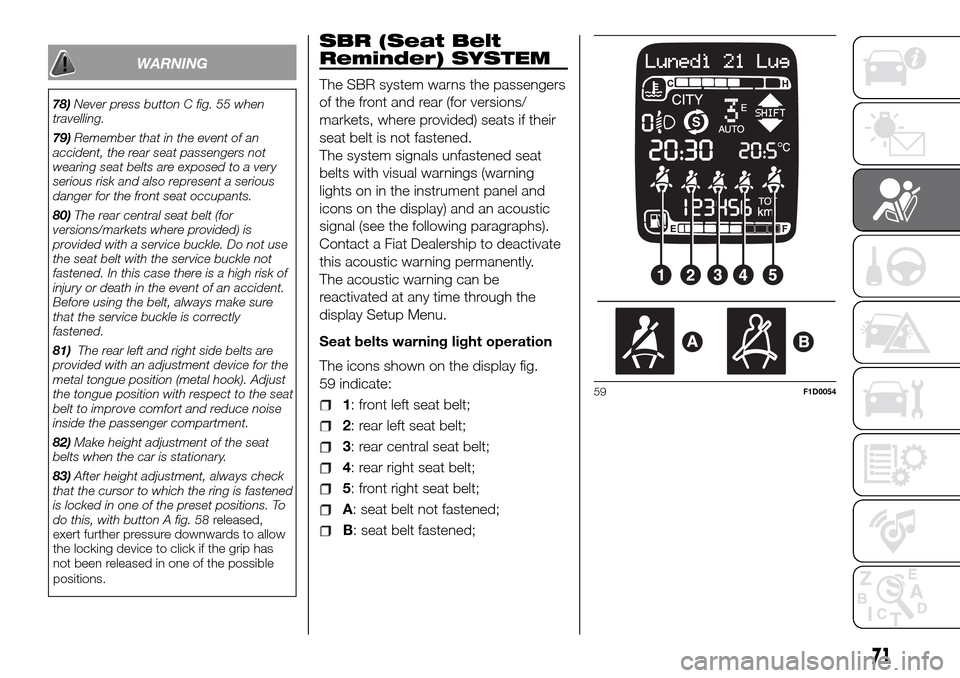
The icons shown on the display fig.
59 indicate:
1: front left seat belt;
2: rear left seat belt;
3: rear central seat belt;
4: rear right seat belt;
5: front right seat belt;
A: seat belt not fastened;
B: seat belt fastened;
59F1D0054
71
Page 103 of 216
WARNING
127)The responsibility for parking and
other dangerous manoeuvres always and
in every case lies with the driver. While
carrying out these manoeuvres, always
make sure that no people (especially
children) or animals are in the area
concerned. The parking sensors are used
to assist the driver, who must never allow
his attention to lapse during potentially
dangerous manoeuvres, even those
executed at low speeds.
WARNING
47)The sensors must be clean of mud,
dirt, snow or ice in order for the system to
operate correctly. Be careful not to scratch
or damage the sensors while cleaning
them. Avoid using dry, rough or hard
cloths. The sensors must be washed using
clean water, with the addition of vehicle
shampoo if necessary. When using special
washing equipment such as high pressure
jets or steam cleaning, clean the sensors
very quickly keeping the jet more than
10 cm away.
REFUELLING THE
VEHICLE
128) 129) 130)
Always stop the engine before
refuelling.
PETROL ENGINES
Only use unleaded petrol, with an
octane number (R.O.N.) not lower than
95. In order to prevent damage to the
catalytic converter never introduce even
the smallest amount of leaded petrol,
even in the event of an emergency.
DIESEL ENGINES
Only use Diesel for motor vehicles
(EN590 specification).
When using or parking the car for a
long time in the mountains or cold
areas, it is advisable to refuel using
locally available diesel. In this case, it is
also advisable to keep the tank over
50% full.
REFUELLING
PROCEDURE
48)
Diesel and petrol versions
The refuelling procedure described
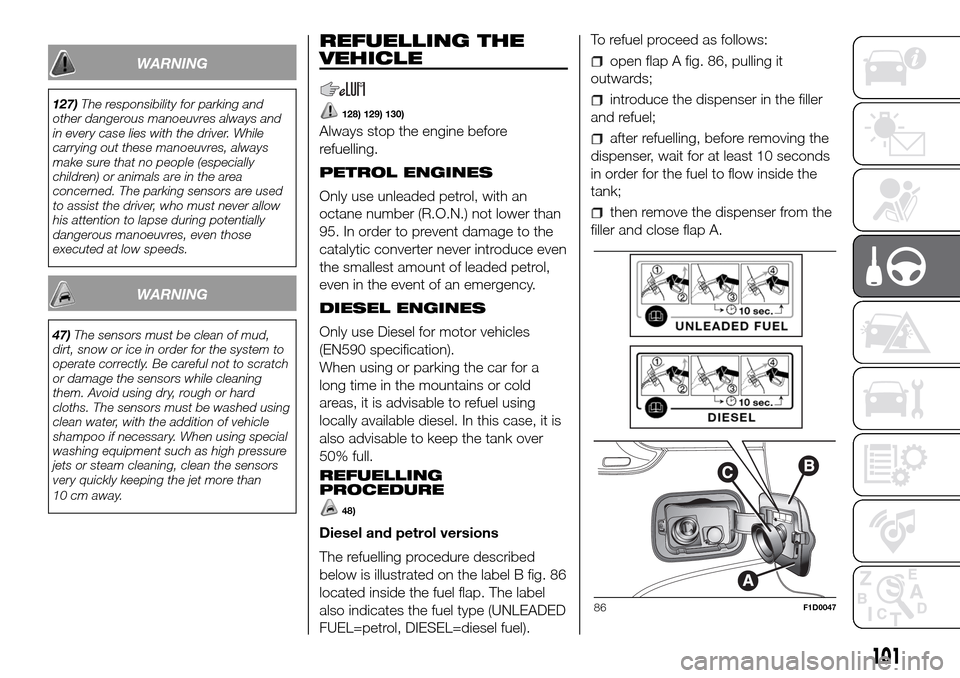
below is illustrated on the label B fig. 86
located inside the fuel flap. The label
also indicates the fuel type (UNLEADED
FUEL=petrol, DIESEL=diesel fuel).To refuel proceed as follows:
open flap A fig. 86, pulling it
outwards;
introduce the dispenser in the filler
and refuel;
after refuelling, before removing the
dispenser, wait for at least 10 seconds
in order for the fuel to flow inside the
tank;
then remove the dispenser from the
filler and close flap A.
86F1D0047
101
Page 105 of 216
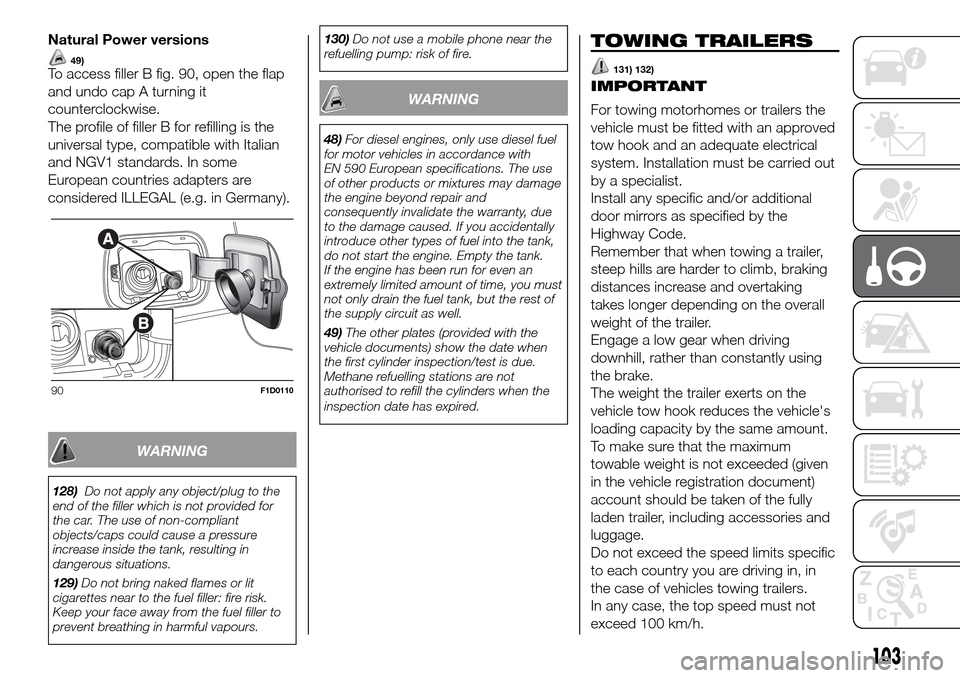
Natural Power versions
49)To access filler B fig. 90, open the flap
and undo cap A turning it
counterclockwise.
The profile of filler B for refilling is the
universal type, compatible with Italian
and NGV1 standards. In some
European countries adapters are
considered ILLEGAL (e.g. in Germany).
WARNING
128)Do not apply any object/plug to the
end of the filler which is not provided for
the car. The use of non-compliant
objects/caps could cause a pressure
increase inside the tank, resulting in
dangerous situations.
129)Do not bring naked flames or lit
cigarettes near to the fuel filler: fire risk.
Keep your face away from the fuel filler to
prevent breathing in harmful vapours.130)Do not use a mobile phone near the
refuelling pump: risk of fire.
WARNING
48)For diesel engines, only use diesel fuel
for motor vehicles in accordance with
EN 590 European specifications. The use
of other products or mixtures may damage
the engine beyond repair and
consequently invalidate the warranty, due
to the damage caused. If you accidentally
introduce other types of fuel into the tank,
do not start the engine. Empty the tank.
If the engine has been run for even an
extremely limited amount of time, you must
not only drain the fuel tank, but the rest of
the supply circuit as well.
49)The other plates (provided with the
vehicle documents) show the date when
the first cylinder inspection/test is due.
Methane refuelling stations are not
authorised to refill the cylinders when the
inspection date has expired.
TOWING TRAILERS
131) 132)
IMPORTANT
For towing motorhomes or trailers the
vehicle must be fitted with an approved
tow hook and an adequate electrical
system. Installation must be carried out
by a specialist.
Install any specific and/or additional
door mirrors as specified by the
Highway Code.
Remember that when towing a trailer,
steep hills are harder to climb, braking
distances increase and overtaking
takes longer depending on the overall
weight of the trailer.
Engage a low gear when driving
downhill, rather than constantly using
the brake.
The weight the trailer exerts on the
vehicle tow hook reduces the vehicle's
loading capacity by the same amount.
To make sure that the maximum
towable weight is not exceeded (given
in the vehicle registration document)
account should be taken of the fully
laden trailer, including accessories and
luggage.
Do not exceed the speed limits specific
to each country you are driving in, in
the case of vehicles towing trailers.
In any case, the top speed must not
exceed 100 km/h.
90F1D0110
103
Page 120 of 216
144)The vehicle's driving characteristics
will be modified with the space-saver wheel
fitted. Avoid violent acceleration and
braking, abrupt steering and fast cornering.
The overall duration of the space-saver
wheel is about 3000 km, after which the
relevant tyre must be replaced with another
one of the same type. Never install a
traditional tyre on a rim designed to be
used as a space-saver wheel. Have the
wheel repaired and refitted as soon as
possible. Using two or more space-saver
wheels at the same time is forbidden.
Do not apply grease to the bolt threads
before fitting: they could come unscrewed.
145)The jack is a tool developed and
designed only for changing a wheel, if a
tyre gets punctured or damaged, on the
vehicle with which it is supplied or on other
vehicles of the same model. Any other
use, e.g. to jack up other vehicle models or
different things, is strictly prohibited. Never
use for maintenance or repair activities
under the car or to exchange the
summer/winter wheels and vice versa.
Never go under the raised vehicle. If any
work under the vehicle is necessary,
contact the Fiat Service Network. Incorrect
positioning of the jack may cause the
raised vehicle to fall: use only in the
positions indicated. Do not use the jack for
loads higher than the one shown on its
label. Never start the engine with vehicle
raised. If the vehicle is raised more than
necessary, everything can become more
unstable, with the risk of the vehicle
dropping violently. Thus, lift the vehicle only
as needed in order to access the spare
wheel.146)If the hub cap is not fitted correctly, it
may come off when the car is travelling.
Never tamper with the inflation valve. Never
introduce tools of any kind between rim
and tyre. Check tyre and space-saver
wheel pressures regularly, complying with
the values given in the "Technical
specifications" chapter.
WARNING
53)When turning the jack handle make
sure that it can turn freely without scraping
your hand against the ground. The moving
components of the jack ("worm screw"
and joints) can also cause injuries: avoid
touching them. If you come into contact
with lubricating grease, clean yourself
thoroughly.
54)Contact a Fiat Dealership as soon as
possible to have the correct tightening
of the wheel bolts checked.
“Fix&Go Airflat” kit
The kit is located in the luggage
compartment under the load platform
cover.
The kit is composed of:
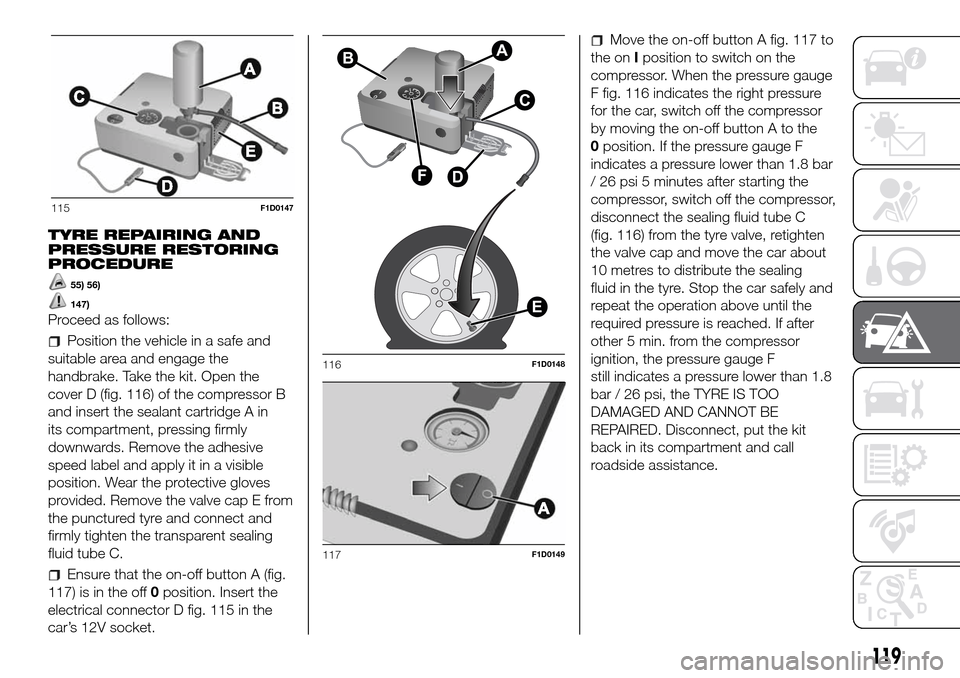
a spray bottle A fig. 115 with the
sealant, equipped with filling pipe B,
separated by the compressor C;
compressor C with pressure gauge,
fitting valve to couple the bottle A,
cable with supply socket D and pipe E
to restore pressure (this is inside the
body as shown);
adhesive label on the spray bottle A,
with the message "max. 80 km/h" to
be placed where the driver can easily
see it (for example on the dashboard)
after repairing the tyre;
instruction booklet, explaining the
quick and correct use of the Fix&Go;
a pair of protective gloves.
118
IN AN EMERGENCY
Page 121 of 216
TYRE REPAIRING AND
PRESSURE RESTORING
PROCEDURE
55) 56)
147)
Proceed as follows:
Position the vehicle in a safe and
suitable area and engage the
handbrake. Take the kit. Open the
cover D (fig. 116) of the compressor B
and insert the sealant cartridge A in
its compartment, pressing firmly
downwards. Remove the adhesive
speed label and apply it in a visible
position. Wear the protective gloves
provided. Remove the valve cap E from
the punctured tyre and connect and
firmly tighten the transparent sealing
fluid tube C.
Ensure that the on-off button A (fig.
117) is in the off0position. Insert the
electrical connector D fig. 115 in the
car’s 12V socket.
Move the on-off button A fig. 117 to
the onIposition to switch on the
compressor. When the pressure gauge
F fig. 116 indicates the right pressure
for the car, switch off the compressor
by moving the on-off button A to the
0position. If the pressure gauge F
indicates a pressure lower than 1.8 bar
/ 26 psi 5 minutes after starting the
compressor, switch off the compressor,
disconnect the sealing fluid tube C
(fig. 116) from the tyre valve, retighten
the valve cap and move the car about
10 metres to distribute the sealing
fluid in the tyre. Stop the car safely and
repeat the operation above until the
required pressure is reached. If after
other 5 min. from the compressor
ignition, the pressure gauge F
still indicates a pressure lower than 1.8
bar / 26 psi, the TYRE IS TOO
DAMAGED AND CANNOT BE
REPAIRED. Disconnect, put the kit
back in its compartment and call
roadside assistance.
115F1D0147
B
D
A
C
E
F
116F1D0148
117F1D0149
119
Page 122 of 216
If the required pressure is reached,
continue driving. Do not exceed
80 km/h. Avoid sudden acceleration or
braking. After driving for about 8 km /
5 miles, position the vehicle in a safe
and suitable area and engage the
handbrake. Take the kit, ensure that the
on-off button A (fig. 117) is in the0
position and insert the electrical
connector in the car’s 12V socket.
Remove the repaired tyre’s valve cap,
take out the black inflation tube and
screw it firmly onto the valve. Inspect
the pressure gauge F to check the tyre
pressure.
If the pressure is lower than 1.8 bar /
26 psi, the TYRE IS TOO DAMAGED
AND CANNOT BE REPAIRED.
Disconnect, put the kit back in its
compartment and call roadside
assistance.
If the pressure is equal to or higher
than 1.8 bar / 26 psi, switch on the
compressor to reach the required
pressure. Disconnect and replace the
kit in the specific compartment. Drive
carefully to a specialist or the
manufacturer’s dealership as soon as
possible.PRESSURE RESTORING
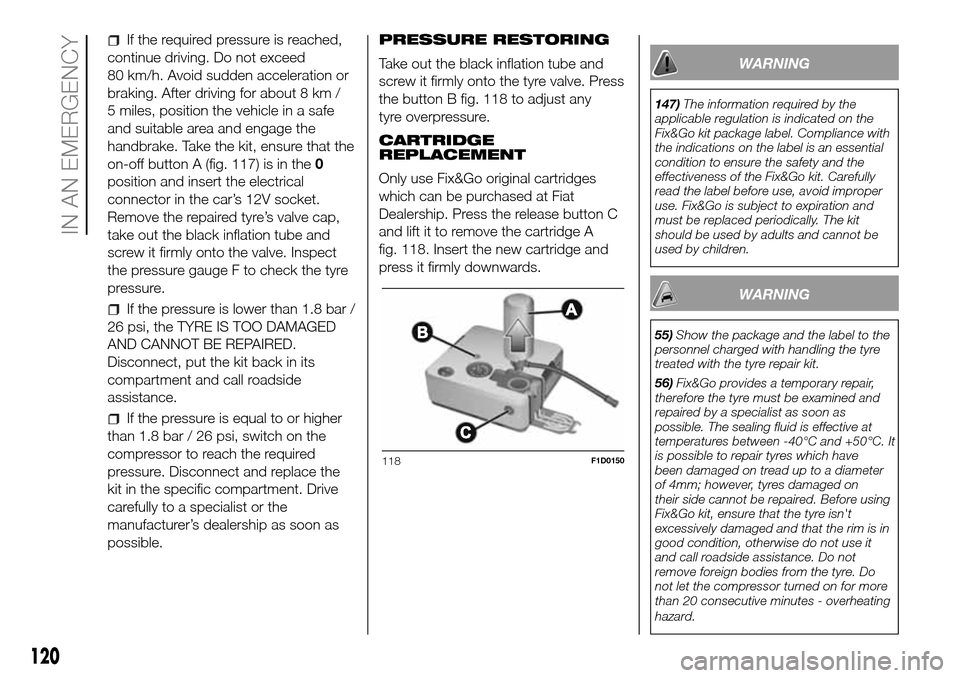
Take out the black inflation tube and
screw it firmly onto the tyre valve. Press
the button B fig. 118 to adjust any
tyre overpressure.
CARTRIDGE
REPLACEMENT
Only use Fix&Go original cartridges
which can be purchased at Fiat
Dealership. Press the release button C
and lift it to remove the cartridge A
fig. 118. Insert the new cartridge and
press it firmly downwards.
WARNING
147)The information required by the
applicable regulation is indicated on the
Fix&Go kit package label. Compliance with
the indications on the label is an essential
condition to ensure the safety and the
effectiveness of the Fix&Go kit. Carefully
read the label before use, avoid improper
use. Fix&Go is subject to expiration and
must be replaced periodically. The kit
should be used by adults and cannot be
used by children.
WARNING
55)Show the package and the label to the
personnel charged with handling the tyre
treated with the tyre repair kit.
56)Fix&Go provides a temporary repair,
therefore the tyre must be examined and
repaired by a specialist as soon as
possible. The sealing fluid is effective at
temperatures between -40°C and +50°C. It
is possible to repair tyres which have
been damaged on tread up to a diameter
of 4mm; however, tyres damaged on
their side cannot be repaired. Before using
Fix&Go kit, ensure that the tyre isn't
excessively damaged and that the rim is in
good condition, otherwise do not use it
and call roadside assistance. Do not
remove foreign bodies from the tyre. Do
not let the compressor turned on for more
than 20 consecutive minutes - overheating
hazard.
118F1D0150
120
IN AN EMERGENCY
Page 128 of 216
SCHEDULED
SERVICING
Correct servicing is crucial for
guaranteeing a long life for the vehicle
under the best conditions. For this
reason, Fiat has planned a series of
checks and services at fixed distance
intervals and, where provided, at fixed
time intervals, as described in the
Scheduled Servicing Plan.
Before each service, it is always
necessary to carefully follow the
instructions in the Scheduled Servicing
Plan (e.g. periodically check level of
fluids, tyre pressure, etc.).
Scheduled Servicing is offered by all
Fiat Dealerships according to a set time
schedule. If, during each operation, in
addition to the ones scheduled, the
need arises for further replacements or
repairs, these may be carried out with
the owner's explicit agreement only.
If your vehicle is used frequently for
towing, the interval between one
service operation and the next should
be reduced.IMPORTANT Scheduled Servicing
interventions are set out by the
Manufacturer. Failure to have them
carried out may invalidate the warranty.
It is advisable to inform a Fiat
Dealership of any small operating
irregularities without waiting for the next
service.
PERIODIC CHECKS
Every1,000km or before long
journeys, check and if necessary, top
up: engine coolant level; brake fluid
level; screen washer fluid level; tyre
inflation pressure and condition; lighting
system operation (headlights, direction
indicators, hazard warning lights, etc.);
screen washer/wiper system operation
and positioning/wear of windscreen/
rear window wiper blades.
Every3,000km, check and top up if
required: engine oil level.DEMANDING USE OF THE
CAR
If the vehicle is used under one of the
following conditions: towing a trailer
or motorhome; dusty roads; short (less
than 7-8 km) and repeated journeys
with sub-zero outside temperatures;
engine often idling or driving long
distances at low speed or long periods
of inactivity, the following checks must
be carried out more often than
indicated in the Scheduled Servicing
Plan:
check front disc brake pad condition
and wear;
check cleanliness of bonnet and
luggage compartment locks,
cleanliness and lubrication of linkage;
visually inspect conditions of:
engine, gearbox, transmission, pipes
and hoses (exhaust/fuel system/brakes)
and rubber elements (gaiters/sleeves/
bushes, etc.);
check battery charge and battery
fluid level (electrolyte);
visually inspect conditions of the
accessory drive belts;
check and, if necessary, change
engine oil and replace oil filter / pollen
filter / air cleaner.
126
SERVICING AND CARE