weight FIAT QUBO 2014 1.G Owners Manual
[x] Cancel search | Manufacturer: FIAT, Model Year: 2014, Model line: QUBO, Model: FIAT QUBO 2014 1.GPages: 231, PDF Size: 5.01 MB
Page 72 of 231
HEADLIGHTSLIGHT BEAM DIRECTION
The correct direction of the headlights is essential
for the comfort and safety of the driver and other
road users. To ensure the best visibility when
travelling with the headlights on, the headlight
alignment must be correct. Contact a Fiat Dealership
to have the direction checked and, if necessary,
adjusted.
HEADLIGHT ALIGNMENT CORRECTOR
This device works with the ignition key in the MAR
position and the dipped headlights on.
The vehicle tilts backwards when it is laden, raising
the beam.
The beams must therefore be aimed again in this
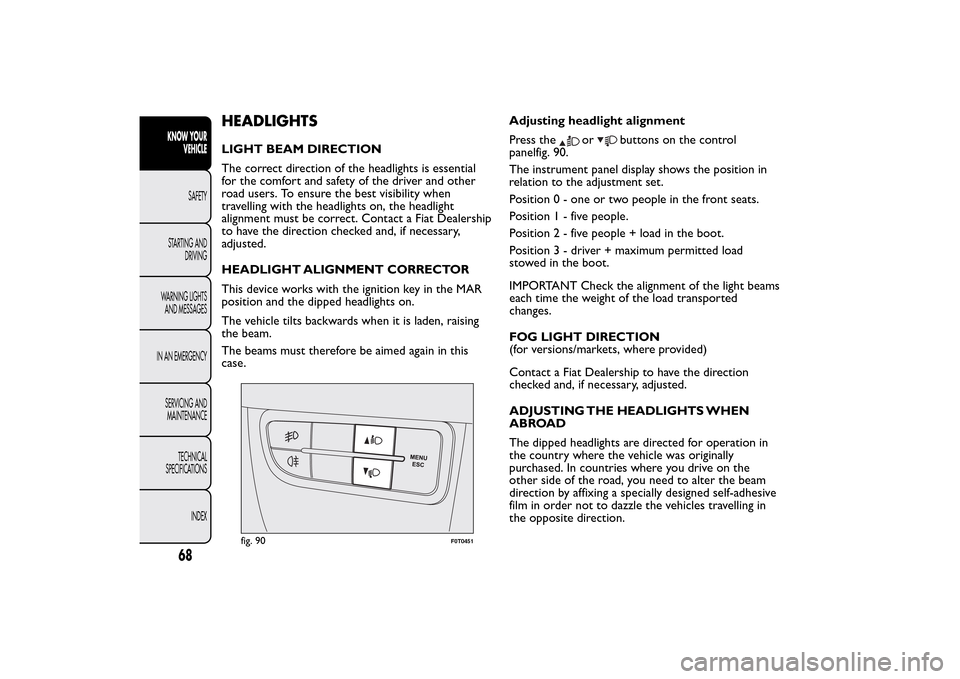
case.Adjusting headlight alignment
Press the
or
buttons on the control
panelfig. 90.
The instrument panel display shows the position in
relation to the adjustment set.
Position 0 - one or two people in the front seats.
Position1-fivepeople.
Position2-fivepeople + load in the boot.
Position 3 - driver + maximum permitted load
stowed in the boot.
IMPORTANT Check the alignment of the light beams
each time the weight of the load transported
changes.
FOG LIGHT DIRECTION
(for versions/markets, where provided)
Contact a Fiat Dealership to have the direction
checked and, if necessary, adjusted.
ADJUSTING THE HEADLIGHTS WHEN
ABROAD
The dipped headlights are directed for operation in
the country where the vehicle was originally
purchased. In countries where you drive on the
other side of the road, you need to alter the beam
direction by affixing a specially designed self-adhesive
film in order not to dazzle the vehicles travelling in
the opposite direction.
fig. 90
F0T0451
68KNOW YOUR
VEHICLE
SAFETY
STARTING AND
DRIVING
WARNING LIGHTS
AND MESSAGES
IN AN EMERGENCY
SERVICING AND
MAINTENANCE
TECHNICAL
SPECIFICATIONS
INDEX
Page 94 of 231
WARNING
If the belt has been subjected to heavy
stress, for example after an accident ,
it should be changed completely together with
the anchors, anchor fastening screws and the
pretensioner. In fact , even if the belt has no
visible defects, it could have lost its resilience.
SEAT BELTS MAINTENANCE
For keeping the seat belts in efficient conditions,
observe the following:
❒always use the belt with the tap taut and never
twisted; make sure that it is free to run without
impediments;
❒replace the belt after an accident of a certain
severity even if it does not appear damaged.
Always replace the seat belt if the pretensioners
were deployed;
❒to clean the belt, wash by hand with water and
mild soap, rinse and leave to dry in the shade.
Do not use strong detergents, bleach, paints or
any other chemicals which could damage the belt
fibres;
❒prevent the reels from getting wet: their correct
operation is guaranteed only if water does not
get inside;
❒replace the seat belt if it shows significant signs of
wear and tear.
CARRYING CHILDREN SAFELYFor optimum protection in the event of a crash, all
passengers must be seated and wearing adequate
restraint systems.
This is even more important for children.
This prescription is compulsory in all EC countries
according to EC Directive 2003/20/EC.
Compared with an adult, a child's head is larger and
heavier in proportion to his/her body and the child's
muscular and bone structures are not fully
developed. For this reason, they require restraint
systems which are different from those used by
adults to protect them in the event of an accident.
The results of research on the best child restraint
systems are contained in the European Standard
ECE-R44, which enforces the use of restraint
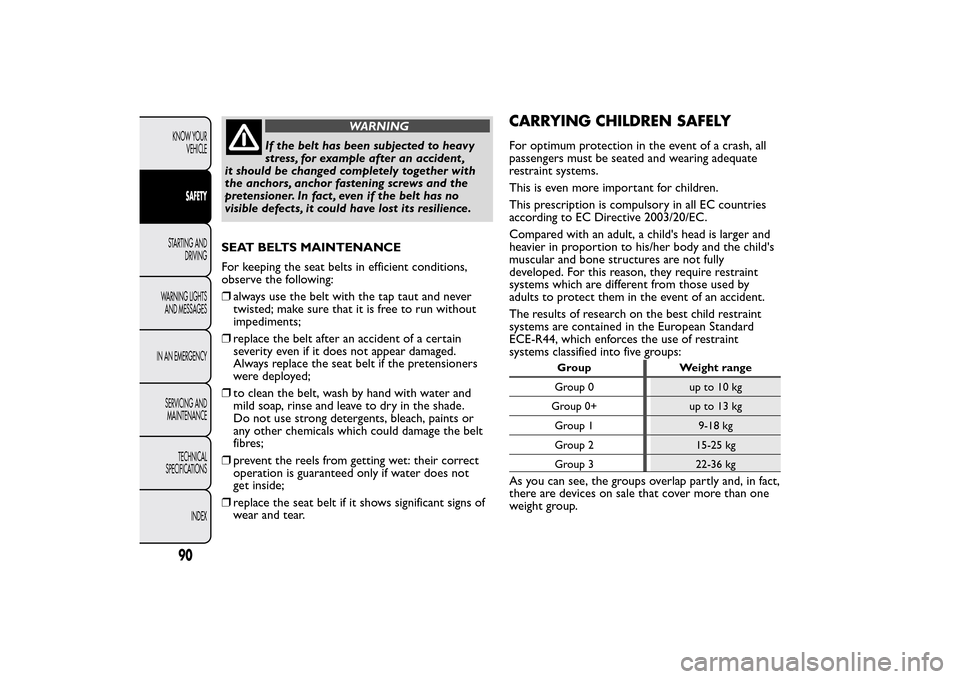
systems classified into five groups:
Group Weight range
Group0 upto10kg
Group 0+ up to 13 kg
Group 1 9-18 kg
Group 2 15-25 kg
Group 3 22-36 kg
As you can see, the groups overlap partly and, in fact,
there are devices on sale that cover more than one
weight group.
90KNOW YOUR
VEHICLE
SAFETY
STARTING AND
DRIVING
WARNING LIGHTS
AND MESSAGES
IN AN EMERGENCY
SERVICING AND
MAINTENANCE
TECHNICAL
SPECIFICATIONS
INDEX
Page 95 of 231
All restraint devices must bear the type-approval
data along with the control mark on a label firmly
secured to the child seat which must never be
removed.
Over 1.50 m in height, from the point of view of
restraint systems, children are considered as adults
and wear seat belts normally.
Lineaccessori Fiat has child seats for each weight
group. These devices are recommended, having been
specifically designed for Fiat cars.
WARNING
DANGER: Do not put cradle seats facing
backwards on the front seat if the front
passenger air bag is enabled.
Deployment of the air bag in an
accident could cause fatal injuries to the child.
It is advisable to carr y children on the rear seat ,
which is the most protected position in the
event of an accident . Child seats must not be
fitted on the front seat of vehicles with a
passenger air bag; their deployment in
an accident , however serious, could cause fatal
injuries to the child. If necessary, children can
travel in the front seat , if the front passenger air
bag can be disabled. In this case, check that
the air bag is actually deactivated by making
sure the “ warning light appears on the
instrument panel (see “Front passenger air bag”
in the “Front air bags” section). Also, the
passenger seat should be as far back as possible
to avoid contact between the child seat and
the dashboard.
91KNOW YOUR
VEHICLESAFETYSTARTING AND
DRIVING
WARNING LIGHTS
AND MESSAGES
IN AN EMERGENCY
SERVICING AND
MAINTENANCE
TECHNICAL
SPECIFICATIONS
INDEX
Page 96 of 231
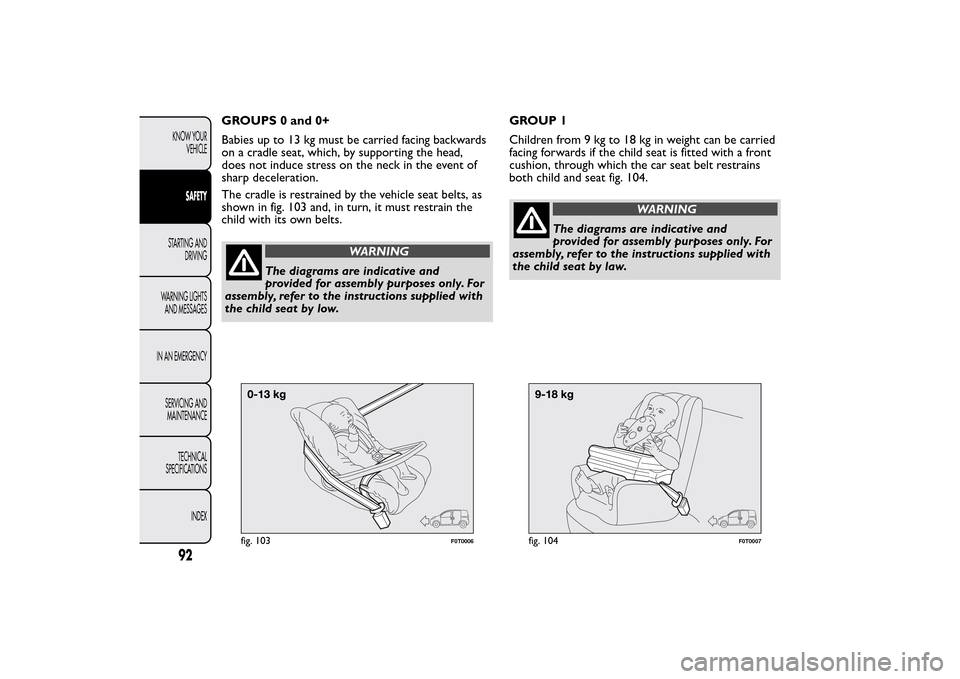
GROUPS 0 and 0+
Babies up to 13 kg must be carried facing backwards
on a cradle seat, which, by supporting the head,
does not induce stress on the neck in the event of
sharp deceleration.
The cradle is restrained by the vehicle seat belts, as
shown in fig. 103 and, in turn, it must restrain the
child with its own belts.
WARNING
The diagrams are indicative and
provided for assembly purposes only. For
assembly, refer to the instructions supplied with
the child seat by low.GROUP 1
Children from 9 kg to 18 kg in weight can be carried
facing forwards if the child seat is fitted with a front
cushion, through which the car seat belt restrains
both child and seat fig. 104.
WARNING
The diagrams are indicative and
provided for assembly purposes only. For
assembly, refer to the instructions supplied with
the child seat by law.
fig. 103
F0T0006
fig. 104
F0T0007
92KNOW YOUR
VEHICLE
SAFETY
STARTING AND
DRIVING
WARNING LIGHTS
AND MESSAGES
IN AN EMERGENCY
SERVICING AND
MAINTENANCE
TECHNICAL
SPECIFICATIONS
INDEX
Page 97 of 231
WARNING
Some child restraint systems for weight
groups 0 and 1 have a rear attachment
to the car seat belts and their own seat belts for
securing the child. Due to their weight , they
may be dangerous if incorrectly mounted (e.g. if
fastened to the vehicle seat belts placing a
cushion in between). Follow the assembly
instructions carefully.
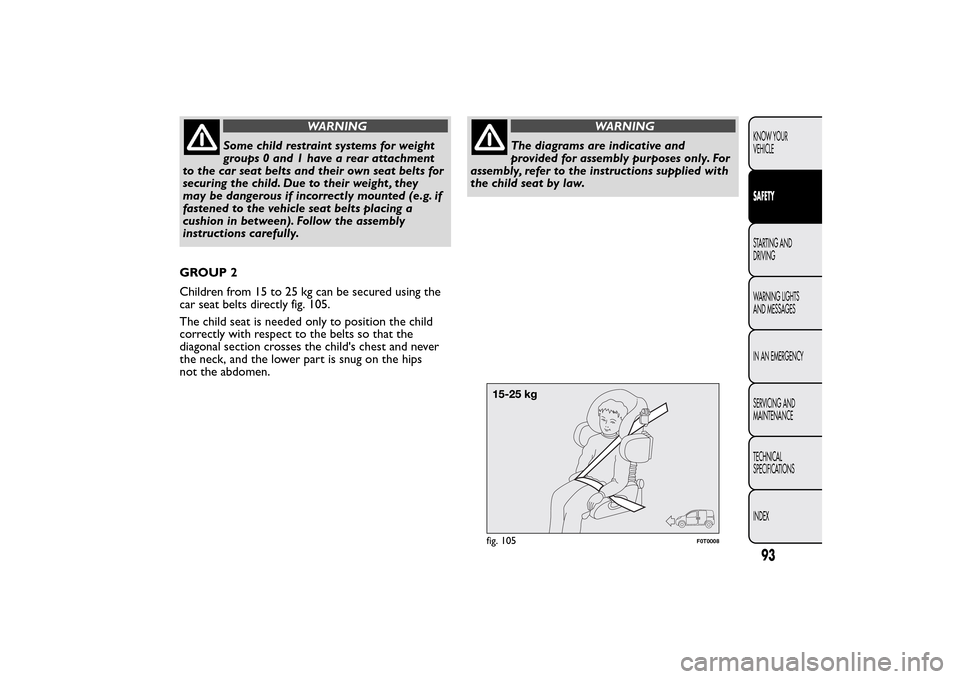
GROUP 2
Children from 15 to 25 kg can be secured using the
car seat belts directly fig. 105.
The child seat is needed only to position the child
correctly with respect to the belts so that the
diagonal section crosses the child's chest and never
the neck, and the lower part is snug on the hips
not the abdomen.
WARNING
The diagrams are indicative and
provided for assembly purposes only. For
assembly, refer to the instructions supplied with
the child seat by law.
fig. 105
F0T0008
93KNOW YOUR
VEHICLESAFETYSTARTING AND
DRIVING
WARNING LIGHTS
AND MESSAGES
IN AN EMERGENCY
SERVICING AND
MAINTENANCE
TECHNICAL
SPECIFICATIONS
INDEX
Page 99 of 231

SUITABILITY OF PASSENGER SEATS FOR CHILD SEAT USE
The vehicle complies with the new European Directive 2000/3/EC which governs the arrangement
possibilities for child restraints on the seats of a vehicle as shown in the following table:
Group Weight range Front passenger seat Rear passenger seat
Groups 0, 0+ up to 13 kg
UU
Group 1 9-18 kg
UU
Group 2 15-25 kg
UU
Group 3 22-36 kg
UU
U suitable for “Universal” child seats, according to European standard ECE-R44 for the specified “Groups”.
95KNOW YOUR
VEHICLESAFETYSTARTING AND
DRIVING
WARNING LIGHTS
AND MESSAGES
IN AN EMERGENCY
SERVICING AND
MAINTENANCE
TECHNICAL
SPECIFICATIONS
INDEX
Page 101 of 231
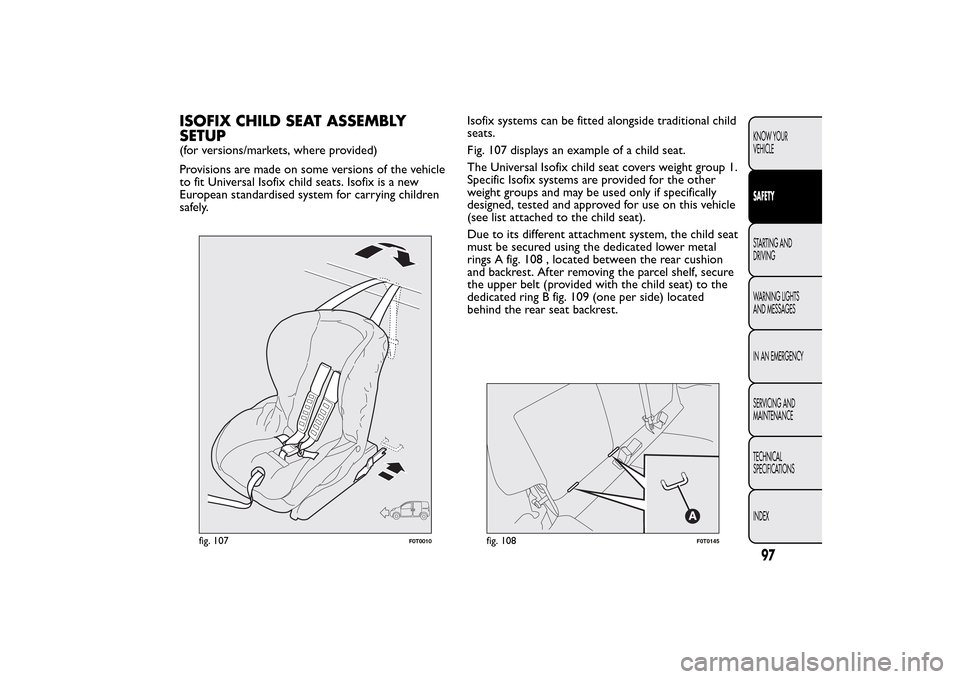
ISOFIX CHILD SEAT ASSEMBLY
SETUP(for versions/markets, where provided)
Provisions are made on some versions of the vehicle
to fit Universal Isofix child seats. Isofix is a new
European standardised system for carrying children
safely.Isofix systems can be fitted alongside traditional child
seats.
ig. 107 displays an example of a child seat.
The Universal Isofix child seat covers weight group 1.
Specific Isofix systems are provided for the other
weight groups and may be used only if specifically
designed, tested and approved for use on this vehicle
(see list attached to the child seat).
Due to its different attachment system, the child seat
must be secured using the dedicated lower metal
rings A fig. 108 , located between the rear cushion
and backrest. After removing the parcel shelf, secure
the upper belt (provided with the child seat) to the
dedicated ring B fig. 109 (one per side) located
behind the rear seat backrest.
fig. 107
F0T0010
fig. 108
F0T0145
97KNOW YOUR
VEHICLESAFETYSTARTING AND
DRIVING
WARNING LIGHTS
AND MESSAGES
IN AN EMERGENCY
SERVICING AND
MAINTENANCE
TECHNICAL
SPECIFICATIONS
INDEX
F
Page 103 of 231
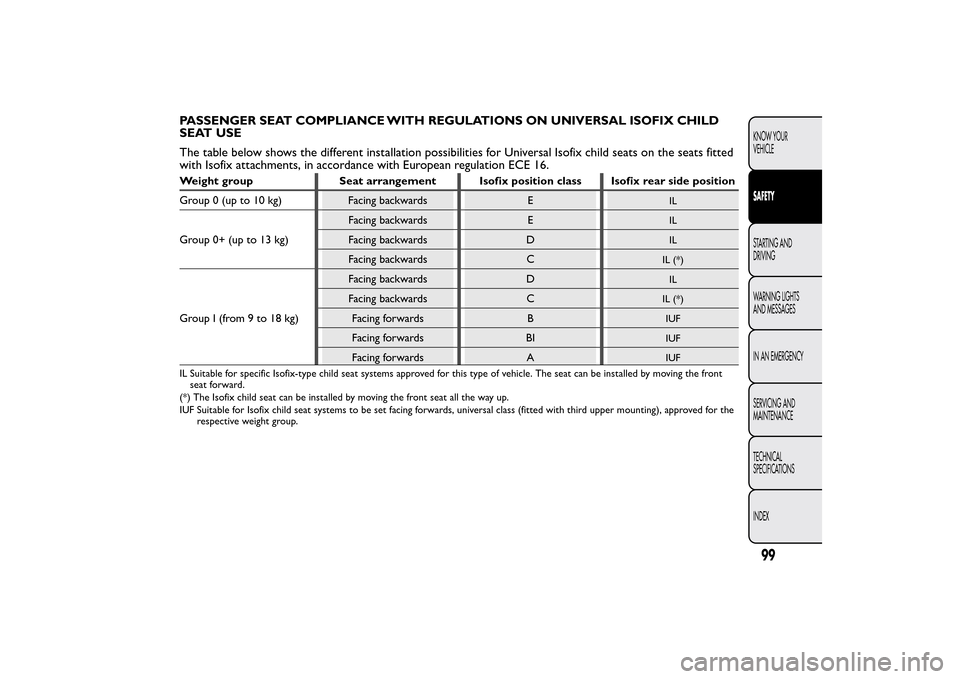
PASSENGER SEAT COMPLIANCE WITH REGULATIONS ON UNIVERSAL ISOFIX CHILD
SEAT USE
The table below shows the different installation possibilities for Universal Isofix child seats on the seats fitted
with Isofix attachments, in accordance with European regulation ECE 16.Weight group Seat arrangement Isofix position class Isofix rear side position
Group 0 (up to 10 kg) Facing backwards E
IL
Group 0+ (up to 13 kg)Facing backwards E
IL
Facing backwards D
IL
Facing backwards C
IL (*)
GroupI(from9to18kg)Facing backwards D
IL
Facing backwards C
IL (*)
Facing forwards B
IUF
Facing forwards BI
IUF
Facing forwards A
IUF
IL Suitable for specific Isofix-type child seat systems approved for this type of vehicle. The seat can be installed by moving the front
seat forward.
(*) The Isofix child seat can be installed by moving the front seat all the way up.
IUF Suitable for Isofix child seat systems to be set facing forwards, universal class (fitted with third upper mounting), approved for the
respective weight group.
99KNOW YOUR
VEHICLESAFETYSTARTING AND
DRIVING
WARNING LIGHTS
AND MESSAGES
IN AN EMERGENCY
SERVICING AND
MAINTENANCE
TECHNICAL
SPECIFICATIONS
INDEX
Page 117 of 231
WARNING
Depress the clutch pedal fully to change
gear correctly.There should be no
obstacles on the floor underneath the pedals;
make sure that mats are always flat and do not
interfere with the pedals.Do not drive with your hand resting on
the gear lever as the force exerted, even if
slight , could lead over time to premature
wear of the gearbox internal components.The
clutch pedal should be used only for gear
changes. Do not drive with your foot resting on
the clutch pedal, however slightly.The electronic
clutch control could cut in by interpreting the
incorrect driving style as a fault (for versions/
markets, where provided).
SAVING FUELSome useful tips are given below for fuel saving and
reducing harmful emissions of CO2 and other
pollutants (nitrogen oxides, unburnt hydrocarbons,
Particulate Matter (PM) etc.).
GENERAL CONSIDERATIONS
The general factors that affect fuel consumption are
listed below.
Vehicle maintenance
Have checks and adjustments carried out in
accordance with the “Scheduled Servicing Plan”.
Ty r e s
Check the tyre pressure at least once every four
weeks: if the pressure is too low, consumption levels
increase as resistance to rolling is higher.
Unnecessary loads
Do not travel with an overloaded boot. The weight
of the vehicle (especially when driving in town)
and its trim greatly affect fuel consumption
and stability.
Roof rack/ski rack
Remove the roof rack or the ski rack from the roof
after use. These accessories reduce the aerodynamic
coefficient of the vehicle and have a negative effect
113KNOW YOUR
VEHICLE
SAFETYSTARTING AND
DRIVINGWARNING LIGHTS
AND MESSAGES
IN AN EMERGENCY
SERVICING AND
MAINTENANCE
TECHNICAL
SPECIFICATIONS
INDEX
on fuel consumption. It is better to use a trailer to
transport particularly bulky objects.
Page 119 of 231
Acceleration
Sudden acceleration has a very negative effect on fuel
consumption and emissions: accelerate gradually.
CONDITIONS OF USE
The main conditions of use which negatively affect
consumption are illustrated below.
Cold starting
Short distances and frequent cold start-ups prevent
the engine from reaching its optimum running
temperature.
Consequently, both consumption (from +15 to +30%
on the urban cycle) and emissions will increase.
Traffic and road conditions
Heavy traffic, for instance when travelling in a queue
with frequent use of low gears or in cities with
lots of traffic lights, causes fairly high fuel
consumption. Mountain roads and uneven surfaces
also have a negative effect on consumption.
Traffic hold-ups
During prolonged hold-ups (e.g. at level crossings)
the engine should be switched off.
TOWING TRAILERSIMPORTANT
The vehicle must be provided with a type-approved
tow hitch and adequate electrical system to tow
trailers. Installation must be performed by specialised
personnel who will issue the required papers for
travelling on roads.
Install any specific and/or additional rear-view mirrors
in accordance with the highway code of the country
in which you are travelling.
Remember that when towing a trailer, steep hills are
harder to climb, braking distances increase and
overtaking takes longer depending on the overall
weight of the trailer.
Engage a low gear when driving downhill, rather than
constantly using the brake.
The weight of the trailer on the vehicle tow hitch
will reduce the loading capacity of the vehicle by the
same amount.
Consider the weight at full load, including accessories
and luggage, to make sure you do not exceed the
maximum towable weight (shown in the log book).
Respect each country's speed limits for vehicles
towing trailers. In all cases, the top speed must not
exceed 80 km/h.
115KNOW YOUR
VEHICLE
SAFETYSTARTING AND
DRIVINGWARNING LIGHTS
AND MESSAGES
IN AN EMERGENCY
SERVICING AND
MAINTENANCE
TECHNICAL
SPECIFICATIONS
INDEX