child seat FIAT SPIDER ABARTH 2017 Owners Manual
[x] Cancel search | Manufacturer: FIAT, Model Year: 2017, Model line: SPIDER ABARTH, Model: FIAT SPIDER ABARTH 2017Pages: 292, PDF Size: 9.24 MB
Page 70 of 292
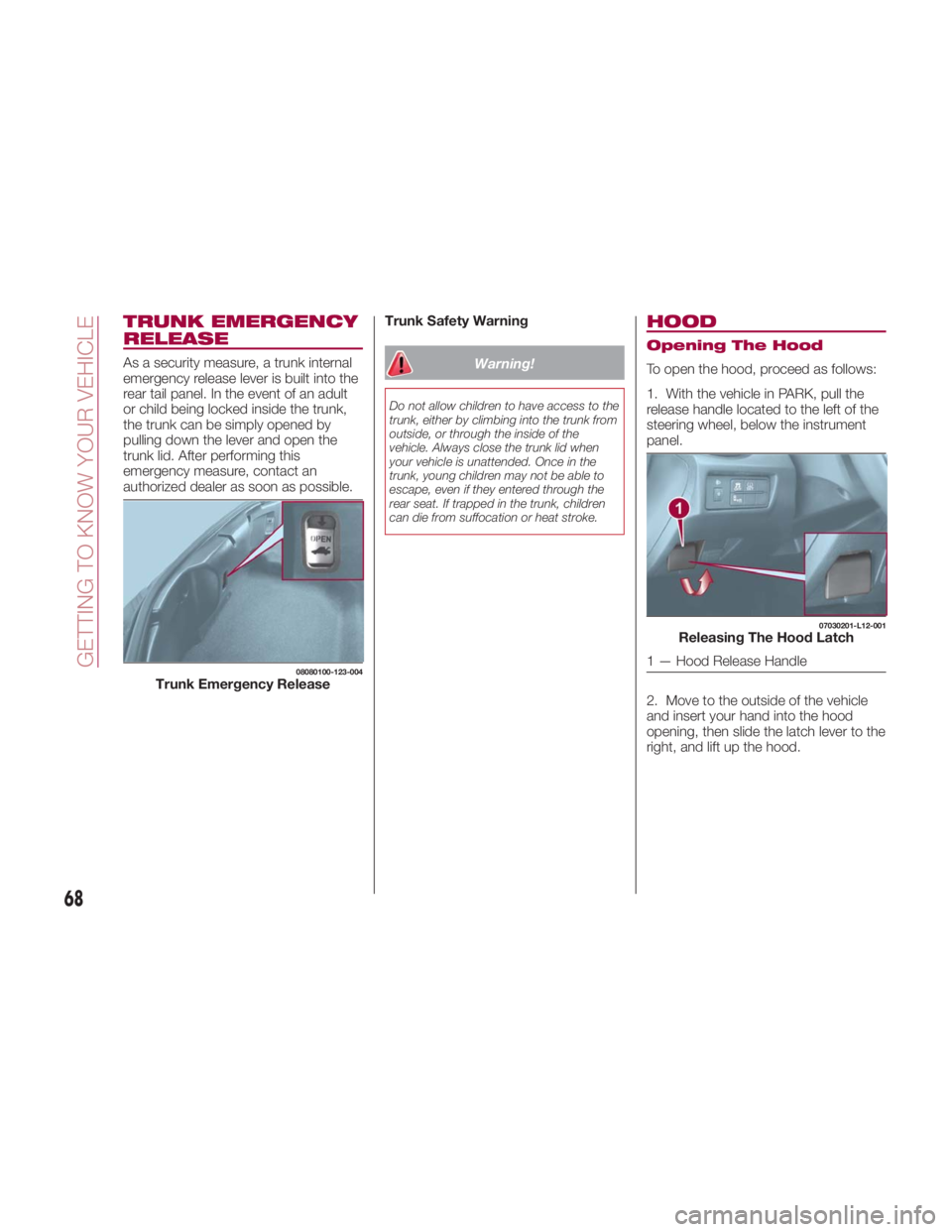
TRUNK EMERGENCY
RELEASE As a security measure, a trunk internal
emergency release lever is built into the
rear tail panel. In the event of an adult
or child being locked inside the trunk,
the trunk can be simply opened by
pulling down the lever and open the
trunk lid. After performing this
emergency measure, contact an
authorized dealer as soon as possible. Trunk Safety Warning
Warning!Do not allow children to have access to the
trunk, either by climbing into the trunk from
outside, or through the inside of the
vehicle. Always close the trunk lid when
your vehicle is unattended. Once in the
trunk, young children may not be able to
escape, even if they entered through the
rear seat. If trapped in the trunk, children
can die from suffocation or heat stroke.
HOOD Opening The Hood
To open the hood, proceed as follows:
1. With the vehicle in PARK, pull the
release handle located to the left of the
steering wheel, below the instrument
panel.
2. Move to the outside of the vehicle
and insert your hand into the hood
opening, then slide the latch lever to the
right, and lift up the hood.08080100-123-004
Trunk Emergency Release 07030201-L12-001
Releasing The Hood Latch
1 — Hood Release Handle
68
GETTING TO KNOW YOUR VEHICLE
Page 103 of 292
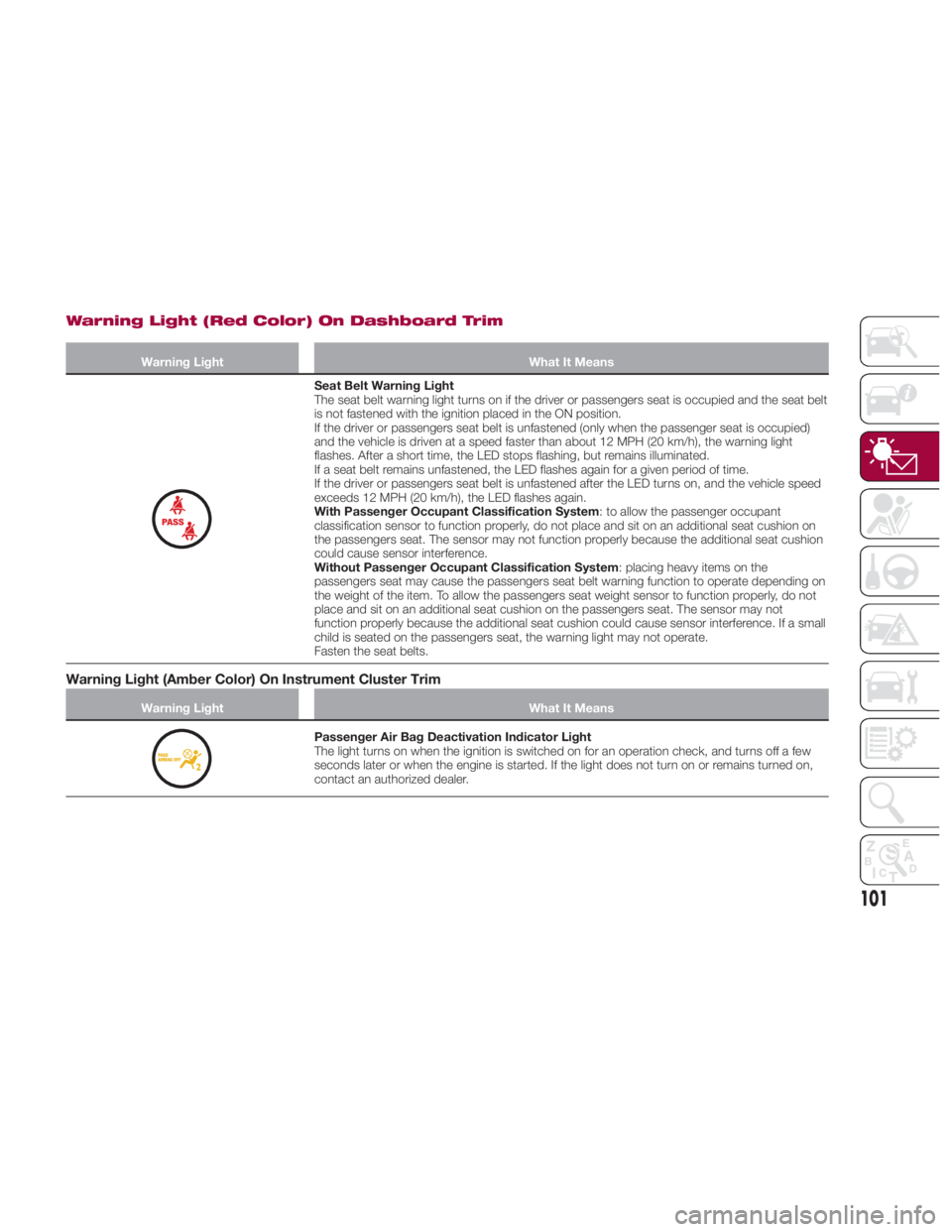
Warning Light (Red Color) On Dashboard Trim Warning Light What It Means
Seat Belt Warning Light
The seat belt warning light turns on if the driver or passengers seat is occupied and the seat belt
is not fastened with the ignition placed in the ON position.
If the driver or passengers seat belt is unfastened (only when the passenger seat is occupied)
and the vehicle is driven at a speed faster than about 12 MPH (20 km/h), the warning light
flashes. After a short time, the LED stops flashing, but remains illuminated.
If a seat belt remains unfastened, the LED flashes again for a given period of time.
If the driver or passengers seat belt is unfastened after the LED turns on, and the vehicle speed
exceeds 12 MPH (20 km/h), the LED flashes again.
With Passenger Occupant Classification System : to allow the passenger occupant
classification sensor to function properly, do not place and sit on an additional seat cushion on
the passengers seat. The sensor may not function properly because the additional seat cushion
could cause sensor interference.
Without Passenger Occupant Classification System : placing heavy items on the
passengers seat may cause the passengers seat belt warning function to operate depending on
the weight of the item. To allow the passengers seat weight sensor to function properly, do not
place and sit on an additional seat cushion on the passengers seat. The sensor may not
function properly because the additional seat cushion could cause sensor interference. If a small
child is seated on the passengers seat, the warning light may not operate.
Fasten the seat belts.
Warning Light (Amber Color) On Instrument Cluster Trim Warning Light What It Means
Passenger Air Bag Deactivation Indicator Light
The light turns on when the ignition is switched on for an operation check, and turns off a few
seconds later or when the engine is started. If the light does not turn on or remains turned on,
contact an authorized dealer.
101
Page 104 of 292
Message Indicated On
Display
If a message is displayed in the center
display, take appropriate action (in a
calm manner) according to the
displayed message.
If the following messages are displayed
in the center display, a vehicle system
may be malfunctioning:
Engine Coolant Temperature
High : displays if the engine coolant
temperature has increased excessively.
Charging System Malfunction :
displays if the charging system has a
malfunction.
Temperature Warning :the
following message is displayed when
the temperature around the center
display is high. Lowering the
temperature of the inside of the vehicle
or the temperature around the center
display by avoiding direct sunlight is
recommended.
Stop the vehicle in a safe place and
contact an authorized dealer.
Warning Sound Is
Activated
Lights-On Reminder
If lights are on and the ignition is placed
in the ACC position, or the ignition is
placed in the OFF position, a
continuous beep sound will be heard
when the driver's door is opened. Note:
When the ignition is placed in the
ACC position, the “Ignition Not Cycled
Off Warning Beep” overrides the
lights-on reminder.
A personalized function is available
to change the sound volume for the
lights-on reminder.
Air Bag/Seat Belt Pretensioner
System Warning Beep
If there is a problem with the air
bag/seat belt pretensioner systems and
the warning light illumination, a warning
beep sound will be heard for about
5 seconds every minute.
The air bag and seat belt pretensioner
system warning beep sound will
continue to be heard for approximately
35 minutes. Contact an authorized
dealer as soon as possible.
Caution!Do not drive the vehicle with the air
bag/seat belt pretensioner system warning
beep sounding. Driving the vehicle with the
air bag/seat belt pretensioner system
warning beep sounding is dangerous. In a
collision, the air bags and the seat belt
pretensioner system will not deploy and this
could result in death or serious injury.
Contact an authorized dealer as soon as
possible. Seat Belt Warning Beep
Except Mexico
If the driver's seat belt is not fastened
when the ignition is in the ON position,
a beep sound will be heard for about
six seconds.
If the driver or the passengers seat belt
is not fastened and the vehicle is driven
at a speed faster than about 12 MPH
(20 km/h), a beep sound will be heard
again for a specified period of time.
Until a seat belt is fastened or a given
period of time has elapsed, the beep
sound will not stop even if the vehicle
speed falls below 12 MPH (20 km/h).
Note:
To allow the passenger occupant
classification sensor to function
properly, do not place and sit on an
additional seat cushion on the
passengers seat. The sensor may not
function properly because the
additional seat cushion could cause
sensor interference.
If a small child is seated on the
passengers seat, the warning beep
may not operate.
Mexico
If the vehicle speed exceeds about
12 MPH (20 km/h) with the driver or
passengers seat belt unfastened, a
warning beep sounds continuously. If
the seat belt remains unfastened, the
beep sound stops once and then
102
GETTING TO KNOW YOUR INSTRUMENT PANEL
Page 105 of 292
continues for about 90 seconds. The
beep stops after the driver or
passengers seat belt is fastened.
Until a seat belt is fastened or a given
period of time has elapsed, the beep
sound will not stop even if the vehicle
speed falls below 12 MPH (20 km/h).
Warning!Placing heavy items on the front
passenger seat may cause the front
passenger seat belt warning function to
operate depending on the weight of the
item.
To allow the front passenger seat weight
sensor to function properly, do not place
and sit on an additional seat cushion on the
front passenger seat. The sensor may not
function properly because the additional
seat cushion could cause sensor
interference.
When a small child sits on the front
passenger seat, it is possible that the
warning beep will not operate. Ignition Not Switched OFF
If the driver's door is opened while the
ignition is placed in the ACC position, a
continuous beep sound will be heard to
notify the driver that the ignition has not
been placed in the OFF position.
Left in this condition, the keyless entry
system will not operate, the car cannot
be locked, and the battery power will
be depleted.
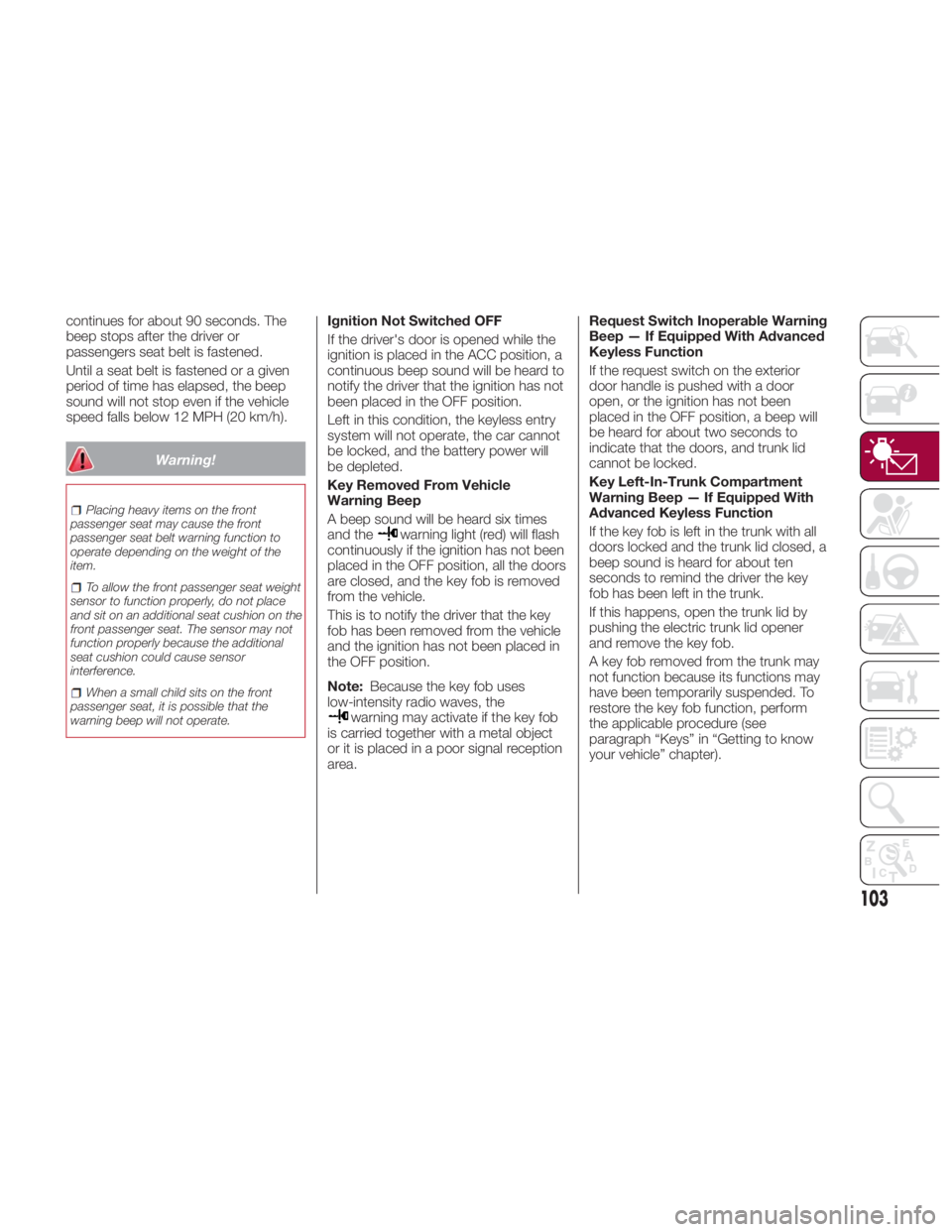
Key Removed From Vehicle
Warning Beep
A beep sound will be heard six times
and the
warning light (red) will flash
continuously if the ignition has not been
placed in the OFF position, all the doors
are closed, and the key fob is removed
from the vehicle.
This is to notify the driver that the key
fob has been removed from the vehicle
and the ignition has not been placed in
the OFF position.
Note: Because the key fob uses
low-intensity radio waves, the
warning may activate if the key fob
is carried together with a metal object
or it is placed in a poor signal reception
area. Request Switch Inoperable Warning
Beep — If Equipped With Advanced
Keyless Function
If the request switch on the exterior
door handle is pushed with a door
open, or the ignition has not been
placed in the OFF position, a beep will
be heard for about two seconds to
indicate that the doors, and trunk lid
cannot be locked.
Key Left-In-Trunk Compartment
Warning Beep — If Equipped With
Advanced Keyless Function
If the key fob is left in the trunk with all
doors locked and the trunk lid closed, a
beep sound is heard for about ten
seconds to remind the driver the key
fob has been left in the trunk.
If this happens, open the trunk lid by
pushing the electric trunk lid opener
and remove the key fob.
A key fob removed from the trunk may
not function because its functions may
have been temporarily suspended. To
restore the key fob function, perform
the applicable procedure (see
paragraph “Keys” in “Getting to know
your vehicle” chapter).
103
Page 113 of 292
SAFETYSAFETY SYSTEMS .......... .112
AUXILIARY DRIVING SYSTEMS . .114
OCCUPANT RESTRAINT
SYSTEMS ............... .122
SEAT BELT SYSTEMS ....... .122
CHILD RESTRAINT
PRECAUTIONS ............ .128
SUPPLEMENTARY RESTRAINT
SYSTEMSRS—AIRBAG..... .131
EVENT DATA RECORDER (EDR) . .145
CONSTANT MONITORING ..... .147
111
Page 124 of 292
The following regulatory statement
applies to all radio frequency (RF)
devices equipped in this vehicle:
This device complies with Part 15 of the
FCC Rules and with Industry Canada
license-exempt RSS standard(s).
Operation is subject to the following
two conditions:
(1) This device may not cause harmful
interference, and
(2) This device must accept any
interference received, including
interference that may cause undesired
operation.
Note: Changes or modifications not
expressly approved by the party
responsible for compliance could void
the user’s authority to operate the
equipment. OCCUPANT
RESTRAINT
SYSTEMS The most important safety equipment
of the vehicle comprise the following
protection systems:
Seat Belts
SBA (Seat Belt Alert) System
Head Restraints
Child Restraint Systems
Front Air Bags And Side Air Bags
Read the information given in the
following pages with the utmost care.
It is of fundamental importance that the
protection systems are used in the
correct way to guarantee the maximum
possible safety level for the driver and
the passengers. SEAT BELT
SYSTEMS Buckle up even though you are an
excellent driver, even on short trips.
Someone on the road may be a poor
driver and could cause a collision that
includes you. This can happen far away
from home or on your own street.
Research has shown that seat belts
save lives, and they can reduce the
seriousness of injuries in a collision.
Some of the worst injuries happen
when people are thrown from the
vehicle. Seat belts reduce the possibility
of ejection and the risk of injury caused
by striking the inside of the vehicle.
Everyone in a motor vehicle should be
belted at all times.
122
SAFETY
Page 125 of 292
Seat Belt Precautions
Seat belts help to decrease the
possibility of severe injury during
accidents and sudden stops. FCA
recommends that the driver and
passengers always wear seat belts.
Mexico
All the seats have lap/shoulder belts.
These belts have retractors with inertia
locks that keep them out of the way
when not in use.
The locks allow the belts to remain
comfortable on users, but they will lock
in position during a collision.
Except Mexico
All of the seat belt retractors are
designed to keep the lap/shoulder belts
out of the way when not in use.
The driver's seat belt has no provisions
for child-restraint systems and has only
an emergency locking mode.
The driver may wear it comfortably, and
it will lock during a collision.
However, the passenger's seat
lap/shoulder belt retractor operates in
two modes: emergency locking mode,
and for child-restraint systems,
automatic locking mode. If you must
use the passenger seat for a child, slide
the passenger seat as far back as
possible and make sure any child
restraint system is secured properly.
Belt retraction may become difficult if
the belts and seat belt guides are
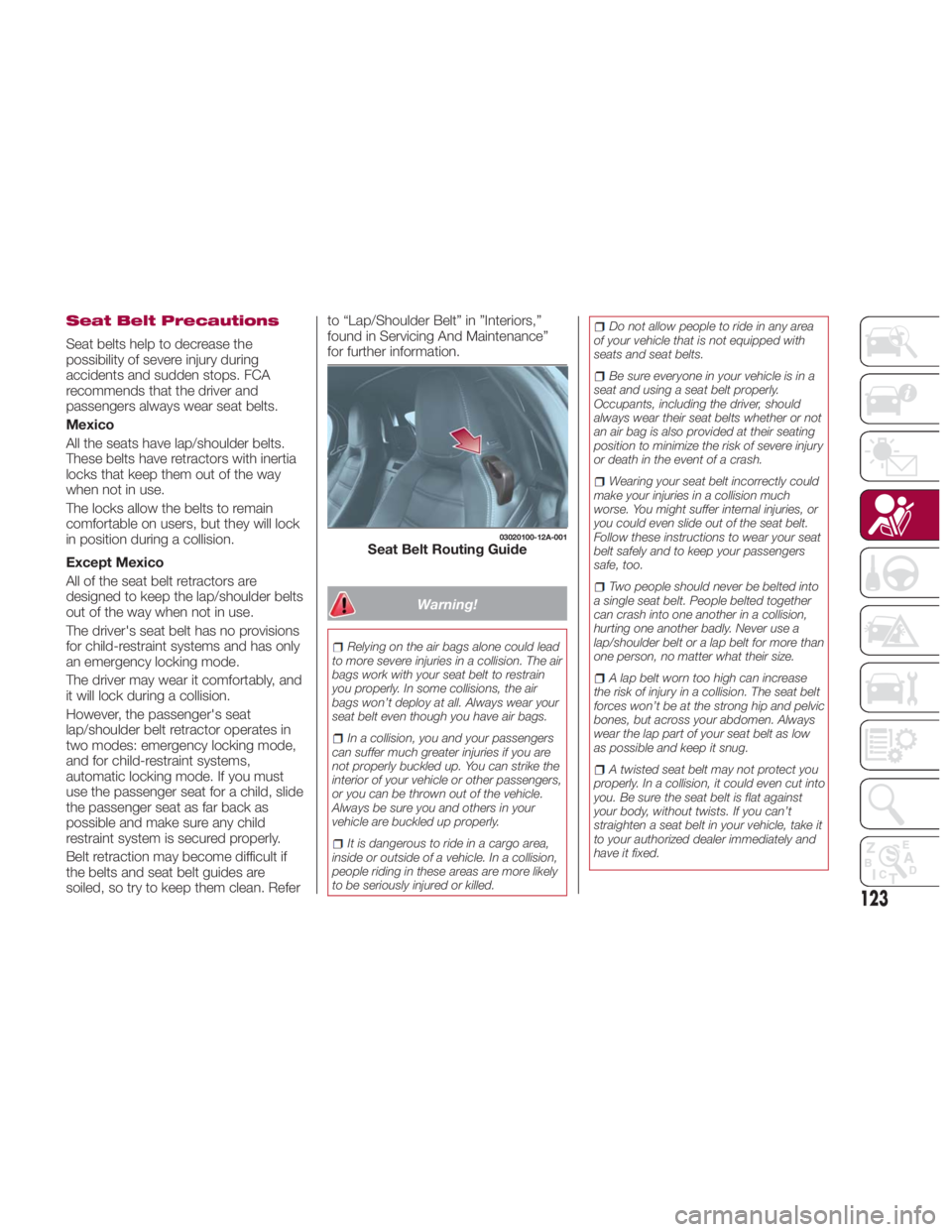
soiled, so try to keep them clean. Refer to “Lap/Shoulder Belt” in ”Interiors,”
found in Servicing And Maintenance”
for further information.
Warning!Relying on the air bags alone could lead
to more severe injuries in a collision. The air
bags work with your seat belt to restrain
you properly. In some collisions, the air
bags won’t deploy at all. Always wear your
seat belt even though you have air bags.
In a collision, you and your passengers
can suffer much greater injuries if you are
not properly buckled up. You can strike the
interior of your vehicle or other passengers,
or you can be thrown out of the vehicle.
Always be sure you and others in your
vehicle are buckled up properly.
It is dangerous to ride in a cargo area,
inside or outside of a vehicle. In a collision,
people riding in these areas are more likely
to be seriously injured or killed. Do not allow people to ride in any area
of your vehicle that is not equipped with
seats and seat belts.
Be sure everyone in your vehicle is in a
seat and using a seat belt properly.
Occupants, including the driver, should
always wear their seat belts whether or not
an air bag is also provided at their seating
position to minimize the risk of severe injury
or death in the event of a crash.
Wearing your seat belt incorrectly could
make your injuries in a collision much
worse. You might suffer internal injuries, or
you could even slide out of the seat belt.
Follow these instructions to wear your seat
belt safely and to keep your passengers
safe, too.
Two people should never be belted into
a single seat belt. People belted together
can crash into one another in a collision,
hurting one another badly. Never use a
lap/shoulder belt or a lap belt for more than
one person, no matter what their size.
A lap belt worn too high can increase
the risk of injury in a collision. The seat belt
forces won’t be at the strong hip and pelvic
bones, but across your abdomen. Always
wear the lap part of your seat belt as low
as possible and keep it snug.
A twisted seat belt may not protect you
properly. In a collision, it could even cut into
you. Be sure the seat belt is flat against
your body, without twists. If you can’t
straighten a seat belt in your vehicle, take it
to your authorized dealer immediately and
have it fixed. 03020100-12A-001
Seat Belt Routing Guide
123
Page 127 of 292
Automatic Locking Mode
Always use the automatic locking mode
to keep the child-restraint system from
shifting to an unsafe position in the
event of an accident.
To enable seat belt automatic locking
mode, pull it all the way out and
connect it as instructed on the child
restraint system. It will retract down to
the child restraint system and stay
locked on it.
Warning!The seat belt assembly must be
replaced if the switchable Automatic
Locking Retractor (ALR) feature or any
other seat belt function is not working
properly when checked according to the
procedures in the Service Manual.
Failure to replace the seat belt assembly
could increase the risk of injury in collisions.
Do not use the Automatic Locking Mode
to restrain occupants who are wearing the
seat belt or children who are using booster
seats. The locked mode is only used to
install rear-facing or forward-facing child
restraints that have a harness for
restraining the child. Lap/Shoulder Belts
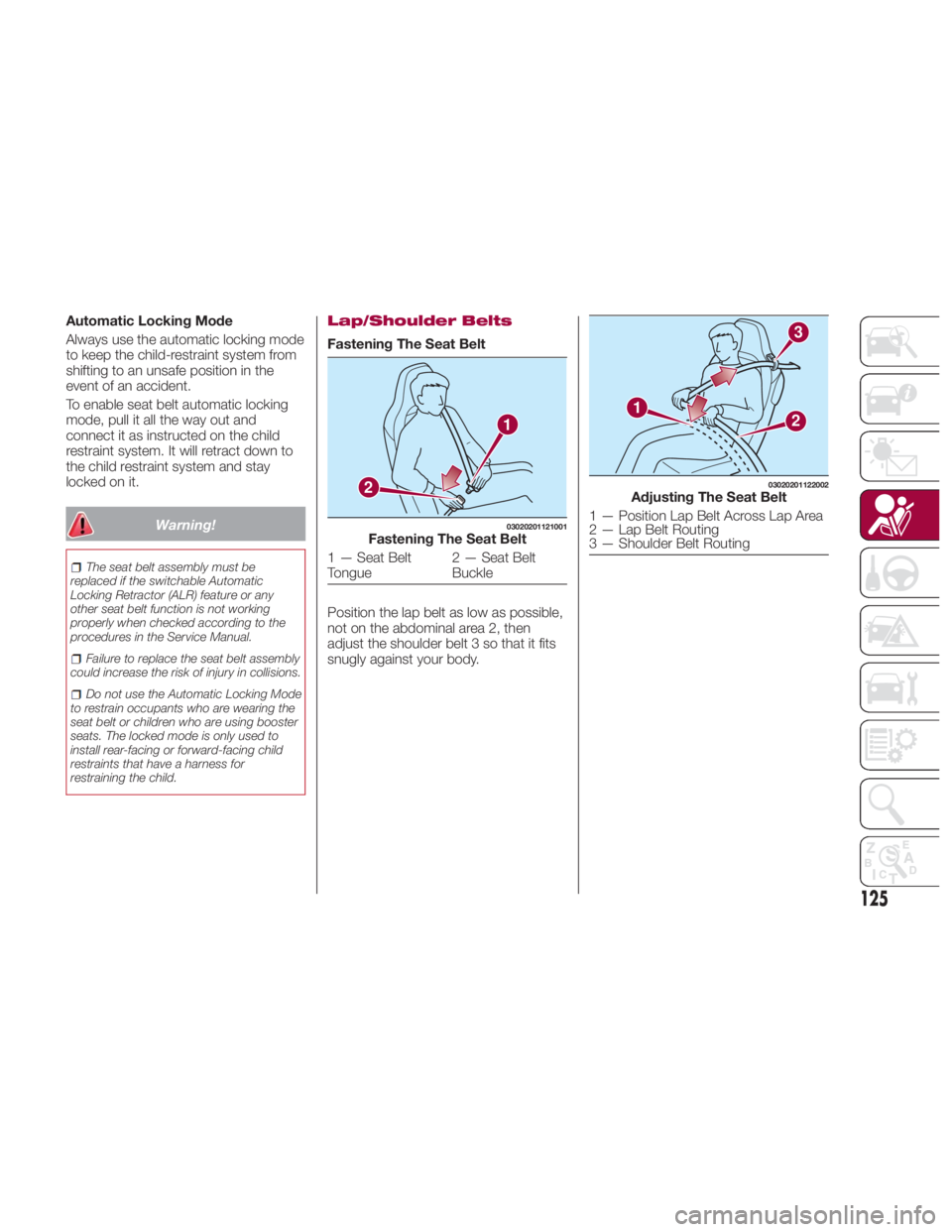
Fastening The Seat Belt
Position the lap belt as low as possible,
not on the abdominal area 2, then
adjust the shoulder belt 3 so that it fits
snugly against your body. 1
2 03020201121001
Fastening The Seat Belt
1 — Seat Belt
Tongue 2 — Seat Belt
Buckle 1 3
2 03020201122002
Adjusting The Seat Belt
1 — Position Lap Belt Across Lap Area
2 — Lap Belt Routing
3 — Shoulder Belt Routing
125
Page 129 of 292
seriously injured in an accident. Only use
the extender provided for you and for the
particular vehicle and seat.
NEVER use the extender in a different
vehicle or seat. If you sell your vehicle, do
not leave your seat belt extender in the
vehicle. It could be used accidentally by the
new owner of the vehicle. After removing
the seat belt extender, discard it. Never use
the seat belt extender in any other vehicle
you may own in the future.
Do not use an extender that is too long.
Using an extender that is too long is
dangerous. The seat belt will not fit
properly. In an accident, the seat belt will
not provide adequate protection and you
could be seriously injured. Do not use the
extender or choose one shorter in length if
the distance between the extender's
buckle and the center of the user's body is
less than 6 inches (15 cm).
Do not leave a seat belt extender
connected to the buckle. Leaving a seat
belt extender connected to the buckle
without using the seat belt is dangerous.
When the seat belt extender is connected
to the driver's seat belt buckle (or
passenger) seat, the SRS driver's (or
passenger's) air bag system will determine
that the driver (or passenger) is wearing the
seat belt even if the driver (or passenger) is
not wearing it. This condition could cause
the driver's (or passenger's) air bag to not
activate correctly and result in death or
serious injury in the event of collision.
Always wear the seat belt with the seat belt
extender.
Do not use the seat belt extender when
installing a child restraint system on the
passenger seat. Using a seat belt extender
to fasten a child restraint system on any
seat is dangerous. Always follow the child restraint system manufacturer's installation
instructions and never use a seat belt
extender.
Driver And Passenger
BeltAlert (If Equipped)
Seat Belt Warning Systems
The LED on dashboard trim turns on if
the driver or passenger's seat is
occupied and the seat belt is not
fastened with the ignition switched ON.
If the driver or passenger's seat belt is
unfastened (only when the passenger
seat is occupied) and the vehicle is
driven at a speed faster than about
12 MPH (20 km/h), the
LED flashes.
After a short time, the LED stops
flashing, but remains illuminated.
If a seat belt remains unfastened, the
LED flashes again for a given period of
time. In this case, fasten the seat belt.
Seat Belt Pretensioner
For optimum protection, the driver and
passenger seat belts are equipped with
pretensioner and load limiting systems.
For both these systems to work
properly you must wear the seat belt
properly.
The seat belt pretensioners are
designed to deploy in moderate or
severe frontal, near frontal collisions. In
addition, during a side collision, the
pretensioner operates on the side in
which the collision occurs. The pretensioners operate differently
depending on what types of air bags
are equipped. For details on the seat
belt pretensioner operation, refer to the
“SRS Air Bag Deployment Criteria”
paragraph in this chapter.
When a collision is detected, the
pretensioners deploy simultaneously with
the air bags. For deployment details, refer
to the “SRS Air Bag Deployment Criteria”
paragraph in this chapter.
The seat belt retractors remove slack
quickly as the air bags are expanding. Any
time the air bags and seat belt
pretensioners have fired they must be
replaced.
With Passenger Occupant
Classification System
In addition, the pretensioner system for
the passenger, like the front and side
passenger Air Bag, is designed to only
deploy when the passenger occupant
classification sensor detects a passenger
sitting on the passenger's seat.
Note:
These devices are not a substitute
for proper seat belt placement by the
occupant. The seat belt still must be
worn snugly and positioned properly.
The pretensioners are triggered by
the Occupant Restraint Controller
(ORC). Like the air bags, the
pretensioners are single use items. A
deployed pretensioner or a deployed
air bag must be replaced immediately.
127
Page 130 of 292
Load Limiter
The load limiting system releases belt
webbing in a controlled manner to
reduce belt force on the occupant's
chest.
While the most severe load on a seat
belt occurs in frontal collisions, the load
limiter has an automatic mechanical
function and can activate in any
accident mode with sufficient occupant
movement.
Even if the pretensioners have not fired,
the load limiting function must be
checked by an authorized dealer. CHILD RESTRAINT
PRECAUTIONS Child Restraints
FCA strongly urges the use of
child-restraint systems for children small
enough to use them.
FCA recommends use of a genuine
child-restraint system or one that
complies with regulation. If you would
like to purchase a FCA genuine
child-restraint system, please contact a
authorized dealer.
Check your local and state or provincial
laws for specific requirements regarding
the safety of children riding in your
vehicle.
Whatever child-restraint system you
consider, please pick the appropriate
one for the age and size of the child,
obey the law and follow the instructions
that come with the individual
child-restraint system.
A child who has outgrown
child-restraint systems should use seat
belts, both lap and shoulder. If the
shoulder belt crosses the neck or face,
move the child closer to the center of
the vehicle.
A rear-facing child-restraint system
should NEVER be used on the
passenger seat with the Air Bag system
activated. In the event of an impact the
Air Bag activation may cause fatal
injuries to the transported child. With Passenger Occupant
Classification System
To reduce the chance of injuries caused
by deployment of the passenger Air
Bag, the passenger occupant
classification sensor work as a part of
the supplementary restraint system.
This system deactivates the passenger
front and side Air Bags and also the
passenger seat belt pretensioner
system when the
OFF passenger Air
Bag deactivation indicator light
illuminates.
When an infant or small child sits on the
passenger seat, the system shuts off
the passenger front and side Air Bags
and seat belt pretensioner system, so
make sure the
OFF passenger Air
Bag deactivation indicator light
illuminates. For more details, refer to
"Passenger Occupant Classification
Sensor" in “Supplementary Restraint
System SRS — Air Bag” for additional
information.
Note: A seat belt or child-restraint
system can become very hot in a
closed vehicle during warm weather. To
avoid burning yourself or a child, check
them before you or your child touches
them.
128
SAFETY