radio FORD E-350 2005 Owner's Manual
[x] Cancel search | Manufacturer: FORD, Model Year: 2005, Model line: E-350, Model: FORD E-350 2005Pages: 248, PDF Size: 2.55 MB
Page 145 of 248
STARTING
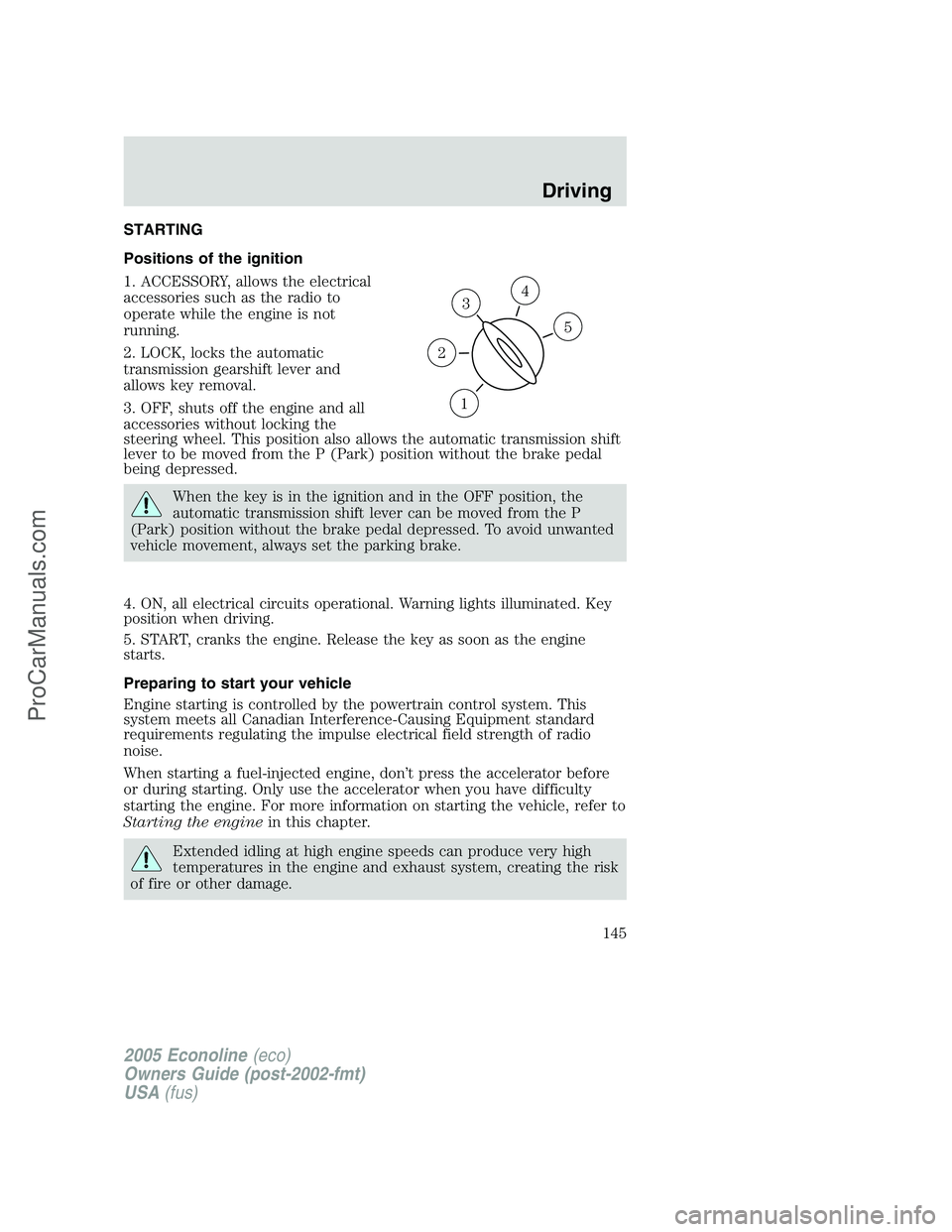
Positions of the ignition
1. ACCESSORY, allows the electrical
accessories such as the radio to
operate while the engine is not
running.
2. LOCK, locks the automatic
transmission gearshift lever and
allows key removal.
3. OFF, shuts off the engine and all
accessories without locking the
steering wheel. This position also allows the automatic transmission shift
lever to be moved from the P (Park) position without the brake pedal
being depressed.
When the key is in the ignition and in the OFF position, the
automatic transmission shift lever can be moved from the P
(Park) position without the brake pedal depressed. To avoid unwanted
vehicle movement, always set the parking brake.
4. ON, all electrical circuits operational. Warning lights illuminated. Key
position when driving.
5. START, cranks the engine. Release the key as soon as the engine
starts.
Preparing to start your vehicle
Engine starting is controlled by the powertrain control system. This
system meets all Canadian Interference-Causing Equipment standard
requirements regulating the impulse electrical field strength of radio
noise.
When starting a fuel-injected engine, don’t press the accelerator before
or during starting. Only use the accelerator when you have difficulty
starting the engine. For more information on starting the vehicle, refer to
Starting the enginein this chapter.
Extended idling at high engine speeds can produce very high
temperatures in the engine and exhaust system, creating the risk
of fire or other damage.
3
1
2
5
4
2005 Econoline(eco)
Owners Guide (post-2002-fmt)
USA(fus)
Driving
145
ProCarManuals.com
Page 154 of 248
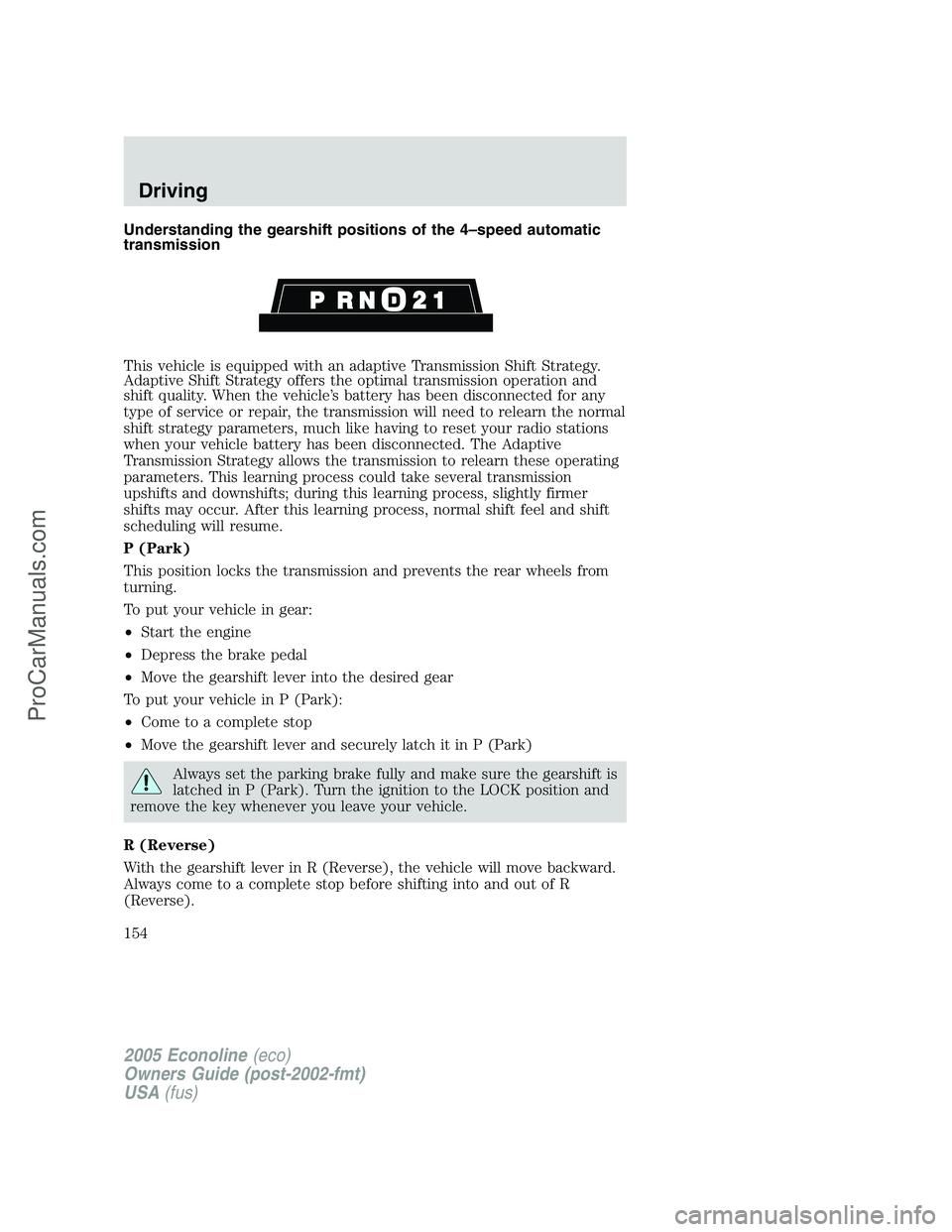
Understanding the gearshift positions of the 4–speed automatic
transmission
This vehicle is equipped with an adaptive Transmission Shift Strategy.
Adaptive Shift Strategy offers the optimal transmission operation and
shift quality. When the vehicle’s battery has been disconnected for any
type of service or repair, the transmission will need to relearn the normal
shift strategy parameters, much like having to reset your radio stations
when your vehicle battery has been disconnected. The Adaptive
Transmission Strategy allows the transmission to relearn these operating
parameters. This learning process could take several transmission
upshifts and downshifts; during this learning process, slightly firmer
shifts may occur. After this learning process, normal shift feel and shift
scheduling will resume.
P (Park)
This position locks the transmission and prevents the rear wheels from
turning.
To put your vehicle in gear:
•Start the engine
•Depress the brake pedal
•Move the gearshift lever into the desired gear
To put your vehicle in P (Park):
•Come to a complete stop
•Move the gearshift lever and securely latch it in P (Park)
Always set the parking brake fully and make sure the gearshift is
latched in P (Park). Turn the ignition to the LOCK position and
remove the key whenever you leave your vehicle.
R (Reverse)
With the gearshift lever in R (Reverse), the vehicle will move backward.
Always come to a complete stop before shifting into and out of R
(Reverse).
2005 Econoline(eco)
Owners Guide (post-2002-fmt)
USA(fus)
Driving
154
ProCarManuals.com
Page 156 of 248
•Selecting 2 (Second) at higher speeds will cause the transmission to
downshift to second gear at the appropriate vehicle speed.
1 (First)
•Provides maximum engine braking.
•Allows upshifts by moving gearshift lever.
•Will not downshift into 1 (First) at high speeds; allows for 1 (First)
when vehicle reaches slower speeds.
Forced downshifts
•Allowed in
(Overdrive) or Drive.
•Depress the accelerator to the floor.
•Allows transmission to select an appropriate gear.
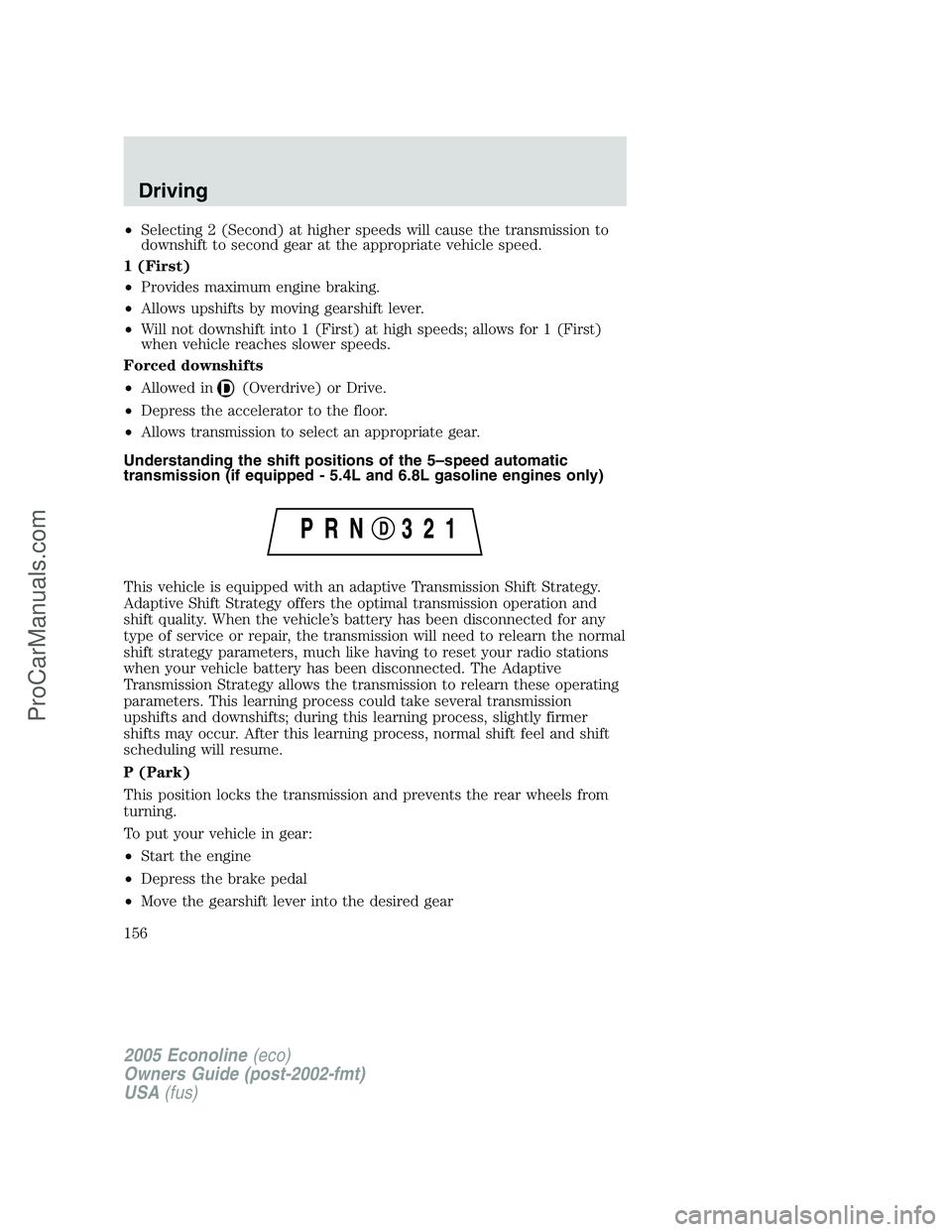
Understanding the shift positions of the 5–speed automatic
transmission (if equipped - 5.4L and 6.8L gasoline engines only)
This vehicle is equipped with an adaptive Transmission Shift Strategy.
Adaptive Shift Strategy offers the optimal transmission operation and
shift quality. When the vehicle’s battery has been disconnected for any
type of service or repair, the transmission will need to relearn the normal
shift strategy parameters, much like having to reset your radio stations
when your vehicle battery has been disconnected. The Adaptive
Transmission Strategy allows the transmission to relearn these operating
parameters. This learning process could take several transmission
upshifts and downshifts; during this learning process, slightly firmer
shifts may occur. After this learning process, normal shift feel and shift
scheduling will resume.
P (Park)
This position locks the transmission and prevents the rear wheels from
turning.
To put your vehicle in gear:
•Start the engine
•Depress the brake pedal
•Move the gearshift lever into the desired gear
2005 Econoline(eco)
Owners Guide (post-2002-fmt)
USA(fus)
Driving
156
ProCarManuals.com
Page 168 of 248
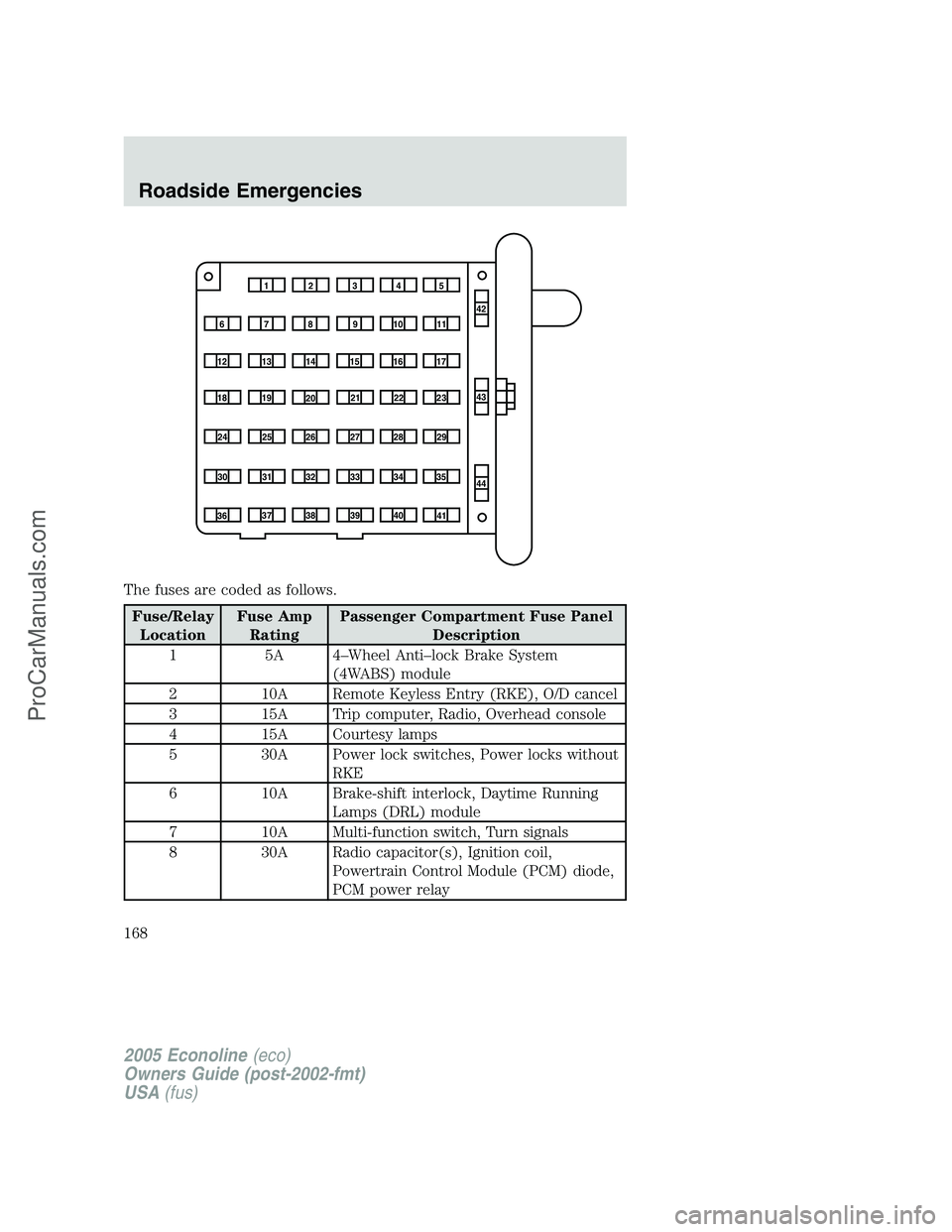
The fuses are coded as follows.
Fuse/Relay
LocationFuse Amp
RatingPassenger Compartment Fuse Panel
Description
1 5A 4–Wheel Anti–lock Brake System
(4WABS) module
2 10A Remote Keyless Entry (RKE), O/D cancel
3 15A Trip computer, Radio, Overhead console
4 15A Courtesy lamps
5 30A Power lock switches, Power locks without
RKE
6 10A Brake-shift interlock, Daytime Running
Lamps (DRL) module
7 10A Multi-function switch, Turn signals
8 30A Radio capacitor(s), Ignition coil,
Powertrain Control Module (PCM) diode,
PCM power relay
1234
5
7
689101142
43
44 13 12 14
15 16 17
19 18
2021 22 23
25 24
26 27 28 29
31 30 32 33 3435
37
3638 3940
41
2005 Econoline(eco)
Owners Guide (post-2002-fmt)
USA(fus)
Roadside Emergencies
168
ProCarManuals.com
Page 169 of 248
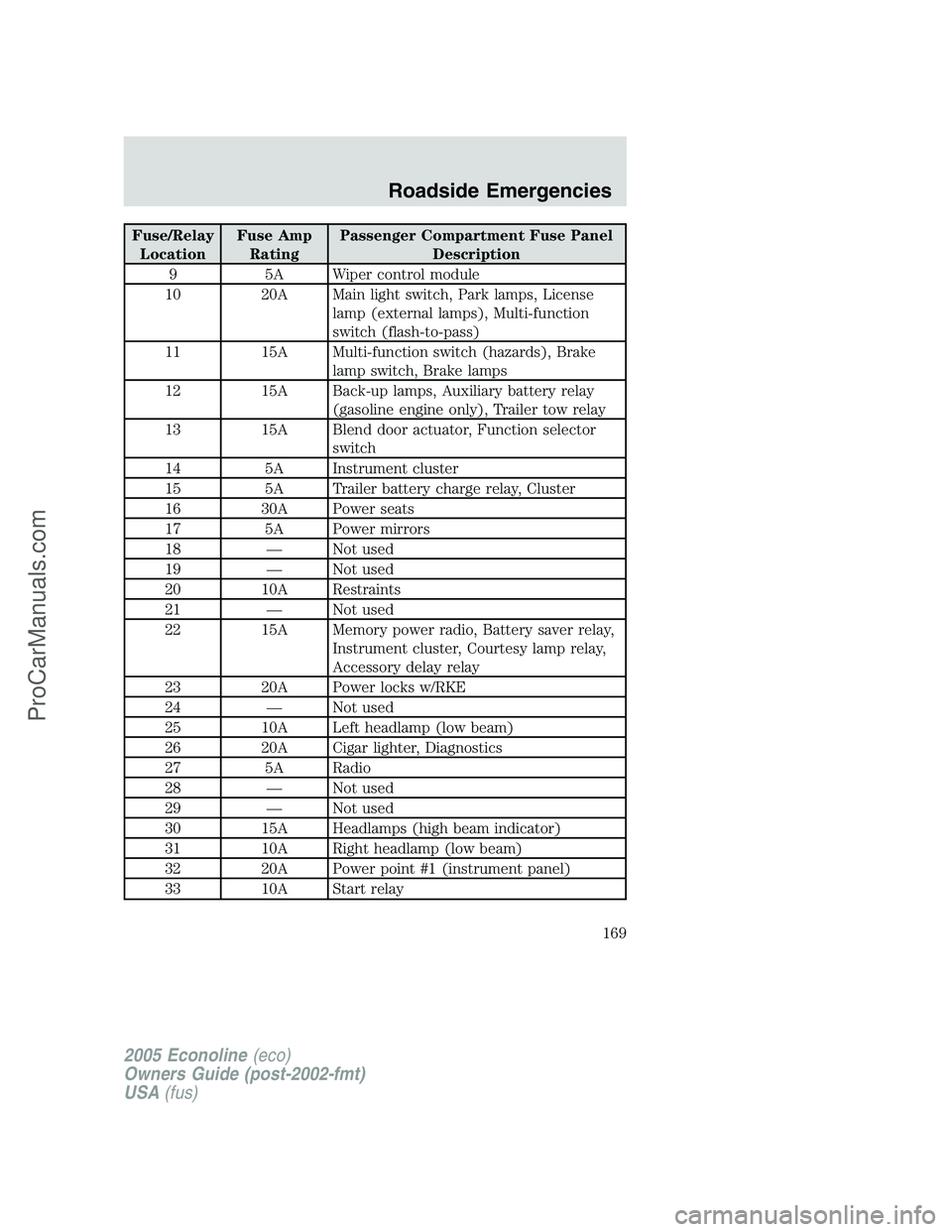
Fuse/Relay
LocationFuse Amp
RatingPassenger Compartment Fuse Panel
Description
9 5A Wiper control module
10 20A Main light switch, Park lamps, License
lamp (external lamps), Multi-function
switch (flash-to-pass)
11 15A Multi-function switch (hazards), Brake
lamp switch, Brake lamps
12 15A Back-up lamps, Auxiliary battery relay
(gasoline engine only), Trailer tow relay
13 15A Blend door actuator, Function selector
switch
14 5A Instrument cluster
15 5A Trailer battery charge relay, Cluster
16 30A Power seats
17 5A Power mirrors
18 — Not used
19 — Not used
20 10A Restraints
21 — Not used
22 15A Memory power radio, Battery saver relay,
Instrument cluster, Courtesy lamp relay,
Accessory delay relay
23 20A Power locks w/RKE
24 — Not used
25 10A Left headlamp (low beam)
26 20A Cigar lighter, Diagnostics
27 5A Radio
28 — Not used
29 — Not used
30 15A Headlamps (high beam indicator)
31 10A Right headlamp (low beam)
32 20A Power point #1 (instrument panel)
33 10A Start relay
2005 Econoline(eco)
Owners Guide (post-2002-fmt)
USA(fus)
Roadside Emergencies
169
ProCarManuals.com
Page 173 of 248
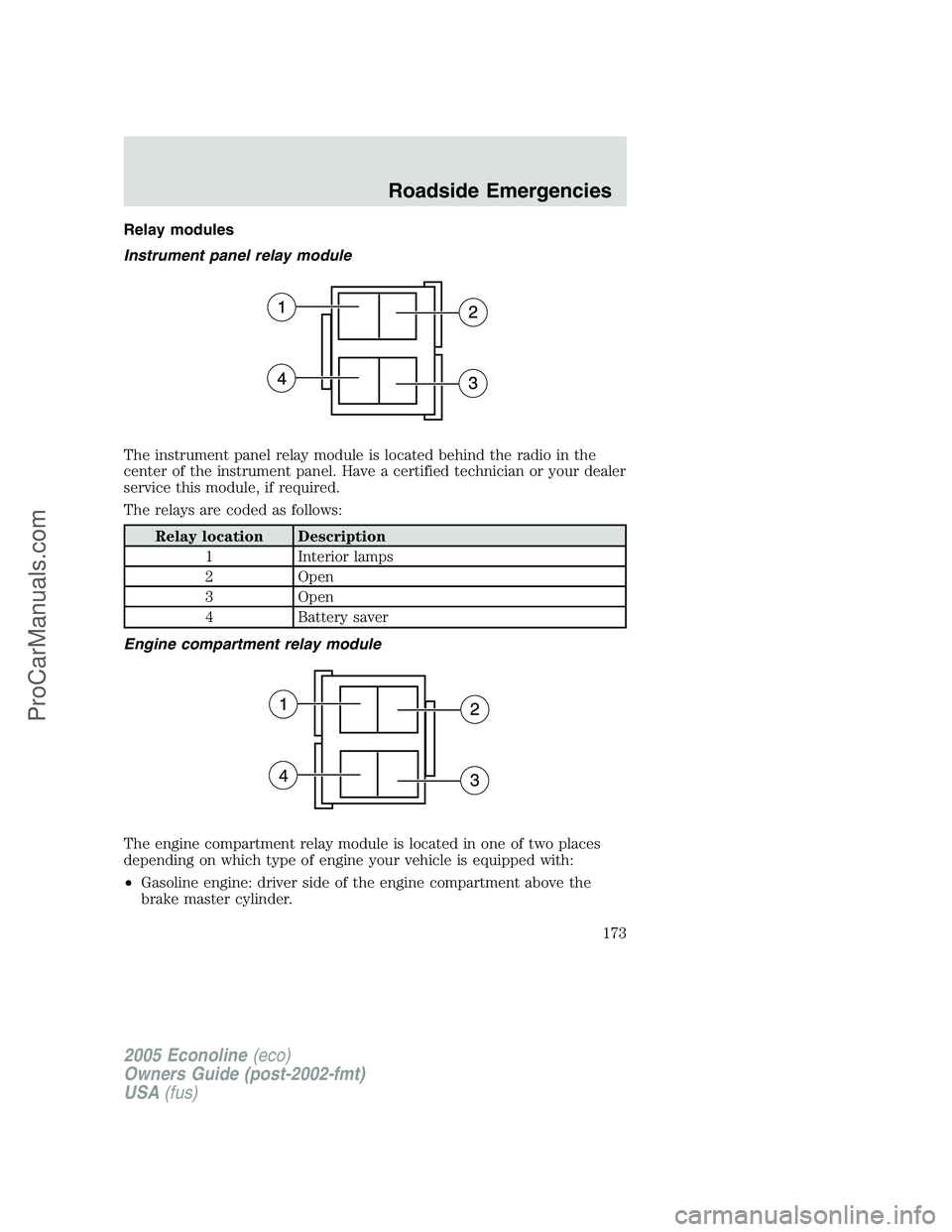
Relay modules
Instrument panel relay module
The instrument panel relay module is located behind the radio in the
center of the instrument panel. Have a certified technician or your dealer
service this module, if required.
The relays are coded as follows:
Relay location Description
1 Interior lamps
2 Open
3 Open
4 Battery saver
Engine compartment relay module
The engine compartment relay module is located in one of two places
depending on which type of engine your vehicle is equipped with:
•Gasoline engine: driver side of the engine compartment above the
brake master cylinder.
2005 Econoline(eco)
Owners Guide (post-2002-fmt)
USA(fus)
Roadside Emergencies
173
ProCarManuals.com
Page 190 of 248
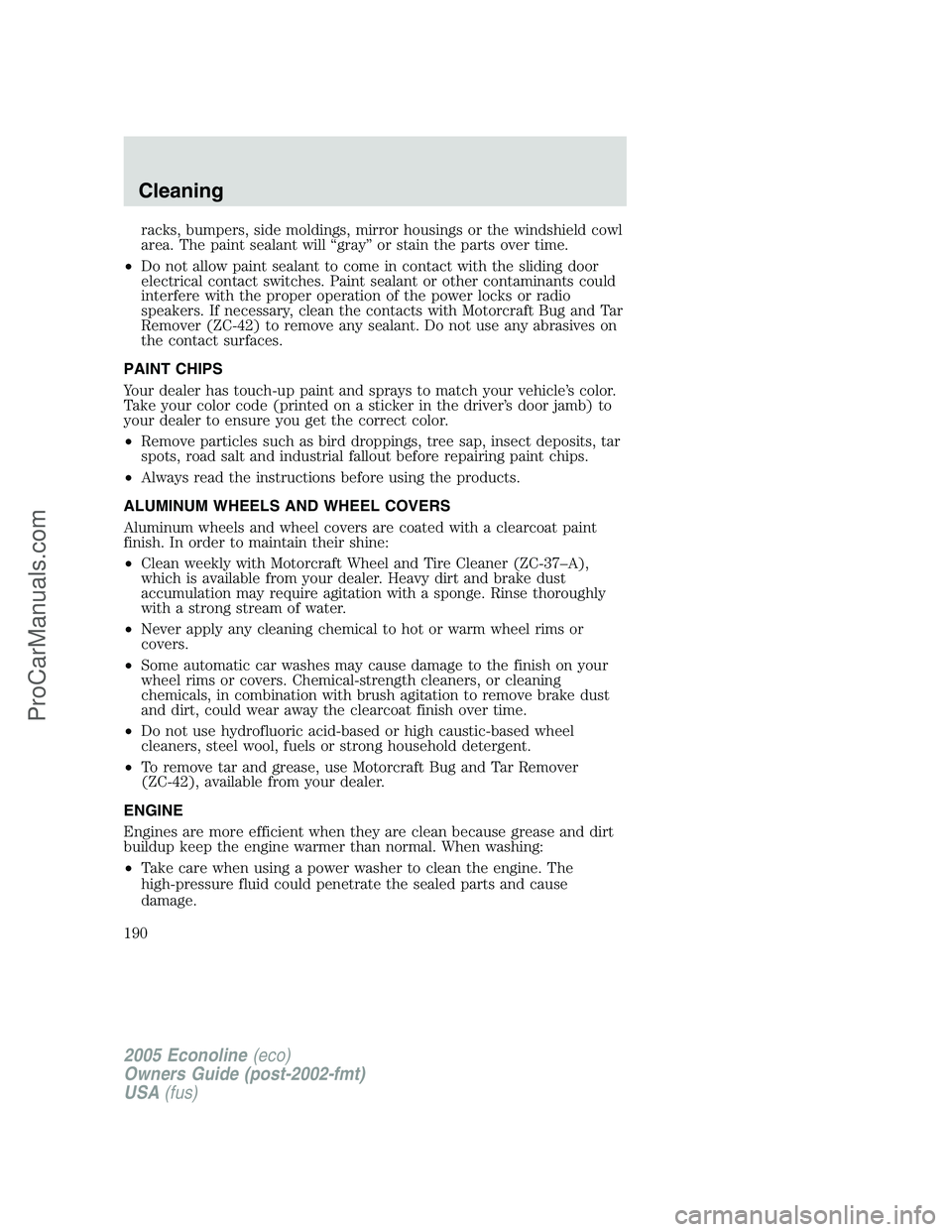
racks, bumpers, side moldings, mirror housings or the windshield cowl
area. The paint sealant will “gray” or stain the parts over time.
•Do not allow paint sealant to come in contact with the sliding door
electrical contact switches. Paint sealant or other contaminants could
interfere with the proper operation of the power locks or radio
speakers. If necessary, clean the contacts with Motorcraft Bug and Tar
Remover (ZC-42) to remove any sealant. Do not use any abrasives on
the contact surfaces.
PAINT CHIPS
Your dealer has touch-up paint and sprays to match your vehicle’s color.
Take your color code (printed on a sticker in the driver’s door jamb) to
your dealer to ensure you get the correct color.
•Remove particles such as bird droppings, tree sap, insect deposits, tar
spots, road salt and industrial fallout before repairing paint chips.
•Always read the instructions before using the products.
ALUMINUM WHEELS AND WHEEL COVERS
Aluminum wheels and wheel covers are coated with a clearcoat paint
finish. In order to maintain their shine:
•Clean weekly with Motorcraft Wheel and Tire Cleaner (ZC-37–A),
which is available from your dealer. Heavy dirt and brake dust
accumulation may require agitation with a sponge. Rinse thoroughly
with a strong stream of water.
•Never apply any cleaning chemical to hot or warm wheel rims or
covers.
•Some automatic car washes may cause damage to the finish on your
wheel rims or covers. Chemical-strength cleaners, or cleaning
chemicals, in combination with brush agitation to remove brake dust
and dirt, could wear away the clearcoat finish over time.
•Do not use hydrofluoric acid-based or high caustic-based wheel
cleaners, steel wool, fuels or strong household detergent.
•To remove tar and grease, use Motorcraft Bug and Tar Remover
(ZC-42), available from your dealer.
ENGINE
Engines are more efficient when they are clean because grease and dirt
buildup keep the engine warmer than normal. When washing:
•Take care when using a power washer to clean the engine. The
high-pressure fluid could penetrate the sealed parts and cause
damage.
2005 Econoline(eco)
Owners Guide (post-2002-fmt)
USA(fus)
Cleaning
190
ProCarManuals.com
Page 203 of 248
2. Put the gearshift in P (Park), turn off all accessories and start the
engine.
3. Run the engine until it reaches normal operating temperature.
4. Allow the engine to idle for at least one minute.
5. Turn the A/C on and allow the engine to idle for at least one minute.
6. Release the parking brake. With your foot on the brake pedal and with
the A/C on, put the vehicle in D (Drive) and allow the engine to idle for
at least one minute.
7. Drive the vehicle to complete the relearning process.
•The vehicle may need to be driven 10 miles (16 km) or more to
relearn the idle and fuel trim strategy.
•If you do not allow the engine to relearn its idle trim, the idle
quality of your vehicle may be adversely affected until the idle
trim is eventually relearned.
If the battery has been disconnected or a new battery has been installed,
the clock and radio settings must be reset once the battery is
reconnected.
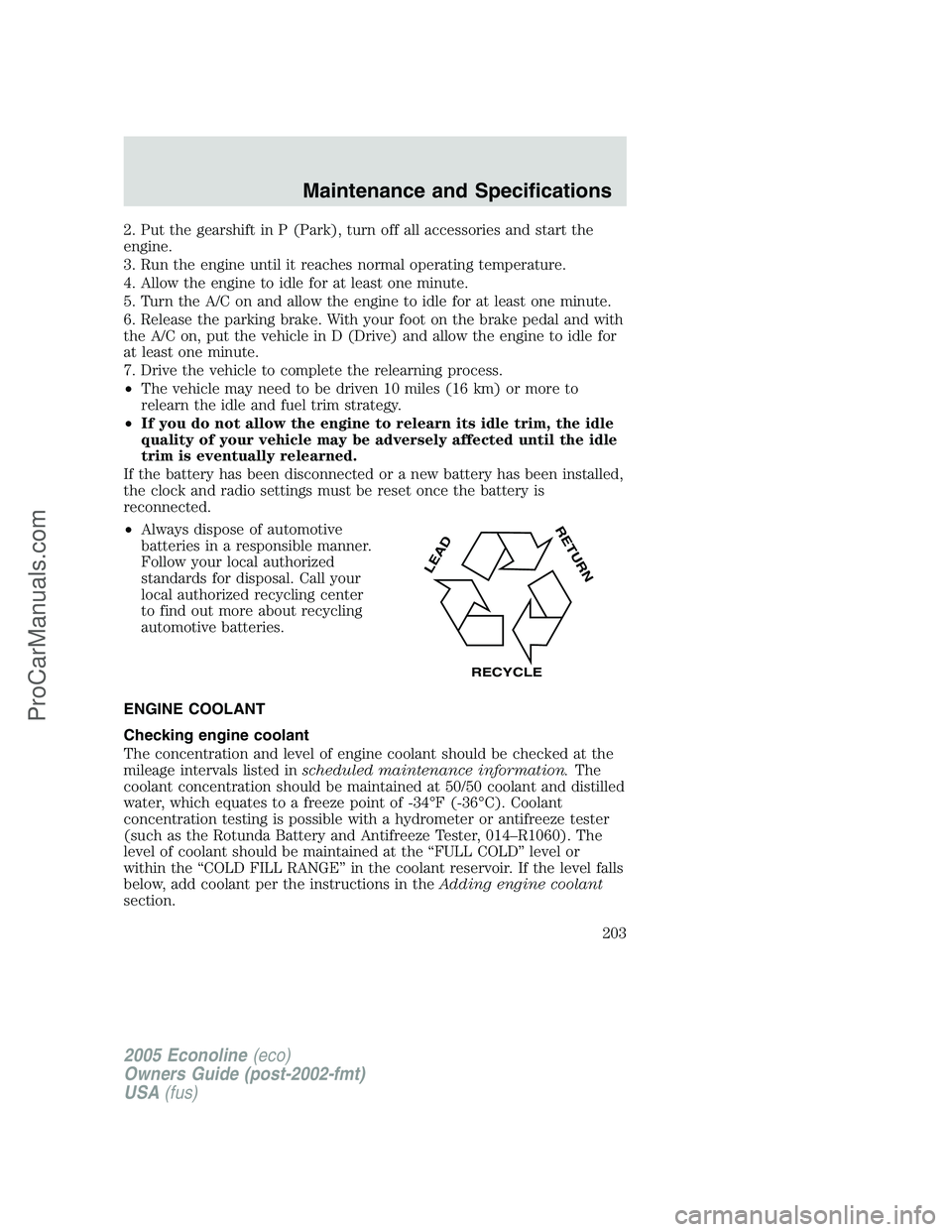
•Always dispose of automotive
batteries in a responsible manner.
Follow your local authorized
standards for disposal. Call your
local authorized recycling center
to find out more about recycling
automotive batteries.
ENGINE COOLANT
Checking engine coolant
The concentration and level of engine coolant should be checked at the
mileage intervals listed inscheduled maintenance information.The
coolant concentration should be maintained at 50/50 coolant and distilled
water, which equates to a freeze point of -34°F (-36°C). Coolant
concentration testing is possible with a hydrometer or antifreeze tester
(such as the Rotunda Battery and Antifreeze Tester, 014–R1060). The
level of coolant should be maintained at the “FULL COLD” level or
within the “COLD FILL RANGE” in the coolant reservoir. If the level falls
below, add coolant per the instructions in theAdding engine coolant
section.
L
E
A
D
RETURN
RECYCLE
2005 Econoline(eco)
Owners Guide (post-2002-fmt)
USA(fus)
Maintenance and Specifications
203
ProCarManuals.com
Page 239 of 248
Scuff plates
Speed control
Lifestyle
Mobile-ease hands-free communication system
Trailer hitches, wiring harnesses and accessories
Peace of mind
First aid and highway safety kits
Keyless entry keypad
Remote start
Vehicle security systems
For maximum vehicle performance, keep the following information in
mind when adding accessories or equipment to your vehicle:
•When adding accessories, equipment, passengers and luggage to your
vehicle, do not exceed the total weight capacity of the vehicle or of
the front or rear axle (GVWR or GAWR as indicated on the Safety
Compliance Certification label). Consult your dealer for specific weight
information.
•The Federal Communications Commission (FCC) and Canadian Radio
Telecommunications Commission (CRTC) regulate the use of mobile
communications systems — such as two-way radios, telephones and
theft alarms - that are equipped with radio transmitters. Any such
equipment installed in your vehicle should comply with FCC or CRTC
regulations and should be installed only by a qualified service
technician.
•Mobile communications systems may harm the operation of your
vehicle, particularly if they are not properly designed for automotive
use.
•To avoid interference with other vehicle functions, such as anti-lock
braking systems, amateur radio users who install radios and antennas
onto their vehicle should not locate the Amateur Radio Antennas in
the area of the driver’s side hood.
•Electrical or electronic accessories or components that are added to
the vehicle by the dealer or the owner may adversely affect battery
performance and durability.
2005 Econoline(eco)
Owners Guide (post-2002-fmt)
USA(fus)
Accessories
239
ProCarManuals.com
Page 240 of 248
A
Accessory delay ..........................56
Air cleaner filter ...............223–224
Airbag supplemental restraint
system ..........................................82
and child safety seats ..............84
description ................................82
disposal ......................................86
driver airbag ..............................84
indicator light ...........................86
operation ...................................84
passenger airbag .......................84
Ambulance packages ....................8
Antifreeze
(see Engine coolant) ................203
Anti-lock brake system
(see Brakes) ..............................149
Audio system
(see Radio) ....18–19, 22, 25, 28, 32
Automatic transmission
driving an automatic
overdrive .................154, 156, 159
fluid, adding ............................220
fluid, checking ........................220
fluid, refill capacities ..............226
fluid, specification ..................233
Auxiliary power point .................55
Axle
lubricant specifications ..230, 233
refill capacities ........................226
traction lok ..............................151
B
Battery .......................................201
acid, treating emergencies .....201
jumping a disabled battery ....174
maintenance-free ....................201replacement, specifications ...224
servicing ..................................201
BeltMinder ...................................77
Brakes ........................................149
anti-lock ...................................149
anti-lock brake system (ABS)
warning light ...........................149
fluid, checking and adding ....220
fluid, refill capacities ..............226
fluid, specifications .........230, 233
lubricant specifications ..230, 233
parking ....................................150
shift interlock ..........................153
Break-in period .............................6
Bulbs ............................................46
C
Capacities for refilling fluids ....226
Cell phone use ............................55
Child safety restraints ................87
child safety belts ......................87
Child safety seats ........................90
in front seat ..............................91
in rear seat ................................91
tether anchorage hardware .....94
Cleaning your vehicle
engine compartment ..............190
exterior ....................................193
instrument panel ....................192
interior .....................................192
interior trim ............................192
plastic parts ............................191
safety belts ..............................192
washing ....................................189
waxing .....................................189
wheels ......................................190
wiper blades ............................191
2005 Econoline(eco)
Owners Guide (post-2002-fmt)
USA(fus)
Index
240
ProCarManuals.com