brakes FORD E-450 2002 User Guide
[x] Cancel search | Manufacturer: FORD, Model Year: 2002, Model line: E-450, Model: FORD E-450 2002Pages: 256, PDF Size: 3.52 MB
Page 148 of 256
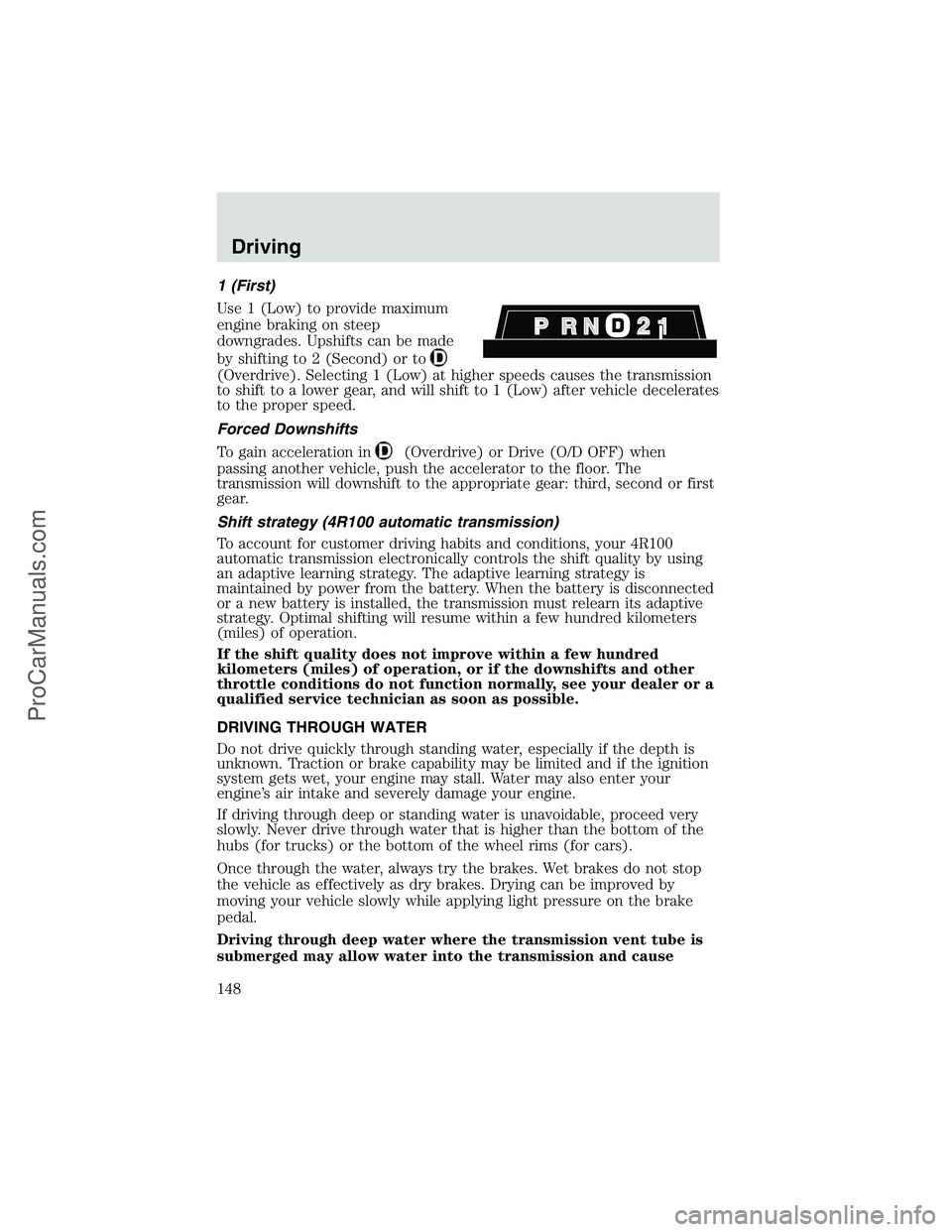
1 (First)
Use 1 (Low) to provide maximum
engine braking on steep
downgrades. Upshifts can be made
by shifting to 2 (Second) or to
(Overdrive). Selecting 1 (Low) at higher speeds causes the transmission
to shift to a lower gear, and will shift to 1 (Low) after vehicle decelerates
to the proper speed.
Forced Downshifts
To gain acceleration in
(Overdrive) or Drive (O/D OFF) when
passing another vehicle, push the accelerator to the floor. The
transmission will downshift to the appropriate gear: third, second or first
gear.
Shift strategy (4R100 automatic transmission)
To account for customer driving habits and conditions, your 4R100
automatic transmission electronically controls the shift quality by using
an adaptive learning strategy. The adaptive learning strategy is
maintained by power from the battery. When the battery is disconnected
or a new battery is installed, the transmission must relearn its adaptive
strategy. Optimal shifting will resume within a few hundred kilometers
(miles) of operation.
If the shift quality does not improve within a few hundred
kilometers (miles) of operation, or if the downshifts and other
throttle conditions do not function normally, see your dealer or a
qualified service technician as soon as possible.
DRIVING THROUGH WATER
Do not drive quickly through standing water, especially if the depth is
unknown. Traction or brake capability may be limited and if the ignition
system gets wet, your engine may stall. Water may also enter your
engine’s air intake and severely damage your engine.
If driving through deep or standing water is unavoidable, proceed very
slowly. Never drive through water that is higher than the bottom of the
hubs (for trucks) or the bottom of the wheel rims (for cars).
Once through the water, always try the brakes. Wet brakes do not stop
the vehicle as effectively as dry brakes. Drying can be improved by
moving your vehicle slowly while applying light pressure on the brake
pedal.
Driving through deep water where the transmission vent tube is
submerged may allow water into the transmission and cause
Driving
148
ProCarManuals.com
Page 154 of 256
GCWR (Gross Combined Weight Rating)/Trailer Weights
EngineRear
axle
ratioMaximum
GCWR - kg
(lbs.)Trailer weight
range - kg
(lbs.)
(0-Maximum)Maximum
frontal area of
trailer - m
2
(ft2)
E-350 Stripped Chassis (dual rear wheel)
5.4L 4.10 5897 (13000) 1361 (3000) 5.52 (60)
E-450 Stripped Chassis (dual rear wheel)
5.4L 4.10 5897 (13000) 1361 (3000) 5.52 (60)
6.8L 4.56 9072 (20000) * 5.52 (60)
E-550 Cutaway (dual rear wheel)
6.8L 4.88/5.38 9072 (20000) * 5.52 (60)
* Maximum trailer weight for all cutaway (E-350 and E-450) vehicles
must be calculated by subtracting the weight of the vehicle (including
incomplete vehicle weight, and payload which includes second unit
body weight, cargo, and passengers) from the GCW. Otherwise,
maximum trailer weight is 4536 kg (10000 lbs).
For high altitude operation reduce GCWR by 2% per 300 meters (1000
ft) elevation.
To determine the maximum trailer weight designed for your particular
vehicle as equipped, follow the sectionCalculating the load your
vehicle can tow/carryearlier in this chapter.
Your vehicle’s load capacity is designated by weight, not by volume, so
you cannot necessarily use all available space when loading a vehicle.
Distribute the load so that only 10 to 15% of the total is on the tongue.
Tie down the load so that it does not shift and change the weight on the
hitch.
Towing a trailer places an additional load on your vehicle’s engine,
transmission, axle, brakes, tires and suspension. Inspect these
components carefully after any towing operation.
Note:Do not exceed the GVWR or the GAWR specified on the
certification label.
Towing trailers beyond the maximum recommended gross trailer
weight exceeds the limit of the vehicle and could result in
engine damage, transmission damage, structural damage, loss of vehicle
control, vehicle rollover and personal injury.
Driving
154
ProCarManuals.com
Page 155 of 256
Preparing to tow
Use the proper equipment for towing a trailer and make sure it is
properly attached to your vehicle. See your dealer or a reliable trailer
dealer if you require assistance.
Hitches
Do not use or install hitches that clamp onto the bumper or to the axle.
Underbody hitches are acceptable if installed properly.
Safety chains
Always connect the trailer’s safety chains to the frame or hook retainers
of the vehicle hitch. To connect the trailer’s safety chains, cross the
chains under the trailer tongue and allow slack for turning corners.
If you use a rental trailer, follow the instructions that the rental agency
gives to you.
Do not attach safety chains to the bumper.
Trailer brakes
Electric brakes and manual, automatic or surge-type trailer brakes are
safe if installed properly and adjusted to the manufacturer’s
specifications. The trailer brakes must meet local and Federal
regulations.
Do not connect a trailer’s hydraulic brake system directly to your
vehicle’s brake system. Your vehicle may not have enough
braking power and your chances of having a collision greatly increase.
The braking system of the tow vehicle is rated for operation at the
GVWR not GCWR.
Trailer lamps
Trailer lamps are required on most towed vehicles. Make sure your
trailer lamps conform to local and Federal regulations. See your dealer or
trailer rental agency for proper instructions and equipment for hooking
up trailer lamps.
Using a step bumper (if equipped)
The rear bumper is equipped with an integral hitch and only requires a
ball with a 25.4 mm (one inch) shank diameter. The bumper has a 2,270
kg (5,000 lb.) trailer weight and 227 kg (500 lb.) tongue weight capacity.
Driving
155
ProCarManuals.com
Page 156 of 256
If it is necessary to relocate the trailer hitch ball position, a
frame-mounted trailer hitch must be installed.
Driving while you tow
When towing a trailer:
•Turn off the speed control. The speed control may shut off
automatically when you are towing on long, steep grades.
•Consult your local motor vehicle speed regulations for towing a trailer.
•To eliminate excessive shifting, use a lower gear. This will also assist
in transmission cooling.
•Anticipate stops and brake gradually.
When descending long, steep downhill grades, always use a lower gear to
provide engine braking to save wear on brakes. Use Drive (Overdrive
OFF) on moderately steep hills, Second (2) on steep hills, and First (1)
on very steep hills.Do not apply your brakes continuously, as they
may overheat and become less effective.
Servicing after towing
If you tow a trailer for long distances, your vehicle will require more
frequent service intervals. Refer to your scheduled maintenance guide for
more information.
Trailer towing tips
•Practice turning, stopping and backing up before starting on a trip to
get the feel of the vehicle trailer combination. When turning, make
wider turns so the trailer wheels will clear curbs and other obstacles.
•Allow more distance for stopping with a trailer attached.
•The trailer tongue weight should be 10–15% of the loaded trailer
weight.
•If you will be towing a trailer frequently in hot weather, hilly
conditions, at GCW, or any combination of these factors, consider
refilling your rear axle with synthetic gear lube. Refer to the
Maintenance and specificationschapter for the lubricant
specification.
•After you have traveled 80 km (50 miles), thoroughly check your
hitch, electrical connections and trailer wheel lug nuts.
•When stopped in traffic for long periods of time in hot weather, place
the gearshift in P (Park) and increase idle speed. This aids engine
cooling and air conditioner efficiency.
Driving
156
ProCarManuals.com
Page 227 of 256
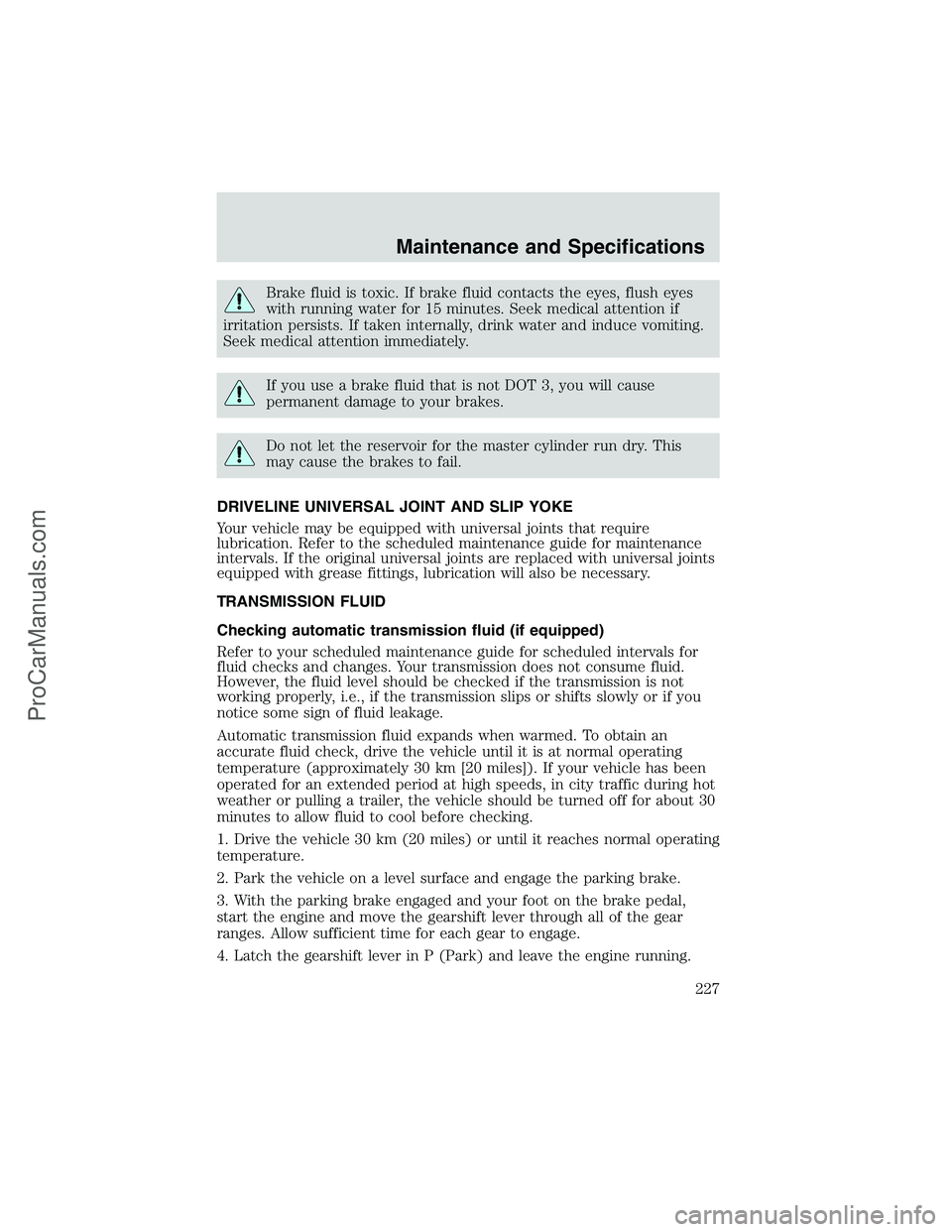
Brake fluid is toxic. If brake fluid contacts the eyes, flush eyes
with running water for 15 minutes. Seek medical attention if
irritation persists. If taken internally, drink water and induce vomiting.
Seek medical attention immediately.
If you use a brake fluid that is not DOT 3, you will cause
permanent damage to your brakes.
Do not let the reservoir for the master cylinder run dry. This
may cause the brakes to fail.
DRIVELINE UNIVERSAL JOINT AND SLIP YOKE
Your vehicle may be equipped with universal joints that require
lubrication. Refer to the scheduled maintenance guide for maintenance
intervals. If the original universal joints are replaced with universal joints
equipped with grease fittings, lubrication will also be necessary.
TRANSMISSION FLUID
Checking automatic transmission fluid (if equipped)
Refer to your scheduled maintenance guide for scheduled intervals for
fluid checks and changes. Your transmission does not consume fluid.
However, the fluid level should be checked if the transmission is not
working properly, i.e., if the transmission slips or shifts slowly or if you
notice some sign of fluid leakage.
Automatic transmission fluid expands when warmed. To obtain an
accurate fluid check, drive the vehicle until it is at normal operating
temperature (approximately 30 km [20 miles]). If your vehicle has been
operated for an extended period at high speeds, in city traffic during hot
weather or pulling a trailer, the vehicle should be turned off for about 30
minutes to allow fluid to cool before checking.
1. Drive the vehicle 30 km (20 miles) or until it reaches normal operating
temperature.
2. Park the vehicle on a level surface and engage the parking brake.
3. With the parking brake engaged and your foot on the brake pedal,
start the engine and move the gearshift lever through all of the gear
ranges. Allow sufficient time for each gear to engage.
4. Latch the gearshift lever in P (Park) and leave the engine running.
Maintenance and Specifications
227
ProCarManuals.com
Page 251 of 256
A
ABS (see Brakes) .....................141
Air bag supplemental restraint
system ................................119–120
and child safety seats ............121
description ..............................120
disposal ....................................124
driver air bag ..........................122
indicator light ...................12, 123
operation .................................122
passenger air bag ...................122
Air cleaner filter ...............229, 235
Air conditioning
manual heating and air
conditioning system .................71
Ambulance packages ....................6
Antifreeze (see Engine
coolant) .....................................209
Anti-lock brake system
(see Brakes) ..............................141
Audio system
(see Radio) ................17, 22, 28, 36
Automatic transmission
driving an automatic
overdrive .................................146
fluid, adding ............................227
fluid, checking ........................227
fluid, refill capacities ..............236
fluid, specification ..................243
Auxiliary power point .................86
Axle
lubricant specifications ..240, 243
refill capacities ........................236
traction lok ..............................143
B
Battery .......................................204acid, treating emergencies .....204
charging system warning
light ............................................12
disconnecting ..........................206
jumping a disabled battery ....175
maintenance-free ....................204
replacement, specifications ...235
servicing ..................................204
voltage gauge ............................15
BeltMinder .................................115
Brakes ........................................140
anti-lock ...................................141
anti-lock brake system (ABS)
warning light .....................12, 142
brake warning light ..................11
fluid, checking and adding ....226
fluid, refill capacities ..............236
fluid, specifications .........240, 243
lubricant specifications ..240, 243
shift interlock ..........................145
Break-in period .............................5
Bulbs ............................................79
C
Capacities for refilling fluids ....236
CD-6 disc .....................................36
CD-single premium .....................28
Changing a tire .........................168
Child safety restraints ..............125
child safety belts ....................125
Child safety seats ......................127
in front seat ............................129
in rear seat ..............................129
tether anchorage hardware ...131
Cleaning your vehicle
engine compartment ..............192
exterior ....................................195
instrument panel ....................194
Index
251
ProCarManuals.com
Page 254 of 256
Infant seats
(see Safety seats) .....................127
Inspection/maintenance (I/M)
testing ........................................224
Instrument panel
cleaning ...................................194
cluster ........................................10
lighting up panel and
interior .......................................77
J
Jack ............................................168
positioning ...............................168
storage .....................................168
Jump-starting your vehicle ......175
K
Keys
key in ignition chime ...............14
positions of the ignition .........136
L
Lamps
bulb replacement
specifications chart ..................79
cargo lamps ...............................77
daytime running light ...............76
headlamps .................................76
headlamps, flash to pass ..........77
instrument panel, dimming .....77
interior lamps ...........................78
replacing bulbs ...................79–83
Lane change indicator
(see Turn signal) ........................77
Lights, warning and indicator ....10
air bag ........................................12
anti-lock brakes (ABS) ....12, 142
brake ..........................................11charging system ........................12
check coolant ............................13
cruise indicator .........................13
engine oil pressure ...................13
high beam .................................13
low fuel ......................................12
safety belt .................................12
service engine soon ..................10
speed control ............................92
turn signal indicator .................13
Limited slip axle (see Traction
Loc) ............................................143
Load limits .................................149
GAWR ......................................149
GVWR ......................................149
trailer towing ..........................149
Loading instructions .................150
Lubricant specifications ...240, 243
Lumbar support, seats .............102
M
Mirrors
fold away ...................................88
side view mirrors (power) .......87
Motorcraft parts ................220, 235
O
Octane rating ............................219
Odometer .....................................16
Oil (see Engine oil) ..................201
Overdrive .....................................92
P
Panic alarm feature, remote
entry system ................................99
Parking brake ............................142
Index
254
ProCarManuals.com