maintenance FORD F650 2013 12.G User Guide
[x] Cancel search | Manufacturer: FORD, Model Year: 2013, Model line: F650, Model: FORD F650 2013 12.GPages: 378, PDF Size: 3.82 MB
Page 110 of 378
3. The accelerator pedal, service brake pedal, and clutch pedal
(if equipped) must not be pressed.
4. The parking brake must remain set.
On average (depending on filter level and other factors), the process
takes 20–30 minutes to complete. The DPF lamp turns off when the
process is complete. Repeat Steps 1–5, if parked regeneration is
interrupted.
To Discontinue Parked Regeneration
Press any of the floor pedals to discontinue parked regeneration.
Maintenance and Service
The DPF is designed to retain a relatively large amount of residual ash
and provide many miles and hours of maintenance-free operation. At
some point, generally beyond 150000 miles (240000 kilometers) or
5000 hours of operation (whichever comes first), the DPF requires
professional cleaning to remove the accumulated ash.
The exact number of miles or hours of operation varies greatly
depending upon vehicle and engine loading and operating conditions, ash
content of the engine oil, and quality of the diesel fuel used in your
truck. Adhering to your engine manufacturer’s recommended oil and fuel
specifications maximizes the miles and hours of operation before a DPF
professional cleaning is required. See your engine manufacturer’s owner’s
manual for more details regarding recommended maintenance and
service of your DPF.
Exhaust Outlet Assembly
WARNING:The normal operating temperature of the exhaust
system is very high. Never work around or attempt to repair any
part of the exhaust system until it has cooled. Failure to follow these
instructions may result in serious personal injury.
Note:Do not modify or remove this device. Modification of the system
or additions of aftermarket devices can reduce the effectiveness of the
system, as well as cause damage to the exhaust system or engine. Any
modifications may also invalidate the vehicle and/or engine warranties.
See your warranty information.
Note:Blocked or plugged holes or modification to, or removal of, the
outlet assembly could result in elevated exhaust temperatures which may
result in vehicle or property damage or personal injury.
Starting and Stopping the Engine109
2013 F-650/750(f67)
Owners Guide gf, 2nd Printing, March 2013
USA(fus)
Page 132 of 378
Cooling System:
•Inspect the fan for blade damage. If damage is found, replace with
the recommended parts. Inspect for fan-to-shroud interference and
any damage to shroud, such as cracks and holes.
•Do not change fan ratio or alter fan spacer dimensions and positions.
•Inspect fan clutch for proper operation. Make sure the fan is
disengaged when cooling of the engine is not required.
•Inspect radiator shutters (if equipped) for proper operation. The
shutters should be open during normal operating temperatures.
Engine:Valve covers and block covers are made to damp-out engine
mechanical noise and, if needed, should be replaced with recommended
parts. Check for mechanical isolations.
Transmission Enclosure:Inspect for cracks, holes and tears. Clean any
deposits, such as oil, dirt and stones.
Exhaust System:
•Inspect for leaks at various joint connections and loose clamps.
•Perform a visual inspection for cracks or holes in the muffler and tail
pipe.
•Always use the recommended parts when items need to be replaced.
•Do not change the tail pipe elbow or offset tail pipe orientation from
the standard position as originally received.
•To avoid abnormal changes in vehicle sound levels, it is necessary for
the owner to perform inspections and necessary maintenance at the
intervals shown in theScheduled Maintenancechapter.
Fuel and Refueling131
2013 F-650/750(f67)
Owners Guide gf, 2nd Printing, March 2013
USA(fus)
Page 134 of 378
Shifting with a Non-Synchronized Transmission
SeeClutch brakeandDouble clutch proceduresin theClutchsection
of this chapter.
Clutch
Do not ride or slip the clutch as this causes unnecessary heat and wear.
Maintain the specified clutch adjustment to prolong its life and regularly
inspect the clutch control linkage for tightness. See theScheduled
Maintenancechapter for other maintenance information. When
adjustment of the clutch is necessary, it is very important that the work
be performed properly or early clutch failure may result and a costly
clutch overhaul may become necessary. Clutch work should only be
performed by a qualified technician.
Note:Continued use of a damaged or worn clutch, prolonged clutch
slippage or downshifting at excessive speeds can result in a failure of the
engine, transmission or clutch components.
Note:To avoid premature clutch wear and failure, do not drive with
your foot resting on the clutch pedal or use it to hold the vehicle at a
standstill on an upgrade as when waiting for a traffic light.
Engaging the Clutch
•Always start in the proper gear.An empty vehicle can start in a
higher gear than a fully-loaded vehicle. Starting in too high a gear can
cause clutch slippage and excessive heat and wear on the clutch. A
gear that starts the vehicle moving at idle speed is the correct gear. If
the engine has to be revved to get the vehicle going, the gear
selection is too high.
•Do not shift until the vehicle has reached the proper speed.
Upshifting before the vehicle has reached the proper speed can cause
clutch slippage and excessive heat and wear on the clutch.
•Never hold a vehicle on a grade with the clutch.This causes the
clutch to slip and can actually burn up the clutch.
•Never coast with the clutch disengaged.The high RPM
(sometimes over 10000) can actually burst the facing material of the
clutch.
•Never engage the clutch while coasting.Re-engaging the clutch
after coasting may not only cause a great shock to the clutch, but the
whole drivetrain. Internal engine damage or clutch and flywheel
failure can result from this.
Transmission133
2013 F-650/750(f67)
Owners Guide gf, 2nd Printing, March 2013
USA(fus)
Page 142 of 378
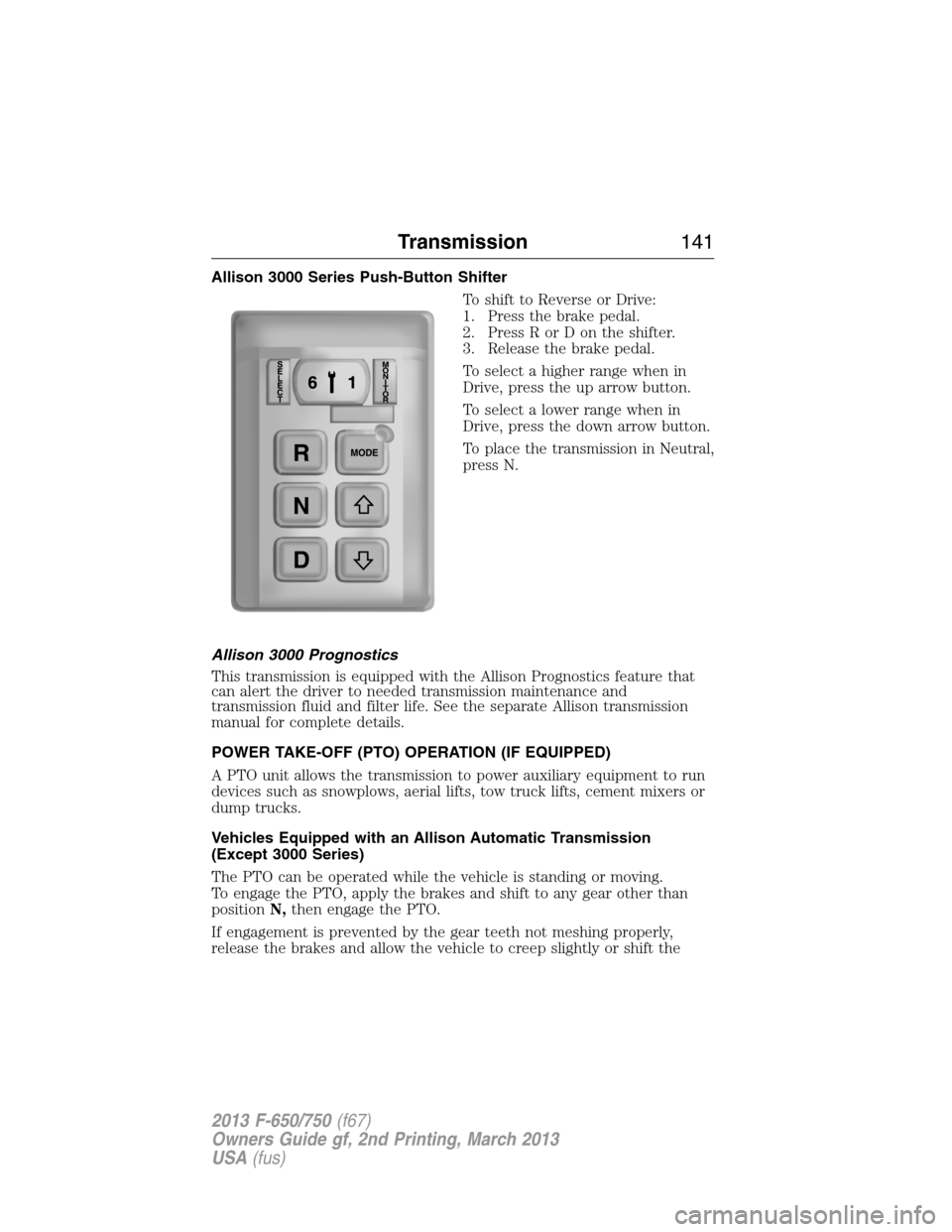
Allison 3000 Series Push-Button Shifter
To shift to Reverse or Drive:
1. Press the brake pedal.
2. Press R or D on the shifter.
3. Release the brake pedal.
To select a higher range when in
Drive, press the up arrow button.
To select a lower range when in
Drive, press the down arrow button.
To place the transmission in Neutral,
press N.
Allison 3000 Prognostics
This transmission is equipped with the Allison Prognostics feature that
can alert the driver to needed transmission maintenance and
transmission fluid and filter life. See the separate Allison transmission
manual for complete details.
POWER TAKE-OFF (PTO) OPERATION (IF EQUIPPED)
A PTO unit allows the transmission to power auxiliary equipment to run
devices such as snowplows, aerial lifts, tow truck lifts, cement mixers or
dump trucks.
Vehicles Equipped with an Allison Automatic Transmission
(Except 3000 Series)
The PTO can be operated while the vehicle is standing or moving.
To engage the PTO, apply the brakes and shift to any gear other than
positionN,then engage the PTO.
If engagement is prevented by the gear teeth not meshing properly,
release the brakes and allow the vehicle to creep slightly or shift the
Transmission141
2013 F-650/750(f67)
Owners Guide gf, 2nd Printing, March 2013
USA(fus)
Page 151 of 378
Air Chamber Stroke Indication
Air chamber push rods have orange stroke indicator markers that warn
when the braking system requires adjustment or repair. The orange
stripe is painted on the air chamber push rod at the slack adjuster stroke
dimension which requires service when visible during brake application.
Air brake inspection and adjustment or repairs should be performed by a
qualified service technician in accordance with the instructions in the
service manual.
Cam Brakes - Automatic Slack Adjusters
WARNING:Do not manually adjust the automatic slack adjusters
to correct excessive push rod stroke as it may result in reduced
brake effectiveness and a vehicle crash. Excessive push rod stroke
indicates that a problem exists with the automatic adjuster, with the
installation of the adjuster, or with foundation brake components that
manual adjustment does not remedy. Seek service from a qualified
facility for excessive push rod stroke.
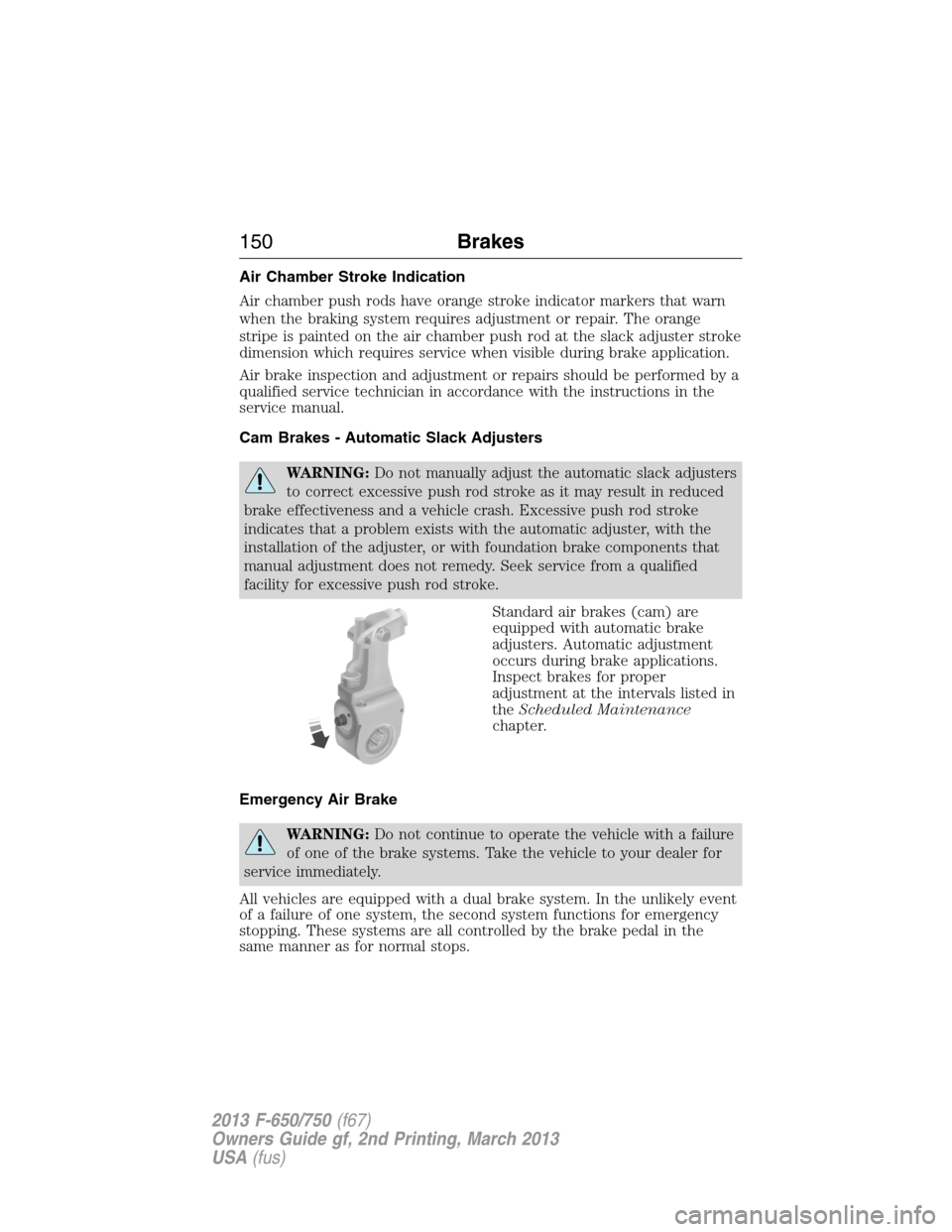
Standard air brakes (cam) are
equipped with automatic brake
adjusters. Automatic adjustment
occurs during brake applications.
Inspect brakes for proper
adjustment at the intervals listed in
theScheduled Maintenance
chapter.
Emergency Air Brake
WARNING:Do not continue to operate the vehicle with a failure
of one of the brake systems. Take the vehicle to your dealer for
service immediately.
All vehicles are equipped with a dual brake system. In the unlikely event
of a failure of one system, the second system functions for emergency
stopping. These systems are all controlled by the brake pedal in the
same manner as for normal stops.
150Brakes
2013 F-650/750(f67)
Owners Guide gf, 2nd Printing, March 2013
USA(fus)
Page 177 of 378
*Specific GCWR and maximum trailer weight applicable to a given
F–650/750 model is dependent on many variables including transmission
capability. Check with your sales consultant for the exact rating on your
vehicle.
ESSENTIAL TOWING CHECKS
Service your vehicle more frequently if you tow a trailer. See your
scheduled maintenance information.
For load specification terms found on the Tire Label and Safety
Compliance Certification Label and for instructions on calculating your
vehicle’s load, seeLoad limitin theLoad Carryingchapter.
Hitches
Do not use a hitch that either clamps onto the bumper or attaches to the
axle.
Distribute the trailer load so 10-15% of the total trailer weight is on the
tongue.
Safety Chains
Note:Do not attach safety chains to the bumper.
Always connect the trailer’s safety chains to the frame or hook retainers
of your vehicle hitch.
To connect the trailer’s safety chains, cross the chains under the trailer
tongue and allow enough slack for turning tight corners. Do not allow the
chains to drag on the ground.
Trailer Brakes
WARNING:Do not connect a trailer’s hydraulic brake system
directly to your vehicle’s brake system. Your vehicle may not have
enough braking power and your chances of having a crash greatly
increase.
Electric brakes and manual, automatic or surge-type trailer brakes are
safe if installed properly and adjusted to the manufacturer’s
specifications. The trailer brakes must meet local and federal regulations.
The braking system of the tow vehicle is rated for operation at
the GVWR not GCWR.
176Towing
2013 F-650/750(f67)
Owners Guide gf, 2nd Printing, March 2013
USA(fus)
Page 183 of 378
BREAKING-IN
You need to break in new tires for approximately 300 miles
(480 kilometers). During this time, your vehicle may exhibit some unique
driving characteristics. Avoid driving too fast during the first 1000 miles
(1600 kilometers). Vary your speed frequently and change up through
the gears early. Do not labor the engine.
ECONOMICAL DRIVING
Fuel economy is affected by several things such as how you drive, the
conditions you drive under and how you maintain your vehicle.
There are some things to keep in mind that may improve your fuel
economy:
•Accelerate and slow down in a smooth, moderate fashion.
•Drive at steady speeds without stopping.
•Anticipate stops; slowing down may eliminate the need to stop.
•Close the windows for high-speed driving.
•Drive at reasonable speeds (traveling at 55 mph [88 km/h] uses 15%
less fuel than traveling at 65 mph [105 km/h]).
•Keep the tires properly inflated and use only the recommended size.
•Use the recommended engine oil.
•Perform all regularly scheduled maintenance.
There are also some things you may not want to do because they may
reduce your fuel economy:
•Sudden or hard accelerations.
•Warm up your vehicle on cold mornings.
•Use the air conditioner or front defroster.
•Use the speed control in hilly terrain.
•Rest your foot on the brake pedal while driving.
•Carry unnecessary weight (approximately 1 mpg [0.4 km/L] is lost for
every 400 pounds [180 kilograms] of weight carried).
•Add particular accessories to your vehicle (e.g., bug deflectors,
rollbars and light bars, running boards, ski racks).
•Drive with the wheels out of alignment.
182Driving Hints
2013 F-650/750(f67)
Owners Guide gf, 2nd Printing, March 2013
USA(fus)
Page 190 of 378
GETTING THE SERVICES YOU NEED
Warranty repairs to your vehicle must be performed by an authorized
Ford dealer. While any authorized dealer handling your vehicle line will
provide warranty service, we recommend that you return to your
authorized selling dealer to ensure your continued satisfaction.
Please note that certain warranty repairs require special training or
equipment, so not all authorized dealers are authorized to perform all
warranty repairs. This means that, depending on the warranty repair
needed, you may need to take your vehicle to another authorized dealer.
If you have questions or concerns, or are unsatisfied with the service you
are receiving, follow these steps:
1. Contact your Sales Representative or Service Advisor at your selling
or servicing dealership.
2. If your inquiry or concern remains unresolved, contact the Sales
Manager or Service Manager at the dealership.
3. If the inquiry or concern cannot be resolved at the dealership level,
contact the Ford Commercial Vehicle Operations Hotline. Please have
the following information available:
•Vehicle Identification Number (VIN)
•your telephone number (home and business)
•the name of the authorized dealer and city where located
•the vehicle’s current odometer reading.
In some states, you must directly notify Ford in writing before pursuing
remedies under your state’s warranty laws. Ford is also allowed a final
repair attempt in some states.
In the United States:
Mailing address
Ford Motor Company
Commercial Vehicle Operations
PO Box 6248
Dearborn, MI 48121
Telephone
800-782-8627 (option #3)
(TDD for the hearing impaired: 1-800-232-5952)
Online
Additional information and resources are available online at
www.fleet.ford.com:
•U.S. dealer locator by Dealer Name, City/State, or Zip Code
•Owner Guides
•Maintenance Schedules
Customer Assistance189
2013 F-650/750(f67)
Owners Guide gf, 2nd Printing, March 2013
USA(fus)
Page 196 of 378
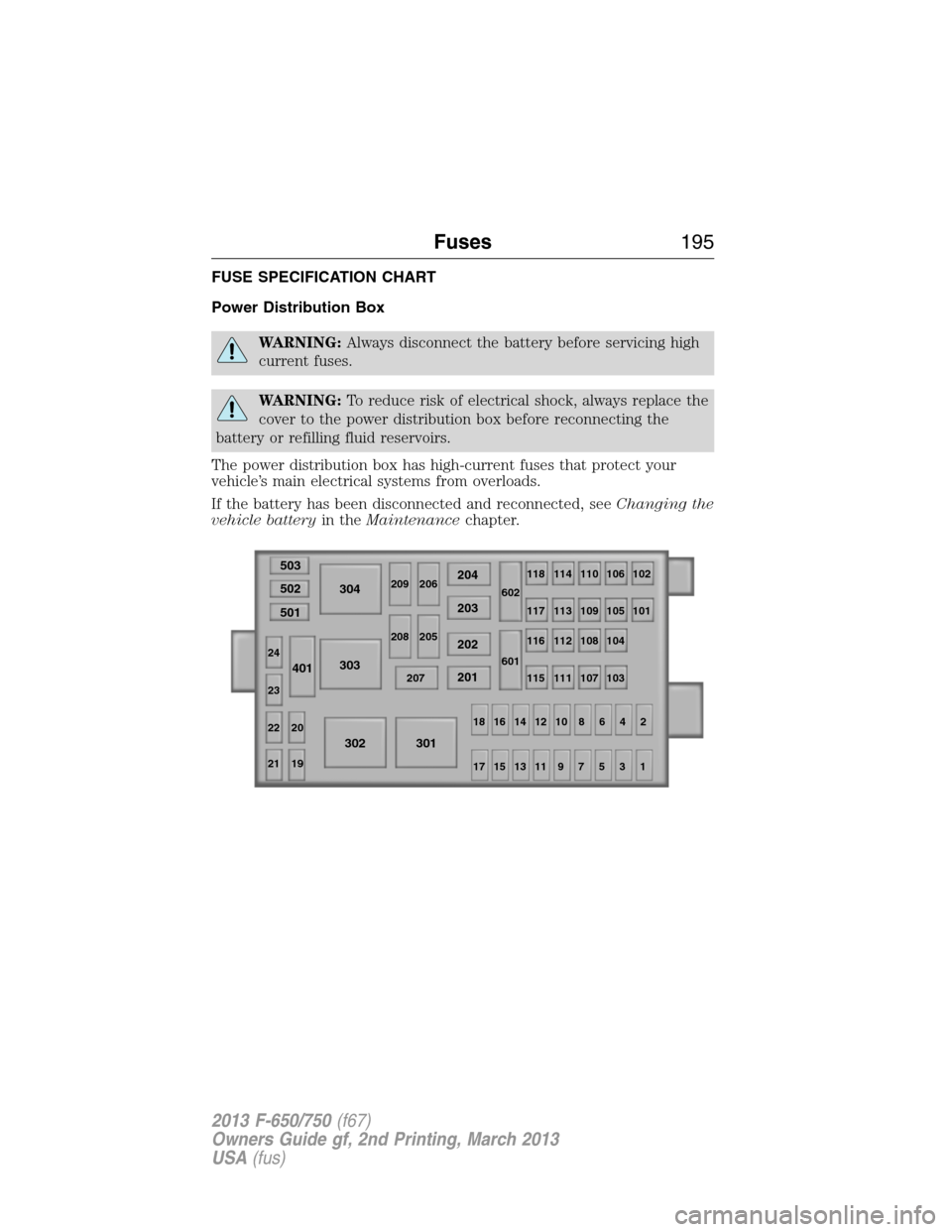
FUSE SPECIFICATION CHART
Power Distribution Box
WARNING:Always disconnect the battery before servicing high
current fuses.
WARNING:To reduce risk of electrical shock, always replace the
cover to the power distribution box before reconnecting the
battery or refilling fluid reservoirs.
The power distribution box has high-current fuses that protect your
vehicle’s main electrical systems from overloads.
If the battery has been disconnected and reconnected, seeChanging the
vehicle batteryin theMaintenancechapter.
503
502
304204
602118 114 110 106 102
117 113 109 105
116 112 108 104
115 111 107 103101
601 209
208206
205
207
203
202
201 303 501
401
302 301
18161412108642
1715131197531
24
23
22 20
21 19
Fuses195
2013 F-650/750(f67)
Owners Guide gf, 2nd Printing, March 2013
USA(fus)
Page 205 of 378
GENERAL INFORMATION
WARNING:Making modifications to various parts, components
and systems of the vehicle, such as brake and steering systems,
can adversely affect the quality, reliability and operation of your vehicle
and could result in property damage, personal injury or death. Such
modifications must be avoided.
WARNING:Failure to properly perform maintenance and
servicing procedures could result in vehicle damage, personal
injury or death.
WARNING:Take care when performing any maintenance,
system check or service on your vehicle. Some of the materials
may also be hazardous if used, serviced or handled improperly and
could result in property damage, personal injury or death.
Always use care when performing vehicle maintenance, repairs or system
checks. Improper or incomplete service could result in the vehicle not
working properly which may result in personal injury or damage to the
vehicle or equipment. It is the operator’s responsibility to see that the
vehicle receives proper care and maintenance. If you have any questions
about performing service, have the service done by a qualified technician.
Servicing Guidelines
When servicing your vehicle:
•always wear safety glasses for eye protection.
•always set the parking brake or chock the wheels.
•always use support stands, not a jack, when working under a raised
vehicle.
•always turn off the ignition unless a procedure requires the engine to
be running.
•always avoid contact with hot metal parts. Allow the components to
cool before working with, or around, them.
•always operate the engine in a well-ventilated area.
•do not wear loose-fitting clothing, hanging jewelry, watches or rings.
•do not smoke.
•do not work on the brakes or the clutch unless the proper
precautions are taken to avoid inhaling friction material dust.
Quality service parts are available through your dealer. If dealer parts are
not used, make sure the replacement parts are of equivalent quality.
204Maintenance
2013 F-650/750(f67)
Owners Guide gf, 2nd Printing, March 2013
USA(fus)