flat tire FORD F650 2013 12.G Owners Manual
[x] Cancel search | Manufacturer: FORD, Model Year: 2013, Model line: F650, Model: FORD F650 2013 12.GPages: 378, PDF Size: 3.82 MB
Page 24 of 378
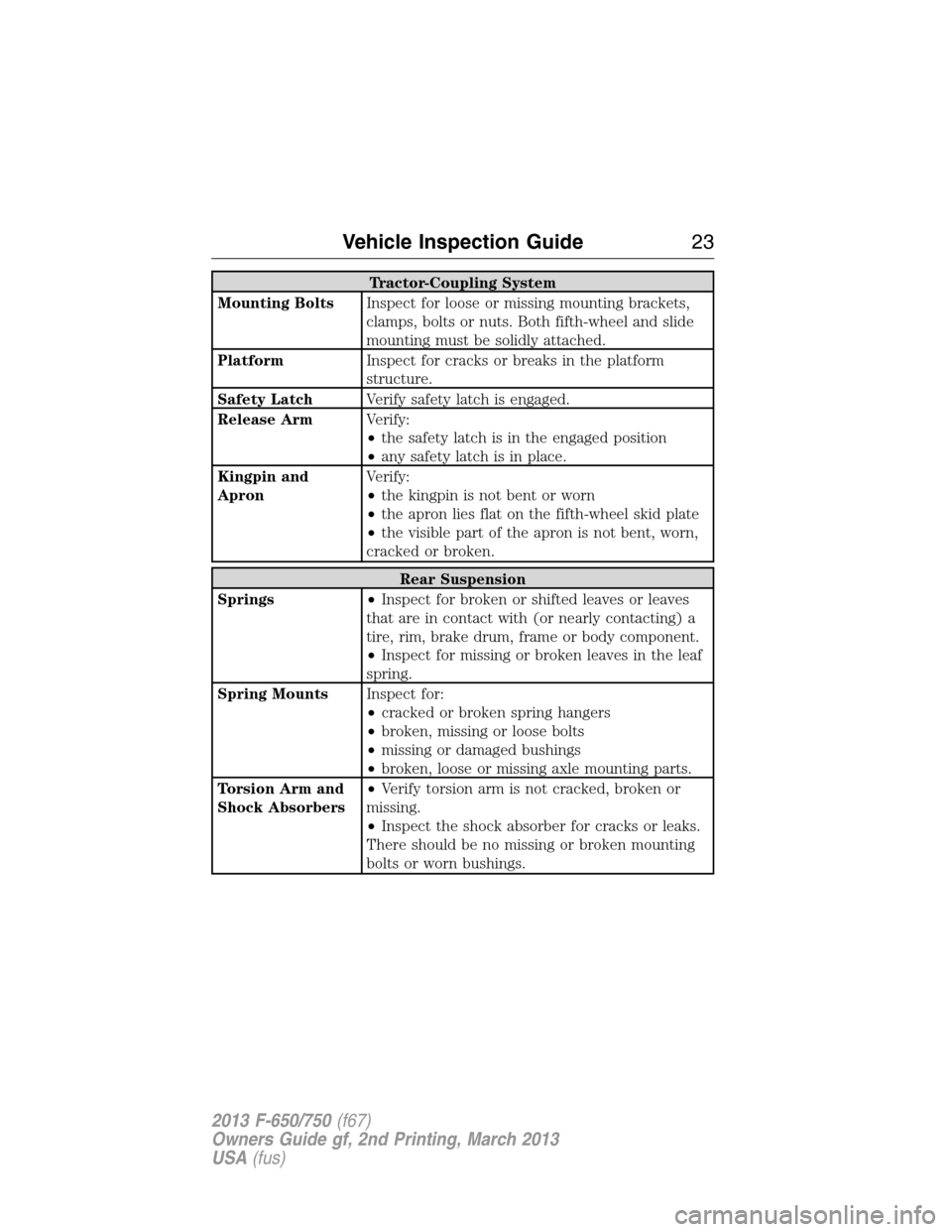
Tractor-Coupling System
Mounting BoltsInspect for loose or missing mounting brackets,
clamps, bolts or nuts. Both fifth-wheel and slide
mounting must be solidly attached.
PlatformInspect for cracks or breaks in the platform
structure.
Safety LatchVerify safety latch is engaged.
Release ArmVerify:
•the safety latch is in the engaged position
•any safety latch is in place.
Kingpin and
ApronVerify:
•the kingpin is not bent or worn
•the apron lies flat on the fifth-wheel skid plate
•the visible part of the apron is not bent, worn,
cracked or broken.
Rear Suspension
Springs•Inspect for broken or shifted leaves or leaves
that are in contact with (or nearly contacting) a
tire, rim, brake drum, frame or body component.
•Inspect for missing or broken leaves in the leaf
spring.
Spring MountsInspect for:
•cracked or broken spring hangers
•broken, missing or loose bolts
•missing or damaged bushings
•broken, loose or missing axle mounting parts.
Torsion Arm and
Shock Absorbers•Verify torsion arm is not cracked, broken or
missing.
•Inspect the shock absorber for cracks or leaks.
There should be no missing or broken mounting
bolts or worn bushings.
Vehicle Inspection Guide23
2013 F-650/750(f67)
Owners Guide gf, 2nd Printing, March 2013
USA(fus)
Page 171 of 378
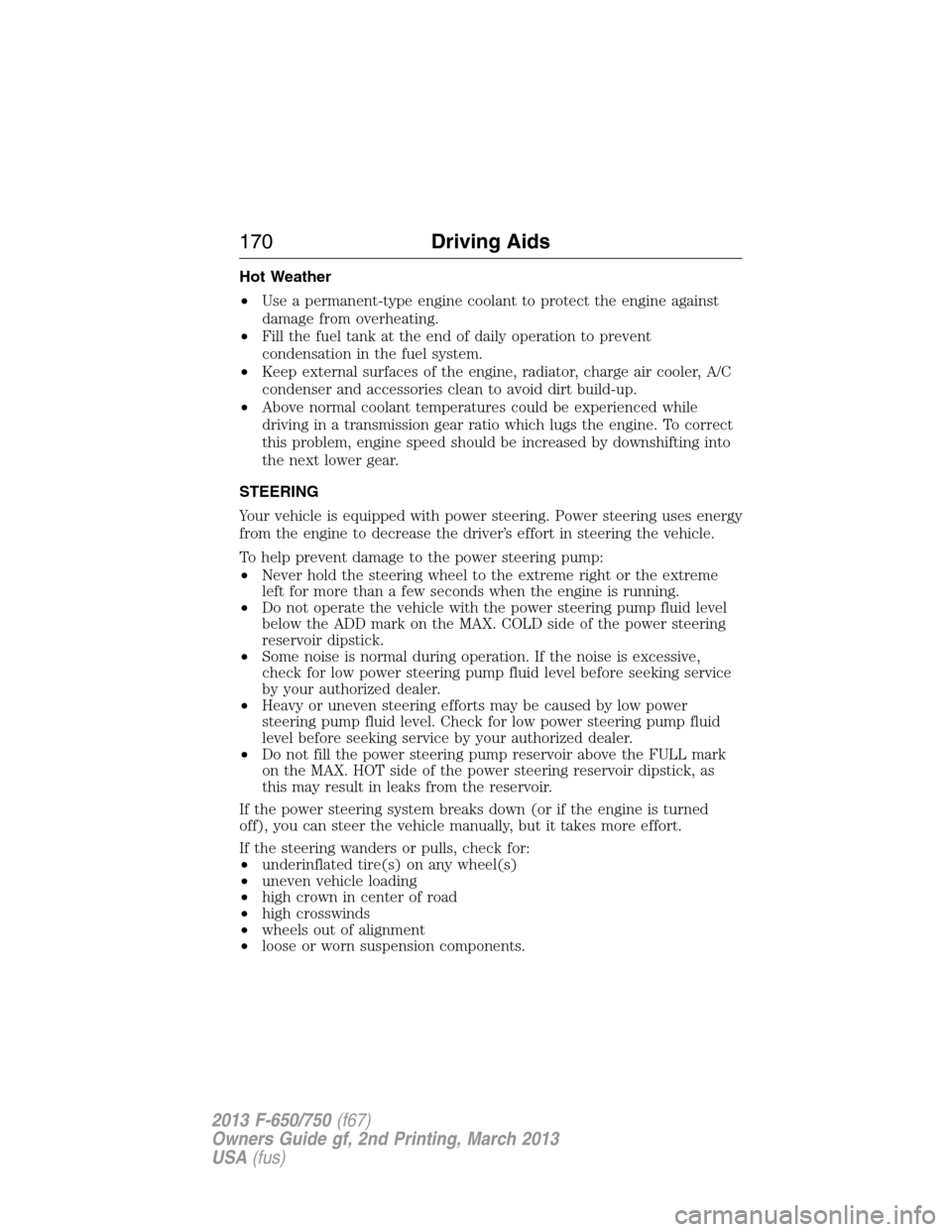
Hot Weather
•Use a permanent-type engine coolant to protect the engine against
damage from overheating.
•Fill the fuel tank at the end of daily operation to prevent
condensation in the fuel system.
•Keep external surfaces of the engine, radiator, charge air cooler, A/C
condenser and accessories clean to avoid dirt build-up.
•Above normal coolant temperatures could be experienced while
driving in a transmission gear ratio which lugs the engine. To correct
this problem, engine speed should be increased by downshifting into
the next lower gear.
STEERING
Your vehicle is equipped with power steering. Power steering uses energy
from the engine to decrease the driver’s effort in steering the vehicle.
To help prevent damage to the power steering pump:
•Never hold the steering wheel to the extreme right or the extreme
left for more than a few seconds when the engine is running.
•Do not operate the vehicle with the power steering pump fluid level
below the ADD mark on the MAX. COLD side of the power steering
reservoir dipstick.
•Some noise is normal during operation. If the noise is excessive,
check for low power steering pump fluid level before seeking service
by your authorized dealer.
•Heavy or uneven steering efforts may be caused by low power
steering pump fluid level. Check for low power steering pump fluid
level before seeking service by your authorized dealer.
•Do not fill the power steering pump reservoir above the FULL mark
on the MAX. HOT side of the power steering reservoir dipstick, as
this may result in leaks from the reservoir.
If the power steering system breaks down (or if the engine is turned
off), you can steer the vehicle manually, but it takes more effort.
If the steering wanders or pulls, check for:
•underinflated tire(s) on any wheel(s)
•uneven vehicle loading
•high crown in center of road
•high crosswinds
•wheels out of alignment
•loose or worn suspension components.
170Driving Aids
2013 F-650/750(f67)
Owners Guide gf, 2nd Printing, March 2013
USA(fus)
Page 183 of 378
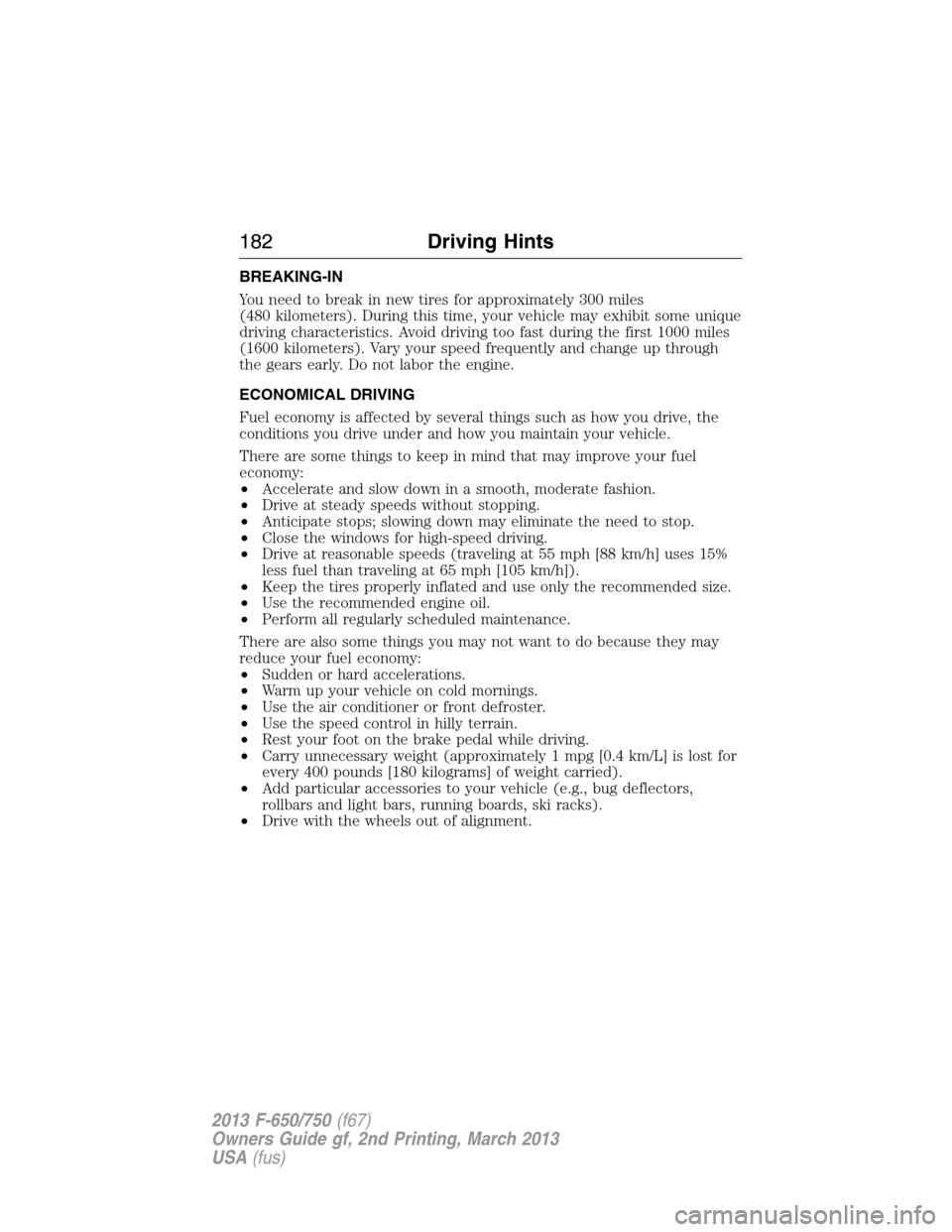
BREAKING-IN
You need to break in new tires for approximately 300 miles
(480 kilometers). During this time, your vehicle may exhibit some unique
driving characteristics. Avoid driving too fast during the first 1000 miles
(1600 kilometers). Vary your speed frequently and change up through
the gears early. Do not labor the engine.
ECONOMICAL DRIVING
Fuel economy is affected by several things such as how you drive, the
conditions you drive under and how you maintain your vehicle.
There are some things to keep in mind that may improve your fuel
economy:
•Accelerate and slow down in a smooth, moderate fashion.
•Drive at steady speeds without stopping.
•Anticipate stops; slowing down may eliminate the need to stop.
•Close the windows for high-speed driving.
•Drive at reasonable speeds (traveling at 55 mph [88 km/h] uses 15%
less fuel than traveling at 65 mph [105 km/h]).
•Keep the tires properly inflated and use only the recommended size.
•Use the recommended engine oil.
•Perform all regularly scheduled maintenance.
There are also some things you may not want to do because they may
reduce your fuel economy:
•Sudden or hard accelerations.
•Warm up your vehicle on cold mornings.
•Use the air conditioner or front defroster.
•Use the speed control in hilly terrain.
•Rest your foot on the brake pedal while driving.
•Carry unnecessary weight (approximately 1 mpg [0.4 km/L] is lost for
every 400 pounds [180 kilograms] of weight carried).
•Add particular accessories to your vehicle (e.g., bug deflectors,
rollbars and light bars, running boards, ski racks).
•Drive with the wheels out of alignment.
182Driving Hints
2013 F-650/750(f67)
Owners Guide gf, 2nd Printing, March 2013
USA(fus)
Page 207 of 378
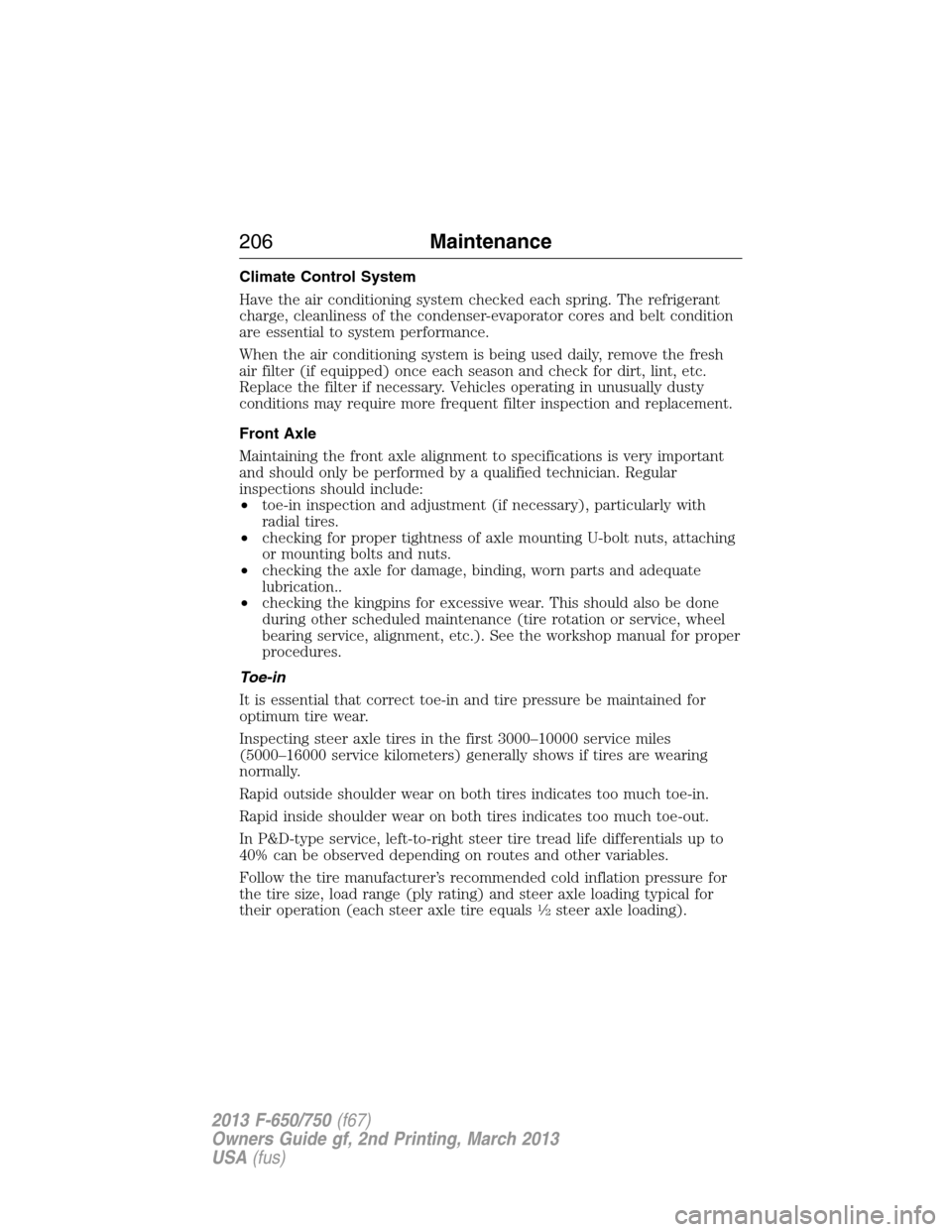
Climate Control System
Have the air conditioning system checked each spring. The refrigerant
charge, cleanliness of the condenser-evaporator cores and belt condition
are essential to system performance.
When the air conditioning system is being used daily, remove the fresh
air filter (if equipped) once each season and check for dirt, lint, etc.
Replace the filter if necessary. Vehicles operating in unusually dusty
conditions may require more frequent filter inspection and replacement.
Front Axle
Maintaining the front axle alignment to specifications is very important
and should only be performed by a qualified technician. Regular
inspections should include:
•toe-in inspection and adjustment (if necessary), particularly with
radial tires.
•checking for proper tightness of axle mounting U-bolt nuts, attaching
or mounting bolts and nuts.
•checking the axle for damage, binding, worn parts and adequate
lubrication..
•checking the kingpins for excessive wear. This should also be done
during other scheduled maintenance (tire rotation or service, wheel
bearing service, alignment, etc.). See the workshop manual for proper
procedures.
Toe-in
It is essential that correct toe-in and tire pressure be maintained for
optimum tire wear.
Inspecting steer axle tires in the first 3000–10000 service miles
(5000–16000 service kilometers) generally shows if tires are wearing
normally.
Rapid outside shoulder wear on both tires indicates too much toe-in.
Rapid inside shoulder wear on both tires indicates too much toe-out.
In P&D-type service, left-to-right steer tire tread life differentials up to
40% can be observed depending on routes and other variables.
Follow the tire manufacturer’s recommended cold inflation pressure for
the tire size, load range (ply rating) and steer axle loading typical for
their operation (each steer axle tire equals
12steer axle loading).
206Maintenance
2013 F-650/750(f67)
Owners Guide gf, 2nd Printing, March 2013
USA(fus)
Page 252 of 378
Removing Your Vehicle from Storage
When your vehicle is ready to come out of storage, do the following:
•Wash your vehicle to remove any dirt or grease film build-up on
window surfaces.
•Check windshield wipers for any deterioration.
•Check under the hood for any foreign material that may have
collected during storage (mice or squirrel nests).
•Check the exhaust for any foreign material that may have collected
during storage.
•Check tire pressures and set tire inflation per the Tire Label.
•Check brake pedal operation. Drive the vehicle 15 feet (4.5 meters)
back and forth to remove rust build-up.
•Check fluid levels (including engine coolant, engine oil and fuel) to
make sure there are no leaks and fluids are at recommended levels.
•If the battery was removed, clean the battery cable ends and inspect.
Contact your authorized dealer if you have any concerns or issues.
Vehicle Care251
2013 F-650/750(f67)
Owners Guide gf, 2nd Printing, March 2013
USA(fus)
Page 253 of 378
TIRES
Tire Inflation Information
WARNING:Always maintain your tires in good condition.
Frequently check and maintain correct inflation pressures as
specified by tire manufacturers. Inspect periodically for abnormal wear
patterns and repair/replace cut or broken tire casings. Always use
experienced, trained personnel with proper equipment and correct
procedures to mount or remove tires and wheels. Failure to adhere to
these warnings could result in wheel or tire malfunction, damage to
your vehicle, personal injury, or death.
WARNING:To avoid personal injury or death, always follow
these instructions when mounting radial tires on wheels:
•Only personnel that have had proper training and experience should
mount or remove tires from rims or wheels.
•Use only heavy-duty rims or approved rims for radial tires. It may be
necessary to contact your wheel and rim distributor to determine if
your rims are approved for radial tires.
•If a tube is to be used, make sure special radial tire tubes are used
because of the increased flexing of the sidewalls on radial tires.
•Never use anti-freeze, silicones, or petroleum-based lubricants when
mounting radial tires. Only an approved lubricant should be used as
an aid for mounting tires.
•Always inflate tires in a safety cage.
•Do not attempt to mix stud piloted wheels or fasteners with hub
piloted wheels or fasteners. To do so may cause premature wheel
failure resulting in property damage, personal injury, or death.
•Do not mix foreign (not made in North America) wheel mounting
parts with domestic (made in North America) parts. Many foreign
wheel components look similar to, but not exactly the same as
domestic made components. Mixing components could cause wheel
or fastener failures and result in property damage, personal injury, or
death.
252Wheels and Tires
2013 F-650/750(f67)
Owners Guide gf, 2nd Printing, March 2013
USA(fus)
Page 254 of 378
WARNING(Continued)
•Do not change from aluminum wheels to steel wheels or vice-versa
without changing the mounting hardware where required or, in some
cases with flange nut mounting systems, changing the hub and stud
assembly. Mixing components could cause wheel or fastener failures
and result in property damage, personal injury, or death.
WARNING:An inflated tire and rim can be very dangerous if
improperly used, serviced or maintained. To avoid serious injury,
never attempt to re-inflate a tire which has been run flat or seriously
under-inflated without first removing the tire from the wheel assembly
for inspection. Do not attempt to add air to tires or replace tires or
wheels without first taking precautions to protect persons and property.
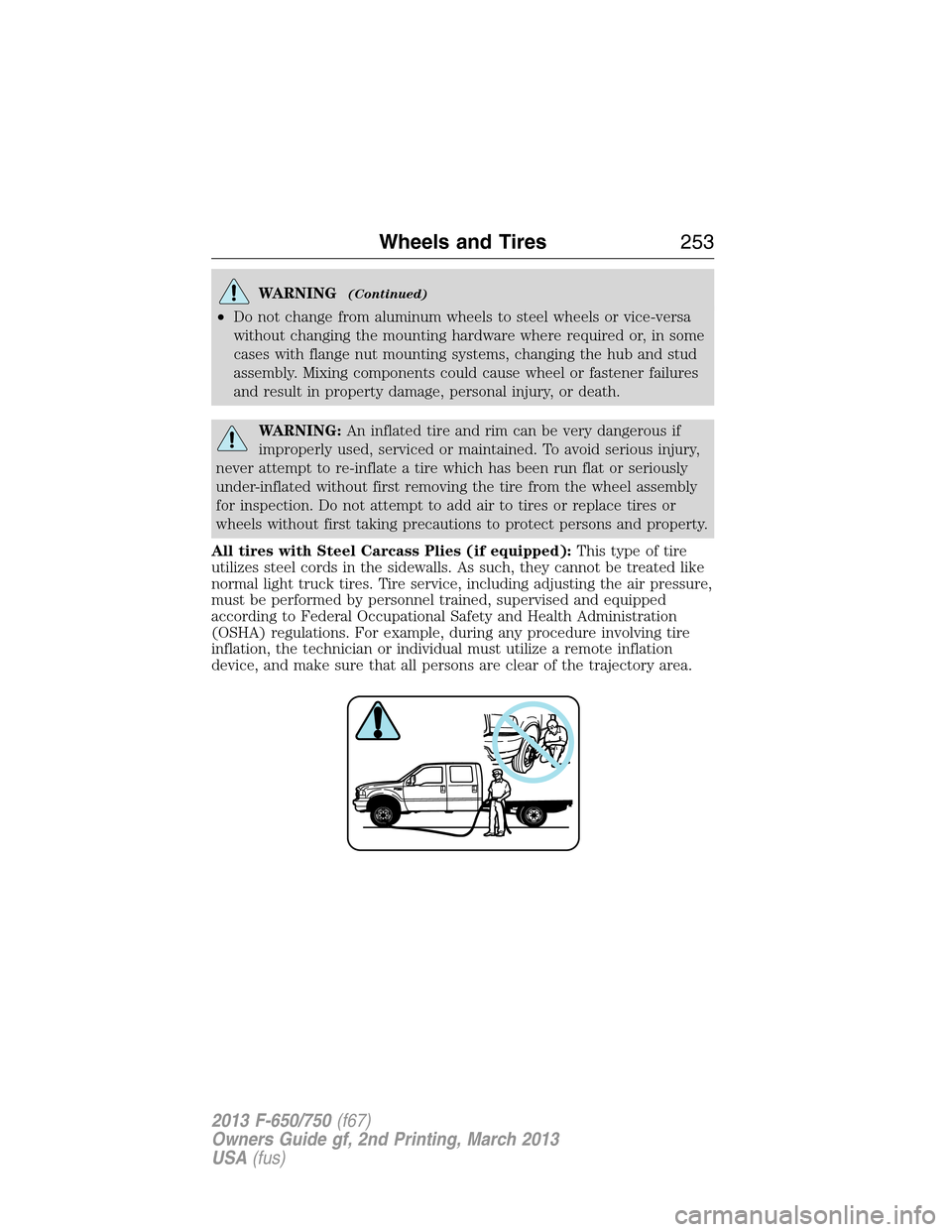
All tires with Steel Carcass Plies (if equipped):This type of tire
utilizes steel cords in the sidewalls. As such, they cannot be treated like
normal light truck tires. Tire service, including adjusting the air pressure,
must be performed by personnel trained, supervised and equipped
according to Federal Occupational Safety and Health Administration
(OSHA) regulations. For example, during any procedure involving tire
inflation, the technician or individual must utilize a remote inflation
device, and make sure that all persons are clear of the trajectory area.
Wheels and Tires253
2013 F-650/750(f67)
Owners Guide gf, 2nd Printing, March 2013
USA(fus)
Page 255 of 378
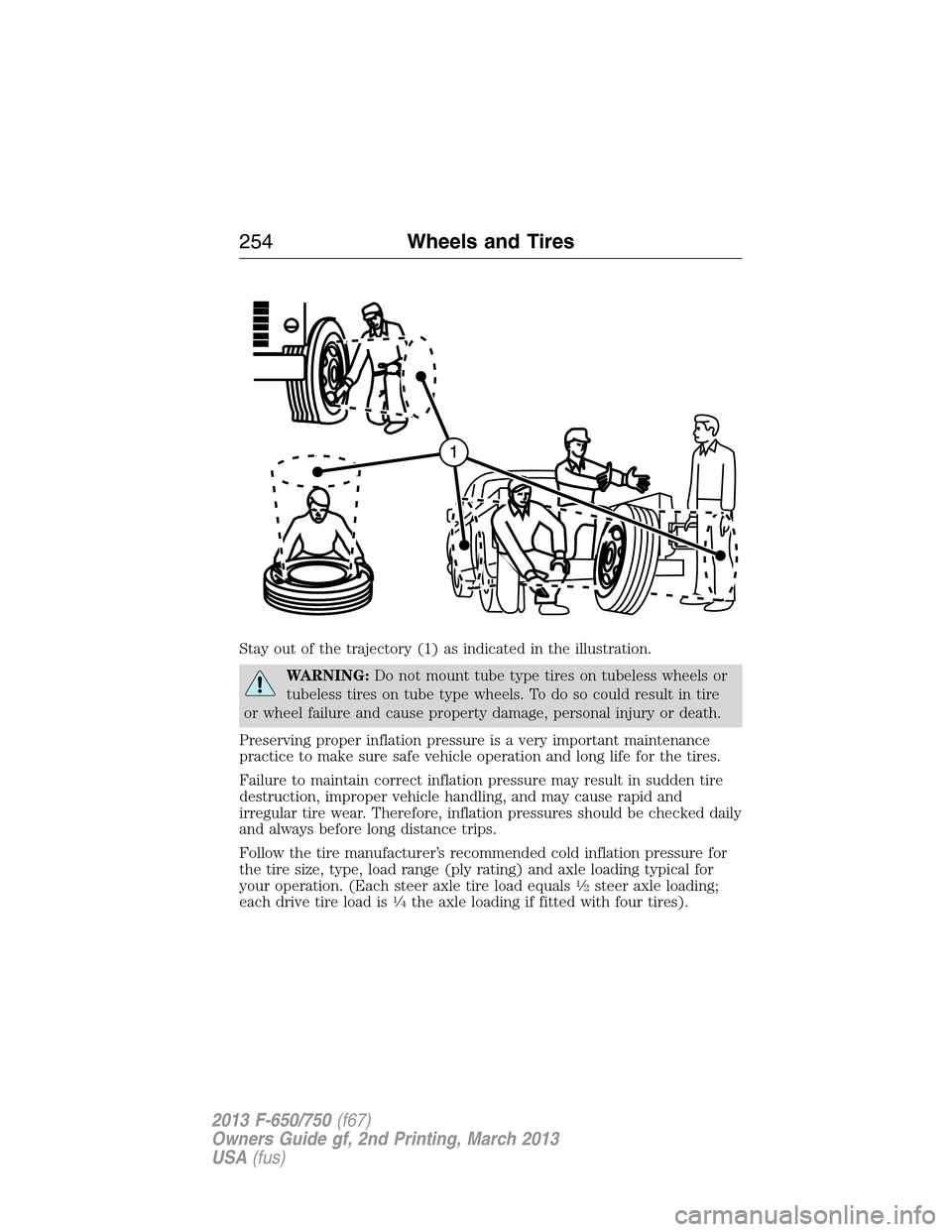
Stay out of the trajectory (1) as indicated in the illustration.
WARNING:Do not mount tube type tires on tubeless wheels or
tubeless tires on tube type wheels. To do so could result in tire
or wheel failure and cause property damage, personal injury or death.
Preserving proper inflation pressure is a very important maintenance
practice to make sure safe vehicle operation and long life for the tires.
Failure to maintain correct inflation pressure may result in sudden tire
destruction, improper vehicle handling, and may cause rapid and
irregular tire wear. Therefore, inflation pressures should be checked daily
and always before long distance trips.
Follow the tire manufacturer’s recommended cold inflation pressure for
the tire size, type, load range (ply rating) and axle loading typical for
your operation. (Each steer axle tire load equals
12steer axle loading;
each drive tire load is14the axle loading if fitted with four tires).
254Wheels and Tires
2013 F-650/750(f67)
Owners Guide gf, 2nd Printing, March 2013
USA(fus)
Page 256 of 378
Checking Tire Pressure
Always check inflation pressure when tires are cold. Never bleed air from
hot tires to relieve normal pressure build-up. Normal increase in pressure
due to service conditions is 10–15 psi (69–103 kPa), which is allowable
in truck tires.
Tires should be properly inflated to manufacturers’ recommended
pressure for the size and service load in which the vehicle is being used.
See the specific tire manufacturer with which your vehicle is equipped
with for the latest information concerning service load and inflation
pressure.
It is particularly important to keep moisture from the inside of tires, and
proper selection of air compressor equipment, proper air line routing,
and the use of shop air dryers is strongly recommended to avoid
moisture in the high pressure air used for tire inflation.
Under-inflation
Tires should not be permitted to become under-inflated. Increased
flexing due to under-inflation causes heat build-up within the tire
components. This leads to reduced strength, breakdown of the rubber
compounds, and possible separation of the tire components (i.e., ply and
tread separation and reduced retreadability).
Under-inflation is the primary cause of premature tire concerns including
sudden loss of air. In addition, low inflation causes an increase in rolling
resistance. This results in reduced fuel mileage, a loss in tread mileage,
and uneven wear due to increased tread movement. To determine proper
inflation, see the tire manufacturer load and inflation guide which can be
found on the tire manufacturer website or at your local truck tire dealer.
Tire Inspection
Check the tires for abnormal wear patterns and proper inflation
pressures. Cut or broken tire casings must be repaired or replaced.
Tires should also be inspected for the following conditions. If any are
present, the tire should be removed and repaired, retreaded or scrapped
as the condition indicates.
•Any blister, bump or raised portion anywhere on the surface of the
tire tread or sidewall (other than a bump made by a repair). These
indicate the start of internal separation.
•Any cut that reaches to the belt or ply cords, or any cut that is large
enough to grow in size and depth.
•Any nail or puncturing object.
•If any stone or object is held by a tread groove and is starting to drill
into the tread base, remove the object.
Wheels and Tires255
2013 F-650/750(f67)
Owners Guide gf, 2nd Printing, March 2013
USA(fus)
Page 257 of 378
Proper tire inflation, toe-in adjustment, loads, and road speeds are
important factors governing tire mileage, steering ease and
maneuverability.
Tire Loading
WARNING:Loading tires beyond their rated capacity decreases
tire life requiring more frequent replacement of tires. Overloading
creates an unsafe condition that may result in sudden air loss from a
tire failure resulting in an accident that could cause property damage,
personal injury or death.
Note:Your GAW/GVW rating is correct at the time of your vehicle
production, and reflects the exact rating of the tires specified. When
replacing tires, make sure that the replacement tire load rating (listed in
pounds and kilograms on the tire sidewall) is the same or higher than
the tire that is removed. Failure to do so adversely affects maximum load
carrying capacity. Tires with the same size specification do not always
have the same load specification.
Matching Tires
Dual Tires:Dual tires should be matched using tires of equivalent size.
Tires which differ more than
14inch (6 millimeters) in diameter or34inch (19 millimeters) in circumference should not be mounted on the
same dual wheel assembly.
Mixing:Never mix bias and radial tires on this vehicle. Never mix
different tire sizes or constructions on the same axle.
Rotation:
Rotation is always advisable:
•If front (steering) axle tires become irregularly worn, move to rear
position.
•In a dual assembly, reverse the position of the tires if one tire wears
much faster than its mate.
•On the drive axle, if heel and toe wear or alternate lug wear occurs,
rotating the tires from one end of the axle to the other end of the
axle may help even out this wear.
Rotation may not advisable:
•Front (Steering) Axle:Tires must be removed when tread is worn
to 4/32 inch (3 millimeters) or less. Retread or rotate worn tires to
drive position. Retreaded tires are not recommended to be used on
steering axles.
•Rear Axles:Tires must be removed when tread is worn to 2/32 inch
(2 millimeters).
256Wheels and Tires
2013 F-650/750(f67)
Owners Guide gf, 2nd Printing, March 2013
USA(fus)