air condition FORD F750 2005 11.G Owner's Manual
[x] Cancel search | Manufacturer: FORD, Model Year: 2005, Model line: F750, Model: FORD F750 2005 11.GPages: 272, PDF Size: 1.5 MB
Page 166 of 272
interval to determine if adjustment is necessary. Brake chamber push
rods on original equipment chambers now incorporate a stroke indicator
to aid in adjustment checks; an orange paint marker near the base of the
push rod. If the push rod is clean and the brakes require adjustment, the
orange marker can be seen protruding from the chamber when the
brakes are applied.
Slack adjusters should also be checked to ensure proper operation of the
adjuster mechanism at the six-month interval. Push rod travel should be
kept at a minimum without the brakes dragging.
Inspect the brake lining every maintenance interval. When brake lining or
blocks are worn to within 1/16 inch (1.6 mm) of rivets, brake lining must
be replaced. This inspection or adjustment should only be performed by
a qualified technician and must be in accordance with instructions
provided by the service manual.
Do not back off or disconnect the front brakes so that they are less
effective, letting the rear brakes do all the stopping of the vehicle. Do
not overlook the brakes on the trailer, either. Brake condition on the
trailer is just as important as the tractor. Proper brake balance on trucks
and tractor-trailers is essential for effective braking.
Once a year, the entire brake system must be inspected. Check the
following:
•Any rubber as it may deteriorate whenever used. Rubber brake
components should be inspected by a qualified technician and
replaced as necessary. Replacement intervals vary according to the
severity and length of vehicle service.
•Condition of brake drums, brake chambers and slack adjusters.
•System for air leaks.
•Hose or pipes for rust, damage and deterioration.
•Operation of service and parking brakes.
Some parts such as air brake chamber diaphragm, air compressor and air
cleaner should be inspected periodically and replaced if considered
unserviceable.
Air brakes - air dryer
Performance of desiccant or after-cooler type air dryers is dependent on
climatic conditions in which your vehicle is operating. Maintenance
schedules must be established for each specific operation.
The use of an air dryer on a vehicle does not eliminate the need to
periodically drain the air reservoirs.
2005 F650/750(f67)
Supplement
USA English(fus)
Maintenance and specifications
166
Page 167 of 272
Air brakes - desiccant air dryer
Inspect for moisture in the air system by opening reservoirs, drain cocks
or valves and checking for presence of water. The presence of small
amounts of water due to condensation is normal and should not be
considered as an indication that the dryer is not functioning properly.
The desiccant cartridge should be replaced or rebuilt when it has been
determined that the desiccant is contaminated and does not have
adequate water absorption capacity. The desiccant change interval may
vary; it is generally recommended that the desiccant be replaced every
12 months (yearly). If experience has shown that extended or shortened
life has resulted for a particular installation, then the yearly interval can
be increased or decreased accordingly.
Hydraulic brakes - general inspection and adjustment
A regular schedule for periodic cleaning, lubrication, adjustment and
inspection should be established based on the type of vehicle operation.
It is difficult to predetermine an exact maintenance interval (time or
mileage), since vehicles will be used in a wide variety of applications and
conditions. If you are uncertain of the proper schedule and procedures
for your vehicle, contact your dealer.
Inspect the brake lining every maintenance interval. Establish inspection
intervals that provide for lining replacement before damage to the disc
occurs. Excessive lining wear may expose the backing plate to the disc
causing scoring of the disc faces.
This inspection should be performed by a qualified technician and must
be in accordance with instructions provided by the service manual.
Note:Hydraulic brake system are power assisted. Braking capabilities
will be greatly reduced without engine assist.
Hydraulic brakes - fluid level
Fluid level should be at the bottom edge of the ring on each reservoir fill
port. Do not fill the master cylinder to the top of the reservoir.
Note:If brake fluid requires attention to maintain a proper master
cylinder level, this is an indication of either severe operation (pad wear)
or fluid system leakage. A more frequent and thorough brake inspection
will be required.
2005 F650/750(f67)
Supplement
USA English(fus)
Maintenance and specifications
167
Page 182 of 272
STEERING - GENERAL INSPECTION
•Ask your service technician to examine the steering mechanism. Only
minor adjustments may be necessary.
•Check tie rod, drag link end clamp bolts and ball joints. They must be
tight.
•Check for installation and spread of cotter pins and tightness of nuts
at both ends of the tie rod and drag link.
•Check that pitman arm (steering arm at steering gear) mounting is
tight and locked. Check system for leaks or hose chafing. Repair at
once.
•Maintain proper steering gear and power steering pump lubricant
levels.
•Regularly inspect steering column joint bolts and steering linkage,
particularly for body-to-chassis clearance.
Note:Have any steering problems corrected at once by a qualified
service technician.
Failure to maintain the steering system in proper condition can
cause reduced steering ability resulting in property damage,
personal injury or death.
Tightening steering column joint bolts
As a good maintenance practice, it is recommended that steering column
joint bolts be checked for tightness every 60,000 miles (96,000 km) or
annually, whichever occurs first. DO NOT OVERTIGHTEN.
Power steering
Whenever the hydraulic (power steering) system has been drained and
refilled for any reason, air must be bled from the system before returning
the vehicle to service. Failure to properly bleed the hydraulic system can
result in degradation of power system performance.
Consult your dealer who is aware of the proper procedures for filling and
bleeding the system.
2005 F650/750(f67)
Supplement
USA English(fus)
Maintenance and specifications
182
Page 187 of 272
Drain and refill your transmission fluid using the following procedure:
1. Drain the transmission while the fluid is warm.
2. Park the vehicle on level ground.
3. Set the parking brake and shift into 1 (First) and turn the engine off.
4. Clean any dirt from around the filler and drain plugs.
5. Remove the filler and drain plugs and drain the fluid into a suitable
container. Dispose all used automotive fluids in a responsible manner
following your local authorized standards.
6. Clean and install the drain plug securely.
7. Add enough fluid through the filler plug opening so that the fluid level
is up to the bottom of the opening.
8. Clean and install the filler plug securely.
ENGINE AND SUBSYSTEM MAINTENANCE
Note:Information in this section pertains to the 6.0L Power Stroke
engine only. For information pertaining to other engines, see the
respective engine operator manual.
Note:To prevent damage to the engine control module, never
spray-wash it directly. Never spray any connector.
For effective emissions control and low operating cost, it is important
that maintenance operations listed in this section be performed at the
specified periods or mileage intervals indicated (kilometers, miles, hours,
or months, whichever comes first).
Service intervals are based upon average operating conditions. Where
dusty, frequent start and stop or heavily laden operations are
encountered, more frequent servicing will be required.
As the vehicle (engine) owner, you are responsible for the performance
of all scheduled maintenance. The required maintenance operations may
be performed by the owner at a service establishment of the owner’s
choosing. Any replacement parts used for required maintenance services
or repairs should be genuine manufacturer service parts or equivalent in
quality and performance to genuine manufacturer service parts. Use of
inferior parts hinders operations of the engine and emissions controls
and can reduce engine life and/or jeopardize the warranty.
Receipts covering the performance of regular maintenance should be
retained in the event questions arise concerning maintenance. The
receipts should be transferred to each subsequent owner of the vehicle
(engine).
2005 F650/750(f67)
Supplement
USA English(fus)
Maintenance and specifications
187
Page 188 of 272
Catalytic converter
If your Diesel engine is equipped with a catalytic converter, it is
important to review the maintenance schedule to insure proper
functioning of the catalytic converter. Also, take precautions not to
damage the catalytic converter when servicing your engine or storing
your vehicle.
Note:If your vehicle is equipped with a catalytic converter/muffler,do
notblend waste oil with Diesel fuel. Operate only on low sulfur (less
than 500 parts per million sulfur) Diesel fuel with a cetane value of 45 or
higher.
Note:If your vehicle is equipped with a vertical exhaust pipe, it is very
important to have and maintain a rain cap on the exhaust pipe to
prevent water from entering the exhaust system and catalytic converter.
Any water entering the catalytic converter may damage the catalyst and
affect the function of the converter.
Air induction system
Once each year, perform a complete inspection of the air induction
system. In areas where road salt is used, the inspection consists of
disassembling the joints of each aluminum component and inspecting for
salt build-up, presence of chlorine that can cause aluminum particles to
flake off and enter the engine combustion chambers.
If evidence of corrosion is found (usually at the pipe connections), use a
wire brush to clean the inside of the pipes and inside the rubber hoses.
If the intake pipes are pitted at the joint ends, use RTV silicone to seal
the joints. Be certain that no excess material is on the inside of the pipes
that can be pulled into the engine. If the service condition of the pipes,
hoses or clamps is questionable, replace the defective part(s).
Be sure that prior to reassembly all dust and debris has been cleaned out
of the pipes and couplings with a clean, damp rag.
To reduce the risk of personal injury or death when performing
maintenance to any turbocharged engine with engine air inlet
piping disconnected, a turbocharger compressor air inlet protective
shield should be installed over the turbocharger air inlet.
Cummins B and Caterpillar engines
Refer to the respective engine operator manual for air filter replacement
procedure.
2005 F650/750(f67)
Supplement
USA English(fus)
Maintenance and specifications
188
Page 196 of 272
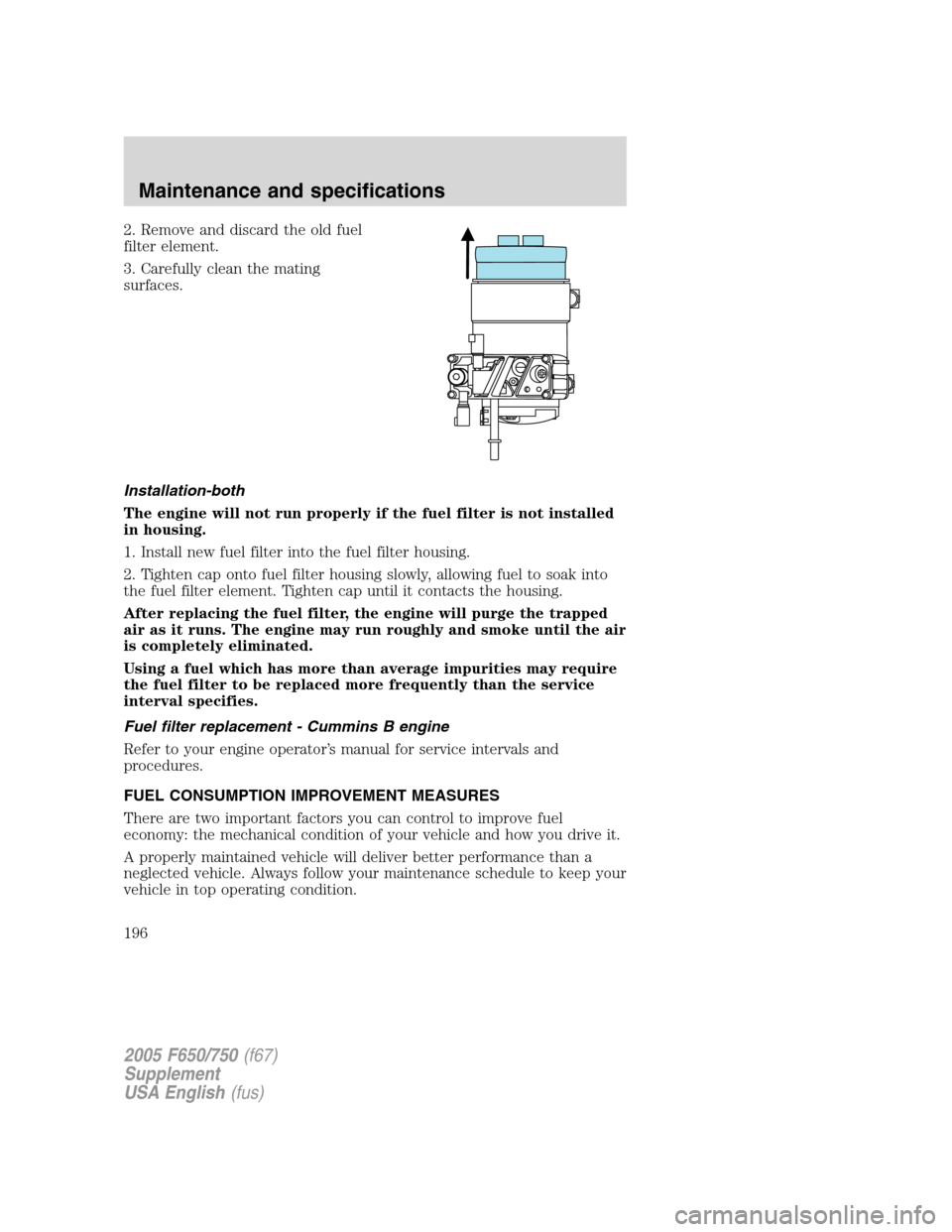
2. Remove and discard the old fuel
filter element.
3. Carefully clean the mating
surfaces.
Installation-both
The engine will not run properly if the fuel filter is not installed
in housing.
1. Install new fuel filter into the fuel filter housing.
2. Tighten cap onto fuel filter housing slowly, allowing fuel to soak into
the fuel filter element. Tighten cap until it contacts the housing.
After replacing the fuel filter, the engine will purge the trapped
air as it runs. The engine may run roughly and smoke until the air
is completely eliminated.
Using a fuel which has more than average impurities may require
the fuel filter to be replaced more frequently than the service
interval specifies.
Fuel filter replacement - Cummins B engine
Refer to your engine operator’s manual for service intervals and
procedures.
FUEL CONSUMPTION IMPROVEMENT MEASURES
There are two important factors you can control to improve fuel
economy: the mechanical condition of your vehicle and how you drive it.
A properly maintained vehicle will deliver better performance than a
neglected vehicle. Always follow your maintenance schedule to keep your
vehicle in top operating condition.
2005 F650/750(f67)
Supplement
USA English(fus)
Maintenance and specifications
196
Page 199 of 272
![FORD F750 2005 11.G Owners Manual •Driving at reasonable speeds (traveling at 55 mph [88 km/h] uses 15%
less fuel than traveling at 65 mph [105 km/h]).
•Using the air conditioner or defroster may reduce fuel economy.
•Resting yo](/img/11/5071/w960_5071-198.png "FORD F750 2005 11.G Owners Manual •Driving at reasonable speeds (traveling at 55 mph [88 km/h] uses 15%
less fuel than traveling at 65 mph [105 km/h]).
•Using the air conditioner or defroster may reduce fuel economy.
•Resting yo")
•Driving at reasonable speeds (traveling at 55 mph [88 km/h] uses 15%
less fuel than traveling at 65 mph [105 km/h]).
•Using the air conditioner or defroster may reduce fuel economy.
•Resting your foot on the brake pedal while driving may reduce fuel
economy.
Conditions
•Carrying unnecessary weight may reduce fuel economy.
•Fuel economy may decrease with lower temperatures during the first
8–10 miles (12–16 km) of driving.
•Flat terrain driving improves fuel economy over hilly roads.
•Transmissions give their best fuel economy when operated in the top
cruise gear and with steady pressure on the accelerator.
•Close windows for highway driving.
NOISE EMISSIONS–EXTERIOR
In order to comply with the federal exterior noise regulations, your
vehicle may be equipped with noise emission items. Depending on the
vehicle configuration, it may have all or some of the following items:
Air Intake System
•Air Cleaner:should be inspected and its location should not be
altered. Do not alter inlet and outlet piping.
Body
•Wheel Well:splash shields, cab shields and under-hood insulation
should be inspected for deterioration, dislocation, and orientation.
Cooling System
•Check the fan for damage to blades; replace, if damaged, with the
recommended parts. Inspect for fan to shroud interference, and any
damage to shroud such as cracks and holes.
•The fan ratio should not be changed and the fan spacer dimensions
and positions should not be altered.
•Inspect the fan clutch for proper operation, make sure that the fan is
disengaged when cooling of the engine is not required.
•Check for proper operation of radiator shutters, if equipped. The
shutters should be open during normal operating temperatures.
2005 F650/750(f67)
Supplement
USA English(fus)
Maintenance and specifications
199
Page 201 of 272
ELECTRICAL SYSTEM INSPECTIONS
Periodically inspect electrical connectors on the outside of the cab, on the
engine and frame for corrosion and tightness. Exposed terminals such as
the fuel sender, cranking motor, alternator and feed-through studs should
be cleaned and re-coated with a lubricant sealing grease such as Motorcraft
XG-3, or equivalent. This should include the ground cable connector for
batteries, engine and cab as well as the jump starting stud.
Accessory feed connections
Vehicle electrical systems are complex and often include electronic
components such as engine and transmission controls, instrument panels,
ABS, etc. While most systems operate on battery voltage (12 volts),
some systems can be as high as 90 volts or as low as five volts. Refer to
the Electrical Circuit Diagram Manuals, available from your vehicle’s
manufacturer, to assure that any additional body lights and accessories
are connected to circuits that are both appropriate and not overloaded.
No modification should be made to any vehicle control system without
first contacting your dealer.
SUSPENSION INSPECTION
Note:Do not adjust air suspension height to any setting other than the
specified setting. Altering the height setting will change the driveline
angle and may result in unwarrantable component damage, such as
transmission component damage.
Verify drive axle air suspension height and height control valve
performance at engine lube oil change intervals.
Periodically:
•Check condition of spring leaves for evidence of fatigue, bending or
breakage.
•Check condition of suspension mounting brackets and bushings.
•Check that torque rod mounting fasteners are tight.
•Check to be sure the suspension alignment is maintained at all time.
•Check U-bolts after the chassis has been operating under load for
1,000 miles (1,600 km) or six months, whichever comes first, the
U-Bolt nuts must be re-torqued. The U-Bolt nuts thereafter must be
re-torqued every 36,000 miles (58,000 km). The U-Bolt and nut
threads and seats should be cleaned and lubricated to assure a“like
new”condition when re-torquing.
Note:See theU-Bolt Nut Torquechart later in this section.
2005 F650/750(f67)
Supplement
USA English(fus)
Maintenance and specifications
201
Page 203 of 272
Air suspension U-bolt checks and re-torquing procedures
1. Inspect the threads of the U-bolt and nut for rust and debris. Clean
the threads if contaminated.
2. Using a torque wrench, determine if any nuts can be turned with a
force below the specified torque.
3. Using the lowest discovered torqued nut as a starting point, retighten
the nuts using the sequence listed underAir suspension U-bolt and
U-bolt nut installation.
Air suspension U-bolt and U-bolt nut installation
1. Inspect the threads of the U-bolt and nut for rust and debris. Clean
the threads if contaminated.
2. Install the U-bolts and nuts and torque the nuts to 15 ft. lbs. (20
N•m), using a diagonal pattern.
3. Re-torque the nuts to 100 ft. lbs. (136 N•m), using a diagonal pattern.
4. Re-torque the nuts to 200 ft. lbs. (271 N•m), using a diagonal pattern.
5. Re-torque the nuts to 400 ft. lbs. (542 N•m), using a diagonal pattern.
(For vehicles equipped with 14ACC, 14 ADN and 14ADP axles, do not
use Step 6.)
6. Re-torque the nuts to 425 ft. lbs (576 N•m), using a diagonal pattern.
(For vehicles equipped with 14ACC, 14 ADN and 14ADP axles.)
7. Use the same diagonal pattern with each U-bolt nut re-torque.
Spring U-bolt checks
Check U-bolt nuts and re-torque every 36,000 miles (58,000 km) after
initial 1,000 miles (1,600 km) re-torque. The U-bolt and nut threads and
seats should be cleaned and lubricated to assure peak condition when
re-torqued.
PROPELLER SHAFT
At the regular lubrication interval, check the universal joints for any
evidence of wear or looseness. Should propeller shaft vibrations occur,
stop the vehicle immediately to avoid possible hazardous consequences
or damage to other components.
2005 F650/750(f67)
Supplement
USA English(fus)
Maintenance and specifications
203
Page 224 of 272
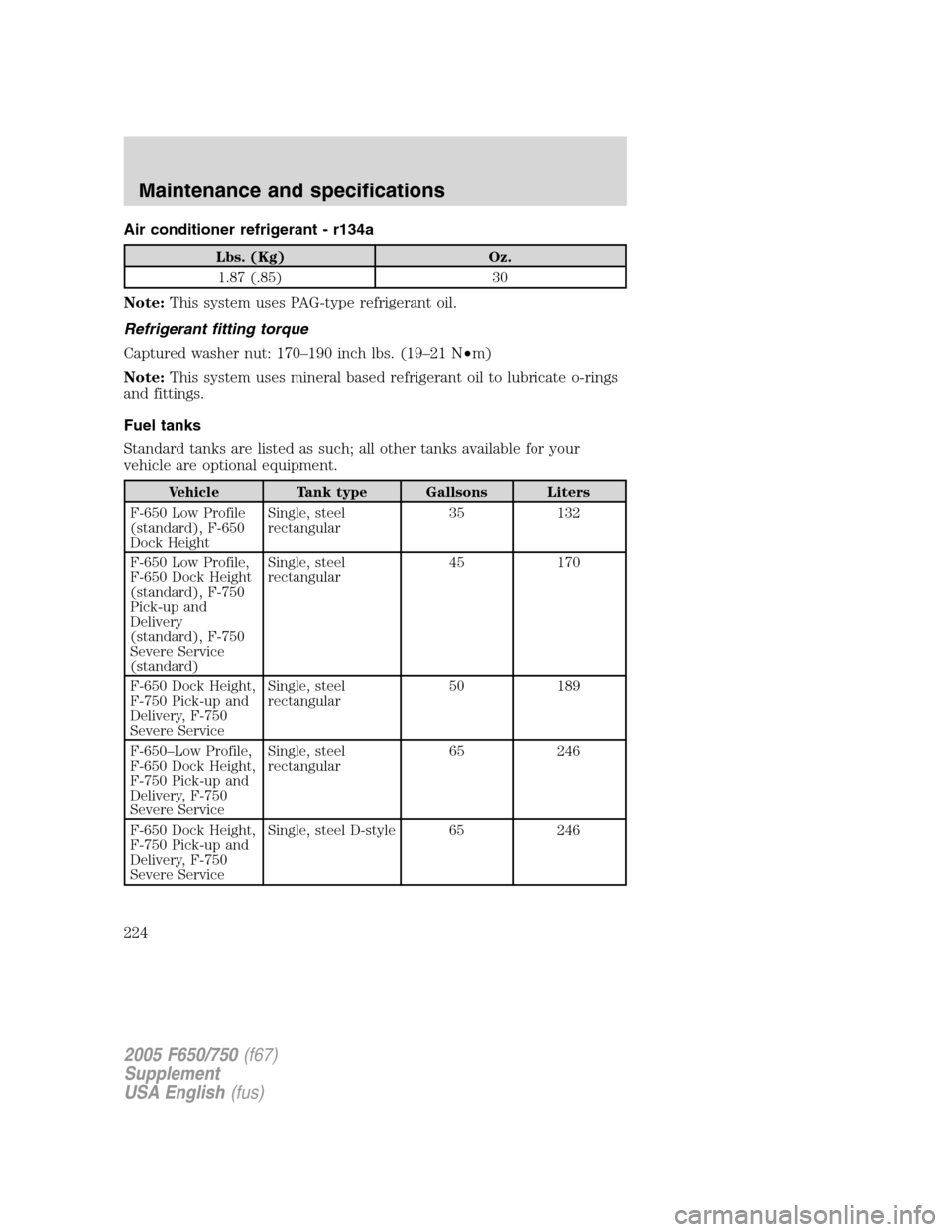
Air conditioner refrigerant - r134a
Lbs. (Kg) Oz.
1.87 (.85) 30
Note:This system uses PAG-type refrigerant oil.
Refrigerant fitting torque
Captured washer nut: 170–190 inch lbs. (19–21 N•m)
Note:This system uses mineral based refrigerant oil to lubricate o-rings
and fittings.
Fuel tanks
Standard tanks are listed as such; all other tanks available for your
vehicle are optional equipment.
Vehicle Tank type Gallsons Liters
F-650 Low Profile
(standard), F-650
Dock HeightSingle, steel
rectangular35 132
F-650 Low Profile,
F-650 Dock Height
(standard), F-750
Pick-up and
Delivery
(standard), F-750
Severe Service
(standard)Single, steel
rectangular45 170
F-650 Dock Height,
F-750 Pick-up and
Delivery, F-750
Severe ServiceSingle, steel
rectangular50 189
F-650–Low Profile,
F-650 Dock Height,
F-750 Pick-up and
Delivery, F-750
Severe ServiceSingle, steel
rectangular65 246
F-650 Dock Height,
F-750 Pick-up and
Delivery, F-750
Severe ServiceSingle, steel D-style 65 246
2005 F650/750(f67)
Supplement
USA English(fus)
Maintenance and specifications
224