maintenance schedule FORD F750 2007 11.G User Guide
[x] Cancel search | Manufacturer: FORD, Model Year: 2007, Model line: F750, Model: FORD F750 2007 11.GPages: 280, PDF Size: 1.93 MB
Page 176 of 280
Do not put engine coolant in the washer fluid reservoir. Engine
coolant can severely reduce visibility if sprayed on the
windshield.
CHANGING THE WIPER BLADES
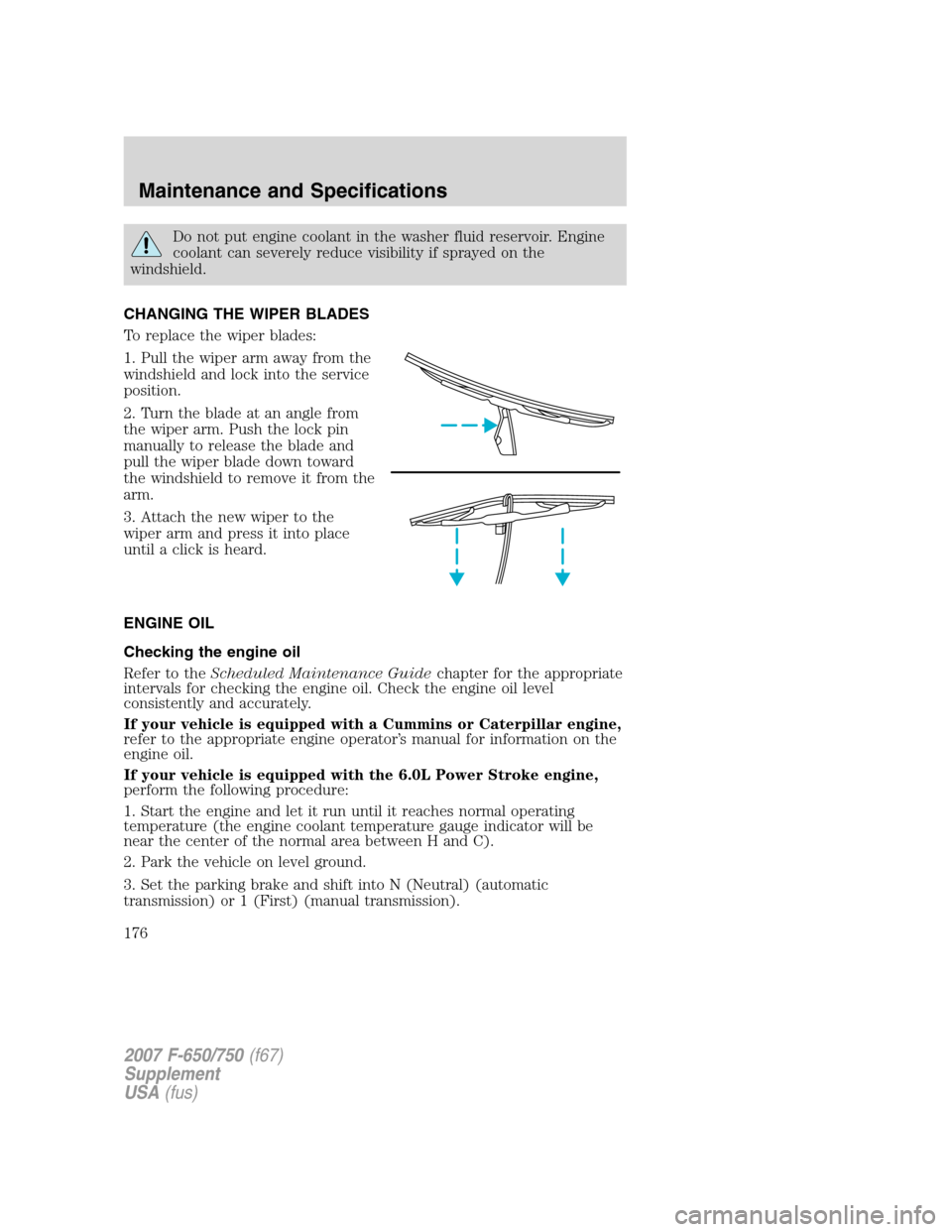
To replace the wiper blades:
1. Pull the wiper arm away from the
windshield and lock into the service
position.
2. Turn the blade at an angle from
the wiper arm. Push the lock pin
manually to release the blade and
pull the wiper blade down toward
the windshield to remove it from the
arm.
3. Attach the new wiper to the
wiper arm and press it into place
until a click is heard.
ENGINE OIL
Checking the engine oil
Refer to the Scheduled Maintenance Guide chapter for the appropriate
intervals for checking the engine oil. Check the engine oil level
consistently and accurately.
If your vehicle is equipped with a Cummins or Caterpillar engine,
refer to the appropriate engine operator’s manual for information on the
engine oil.
If your vehicle is equipped with the 6.0L Power Stroke engine,
perform the following procedure:
1. Start the engine and let it run until it reaches normal operating
temperature (the engine coolant temperature gauge indicator will be
near the center of the normal area between H and C).
2. Park the vehicle on level ground.
3. Set the parking brake and shift into N (Neutral) (automatic
transmission) or 1 (First) (manual transmission).
2007 F-650/750 (f67)
Supplement
USA (fus)
Maintenance and Specifications
176
Page 177 of 280
4. Turn off the engine and wait a few minutes for the oil to drain
completely into the oil pan.
5. Open the hood.
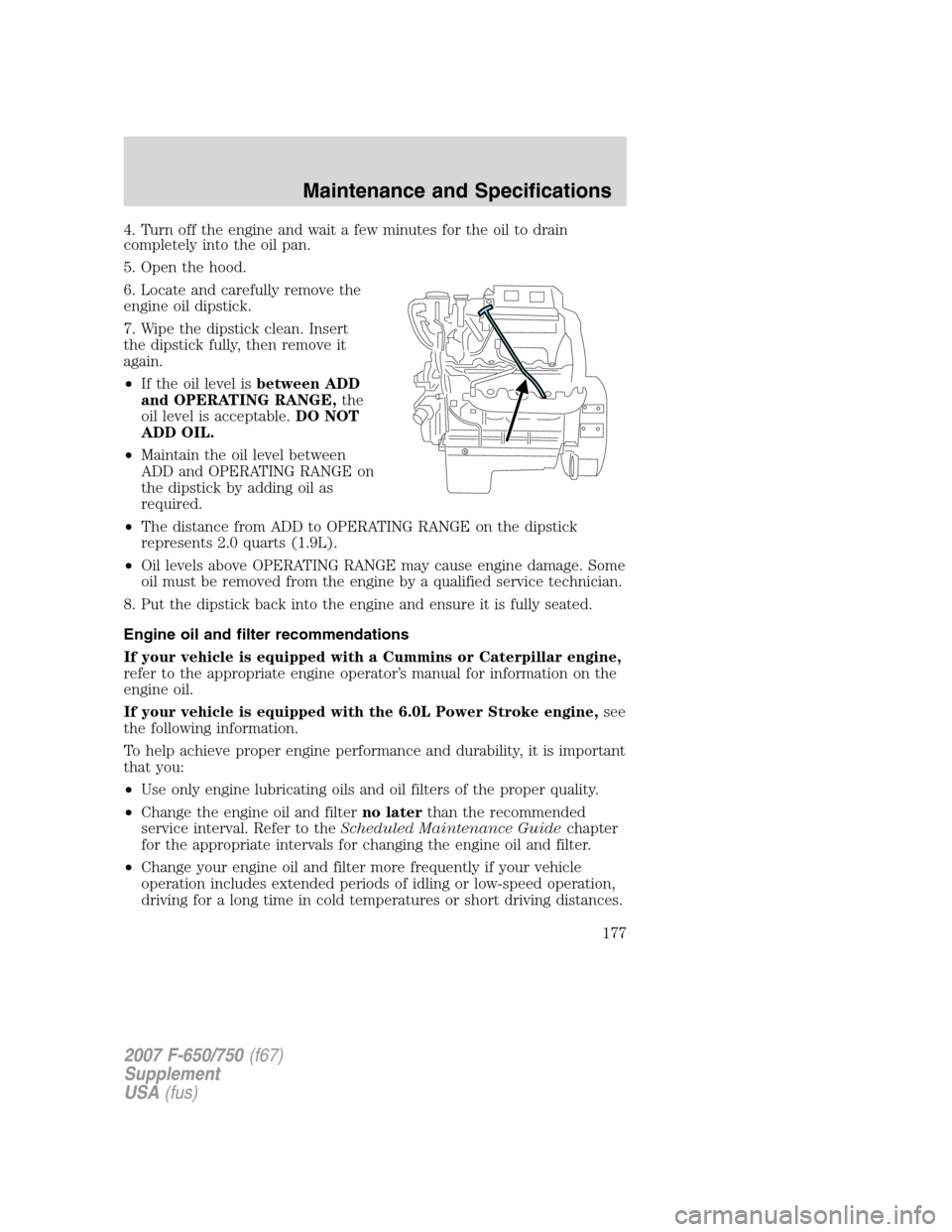
6. Locate and carefully remove the
engine oil dipstick.
7. Wipe the dipstick clean. Insert
the dipstick fully, then remove it
again.
•If the oil level is between ADD
and OPERATING RANGE, the
oil level is acceptable. DO NOT
ADD OIL.
• Maintain the oil level between
ADD and OPERATING RANGE on
the dipstick by adding oil as
required.
• The distance from ADD to OPERATING RANGE on the dipstick
represents 2.0 quarts (1.9L).
• Oil levels above OPERATING RANGE may cause engine damage. Some
oil must be removed from the engine by a qualified service technician.
8. Put the dipstick back into the engine and ensure it is fully seated.
Engine oil and filter recommendations
If your vehicle is equipped with a Cummins or Caterpillar engine,
refer to the appropriate engine operator’s manual for information on the
engine oil.
If your vehicle is equipped with the 6.0L Power Stroke engine, see
the following information.
To help achieve proper engine performance and durability, it is important
that you:
• Use only engine lubricating oils and oil filters of the proper quality.
• Change the engine oil and filter no laterthan the recommended
service interval. Refer to the Scheduled Maintenance Guide chapter
for the appropriate intervals for changing the engine oil and filter.
• Change your engine oil and filter more frequently if your vehicle
operation includes extended periods of idling or low-speed operation,
driving for a long time in cold temperatures or short driving distances.
2007 F-650/750 (f67)
Supplement
USA (fus)
Maintenance and Specifications
177
Page 181 of 280
Always dispose of automotive
batteries in a responsible manner.
Follow your local authorized
standards for disposal. Call your
local authorized recycling center to
find out more about recycling
automotive batteries.
ENGINE COOLANT
If your vehicle is equipped with a Caterpillar or Cummins engine,
refer to your engine operator’s manual for engine coolant check and
adding instructions as well as fluid specifications and capacities.
Checking engine coolant
The concentration and level of engine coolant should be checked twice a
year to ensure proper glycol/ water concentrations. The coolant
concentration should be maintained at 50/50 coolant and distilled water,
which equates to a freeze point of -34°F (-36°C). Coolant concentration
testing is possible with a hydrometer or antifreeze tester (such as the
Rotunda Battery and Antifreeze Tester, 014–R1060). The level of coolant
should be maintained at the full mark in the coolant reservoir. If the level
falls below, add coolant per the instructions in theAdding engine
coolantsection.
Your vehicle was factory-filled with a 50/50 engine coolant and water
concentration. If the concentration of coolant falls below 40% or above
60%, the engine parts could become damaged or not work properly.A
50–50 mixture of coolant and water provides the following:
•Freeze protection down to -34°F (-36°C).
•Boiling protection up to 265°F (129°C).
•Protection against rust and other forms of corrosion.
•Enables calibrated gauges to work properly.
The engine coolant should be at the full mark as shown on the engine
coolant reservoir (depending upon application).
Refer to thescheduled maintenance informationfor service interval
schedules.
Be sure to read and understandPrecautions when servicing your
vehiclein this chapter.
L
E
A
D
RETURN
RECYCLE
2007 F-650/750(f67)
Supplement
USA(fus)
Maintenance and Specifications
181
Page 185 of 280
If you drive in extremely hot climates:
•It is still necessary to maintain the coolant concentration
above 40%.
•NEVER decrease the coolant concentration below 40%.
•Engine coolant concentrations below 40% will decrease the
corrosion protection characteristics of the engine coolant and
may cause engine damage.
•Engine coolant concentrations below 40% will decrease the
freeze protection characteristics of the engine coolant and may
cause engine damage.
•If available, refer to the chart on the coolant container to
ensure the coolant concentration in your vehicle will provide
adequate protection at the temperatures in which you drive.
Vehicles driven year-round in non-extreme climates should use a 50/50
mixture of engine coolant and distilled water for optimum cooling system
and engine protection.
Fan clutches
Your vehicle’s cooling system is equipped with a viscous fan clutch.
•The fan clutch helps control cooling, increase performance, improve
fuel economy and reduce noise.
•The fan clutch is controlled by bimetallic spring sensors. Do not
tamper with these sensors as this may change their calibration or keep
the fan clutch from operating at all.
Stay clear of the fan/fan area while the engine is running or
possible personal injury may occur.
FUEL FILTER/WATER SEPARATOR
Do not drain water separator while engine is running. Fuel may
ignite if separator is drained while engine is running or vehicle is
moving.
The fuel filter/water separator removes any contaminated particles
and/or water from the fuel before the fuel enters the engine.
The fuel filter/water separator should be drained as recommended in the
Scheduled Maintenance Guidechapter.
2007 F-650/750(f67)
Supplement
USA(fus)
Maintenance and Specifications
185
Page 188 of 280
After replacing the fuel filter, the engine will purge the trapped
air as it runs. The engine may run roughly and smoke until the air
is completely eliminated.
Using a fuel which has more than average impurities may require
the fuel filter to be replaced more frequently than the service
interval specifies.
Fuel filter replacement - Cummins B engine
Refer to your engine operator’s manual for service intervals and
procedures.
Fuel filter replacement - Caterpillar engine
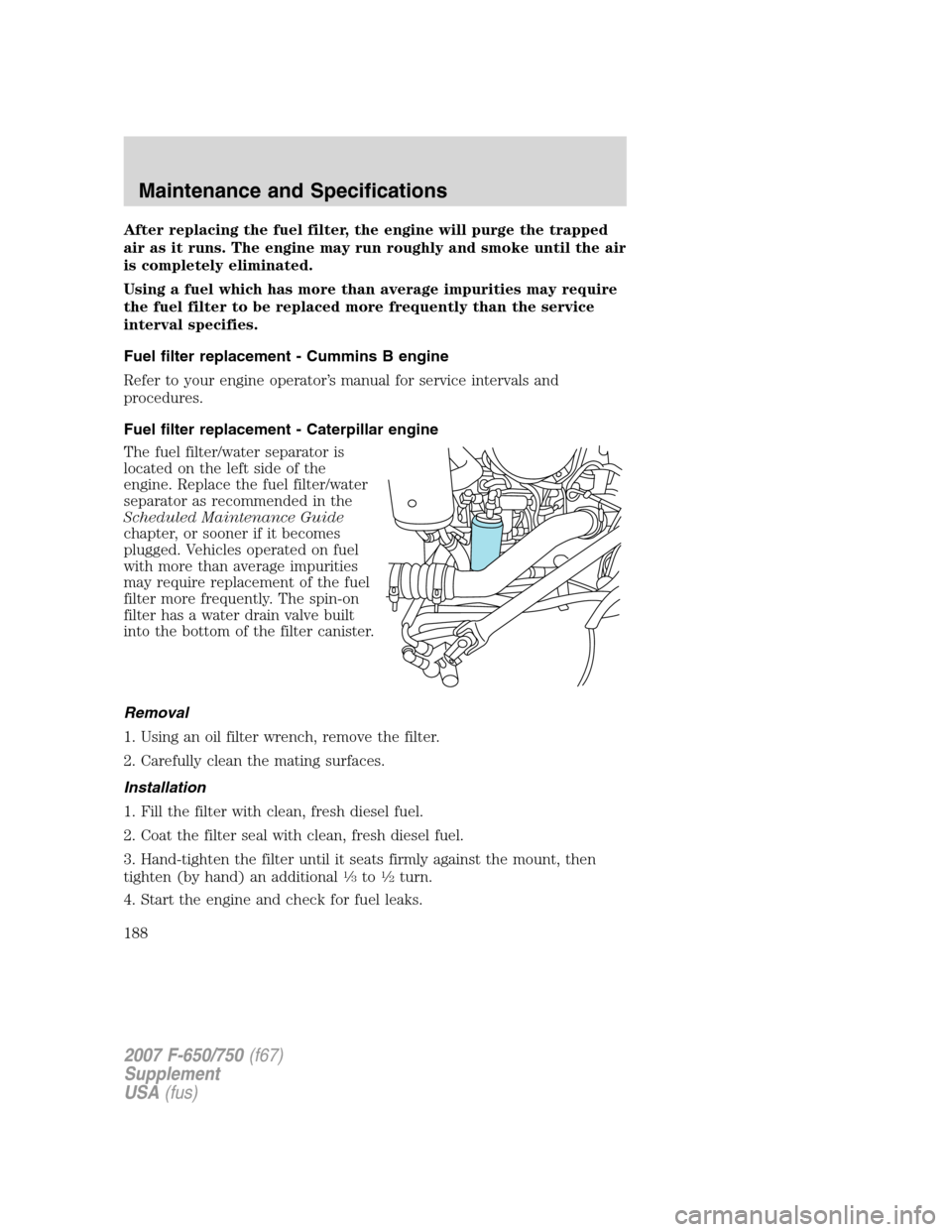
The fuel filter/water separator is
located on the left side of the
engine. Replace the fuel filter/water
separator as recommended in the
Scheduled Maintenance Guide
chapter, or sooner if it becomes
plugged. Vehicles operated on fuel
with more than average impurities
may require replacement of the fuel
filter more frequently. The spin-on
filter has a water drain valve built
into the bottom of the filter canister.
Removal
1. Using an oil filter wrench, remove the filter.
2. Carefully clean the mating surfaces.
Installation
1. Fill the filter with clean, fresh diesel fuel.
2. Coat the filter seal with clean, fresh diesel fuel.
3. Hand-tighten the filter until it seats firmly against the mount, then
tighten (by hand) an additional
13to12turn.
4. Start the engine and check for fuel leaks.
2007 F-650/750(f67)
Supplement
USA(fus)
Maintenance and Specifications
188
Page 191 of 280
Many of the world’s automakers approved the World-wide Fuel Charter
that recommends diesel fuel specifications to provide improved
performance and emission control system protection for your vehicle.
Diesel fuel that meet the World-wide Fuel Charter should be used when
available. Ask your fuel supplier about fuel that meet the World-Wide
Fuel Charter.
Running out of fuel
Avoid running out of fuel as this will allow air to enter the fuel system,
which will make restarting the vehicle difficult.
If you have run out of fuel:
•If your vehicle is equipped with dual fuel tanks,add at least 4–5
gallons (15–19 liters) of fuel to each tank before attempting to restart
the engine.
•If your vehicle is equipped with a Caterpillar engine,the fuel
system must be primed before attempting to restart the engine. Refer
to the engine operator’s manual for instructions on priming the engine.
•Use caution not to overheat and damage the starterby cranking
the engine for an excessive period of time. You may need to crank the
engine for a longer time than normal. If the engine fails to start in 30
seconds, turn the ignition to the OFF position and wait for two
minutes before cranking the engine again.
•Any remaining trapped air will self-purge from the fuel system once
the engine starts running.
•The engine may run rough and produce white smoke while air is in
the fuel system. This is normal and should stop after a short period of
time.
FUEL CONSUMPTION IMPROVEMENT MEASURES
There are two important factors you can control to improve fuel
economy: the mechanical condition of your vehicle and how you drive it.
A properly maintained vehicle will deliver better performance than a
neglected vehicle. Always follow your maintenance schedule to keep your
vehicle in top operating condition.
Also, your driving habits have a significant influence on use of fuel. By
following these suggestions, you can stretch your fuel use:
•Avoid changes in speed as much as possible.
•Anticipate changing traffic conditions. Sudden stops and fast
acceleration waste fuel.
2007 F-650/750(f67)
Supplement
USA(fus)
Maintenance and Specifications
191
Page 195 of 280
•Do a visual inspection for cracks or holes in the muffler and tail pipe.
•Always use the recommended parts when items need to be replaced.
•The tail pipe elbow or offset tail pipe orientation must not be changed
from the standard position as originally received.
•To avoid abnormal changes in vehicle sound levels, it is necessary for
the owner to perform inspections and necessary maintenance at the
intervals shown in theScheduled Maintenance Guidechapter.
POWER STEERING FLUID
Check the power steering fluid level using the following procedure. If
adding fluid is necessary, refer toLubricant Specificationsin this
chapter for the proper fluid type. Refer to theScheduled Maintenance
Guidechapter for the recommended service intervals.
1. Set the parking brake, shift into N (Neutral) (automatic transmission)
or 1 (First) (manual transmission) and turn the engine off.
2. Open the hood.
3. Clean the top of the power steering fluid reservoir.
4. Remove the dipstick from the reservoir and wipe the dipstick clean.
5. Reinstall the dipstick. Remove it again and check the fluid level.
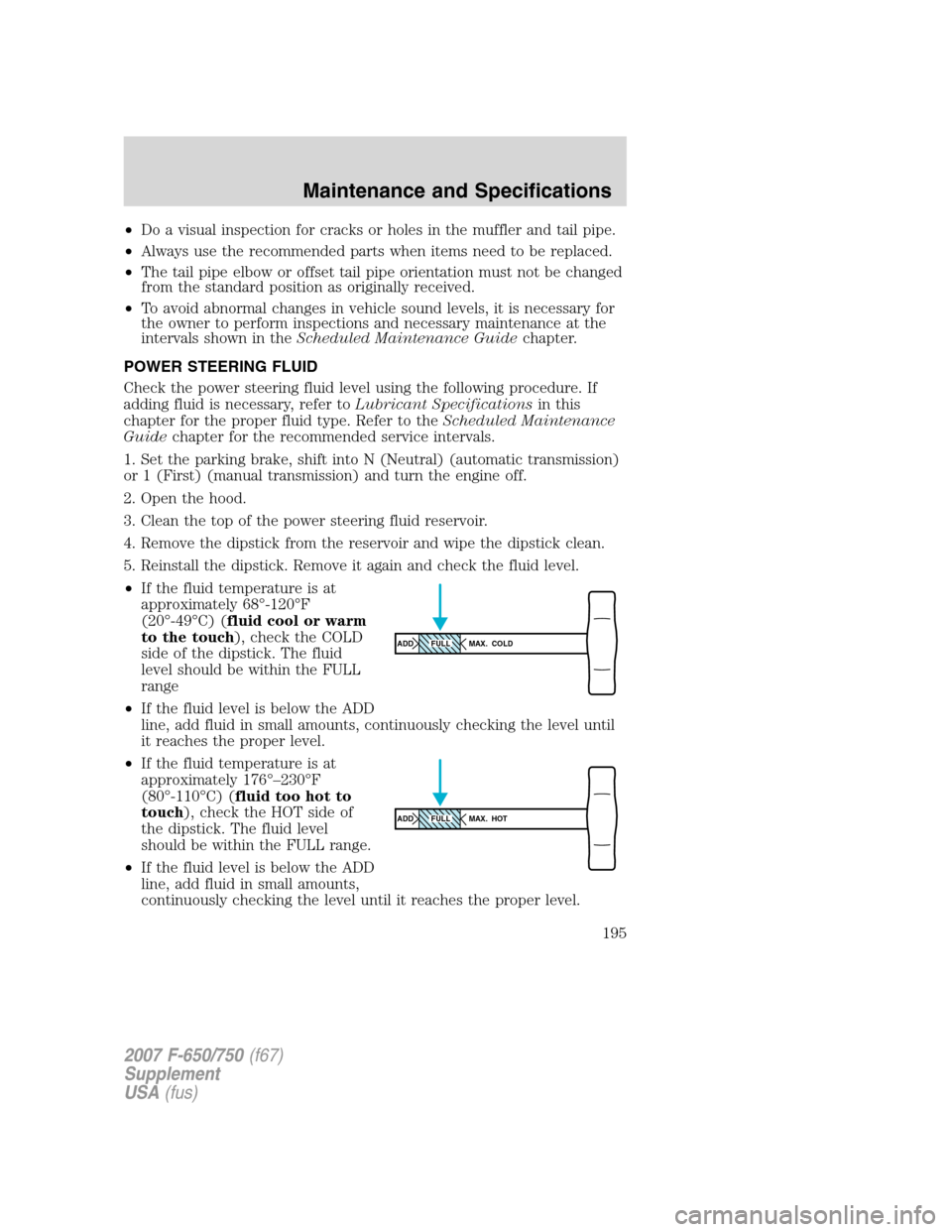
•If the fluid temperature is at
approximately 68°-120°F
(20°-49°C) (fluid cool or warm
to the touch), check the COLD
side of the dipstick. The fluid
level should be within the FULL
range
•If the fluid level is below the ADD
line, add fluid in small amounts, continuously checking the level until
it reaches the proper level.
•If the fluid temperature is at
approximately 176°–230°F
(80°-110°C) (fluid too hot to
touch), check the HOT side of
the dipstick. The fluid level
should be within the FULL range.
•If the fluid level is below the ADD
line, add fluid in small amounts,
continuously checking the level until it reaches the proper level.
ADD MAX. COLDFULL
ADD MAX. HOTFULL
2007 F-650/750(f67)
Supplement
USA(fus)
Maintenance and Specifications
195
Page 196 of 280
Note:The fluid level may also be checked by looking at the see-through
plastic reservoir. Make sure that the fluid is within the minimum and
maximum fluid range as marked on the reservoir.
A low fluid level may indicate a leak in the power steering system.
Inspect the power steering system and repair the leak. If necessary, see
your dealer or a qualified service technician.
To avoid damage to the power steering system,do notoperate the
vehicle with a low power steering fluid level.
Whenever the dipstick is installed, make sure it is properly seated and
tightened securely.
BRAKE FLUID
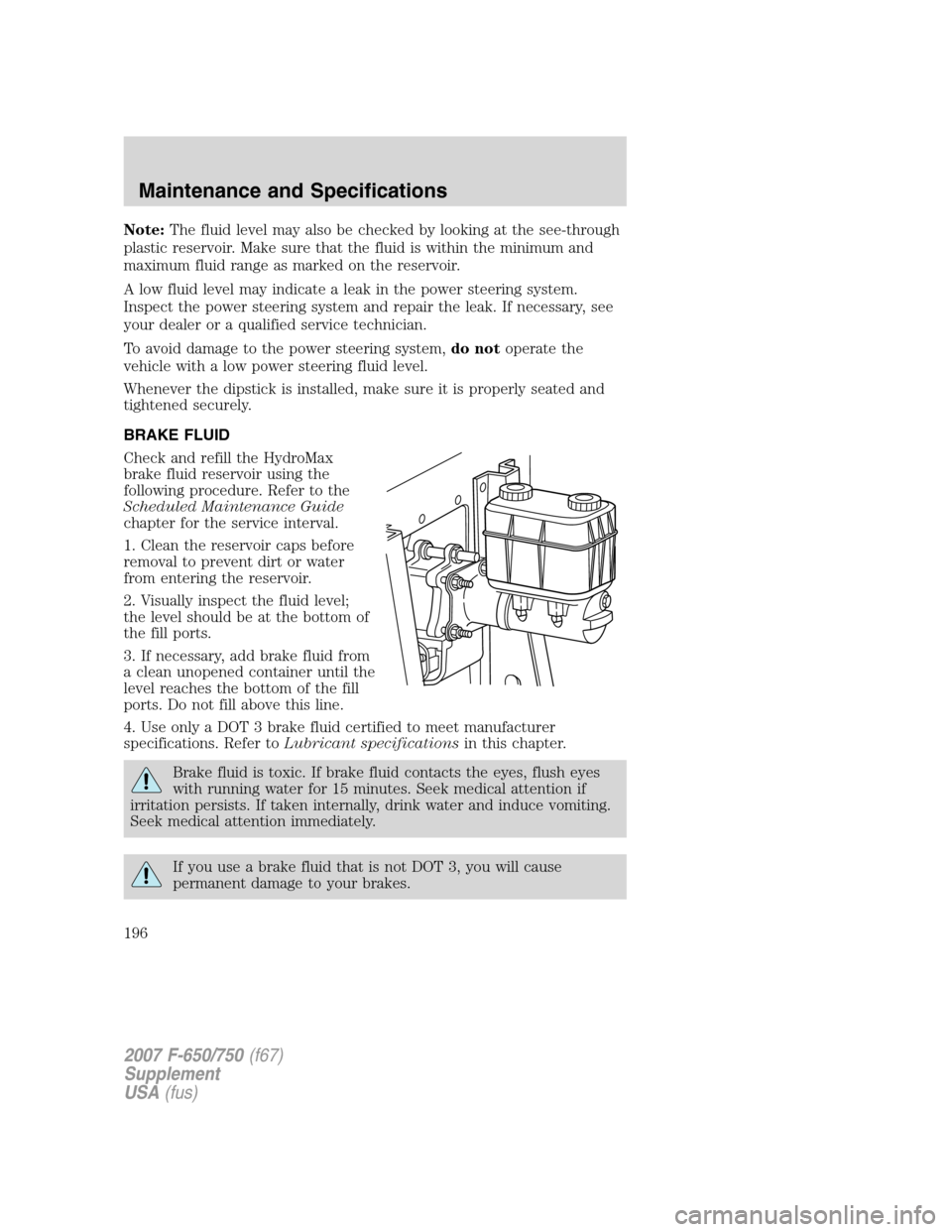
Check and refill the HydroMax
brake fluid reservoir using the
following procedure. Refer to the
Scheduled Maintenance Guide
chapter for the service interval.
1. Clean the reservoir caps before
removal to prevent dirt or water
from entering the reservoir.
2. Visually inspect the fluid level;
the level should be at the bottom of
the fill ports.
3. If necessary, add brake fluid from
a clean unopened container until the
level reaches the bottom of the fill
ports. Do not fill above this line.
4. Use only a DOT 3 brake fluid certified to meet manufacturer
specifications. Refer toLubricant specificationsin this chapter.
Brake fluid is toxic. If brake fluid contacts the eyes, flush eyes
with running water for 15 minutes. Seek medical attention if
irritation persists. If taken internally, drink water and induce vomiting.
Seek medical attention immediately.
If you use a brake fluid that is not DOT 3, you will cause
permanent damage to your brakes.
2007 F-650/750(f67)
Supplement
USA(fus)
Maintenance and Specifications
196
Page 197 of 280
Do not let the reservoir for the master cylinder run dry. This
may cause the brakes to fail.
CLUTCH FLUID/LINKAGE ADJUSTMENTS
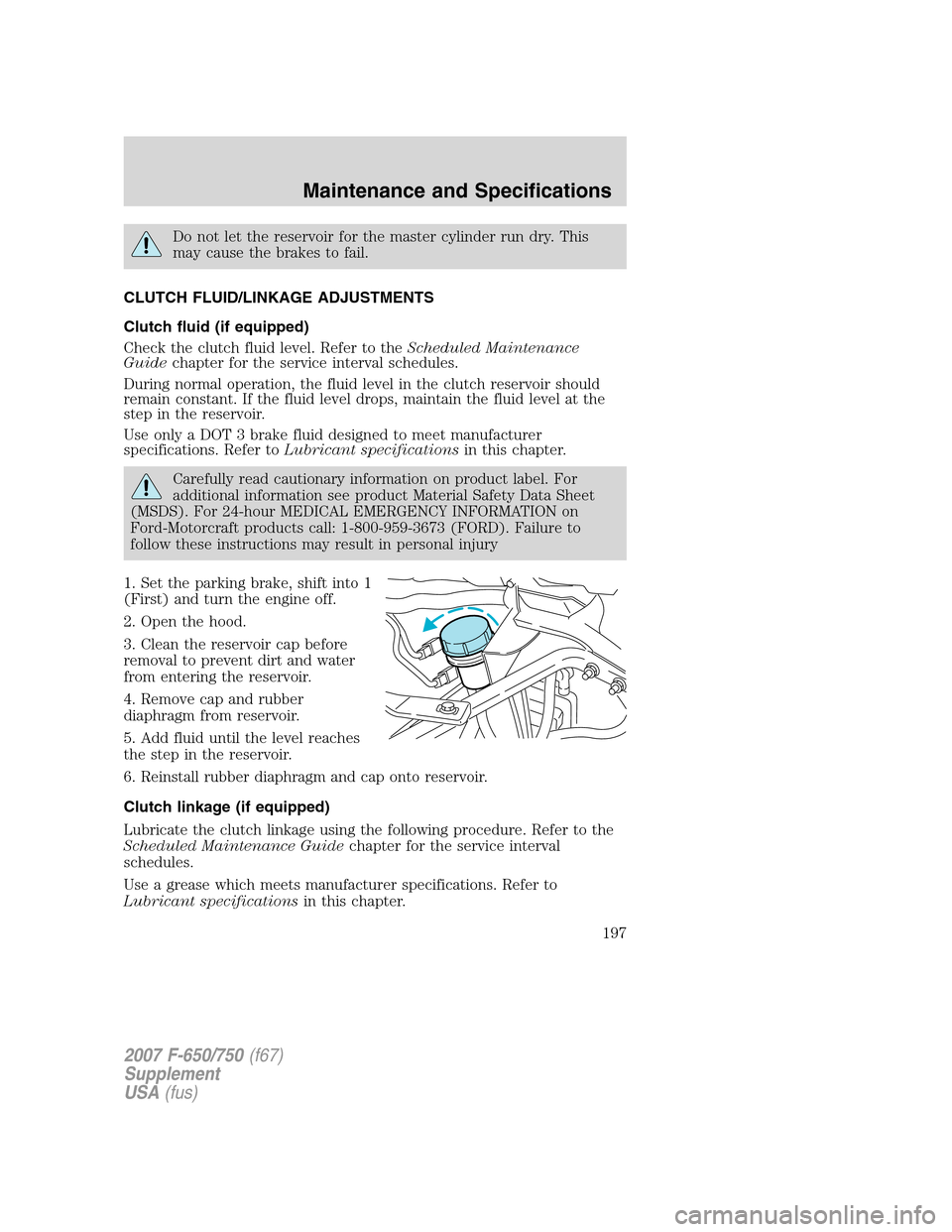
Clutch fluid (if equipped)
Check the clutch fluid level. Refer to theScheduled Maintenance
Guidechapter for the service interval schedules.
During normal operation, the fluid level in the clutch reservoir should
remain constant. If the fluid level drops, maintain the fluid level at the
step in the reservoir.
Use only a DOT 3 brake fluid designed to meet manufacturer
specifications. Refer toLubricant specificationsin this chapter.
Carefully read cautionary information on product label. For
additional information see product Material Safety Data Sheet
(MSDS). For 24-hour MEDICAL EMERGENCY INFORMATION on
Ford-Motorcraft products call: 1-800-959-3673 (FORD). Failure to
follow these instructions may result in personal injury
1. Set the parking brake, shift into 1
(First) and turn the engine off.
2. Open the hood.
3. Clean the reservoir cap before
removal to prevent dirt and water
from entering the reservoir.
4. Remove cap and rubber
diaphragm from reservoir.
5. Add fluid until the level reaches
the step in the reservoir.
6. Reinstall rubber diaphragm and cap onto reservoir.
Clutch linkage (if equipped)
Lubricate the clutch linkage using the following procedure. Refer to the
Scheduled Maintenance Guidechapter for the service interval
schedules.
Use a grease which meets manufacturer specifications. Refer to
Lubricant specificationsin this chapter.
2007 F-650/750(f67)
Supplement
USA(fus)
Maintenance and Specifications
197
Page 198 of 280
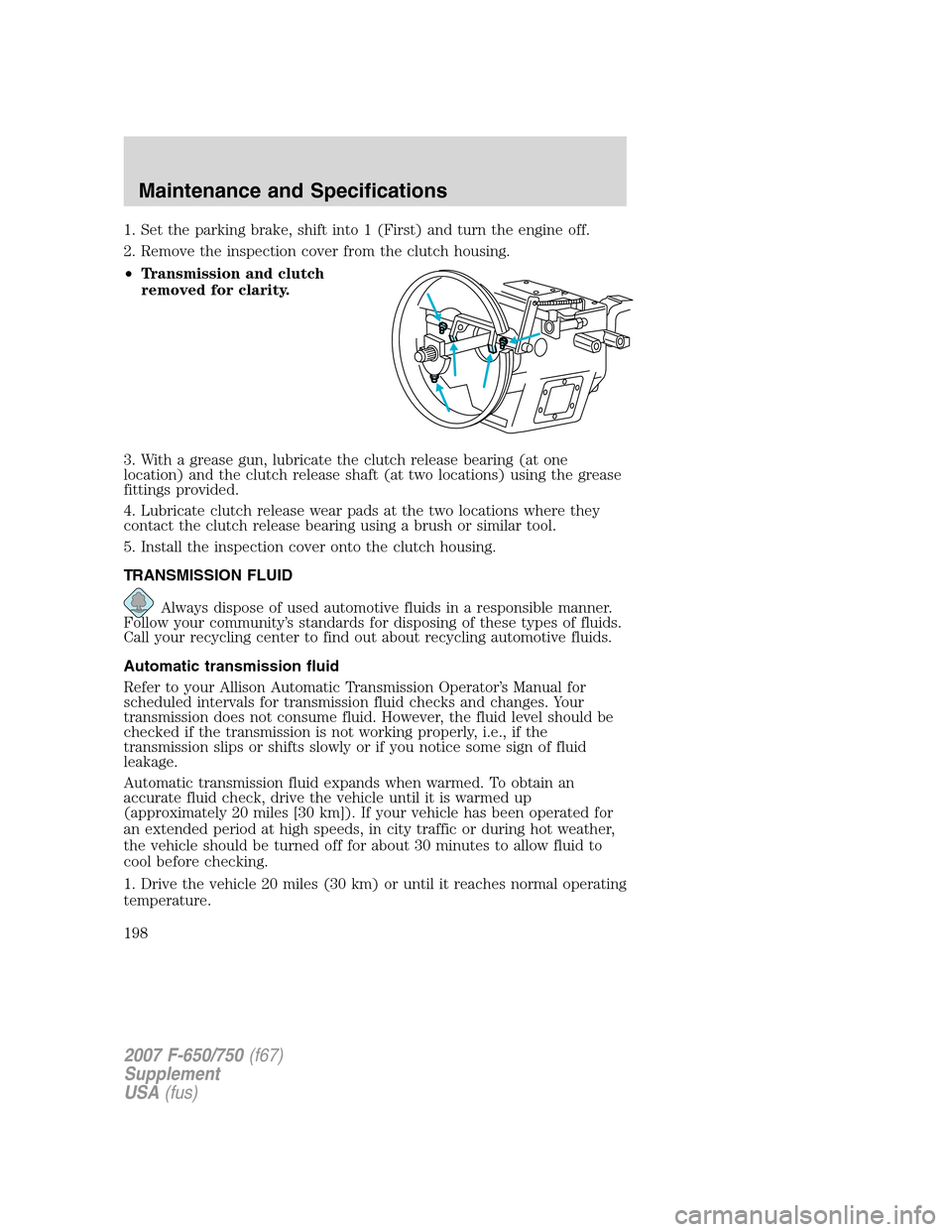
1. Set the parking brake, shift into 1 (First) and turn the engine off.
2. Remove the inspection cover from the clutch housing.
•Transmission and clutch
removed for clarity.
3. With a grease gun, lubricate the clutch release bearing (at one
location) and the clutch release shaft (at two locations) using the grease
fittings provided.
4. Lubricate clutch release wear pads at the two locations where they
contact the clutch release bearing using a brush or similar tool.
5. Install the inspection cover onto the clutch housing.
TRANSMISSION FLUID
Always dispose of used automotive fluids in a responsible manner.
Follow your community’s standards for disposing of these types of fluids.
Call your recycling center to find out about recycling automotive fluids.
Automatic transmission fluid
Refer to your Allison Automatic Transmission Operator’s Manual for
scheduled intervals for transmission fluid checks and changes. Your
transmission does not consume fluid. However, the fluid level should be
checked if the transmission is not working properly, i.e., if the
transmission slips or shifts slowly or if you notice some sign of fluid
leakage.
Automatic transmission fluid expands when warmed. To obtain an
accurate fluid check, drive the vehicle until it is warmed up
(approximately 20 miles [30 km]). If your vehicle has been operated for
an extended period at high speeds, in city traffic or during hot weather,
the vehicle should be turned off for about 30 minutes to allow fluid to
cool before checking.
1. Drive the vehicle 20 miles (30 km) or until it reaches normal operating
temperature.
2007 F-650/750(f67)
Supplement
USA(fus)
Maintenance and Specifications
198