service FORD FIESTA 2007 User Guide
[x] Cancel search | Manufacturer: FORD, Model Year: 2007, Model line: FIESTA, Model: FORD FIESTA 2007Pages: 1226, PDF Size: 61.26 MB
Page 155 of 1226
205-04-3 Front Drive Halfshafts 205-04-3
DESCRIPTION AND OPERATION
Front Drive Halfshafts
Drives hafts
Conventional driveshafts are used on the front axle.
For servicing purposes it is important to note that
the inner tripod joints are pressed onto the shaft.
This has made it possible to reduce noise levels
when the vehicle is pulling away from standing.
The outer joint has not been approved for service
repairs, so in the event of a fault it is necessary to
replace the complete shaft and outer joint
assembly. The inner joints are dismantled with the
aid of a puller. The driveshaft needs to be removed
first.
In order to install a new boot on the outer joint, it
is first necessary to remove the driveshaft and then
disassemble the inner joint. A special service kit is
available in service for this purpose, consisting of
the inner and outer boot and the necessary small
parts.
The same amount of grease is used to pack the
inner and outer joints.
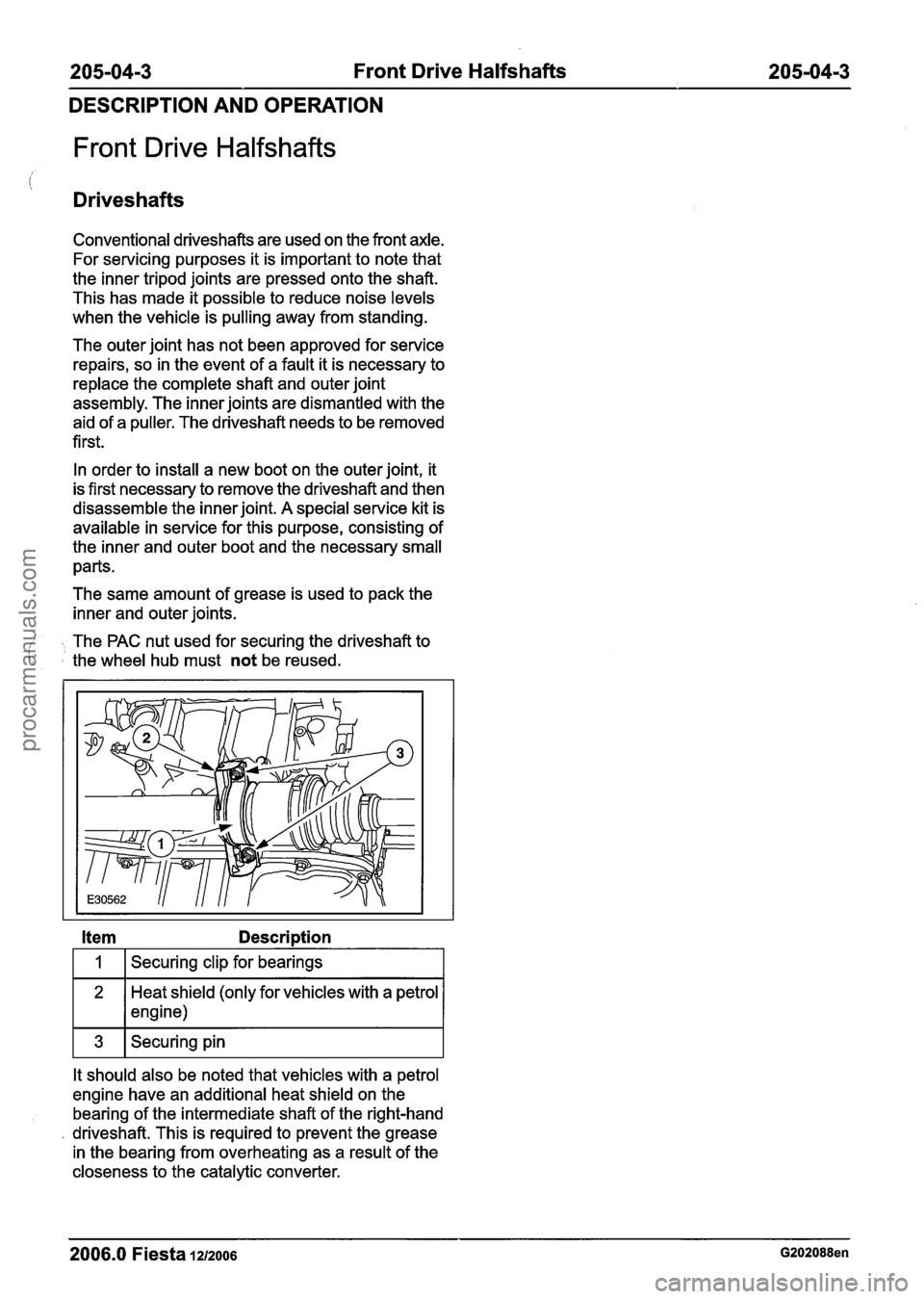
- The PAC nut used for securing the driveshaft to ' the wheel hub must not be reused.
Item Description
I 1 I Securing clip for bearings I
Heat shield (only for vehicles with a petrol
1 * 1 engine)
It should also be noted that vehicles with a petrol
engine have an additional heat shield on the bearing of the intermediate shaft of the right-hand
driveshaft. This is required to prevent the grease
in the bearing from overheating as a result of the
closeness to the catalytic converter.
2006.0 Fiesta 1212006 G202088en
procarmanuals.com
Page 202 of 1226
Brake System - General Information
DIAGNOSIS AND TESTING
evidence of a brake concern. Check for the brake
warning indicator illumination and the fluid level in
the master cylinder reservoir.
Normal Conditions
The following conditions are considered normal
and are not indications that the brake master
cylinder is in need of service.
- Modern brake systems are not designed to
produce as hard a pedal effort as in the past.
Complaints of light pedal efforts should be
compared to pedal efforts of another vehicle, of
the same model and year.
- During normal operation of the brake the fluid
level in the reservoir will rise during brake
application and fall during release. The net fluid
level
(i.e., after brake application and release)
will remain unchanged.
- A trace of brake fluid will exists on the brake
booster shell below the master cylinder
mounting flange. This results from the normal
lubricating action of the master cylinder bore
end seal.
- The fluid level will fall with brake shoe and lining
wear.
Abnormal Conditions
N0TE:Prior to performing any diagnosis, make
sure the brake system warning indicator is
functional.
Changes in brake pedal feel or travel are indicators
that something could be wrong with the braking system. The diagnostic procedure and techniques
use brake pedal feel, warning indicator illumination
and low brake fluid level as indicators in diagnosing
braking system concerns. The following conditions
are considered abnormal and indicate that the
brake master cylinder is in need of service.
- The brake pedal effort is excessive. This may
be caused by a bind or obstruction in the pedal
.
or linkage, clogged fluid control valve or ( ' insufficient booster vacuum.
- The rear brakes lock up during light pedal force.
This may be caused by incorrect tire pressures,
grease or fluid on the brake shoes and linings,
damaged brake shoes and linings, incorrectly
adjusted parking brake, or damaged or
contaminated brake pressure control valves.
- The brake pedal effort is erratic. This condition
could be caused by a brake booster malfunction,
extreme caliper piston knock back or incorrectly
installed brake shoes and linings.
- The brake warning indicator is ON. This may
be caused by low fluid level, ignition wire routing
too close to the fluid level indicator assembly,
or float assembly damage.
Bypass Condition Test
1. Check the fluid in brake master cylinder. Fill the
brake master cylinder reservoir if low or empty.
2. Observe the fluid level in the brake master
cylinder reservoir. If after several brake
applications, the fluid level remains the same,
measure the wheel turning torque required to
rotate the wheels with the brakes applied as
follows:
Place the transaxle in NEUTRAL and raise and
support the vehicle. REFER to: (1 00-02 Jacking
and Lifting)
Jacking (Description and Operation),
Lifting (Description and Operation).
Apply the brakes with a minimum of 445 N (100
Ib) and hold for approximately 15 seconds. With
the brakes still applied, exert a torque on the front
wheels of 10.1 Nm (75
1b.R). If either wheel rotates,
install a new brake master cylinder. REFER to:
(206-06 Hydraulic Brake Actuation)
- The brake pedal goes down fast. This could be Brake Master Cylinder - RHD (Removal and
caused by an external or internal leak. Installation),
- The brake
pedal eases down slowly. This could Brake Master Cylinder - LHD
(Removal and
be caused by an external or internal leak. Installation).
- The
brake pedal is low and or feels spongy. This
condition may be caused by no fluid in the brake
Non-Pressure Leaks master cylinder reservoir, reservoir cap vent
holes clogged or air in the hydraulic system.
Any empty brake master cylinder reservoir
condition may be caused by two types of
non-pressure external leaks.
2006.0 Fiesta 1212006
procarmanuals.com
Page 203 of 1226
206-00-31 Brake System - General Information 206-00-31
DIAGNOSIS AND TESTING
Type 1: An external leak may occur at the master
cylinder reservoir cap because of incorrect
( positioning of the gasket and cap. Reposition the
cap and gasket.
Type
2: An external leak may occur at the reservoir
mounting seals. Service such a leak by installing
new seals.
2006.0 Fiesta 1212006 G28494en
procarmanuals.com
Page 270 of 1226
206-0716 Power Brake Actuation 206-0716
DESCRIPTION AND OPERATION
Release of the brake assistant
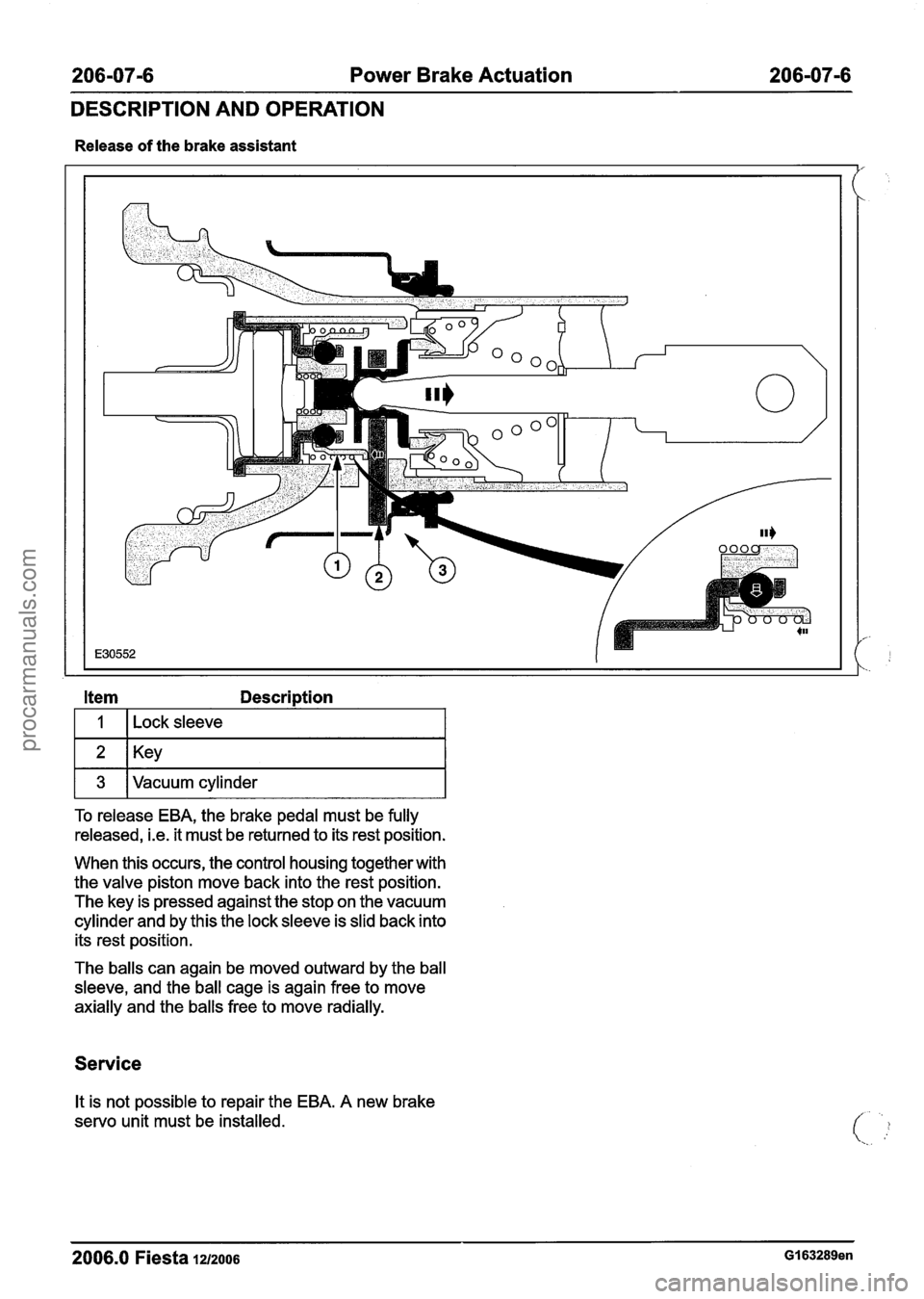
Item Description
I I I ~ock sleeve I
1 3 IVacuum cylinder I
To release EBA, the brake pedal must be fully
released,
i.e. it must be returned to its rest position.
When this occurs, the control housing together with
the valve piston move back into the rest position.
The key is pressed against the stop on the vacuum
cylinder and by this the lock sleeve is slid back into
its rest position.
The balls can again be moved outward by the ball
sleeve, and the ball cage is again free to move
axially and the balls free to move radially.
Service
It is not possible to repair the EBA. A new brake
servo unit must be installed.
2006.0 Fiesta 12/2006 GI 63289en
procarmanuals.com
Page 280 of 1226
206-09A-6 Anti-Lock Control 206-09A-6
DESCRIPTION AND OPERATION
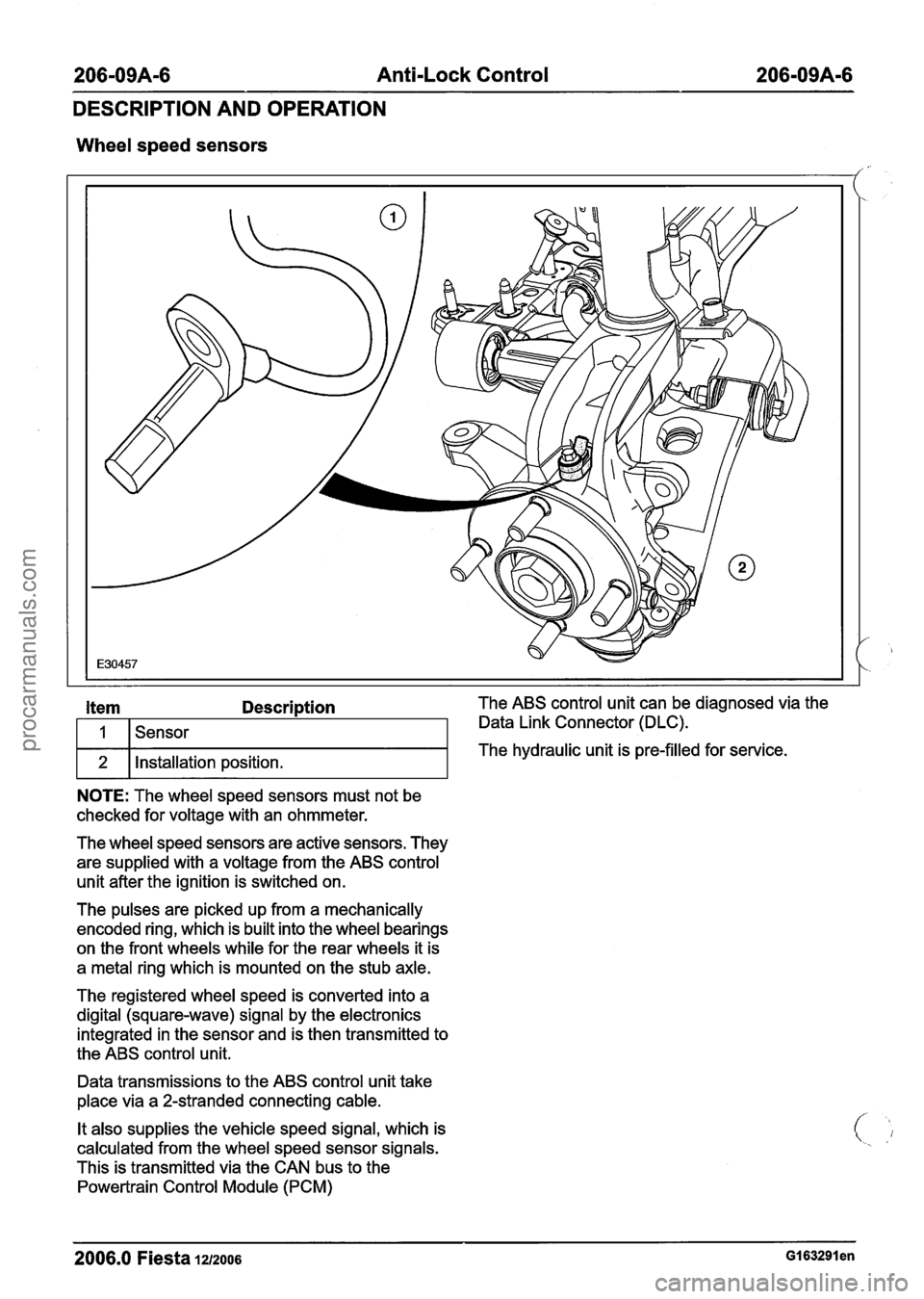
Wheel speed sensors
I f
The wheel speed sensors are active sensors. They
are supplied with a voltage from the ABS control
unit after the ignition is switched on.
Item Description The ABS control unit can be diagnosed via the
The pulses are picked up from a mechanically
encoded ring, which is built into the wheel bearings
on the front wheels while for the rear wheels it is
a metal ring which is mounted on the stub axle.
The registered wheel speed is converted into a
digital (square-wave) signal by the electronics
integrated in the sensor and is then transmitted to
the ABS control unit. Data Link Connector
(DLC).
The hydraulic unit is pre-filled for service.
1
2
Data transmissions to the ABS control unit take
place via a 2-stranded connecting cable.
NOTE: The wheel speed sensors must not be
checked for voltage with an ohmmeter.
Sensor
Installation position.
It also supplies the vehicle speed signal, which is
calculated from the wheel speed sensor signals.
This is transmitted via the CAN bus to the
Powertrain Control Module (PCM)
2006.0 Fiesta 1212006 GI 63291 en
procarmanuals.com
Page 336 of 1226
21 1-00-1 6 Steering System - General Information 21 I -00-1 6
DIAGNOSIS AND TESTING
8m ACAUTION:T~ prevent damage to the
steering linkage, turn the steering wheel to
move the steering linkage to the steering
lock stop.
Turn the steering wheel to position the steering
linkage against the left-hand steering lock stop.
9. N0TE:To isolate the steering gear design
'clearance, check the left-hand
tiemrod with
the steering held against the left-hand
steering lock stop.
With the aid of another technician holding the
steering against the left-hand steering lock stop,
firmly grasp the left-hand road wheel and apply
a rocking motion to check for any free play in
the tie-rod.
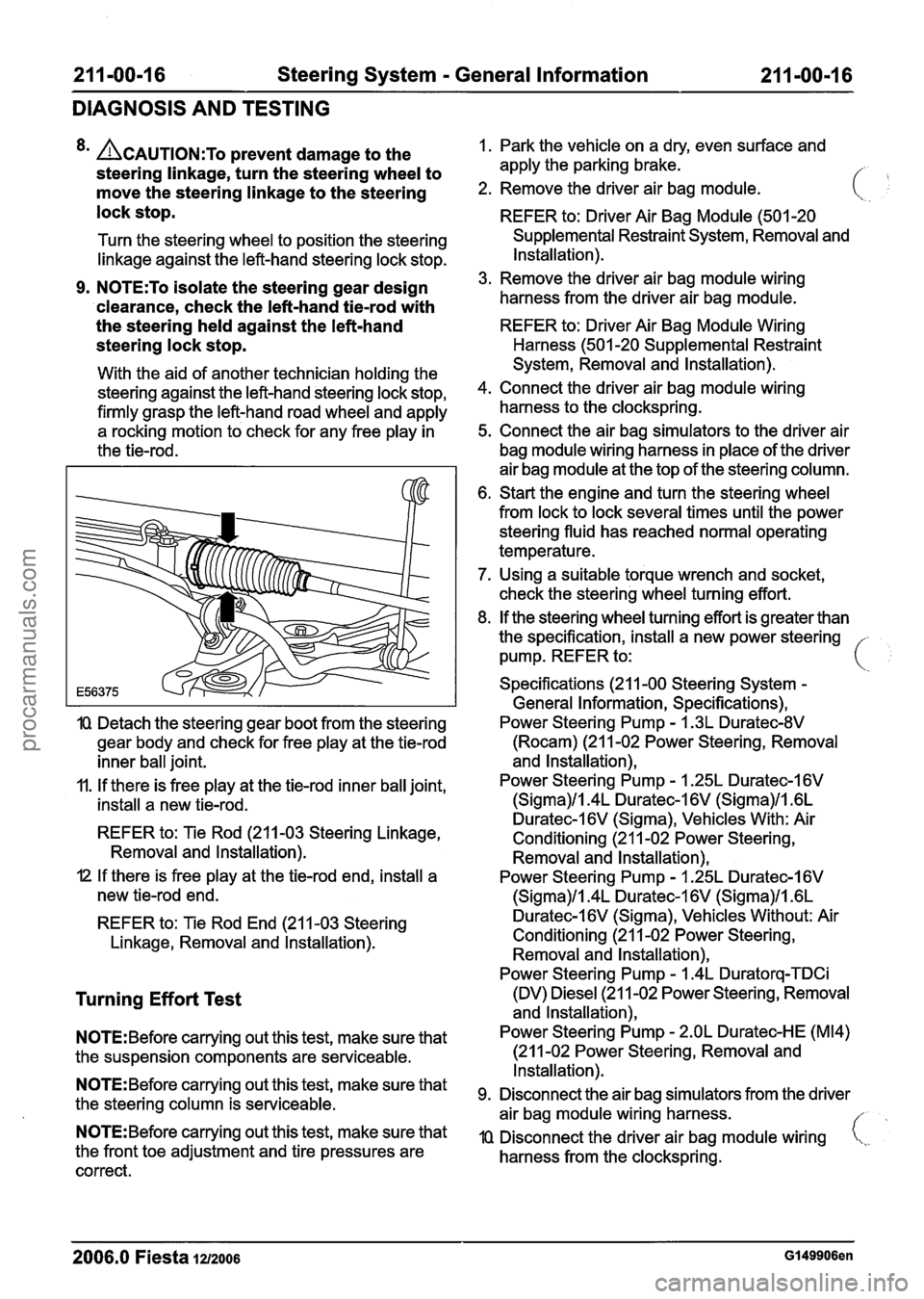
IQ Detach the steering gear boot from the steering
gear body and check for free play at the tie-rod
inner ball joint.
11. If there is free play at the tie-rod inner ball joint,
install a new tie-rod.
REFER to: Tie Rod (211-03 Steering Linkage,
Removal and lnstallation).
I2 If there is free play at the tie-rod end, install a
new tie-rod end.
REFER to: Tie Rod End (21 1-03 Steering
Linkage, Removal and lnstallation).
Turning Effort Test
N0TE:Before carrying out this test, make sure that
the suspension components are serviceable.
N0TE:Before carrying out this test, make sure that
the steering column is serviceable.
N0TE:Before carrying out this test, make sure that
the front toe adjustment and tire pressures are
correct. 1.
Park the vehicle on a dry, even surface and
apply the parking brake.
/- ,
2. Remove the driver air bag module.
REFER to: Driver Air Bag Module (501 -20
Supplemental Restraint System, Removal and
Installation).
3. Remove the driver air bag module wiring
harness from the driver air bag module.
REFER to: Driver Air Bag Module Wiring
Harness (501 -20 Supplemental Restraint
System, Removal and Installation).
4. Connect the driver air bag module wiring
harness to the clockspring.
5. Connect the air bag simulators to the driver air
bag module wiring harness in place of the driver
air bag module at the top of the steering column.
6. Start the engine and turn the steering wheel
from lock to lock several times until the power
steering fluid has reached normal operating
temperature.
7. Using a suitable torque wrench and socket,
check the steering wheel turning effort.
8. If the steering wheel turning effort is greater than
the specification, install a new power steering -
pump. REFER to: i
Specifications (21 1-00 Steering System -
General Information, Specifications),
Power Steering Pump
- I .3L Duratec-8V
(Rocam) (21 1-02 Power Steering, Removal
and lnstallation),
Power Steering Pump
- 1.25L Duratec-1 6V
(Sigma)/l.4L Duratec-1 6V (Sigma)/l .6L
Duratec-l6V (Sigma), Vehicles With: Air
Conditioning (21 1-02 Power Steering,
Removal and lnstallation),
Power Steering Pump
- I .25L Duratec-I 6V
(Sigma)/l.4L Duratec-1 6V (Sigma)/l .6L
Duratec-I 6V (Sigma), Vehicles Without: Air
Conditioning (21 1-02 Power Steering, Removal and lnstallation),
Power Steering Pump
- 1.4L Duratorq-TDCi
(DV) Diesel (21 1-02 Power Steering, Removal
and lnstallation),
Power Steering Pump
- 2.OL Duratec-HE (M14)
(21 1-02 Power Steering, Removal and
Installation).
Disconnect the air bag simulators from the driver
air bag module wiring harness.
//
IQ Disconnect the driver air bag module wiring i,,.
harness from the clockspring.
2006.0 Fiesta 1212006 GI 49906en
procarmanuals.com
Page 480 of 1226
Engine - 1.25L Duratec-1 6V (Sigma)ll.4L
Duratec-1 6V (Sigma)ll .6L Duratec-1 6V (Sigma)
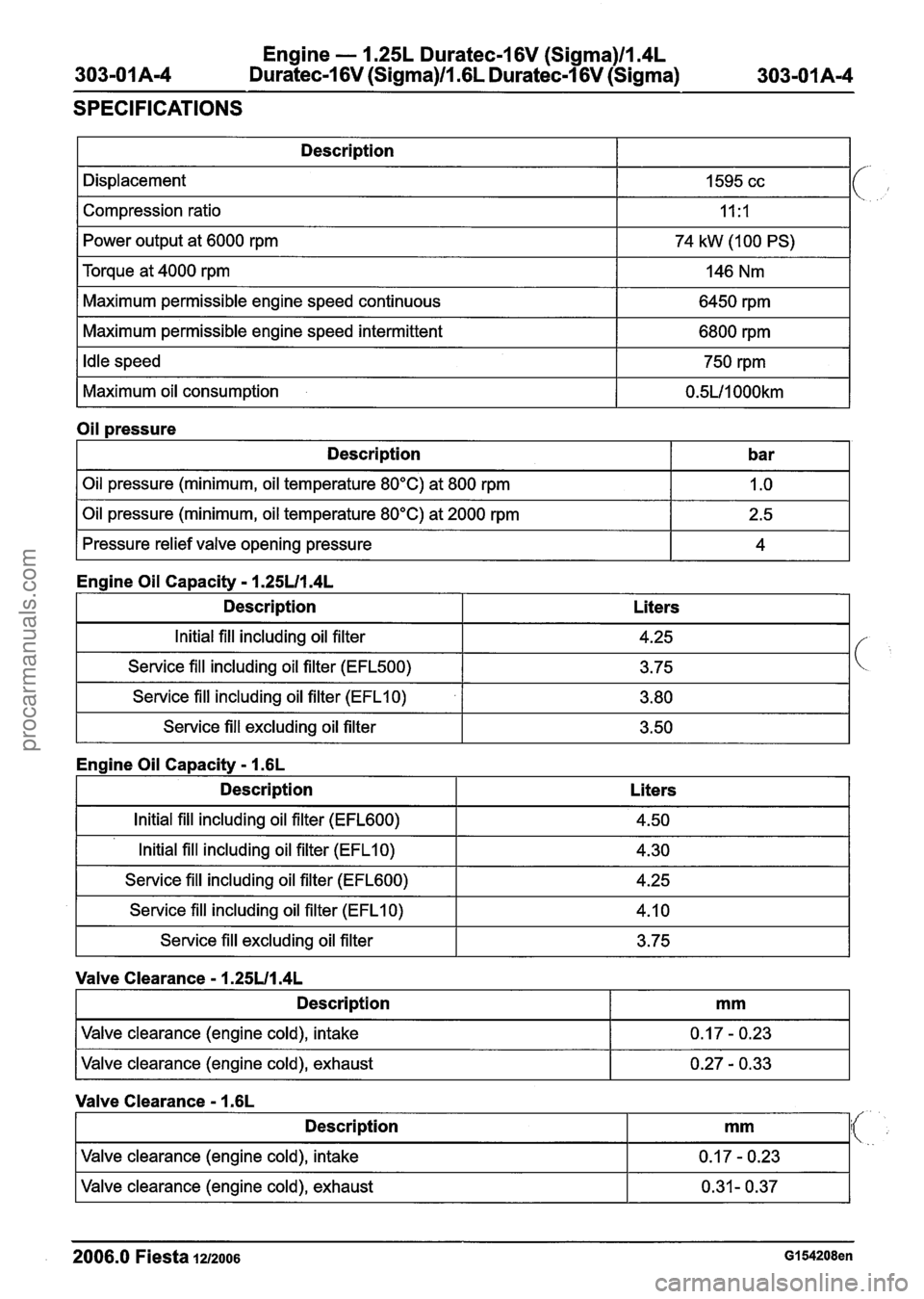
SPECIFICATIONS
I Power output at 6000 rpm I 74 kW (1 00 PS) I
Description
Displacement
Compression ratio 1595
cc
11:l
Torque at 4000 rpm
Maximum permissible engine speed continuous
I Idle speed I 750 rpm I
1
146 Nm
6450 rpm
I Maximum permissible engine speed intermittent
I Maximum oil consumption I 0.5U1 OOOkm I
6800 rpm
Oil
Dressure
I Description I bar I
I Oil pressure (minimum, oil temperature 80°C) at 800 rpm I 1 .O I
I Oil pressure (minimum, oil temperature 80°C) at 2000 rpm I 2.5 I
I Pressure relief valve opening pressure I 4 1
Engine Oil Capacity - 1.25U1.4L
I Service fill including oil filter (EFLI 0) I 3.80 I
Description
Initial fill including oil filter
Service fill including oil filter
(EFL500)
I Service fill excluding oil filter I 3.50 I
Liters
4.25
3.75
I Initial fill including oil filter (EFLGOO) I 4.50 I
Engine Oil Capacity - 1.6L
I Initial fill including oil filter (EFLI 0) I 4.30 I
Description
I Service fill including oil filter (EFLGOO) I 4.25 I
Liters
I Service fill including oil filter (EFLI 0) I 4.10 I
I Service fill excluding oil filter I 3.75 I
Valve Clearance - 1.25U1.4L
Valve Clearance - 1.6L
Description
Valve clearance (engine cold), intake
Valve clearance (engine cold), exhaust
Description mm
I!{
mm
0.17 - 0.23
0.27
- 0.33
I Valve clearance (engine cold), intake I 0.17 - 0.23 I
I Valve clearance (engine cold), exhaust I 0.31- 0.37 I
2006.0 Fiesta 1212006 GI 54208en
procarmanuals.com
Page 626 of 1226
Engine - 2.OL Duratec-HE (M14)
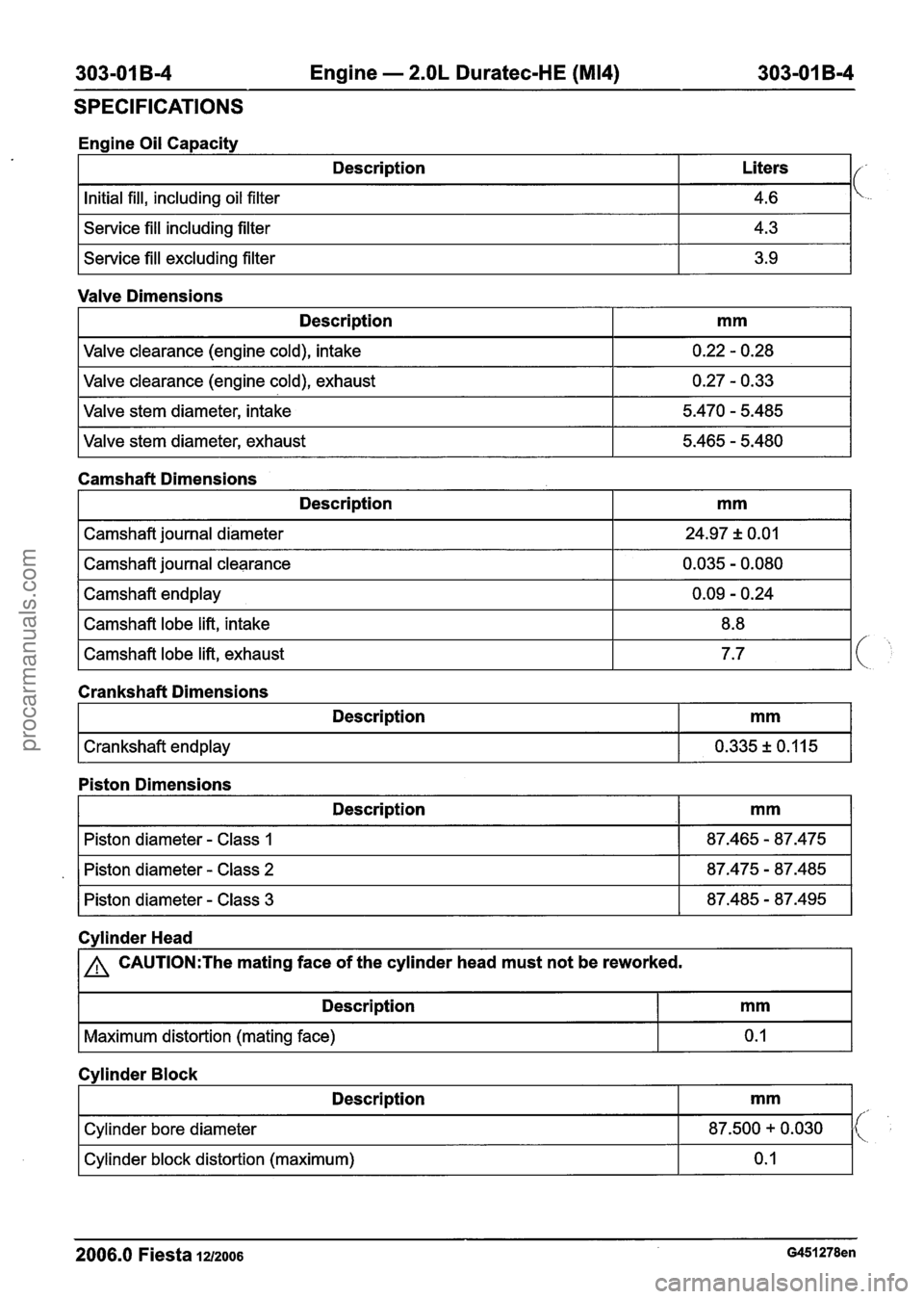
SPECIFICATIONS
I Service fill including filter I 4.3 I
Engine Oil Capacity
I Service fill excluding filter I 3.9 I
Description
Initial fill, including oil filter
Valve Dimensions Liters
4.6
Camshaft Dimensions Description
Valve
clearance (engine cold), intake
Valve clearance (engine cold), exhaust
Valve stem diameter, intake
Valve stem diameter, exhaust
mm
0.22 - 0.28
0.27
- 0.33
5.470
- 5.485
5.465
- 5.480
I Camshaft journal clearance I 0.035 - 0.080 I
Description
Camshaft journal diameter
I Camshaft endplay I 0.09 - 0.24 I
mm
24.97 + 0.01
Camshaft lobe lift, intake
Camshaft lobe lift, exhaust
Piston Dimensions
8.8
7.7
Description
Crankshaft endplay
Crankshaft Dimensions
mm
0.335 + 0.1 15
Cvlinder Head Description
Piston diameter - Class 1
Piston diameter - Class 2
Piston diameter - Class 3
1 a CAUTI0N:The mating face
of the cylinder head must not be reworked. mm
87.465 - 87.475
87.475
- 87.485
87.485
- 87.495
I Description I mm I
I Maximum distortion (mating face) I 0.1 I
2006.0 Fiesta 1u2006
Cylinder Block
'(, ',
Description
Cylinder bore diameter
Cylinder block distortion (maximum)
mm
87.500 + 0.030
0.
I
procarmanuals.com
Page 631 of 1226
303101 B-9 Engine - 2.OL Duratec-HE (M14) 303-01 B-9
DESCRIPTION AND OPERATION
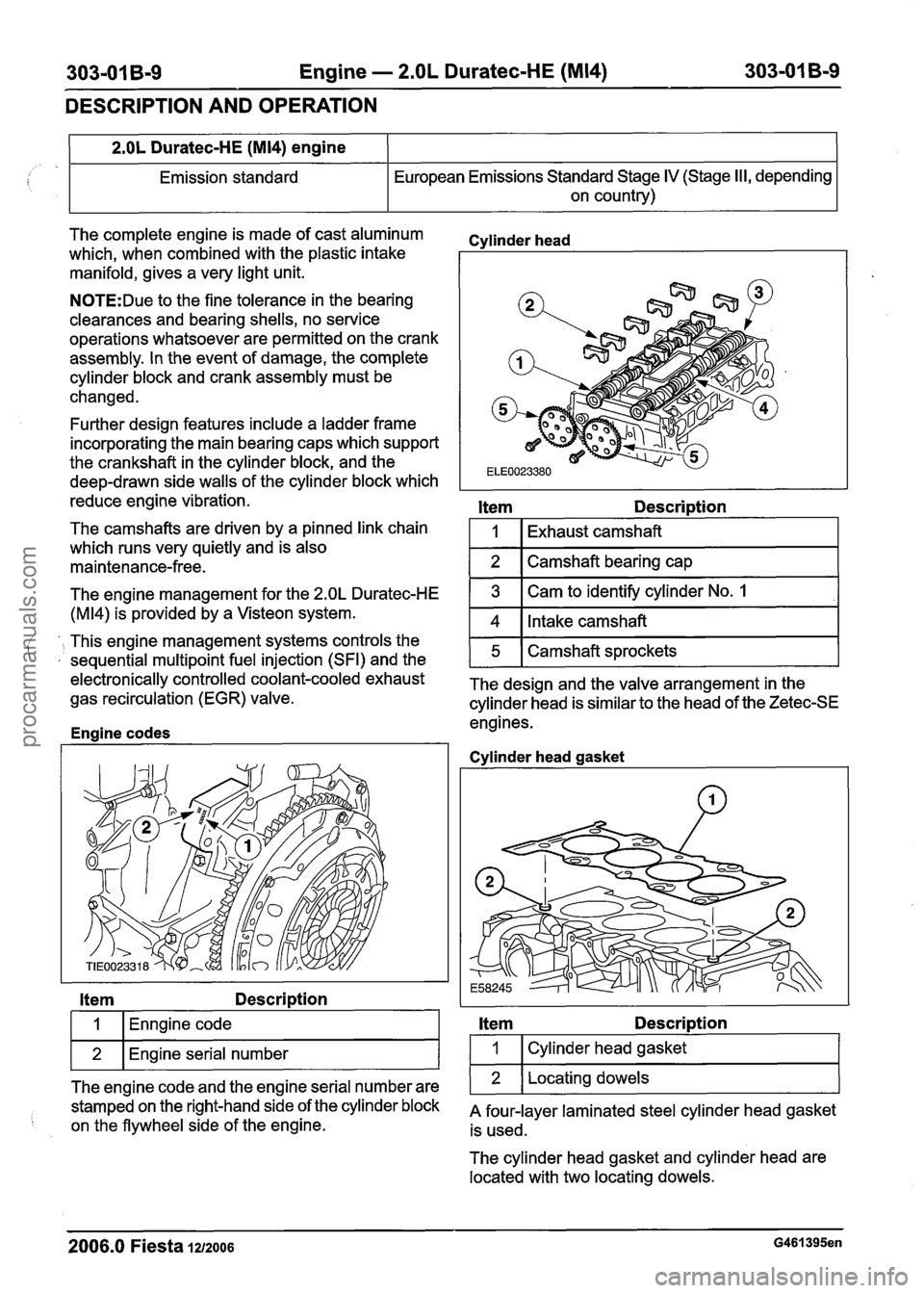
The complete engine is made of cast aluminum
which, when combined with the plastic intake
manifold, gives a very light unit.
2.OL Duratec-HE (M14) engine
Emission standard
N0TE:Due to the fine tolerance in the bearing
clearances and bearing shells, no service
operations whatsoever are permitted on the crank
assembly. In the event of damage, the complete
cylinder block and crank assembly must be
changed. European
Emissions Standard Stage
IV (Stage II I, depending
on country)
Further design features include a ladder frame
incorporating the main bearing caps which support
the crankshaft in the cylinder block, and the
deep-drawn side walls of the cylinder block which
reduce engine vibration.
The camshafts are driven by a pinned link chain
which runs very quietly and is also
maintenance-free.
Cvlinder head
Item Description
1
2
The engine management for the 2.OL Duratec-HE
(M14) is provided by a Visteon system.
Item Description
Exhaust camshaft
Camshaft bearing cap
', This engine management systems controls the ' , sequential multipoint fuel injection (SFI) and the
I 1 (Enngine code I
3
4
wl~n~ine serial number I
Cam to identify cylinder No. 1
Intake camshaft
ele~tronically controlled coolant-cooled exhaust The design and the valve arrangement in the gas recirculation (EGR) valve.
cylinder head is similar to the head of the Zetec-SE
engines.
Enaine codes
5
The engine code and the engine serial number are
stamped on the right-hand side of the cylinder block
on the flywheel side of the engine. Camshaft sprockets
Cvlinder
head gasket
Item Description
I 1 I Cylinder head gasket I
1 2 1 Locating dowels 1
A four-layer laminated steel cylinder head gasket
is used.
The cylinder head gasket and cylinder head are
located with two locating dowels.
2006.0 Fiesta 1212006 G461395en
procarmanuals.com
Page 632 of 1226
303-01 B-I 0 Engine - 2.OL Duratec-HE (M14) 303-01 B-I 0 - -- --
DESCRIPTION AND OPERATION
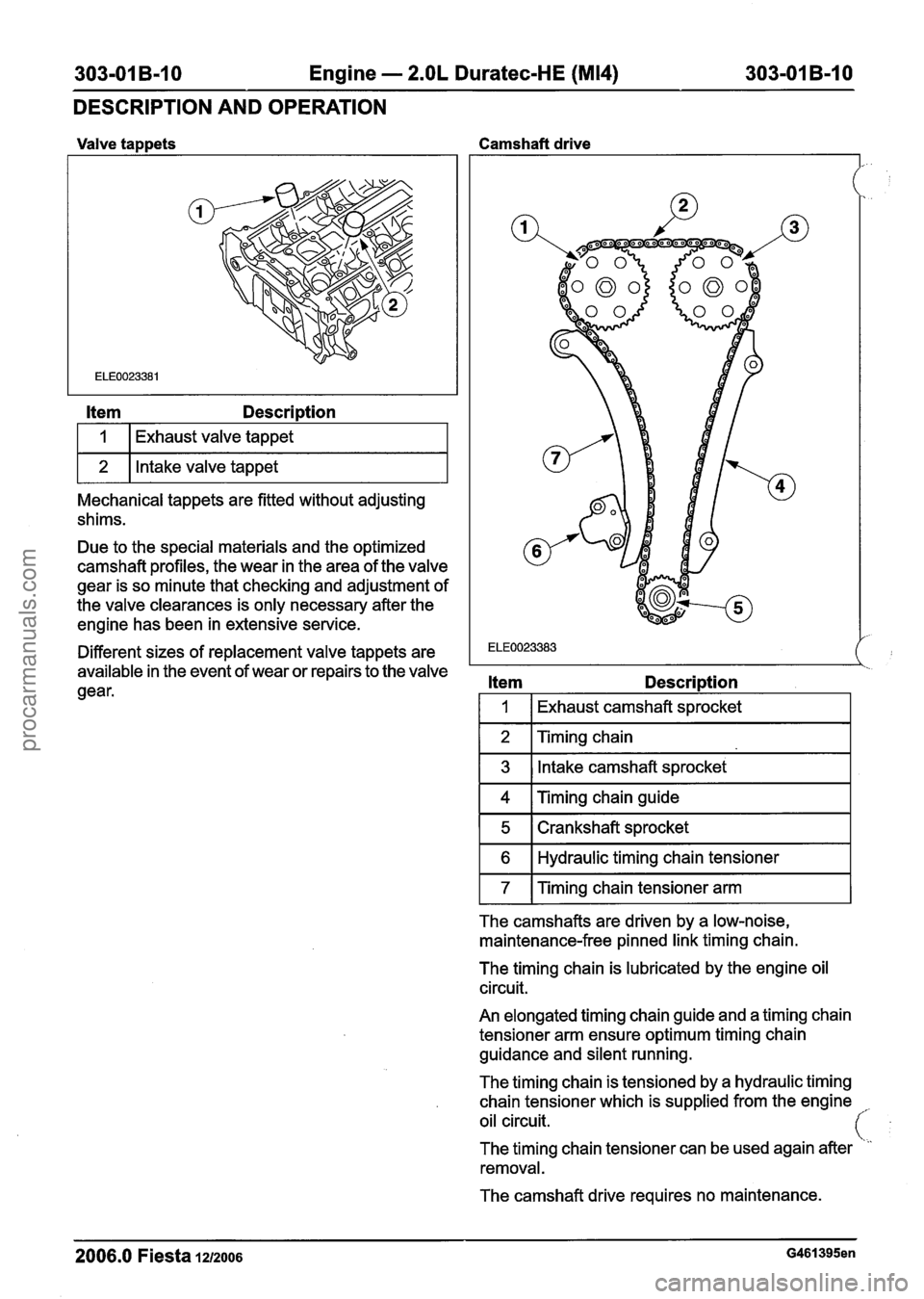
Valve tappets Camshaft drive
Item Description
I 1 I Exhaust valve tappet I
1 2 1 Intake valve tappet I
Mechanical tappets are fitted without adjusting
shims.
Due to the special materials and the optimized
camshaft profiles, the wear in the area of the valve
gear is so minute that checking and adjustment of
the valve clearances is only necessary after the
engine has been in extensive service.
Different sizes of replacement valve tappets are
I ELE0023383
available in the event of wear or repairs to the valve ' '2
gear. Item Description
I 1 I Exhaust camshaft sprocket
1 2 I Timing chain I
1 3 1 Intake camshaft sprocket I
1 4 I ~imin~ chain guide I
1 5 1 Crankshaft sprocket I
1 6 1 Hydraulic timing chain tensioner I
1 7 1 ~imin~ chain tensioner arm 1 - -
The camshafts are driven by a low-noise,
maintenance-free pinned link timing chain.
The timing chain is lubricated by the engine oil
circuit.
An elongated timing chain guide and a timing chain
tensioner arm ensure optimum timing chain
guidance and silent running.
The timing chain is tensioned by a hydraulic timing
chain tensioner which is supplied from the engine
,.
oil circuit.
The timing chain tensioner can be used again after
removal.
The camshaft drive requires no maintenance.
2006.0 Fiesta 1212006 G461395en
procarmanuals.com