air condition FORD FUSION/HYBRID 2018 User Guide
[x] Cancel search | Manufacturer: FORD, Model Year: 2018, Model line: FUSION/HYBRID, Model: FORD FUSION/HYBRID 2018Pages: 538, PDF Size: 6.06 MB
Page 122 of 538
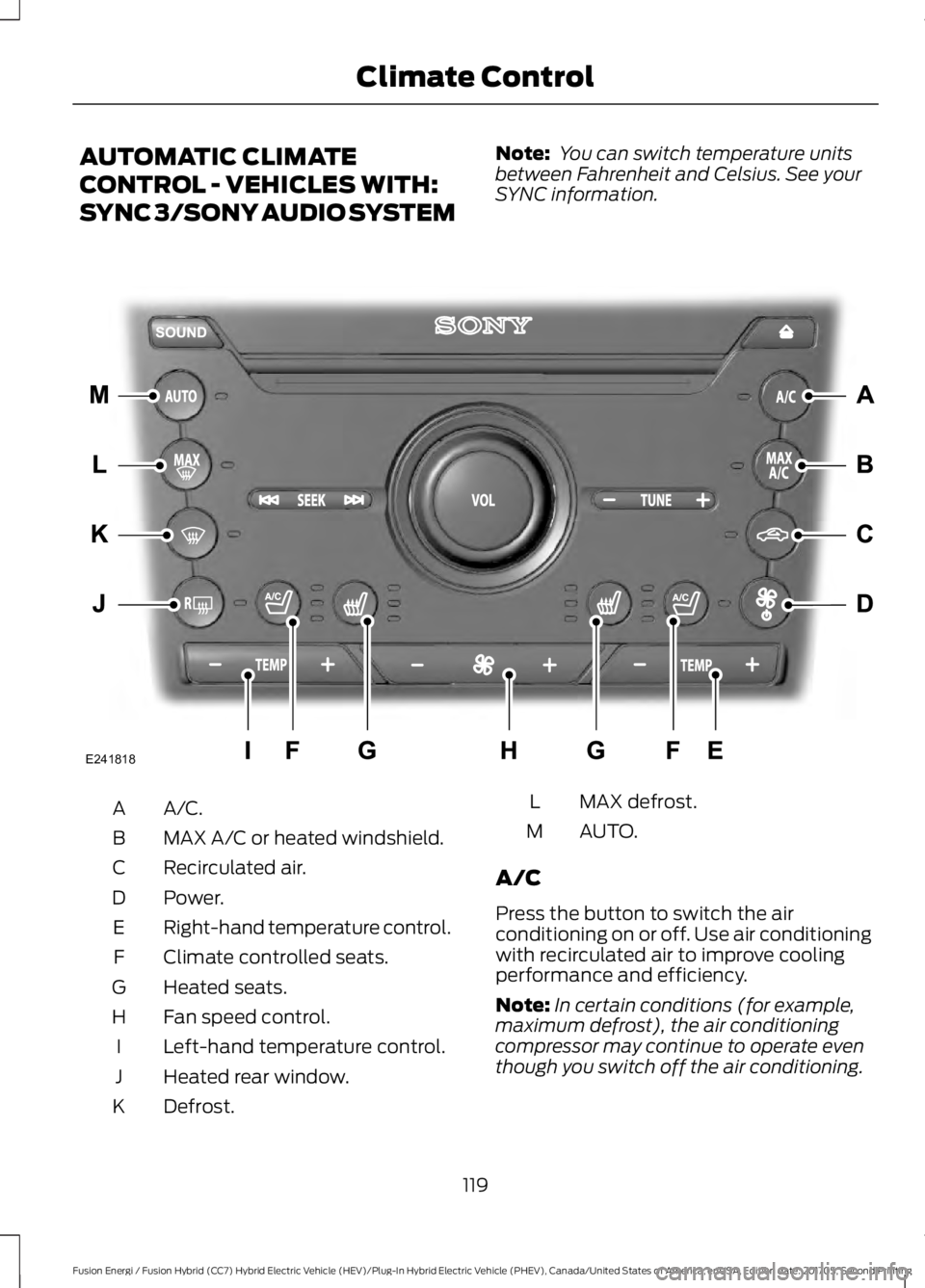
AUTOMATIC CLIMATE
CONTROL - VEHICLES WITH:
SYNC 3/SONY AUDIO SYSTEM
Note:
You can switch temperature units
between Fahrenheit and Celsius. See your
SYNC information. A/C.A
MAX A/C or heated windshield.
B
Recirculated air.
C
Power.
D
Right-hand temperature control.
E
Climate controlled seats.
F
Heated seats.
G
Fan speed control.
H
Left-hand temperature control.
I
Heated rear window.
J
Defrost.
K MAX defrost.
L
AUTO.
M
A/C
Press the button to switch the air
conditioning on or off. Use air conditioning
with recirculated air to improve cooling
performance and efficiency.
Note: In certain conditions (for example,
maximum defrost), the air conditioning
compressor may continue to operate even
though you switch off the air conditioning.
119
Fusion Energi / Fusion Hybrid (CC7) Hybrid Electric Vehicle (HEV)/Plug-In Hybrid Electric Vehicle (PHEV), Canada/United States of America, enUSA, Edition date: 201705, Second Printing Climate ControlE241818
Page 123 of 538
Max A/C (If Equipped)
Press for maximum cooling. The left-hand
and right-hand settings set to LO,
recirculated air flows through the
instrument panel vents, air conditioning
turns on and the fan adjusts to the highest
speed.
Heated Windshield
(If Equipped)
Press to clear the heated windshield of thin
ice and fog.
Recirculated Air
Press to switch between outside air and
recirculated air. The air currently in the
passenger compartment recirculates. This
may reduce the time needed to cool the
interior (when used with A/C) and reduce
unwanted odors from entering your vehicle.
Note: Recirculated air may turn off (or
prevent you from switching on) in all air flow
modes except MAX A/C to reduce the risk
of fogging. Recirculation may also turn on
and off in various air distribution control
combinations during hot weather in order
to improve cooling efficiency.
Power
Press to switch the system on and off.
When the system is off, it prevents outside
air from entering the vehicle.
Right-hand Temperature Control
Adjusts the temperature setting on the
right-hand side.
Climate Controlled Seats
Press cycle through the various climate
controlled seat settings and off. See
Climate Controlled Seats
(page 135). Heated Seats
Press to cycle through the various heat
settings and off. See Heated Seats (page
135
).
Fan Speed Control
Adjust the volume of air circulated in the
vehicle.
Left-hand Temperature Control
Adjusts the temperature setting on the
left-hand side.
Note: This control also adjusts the
right-hand side temperature when you
switch off dual zone mode.
Heated Rear Window
Press to switch the heated rear window on
and off. See
Heated Windows and
Mirrors (page 126).
Defrost
Press to distribute air through the
windshield air vents and de-mister. Air
distribution to the instrument panel and
footwell vents turns off. You can also use
this setting to defog and clear the
windshield of a thin covering of ice.
Max Defrost
Press to switch on defrost. The left-hand
and right-hand settings set to HI, air flows
through the windshield vents, and the fan
adjusts to the highest speed. You can also
use this setting to defog and clear the
windshield of a thin covering of ice. The
heated rear window also turns on when
you select maximum defrost.
Note: To prevent window fogging, you
cannot select recirculated air when
maximum defrost is on.
120
Fusion Energi / Fusion Hybrid (CC7) Hybrid Electric Vehicle (HEV)/Plug-In Hybrid Electric Vehicle (PHEV), Canada/United States of America, enUSA, Edition date: 201705, Second Printing Climate Control
Page 124 of 538
AUTO
Press to switch on automatic operation,
then adjust the temperature control to
select the desired temperature. The
system adjusts fan speed, air distribution,
air conditioning operation, and outside or
recirculated air to heat or cool the vehicle
to maintain the desired temperature.
Note:
You can also switch off dual zone
mode by pressing and holding the button
for more than two seconds.
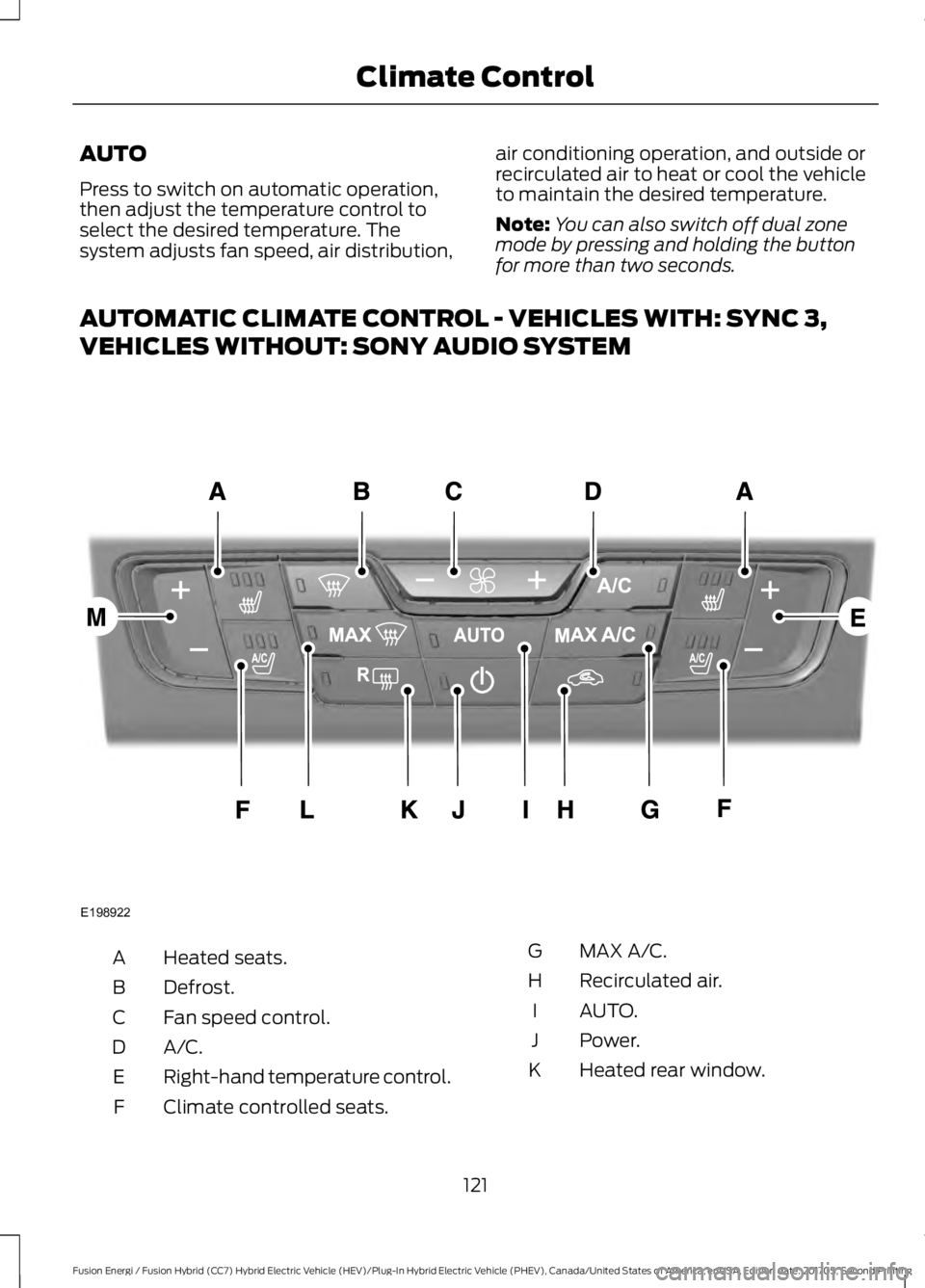
AUTOMATIC CLIMATE CONTROL - VEHICLES WITH: SYNC 3,
VEHICLES WITHOUT: SONY AUDIO SYSTEM Heated seats.
A
Defrost.
B
Fan speed control.
C
A/C.D
Right-hand temperature control.
E
Climate controlled seats.
F MAX A/C.
G
Recirculated air.
H
AUTO.
I
Power.
J
Heated rear window.
K
121
Fusion Energi / Fusion Hybrid (CC7) Hybrid Electric Vehicle (HEV)/Plug-In Hybrid Electric Vehicle (PHEV), Canada/United States of America, enUSA, Edition date: 201705, Second Printing Climate ControlE198922
Page 125 of 538
MAX defrost.
L
Left-hand temperature control.
M
Heated Seats
Press to cycle through the various heat
settings and off. See Heated Seats (page
135).
Defrost
Press to distribute air through the
windshield air vents and de-mister. Air
distribution to the instrument panel and
footwell vents turns off. You can also use
this setting to defog and clear the
windshield of a thin covering of ice.
Fan Speed Control
Adjust the volume of air circulated in the
vehicle.
A/C
Press the button to switch the air
conditioning on or off. Use air conditioning
with recirculated air to improve cooling
performance and efficiency.
Note: In certain conditions (for example,
maximum defrost), the air conditioning
compressor may continue to operate even
though you switch off the air conditioning.
Right-hand Temperature Control
Adjusts the temperature setting on the
right-hand side.
Climate Controlled Seats
Press to cycle through the various climate
controlled seat settings and off. See
Climate Controlled Seats
(page 135). Max A/C
Press for maximum cooling. The driver and
passenger settings set to LO, recirculated
air flows through the instrument panel
vents, air conditioning turns on and the fan
adjusts to the highest speed.
Recirculated Air
Press to switch between outside air and
recirculated air. The air currently in the
passenger compartment recirculates. This
may reduce the time needed to cool the
interior (when used with A/C) and reduce
unwanted odors from entering your vehicle.
Note:
Recirculated air may turn off (or
prevent you from switching on) in all air flow
modes except MAX A/C to reduce the risk
of fogging. Recirculation may also turn on
and off in various air distribution control
combinations during hot weather to improve
cooling efficiency.
AUTO
Press to switch on automatic operation,
then adjust the temperature control to
select the desired temperature. The
system adjusts fan speed, air distribution,
air conditioning operation, and outside or
recirculated air to heat or cool the vehicle
to maintain the desired temperature.
Note: You can also switch off dual zone
mode by pressing and holding the button
for more than two seconds.
Power
Press to switch the system on and off.
When the system is off, it prevents outside
air from entering the vehicle.
Heated Rear Window
Press to switch the heated rear window on
and off. See
Heated Windows and
Mirrors (page 126).
122
Fusion Energi / Fusion Hybrid (CC7) Hybrid Electric Vehicle (HEV)/Plug-In Hybrid Electric Vehicle (PHEV), Canada/United States of America, enUSA, Edition date: 201705, Second Printing Climate Control
Page 127 of 538
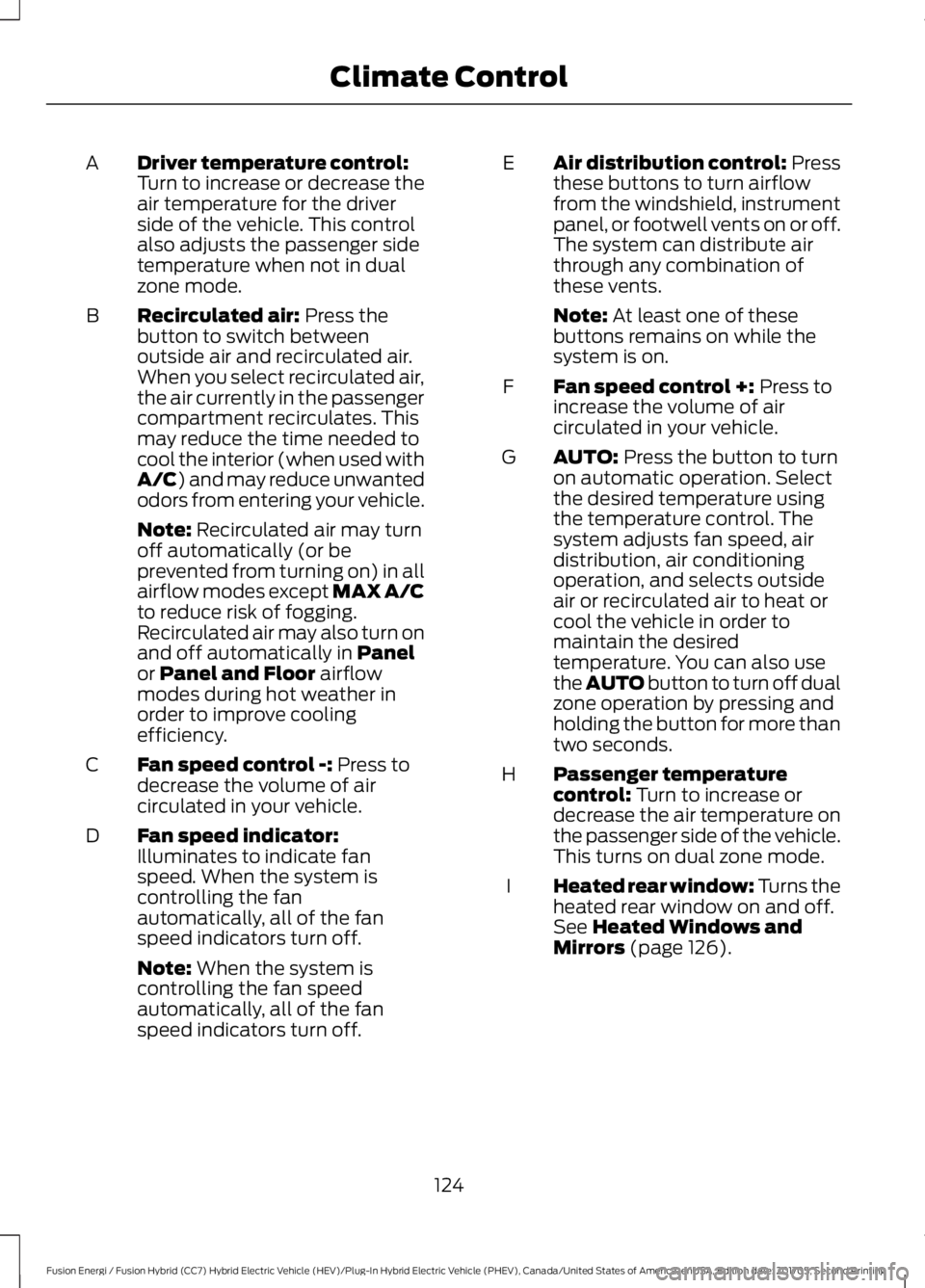
Driver temperature control:
Turn to increase or decrease the
air temperature for the driver
side of the vehicle. This control
also adjusts the passenger side
temperature when not in dual
zone mode.
A
Recirculated air: Press the
button to switch between
outside air and recirculated air.
When you select recirculated air,
the air currently in the passenger
compartment recirculates. This
may reduce the time needed to
cool the interior (when used with
A/C
) and may reduce unwanted
odors from entering your vehicle.
B
Note:
Recirculated air may turn
off automatically (or be
prevented from turning on) in all
airflow modes except MAX A/C
to reduce risk of fogging.
Recirculated air may also turn on
and off automatically in
Panel
or Panel and Floor airflow
modes during hot weather in
order to improve cooling
efficiency.
Fan speed control -:
Press to
decrease the volume of air
circulated in your vehicle.
C
Fan speed indicator:
Illuminates to indicate fan
speed. When the system is
controlling the fan
automatically, all of the fan
speed indicators turn off.
D
Note:
When the system is
controlling the fan speed
automatically, all of the fan
speed indicators turn off. Air distribution control: Press
these buttons to turn airflow
from the windshield, instrument
panel, or footwell vents on or off.
The system can distribute air
through any combination of
these vents.
E
Note:
At least one of these
buttons remains on while the
system is on.
Fan speed control +:
Press to
increase the volume of air
circulated in your vehicle.
F
AUTO:
Press the button to turn
on automatic operation. Select
the desired temperature using
the temperature control. The
system adjusts fan speed, air
distribution, air conditioning
G
operation, and selects outside
air or recirculated air to heat or
cool the vehicle in order to
maintain the desired
temperature. You can also use
the AUTO button to turn off dual
zone operation by pressing and
holding the button for more than
two seconds.
Passenger temperature
control:
Turn to increase or
decrease the air temperature on
the passenger side of the vehicle.
This turns on dual zone mode.
H
Heated rear window: Turns the
heated rear window on and off.
See
Heated Windows and
Mirrors (page 126).
I
124
Fusion Energi / Fusion Hybrid (CC7) Hybrid Electric Vehicle (HEV)/Plug-In Hybrid Electric Vehicle (PHEV), Canada/United States of America, enUSA, Edition date: 201705, Second Printing Climate Control
Page 128 of 538
MAX Defrost: Press the button
to maximize defrosting. Outside
air flows through the windshield
vents, and the fan automatically
adjusts to the highest speed. You
can use this setting to defog or
clear a thin covering of ice from
the windshield. The heated rear
window also automatically turns
on when you select MAX Defrost.
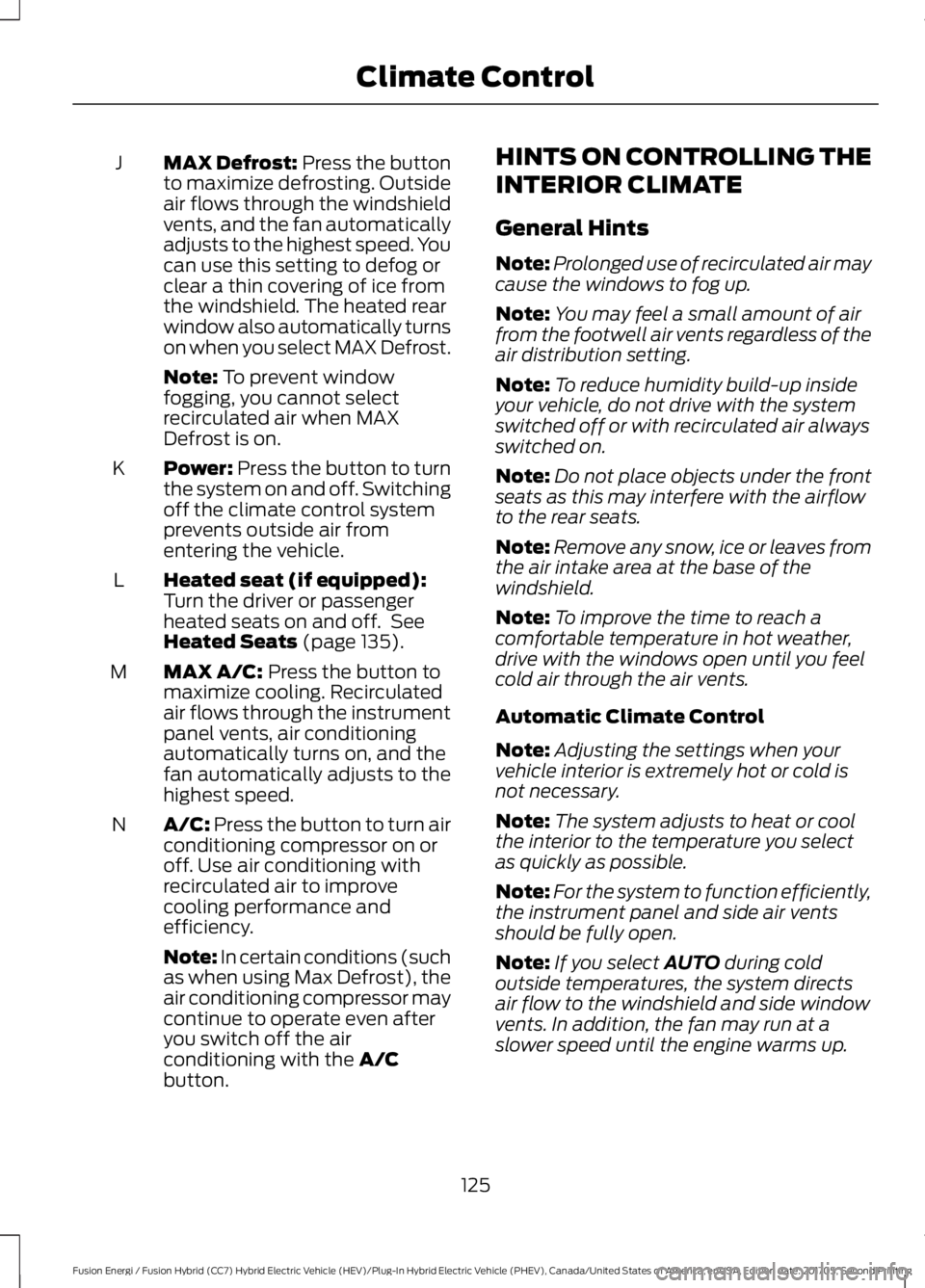
J
Note:
To prevent window
fogging, you cannot select
recirculated air when MAX
Defrost is on.
Power:
Press the button to turn
the system on and off. Switching
off the climate control system
prevents outside air from
entering the vehicle.
K
Heated seat (if equipped):
Turn the driver or passenger
heated seats on and off. See
Heated Seats
(page 135).
L
MAX A/C:
Press the button to
maximize cooling. Recirculated
air flows through the instrument
panel vents, air conditioning
automatically turns on, and the
fan automatically adjusts to the
highest speed.
M
A/C:
Press the button to turn air
conditioning compressor on or
off. Use air conditioning with
recirculated air to improve
cooling performance and
efficiency.
N
Note: In certain conditions (such
as when using Max Defrost), the
air conditioning compressor may
continue to operate even after
you switch off the air
conditioning with the
A/C
button. HINTS ON CONTROLLING THE
INTERIOR CLIMATE
General Hints
Note:
Prolonged use of recirculated air may
cause the windows to fog up.
Note: You may feel a small amount of air
from the footwell air vents regardless of the
air distribution setting.
Note: To reduce humidity build-up inside
your vehicle, do not drive with the system
switched off or with recirculated air always
switched on.
Note: Do not place objects under the front
seats as this may interfere with the airflow
to the rear seats.
Note: Remove any snow, ice or leaves from
the air intake area at the base of the
windshield.
Note: To improve the time to reach a
comfortable temperature in hot weather,
drive with the windows open until you feel
cold air through the air vents.
Automatic Climate Control
Note: Adjusting the settings when your
vehicle interior is extremely hot or cold is
not necessary.
Note: The system adjusts to heat or cool
the interior to the temperature you select
as quickly as possible.
Note: For the system to function efficiently,
the instrument panel and side air vents
should be fully open.
Note: If you select
AUTO during cold
outside temperatures, the system directs
air flow to the windshield and side window
vents. In addition, the fan may run at a
slower speed until the engine warms up.
125
Fusion Energi / Fusion Hybrid (CC7) Hybrid Electric Vehicle (HEV)/Plug-In Hybrid Electric Vehicle (PHEV), Canada/United States of America, enUSA, Edition date: 201705, Second Printing Climate Control
Page 153 of 538
HYBRID VEHICLE OPERATION
This hybrid vehicle combines electric and
gasoline propulsion to provide
breakthrough performance and improved
efficiency.
Familiarizing yourself with these unique
characteristics will provide an optimal
driving experience from your new vehicle.
Note:
You may notice higher engine speeds
upon start-up. This temporary condition is
normal and necessary to heat up the cabin
and minimize emissions.
Starting: When you start your vehicle, a
green ready indicator light will
appear in the lower right portion
of the instrument cluster and a ready to
drive message will appear in the middle of
the left cluster screen, letting you know
that your vehicle is ready for driving.
The engine may not start because this
vehicle is equipped with silent key start.
This fuel saving feature allows your vehicle
to be ready –to–drive without requiring the
gas engine to be running. This indicator will
remain on while your vehicle is on, whether
the engine is running or not to indicate your
vehicle is capable of movement (using its
electric motor, engine, or both). Typically,
the engine will not start unless the vehicle
is cold, a climate control change is
requested, or the accelerator is pressed.
Driving:
The gas engine automatically starts and
stops to provide power when needed and
to save fuel when not needed. While
coasting at low speeds, coming to a stop,
or standing, the gas engine normally shuts
down and your vehicle operates in
electric-only mode. Conditions that may cause the engine to
start up or remain running include:
•
Considerable vehicle acceleration.
• Vehicle speed above 85 mph
(137 km/h). However, the maximum
speed for electric-only operation may
be lower while driving in hot
temperatures or on hilly terrain.
• Ascending a hill.
• Charge level of high voltage battery is
low.
• Very high or low outside temperature
(to provide system cooling or heating).
• Engine not warm enough to provide
passenger requested cabin
temperature.
Stopping:
The gas engine may shut off to conserve
fuel as you come to a stop. Restarting your
vehicle is not required. Simply step on the
accelerator when you are ready to drive.
Transmission Operation:
Due to the technologically advanced,
electronically-controlled continuously
variable transaxle, you will not feel shift
changes like those of a non-hybrid vehicle.
Note: Since engine speed is controlled by
the transmission, it may seem elevated at
times. This is normal hybrid operation and
helps deliver fuel efficiency and
performance.
Neutral:
We recommend that you do not idle the
vehicle in neutral (N) for an extended
period of time because this will discharge
your high voltage battery, shut off your air
conditioning and heating, and decrease
fuel economy. The engine will not start or
stop, and cannot provide power to the
hybrid system in neutral (N).
150
Fusion Energi / Fusion Hybrid (CC7) Hybrid Electric Vehicle (HEV)/Plug-In Hybrid Electric Vehicle (PHEV), Canada/United States of America, enUSA, Edition date: 201705, Second Printing Unique Driving CharacteristicsE144692
Page 154 of 538
Low:
Low (L) is designed to mimic the enhanced
engine braking available in non-hybrid
vehicles. Low gear will produce high engine
speeds to provide necessary engine
braking. This is normal and will not damage
your vehicle. In low gear, the gas engine
will remain on more often than in drive (D).
Reverse:
In reverse (R), vehicle speed is limited to
22 mph (35 km/h).
Battery:
Your hybrid is equipped with a high voltage
battery. A cool battery maintains battery
life and provides the best possible
performance. The high voltage battery is
cooled by cabin air drawn from vent holes
in the trim panels behind the rear seats.
Avoid placing objects at the vent holes that
block airflow to the high voltage battery.
Engine:
The engine speed in your hybrid is not
directly tied to your vehicle speed. Your
vehicle's engine and transmission are
designed to deliver the power you need at
the most efficient engine speed. During
heavy accelerations, your hybrid may reach
high engine speeds (up to 6000 RPM).
In prolonged mountainous driving, you may
see the engine speed changing without
your input. This is intentional and maintains
the battery charge level. You may also
notice during extended downhill driving
that your engine continues to run instead
of shutting off.
During this engine braking, the engine stays
on, but it is not using any fuel. You may also
hear a slight whine or whistle when
operating your vehicle. This is the normal
operation of the electric generator in the
hybrid system. During certain events (such as vehicle
servicing) your low voltage 12-volt battery
may become disconnected or disabled.
Once the battery is reconnected and after
driving the vehicle, the engine may
continue to operate for three to five
seconds after the key is turned to off. This
is a normal condition.
Braking:
Your hybrid is equipped with standard
hydraulic braking and regenerative braking.
Regenerative braking is performed by your
transmission and it captures brake energy
and stores it in your high voltage battery.
Driving to Optimize Fuel Economy
Note:
Having your engine running is not
always an indication of inefficiency. In some
cases, it is actually more efficient than
driving in electric mode.
Your fuel economy should improve
throughout your hybrid's break-in period.
As with any vehicle, your driving habits and
accessory usage can significantly impact
your fuel economy. For best results, keep
in mind these tips:
• Keep the tires properly inflated and
only use the recommended size.
• Aggressive driving increases the
amount of energy required to move
your vehicle. In general, you can
achieve better fuel economy with mild
to moderate acceleration and
deceleration. Moderate braking is
particularly important since it allows
you to maximize the energy captured
by the regenerative braking system.
Additional Tips:
• Do not carry extra loads.
• Be mindful of adding external
accessories that may increase
aerodynamic drag.
• Observe posted speed limits.
151
Fusion Energi / Fusion Hybrid (CC7) Hybrid Electric Vehicle (HEV)/Plug-In Hybrid Electric Vehicle (PHEV), Canada/United States of America, enUSA, Edition date: 201705, Second Printing Unique Driving Characteristics
Page 158 of 538
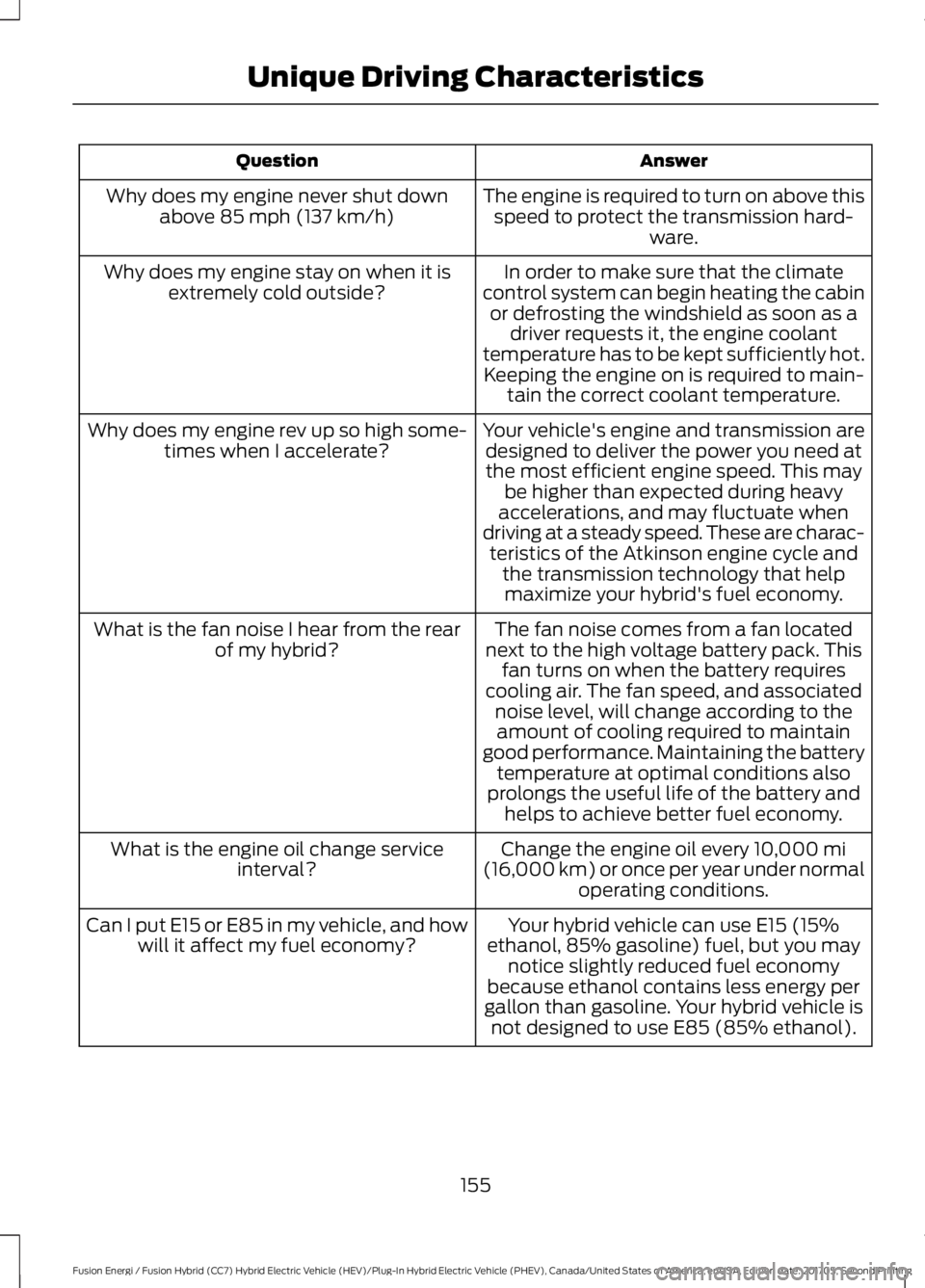
Answer
Question
The engine is required to turn on above thisspeed to protect the transmission hard- ware.
Why does my engine never shut down
above 85 mph (137 km/h)
In order to make sure that the climate
control system can begin heating the cabin or defrosting the windshield as soon as a driver requests it, the engine coolant
temperature has to be kept sufficiently hot. Keeping the engine on is required to main- tain the correct coolant temperature.
Why does my engine stay on when it is
extremely cold outside?
Your vehicle's engine and transmission aredesigned to deliver the power you need atthe most efficient engine speed. This may be higher than expected during heavy
accelerations, and may fluctuate when
driving at a steady speed. These are charac- teristics of the Atkinson engine cycle and the transmission technology that helpmaximize your hybrid's fuel economy.
Why does my engine rev up so high some-
times when I accelerate?
The fan noise comes from a fan located
next to the high voltage battery pack. This fan turns on when the battery requires
cooling air. The fan speed, and associated noise level, will change according to theamount of cooling required to maintain
good performance. Maintaining the battery temperature at optimal conditions also
prolongs the useful life of the battery and helps to achieve better fuel economy.
What is the fan noise I hear from the rear
of my hybrid?
Change the engine oil every 10,000 mi
(16,000 km) or once per year under normal operating conditions.
What is the engine oil change service
interval?
Your hybrid vehicle can use E15 (15%
ethanol, 85% gasoline) fuel, but you may notice slightly reduced fuel economy
because ethanol contains less energy per
gallon than gasoline. Your hybrid vehicle is not designed to use E85 (85% ethanol).
Can I put E15 or E85 in my vehicle, and how
will it affect my fuel economy?
155
Fusion Energi / Fusion Hybrid (CC7) Hybrid Electric Vehicle (HEV)/Plug-In Hybrid Electric Vehicle (PHEV), Canada/United States of America, enUSA, Edition date: 201705, Second Printing Unique Driving Characteristics
Page 168 of 538
•
Incorrect fuel for climatic conditions.
• Incorrect engine oil viscosity for
climactic conditions.
Note: Some vehicles have a lifetime fuel
filter that is integrated with the fuel tank.
Regular maintenance or replacement is not
needed.
Note: If these checks do not help you
correct the concern, have your vehicle
checked as soon as possible.
Noise Emissions Warranty,
Prohibited Tampering Acts and
Maintenance
On January 1, 1978, Federal regulation
became effective governing the noise
emission on trucks over 10,000 lb
(4,536 kg) Gross Vehicle Weight Rating
(GVWR). The preceding statements
concerning prohibited tampering acts and
maintenance, and the noise warranty
found in the Warranty Guide, are
applicable to complete chassis cabs over
10,000 lb (4,536 kg)
GVWR.
CATALYTIC CONVERTER WARNINGS
Do not park, idle or drive your vehicle
on dry grass or other dry ground
cover. The emission system heats up
the engine compartment and exhaust
system, creating the risk of fire. The normal operating temperature
of the exhaust system is very high.
Never work around or attempt to
repair any part of the exhaust system until
it has cooled. Use special care when
working around the catalytic converter.
The catalytic converter heats up to a very
high temperature after only a short period
of engine operation and stays hot after the
engine is switched off. WARNINGS
Exhaust leaks may result in entry of
harmful and potentially lethal fumes
into the passenger compartment. If
you smell exhaust fumes inside your
vehicle, have your vehicle inspected
immediately. Do not drive if you smell
exhaust fumes. Your vehicle has various emission control
components and a catalytic converter that
enables it to comply with applicable
exhaust emission standards.
To make sure that the catalytic converter
and other emission control components
continue to work properly:
•
Do not crank the engine for more than
10 seconds at a time.
• Do not run the engine with a spark plug
lead disconnected.
• Do not push-start or tow-start your
vehicle. Use booster cables. See Jump
Starting the Vehicle (page 233).
• Use only the specified fuel listed.
• Do not switch the ignition off when your
vehicle is moving.
• Avoid running out of fuel.
• Have the items listed in scheduled
maintenance information performed
according to the specified schedule.
Note: Resulting component damage may
not be covered by the vehicle Warranty.
The scheduled maintenance items listed
in scheduled maintenance information are
essential to the life and performance of
your vehicle and to its emissions system.
If you use anything other than Ford,
Motorcraft or Ford-authorized parts for
maintenance replacements or for service
of components affecting emission control,
such non-Ford parts should be equivalent
to genuine Ford Motor Company parts in
performance and durability.
165
Fusion Energi / Fusion Hybrid (CC7) Hybrid Electric Vehicle (HEV)/Plug-In Hybrid Electric Vehicle (PHEV), Canada/United States of America, enUSA, Edition date: 201705, Second Printing Engine Emission Control