seats FORD GT 2019 Owners Manual
[x] Cancel search | Manufacturer: FORD, Model Year: 2019, Model line: GT, Model: FORD GT 2019Pages: 321, PDF Size: 5.24 MB
Page 4 of 321
Introduction
About This Manual
..........................................5
Symbols Glossary ............................................
5
Data Recording ..................................................
7
Perchlorate .........................................................
9
Replacement Parts Recommendation ........................................................................\
.....
9
Special Notices ...............................................
10
Mobile Communications Equipment ........................................................................\
.....
11
Ford Performance ...........................................
11
Environment
Protecting the Environment .......................
13
At a Glance
Instrument Panel Overview .......................
14
Unique Features .............................................
15
Child Safety
General Information ......................................
17
Installing Child Restraints ...........................
18
Booster Seats ..................................................
22
Child Restraint Positioning ........................
24
Seatbelts
Principle of Operation .................................
26
Fastening the Seatbelts .............................
26
Seatbelt Warning Lamp and Indicator Chime ............................................................
29
Seatbelt Reminder .......................................
29
Child Restraint and Seatbelt Maintenance ................................................
31
Seatbelt Extension ........................................
31
Personal Safety System ™
Personal Safety System ™.........................
32 Supplementary Restraints
System
Principle of Operation ..................................
33
Driver and Passenger Airbags ..................
34
Front Passenger Sensing System ...........
35
Side Airbags .....................................................
37
Driver and Passenger Knee Airbags .......
38
Crash Sensors and Airbag Indicator ......
38
Airbag Disposal ..............................................
39
Keys and Remote Controls
General Information on Radio Frequencies ................................................
40
Remote Control ..............................................
41
Replacing a Lost Key or Remote Control ........................................................................\
..
44
Doors and Locks
Locking and Unlocking ................................
45
Opening the Doors ........................................
47
Emergency Door Release ...........................
48
Security
Passive Anti-Theft System .......................
49
Anti-Theft Alarm ...........................................
50
Steering Wheel
Adjusting the Steering Wheel ....................
51
Audio Control ..................................................
52
Voice Control ...................................................
52
Cruise Control .................................................
52
Information Display Control ......................
53
Drive Mode Control .......................................
53
Wiper and Washer Control ........................
53
Lighting Control .............................................
53
Pedals
Adjusting the Pedals ....................................
55
1
Ford GT (CGX) Canada/United States of America, enUSA, Edition date: 201810, First-Printing Table of Contents
Page 5 of 321
Wipers and Washers
Windshield Wipers
.......................................56
Windshield Washers ....................................
56
Lighting
General Information .....................................
57
Lighting Control ..............................................
57
Autolamps .......................................................
58
Instrument Lighting Dimmer ....................
58
Daytime Running Lamps ...........................
58
Direction Indicators ......................................
59
Interior Lamps ................................................
59
Windows and Mirrors
Power Windows ............................................
60
Global Opening .............................................
60
Exterior Mirrors ................................................
61
Interior Mirror ...................................................
61
Instrument Cluster
Gauges ..............................................................
62
Warning Lamps and Indicators ...............
64
Audible Warnings and Indicators ............
68
Information Displays
General Information ....................................
69
Information Messages .................................
72
Climate Control
Automatic Climate Control .......................
79
Hints on Controlling the Interior Climate ........................................................................\
..
80
Cabin Air Filter .................................................
81
Seats
Sitting in the Correct Position ..................
82
Manual Seats ..................................................
82Auxiliary Power Points
Auxiliary Power Points
................................
84
Storage Compartments
Cup Holders ....................................................
85
Map Pockets ...................................................
85
Under Seat Storage ......................................
85
Starting and Stopping the Engine
General Information ....................................
86
Keyless Starting .............................................
86
Steering Wheel Lock ....................................
87
Starting the Engine .......................................
87
Fuel and Refueling
Safety Precautions .......................................
90
Fuel Quality .....................................................
90
Fuel Filler Funnel Location .........................
91
Running Out of Fuel ......................................
91
Refueling ..........................................................
92
Fuel Consumption ........................................
94
Engine Emission Control
Emission Law .................................................
96
Catalytic Converter .......................................
97
Transmission
Automatic Transmission ..........................
100
Brakes
General Information ...................................
105
Hints on Driving With Anti-Lock Brakes ........................................................................\
.
105
Electric Parking Brake ................................
106
Hill Start Assist ............................................
108
Stability Control
Principle of Operation ...............................
109
2
Ford GT (CGX) Canada/United States of America, enUSA, Edition date: 201810, First-Printing Table of Contents
Page 7 of 321
Vehicle Care
General Information
...................................168
Cleaning Products ......................................
168
Cleaning the Exterior ..................................
168
Waxing .............................................................
170
Cleaning the Engine ....................................
170
Cleaning the Windows and Wiper Blades ........................................................................\
..
171
Cleaning the Interior .....................................
171
Cleaning the Instrument Panel and Instrument Cluster Lens ........................
172
Cleaning Leather Seats ..............................
172
Repairing Minor Paint Damage ...............
173
Cleaning the Wheels ...................................
173
Vehicle Storage .............................................
173
Wheels and Tires
Tire Sealant and Inflator Kit .....................
176
Tire Care ..........................................................
182
Using Summer Tires ...................................
194
Using Snow Chains .....................................
194
Tire Pressure Monitoring System ..........
194
Changing a Road Wheel ...........................
198
Driving at High Speed ................................
198
Technical Specifications ..........................
199
Capacities and Specifications
Engine Specifications ...............................
200
Motorcraft Parts ...........................................
201
Vehicle Dimensions ...................................
202
Vehicle Identification Number ...............
203
Vehicle Certification Label ......................
204
Transmission Code Designation ...........
204
Capacities and Specifications ...............
205
Audio System
Audio Unit .....................................................
208
USB Port ........................................................
208SYNC™ 3
General Information
..................................
209
Home Screen ................................................
219
Using Voice Recognition ..........................
220
Entertainment ..............................................
227
Phone ...............................................................
231
Navigation .....................................................
236
Apps ................................................................
244
Settings ..........................................................
245
SYNC™ 3 Troubleshooting .....................
256
Accessories
Accessories ...................................................
270
Scheduled Maintenance
General Maintenance Information ........
271
Normal Scheduled Maintenance ..........
272
Special Operating Conditions Scheduled Maintenance .............................................
273
Scheduled Maintenance Record ...........
274
Appendices
End User License Agreement ................
285
4
Ford GT (CGX) Canada/United States of America, enUSA, Edition date: 201810, First-Printing Table of Contents
Page 8 of 321
ABOUT THIS MANUAL
Thank you for choosing Ford Performance.
If you have owned a Ford Performance
vehicle before, welcome back. If this is
your first Ford Performance vehicle,
welcome to the family. We are confident
that our dedication to performance,
quality, craftsmanship and customer
service will provide you with many miles
of exhilarating, safe and comfortable
driving.
We strive to build engaging vehicles that
involve the driver in every aspect of the
driving experience. Although performance
is at the heart of every Ford Performance
vehicle, we go further. Our goal is to deliver
a comprehensive, complete vehicle, paying
close attention to the smallest details such
as the sound of the exhaust, the quality of
the interior materials and the functionality
and the comfort of the seats, to make sure
that you enjoy not only exceptional
performance but an outstanding driving
environment as well. In this vehicle, we
express this philosophy through the use of
lightweight materials, a sophisticated
powertrain and outstanding chassis
dynamics and aerodynamics.
This manual provides information specific
to your Ford GT. By referring to this manual,
you can identify those features, controls
and specifications unique to your new Ford
GT.
To assist you with any questions or
concerns regarding your vehicle, we
established the Ford GT Concierge.
Contact your Ford GT Concierge at the
number listed if you need assistance.
Ford GT Concierge Phone Numbers Phone number
Market
0800-802632
Austria
0800-795-45
Belgium
1-800-210-5795
Canada
400-120-9152
China
0805-080272
France
0800-182-4992
Germany
1-800-901-591
Ireland
800-789-771
Italy
+853-62621460
Macau
1-800-210-5795
Mexico
0-800-022-2286
Netherlands
800-844-7834
Saudi Arabia
900-839249
Spain
020-889-877
Sweden
0800-890-079
Switzerland
8000-35703061
United Arab Emir-
ates
0800-014-8400
United Kingdom
1-800-210-5795
United States
All other countries should use
001-313-427-8617.
Note: Please be advised that international
calls may be subject to carrier fees.
SYMBOLS GLOSSARY
These are some of the symbols you may
see on your vehicle.
5
Ford GT (CGX) Canada/United States of America, enUSA, Edition date: 201810, First-Printing Introduction
Page 20 of 321
GENERAL INFORMATION
See the following sections for directions
on how to properly use safety restraints
for children.
WARNING: Always make sure your
child is secured properly in a device that
is appropriate for their height, age and
weight. Child safety restraints must be
bought separately from your vehicle.
Failure to follow these instructions and
guidelines may result in an increased risk
of serious injury or death to your child. WARNING: All children are shaped
differently. The recommendations for
safety restraints are based on probable
child height, age and weight thresholds
from the National Highway Traffic Safety
Administration and other safety
organizations, or are the minimum
requirements of law. We recommend
checking with a NHTSA Certified Child
Passenger Safety Technician (CPST) and consult your pediatrician to make
sure your child seat is appropriate for
your child, and is compatible with and
properly installed in your vehicle. To
locate a child seat fitting station and
CPST, contact NHTSA toll free at
1-888-327-4236 or go to
http://www.nhtsa.dot.gov. In Canada,
contact Transport Canada toll free at
1-800-333-0371 or go to www.tc.gc.ca
to find a Child Car Seat Clinic in your
area. Failure to properly restrain children
in safety seats made especially for their
height, age, and weight may result in an
increased risk of serious injury or death
to your child.
WARNING: On hot days, the
temperature inside the vehicle can rise
very quickly. Exposure of people or
animals to these high temperatures for
even a short time can cause death or
serious heat related injuries, including
brain damage. Small children are
particularly at risk.
17
Ford GT (CGX) Canada/United States of America, enUSA, Edition date: 201810, First-Printing Child Safety
Page 21 of 321
Recommendations for Safety Restraints for Children
Recommended restraint
type
Child size, height, weight, or age
Child
Use a child safety seat(sometimes called an
infant carrier, convertible seat, or toddler seat).
Children weighing 40 lb (18 kg) or less
(generally age four or younger).
Infants or
toddlers
Use a belt-positioningbooster seat.
Children who have outgrown or no longer
properly fit in a child safety seat (gener-ally children who are less than 4 ft. 9 in. (1.45 m) tall, are greater than age four
and less than age 12, and between 40 lb
(18 kg) and 80 lb (36 kg) and upward to 100 lb (45 kg) if recommended by your child restraint manufacturer).
Small children
Use a vehicle seatbelt
having the lap belt snug
and low across the hips, shoulder belt centered
across the shoulder and chest, and seat back upright.
Children who have outgrown or no longer
properly fit in a belt-positioning booster
seat (generally children who are at least
4 ft. 9 in. (1.45 m) tall or greater than 80 lb (36 kg) or 100 lb (45 kg) if recom-
mended by child restraint manufacturer).
Larger children
• You are required by law to properly use
safety seats for infants and toddlers in
the United States and Canada.
• Many states and provinces require that
small children use approved booster
seats until they reach age eight, a
height of 4 feet 9 inches (1.45 meters)
tall, or 80 pounds (36 kilograms).
Check your local and state or provincial
laws for specific requirements about
the safety of children in your vehicle. INSTALLING CHILD
RESTRAINTS
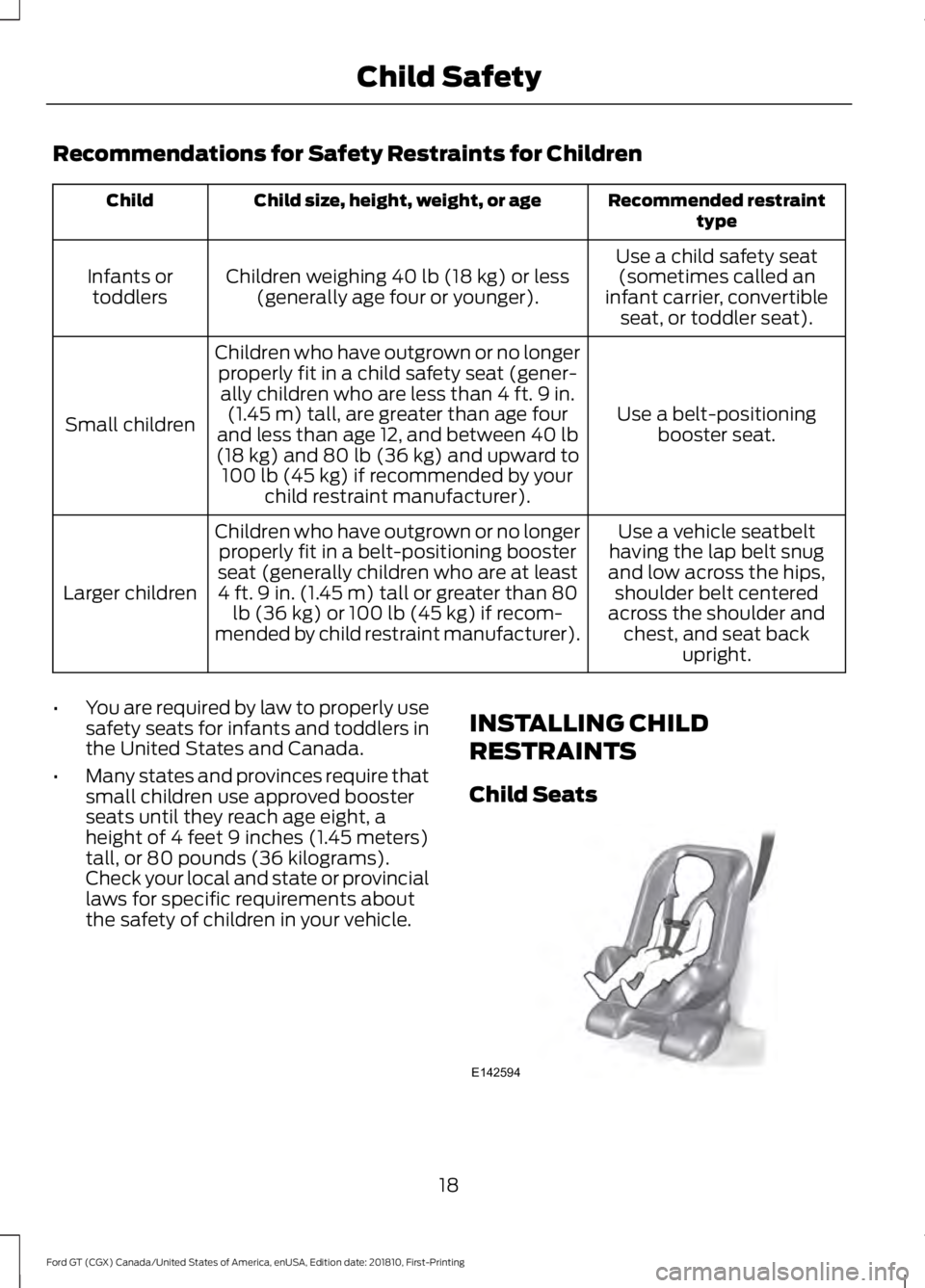
Child Seats
18
Ford GT (CGX) Canada/United States of America, enUSA, Edition date: 201810, First-Printing Child SafetyE142594
Page 25 of 321
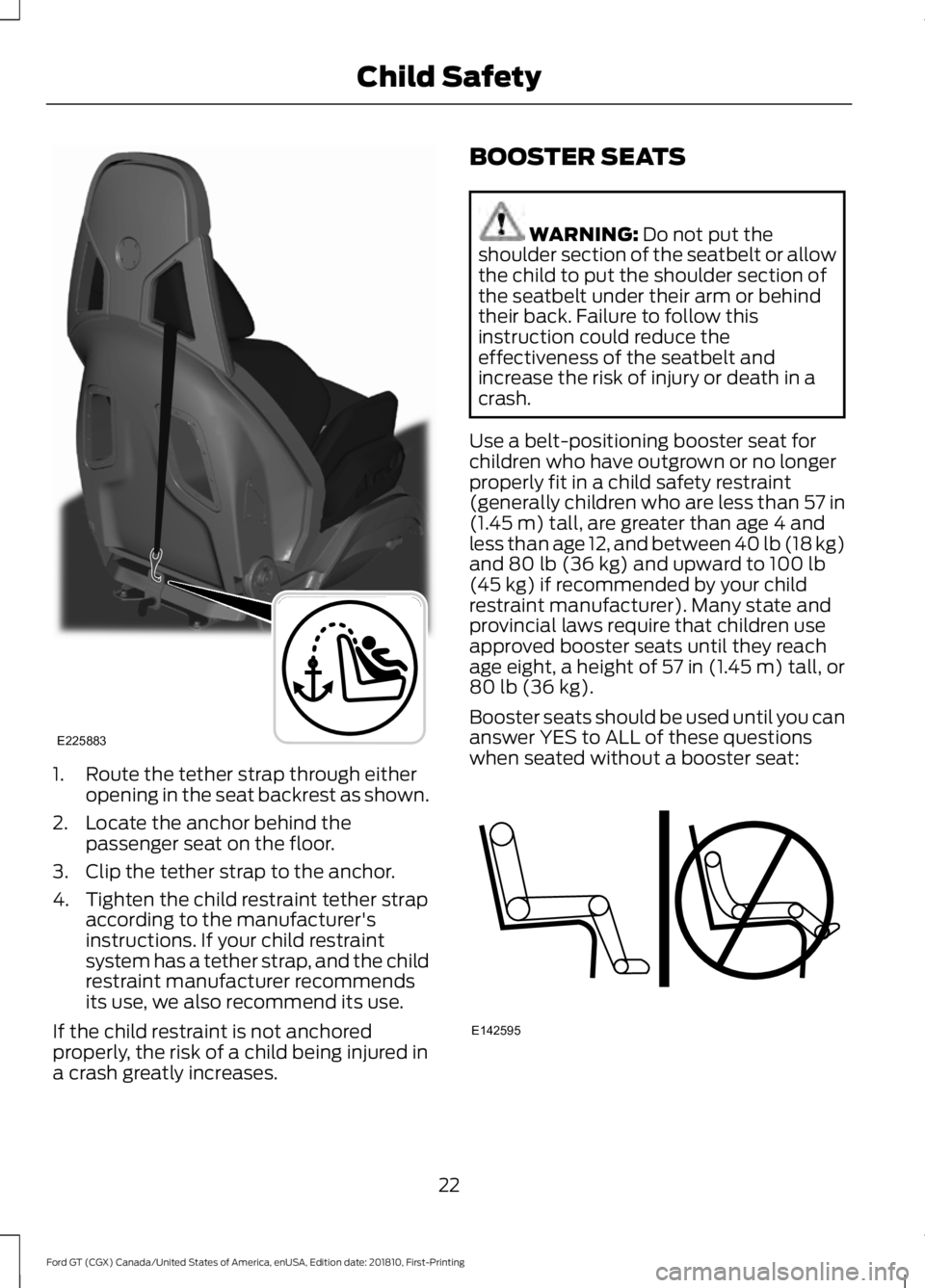
1. Route the tether strap through either
opening in the seat backrest as shown.
2. Locate the anchor behind the passenger seat on the floor.
3. Clip the tether strap to the anchor.
4. Tighten the child restraint tether strap according to the manufacturer's
instructions. If your child restraint
system has a tether strap, and the child
restraint manufacturer recommends
its use, we also recommend its use.
If the child restraint is not anchored
properly, the risk of a child being injured in
a crash greatly increases. BOOSTER SEATS WARNING: Do not put the
shoulder section of the seatbelt or allow
the child to put the shoulder section of
the seatbelt under their arm or behind
their back. Failure to follow this
instruction could reduce the
effectiveness of the seatbelt and
increase the risk of injury or death in a
crash.
Use a belt-positioning booster seat for
children who have outgrown or no longer
properly fit in a child safety restraint
(generally children who are less than
57 in
(1.45 m) tall, are greater than age 4 and
less than age 12, and between 40 lb (18 kg)
and
80 lb (36 kg) and upward to 100 lb
(45 kg) if recommended by your child
restraint manufacturer). Many state and
provincial laws require that children use
approved booster seats until they reach
age eight, a height of
57 in (1.45 m) tall, or
80 lb (36 kg).
Booster seats should be used until you can
answer YES to ALL of these questions
when seated without a booster seat: 22
Ford GT (CGX) Canada/United States of America, enUSA, Edition date: 201810, First-Printing Child SafetyE225883 E142595
Page 26 of 321
•
Can the child sit all the way back
against their vehicle seat backrest with
knees bent comfortably at the edge of
the seat cushion?
• Can the child sit without slouching?
• Does the lap belt rest low across the
hips?
• Is the shoulder belt centered on the
shoulder and chest?
• Can the child stay seated like this for
the whole trip?
Always use booster seats in conjunction
with your vehicle lap and shoulder belt.
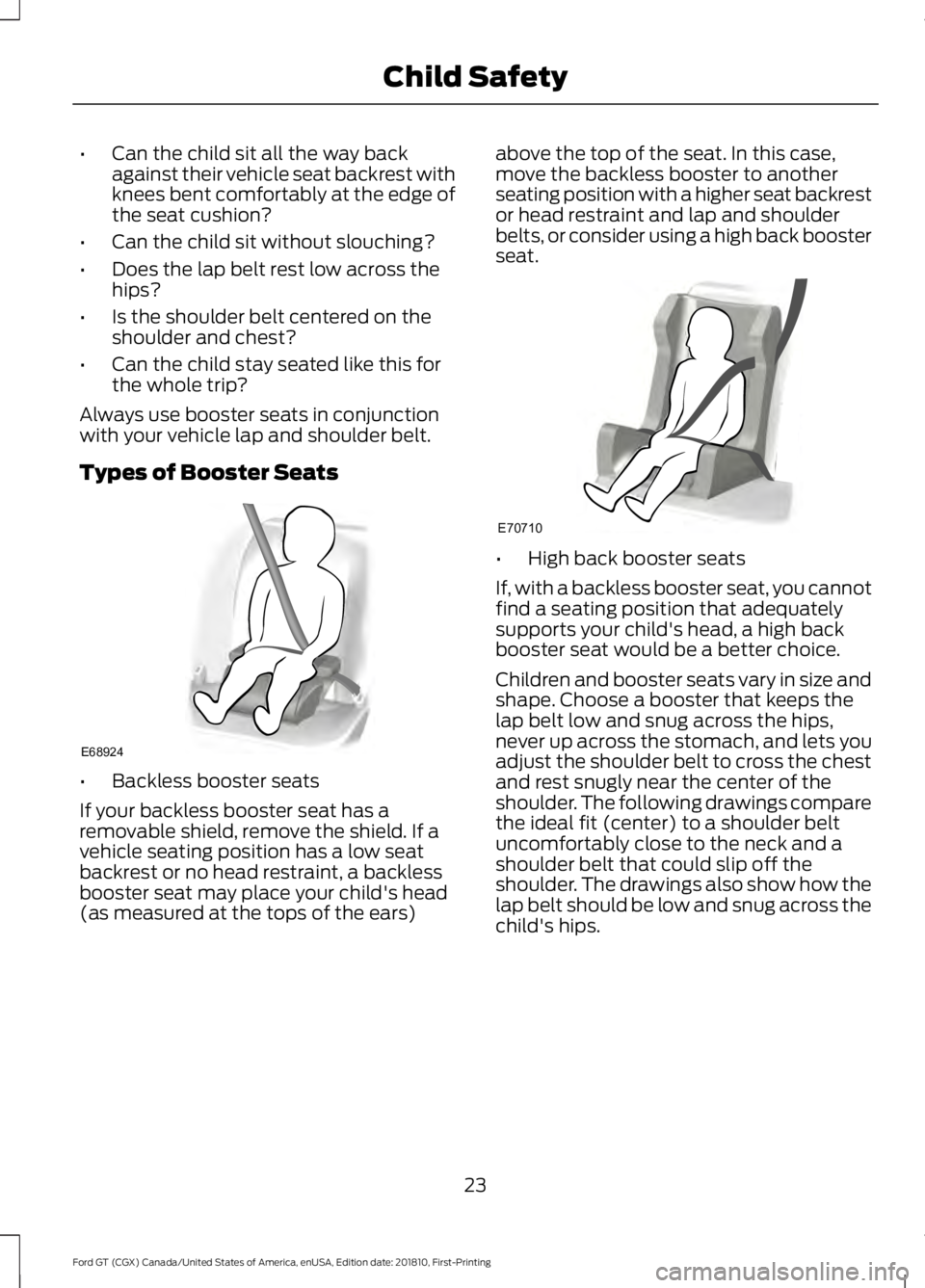
Types of Booster Seats •
Backless booster seats
If your backless booster seat has a
removable shield, remove the shield. If a
vehicle seating position has a low seat
backrest or no head restraint, a backless
booster seat may place your child's head
(as measured at the tops of the ears) above the top of the seat. In this case,
move the backless booster to another
seating position with a higher seat backrest
or head restraint and lap and shoulder
belts, or consider using a high back booster
seat.
•
High back booster seats
If, with a backless booster seat, you cannot
find a seating position that adequately
supports your child's head, a high back
booster seat would be a better choice.
Children and booster seats vary in size and
shape. Choose a booster that keeps the
lap belt low and snug across the hips,
never up across the stomach, and lets you
adjust the shoulder belt to cross the chest
and rest snugly near the center of the
shoulder. The following drawings compare
the ideal fit (center) to a shoulder belt
uncomfortably close to the neck and a
shoulder belt that could slip off the
shoulder. The drawings also show how the
lap belt should be low and snug across the
child's hips.
23
Ford GT (CGX) Canada/United States of America, enUSA, Edition date: 201810, First-Printing Child SafetyE68924 E70710
Page 29 of 321
PRINCIPLE OF OPERATION
WARNING: Always drive and ride
with your seatback upright and the lap
belt snug and low across the hips. WARNING:
Children must always
be properly restrained. WARNING:
Never let a passenger
hold a child on his or her lap while the
vehicle is moving. The passenger cannot
protect the child from injury in a crash. WARNING:
All occupants of your
vehicle, including the driver, should
always properly wear their seatbelts,
even when an airbag supplemental
restraint system is provided. Failure to
properly wear your seatbelt could
seriously increase the risk of injury or
death. WARNING:
In a rollover crash, an
unbelted person is significantly more
likely to die than a person wearing a
seatbelt. WARNING:
Each seating position
in your vehicle has a specific seatbelt
assembly made up of one buckle and
one tongue designed to be used as a pair.
Use the shoulder belt on the outside
shoulder only. Never wear the shoulder
belt under the arm. Never use a single
seatbelt for more than one person. WARNING:
Seatbelts and seats
may be hot in a vehicle that is in the
sunshine. The hot seatbelts or seats may
burn a small child. Check seat covers and
buckles before you place a child
anywhere near them. All seating positions in your vehicle have
lap and shoulder seatbelts. All occupants
of the vehicle should always properly wear
their seatbelts, even when an airbag
supplemental restraint system is provided.
The seatbelt system consists of:
•
Lap and shoulder seatbelts.
• Seatbelt pretensioner at the front
outboard seating positions.
• Belt tension sensor at the front
outboard passenger seating position. · Seatbelt warning light and
chime.
· Crash sensors and monitoring
system with readiness indicator.
The seatbelt pretensioners at the front
seating positions are designed to tighten
the seatbelts when activated. In frontal
and near-frontal crashes, the seatbelt
pretensioners may be activated alone or,
if the crash is of sufficient severity, together
with the front airbags.
FASTENING THE SEATBELTS
The safety restraints in the vehicle are
combination lap and shoulder belts.
26
Ford GT (CGX) Canada/United States of America, enUSA, Edition date: 201810, First-Printing SeatbeltsE71880 E67017
Page 83 of 321
The air currently in the passenger
compartment recirculates. This may
reduce the time needed to cool the interior,
when used with A/C, and reduce unwanted
odors from entering your vehicle.
HINTS ON CONTROLLING THE
INTERIOR CLIMATE
General Hints
Note:
Prolonged use of recirculated air may
cause the windows to fog up.
Note: You may feel a small amount of air
from the footwell air vents regardless of the
air distribution setting.
Note: To reduce humidity build-up inside
your vehicle, do not drive with the system
switched off or with recirculated air always
switched on.
Note: Do not place objects under the front
seats as this may interfere with the airflow
to the rear seats.
Note: Remove any snow, ice or leaves from
the air intake area at the base of the
windshield.
Note: To improve the time to reach a
comfortable temperature in hot weather,
drive with the windows open until you feel
cold air through the air vents.
Automatic Climate Control
Note: Adjusting the settings when your
vehicle interior is extremely hot or cold is
not necessary.
Note: The system adjusts to heat or cool
the interior to the temperature you select
as quickly as possible.
Note: For the system to function efficiently,
the instrument panel and side air vents
should be fully open. Note:
If you select AUTO during cold
outside temperatures, the system directs
air flow to the windshield and side window
air vents. In addition, the blower motor may
run at a slower speed until the engine warms
up.
Note: If you select
AUTO during hot
temperatures and the inside of the vehicle
is hot, the system uses recirculated air to
maximize interior cooling. Blower motor
speed may also reduce until the air cools.
Quickly Heating the Interior
1. Press and release
AUTO.
2. Adjust the temperature function to the
setting you prefer.
Recommended Settings for
Heating
1. Press and release
AUTO.
2. Adjust the temperature function to the
setting you prefer. Use
72°F (22°C) as
a starting point, then adjust the setting
as necessary.
Quickly Cooling the Interior
1. Press and release
AUTO.
2. Press and release
A/C if is not lit.
3. Adjust the temperature function to the
setting you prefer.
Recommended Settings for
Cooling
1. Press and release
AUTO.
2. Adjust the temperature function to the
setting you prefer. Use
72°F (22°C) as
a starting point, then adjust the setting
as necessary.
Defogging the Side Windows in
Cold Weather
1. Press and release defrost.
80
Ford GT (CGX) Canada/United States of America, enUSA, Edition date: 201810, First-Printing Climate Control