parking brake FORD SUPER DUTY 2014 3.G Diesel Supplement Manual
[x] Cancel search | Manufacturer: FORD, Model Year: 2014, Model line: SUPER DUTY, Model: FORD SUPER DUTY 2014 3.GPages: 82, PDF Size: 3.12 MB
Page 12 of 82
STARTING A DIESEL ENGINE
Read all starting instructions carefully
before you start your vehicle.
For temperatures below 32°F (0°C), the
use of the correct grade engine oil is
essential for proper operation. Refer to
Engine oil specifications for more
information. See Technical
Specifications (page 56).
Your vehicle may be equipped with a cold
weather starting strategy that prevents
severe engine damage by assisting in
engine lubrication warm-up. In extremely
cold ambient temperatures, this strategy
activates and prevents the accelerator
pedal from being used for 30 seconds after
starting your vehicle. A message will
appear in the information display as your
vehicle warms up. By not allowing the
accelerator pedal to be used, the engine
oil is allowed to properly lubricate the
bearings preventing engine damage due
to lack of proper lubrication. After the 30
second warm-up period, the accelerator
pedal will be operational again and a
message will appear informing you the
vehicle is ok to drive.
When starting the engine in extremely cold
temperatures (-15°F [– 26°C]), it is
recommended to allow the engine to idle
for several minutes before driving the
vehicle.
Make sure the gearshift lever is in P (Park)
and the parking brake is fully set before
you turn the key. Do not press the
accelerator during starting.
Cold Weather Starting WARNINGS
Do not use starting fluid, such as
ether, in the air intake system (see
air filter decal). Such fluid could
cause immediate explosive damage to the
engine and possible personal injury WARNINGS
Do not add gasoline, gasohol, alcohol
or Kerosene to diesel fuel. This
practice creates a serious fire hazard
and causes engine performance problems. It is recommended that the engine block
heater be used for starting when the
temperature is -10°F (-23°C) or colder.
Refer to Engine block heater later in this
chapter for more information.
When operating in cold weather,
Motorcraft® cetane improvers or
non-alcohol-based cetane improvers from
a reputable manufacturer may be used as
needed.
Do not crank the engine for more than 10
seconds as starter damage may occur. If
the engine fails to start, turn the key to
position 3 (off) and wait 30 seconds
before trying again.
1. Turn the key to on without turning the
key to start. Do not start the engine
until the glow-plug indicator turns off.
2. When the glow plug pre-heat indicator
turns off, turn the key to start and
release the key as soon as the engine
starts. After starting the engine, the
glow plugs may remain on for a period.
If you do not start the engine before
the glow plug activation time ends, you
will need to reset the glow plugs by
turning the key to off.
3. After the engine starts, allow it to idle for about 15 seconds. This is to protect
the engine. Do not increase engine
speed until the oil pressure gauge
indicates normal pressure.
9
Super Duty (TFA) Starting and Stopping the Engine
Page 15 of 82
Operation in Snow and Rain
Vehicle operation in heavy snowfall or
extreme rain conditions may feed
excessive amounts of snow or water into
the air intake system. This could plug the
air filter with snow and may cause the
engine to lose power and possibly shut
down.
We recommend the following actions after
operating your vehicle up to 200 miles
(320 kilometers) in snowfall or extreme
rain:
•
Snow: At the earliest opportunity, open
the hood and clear all the snow and ice
from the air filter housing inlet (do not
remove the foam filter) and reset the
air filter restriction gauge.
Note: Removal of the foam filter degrades
your vehicle performance during snow and
hot weather conditions.
• Extreme rain: The air filter dries after
about 15– 30 minutes at highway
speeds. At the earliest opportunity,
open the hood and reset the air filter
restriction gauge.
Refer to Air filter and restriction gauge in
the Maintenance chapter for more
information. See Changing the Engine
Air Filter (page 49).
Operation in Standing Water
Ingestion of water into the diesel engine
can result in immediate and severe
damage to the engine. If driving through
water, slow down to avoid splashing water
into the intake. If the engine stalls, and you
suspect ingestion of water into the engine,
do not try to restart the engine. Consult
your dealer for service immediately. Your fuel tank vents to the atmosphere by
valves on top of the tank and through the
fuel cap. If water reaches the top of the
tank, the valves may pull water into the
fuel tank. Water in the fuel can cause
performance issues and damage the fuel
injection system.
SWITCHING OFF THE ENGINE
Turn the ignition to the off position.
To prolong engine life (especially after
extended high speed, high ambient
temperature, or high GVW/GCW operation,
such as heavy loads or heavy trailers), it is
recommended that a hot engine be idled
for 3-5 minutes. This allows the
turbocharged engine to cool down. For
more information on GVW/GCW, see the
Load Carrying chapter in your Owner
’s
Manual.
ENGINE IDLE SHUTDOWN
Your vehicle may be equipped with an
engine idle shutdown system. This system
automatically shuts down your engine
when it has been idling in
P (Park) or N
(Neutral) for five minutes (parking brake
set) or 15 minutes (parking brake not set).
When the engine idle shutdown process
has started:
• A chime sounds and the information
display will show ENGINE TURNS OFF
IN 30 (seconds) and start counting
down
• You can restart the five or 15-minute
timer by changing the position of the
accelerator pedal, brake pedal or the
park brake within the final 30 seconds
• When the timer reaches zero, the
engine shuts down and this message
will appear in your information display
ENGINE TURNED OFF
12
Super Duty (TFA) Starting and Stopping the Engine
Page 25 of 82
Low DEF Warnings and Actions — Instrument Cluster Messages (Optional message center
messages shown, base message center messages similar)
None
Refill exhaust fluid
0 Miles (0 km) –
exhaust fluid tank is empty
Speed Limited to 50
MPH (80 km/h)Upon Restart
Exhaust Fluid Empty
Speed is limited to
50 MPH. (80 km/h)
Refill exhaust fluid
Vehicle restarted
with exhaust fluid tank empty
Speed Limited To 50
MPH (80 km/h)
Exhaust Fluid Empty
-
Refill exhaust fluid
This occurs 200
Miles (322 km) after the vehicle reaches the 0 mile (0 km)
exhaust fluid range
Engine Idled Soon
Exhaust Fluid Empty
Engine is limited toidle ONLY
Refill exhaust fluid
This occurs when
the exhaust fluid is empty and:
Engine Idled-See
Owner ’s Manual
Exhaust Fluid Empty The vehicle’s diesel
fuel tank is refueled or,
the engine is shut off for 10 minutes or,
the engine is idling with the parking
brake engaged for 60 minutes.
Filling the Diesel Exhaust Fluid tank WARNINGS
Make sure that diesel exhaust fluid
does not come into contact with
eyes, skin or clothing. Should diesel
exhaust fluid contact your eyes, flush them
with plenty of water and contact a
physician. Clean affected skin with soap
and water. If diesel exhaust fluid is
swallowed, drink plenty of water and
contact a physician immediately WARNINGS
Refill diesel exhaust fluid in a
well-ventilated area. When opening
the cap on the diesel exhaust fluid
tank or bottle containing diesel exhaust
fluid, ammonia vapors may escape. The
vapors can be irritating to skin, eyes and
mucous membranes. Inhaling ammonia
vapors can cause burning to the eyes,
throat and nose and cause coughing and
watery eyes. Note:
Do not put diesel exhaust fluid in the
fuel tank. This can cause engine damage
not covered by your vehicle ’s warranty.
22
Super Duty (TFA) Fuel and Refueling
Page 34 of 82
Operator Commanded Regeneration
If your vehicle is operated with significant
stationary operation, low speed drive
cycles less than 25 mph, short drive cycles,
a drive time is less than 10 - 15 minutes or
the vehicle does not fully warm up, passive
and active regeneration may not
sufficiently clean the diesel particulate
filter system. Operator commanded
regeneration allows you to manually start
regeneration of the diesel particulate filter
at idle (while stationary) to clean the filter.
If you are not sure whether your vehicle is
equipped with this feature, contact an
authorized dealer.
When to perform Operator Commanded
Regeneration
Use the Operator Commanded
Regeneration feature when the EXH
OVERLOADED DRIVE TO CLEAN
message appears in the information
display and:
• the operator is not able to drive in
manner that allows effective
automatic cleaning (active
regeneration),
• or the operator instead wishes to
manually start regeneration (cleaning)
of the diesel particulate filter while the
vehicle is idle (stationary).
Operator Commanded Regeneration
precautions and safe exhaust position WARNING
Failure to comply with the following
instructions for operator
commanded regeneration may result
in fire, serious injury, death and/or property
damage. Before you start operator commanded
regeneration, do the following: •
Place your vehicle in
P (Park) with the
parking brake set on stable, level
ground
• You must park your vehicle outside of
any structure
• Your vehicle must be 10 – 15 feet (3 –
5 meters) away from any obstructions
and must be away from materials that
can easily combust or melt (for
example, paper, leaves, petroleum
products, fuels, plastics and other dry
organic material)
• Make sure there is a minimum of 1/8
tank of fuel
• Make sure all fluids are at proper levels
Make sure that the louvers (holes) located
at the tip of the exhaust are also clear of
any obstructions as they are used to
introduce fresh air into the tailpipe to cool
the exhaust gas as it leaves. See Cleaning
the Exhaust
(page 53).
How to start Operator Commanded
Regeneration WARNING
Stay clear of exhaust tip during
regeneration. You or others can be
burned.
Note:
You cannot use the operator
commanded regeneration until the diesel
particulate filter load percentage has
reached 100% (Full). The diesel particulate
filter load percentage will fluctuate up and
down when driving your vehicle due to active
and passive regenerations.
Note: During the use of operator
commanded regeneration, you may observe
a light amount of white smoke. This is
normal. You cannot use the operator
commanded if the service engine
soon light is illuminated.
31
Super Duty (TFA) Fuel and Refueling
Page 65 of 82
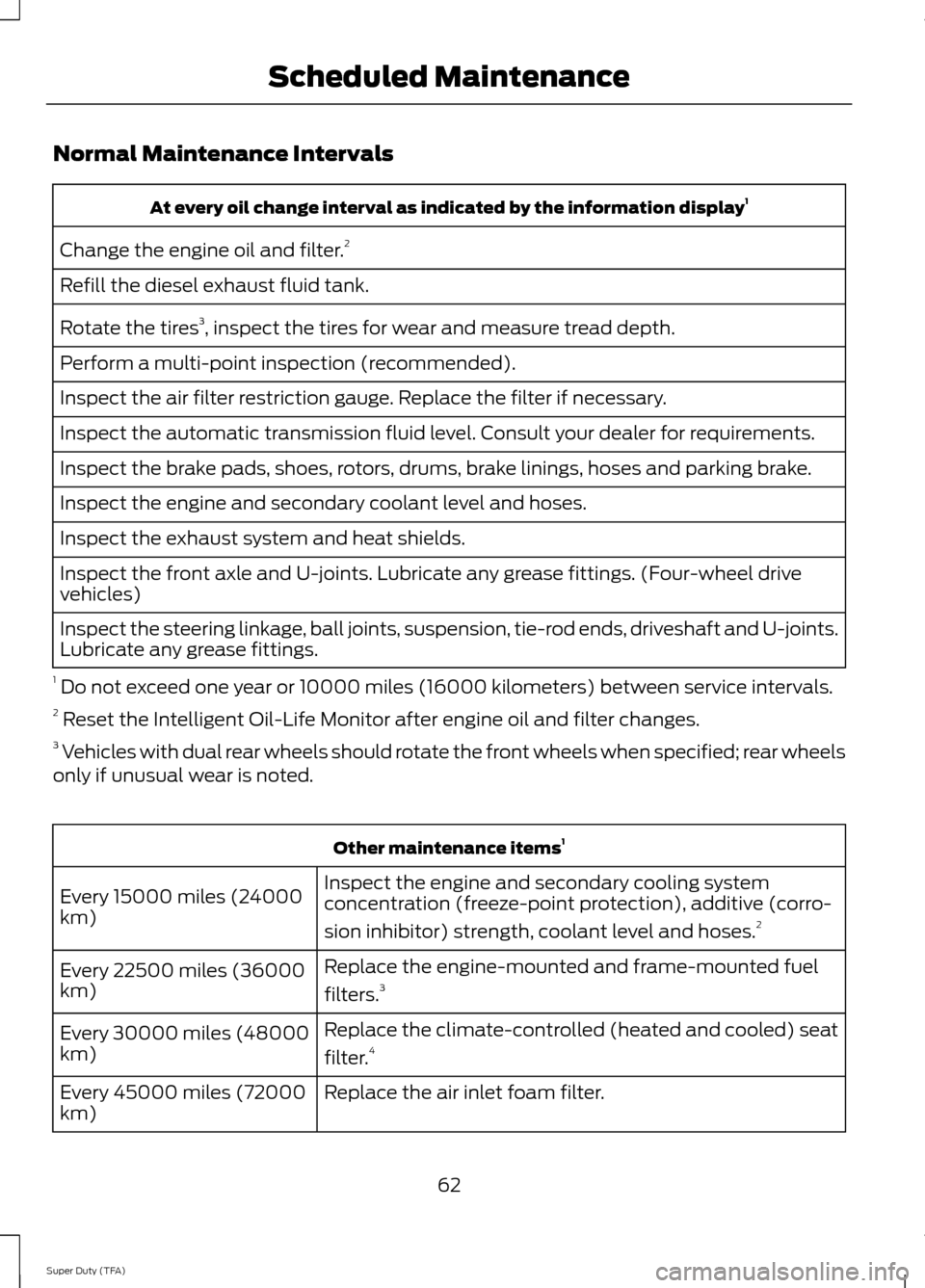
Normal Maintenance Intervals
At every oil change interval as indicated by the information display
1
Change the engine oil and filter. 2
Refill the diesel exhaust fluid tank.
Rotate the tires 3
, inspect the tires for wear and measure tread depth.
Perform a multi-point inspection (recommended).
Inspect the air filter restriction gauge. Replace the filter if necessary.
Inspect the automatic transmission fluid level. Consult your dealer for requirements.
Inspect the brake pads, shoes, rotors, drums, brake linings, hoses and parking brake.
Inspect the engine and secondary coolant level and hoses.
Inspect the exhaust system and heat shields.
Inspect the front axle and U-joints. Lubricate any grease fittings. (Four-wheel drive
vehicles)
Inspect the steering linkage, ball joints, suspension, tie-rod ends, driveshaft and U-joints.
Lubricate any grease fittings.
1 Do not exceed one year or 10000 miles (16000 kilometers) between service intervals.
2 Reset the Intelligent Oil-Life Monitor after engine oil and filter changes.
3 Vehicles with dual rear wheels should rotate the front wheels when specified; rear wheels
only if unusual wear is noted. Other maintenance items
1
Inspect the engine and secondary cooling system
concentration (freeze-point protection), additive (corro-
sion inhibitor) strength, coolant level and hoses. 2
Every 15000 miles (24000
km)
Replace the engine-mounted and frame-mounted fuel
filters.3
Every 22500 miles (36000
km)
Replace the climate-controlled (heated and cooled) seat
filter.4
Every 30000 miles (48000
km)
Replace the air inlet foam filter.
Every 45000 miles (72000
km)
62
Super Duty (TFA) Scheduled Maintenance