brake FORD TAURUS 1997 Owner's Guide
[x] Cancel search | Manufacturer: FORD, Model Year: 1997, Model line: TAURUS, Model: FORD TAURUS 1997Pages: 167, PDF Size: 1.48 MB
Page 118 of 167
²Keep all lit cigarettes, open flames and other lit
material away from the battery and all fuel related
parts.
If you disconnect the battery, the engine must
ªrelearnº its idle conditions before your vehicle will
drive properly, as explained inBatteryin this
chapter.
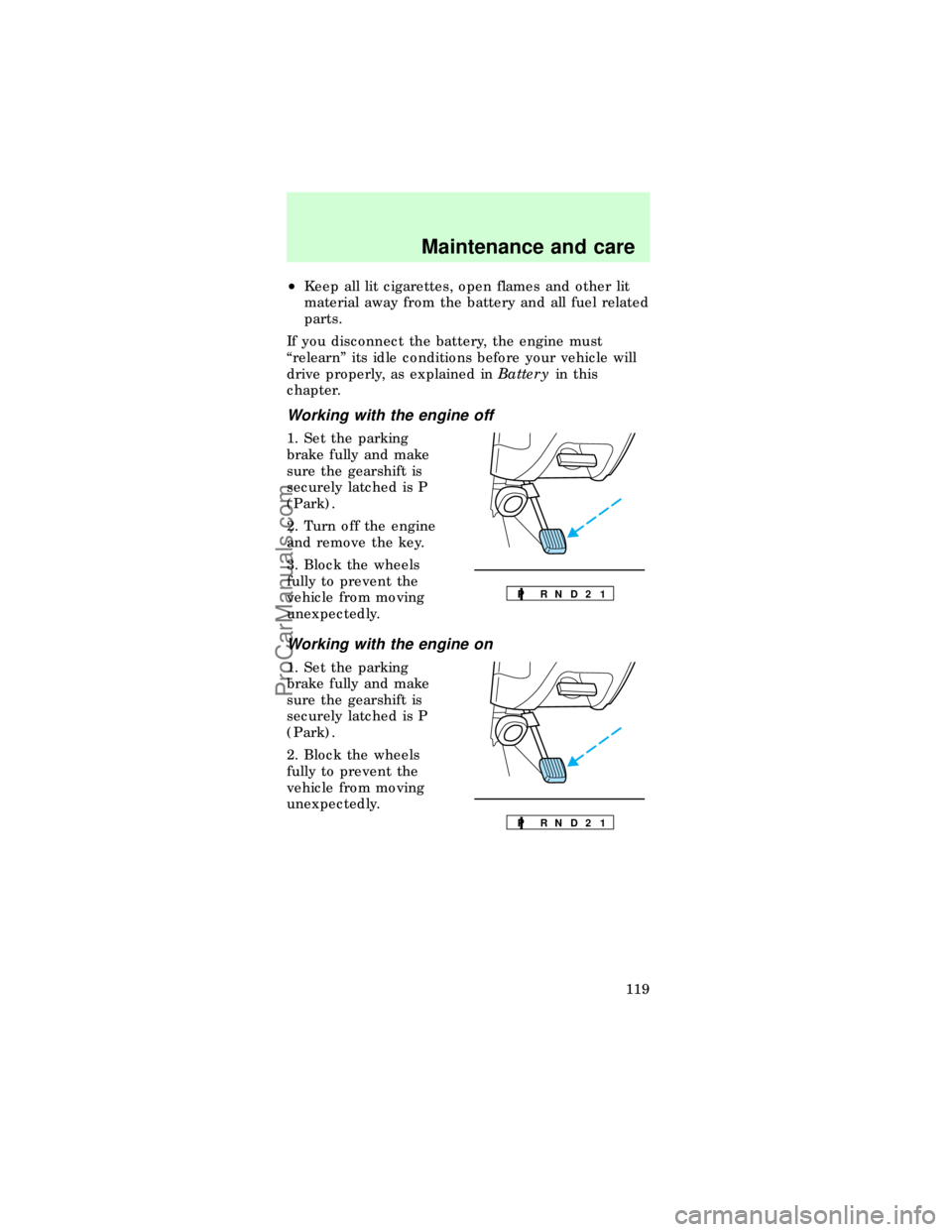
Working with the engine off
1. Set the parking
brake fully and make
sure the gearshift is
securely latched is P
(Park).
2. Turn off the engine
and remove the key.
3. Block the wheels
fully to prevent the
vehicle from moving
unexpectedly.
Working with the engine on
1. Set the parking
brake fully and make
sure the gearshift is
securely latched is P
(Park).
2. Block the wheels
fully to prevent the
vehicle from moving
unexpectedly.
P R N D 2 1
P R N D 2 1
Maintenance and care
119
ProCarManuals.com
Page 120 of 167
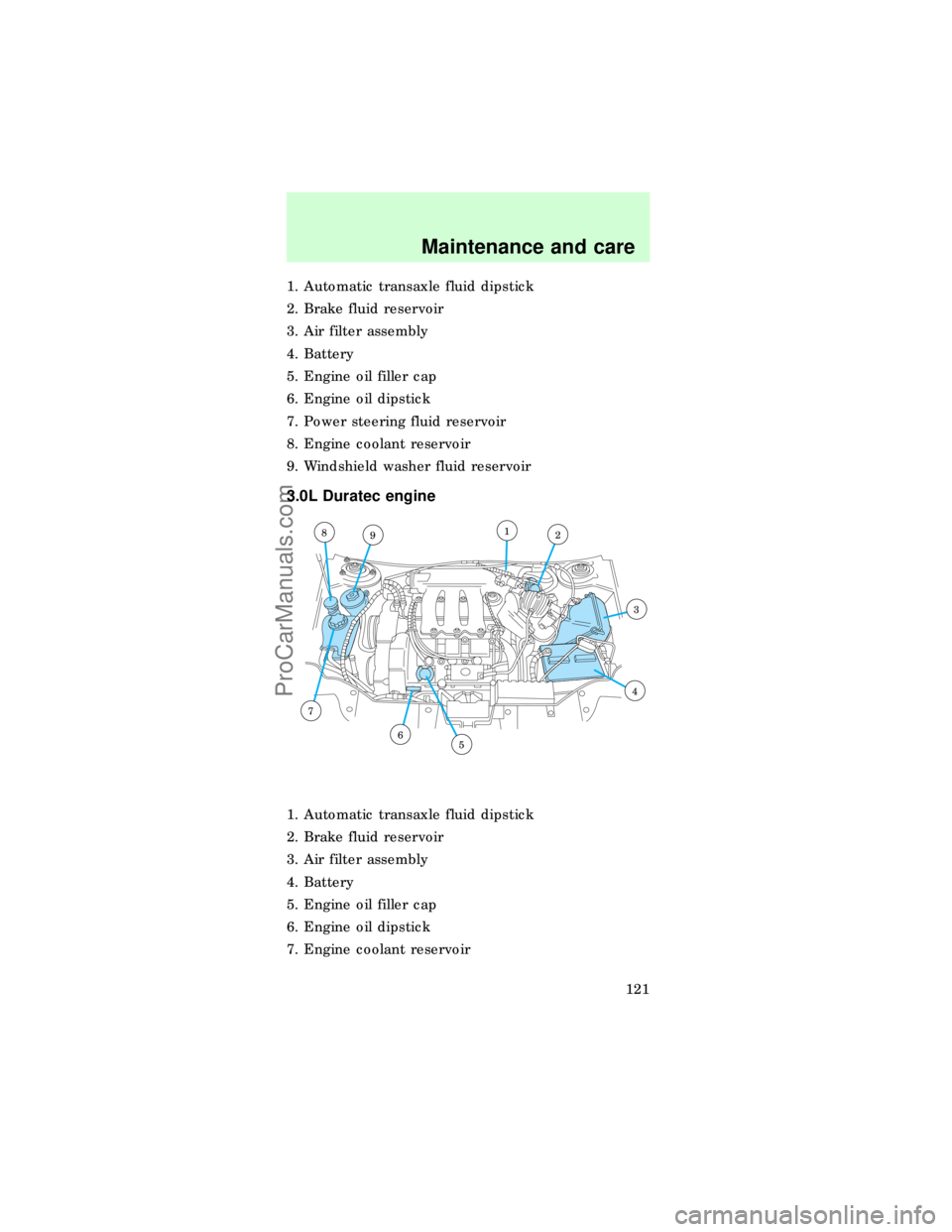
1. Automatic transaxle fluid dipstick
2. Brake fluid reservoir
3. Air filter assembly
4. Battery
5. Engine oil filler cap
6. Engine oil dipstick
7. Power steering fluid reservoir
8. Engine coolant reservoir
9. Windshield washer fluid reservoir
3.0L Duratec engine
1. Automatic transaxle fluid dipstick
2. Brake fluid reservoir
3. Air filter assembly
4. Battery
5. Engine oil filler cap
6. Engine oil dipstick
7. Engine coolant reservoir
8912
3
4
56
7
Maintenance and care
121
ProCarManuals.com
Page 121 of 167
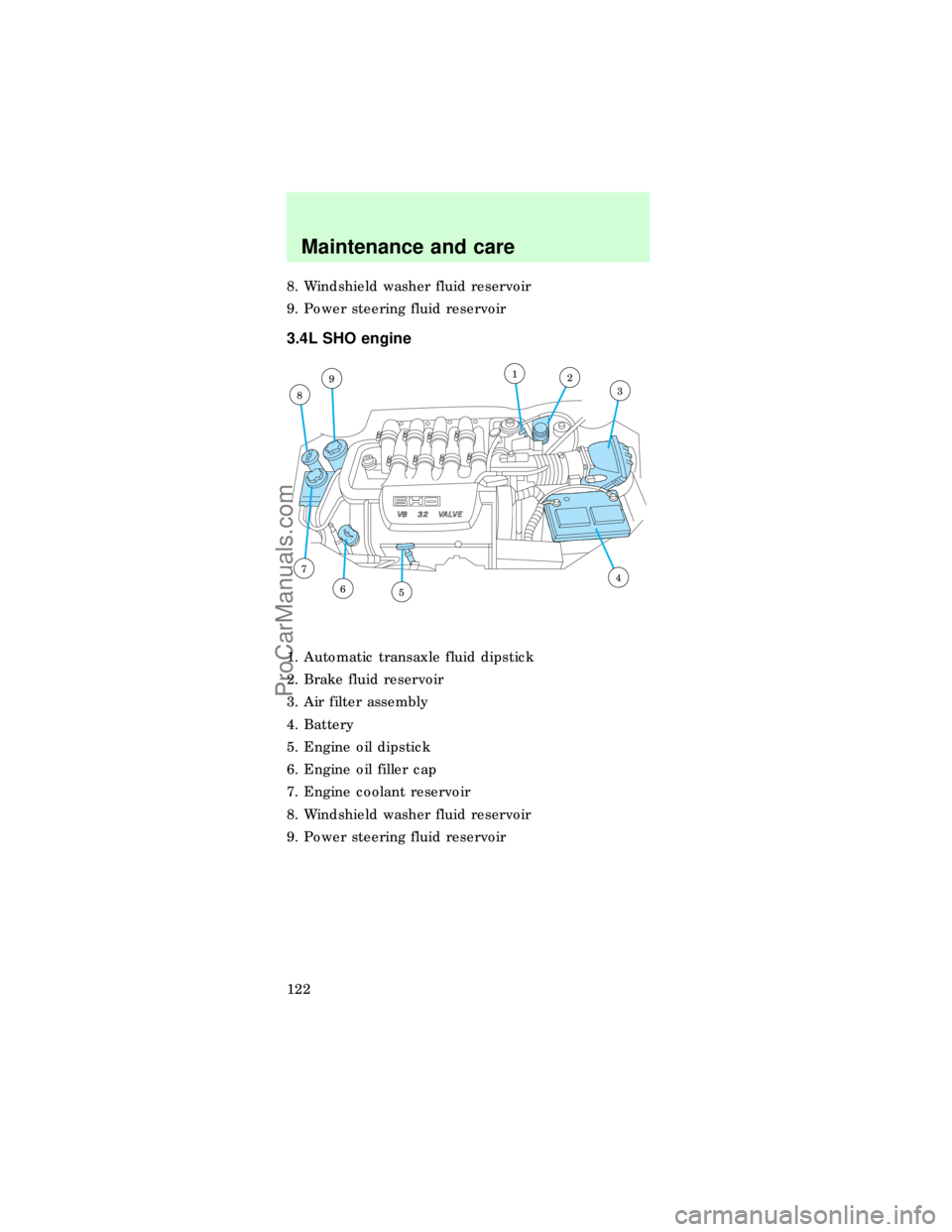
8. Windshield washer fluid reservoir
9. Power steering fluid reservoir
3.4L SHO engine
1. Automatic transaxle fluid dipstick
2. Brake fluid reservoir
3. Air filter assembly
4. Battery
5. Engine oil dipstick
6. Engine oil filler cap
7. Engine coolant reservoir
8. Windshield washer fluid reservoir
9. Power steering fluid reservoir
8
9123
456
7
Maintenance and care
122
ProCarManuals.com
Page 122 of 167

CHECKING AND ADDING ENGINE OIL
Checking the engine oil
Check the engine oil each time you fuel your
vehicle.
To check the oil:
1. Make sure the vehicle is on level ground. If the
engine is warm, turn the engine off and wait a few
minutes for the oil to drain into the oil pan.
2. Set the parking brake and ensure the gearshift is
securely latched in P (Park).
3. Open the hood. Protect yourself from engine heat.
4. Locate and carefully
remove the engine oil
dipstick.
5. Wipe the dipstick clean. Insert the dipstick fully,
then remove it again. The oil level should be in the
range shown on the dipstick.
6. If the oil level is below the MIN line or the ADD 1
QUART line, add oil as necessary. If the oil level is
beyond the MAX or FULL line, engine damage or
high engine oil consumption may occur and some oil
must be removed from the engine by a service
technician.
7. Put the dipstick back in and ensure it is fully
seated.
Adding engine oil
1. Check the engine oil. For instructions, refer to
Checking the engine oilin this chapter.
2. If the fluid level is not within the normal range,
add only certified engine oil of the preferred
viscosity. Add engine oil through the oil filler cap.
ADD 1 QTFULL
Maintenance and care
123
ProCarManuals.com
Page 124 of 167
BRAKE FLUID
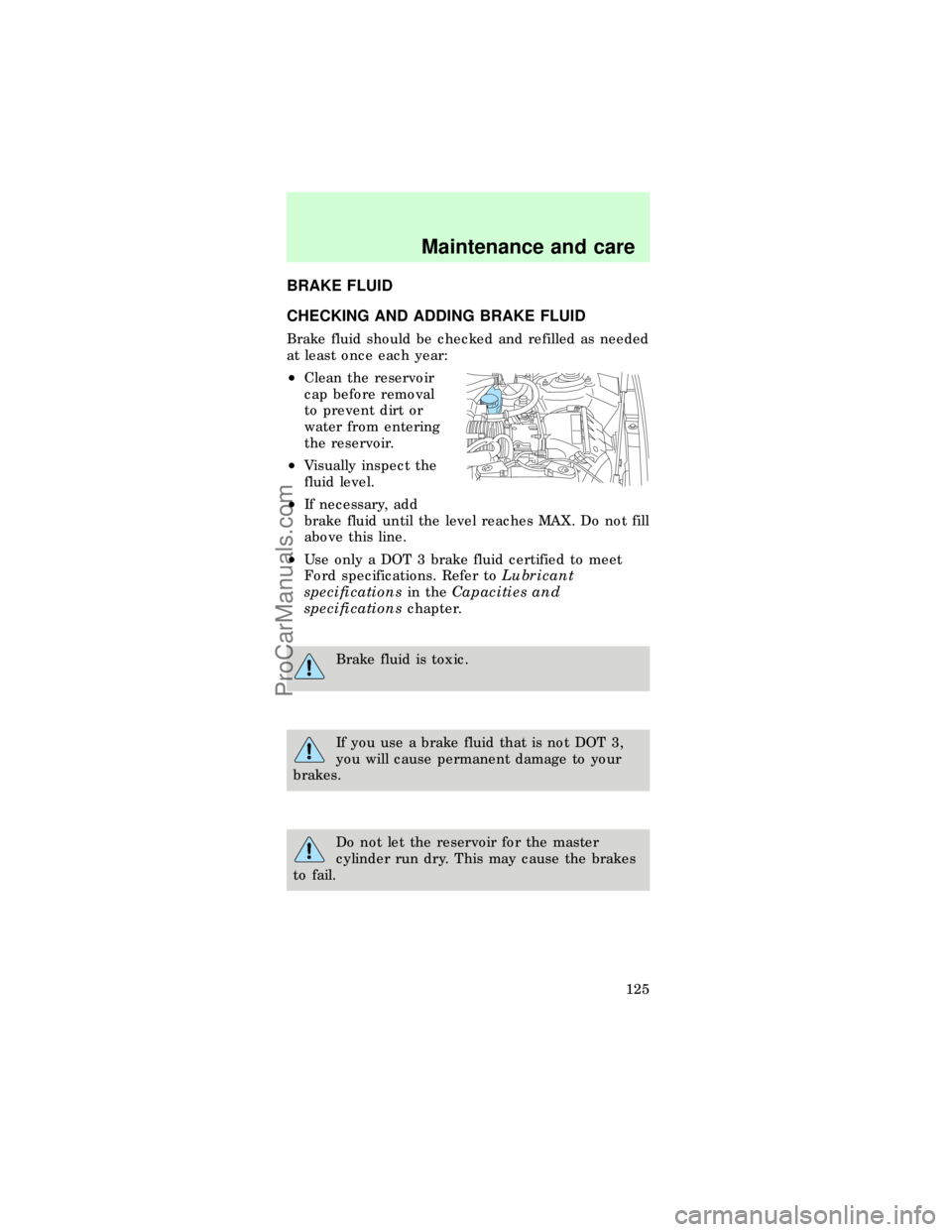
CHECKING AND ADDING BRAKE FLUID
Brake fluid should be checked and refilled as needed
at least once each year:
²Clean the reservoir
cap before removal
to prevent dirt or
water from entering
the reservoir.
²Visually inspect the
fluid level.
²If necessary, add
brake fluid until the level reaches MAX. Do not fill
above this line.
²Use only a DOT 3 brake fluid certified to meet
Ford specifications. Refer toLubricant
specificationsin theCapacities and
specificationschapter.
Brake fluid is toxic.
If you use a brake fluid that is not DOT 3,
you will cause permanent damage to your
brakes.
Do not let the reservoir for the master
cylinder run dry. This may cause the brakes
to fail.
Maintenance and care
125
ProCarManuals.com
Page 130 of 167
Checking the automatic transaxle fluid
Your vehicle should be at normal operating
temperature to get an accurate reading on the
transaxle fluid dipstick. Normal operating
temperature is reached after driving approximately
32 km (20 miles). If the vehicle has been operating
for extended periods of time at high speeds, driven
in city traffic during hot weather or has been pulling
a trailer, the vehicle should be turned off for at least
30 minutes to allow the fluid to cool before
checking.
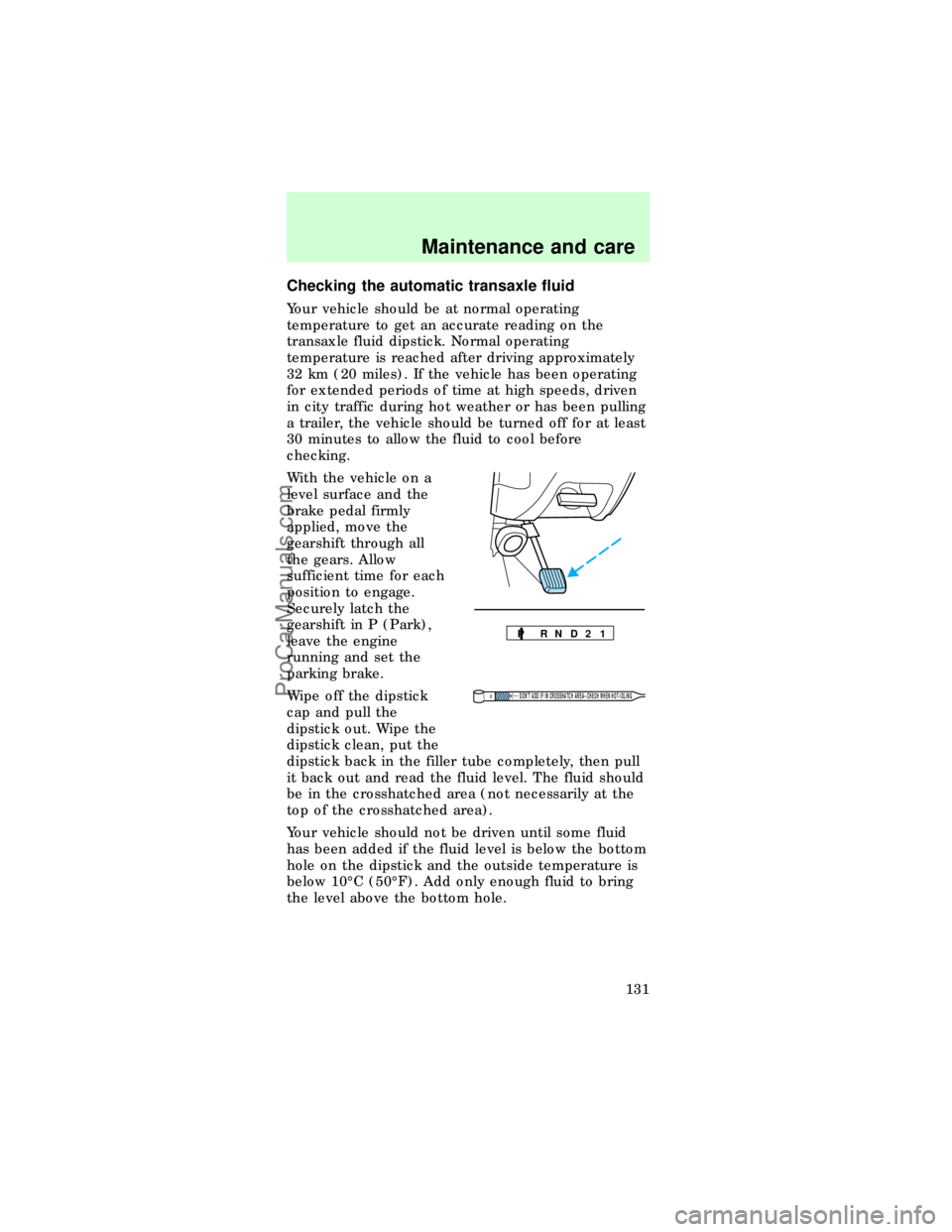
With the vehicle on a
level surface and the
brake pedal firmly
applied, move the
gearshift through all
the gears. Allow
sufficient time for each
position to engage.
Securely latch the
gearshift in P (Park),
leave the engine
running and set the
parking brake.
Wipe off the dipstick
cap and pull the
dipstick out. Wipe the
dipstick clean, put the
dipstick back in the filler tube completely, then pull
it back out and read the fluid level. The fluid should
be in the crosshatched area (not necessarily at the
top of the crosshatched area).
Your vehicle should not be driven until some fluid
has been added if the fluid level is below the bottom
hole on the dipstick and the outside temperature is
below 10ÉC (50ÉF). Add only enough fluid to bring
the level above the bottom hole.
P R N D 2 1
DON’T ADD IF IN CROSSHATCH AREA--CHECH WHEN HOT-IDLING
Maintenance and care
131
ProCarManuals.com
Page 137 of 167
Tires that are larger or smaller than your vehicle's
original tires may also affect the accuracy of your
speedometer.
SNOW TIRES AND CHAINS
The tires on your vehicle have all weather treads to
provide traction in rain and snow. However, in some
climates, you may need to use snow tires and
chains. Follow these guidelines when using snow
tires and chains:
²Use only SAE Class S chains.
²Install chains securely, verifying that the chains do
not touch any wiring, brake lines or fuel lines.
²Drive cautiously. If you hear the chains rub or
bang against your vehicle, stop and re-tighten the
chains. If this does not work, remove the chains
to prevent damage to your vehicle.
²If possible, avoid fully loading your vehicle.
²Do not use tire chains on aluminum wheels.
²Do not use tire chains if your vehicle is equipped
with P225/55VR16 tires.
²Remove the tire chains when they are no longer
needed. Do not use tire chains on dry roads.
²The suspension insulation and bumpers will help
prevent vehicle damage. Do not remove these
components from your vehicle when using snow
tires and chains.
WHAT YOU SHOULD KNOW ABOUT
AUTOMOTIVE FUELS
Important safety precautions
Do not overfill the fuel tank. The pressure in
an overfilled tank may cause leakage and
lead to fuel spray and fire.
Maintenance and care
138
ProCarManuals.com
Page 144 of 167
²Headlamps
²High-mount brake lamp
²Tail lamps
²Brake lamps
²Backup lamps
²Hazard flashers
²Turn signals
²License plate lamp
²Interior overhead lamps
Do not remove lamp bulbs unless they will be
replaced immediately. If a bulb is removed for an
extended period of time, contaminants may enter
the lamp housings and affect performance.
High-mount brake lamp - Sedan
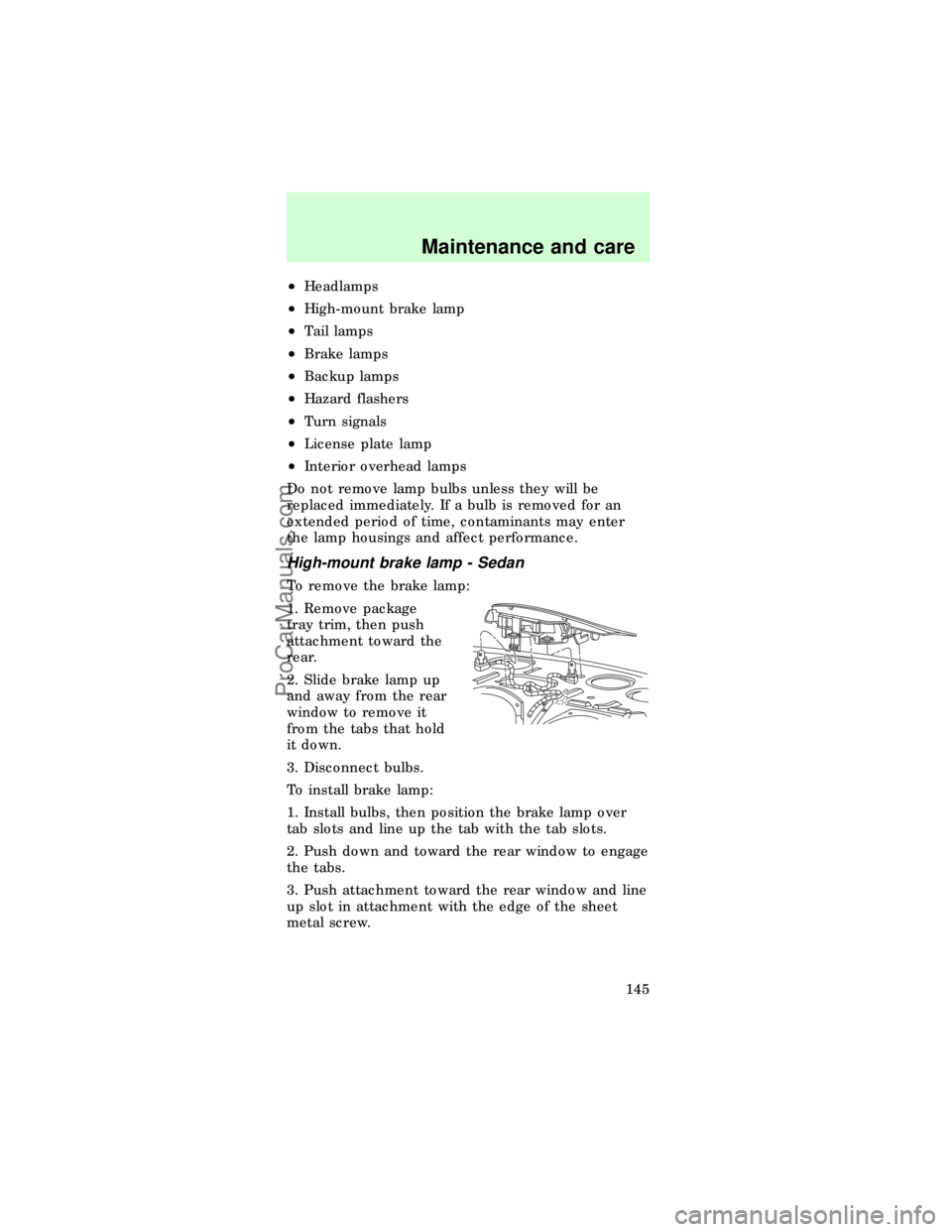
To remove the brake lamp:
1. Remove package
tray trim, then push
attachment toward the
rear.
2. Slide brake lamp up
and away from the rear
window to remove it
from the tabs that hold
it down.
3. Disconnect bulbs.
To install brake lamp:
1. Install bulbs, then position the brake lamp over
tab slots and line up the tab with the tab slots.
2. Push down and toward the rear window to engage
the tabs.
3. Push attachment toward the rear window and line
up slot in attachment with the edge of the sheet
metal screw.
Maintenance and care
145
ProCarManuals.com
Page 145 of 167

4. Release the attachment slot onto the sheet metal
hole. Install the package tray trim.
High-mount brake lamp - Wagon
To remove the brake lamp:
1. Remove interior trim
panel, then remove the
three attachment nuts
that hold brake lamp in
place.
2. Lift whole assembly
off vehicle from the
outside.
3. Disconnect bulbs.
To install brake lamp:
1. Install bulbs, the position brake lamp into tailgate
holes.
2. From the inside of the vehicle, stall and tighten
the four nuts that hold the brake lamp in place.
3. Install the interior trim panel.
Using the right bulbs
Function Trade Number
Front side marker lamp 194
Front park/turn lamp 3457NA
Headlamp 9007
Tail lamp/brake lamp 3157
Rear turn lamp 3156
Backup lamp 3156
License plate lamp 168
High-mount brake lamp 912
Rear side marker lamp 168
Cargo lamp (wagon) 211-2
Dome lamp 211-2
Dome/map lamp 578
Maintenance and care
146
ProCarManuals.com
Page 151 of 167
exterior accessories, such as antennas, before
entering a car wash.
²After washing, apply the brakes several times to
dry them.
Waxing your vehicle
The best way to determine when the paintwork
needs waxing is by noting when water stops beading
on the surface. This could be every three or four
months, depending on operating conditions.
Use only carnauba or synthetic-based waxes.
Remove any bugs and tar before waxing vehicle. Use
cleaning fluid or alcohol with a clean cloth to
remove. Use tar remover to remove any tar spots.
Repairing paint chips
Minor scratches or paint damage from road debris
may be repaired with touch-up paint, paint repair
foil or aerosol paint spray from the Ford accessory
line. Observe the application instructions on the
products.
Remove particles such as bird droppings, tree sap,
insect remains, tar spots, road salt and industrial
fallout immediately.
Cleaning the wheels
Wash the wheels with
the same detergent you
use to clean the body
of your vehicle. Do not
use acid-based wheel cleaners, steel wool, fuel or
strong detergents. Never use abrasives that will
damage the finish of special wheel surfaces. Use a
tar remover to remove grease and tar.
Cleaning the engine
Engines are more efficient when they are clean
because grease and dirt buildup act as insulators and
keep the engine warmer than normal. Follow these
guidelines to clean your engine:
Maintenance and care
152
ProCarManuals.com