oil level GMC CANYON 2008 Owner's Manual
[x] Cancel search | Manufacturer: GMC, Model Year: 2008, Model line: CANYON, Model: GMC CANYON 2008Pages: 428, PDF Size: 5.82 MB
Page 134 of 428
Up-Shift Light...............................................3-30
Brake System Warning Light..........................3-31
Antilock Brake System Warning Light...............3-32
Traction Control System (TCS)
Warning Light...........................................3-32
Engine Coolant Temperature Gage..................3-33
Tire Pressure Light.......................................3-33
Malfunction Indicator Lamp.............................3-34
Oil Pressure Light.........................................3-36
Security Light...............................................3-37
Cruise Control Light......................................3-37
Highbeam On Light.......................................3-37
Fuel Gage...................................................3-38Driver Information Center (DIC).......................3-38
DIC Operation and Displays...........................3-38
DIC Warnings and Messages.........................3-42
Audio System(s).............................................3-46
Setting the Time...........................................3-47
Radio(s)......................................................3-48
Using an MP3..............................................3-64
XM Radio Messages.....................................3-68
Theft-Deterrent Feature..................................3-69
Radio Reception...........................................3-69
Fixed Mast Antenna......................................3-70
XM™ Satellite Radio Antenna System..............3-70
Chime Level Adjustment................................3-70
Section 3 Instrument Panel
3-2
Page 227 of 428
Hydroplaning
Hydroplaning is dangerous. Water can build up under
your vehicle’s tires so they actually ride on the water.
This can happen if the road is wet enough and you are
going fast enough. When your vehicle is hydroplaning,
it has little or no contact with the road.
There is no hard and fast rule about hydroplaning.
The best advice is to slow down when the road is wet.
Other Rainy Weather Tips
Besides slowing down, other wet weather driving tips
include:
Allow extra following distance.
Pass with caution.
Keep windshield wiping equipment in good shape.
Keep the windshield washer uid reservoir lled.
Have good tires with proper tread depth. SeeTires
on page 5-56.
Before Leaving on a Long Trip
To prepare your vehicle for a long trip, consider having
it serviced by your dealer/retailer before departing.
Things to check on your own include:
Windshield Washer Fluid:Reservoir full? Windows
clean — inside and outside?
Wiper Blades:In good shape?
Fuel, Engine Oil, Other Fluids:All levels checked?
Lamps:Do they all work and are lenses clean?
Tires:Are treads good? Are tires inated to
recommended pressure?
Weather and Maps:Safe to travel? Have
up-to-date maps?
Highway Hypnosis
Always be alert and pay attention to your surroundings
while driving. If you become tired or sleepy, nd a safe
place to park your vehicle and rest.
Other driving tips include:
Keep the vehicle well ventilated.
Keep interior temperature cool.
Keep your eyes moving — scan the road ahead
and to the sides.
Check the rearview mirror and vehicle
instruments often.
4-25
Page 257 of 428
When towing at high altitude on steep uphill grades,
consider the following: Engine coolant will boil at a lower
temperature than at normal altitudes. If you turn your
engine off immediately after towing at high altitude
on steep uphill grades, your vehicle may show signs
similar to engine overheating. To avoid this, let the
engine run while parked (preferably on level ground)
with the automatic transmission in PARK (P) (or
the manual transmission out of gear and the parking
brake applied) for a few minutes before turning the
engine off. If you do get the overheat warning,
seeEngine Overheating on page 5-29.
Parking on Hills
{CAUTION:
You really should not park your vehicle, with a
trailer attached, on a hill. If something goes
wrong, your rig could start to move. People
can be injured, and both your vehicle and the
trailer can be damaged.But if you ever have to park your rig on a hill,
here’s how to do it:
1. Apply your regular brakes, but don’t shift into
PARK (P) yet, or into gear for a manual transmission.
When parking uphill, turn your wheels away from the
curb. When parking downhill, turn your wheels into
the curb.
2. Have someone place chocks under the trailer
wheels.
3. When the wheel chocks are in place, release the
regular brakes until the chocks absorb the load.
4. Reapply the regular brakes. Then apply your
parking brake, and then shift into PARK (P), or
REVERSE (R) for a manual transmission. See
Parking Brake on page 2-32for more information.
5. If you have a four-wheel-drive vehicle, be sure
the transfer case is in a drive gear and not in
NEUTRAL. SeeFour-Wheel Drive on page 2-28
for more information.
6. Release the regular brakes.
4-55
Page 273 of 428
A. Windshield Washer Fluid. See “Adding Washer
Fluid” underWindshield Washer Fluid on page 5-37.
B. Engine Coolant Recovery Tank.
SeeEngine Coolant on page 5-26.
C. Engine Air Cleaner/Filter. SeeEngine
Air Cleaner/Filter on page 5-19.
D. Power Steering Fluid Reservoir (low in engine
compartment). SeePower Steering Fluid
on page 5-36.
E. Automatic Transmission Fluid Dipstick (If Equipped).
See “Checking the Fluid Level” underAutomatic
Transmission Fluid on page 5-21.
F. Engine Oil Fill Cap. See “When to Add Engine Oil”
underEngine Oil on page 5-15.
G. Radiator Pressure Cap. SeeCooling System
on page 5-31.H. Remote Negative (−) Terminal (GND).
SeeJump Starting on page 5-42.
I. Engine Oil Dipstick. See “Checking Engine Oil”
underEngine Oil on page 5-15.
J. Remote Positive (+) Terminal. SeeJump Starting
on page 5-42.
K. Brake Fluid Reservoir. See “Brake Fluid” under
Brakes on page 5-38.
L. Engine Compartment Fuse Block. SeeEngine
Compartment Fuse Block on page 5-111.
M. Battery. SeeBattery on page 5-41.
N. Hydraulic Clutch Fluid Reservoir (If Equipped).
SeeHydraulic Clutch on page 5-24.
5-13
Page 275 of 428
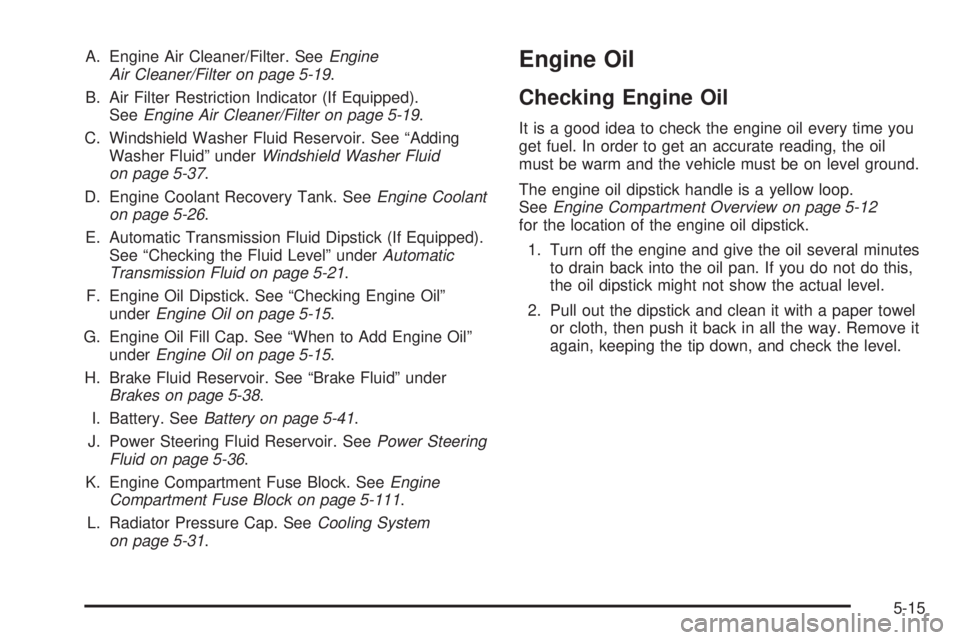
A. Engine Air Cleaner/Filter. SeeEngine
Air Cleaner/Filter on page 5-19.
B. Air Filter Restriction Indicator (If Equipped).
SeeEngine Air Cleaner/Filter on page 5-19.
C. Windshield Washer Fluid Reservoir. See “Adding
Washer Fluid” underWindshield Washer Fluid
on page 5-37.
D. Engine Coolant Recovery Tank. SeeEngine Coolant
on page 5-26.
E. Automatic Transmission Fluid Dipstick (If Equipped).
See “Checking the Fluid Level” underAutomatic
Transmission Fluid on page 5-21.
F. Engine Oil Dipstick. See “Checking Engine Oil”
underEngine Oil on page 5-15.
G. Engine Oil Fill Cap. See “When to Add Engine Oil”
underEngine Oil on page 5-15.
H. Brake Fluid Reservoir. See “Brake Fluid” under
Brakes on page 5-38.
I. Battery. SeeBattery on page 5-41.
J. Power Steering Fluid Reservoir. SeePower Steering
Fluid on page 5-36.
K. Engine Compartment Fuse Block. SeeEngine
Compartment Fuse Block on page 5-111.
L. Radiator Pressure Cap. SeeCooling System
on page 5-31.Engine Oil
Checking Engine Oil
It is a good idea to check the engine oil every time you
get fuel. In order to get an accurate reading, the oil
must be warm and the vehicle must be on level ground.
The engine oil dipstick handle is a yellow loop.
SeeEngine Compartment Overview on page 5-12
for the location of the engine oil dipstick.
1. Turn off the engine and give the oil several minutes
to drain back into the oil pan. If you do not do this,
the oil dipstick might not show the actual level.
2. Pull out the dipstick and clean it with a paper towel
or cloth, then push it back in all the way. Remove it
again, keeping the tip down, and check the level.
5-15
Page 276 of 428
When to Add Engine Oil
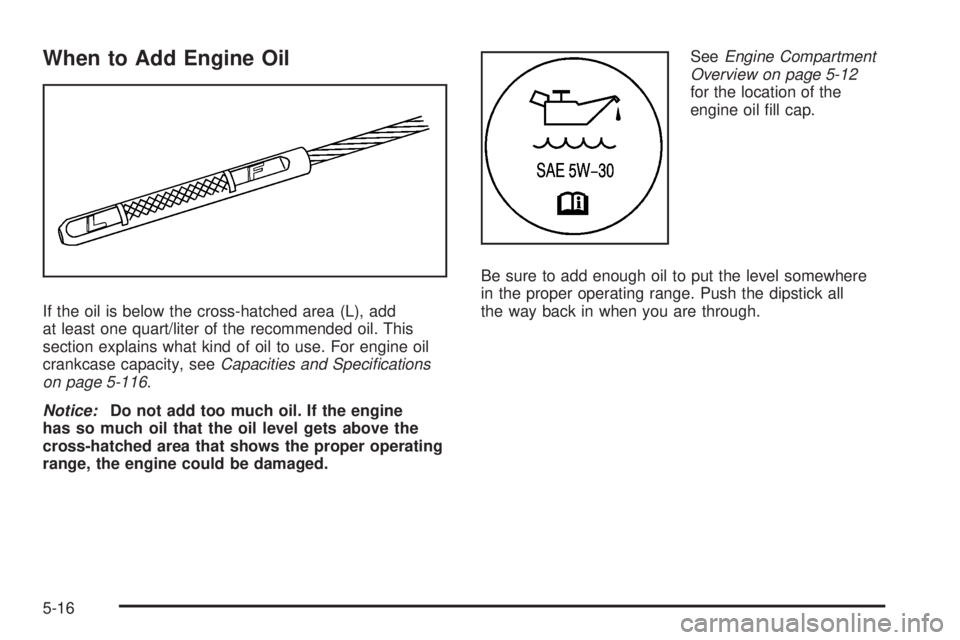
If the oil is below the cross-hatched area (L), add
at least one quart/liter of the recommended oil. This
section explains what kind of oil to use. For engine oil
crankcase capacity, seeCapacities and Specifications
on page 5-116.
Notice:Do not add too much oil. If the engine
has so much oil that the oil level gets above the
cross-hatched area that shows the proper operating
range, the engine could be damaged.SeeEngine Compartment
Overview on page 5-12
for the location of the
engine oil ll cap.
Be sure to add enough oil to put the level somewhere
in the proper operating range. Push the dipstick all
the way back in when you are through.
5-16
Page 278 of 428
Engine Oil Additives
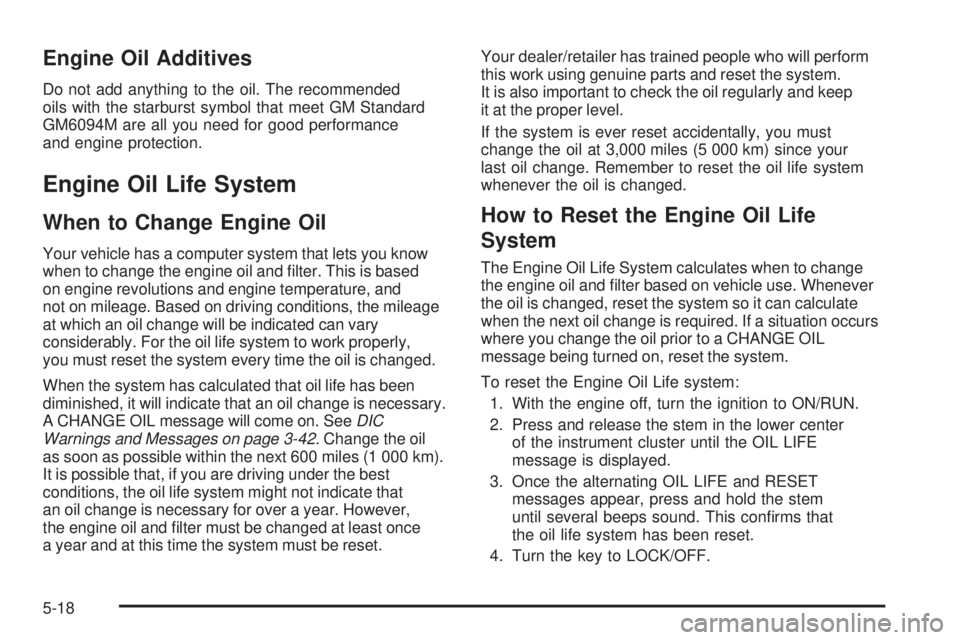
Do not add anything to the oil. The recommended
oils with the starburst symbol that meet GM Standard
GM6094M are all you need for good performance
and engine protection.
Engine Oil Life System
When to Change Engine Oil
Your vehicle has a computer system that lets you know
when to change the engine oil and lter. This is based
on engine revolutions and engine temperature, and
not on mileage. Based on driving conditions, the mileage
at which an oil change will be indicated can vary
considerably. For the oil life system to work properly,
you must reset the system every time the oil is changed.
When the system has calculated that oil life has been
diminished, it will indicate that an oil change is necessary.
A CHANGE OIL message will come on. SeeDIC
Warnings and Messages on page 3-42. Change the oil
as soon as possible within the next 600 miles (1 000 km).
It is possible that, if you are driving under the best
conditions, the oil life system might not indicate that
an oil change is necessary for over a year. However,
the engine oil and lter must be changed at least once
a year and at this time the system must be reset.Your dealer/retailer has trained people who will perform
this work using genuine parts and reset the system.
It is also important to check the oil regularly and keep
it at the proper level.
If the system is ever reset accidentally, you must
change the oil at 3,000 miles (5 000 km) since your
last oil change. Remember to reset the oil life system
whenever the oil is changed.
How to Reset the Engine Oil Life
System
The Engine Oil Life System calculates when to change
the engine oil and lter based on vehicle use. Whenever
the oil is changed, reset the system so it can calculate
when the next oil change is required. If a situation occurs
where you change the oil prior to a CHANGE OIL
message being turned on, reset the system.
To reset the Engine Oil Life system:
1. With the engine off, turn the ignition to ON/RUN.
2. Press and release the stem in the lower center
of the instrument cluster until the OIL LIFE
message is displayed.
3. Once the alternating OIL LIFE and RESET
messages appear, press and hold the stem
until several beeps sound. This conrms that
the oil life system has been reset.
4. Turn the key to LOCK/OFF.
5-18
Page 281 of 428
Automatic Transmission Fluid
When to Check and Change
Automatic Transmission Fluid
A good time to check your automatic transmission uid
level is when the engine oil is changed.
Change the uid and lter at the intervals listed in
Additional Required Services on page 6-6, and be sure
to use the transmission uid listed inRecommended
Fluids and Lubricants on page 6-12.
How to Check Automatic
Transmission Fluid
Because this operation can be a little difficult, you may
choose to have this done at the dealer/retailer service
department.
If you do it yourself, be sure to follow all the instructions
here, or you could get a false reading on the dipstick.
Notice:Too much or too little uid can damage
your transmission. Too much can mean that some
of the uid could come out and fall on hot engine
parts or exhaust system parts, starting a re.
Too little uid could cause the transmission to
overheat. Be sure to get an accurate reading if
you check your transmission uid.Wait at least 30 minutes before checking the
transmission uid level if you have been driving:
When outside temperatures are above 90°F (32°C).
At high speed for quite a while.
In heavy traffic — especially in hot weather.
While pulling a trailer.
To get the right reading, the uid should be at
normal operating temperature, which is 180°F to 200°F
(82°C to 93°C).
Get the vehicle warmed up by driving about 15 miles
(24 km) when outside temperatures are above
50°F (10°C). If it is colder than 50°F (10°C), drive
the vehicle in THIRD (3) until the engine temperature
gage moves and then remains steady for 10 minutes.
A cold uid check can be made after the vehicle
has been sitting for eight hours or more with the
engine off, but this is used only as a reference.
Let the engine run at idle for ve minutes if outside
temperatures are 50°F (10°C) or more. If it is colder than
50°F (10°C), you may have to idle the engine longer.
Should the uid level be low during this cold check,
you must check the uid hot before adding uid.
Checking the uid hot will give you a more accurate
reading of the uid level.
5-21
Page 283 of 428
How to Add Automatic
Transmission Fluid
Refer to the Maintenance Schedule to determine what
kind of transmission uid to use. SeeRecommended
Fluids and Lubricants on page 6-12.
Add uid only after checking the transmission uid
while it is hot. A cold check is used only as a reference.
If the uid level is low, add only enough of the proper
uid to bring the level up to the HOT area for a hot
check. It does not take much uid, generally less than
one pint (0.5 L). Do not overll.
Notice:Use of the incorrect automatic transmission
uid may damage your vehicle, and the damages
may not be covered by your warranty. Always
use the automatic transmission uid listed in
Recommended Fluids and Lubricants on page 6-12.
After adding uid, recheck the uid level as
described under “How to Check Automatic
Transmission Fluid,” earlier in this section.
When the correct uid level is obtained, push
the dipstick back in all the way; then ip the
handle down to lock the dipstick in place.
Manual Transmission Fluid
When to Check
A good time to have it checked is when the engine oil is
changed. However, the uid in your manual transmission
does not require changing.
How to Check
Because this operation can be a little difficult, you may
choose to have this done at your GM dealer/retailer
service department.
If you do it yourself, be sure to follow all the instructions
here, or you could get a false reading.
Notice:Too much or too little uid can damage
your transmission. Too little uid could cause
the transmission to overheat. Be sure to get an
accurate reading if you check your transmission
uid.
Check the uid level only when your engine is off, the
vehicle is parked on a level place and the transmission
is cool enough for you to rest your ngers on the
transmission case.
5-23
Page 287 of 428
{CAUTION:
Adding only plain water to your cooling system
can be dangerous. Plain water, or some other
liquid such as alcohol, can boil before the
proper coolant mixture will. Your vehicle’s
coolant warning system is set for the proper
coolant mixture. With plain water or the wrong
mixture, your engine could get too hot but
you would not get the overheat warning.
Your engine could catch re and you or others
could be burned. Use a 50/50 mixture of clean,
drinkable water and the proper coolant.
Notice:If you use an improper coolant mixture, your
engine could overheat and be badly damaged. The
repair cost would not be covered by your warranty.
Too much water in the mixture can freeze and crack
the engine, radiator, heater core, and other parts.
Notice:If you use extra inhibitors and/or additives
in your vehicle’s cooling system, you could damage
your vehicle. Use only the proper mixture of the
engine coolant listed in this manual for the cooling
system. SeeRecommended Fluids and Lubricants
on page 6-12for more information.
Checking Coolant
The coolant recovery tank
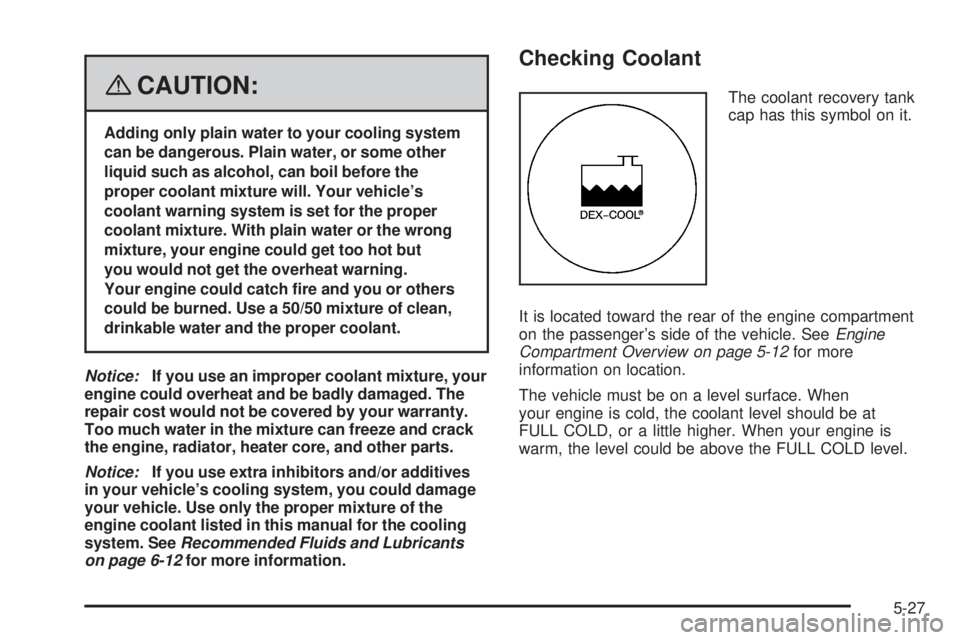
cap has this symbol on it.
It is located toward the rear of the engine compartment
on the passenger’s side of the vehicle. SeeEngine
Compartment Overview on page 5-12for more
information on location.
The vehicle must be on a level surface. When
your engine is cold, the coolant level should be at
FULL COLD, or a little higher. When your engine is
warm, the level could be above the FULL COLD level.
5-27