display GMC CANYON 2010 Workshop Manual
[x] Cancel search | Manufacturer: GMC, Model Year: 2010, Model line: CANYON, Model: GMC CANYON 2010Pages: 448, PDF Size: 2.62 MB
Page 311 of 448
Engine Overheating
The vehicle has a coolant temperature gage displayed
on the instrument panel to warn if the engine is
overheating. SeeEngine Coolant Temperature Gage on
page 4-27. If the engine is too hot, the air conditioning
might stop working. This is normal and helps cool
the engine.
You may decide not to lift the hood when the warning
appears, but instead get service help right away.
SeeRoadside Assistance Program on page 8-7.
If you do decide to lift the hood, make sure the vehicle
is parked on a level surface.
Then check to see if the engine cooling fan is running.
If the engine is overheating, the fan should be running.
If it is not, do not continue to run the engine and have the
vehicle serviced.
The engine cooling fan speed should increase when
idle speed is doubled by pushing the accelerator
pedal down. If it does not, the vehicle needs service.
Turn off the engine.
Notice:Engine damage from running the engine
without coolant is not covered by the warranty.
Notice:If the engine catches re because of being
driven with no coolant, your vehicle can be badly
damaged. The costly repairs would not be covered
by the vehicle warranty.
If Steam is Coming from the Engine
Compartment
{WARNING:
Steam from an overheated engine can burn you
badly, even if you just open the hood. Stay away
from the engine if you see or hear steam coming
from it. Just turn it off and get everyone away
from the vehicle until it cools down. Wait until
there is no sign of steam or coolant before you
open the hood.
If you keep driving when your engine is
overheated, the liquids in it can catch fire. You or
others could be badly burned. Stop your engine if
it overheats, and get out of the vehicle until the
engine is cool.
6-35
Page 312 of 448
If No Steam is Coming from the Engine
Compartment
If an engine overheat warning is displayed but no steam
can be seen or heard, the problem may not be too
serious. Sometimes the engine can get a little too hot
when the vehicle:
•Climbs a long hill on a hot day.
•Stops after high-speed driving.
•Idles for long periods in traffic.
•Tows a trailer. See “Driving on Grades” under
Towing a Trailer on page 5-48.
If the overheat warning is displayed with no sign of
steam:
1. Turn the air conditioning off.
2. Turn the heater on to the highest temperature and
to the highest fan speed. Open the windows as
necessary.
3. In heavy traffic, let the engine idle in N (Neutral)
while stopped. If it is safe to do so, pull off the
road, shift to P (Park) or N (Neutral) and let
the engine idle.
If the temperature overheat gage is no longer in the
overheat zone or an overheat warning no longer
displays, the vehicle can be driven. Continue to drivethe vehicle slow for about 10 minutes. Keep a safe
vehicle distance from the car in front of you. If the
warning does not come back on, continue to drive
normally.
If the warning continues, pull over, stop, and park the
vehicle right away.
If there is no sign of steam, idle the engine for three
minutes while parked. If the warning is still displayed,
turn off the engine until it cools down.Engine Fan Noise
This vehicle has a clutched engine cooling fan. When the
clutch is engaged, the fan spins faster to provide more air
to cool the engine. In most everyday driving conditions,
the clutch is not engaged. This improves fuel economy
and reduces fan noise. Under heavy vehicle loading,
trailer towing and/or high outside temperatures, the fan
speed increases when the clutch engages. So you may
hear an increase in fan noise. This is normal and should
not be mistaken as the transmission slipping or making
extra shifts. It is merely the cooling system functioning
properly. The fan will slow down when additional cooling
is not required and the clutch disengages.
You may also hear this fan noise when you start the
engine. It will go away as the fan clutch disengages.
6-36
Page 343 of 448
When the malfunction indicator is illuminated, the system
may not be able to detect or signal low tire pressure as
intended. TPMS malfunctions may occur for a variety of
reasons, including the installation of replacement or
alternate tires or wheels on the vehicle that prevent the
TPMS from functioning properly. Always check the TPMS
malfunction telltale after replacing one or more tires or
wheels on your vehicle to ensure that the replacement
or alternate tires and wheels allow the TPMS to continue
to function properly.
SeeTire Pressure Monitor Operation on page 6-67for
additional information.
Federal Communications
Commission (FCC) and Industry
and Science Canada
SeeRadio Frequency Statement on page 8-18
for information regarding Part 15 of the Federal
Communications Commission (FCC) Rules and
RSS-210/211 of Industry and Science Canada.
Tire Pressure Monitor Operation
This vehicle may have a Tire Pressure Monitor
System (TPMS). The TPMS is designed to warn the
driver when a low tire pressure condition exists. TPMS
sensors are mounted onto each tire and wheel assembly
on your vehicle, excluding the spare tire. The TPMS
sensors monitor the air pressure in your vehicle’s tires
and transmit the tire pressure readings to a receiver
located in the vehicle.
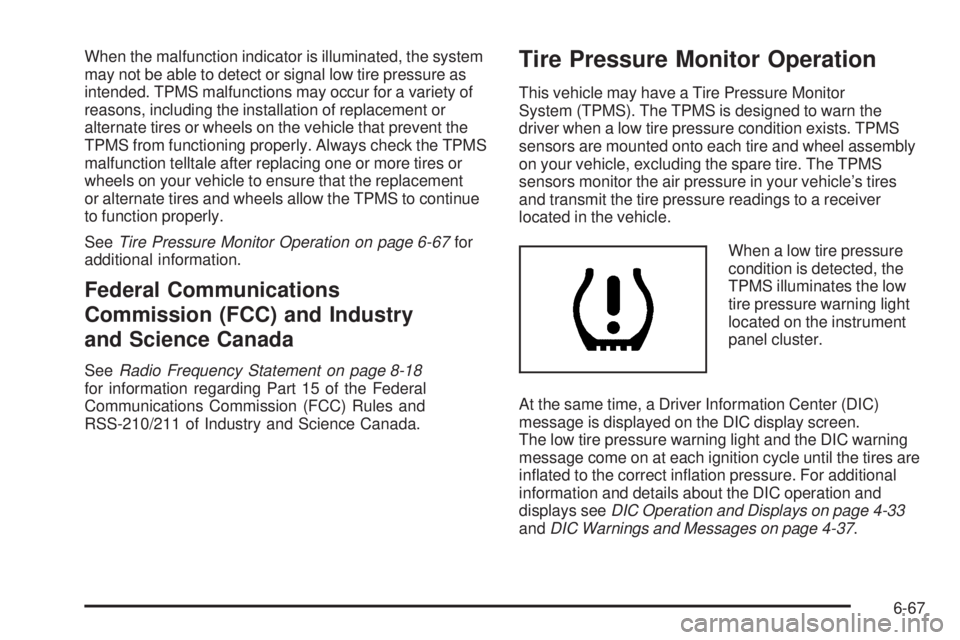
When a low tire pressure
condition is detected, the
TPMS illuminates the low
tire pressure warning light
located on the instrument
panel cluster.
At the same time, a Driver Information Center (DIC)
message is displayed on the DIC display screen.
The low tire pressure warning light and the DIC warning
message come on at each ignition cycle until the tires are
inflated to the correct inflation pressure. For additional
information and details about the DIC operation and
displays seeDIC Operation and Displays on page 4-33
andDIC Warnings and Messages on page 4-37.
6-67
Page 344 of 448
The low tire pressure warning light may come on in
cool weather when the vehicle is first started, and then
turn off as you start to drive. This could be an early
indicator that the air pressure in the tire(s) are getting
low and need to be inflated to the proper pressure.
A Tire and Loading Information label, attached to
your vehicle, shows the size of your vehicle’s original
equipment tires and the correct inflation pressure for
your vehicle’s tires when they are cold. SeeLoading the
Vehicle on page 5-33, for an example of the Tire and
Loading Information label and its location on your vehicle.
Also seeInation - Tire Pressure on page 6-64.
Your vehicle’s TPMS can warn you about a low tire
pressure condition but it does not replace normal
tire maintenance. SeeTire Inspection and Rotation
on page 6-71andTires on page 6-57.
Notice:Liquid tire sealants could damage the Tire
Pressure Monitor System (TPMS) sensors. Sensor
damage caused by using a tire sealant is not covered
by your warranty. Do not use liquid tire sealants.TPMS Malfunction Light and Message
The TPMS will not function properly if one or more of the
TPMS sensors are missing or inoperable. When the
system detects a malfunction, the low tire warning light
flashes for about one minute and then stays on for the
remainder of the ignition cycle. A DIC warning message
is also displayed. The low tire warning light and DIC
warning message come on at each ignition cycle until
the problem is corrected. Some of the conditions that
can cause the malfunction light and DIC message to
come on are:
•One of the road tires has been replaced with the
spare tire. The spare tire does not have a TPMS
sensor. The TPMS malfunction light and DIC
message should go off once you re-install the
road tire containing the TPMS sensor.
•The TPMS sensor matching process was started but
not completed or not completed successfully after
rotating the vehicle’s tires. The DIC message and
TPMS malfunction light should go off once the TPMS
sensor matching process is performed successfully.
See “TPMS Sensor Matching Process” later in this
section.
6-68
Page 346 of 448
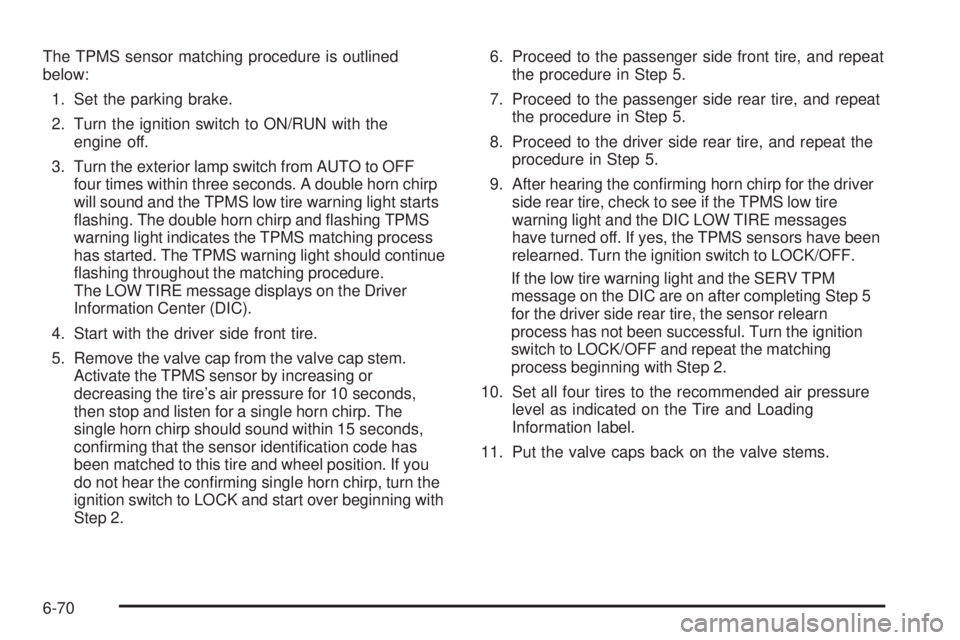
The TPMS sensor matching procedure is outlined
below:
1. Set the parking brake.
2. Turn the ignition switch to ON/RUN with the
engine off.
3. Turn the exterior lamp switch from AUTO to OFF
four times within three seconds. A double horn chirp
will sound and the TPMS low tire warning light starts
flashing. The double horn chirp and flashing TPMS
warning light indicates the TPMS matching process
has started. The TPMS warning light should continue
flashing throughout the matching procedure.
The LOW TIRE message displays on the Driver
Information Center (DIC).
4. Start with the driver side front tire.
5. Remove the valve cap from the valve cap stem.
Activate the TPMS sensor by increasing or
decreasing the tire’s air pressure for 10 seconds,
then stop and listen for a single horn chirp. The
single horn chirp should sound within 15 seconds,
confirming that the sensor identification code has
been matched to this tire and wheel position. If you
do not hear the confirming single horn chirp, turn the
ignition switch to LOCK and start over beginning with
Step 2.6. Proceed to the passenger side front tire, and repeat
the procedure in Step 5.
7. Proceed to the passenger side rear tire, and repeat
the procedure in Step 5.
8. Proceed to the driver side rear tire, and repeat the
procedure in Step 5.
9. After hearing the confirming horn chirp for the driver
side rear tire, check to see if the TPMS low tire
warning light and the DIC LOW TIRE messages
have turned off. If yes, the TPMS sensors have been
relearned. Turn the ignition switch to LOCK/OFF.
If the low tire warning light and the SERV TPM
message on the DIC are on after completing Step 5
for the driver side rear tire, the sensor relearn
process has not been successful. Turn the ignition
switch to LOCK/OFF and repeat the matching
process beginning with Step 2.
10. Set all four tires to the recommended air pressure
level as indicated on the Tire and Loading
Information label.
11. Put the valve caps back on the valve stems.
6-70
Page 399 of 448
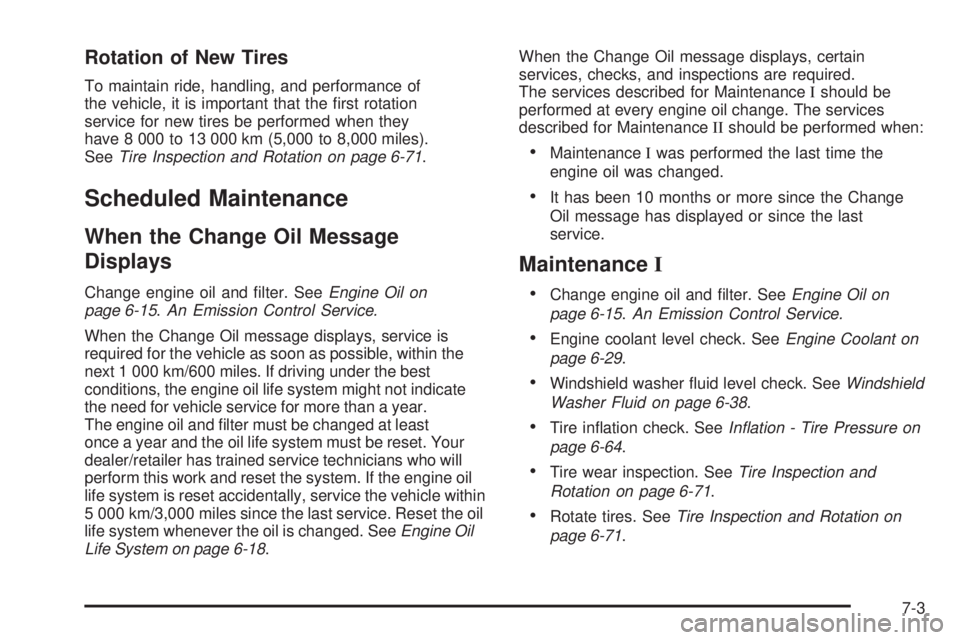
Rotation of New Tires
To maintain ride, handling, and performance of
the vehicle, it is important that the first rotation
service for new tires be performed when they
have 8 000 to 13 000 km (5,000 to 8,000 miles).
SeeTire Inspection and Rotation on page 6-71.
Scheduled Maintenance
When the Change Oil Message
Displays
Change engine oil and filter. SeeEngine Oil on
page 6-15.An Emission Control Service.
When the Change Oil message displays, service is
required for the vehicle as soon as possible, within the
next 1 000 km/600 miles. If driving under the best
conditions, the engine oil life system might not indicate
the need for vehicle service for more than a year.
The engine oil and filter must be changed at least
once a year and the oil life system must be reset. Your
dealer/retailer has trained service technicians who will
perform this work and reset the system. If the engine oil
life system is reset accidentally, service the vehicle within
5 000 km/3,000 miles since the last service. Reset the oil
life system whenever the oil is changed. SeeEngine Oil
Life System on page 6-18.When the Change Oil message displays, certain
services, checks, and inspections are required.
The services described for MaintenanceIshould be
performed at every engine oil change. The services
described for MaintenanceIIshould be performed when:
•MaintenanceIwas performed the last time the
engine oil was changed.
•It has been 10 months or more since the Change
Oil message has displayed or since the last
service.
MaintenanceI
•Change engine oil and filter. SeeEngine Oil on
page 6-15.An Emission Control Service.
•Engine coolant level check. SeeEngine Coolant on
page 6-29.
•Windshield washer fluid level check. SeeWindshield
Washer Fluid on page 6-38.
•Tire inflation check. SeeInation - Tire Pressure on
page 6-64.
•Tire wear inspection. SeeTire Inspection and
Rotation on page 6-71.
•Rotate tires. SeeTire Inspection and Rotation on
page 6-71.
7-3
Page 406 of 448
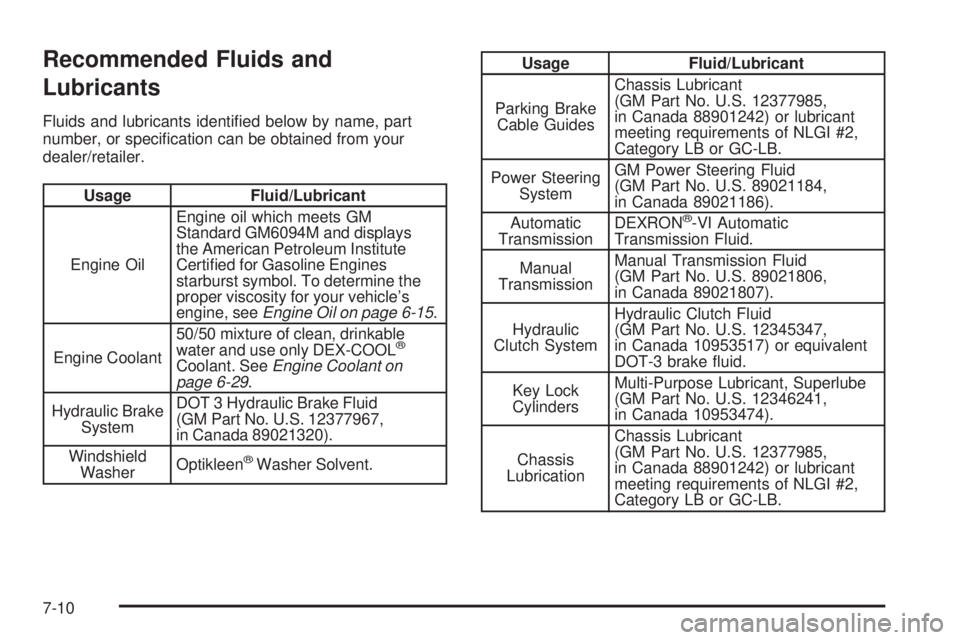
Recommended Fluids and
Lubricants
Fluids and lubricants identified below by name, part
number, or specification can be obtained from your
dealer/retailer.
Usage Fluid/Lubricant
Engine OilEngine oil which meets GM
Standard GM6094M and displays
the American Petroleum Institute
Certified for Gasoline Engines
starburst symbol. To determine the
proper viscosity for your vehicle’s
engine, seeEngine Oil on page 6-15.
Engine Coolant50/50 mixture of clean, drinkable
water and use only DEX-COOL
®
Coolant. SeeEngine Coolant on
page 6-29.
Hydraulic Brake
SystemDOT 3 Hydraulic Brake Fluid
(GM Part No. U.S. 12377967,
in Canada 89021320).
Windshield
WasherOptikleen
®Washer Solvent.
Usage Fluid/Lubricant
Parking Brake
Cable GuidesChassis Lubricant
(GM Part No. U.S. 12377985,
in Canada 88901242) or lubricant
meeting requirements of NLGI #2,
Category LB or GC-LB.
Power Steering
SystemGM Power Steering Fluid
(GM Part No. U.S. 89021184,
in Canada 89021186).
Automatic
TransmissionDEXRON
®-VI Automatic
Transmission Fluid.
Manual
TransmissionManual Transmission Fluid
(GM Part No. U.S. 89021806,
in Canada 89021807).
Hydraulic
Clutch SystemHydraulic Clutch Fluid
(GM Part No. U.S. 12345347,
in Canada 10953517) or equivalent
DOT-3 brake fluid.
Key Lock
CylindersMulti-Purpose Lubricant, Superlube
(GM Part No. U.S. 12346241,
in Canada 10953474).
Chassis
LubricationChassis Lubricant
(GM Part No. U.S. 12377985,
in Canada 88901242) or lubricant
meeting requirements of NLGI #2,
Category LB or GC-LB.
7-10
Page 435 of 448
Door
Locks.......................................................... 3-5
Power Locks................................................ 3-6
Programmable Automatic Door Locks............... 3-6
Rear Door Security Locks............................... 3-7
Rear Doors.................................................. 3-7
DOORS.........................................................4-38
Driver Information Center (DIC).........................4-33
DIC Operation and Displays..........................4-33
DIC Warnings and Messages........................4-37
Driving
At Night.....................................................5-25
Before a Long Trip......................................5-27
Defensive..................................................... 5-2
Drunk.......................................................... 5-2
Highway Hypnosis.......................................5-27
Hill and Mountain Roads..............................5-28
In Rain and on Wet Roads...........................5-26
Loss of Control...........................................5-12
Off-Road ....................................................5-13
Off-Road Recovery......................................5-11
Recovery Hooks..........................................5-32
Rocking Your Vehicle to Get it Out.................5-32
Winter........................................................5-29
Driving Across an Incline..................................5-22
Driving Downhill..............................................5-21Driving for Better Fuel Economy.......................1-19
Driving in Mud, Sand, Snow, or Ice...................5-23
Driving in Water..............................................5-24
Driving On Grades..........................................5-58
Driving on Hills...............................................5-17
Driving on Snow or Ice....................................5-29
Driving Uphill..................................................5-18
Driving with a Trailer.......................................5-56
E
EDR .............................................................8-16
Electrical Equipment, Add-On..........................6-111
Electrical System
Engine Compartment Fuse Block.................6-112
Fuses and Circuit Breakers.........................6-111
Windshield Wiper Fuses.............................6-111
Electronic Immobilizer
PASS-Key
®III+...........................................3-15
Electronic Immobilizer Operation
PASS-Key
®III+...........................................3-15
Emissions Inspection and
Maintenance Programs.................................4-31
ENG (Engine) HOT.........................................4-38
5
Page 445 of 448
Spare Tire....................................................6-101
Installing....................................................6-85
Removing...................................................6-81
Storing.......................................................6-96
Specifications and Capacities..........................6-118
Speedometer..................................................4-20
STAB (Stability) SYS (System) OFF..................4-41
StabiliTrak
®System.......................................... 5-6
StabiliTrak®/TCS Warning Light.........................4-26
Stalling on an Incline.......................................5-23
Starter Switch Check........................................ 7-8
Starting the Engine.........................................3-18
Steering.......................................................... 5-9
Steering in Emergencies..................................5-10
Steering Tips................................................... 5-9
Steering Wheel, Tilt Wheel................................. 4-3
Storage Areas
Center Console...........................................3-40
Cupholders.................................................3-40
Glove Box..................................................3-40
Rear ..........................................................3-41
Stuck in Sand, Mud, Ice, or Snow.....................5-31
Sun Visors.....................................................3-12
Sunroof.........................................................3-42
T
Tachometer....................................................4-20
Tailgate........................................................... 3-8
Taillamps
Turn Signal, Stoplamps and Back-up Lamps....6-53
Temperature Display........................................3-37
Temperature – A, B, C....................................6-76
Testing the Alarm............................................3-14
Text Telephone (TTY) Users............................... 8-6
Theft-Deterrent Feature....................................4-61
Theft-Deterrent Systems...................................3-13
Content Theft-Deterrent................................3-13
PASS-Key
®III+ Electronic Immobilizer............3-15
PASS-Key®III+ Electronic Immobilizer
Operation................................................3-15
Passlock
®...................................................3-14
Tilt Wheel........................................................ 4-3
Time, Setting..................................................4-43
Tire Size.......................................................6-60
Tires.............................................................6-57
Aluminum or Chrome-Plated Wheels,
Cleaning...............................................6-108
Buying New Tires........................................6-73
Chains.......................................................6-78
15
Page 448 of 448
When the Change Oil Message Displays............. 7-3
When to Add Engine Oil..................................6-16
When to Change Engine Oil.............................6-18
When to Check......................................6-25, 6-64
When to Check and Change Automatic
Transmission Fluid.......................................6-21
When to Check and Change Lubricant.......6-47, 6-49
When to Check and What to Use.....................6-27
When to Check Power Steering Fluid................6-37
When to Inspect the Engine Air Cleaner/Filter.....6-20
Where to Put the Child Restraint.......................2-44
Why Safety Belts Work....................................2-14
Window Lockout.............................................3-12
Windows.......................................................3-10
Manual......................................................3-10
Power ........................................................3-11
Sliding Rear................................................3-12Windshield
Washer........................................................ 4-6
Washer Fluid..............................................6-38
Wiper Blade Replacement.............................6-55
Wiper Blades, Cleaning..............................6-107
Wiper Fuses.............................................6-111
Wipers......................................................... 4-5
Winter Driving................................................5-29
X
XM Radio Messages.......................................4-60
XM™ Satellite Radio
Antenna.....................................................4-63
XM™ Satellite Radio Service....................4-52, 4-62
Y
Your Responsibility..........................................1-22
18