lock GMC ENVOY 1998 Manual PDF
[x] Cancel search | Manufacturer: GMC, Model Year: 1998, Model line: ENVOY, Model: GMC ENVOY 1998Pages: 386, PDF Size: 20.33 MB
Page 283 of 386
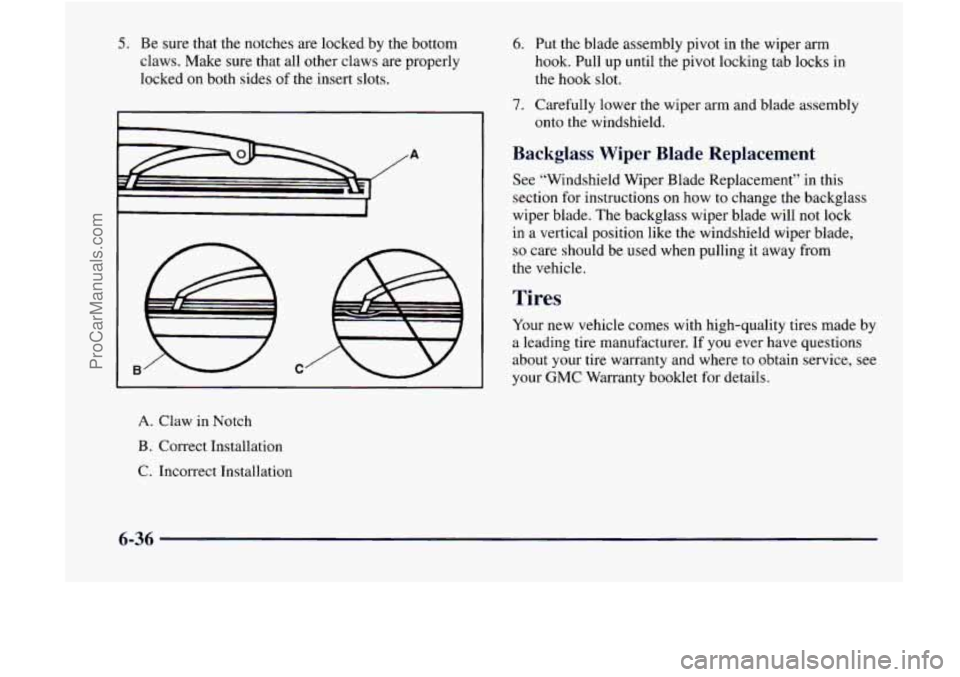
5. Be sure that the notches are locked by the bottom
claws. Make sure that all other claws are properly
locked on both sides
of the insert slots.
A
t------
A. Claw in Notch
B. Correct Installation
C. Incorrect Installation
6. Put the blade assembly pivot in the wiper arm
hook. Pull up until the pivot locking tab locks in
the hook
slot.
7. Carefully lower the wiper arm and blade assembly
onto the windshield.
Backglass Wiper Blade Rep --ment
See “Windshield Wiper Blade Replacement” in this
section
for instructions on how to change the backglass
wiper blade. The backglass wiper blade will not lock
in a vertical position like the windshield wiper blade,
so care should be used when pulling it away from
the vehicle.
Tires
Your new vehicle comes with high-quality tires made by
a leading tire manufacturer. If you ever have questions
about your tire warranty and where to obtain service, see
your
GMC Warranty booklet for details.
6-36
ProCarManuals.com
Page 303 of 386

Instrument Panel Fuse Block
instrument panel.
Remove the cover by turning the fastener to the left.
Extra fuses and the fuse extractor
are provided in the
cover.
To reinstall the fuse panel cover, push in and turn
the fastener to the right.
Fuse/Circuit
Breaker
A
B
1
Usage
Not Used
Not Used
Headlamp Switch, Body Control
Module, Headlamp Relay
ProCarManuals.com
Page 304 of 386

FuseKircuit Usage
Breaker
2
3
4
8
9
10
11
12 Cigarette
Lighter, Data
Link Connector
Cruise Control Module and
Switch, Body Control Module,
Heated Seats
Gages, Body Control Module,
Instrument Panel Cluster
Interior Lights
Not Used
Power Outside Mirror, Power
Lock Relay
Courtesy Lamps, Battery
Run-Down Protection
Not Used
Turn Signal
Cluster, Engine Control Module
Parking Lamps, Power Window
Switch, Body Control Module,
Ashtray Lamp
FuseKircuit
Breaker
13
14
15
16
17
18
19
20
21
22
23
24
Usage
Auxiliary Power
Power Locks Motor
4WD Switch, Engine Controls (VCM, PCM, Transmission)
Air Bag
Front Wiper
Not Used
Radio Battery
Amplifier
HVAC
I (Automatic), HVAC
Sensors (Automatic)
Anti-Lock Brakes
Rear Wiper
Radio, Ignition
6-57
ProCarManuals.com
Page 305 of 386

Engine Compartment Fuse Block
The fuse block is under the hood at the driver’s side of
the engine compartment.
Remove the cover
by turning the fastener to the left. To
reinstall the fuse panel cover, push in and
turn the
fastener to
the right.
TRR TRN RTTRN STARTER
rRL BU
Name
TRL TRN
TRR TRN
TRL
BPU
VEH B/U
RT TURN
LT TURN
LT TRN
Usage
Trailer Left Turn
Trailer Right Turn
Trailer
Back-up Lamps
Vehicle Back-up Lamps
Right Turn Signal Front
Left Turn Signal Front
Left Turn Signal Rear
6-58
ProCarManuals.com
Page 306 of 386
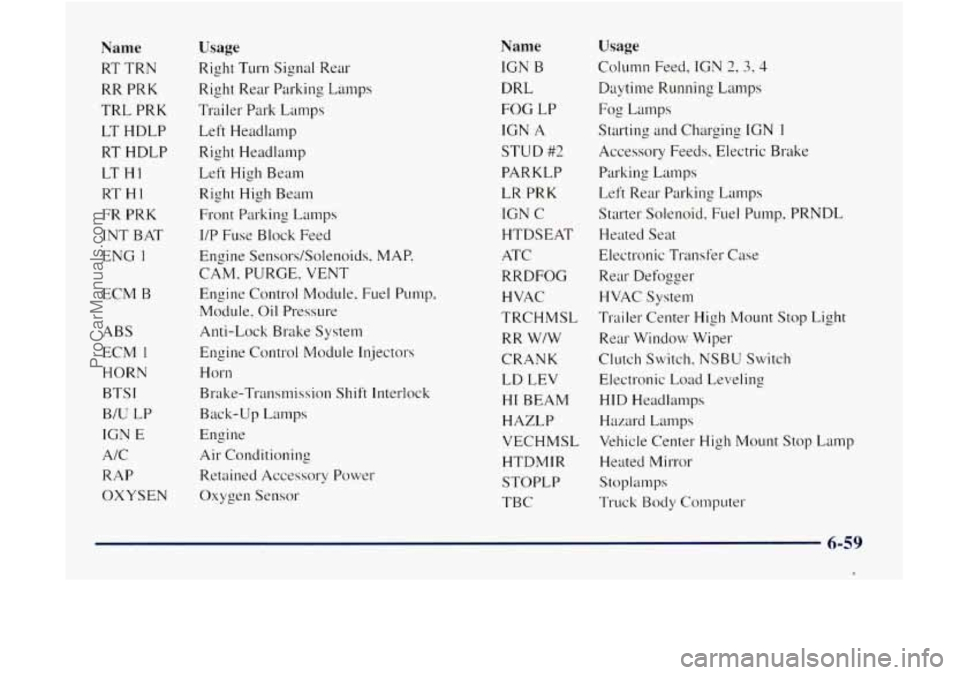
Name
RT TRN
RR PRK
TRL PRK
LT HDLP
RT HDLP
LT HI
RT HI
FR PRK
INT BAT
ENG
I
ECM B
ABS
ECM
1
HORN
BTS
I
BIU LP
IGN E
AIC
RAP
OXYSEN
Usage
Right Turn Signal Rear
Right Rear Parking Lamps
Trailer Park Lamps Left Headlamp
Right Headlamp
Left High Beam
Right High Beam
Front Parking Lamps
I/P Fuse Block Feed
Engine SensorsISolenoids, MAP,
CAM. PURGE, VENT
Engine Control Module, Fuel Pump,
Module, Oil Pressure
Anti-Lock Brake System
Engine Control Module Injectors Horn
Brake-Transmission Shift Interlock
Back-up
Lalllps
Engine
Air Conditioning
Retained Accessory Power
Oxygen Sensor
Name
IGN B
DRL
FOG LP
IGN
A
STUD #2
PARKLP
LR PRK
IGN C
HTDSEAT ATC
RRDFOG
HVAC
TRCHMSL
RR W/W
CRANK
LD LEV
HI BEAM
HAZLP
VECHMSL
HTDMIR
STOPLP
TBC
Usage
Column Feed, IGN 2, 3,4
Daytime Running Lamps
Fog Lamps
Starting and Charging IGN
I
Accessory Feeds, Electric Brake
Parking La~nps
Left Rear Parking Lamps Starter Solenoid, Fuel Pump. PRNDL
Heated Seat
Electronic Transfer Case
Rear Defogger
HVAC System
Trailer Center High Mount Stop Light
Rear Window Wiper
Clutch Switch, NSBU Switch
Electronic Load Leveling
HID Headlamps Hazard Lamps
Vehicle Center High
Mount Stop Lamp
Heated Mirror
Stoplamps
Truck Body Computer
6-59
1
ProCarManuals.com
Page 318 of 386

Short TripKity Maintenance Schedule I
The services shown in this schedule up to 100,000 miles
( 166 000 km) should be performed after 100,000 miles
( 166 000 km) at the same intervals. The services shown
at
150,000 miles (240 000 km) should be performed at
the same interval after 150,000 miles (240
000 ktn).
See “Owner Checks and Services” and “Periodic
Maintenance Inspections” following.
Footnotes
7 The U.S. Environmental Protection Agency or the
California Air Resources Board has determined that the
failure
to perform this maintenance item will not nullify
the emission warranty or limit recall liability prior to the
completion
of the vehicle’s ~1sefu1 life. We, however.
urge that all recommended maintenance services be
performed
at the indicated intervals and the maintenance
be recorded.
## Lubricate the front suspension, ball joints, steering
linkage, parking brake cable guides, propshaft splines.
universal joints and brake pedal springs.
+ A ~ood time to check your brakes is during tire
rotation. See “Brake System Inspection” under ”Periodic
Maintenance Inspections”
in Part C of this schedule.
.:. .:, -,-*,- Drive axle service (see “Recommended Fluids and
Lubricants“ in the Index for proper lubricant to use):
Locking Differential -- Drain fluid and refill at first
engine oil change.
At subsequent oil changes. check
fluid level and add fluid
as needed. If driving in
dusty areas or towing a trailer, drain fluid and refill
every 15,000 miles
(25 000 km).
Standard Differential -- Check fluid level and add
fluid
as needed at every oil change. If driving in
dusty areas or towing a trailer. drain fluid and refill
every
15,000 miles (25 000 km).
More frequent lubrication may be required for
hea\jy-duty
or off-l-oad use.
7-7
ProCarManuals.com
Page 338 of 386

I Long Tripmighway Maintenance Schedule I
The services shown in this schedule up to 100,000 miles
(166 000 km) should be performed after 100,000 miles
( 166 000 km) at the same intervals. The services shown
at
150,000 miles (240 000 km) should be performed at
the same interval after 150,000 miles (240 000 km).
See “Owner Checks and Services” and “Periodic
Maintenance Inspections” following.
Footnotes
i- The U.S. Environmental Protection Agency or the
California Air Resources Board has determined that the
failure to perform this maintenance item will not nullify
the emission warranty or limit recall liability prior to the
completion
of the vehicle’s useful life. We, however,
urge that all recommended maintenance services be
performed at the indicated intervals and the maintenance
be recorded.
## Lubricate the front suspension, ball joints, steering
linkage and transfer case shift linkage, parking brake
cable guides, propshaft splines, universal joints and
brake pedal springs.
+ A good time to check your brakes is during tire
rotation. See ‘’Brake System Inspection’’ under “Periodic
Maintenance Inspections”
in Part C of this schedule.
:k:k Drive axle service (see “Recommended Fluids and
Lubricants”
in the Index for proper lubricant to use):
Locking Differential -- Drain fluid and refill at first
engine oil change. At subsequent oil changes, check
fluid level and add fluid
as needed.
fluid as needed at every engine
oil change.
Standard Differential -- Check fluid level and add
7-27
1
ProCarManuals.com
Page 351 of 386

At Least Twice a Year
Restraint System Check
Make sure the safety belt reminder light and all your
belts, buckles, latch plates, retractors and anchorages are
working properly. Look for any other
loose or damaged
safety belt system parts.
If you see anything that might
keep a safety belt system from doing its
job, have it
repaired. Have any torn or frayed safety belts replaced.
Also look for any opened or broken air bag coverings,
and have them repaired or replaced. (The air bag system
does not need regular maintenance.)
Wiper Blade Check
Inspect wiper blades for wear or cracking. Replace blade
inserts that appear worn or damaged or that streak or
miss areas of the windshield. Also see “Wiper Blades,
Cleaning”
in the Index.
Automatic Transmission Check
Check the transmission fluid level; add if needed. See
“Automatic Transmission’’ in the Index. A fluid loss
may indicate
a problem. Check the system and repair
if needed.
At Least Once a Year
Key Lock Cylinders Service
Lubricate the key lock cylinders with the lubricant
specified in Part
D.
Body Lubrication Service
Lubricate all body door and fuel door hinges, rear
compartment hinges, latches and locks including
the
glove box, console doors and the body hood and any
moving seat hardware. Lubricate the hood safety lever
pivot and prop rod pivot. Part
D tells you what to use.
More frequent lubrication may be required when
exposed to
a corrosive environment.
7-40
ProCarManuals.com
Page 352 of 386

Starter Switch Check Brake-Transmission Shift Interlock (BTSI) Check
When you are doing this check, the vehicle could
move suddenly.
If it does, you or others could be
injured. Follow the steps below.
A CAUTION:
I
When you are doing this check, the vehicle could
move suddenly. If it does, you
or others could be
injured. Follow the steps below.
1. Before you start, be sure you have enough room
around
the vehicle.
2. Firmly apply both the parking brake (see “Parking
Brake”
in the Index if necessary) and the
regular brake.
NOTE:
Do not use the accelerator pedal, and be
ready
to turn off the engine immediately if it starts.
3. Try to start the engine in each gear. The starter
should work only in PARK (P) or NEUTRAL (N).
If the starter works in any other position, your
vehicle needs service.
1. Before you start, be sure you have enough room
around the vehicle.
It should be parked on a
level surface.
2. Firmly apply the parking brake (see “Parking Brake”
in the Index if necessary).
NOTE: Be ready to apply the regular brake
immediately if the vehicle begins to move.
3. With the engine off, turn the key to the RUN
position, but don’t start the engine. Without applying
the regular brake, try
to move the shift lever out of
PARK
(P) with normal effort. If the shift lever
moves out of PARK
(P), your vehicle’s BTSI
needs service.
7-41
!
ProCarManuals.com
Page 353 of 386

Ignition Transmission Lock Check
While parked, and with the parking brake set, try to turn
the ignition key to LOCK
in each shift lever position.
The key should turn to LOCK only when the shift
lever is in PARK (P).
The key should come out only in LOCK.
Parking Brake and Automatic Transmission
PARK
(P) Mechanism Check
b-
When you are doing this check, your vehicle
could begin to move.
You or others could be
injured and property could be damaged. Make
sure there is room in front
of your vehicle in case
it begins to roll. Be ready to apply the regular
brake
at once should the vehicle begin to move.
Park on a fairly steep hill, with the vehicle facing
downhill. Keeping your foot
on the regular brake, set the
parking brake.
0 To check the parking brake’s holding ability:
With the engine running and transmission in
NEUTRAL
(N), slowly remove foot pressure from
the regular brake pedal.
Do this until the vehicle is
held by the parking brake only.
0 To check the PARK (P) mechanism’s holding ability:
With the engine running, shift to PARK
(P). Then
release all brakes.
Underbody Flushing Service
At least every spring, use plain water to flush any
corrosive materials from the underbody. Take care
to
clean thoroughly any areas where mud and other debris
can collect.
7-42
ProCarManuals.com