weight GMC ENVOY DENALI 2008 User Guide
[x] Cancel search | Manufacturer: GMC, Model Year: 2008, Model line: ENVOY DENALI, Model: GMC ENVOY DENALI 2008Pages: 468, PDF Size: 2.51 MB
Page 275 of 468
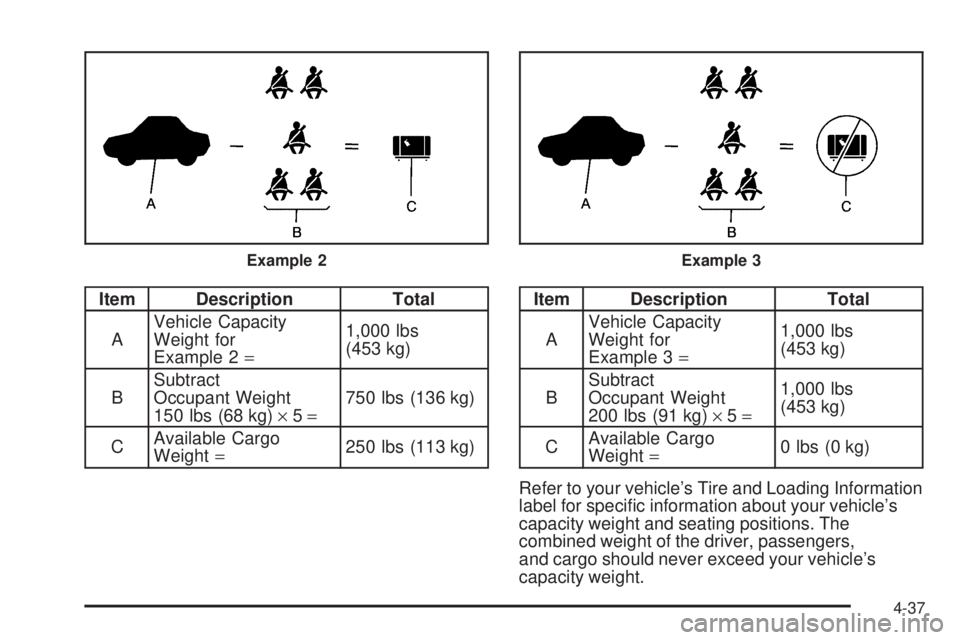
Item Description Total
AVehicle Capacity
Weight for
Example 2=1,000 lbs
(453 kg)
BSubtract
Occupant Weight
150 lbs (68 kg)×5=750 lbs (136 kg)
CAvailable Cargo
Weight=250 lbs (113 kg)Item Description Total
AVehicle Capacity
Weight for
Example 3=1,000 lbs
(453 kg)
BSubtract
Occupant Weight
200 lbs (91 kg)×5=1,000 lbs
(453 kg)
CAvailable Cargo
Weight=0 lbs (0 kg)
Refer to your vehicle’s Tire and Loading Information
label for specic information about your vehicle’s
capacity weight and seating positions. The
combined weight of the driver, passengers,
and cargo should never exceed your vehicle’s
capacity weight.
Example 2Example 3
4-37
Page 276 of 468
Your vehicle may have an electronically controlled
air suspension system that automatically keeps
your vehicle level as you load and unload
your vehicle. SeeElectronically Controlled Air
Suspension System on page 4-44for additional
information.
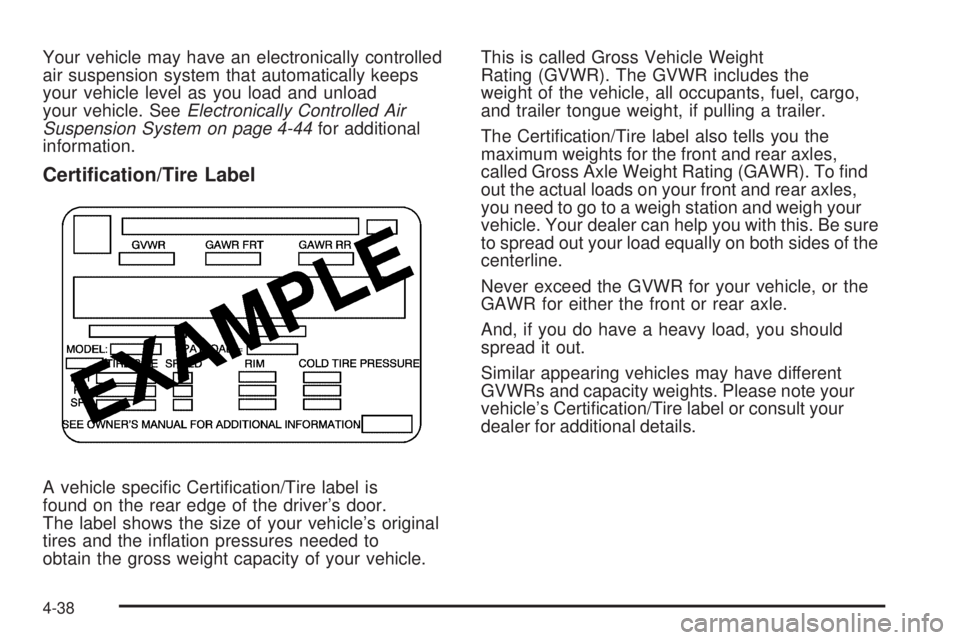
Certication/Tire Label
A vehicle specic Certication/Tire label is
found on the rear edge of the driver’s door.
The label shows the size of your vehicle’s original
tires and the ination pressures needed to
obtain the gross weight capacity of your vehicle.This is called Gross Vehicle Weight
Rating (GVWR). The GVWR includes the
weight of the vehicle, all occupants, fuel, cargo,
and trailer tongue weight, if pulling a trailer.
The Certication/Tire label also tells you the
maximum weights for the front and rear axles,
called Gross Axle Weight Rating (GAWR). To nd
out the actual loads on your front and rear axles,
you need to go to a weigh station and weigh your
vehicle. Your dealer can help you with this. Be sure
to spread out your load equally on both sides of the
centerline.
Never exceed the GVWR for your vehicle, or the
GAWR for either the front or rear axle.
And, if you do have a heavy load, you should
spread it out.
Similar appearing vehicles may have different
GVWRs and capacity weights. Please note your
vehicle’s Certication/Tire label or consult your
dealer for additional details.
4-38
Page 277 of 468
{CAUTION:
Do not load your vehicle any heavier than
the Gross Vehicle Weight Rating (GVWR),
or either the maximum front or rear Gross
Axle Weight Rating (GAWR). If you do,
parts on your vehicle can break, and it
can change the way your vehicle handles.
These could cause you to lose control
and crash. Also, overloading can shorten
the life of your vehicle.
Using heavier suspension components to get
added durability might not change your vehicle’s
weight ratings. Ask your dealer to help you
load your vehicle the right way.
Notice:Overloading your vehicle may cause
damage. Repairs would not be covered by your
warranty. Do not overload your vehicle.
If you put things inside your vehicle — like
suitcases, tools, packages, or anything else — they
will go as fast as the vehicle goes. If you have to
stop or turn quickly, or if there is a crash, they will
keep going.
{CAUTION:
Things you put inside your vehicle can
strike and injure people in a sudden stop
or turn, or in a crash.
Put things in the cargo area of your
vehicle. Try to spread the weight
evenly.
Never stack heavier things, like
suitcases, inside the vehicle so that
some of them are above the tops of
the seats.
Do not leave an unsecured child
restraint in your vehicle.
When you carry something inside the
vehicle, secure it whenever you can.
Do not leave a seat folded down unless
you need to.
There is also important loading information for
off-road driving in this manual. See “Loading Your
Vehicle for Off-Road Driving” underOff-Road
Driving on page 4-13.
4-39
Page 283 of 468
Overload Protection
The air suspension system is equipped with overload
protection. Overload protection is designed to protect
the air suspension system, and it is an indicator to
the driver that the vehicle is overloaded. When
the overload protection mode is on, it will not allow
damage to the air compressor. However, do not
overload the vehicle. SeeLoading Your Vehicle
on page 4-34.
If the suspension remains at a low height, the rear
axle load has exceeded GAWR (Gross Axle Weight
Rating). When the overload protection mode is activated,
the compressor operates for about 30 seconds to one
minute without raising the vehicle depending on the
amount of overload. This will continue each time
the ignition is turned on until the rear axle load is
reduced below GAWR.
Indicator Light
The indicator light on the inator switch in the rear
passenger compartment also serves as an indicator for
internal system error. If the indicator light is ashing
without the load leveling function or the inator being
active, turn off the ignition. The next day turn on the
ignition and check the indicator light. The vehicle can
be driven with the light ashing, but if it is you should
have the vehicle serviced as soon as possible.
Towing a Trailer
{CAUTION:
If you do not use the correct equipment and
drive properly, you can lose control when you
pull a trailer. For example, if the trailer is too
heavy, the brakes may not work well — or even
at all. You and your passengers could be
seriously injured. You may also damage your
vehicle; the resulting repairs would not be
covered by your warranty. Pull a trailer only if
you have followed all the steps in this section.
Ask your dealer/retailer for advice and
information about towing a trailer with
your vehicle.
Notice:Pulling a trailer improperly can damage
your vehicle and result in costly repairs that would
not be covered by your warranty. Always follow
the instructions in this section and check with your
dealer/retailer for more information about towing
a trailer with your vehicle.
To identify the trailering capacity of your vehicle, you
should read the information in “Weight of the Trailer” that
appears later in this section.
4-45
Page 284 of 468
Trailering is different than just driving your vehicle by
itself. Trailering means changes in acceleration, braking,
handling, durability and fuel economy. Successful,
safe trailering takes correct equipment, and it has to
be used properly.
That’s the reason for this part. In it are many
time-tested, important trailering tips and safety rules.
Many of these are important for your safety and that of
your passengers. So please read this section carefully
before you pull a trailer.
If You Do Decide To Pull A Trailer
If you do, here are some important points:
There are many different laws, including speed limit
restrictions, having to do with trailering. Make sure
your rig will be legal, not only where you live but also
where you’ll be driving. A good source for this
information can be state or provincial police.
Consider using a sway control. See “Hitches” later in
this section.
Don’t tow a trailer at all during the rst 500 miles
(800 km) your new vehicle is driven. Your engine,
axle or other parts could be damaged.
Then, during the rst 500 miles (800 km) that you tow
a trailer, don’t drive over 50 mph (80 km/h) and don’t
make starts at full throttle. This helps your engine
and other parts of your vehicle wear in at the heavier
loads.
You can tow in DRIVE (D). You may want to shift the
transmission to THIRD (3) or, if necessary, a lower
gear selection if the transmission shifts too often
(e.g., under heavy loads and/or hilly conditions).
Three important considerations have to do with weight:
the weight of the trailer,
the weight of the trailer tongue
and the weight on your vehicle’s tires.
Weight of the Trailer
How heavy can a trailer safely be?
It depends on how you plan to use your rig. For example,
speed, altitude, road grades, outside temperature and
how much your vehicle is used to pull a trailer are all
important. It can also depend on any special equipment
that you have on your vehicle, and the amount of tongue
weight the vehicle can carry. See “Weight of the Trailer
Tongue” later in this section for more information.
4-46
Page 285 of 468
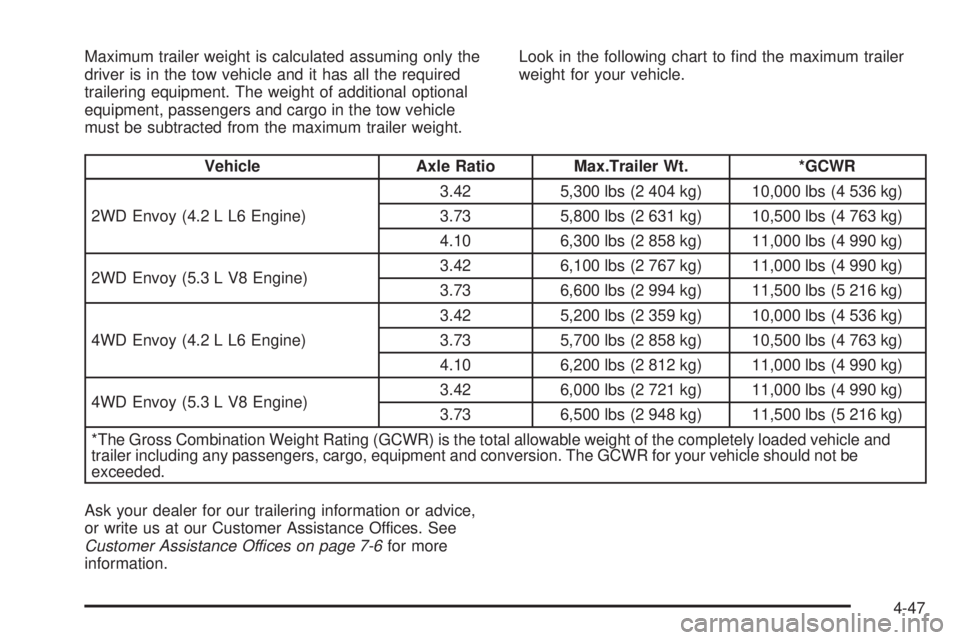
Maximum trailer weight is calculated assuming only the
driver is in the tow vehicle and it has all the required
trailering equipment. The weight of additional optional
equipment, passengers and cargo in the tow vehicle
must be subtracted from the maximum trailer weight.Look in the following chart to nd the maximum trailer
weight for your vehicle.
Vehicle Axle Ratio Max.Trailer Wt. *GCWR
2WD Envoy (4.2 L L6 Engine)3.42 5,300 lbs (2 404 kg) 10,000 lbs (4 536 kg)
3.73 5,800 lbs (2 631 kg) 10,500 lbs (4 763 kg)
4.10 6,300 lbs (2 858 kg) 11,000 lbs (4 990 kg)
2WD Envoy (5.3 L V8 Engine)3.42 6,100 lbs (2 767 kg) 11,000 lbs (4 990 kg)
3.73 6,600 lbs (2 994 kg) 11,500 lbs (5 216 kg)
4WD Envoy (4.2 L L6 Engine)3.42 5,200 lbs (2 359 kg) 10,000 lbs (4 536 kg)
3.73 5,700 lbs (2 858 kg) 10,500 lbs (4 763 kg)
4.10 6,200 lbs (2 812 kg) 11,000 lbs (4 990 kg)
4WD Envoy (5.3 L V8 Engine)3.42 6,000 lbs (2 721 kg) 11,000 lbs (4 990 kg)
3.73 6,500 lbs (2 948 kg) 11,500 lbs (5 216 kg)
*The Gross Combination Weight Rating (GCWR) is the total allowable weight of the completely loaded vehicle and
trailer including any passengers, cargo, equipment and conversion. The GCWR for your vehicle should not be
exceeded.
Ask your dealer for our trailering information or advice,
or write us at our Customer Assistance Offices. See
Customer Assistance Offices on page 7-6for more
information.
4-47
Page 286 of 468
Weight of the Trailer Tongue
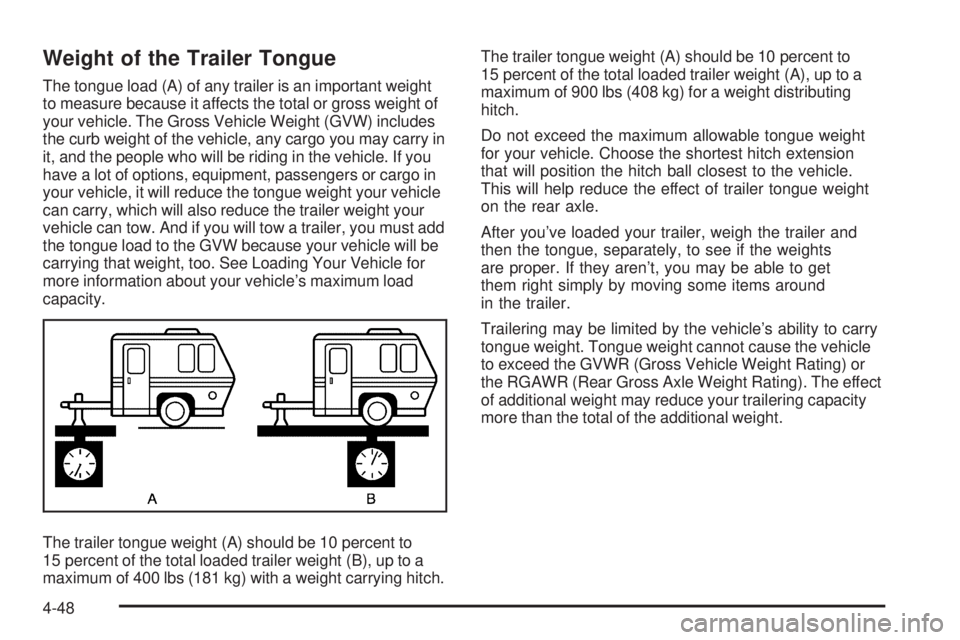
The tongue load (A) of any trailer is an important weight
to measure because it affects the total or gross weight of
your vehicle. The Gross Vehicle Weight (GVW) includes
the curb weight of the vehicle, any cargo you may carry in
it, and the people who will be riding in the vehicle. If you
have a lot of options, equipment, passengers or cargo in
your vehicle, it will reduce the tongue weight your vehicle
can carry, which will also reduce the trailer weight your
vehicle can tow. And if you will tow a trailer, you must add
the tongue load to the GVW because your vehicle will be
carrying that weight, too. See Loading Your Vehicle for
more information about your vehicle’s maximum load
capacity.
The trailer tongue weight (A) should be 10 percent to
15 percent of the total loaded trailer weight (B), up to a
maximum of 400 lbs (181 kg) with a weight carrying hitch.The trailer tongue weight (A) should be 10 percent to
15 percent of the total loaded trailer weight (A), up to a
maximum of 900 lbs (408 kg) for a weight distributing
hitch.
Do not exceed the maximum allowable tongue weight
for your vehicle. Choose the shortest hitch extension
that will position the hitch ball closest to the vehicle.
This will help reduce the effect of trailer tongue weight
on the rear axle.
After you’ve loaded your trailer, weigh the trailer and
then the tongue, separately, to see if the weights
are proper. If they aren’t, you may be able to get
them right simply by moving some items around
in the trailer.
Trailering may be limited by the vehicle’s ability to carry
tongue weight. Tongue weight cannot cause the vehicle
to exceed the GVWR (Gross Vehicle Weight Rating) or
the RGAWR (Rear Gross Axle Weight Rating). The effect
of additional weight may reduce your trailering capacity
more than the total of the additional weight.
4-48
Page 287 of 468
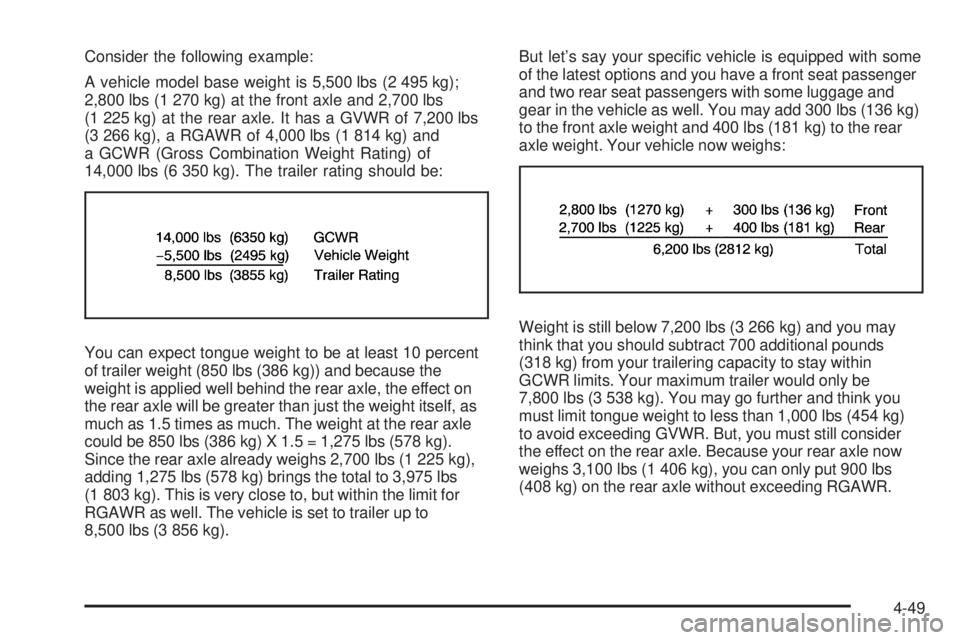
Consider the following example:
A vehicle model base weight is 5,500 lbs (2 495 kg);
2,800 lbs (1 270 kg) at the front axle and 2,700 lbs
(1 225 kg) at the rear axle. It has a GVWR of 7,200 lbs
(3 266 kg), a RGAWR of 4,000 lbs (1 814 kg) and
a GCWR (Gross Combination Weight Rating) of
14,000 lbs (6 350 kg). The trailer rating should be:
You can expect tongue weight to be at least 10 percent
of trailer weight (850 lbs (386 kg)) and because the
weight is applied well behind the rear axle, the effect on
the rear axle will be greater than just the weight itself, as
much as 1.5 times as much. The weight at the rear axle
could be 850 lbs (386 kg) X 1.5 = 1,275 lbs (578 kg).
Since the rear axle already weighs 2,700 lbs (1 225 kg),
adding 1,275 lbs (578 kg) brings the total to 3,975 lbs
(1 803 kg). This is very close to, but within the limit for
RGAWR as well. The vehicle is set to trailer up to
8,500 lbs (3 856 kg).But let’s say your specic vehicle is equipped with some
of the latest options and you have a front seat passenger
and two rear seat passengers with some luggage and
gear in the vehicle as well. You may add 300 lbs (136 kg)
to the front axle weight and 400 lbs (181 kg) to the rear
axle weight. Your vehicle now weighs:
Weight is still below 7,200 lbs (3 266 kg) and you may
think that you should subtract 700 additional pounds
(318 kg) from your trailering capacity to stay within
GCWR limits. Your maximum trailer would only be
7,800 lbs (3 538 kg). You may go further and think you
must limit tongue weight to less than 1,000 lbs (454 kg)
to avoid exceeding GVWR. But, you must still consider
the effect on the rear axle. Because your rear axle now
weighs 3,100 lbs (1 406 kg), you can only put 900 lbs
(408 kg) on the rear axle without exceeding RGAWR.
4-49
Page 288 of 468
The effect of tongue weight is about 1.5 times the actual
weight. Dividing the 900 lbs (408 kg) by 1.5 leaves you
with being able to handle only 600 lbs (272 kg) of tongue
weight. Since tongue weight is usually at least 10 percent
of total loaded trailer weight, you can expect that the
largest trailer your vehicle can properly handle is
6,000 lbs (2 721 kg).
It is important that you make sure your vehicle does not
exceed any of its ratings — GCWR, GVWR, RGAWR,
Maximum Trailer Rating or Tongue Weight. The
only way to be sure you are not exceeding any of
these ratings is to weigh your vehicle and trailer.Total Weight on Your Vehicle’s Tires
Be sure your vehicle’s tires are inated to the upper
limit for cold tires. You’ll nd these numbers on
the Certication label at the rear edge of the driver’s
door or see Loading Your Vehicle for more information.
Then, be sure you don’t go over the GVW limit for
your vehicle, or the GAWR, including the weight of the
trailer tongue. If you use a weight distributing hitch,
make sure you don’t go over the rear axle limit before
you apply the weight distribution spring bars.
Hitches
It’s important to have the correct hitch equipment.
Crosswinds, large trucks going by and rough roads
are a few reasons why you’ll need the right hitch.
4-50
Page 289 of 468
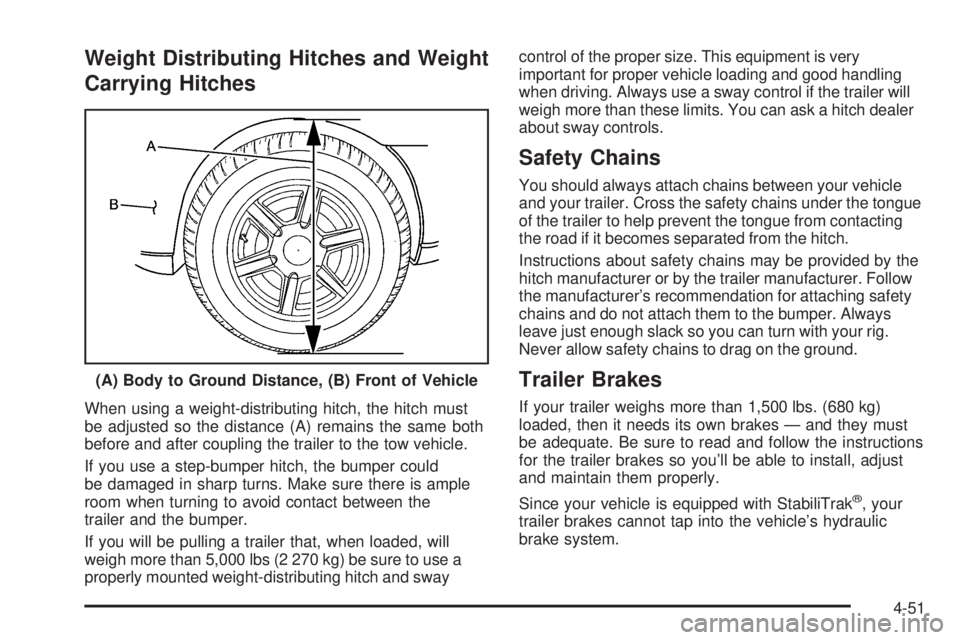
Weight Distributing Hitches and Weight
Carrying Hitches
When using a weight-distributing hitch, the hitch must
be adjusted so the distance (A) remains the same both
before and after coupling the trailer to the tow vehicle.
If you use a step-bumper hitch, the bumper could
be damaged in sharp turns. Make sure there is ample
room when turning to avoid contact between the
trailer and the bumper.
If you will be pulling a trailer that, when loaded, will
weigh more than 5,000 lbs (2 270 kg) be sure to use a
properly mounted weight-distributing hitch and swaycontrol of the proper size. This equipment is very
important for proper vehicle loading and good handling
when driving. Always use a sway control if the trailer will
weigh more than these limits. You can ask a hitch dealer
about sway controls.
Safety Chains
You should always attach chains between your vehicle
and your trailer. Cross the safety chains under the tongue
of the trailer to help prevent the tongue from contacting
the road if it becomes separated from the hitch.
Instructions about safety chains may be provided by the
hitch manufacturer or by the trailer manufacturer. Follow
the manufacturer’s recommendation for attaching safety
chains and do not attach them to the bumper. Always
leave just enough slack so you can turn with your rig.
Never allow safety chains to drag on the ground.
Trailer Brakes
If your trailer weighs more than 1,500 lbs. (680 kg)
loaded, then it needs its own brakes — and they must
be adequate. Be sure to read and follow the instructions
for the trailer brakes so you’ll be able to install, adjust
and maintain them properly.
Since your vehicle is equipped with StabiliTrak
®, your
trailer brakes cannot tap into the vehicle’s hydraulic
brake system. (A) Body to Ground Distance, (B) Front of Vehicle
4-51