ignition GMC SIERRA 1993 Owner's Manual
[x] Cancel search | Manufacturer: GMC, Model Year: 1993, Model line: SIERRA, Model: GMC SIERRA 1993Pages: 436, PDF Size: 23.88 MB
Page 158 of 436
Features & Controls
A reading in the low pressure zone may be caused by a dangerously low oil
level or other problem causing low oil pressure. Check your oil as soon as
possible.
bnu I IUIY
+ Don’t keep driving if the oil pressure is low. If you do, your engine
can become
so hot that it catches on fire. You or others could be
burned. Check your oil as soon as possible and have your vehicle
serviced.
I NOTICE
Damage to your engine from neglected oil problems can be costly anc
not covered by your warranty.
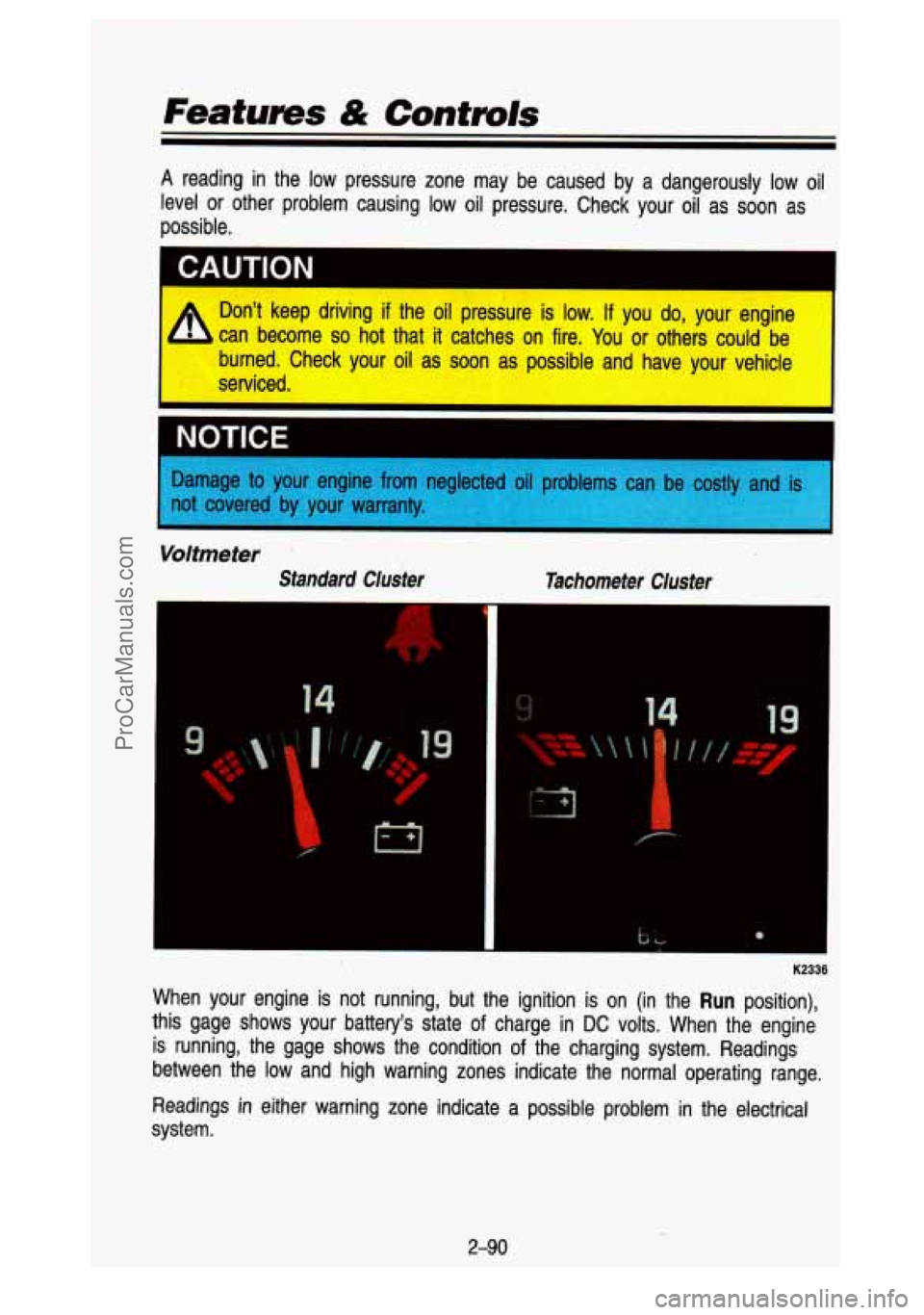
Voltmeter
Standard Cluster Tachometer Cluster
14 14
A
K2336
When your engine is not running, but the ignition is on (in the Run position),
this gage shows your battery’s state of charge in DC volts. When the engine
is running, the gage shows the condition of the charging system. Readings
between the low and high warning zones indicate the normal ope\
rating range.
Readings
in either warning zone indicate a possible problem in the electrical
system.
2-90
ProCarManuals.com
Page 168 of 436
Comfort Controls & Audio Systems
i
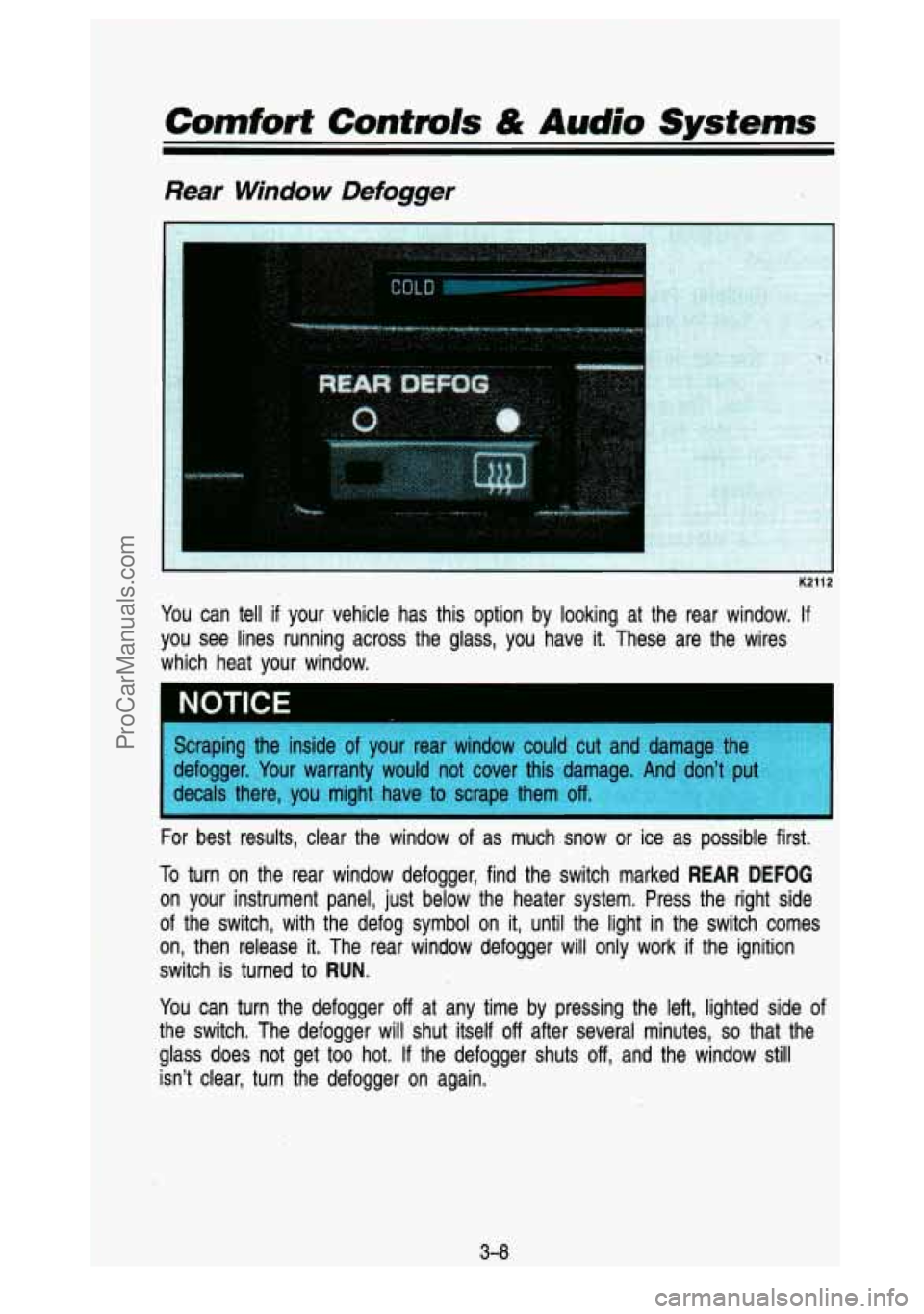
Rear Window Defogger
You can tell if your vehicle has this option by looking at the rear window. If
you see lines running across the glass, you have it. Thes'e a\
re the wires
which heat your window.
For best results, clear the window of as much snow or ice as possible first.
To turn on the rear window defogger, find the switch marked
REAR DEFOG
on your instrument panel, just below the heater system. Press \
the right side
of the switch, with the defog symbol on
it, until the light in the switch comes
on, then release
it. The rear window defogger will only work if the ignition
switch is turned
to RUN.
You can turn the defogger off at any time by pressing the left, lighted side of
the switch. The defogger will shut itself
off after several minutes, so that the
glass does not get
too hot. If the defogger shuts off, and the window still
isn't clear, turn the defogger on again.
-. -
I.--:
3-0
ProCarManuals.com
Page 170 of 436

Comfort Controls & Audio Systems
AM Stereo
This means the Delco@ system can receive C-QUAM@ stereo broadca\
sts. Many AM stations around the country use C-QUAM@
to produce stereo,
though some do not. (C-QUAM@ is a registered trademark of Motorola, Inc.).
If your Delco@ system can get C-QUAM? your “STEREO” light will come on
when you’re receiving it.
How to Operate Your AM ETWRadio
I 2 3 4 ..
K2186
To Play the Radio
Press the PWR-VOL-TONE knob to switch the radio on and off. This knob
does
two other things:
It controls the volume. The VOL knob increases the volume when
rotated clockwise.
The knob behind the PWR-VOL knob is the TONE knob. Rotate this
knob counterclockwise for more bass and clockwise for more treb\
le.
TUNE Button
Press the side of the button with the down arrow to decrease the radio
frequency or the side of the switch with the up arrow to increase the radio
frequency.
RCL Button
When the ignition is off, press the RCL button to display the time. With the
ignition in
RUN or ACC, press it to recall the station frequency when the time
is showing.
3-1 0
ProCarManuals.com
Page 171 of 436

Pushbuttons
The five pushbuttons let you return to favorite stations. Just:\
Tune in the station you want.
Press the SET button. (SET appears in the VF display for a few
Within 5 seconds, press one of the five pushbuttons to store the station.
seconds).
Whenever you press that button, the preset station will return.\
How to Operate Your AM-FM Stereo
Audio System and Cassette Deck
PO200
To Play the Radio
Press the amber PWR button
to switch the radio on and off.
VOL
Controls the volume. Pressing (t) increases volume; (-) decreases volume.
RCL
When the ignition is off, press the RCL button to display the time. With the
ignition on, press
RCL to recall the station frequency and volume setting
when the time is showing.
BAUFADE
To balance and fade the sound between the rightlleft or frontlrear speakers,
use the four buttons with the speaker symbols on them. Press \
the left and
right buttons to adjust the left and right speaker balance. Pr\
essing the top
3-1 1
ProCarManuals.com
Page 174 of 436
Comfort Contmls & Audio Systems
If a tape is inserted with side “1” (or “A”) up, then the up arrow means that
that side is being played. Likewise, a down arrow would indica\
te that side
“2”
(or “B”) had been selected. The player will automatically switch to the other
side of the tape when the first side ends.
EJECT
To remove the tape or stop the tape and switch to radio, press the EJCT
button.
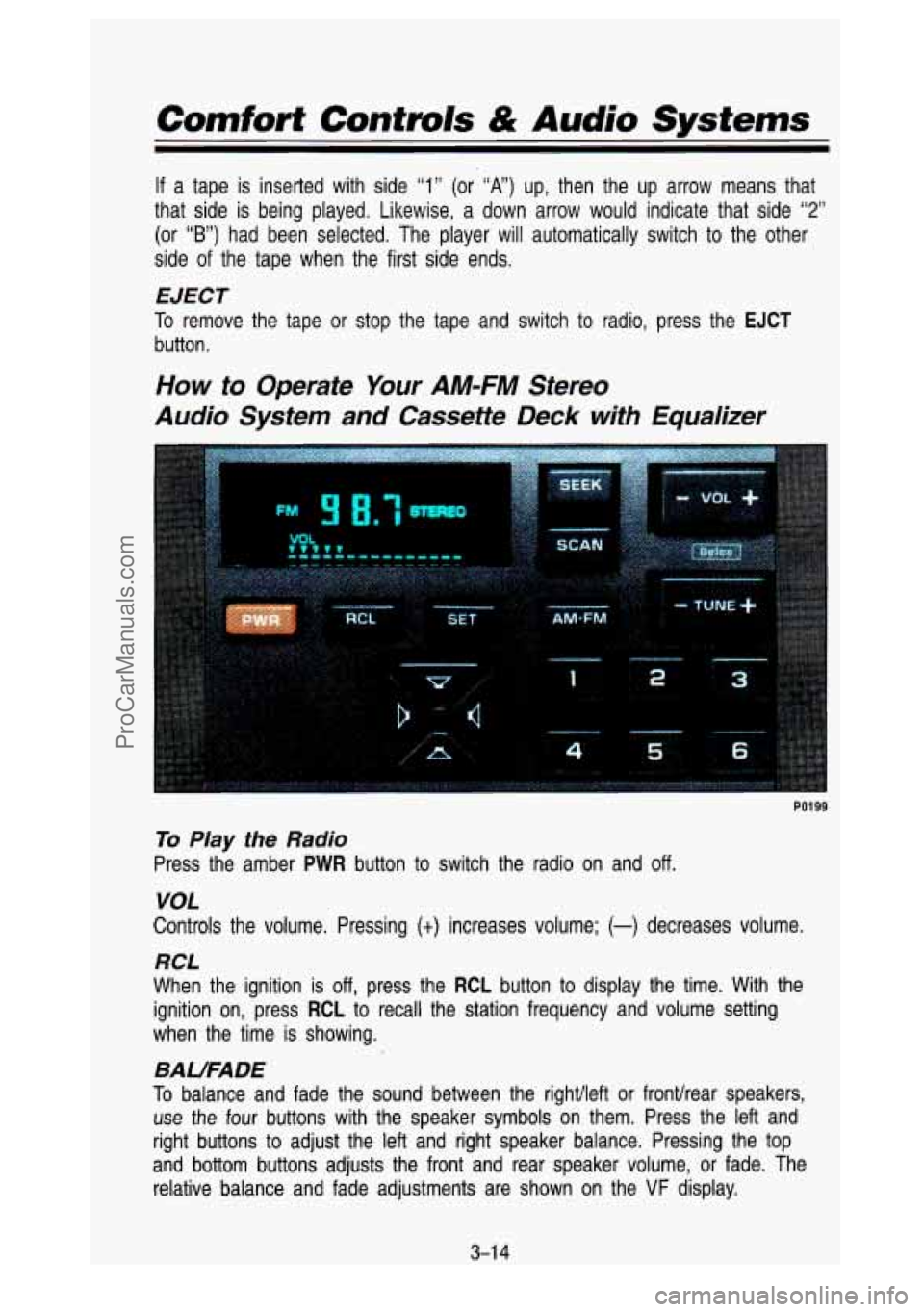
How to Operate Your AM-FM Stereo
Audio System
and Cassette Deck with Equalizer
PO1 99
To Play the Radio
Press the amber PWR button to switch the radio on and off.
VOL
Controls the volume. Pressing (t) increases volume; (-) decreases volume.
RCL
When the ignition is off, press the RCL button to display the time. With the
ignition on, press
RCL to recall the station frequency and volume setting
when the time is showing.
BAUFADE
To balance and fade the sound between the rightlleft or fronurear speakers,
use the four buttons with the speaker symbols on them. Press the \
left and
right buttons to adjust the
left and right speaker balance. Pressing the top
and bottom buttons adjusts the front and rear speaker volume, \
or fade. The
relative balance and fade adjustments are shown on the
VF display.
3-1 4
ProCarManuals.com
Page 213 of 436

has an effect on steering, accelerating, and braking. You may want to reduce
the air pressure in your tires slightly when driving on sand. \
This will improve
traction.
Hard packed snow and ice offer the worst tire traction. On th\
ese surfaces, it’s
very easy to lose control. On wet ice, for example, the tract\
ion
is so poor
that you will have difficulty accelerating. And
if you do get moving, poor
steering and difficult braking can cause you to slide out of control.
I A Driving on frozen lakes, ponds or rivers can be dangerous. I
Underwater springs, currents under the ice, or sudden thaws can
weaken the ice. Your vehicle could fall through the ice and you and
your passengers could drown. Drive your vehicle on
safe surfaces
on
I y.
.
Driving In Water
Light rain causes no special off-road driving problems. But hea\
vy rain can
mean flash flooding, and flood waters demand extreme caution.
Find out how deep the water is before you drive through
it. If it’s deep
enough to cover your wheel hubs, axles, or exhaust pipe, don’\
t try it-you
probably won’t get through. Also, water that deep can damage\
your axle and
other vehicle parts.
If the water isn’t too deep, then drive through it slowly. At fast speeds, water
splashes on your ignition system and your vehicle can stall. S\
talling can also
occur
if you get your tailpipe under water. And, as long as your tailp\
ipe is
under water, you’ll never be able to start your engine. Whe\
n you go through
water, remember that when your brakes get wet, it may take you longer to
stop.
Driving through rushing water can be dangerous. Deep water can \
sweep your vehicle downstream and you and your passengers could\
drown.
If it’s only inches deep, it can still wash away the ground
from under your tires, and you could lose traction and roll t\
he vehicle
over. Don’t drive throuah rushina water. I
If you have a diesel engine, see “Driving Through Water (Diese\
l Engines)” in
the Index for more information on driving through water.
4-35
ProCarManuals.com
Page 226 of 436
I CAUTION
A Coasting downhill in N (Neutral) or with the ignition off is dangerous.
E ‘ Your brakes will have to do all the work of slowing down. They could
get
so hot that they wouldn’t work well. You could crash. Always
have your engine running and your vehicle in gear when you go
downhill.
l I
e
e
e
e
e
Know how to go uphill. You may want to shift down to a lower gear.
The lower gears help cool your engine and transmission, and yo\
u can
climb the hill better.
Stay .in your own lane when driving on two-lane roads in hills or
mountains. Don’t swing wide
or cut across the center of the road. Drive
at speeds that let you stay in your own lane. That way, you won’t be
surprised by a vehicle coming toward you in the same lane.
It takes longer to pass another vehicle when you’re going uphill. You’ll
want
to leave extra room to pass. If a vehicle is passing you and
doesn’t have enough room,
slow down to make it easier for the other
vehicle to get by.
As you go over the top of a hill, be alert. There could be something in
your lane, like a stalled car
or an accident.
You may see highway signs on mountains that warn of special problems.
Examples are long grades, passing or no-passing zones, a fallin\
g rocks
area, or winding roads. Be alert to these and take appropriate action.
Winter driving can present special problems. See “Winter Driv\
ing” in the
Index.
4-48
ProCarManuals.com
Page 246 of 436
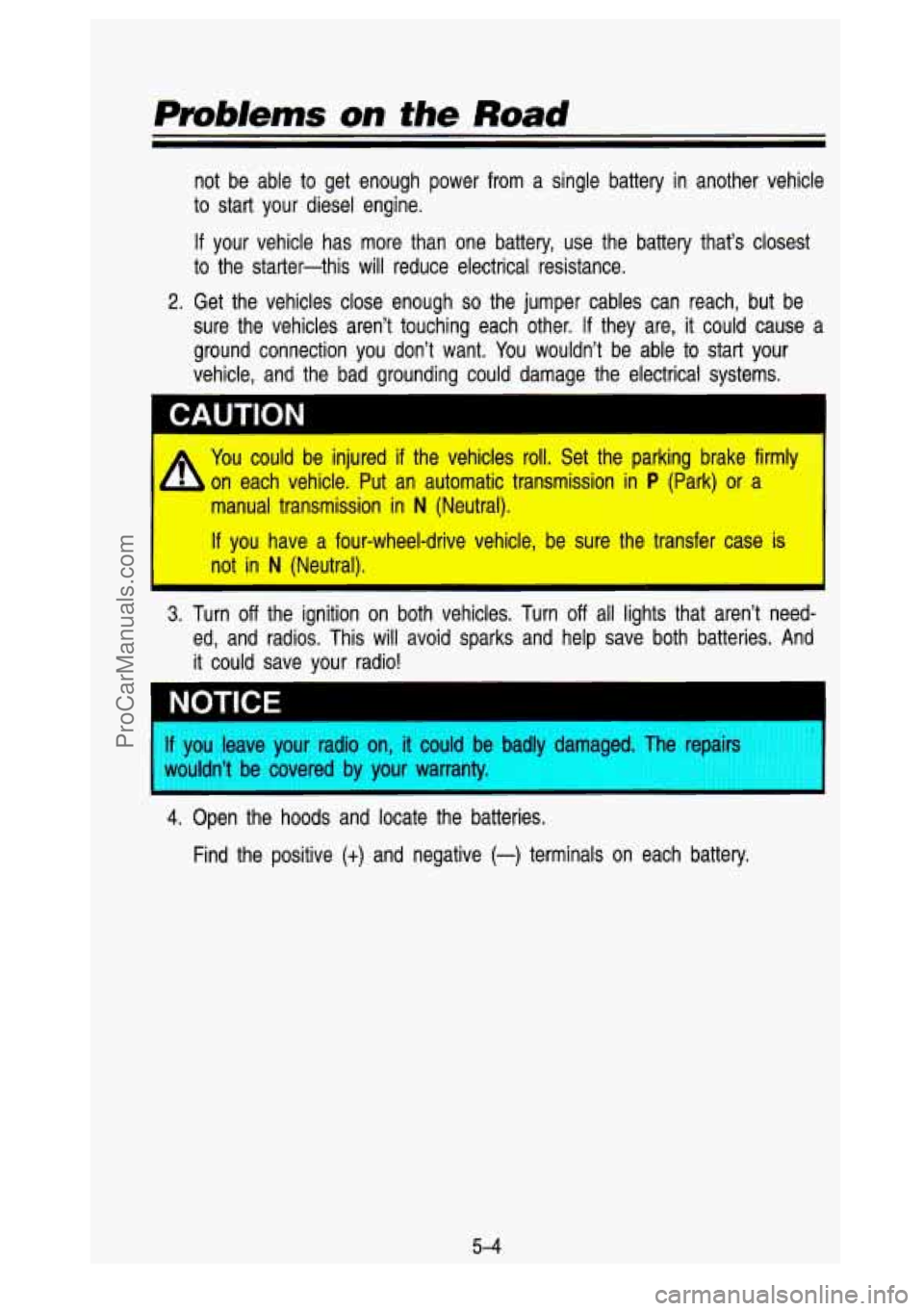
Pmbkms on the Road
not be able to get enough power from a single battery in another vehicle
to start your diesel engine.
If your vehicle has more than one battery, use the battery that’\
s closest
to the starter-this will reduce electrical resistance.
2. Get the vehicles close enough so the jumper cables can reach, but be
sure the vehicles aren’t touching each other.
If they are, it could cause a
ground connection you don’t want. You wouldn’t be able
to start your
vehicle, and the bad grounding could damage the electrical syst\
ems.
You could be injured
if the vehicles roll. Set the parking brake firmly
manual transmission in
N (Neutral).
If you have a four-wheel-drive vehicle, be sure the transfer c\
ase is
not in
N (Neutral).
1 on each vehicle. Put an automatic transmission in P (Park) or a
3. Turn off the ignition on both vehicles. Turn off all lights that aren’t need-
ed, and radios. This will avoid sparks and help save both bat\
teries. And
it could save your radio!
ou leave your radio on, it could be badly damaged. The repairs
r.,Jldn’t be covered by your warranty. I
4. Open the hoods and locate the batteries.
Find the positive
(t) and negative (-) terminals on each battery.
5-4
ProCarManuals.com
Page 250 of 436
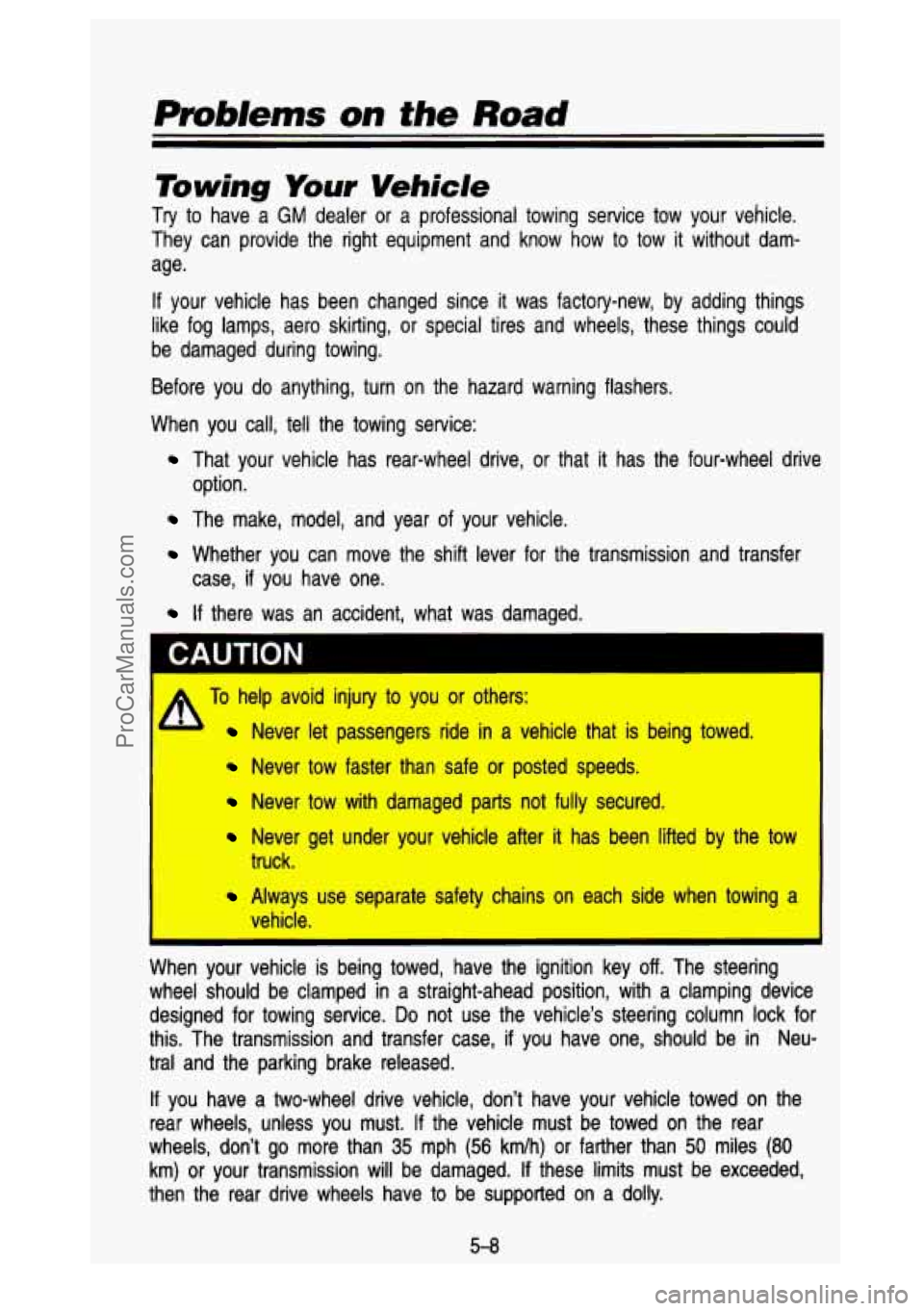
Problenrs on the Road
Towing Your Vehicle
Try to have a GM dealer or a professional towing service tow your vehicle.
They can provide the right equipment and know how to tow it without dam-
age.
If your vehicle has been changed since it was factory-new, by adding things
like fog lamps, aero skirting, or special tires and wheels, th\
ese things could
be damaged during towing.
Before you do anything, turn on the hazard warning flashers.
When you call, tell the towing service:
That your vehicle has rear-wheel drive, or that it has the four-wheel drive
option.
The make, model, and year of your vehicle.
Whether you can move the shift lever for the transmission and \
transfer case,
if you have one.
If there was an accident, what was damaged.
I A To help avoid injury to you or others:
Never let passengers ride in a vehicle that is being towed.
Never tow faster than safe or posted speeds.
Never tow with damaged parts not fully secured.
Never get under your vehicle after it has been lifted by the tow
truck.
Always use separate safety chains on each side when towing a
vehicle.
When your vehicle is being towed, have the ignition key
off. The steering
wheel should be clamped in a straight-ahead position, with a clamping device
designed for towing service.
Do not use the vehicle’s steering column lock for
this. The transmission and transfer case,
if you have one, should be in Neu-
tral and the parking brake released.
If you have a two-wheel drive vehicle, don’t have your vehicle \
towed on the
rear wheels, unless you must. If the vehicle must be towed on\
the rear
wheels, don’t go more than
35 mph (56 km/h) or farther than 50 miles (80
krn) or your transmission will be damaged. If these limits must be exceeded,
then the rear drive wheels have to be supported on a dolly.
5-8
ProCarManuals.com
Page 289 of 436
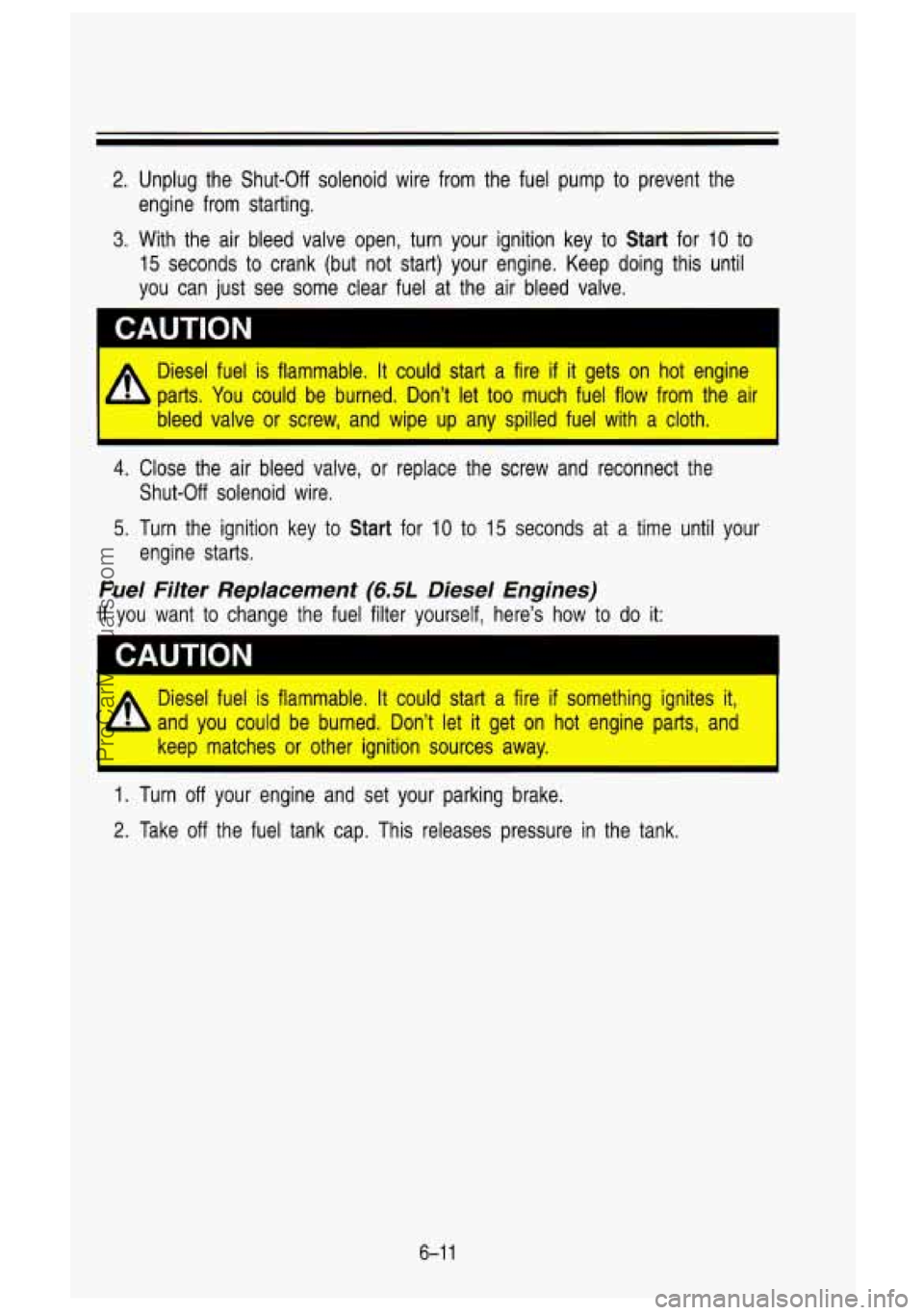
2. Unplug the Shut-Off solenoid wire from the fuel pump to prevent the
engine from starting.
3. With the air bleed valve open, turn your ignition key to Start for 10 to
15 seconds to crank (but not start) your engine. Keep doing this until
you can just see some clear fuel at the air bleed valve.
I A Diesel fuel is flammable. It could start a fire if it gets on hot engine
b parts. You could be burned. Don’t let too much fuel flow from the air
bleed valve or screw, and wipe up any spilled fuel with a cloth.
4. Close the air bleed valve, or replace the screw and reconnect \
the
Shut-Off solenoid wire.
5. Turn the ignition key to Start for 10 to 15 seconds at a time until your
engine starts.
Fuel Filter Replacement (6.5L Diesel Engines)
If you want to change the fuel filter yourself, here’s how \
to do it:
1 CAUTION
A Diesel fuel is flammable. It could start a fire if something ignites it,
-L and you could be burned. Don’t let it get on hot .engine parts, and
I keep matches or other ignition sources away.
1. Turn off your engine and set your parking brake.
2. Take off the fuel tank cap. This releases pressure in the tank.
6-1 1
ProCarManuals.com