headlights GMC SIERRA 1994 User Guide
[x] Cancel search | Manufacturer: GMC, Model Year: 1994, Model line: SIERRA, Model: GMC SIERRA 1994Pages: 404, PDF Size: 20.91 MB
Page 189 of 404
Nighf Vision
No one can see as well at night as in the daytime. But as we get older these
differences increase. A 50-year-old driver may require at least twice as
much light to see the same thing at night as a 20-year-old.
What
you do in the daytime can also affect your night vision. For example,
if you spend the day in bright sunshine you are wise to wear sunglasses.
Your eyes
will have less trouble adjusting to night. But if you’re driving,
don’t wear sunglasses at night. They may cut down
on glare from
headlights, but they also make a lot of things invisible.
You can be temporarily blinded by approaching lights. It can take a second
or two, or even several seconds, for your eyes
to readjust to the dark. When
you are faced with severe glare (,as from a driver
who doesn’t lower the high
beams,
or a vehicle with misairned headlights), slow down a little. Avoid
staring directly into the approaching lights.
Keep your windshield and all the glass on your vehicle clean
- inside and
out. Glare at night is made much worse by dirt
on the glass. Even the inside
of the glass can build up a film caused by dust. Dirty glass makes lights
dazzle and flash more than clean glass would, making
the pupils of your
eyes contract repeatedly.
Remember that
your headlights light up fir less of a roadway when you are
in a turn or curve. Keep your eyes moving; that way, it’s easier to pick out
dimly lighted objects. Just
as your headlights should be checked regularly
for proper aim,
so should your eyes be examined regularly. Some drivers
suffer from night blindness
- the inability to see in dim light - and aren’t
even aware
of it.
4-25
ProCarManuals.com
Page 192 of 404
Some Other Rainy Weather Tips
0 Turn on your low-beam headlights - not just your parking llgnts - to
help make you more visible to others.
Besides slowing down, allow some extra following distance. And be
especially careful when you pass another vehicle. Allow yourself more
clear room ahead, and be prepared to have your view restricted by road
spray.
Have good tires with proper tread depth. (See “Tires” in the Index.)
City Driving
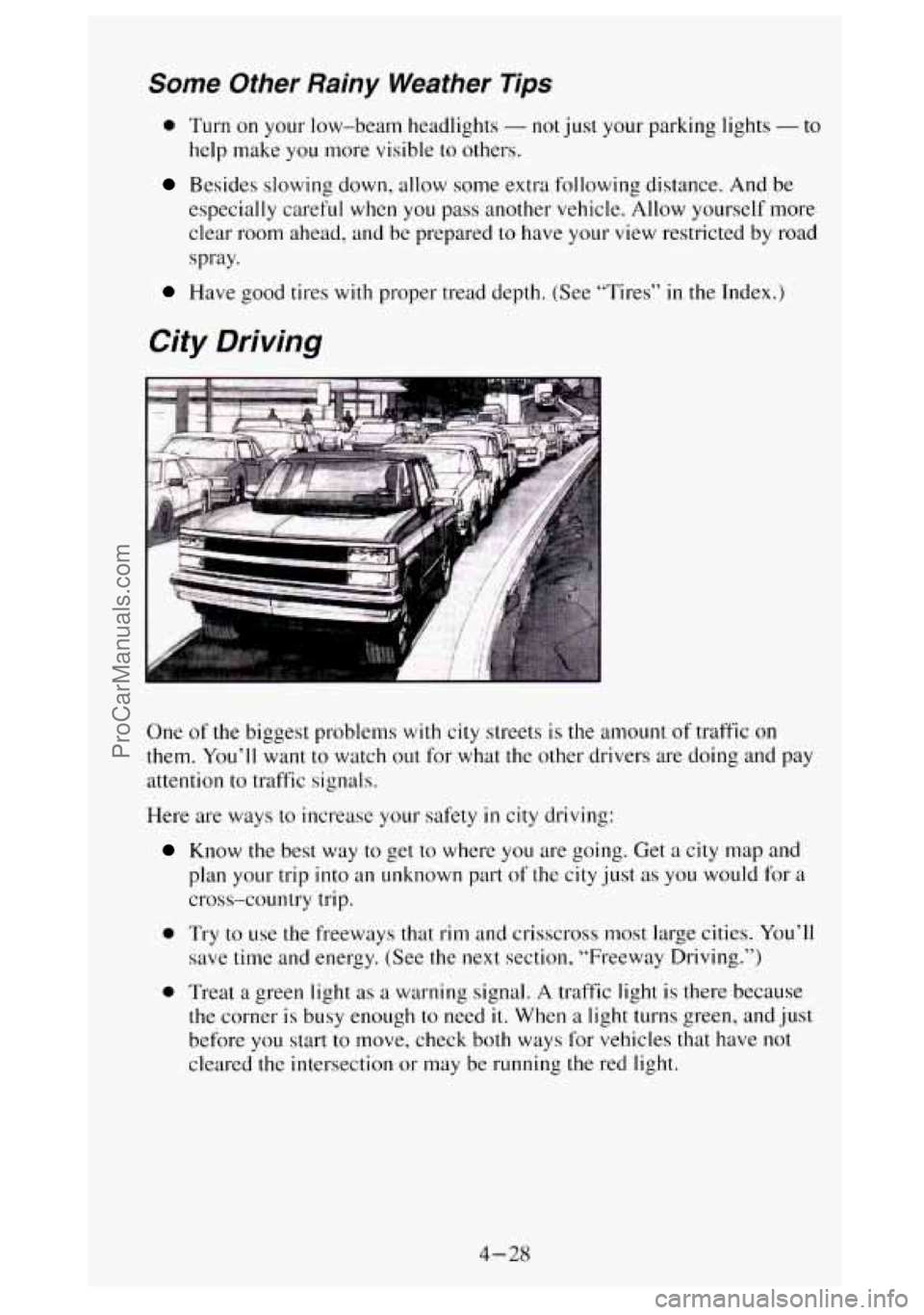
One of the biggest problems with city streets is the amount of traffic on
them. You’ll want to watch out for what the other drivers are doing and pay
attention to traffic signals.
Here are ways to increase your safety
in city driving:
Know the best way to get to where you are going. Get a city map and
plan your trip
into an unknown part of the city just as you would for a
cross-country trip.
save time and energy. (See the
next section, “Freeway Driving.”)
0 Try to use the freeways that rim and crisscross most large cities. You’ll
0 Treat a green light as a warning signal. A traffic light is there because
the corner is busy enough to need
it. When a light turns green, and just
before you start to move, check both ways for vehicles that have not
cleared the intersection or may be running the red light.
4-28
ProCarManuals.com
Page 200 of 404
I
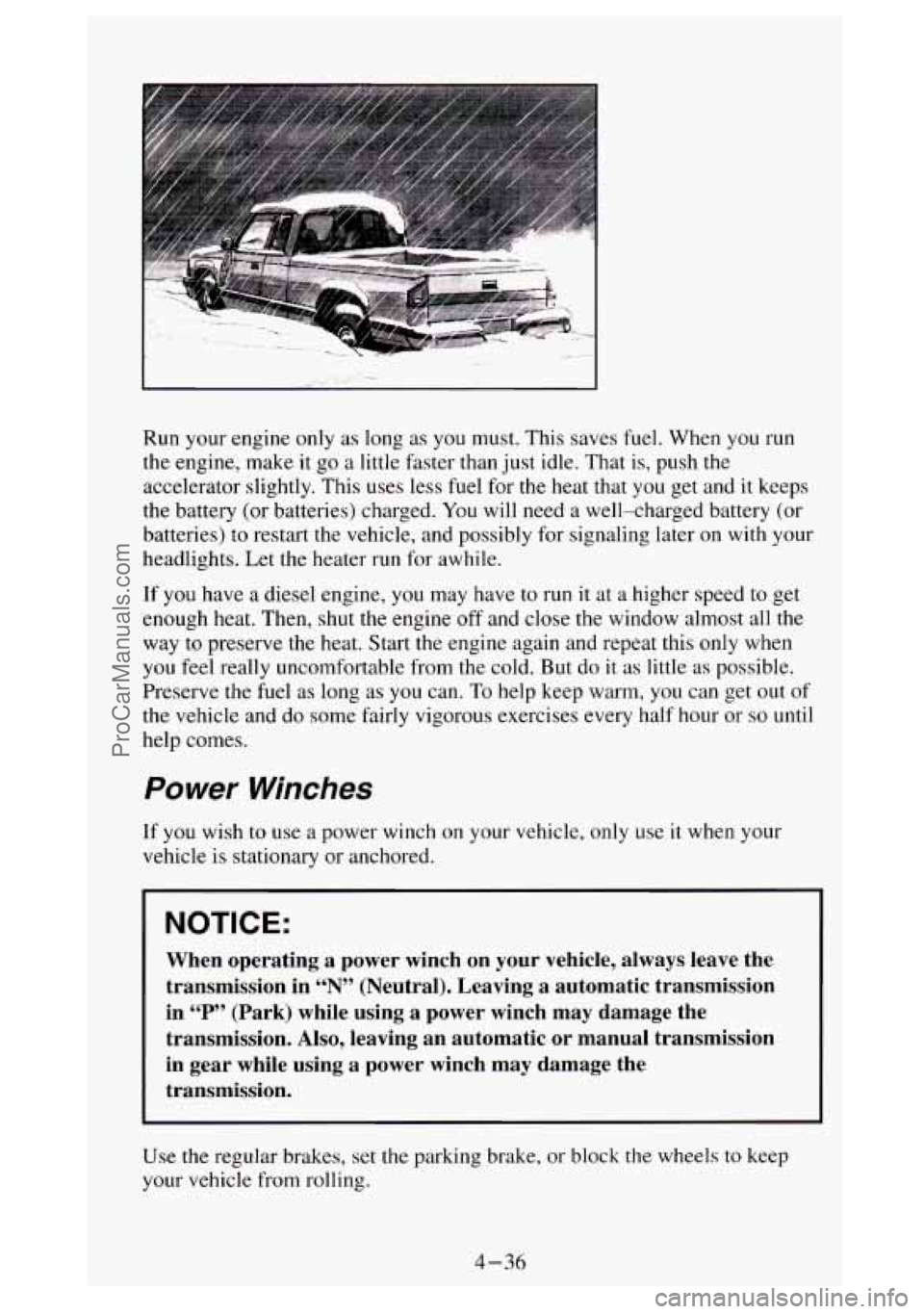
Run your engine only as long as you must. This saves fuel. When you run
the engine, make it go a little faster than just idle. That is, push the
accelerator slightly. This uses less fuel for the heat that you get and it keeps
the battery (or batteries) charged.
You will need a well-charged battery (or
batteries) to restart the vehicle, and possibly for signaling later on with your
headlights. Let the heater run for awhile.
If you have a diesel engine, you may have to run it at a higher speed to get
enough heat. Then, shut the engine off and close
the window almost all the
way to preserve the heat. Start the engine again and repeat this only when
you feel really uncomfortable from the cold. But do it as little as possible.
Preserve the fuel
as long as you can. To help keep warm, you can get out of
the vehicle and do some fairly vigorous exercises every half hour or so until
help comes.
Power Winches
If you wish to use a power winch on your vehicle, only use it when your
vehicle
is stationary or anchored.
When operating a power winch on your vehicle, always leave the\
transmission
in "N" (Neutral). Leaving a automatic transmission
in "P" (Park) while using a power winch may damage the
transmission.
Also, leaving an automatic or manual transmission
in gear while using a power winch may damage the
transmission.
Use the regular brakes, set the parking brake, or block the wheels to keep
your vehicle
from rolling.
4-36
ProCarManuals.com
Page 303 of 404

Contact your dealer to learn how to prepare your vehicle for longer storage
periods.
Bulb Replacement
Before you replace any bulbs, be sure that all the lights are\
off and the
engine isn’t running.
Sealed Beam Headlights
I
1. Remove the four
screws from the
headlight retainer.
2. Pull the headlight
out and remove
the retainer.
3.
4.
5.
Unplug and
remove the
headlight.
Plug in the new
headlight and put
it in place.
Install the
retainer
to the
headlight and
tighten the
screws.
6-53
ProCarManuals.com
Page 304 of 404
Halogen Bulbs
NOTICE:
Avoid touching the bulb or letting it come in contact with
anything damp. Oil from your skin or moisture on the bulb can
cause the bulb to explode when it is turned on.
If either comes in
contact with the bulb, clean it with alcohol or a suitable
degreaser and wipe the bulb dry.
Composite Headlights
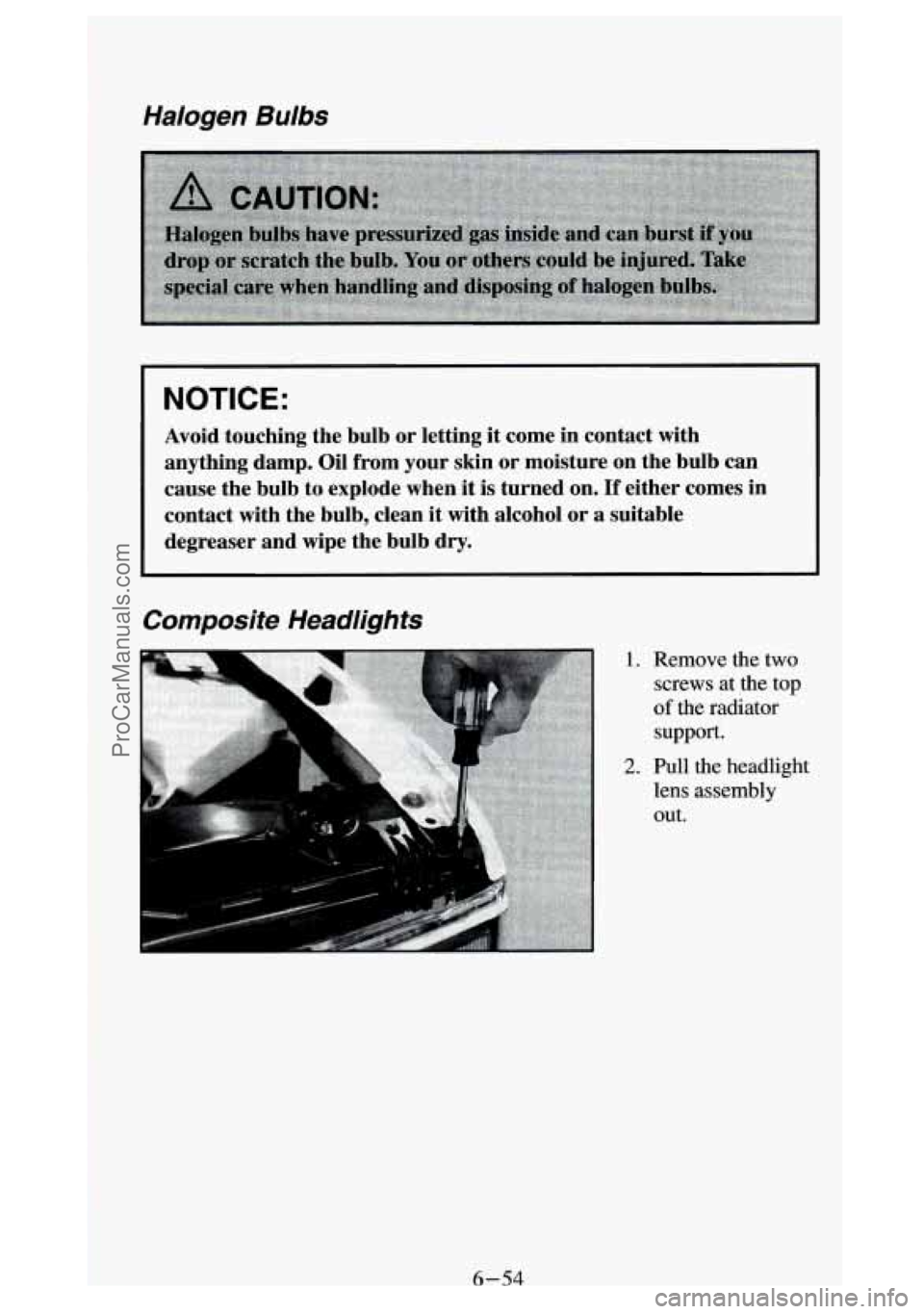
1.
2.
Remove the two
screws at the top
of the radiator
support.
Pull the headlight
lens assembly
out.
6-54
ProCarManuals.com
Page 305 of 404
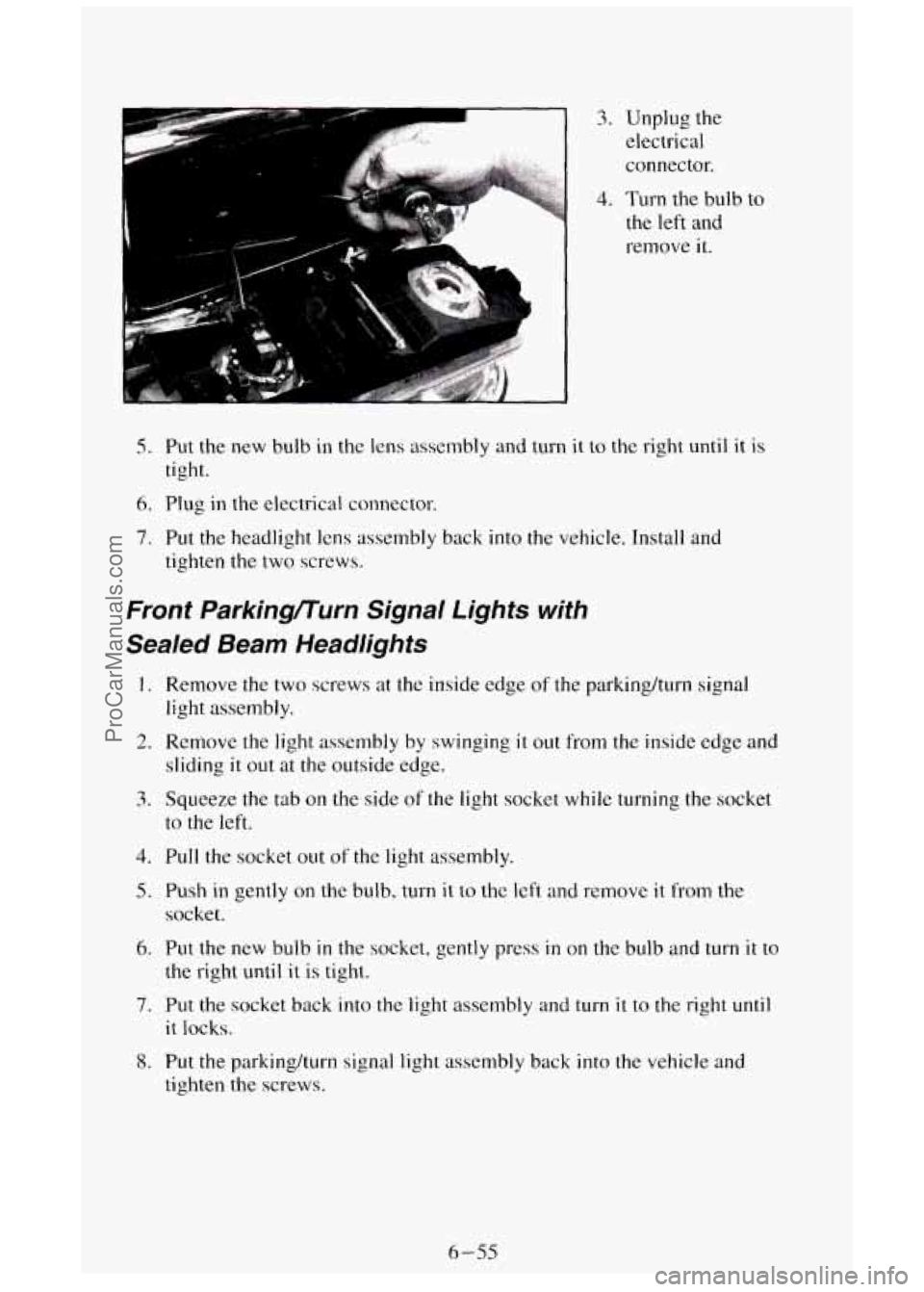
3. Unplug the
electrical
connector.
4. Turn the bulb to
the left and
i
remove it.
5. Put the new bulb in the lens assembly and turn it to the right until it is
tight.
6. Plug in the electrical connector.
7. Put the headlight lens assembly back into the vehicle. Install and
tighten the two screws.
Front Parkingflurn Signal Lights with
Sealed Beam Headlights
1. Remove the two screws at the inside edge of the parking/turn signal
2. Remove the light assembly by swinging it out from the inside edge and
3. Squeeze the tab on the side of the light socket while turning the socket
4. Pull the socket out of the light assembly.
5. Push in gently on the bulb, turn it to the left and remove it from the
6. Put the new bulb in the socket, gently press in on the bulb and turn it to
7. Put the socket back into the light assembly and turn it to the right until
8. Put the parking/turn signal light assembly back into the vehicle and
light assembly.
sliding
it out at the outside edge.
to the
left.
socket.
the right until it is tight.
it locks.
tighten the screws.
6-55
ProCarManuals.com
Page 306 of 404
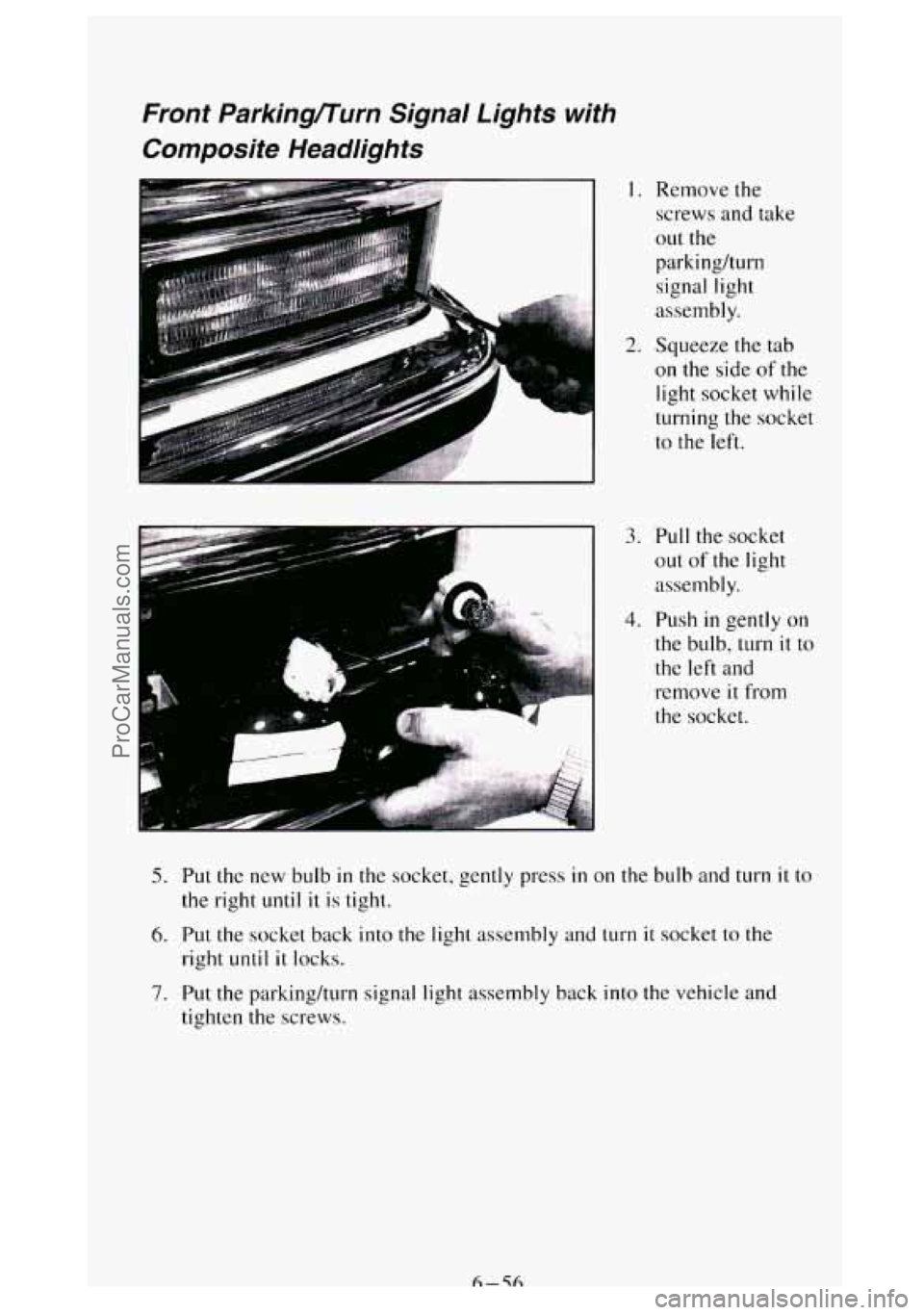
Front Parkingnurn Signal Lights with
Composite Headlights
-7
I. Remove the
screws and take
out the parkinghurn
signal light
assembly.
2. Squeeze the tab
on the side of the
light socket while
turning the socket
to the left.
3.
4.
Pull the socket
out
of the light
assembly.
Push
in gently on
the bulb, turn it to
the left and
remove
it from
the socket.
5. Put the new bulb in the socket, gently press in on the bulb and turn it to
the right
until it is tight.
6. Put the socket back into the light assembly and turn it socket to the
right
until it locks.
7. Put the parkinghrn signal light assembly back into the vehicle and
tighten the screws.
6-56
ProCarManuals.com
Page 312 of 404
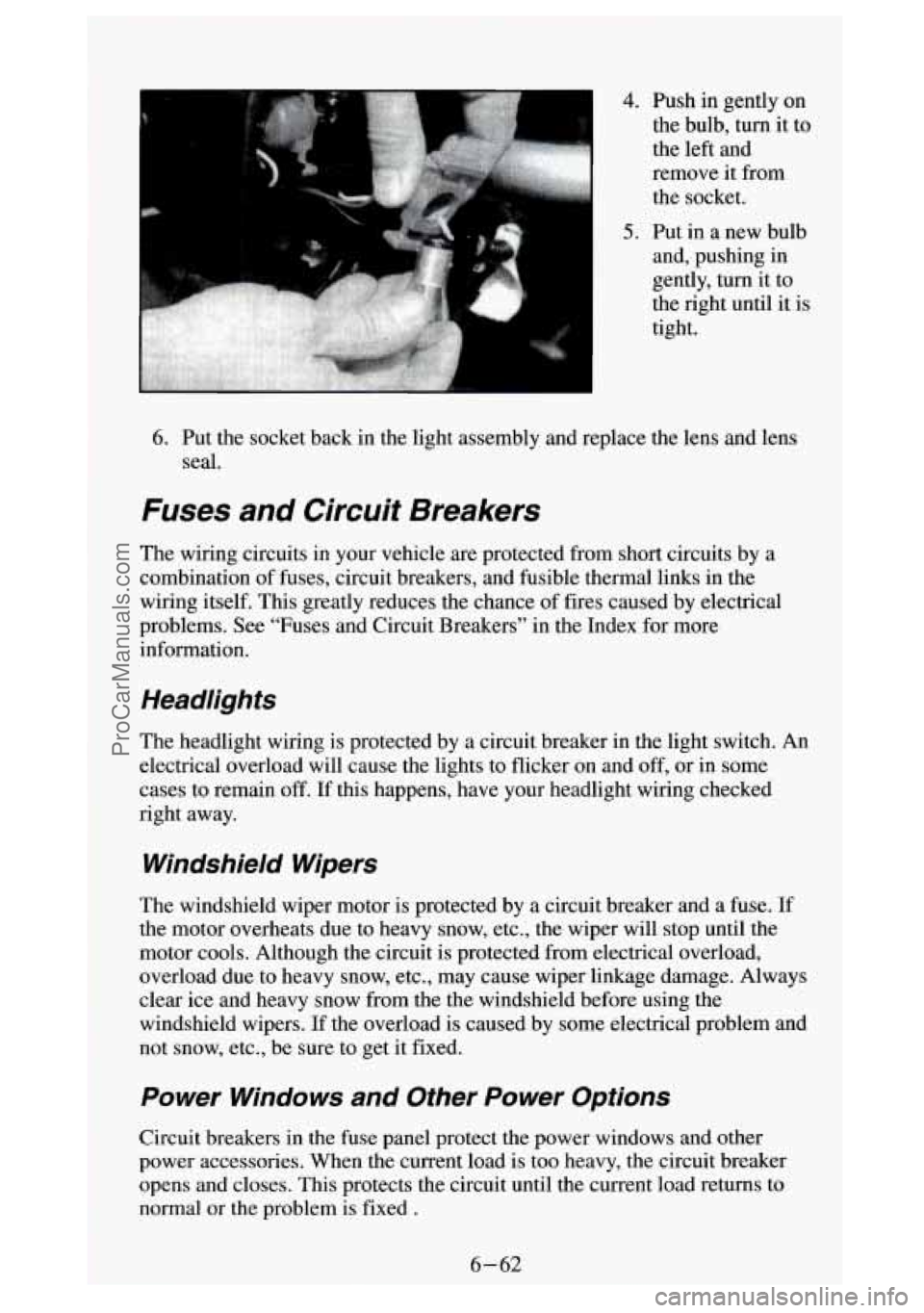
4. Push in gently on
the bulb, turn it to
the left and
remove it from
the socket.
5. Put in a new bulb and, pushing in
gently, turn it to
the right until it is
tight.
6. Put the socket back in the light assembly and replace the lens and lens
seal.
Fuses and Circuit Breakers
The wiring circuits in your vehicle are protected from short circuits by a
combination of fuses, circuit breakers, and fusible thermal links in the
wiring itself. This greatly reduces the chance of fires caused by electrical
problems. See “Fuses and Circuit Breakers” in the Index for more
information.
Headlights
The headlight wiring is protected by a circuit breaker in the \
light switch. An
electrical overload will cause the lights to flicker on and of\
f, or in some
cases to remain
off. If this happens, have your headlight wiring checked
right away.
Windshield Wipers
The windshield wiper motor is protected by a circuit breaker and a\
fuse. If
the motor overheats due to heavy snow, etc., the wiper will stop until the
motor cools. Although the circuit is protected from electrical \
overload,
overload due to heavy snow, etc., may cause .wiper linkage damage. Always
clear ice and heavy snow from the the windshield before using \
the
windshield wipers.
If the overload is caused by some electrical problem and
not snow, etc., be sure to get it fixed.
Power Windows and Other Power Options
Circuit breakers in the fuse panel protect the power windows and other
power accessories. When the current load is too heavy, the circuit breaker
opens and closes. This protects the circuit until the current \
load returns to
normal or the problem is fixed
.
6-62
ProCarManuals.com
Page 396 of 404
F
FanNoise ...................................................... 5-25
Filter Replacement Chart
.......................................... 6-94
Finish Care
........................................................ 6-85
Damage
..................................................... 6-86
Automatic Transmission
........................................ 6-30
Brake
....................................................... 647
Coolant
..................................................... 5-17
Capacities .............................................. 6-92, 6-93
FrontAxle
................................................... 6-37
Hydraulicclutch
.............................................. 6-35
LeakCheck
............................................. 6-47. 6-51
ManualTransmission .......................................... 6-33
Power Steering
............................................... 6-43
Radiator
..................................................... 5-17
Rear Axle ................................................... 6-39
Recommended Fluids
.......................................... 7-25
Transfer Case
................................................ 6-36
Windshield Washer
............................................ 6-45
Four-WheelDrive ............................................... 244
Transfer Case
........................................... 2-35, 6-36
Front Axle ................................................... 6-37
Fuel (Diesel Engines)
............................................. 6-11
Cold Weather Operation ......................................... 6-6
Filter Replacement ............................................ 6-11
Fuel Requirements ............................................. 6-4
Gage
....................................................... 2-78
RunningOutOf
.............................................. 6-10
Tankcapacity ................................................ 6-93
WaterinFuel
................................................. 2-71
Fuel (Gasoline Engines)
............................................ 6-4
FillingYourTank
............................................. 6-13
Foreign Countries
............................................. 6-12
Gage
....................................................... 2-78
Gasolines for Cleaner Air
........................................ 6-5
Tankcapacity
................................................ 6-93
Fuses and Circuit Breakers
................................... 6-64. 6-96
FuseBlock ............................................. 6-63, 6-95
Headlights
.............................................. 6-62-6-97
Trailer Wiring Harness
......................................... 6-62
Windshield Wipers
....................................... 6-45, 6-96
Fluid
Power Windows and Other
Power Options ......................... 6-62
Gages ......................................................... 2-78
Coolant Temperature Gage
...................................... 2-79
FuelGage
................................................... 2-78
Odometer
................................................... 2-68
Oil Pressure Gage ............................................. 2-80
Speedometer
................................................. 2-68
4
ProCarManuals.com
Page 397 of 404
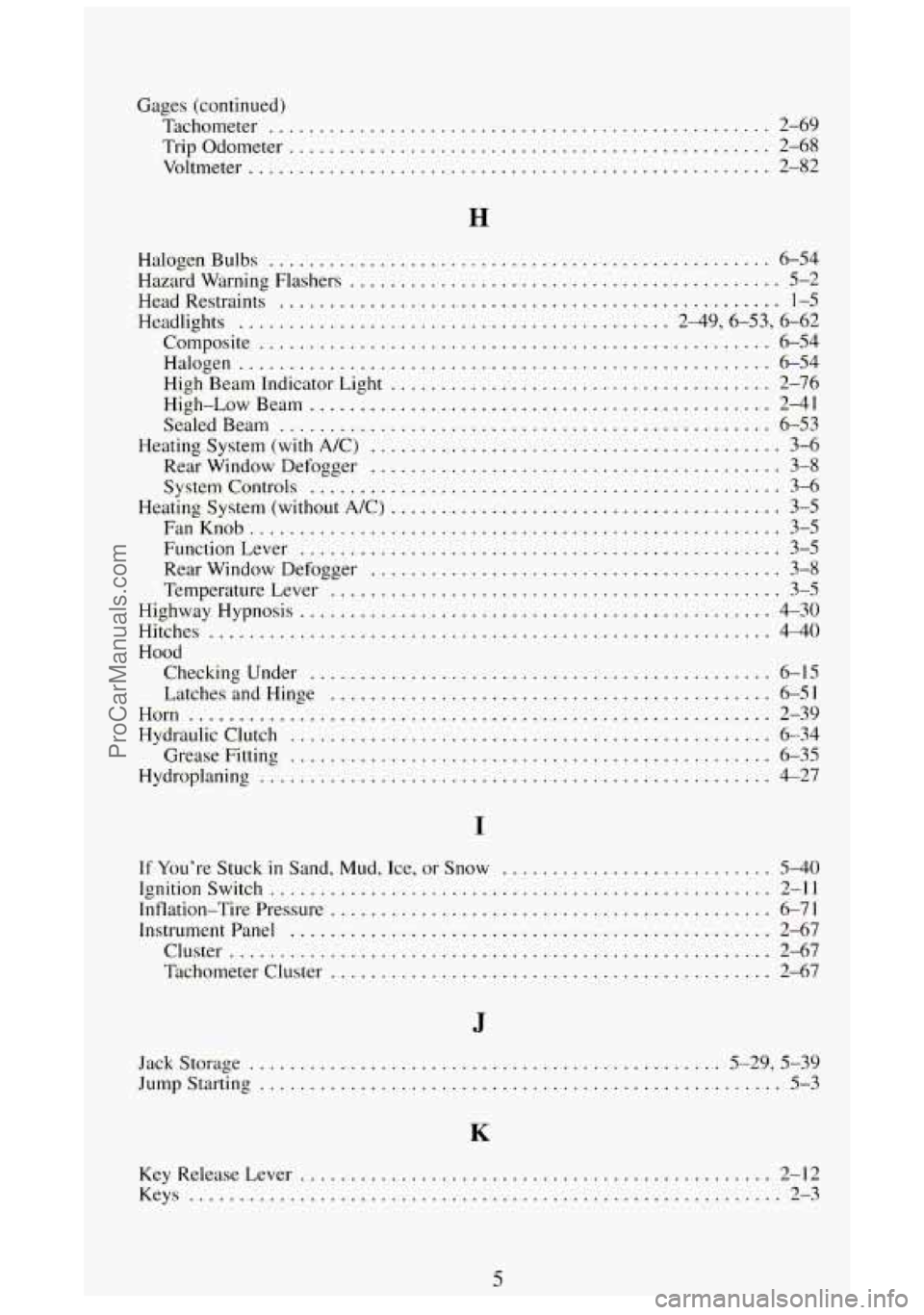
Gages (continued) Tachometer
.................................................. 2-69
Voltmeter
.................................................... 2-82
Trip Odometer
................................................ 2-68
HalogenBulbs .................................................. 6-54
Hazard Warning Flashers
........................................... 5-2
Head Restraints
.................................................. 1-5
Headlights
........................................... 2-49,6-53, 6-62
Composite
................................................... 6-54
Halogen
..................................................... 6-54
High Beam Indicator Light
...................................... 2-76
SealedBeam
................................................. 6-53
Heating System (with
A/C) ......................................... 3-6
Rear Window Defogger
......................................... 3-8
Heating System (without A/C)
....................................... 3-5
FanKnob ..................................................... 3-5
FunctionLever
................................................ 3-5
Rear Window Defogger
......................................... 3-8
Hi~h-LowBeam
.............................................. 241
System Controls ............................................... 3-6
Temperature Lever
............................................. 3-5
Highway Hypnosis ............................................... 4-30
Hitches ........................................................ 4-40
Hood
CheclungUnder
.............................................. 6-15
LatchesandHinge ............................................ 6-51
Horn
.......................................................... 2-39
Hydraulicclutch
................................................ 6-34
Grease Fitting
................................................ 6-35
Hydroplaning
................................................... 4-27
I
If You’re Stuck in Sand. Mud. Ice. or Snow ........................... 5-40
Ignitionswitch .................................................. 2-11
Inflation-Tire Pressure ............................................ 6-71
Instrument Panel ................................................ 2-67
Cluster
...................................................... 2-67
Tachometer Cluster
............................................ 2-67
J
Jack Storage ............................................... 5.29, 5.39
Jumpstarting
.................................................... 5-3
K
Key ReleaseLever ............................................... 2-12
Keys
........................................................... 2-3
5
ProCarManuals.com