engine coolant GMC SIERRA 1995 User Guide
[x] Cancel search | Manufacturer: GMC, Model Year: 1995, Model line: SIERRA, Model: GMC SIERRA 1995Pages: 488, PDF Size: 26.01 MB
Page 222 of 488
When towing at high altitude on steep uphill grades, consider the following:
Engine coolant will boil at a lower temperature than at normal altitudes. If
you turn your engine off immediately after towing at high altitude on steep
uphill grades, your vehicle
may show signs similar to engine overheating.
To avoid this, let the engine run while parked (preferably on level ground)
with the automatic transmission
in PARK (Pj (or the manual transmission
out
of gear and the parking brake applied) for a few minutes before turning
the engine off.
If you do get the overheat warning, see “Engine
Overheating”
in the Index.
Parking on Hills
You really should not park your vehicle, with a trailer attached, on a hill. If
something goes wrong, your rig could start to move. People can be injured,
and both your vehicle and the trailer can be damaged.
But
if you ever have to park your rig on a hill, here’s how to do it:
1.
2.
3.
4.
5.
6.
Apply your regular brakes, but don’t shift into PARK (P) yet, or in gear
for a manual transmission.
Have someone place chocks under the trailer wheels.
When the wheel chocks are
in place, release the regular brakes until the
chocks absorb the load.
Re-apply the regular brakes. Then apply your parking brake, and then
shift
to PARK (P), or REVERSE (Rj for a manual transmission.
If you have
a four-wheel-drive vehicle, be sure the transfer case is in a
drive gear-not in NEUTRAL
(N).
Release the regular brakes.
A CAUTION:
It can be dangerous to get out of your vehicle if the shift lever is
not fully in
PARK (P) with the parking brake firmly set. Your
vehicle can rofl.
If you have Ieft the engine running, the vehicle can move
suddenly. You or others could be injured.
To be sure your vehicle
won’t move, even when you’re on fairly level ground, use the
steps that follow.
If you have four-wheel drive and your transfer case is in
NEUTRAL (N), your vehicle will be free to roll, even if your
shift lever is in
PARK (P). So, be sure the transfer case is in a
drive gear
- not in NEUTRAL (N).
4-48
ProCarManuals.com
Page 234 of 488
Engine Overheating
YOU will find a coolant temperature gage on your vehicle instrument panel.
If
YOU have a diesel engine, you will also find a low coolant light on your
instrument panel.
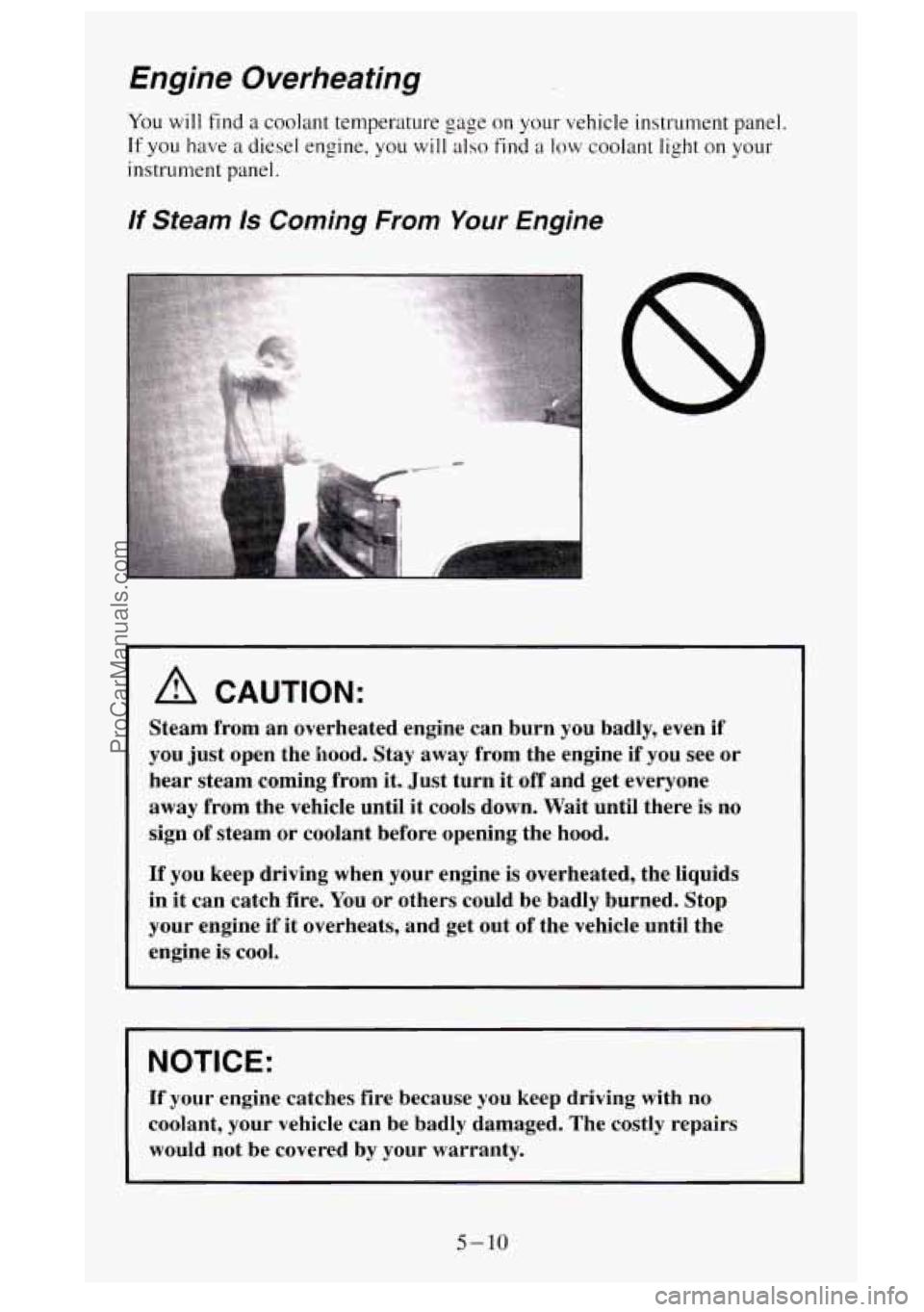
lf Steam Is Coming From Your Engine
A CAUTION:
Steam from an overheated engine can burn you badly, even if
you just open the hood. Stay away from the engine if you see or
hear steam coming from it. Just turn it
off and get everyone
away from the vehicle until it cools down. Wait until there is no
sign of steam or coolant before opening the hood.
If you keep driving when your engine is overheated, the liquids
in it can catch fire. You or others could be badly burned. Stop
your engine
if it overheats, and get out of the vehicle until the
engine
is cool.
NOTICE:
If your engine catches fire because you keep driving with no
coolant, your vehicle can be badly damaged. The costly repairs
would not be covered by your warranty.
5-10
ProCarManuals.com
Page 236 of 488
Cooling System - Gasoline Engines
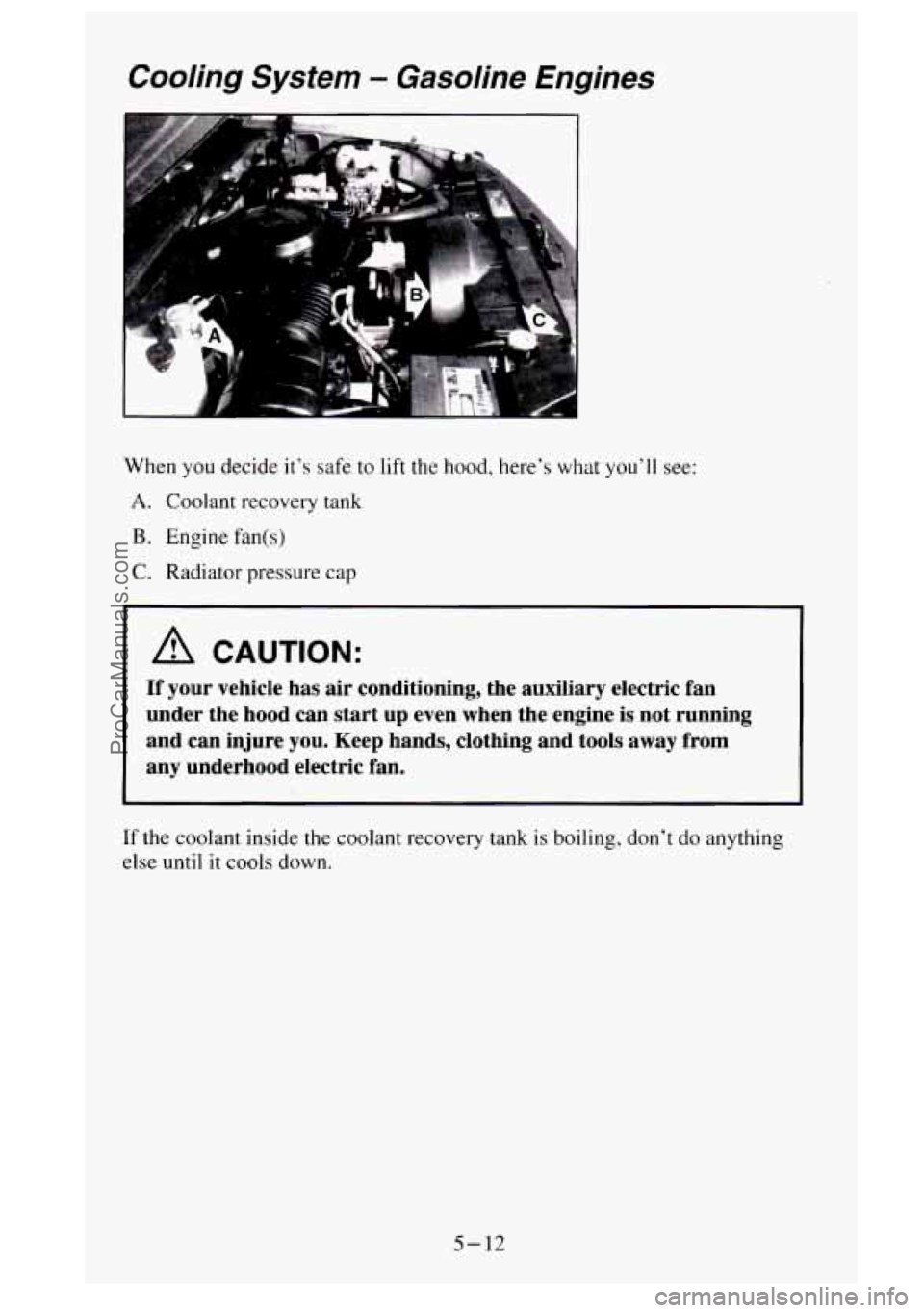
When you decide it’s safe to lift the hood, here’s what you’ll see:
A. Coolant recovery tank
B. Engine fan(s)
C. Radiator pressure cap
I A CAUTION:
If your vehicle has air conditioning, the auxiliary electric fan
under the hood can start up even when the engine is not runn\
ing
and can injure you. Keep hands, clothing and tools away from any underhood electric fan.
If the coolant inside the coolant recovery tank is boiling, don’t do anything
else
until it cools down.
5-12
ProCarManuals.com
Page 237 of 488
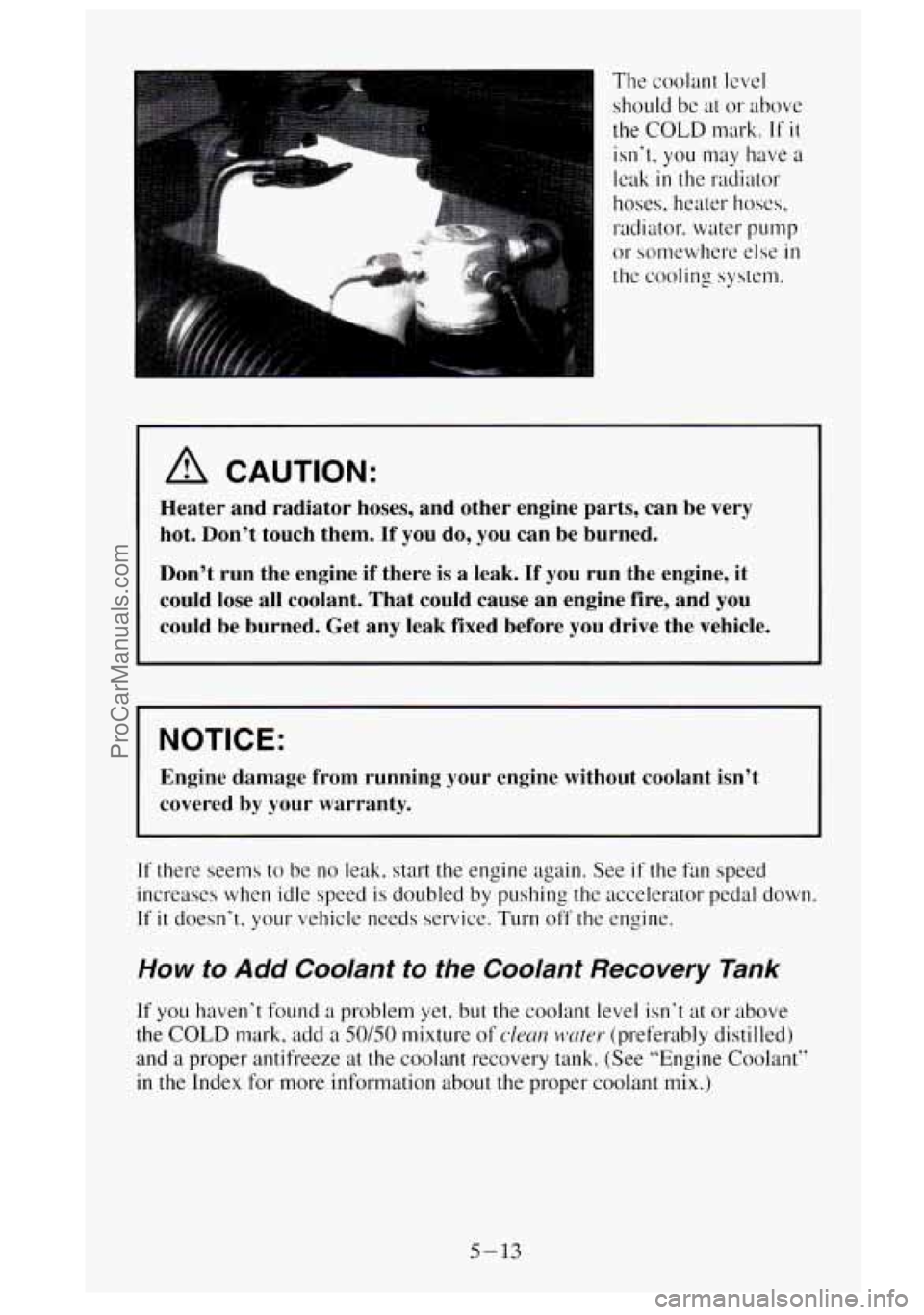
The coolant level
should be a1 or above
the
COLD mark. If it
isn’t, you may have a
leak in the radiator
hoses. heater hoses,
radiator. water
pump
or somewhere else in
the cooling system.
A CAUTION:
Heater and radiator hoses, and other engine parts, can be very
hot. Don’t touch them.
If you do, you can be burned.
Don’t run the engine
if there is a leak. If you run the engine, it
could lose all coolant. That could cause an engine fire, and you
could be burned. Get any leak fixed before you drive the vehicle.
NOTICE:
Engine damage from running your engine without coolant isn’t
covered
by your warranty.
If there seem to be no leak. start the engine again. See if the fan speed
increases when idle speed is doubled
by pushing the accelerator pedal down.
If it doesn’t, your vehicle needs service. Turn off the engine.
How to Add Coolant to the Coolant Recovery Tank
If you haven’t found a problem yet, but the coolant level isn’t at or above
the COLD mark, add
a SO/SO mixture of c.lea12 water (preferably distilled)
and
a proper antifreeze at the coolant recovery tank. (See “Engine Coolant”
in the Index for more information about the proper coolant mix.)
5-13
ProCarManuals.com
Page 238 of 488

NOTICE:
In cold weather, water can freeze and crack the engine, radiat\
or,
heater core and other parts. Use the recommended coolant.
5-14
ProCarManuals.com
Page 242 of 488
F
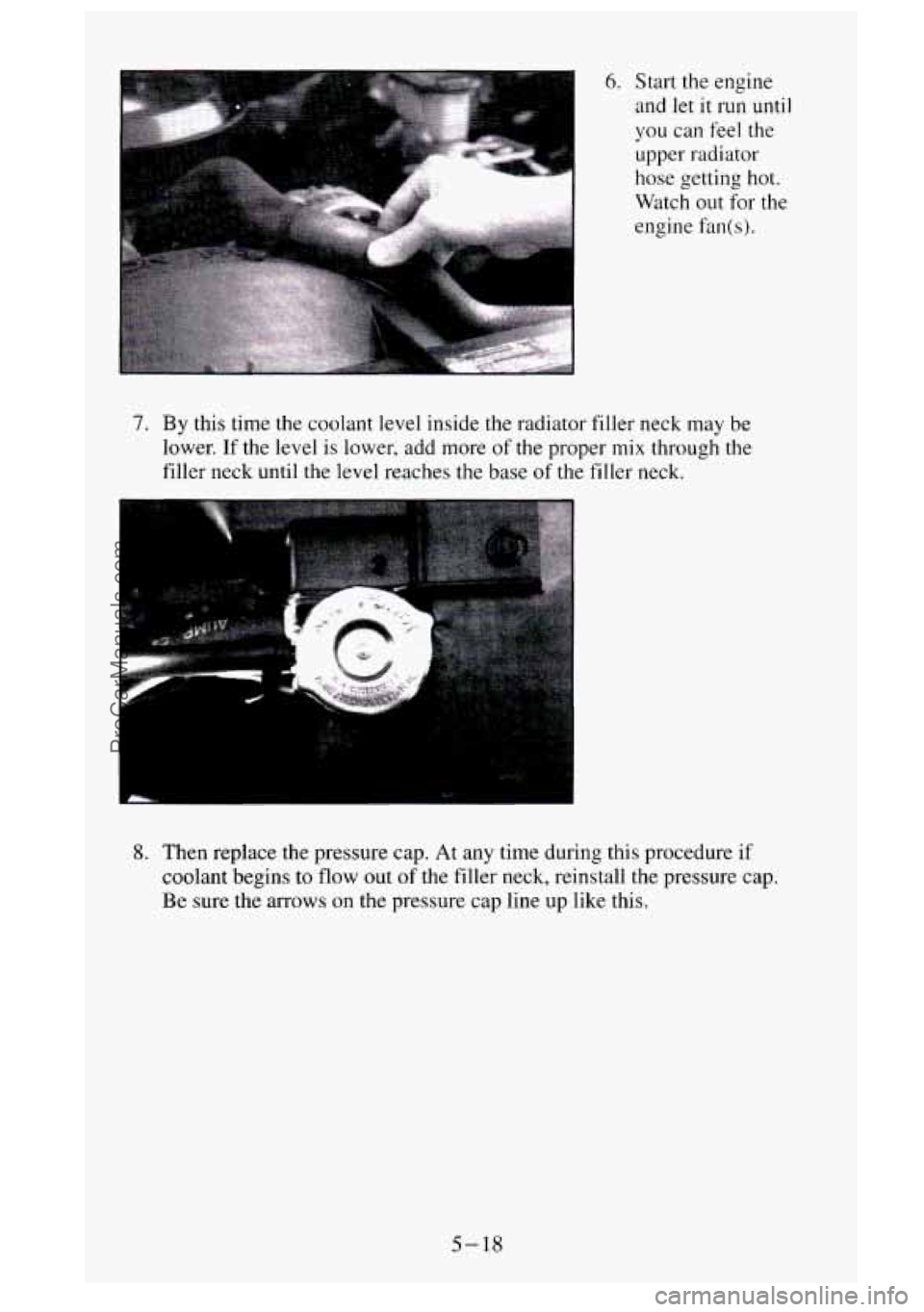
6. Start the engine
and let it run
until
you can feel the
upper radiator
hose getting hot.
Watch out for the
engine fan(s).
7. By this time the coolant level inside the radiator filler neck may be
lower.
If the level is lower, add more of the proper mix through the
filler neck until the level reaches the base
of the filler neck.
I_
8. Then replace the pressure cap. At any time during this procedure if
coolant begins
to flow out of the filler neck, reinstall the pressure cap.
Be sure the arrows
on the pressure cap line up like this.
5-18
ProCarManuals.com
Page 243 of 488
Cooling System - Diesel Engines
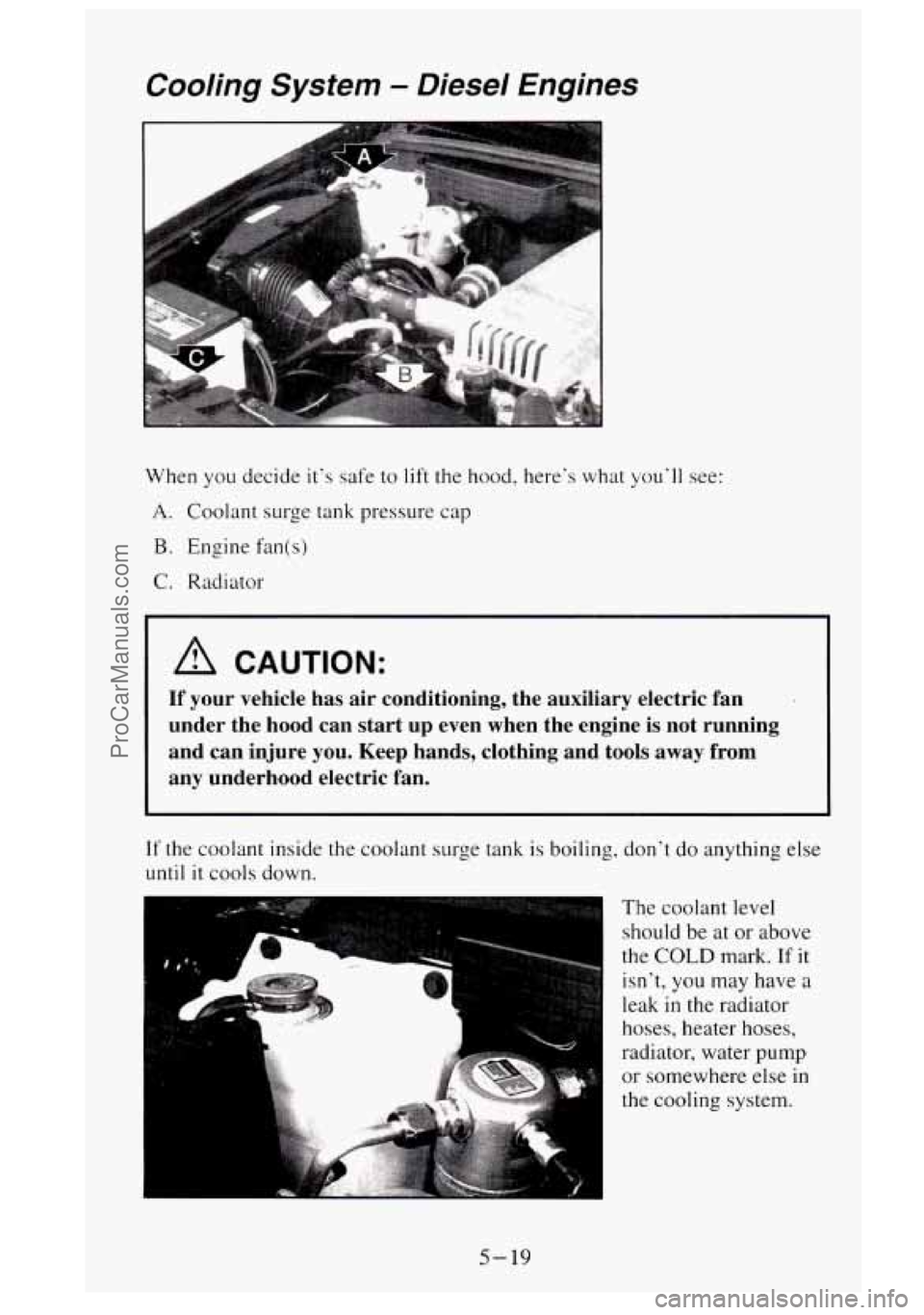
When you decide it‘s safe to lift the hood, here’s what you’ll see:
A. Coolant surge tank pressure cap
B. Engine fan(s)
C. Radiator
A CAUTION:
If your vehicle has air conditioning, the auxiliary electric fan
under the hood can start up even when the engine is not running
and can injure you. Keep hands, clothing and tools away from
any underhood electric fan.
If the coolant inside the coolant surge tank is boiling, don’t do anything else
until it cools down.
The coolant level
should be
at or above
the
COLD mark. If it
isn’t,
you may have a
leak in the radiator
hoses, heater hoses,
radiator, water pump
or somewhere else in
the cooling system.
5-19
ProCarManuals.com
Page 244 of 488
I A CAUTION:
Heater and radiator hoses, and other engine parts, can be very
hot. Don’t touch them.
If you do, you can be burned.
Don’t run the engine
if there is a leak. If you run the engine, it
could lose all coolant. That could cause an engine
fire, and you
could be burned. Get any leak fixed before you drive the vehicle.
I NOTICE:
Engine damage from running your engine without coolant isn’t
covered by your warranty.
If there seems to be no leak, start the engine again. See if the fan speed
increases when idle speed
is doubled by pushing the accelerator pedal down.
If
it doesn’t, your vehicle needs service. Turn off the engine.
How to Add Coolant to the Coolant Surge Tank
I NOTICE:
The diesel engine has a specific coolant fill procedure. Failure to
follow this procedure could cause your engine to overheat and be
severely damaged.
If you haven’t found a problem yet, but the coolant level isn’t at the COLD
mark, add a
50/50 mixture of cleun water (preferably distilled) and a proper
antifreeze at the coolant surge tank, but be sure the cooling system,
including the
coolant surge tank pressure cap, is cool before you do it. (See
“Engine Coolant”
in the Index for more information about the proper
coolant mix.)
5-20
ProCarManuals.com
Page 245 of 488
A CAUTION:
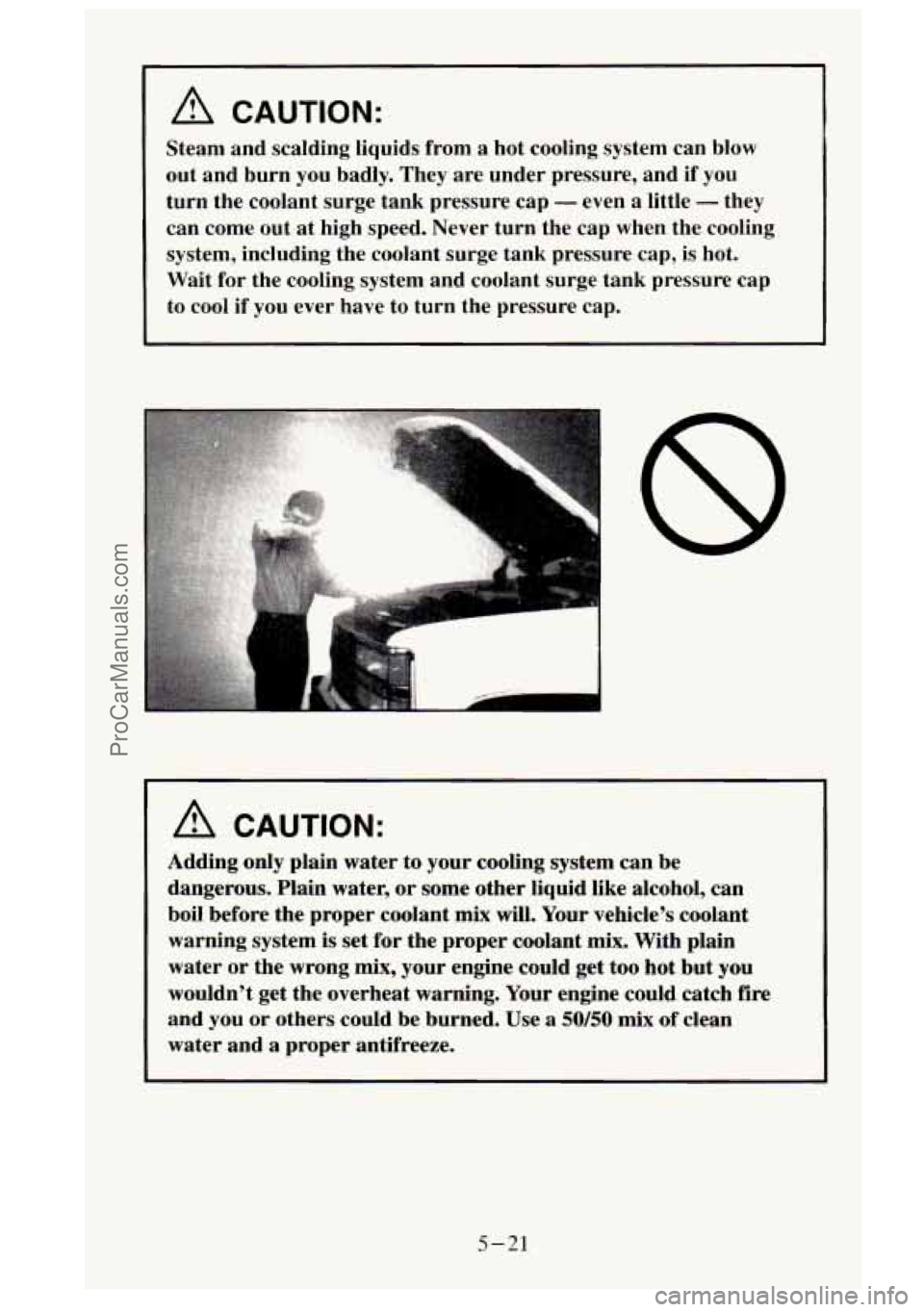
Steam and scalding liquids from a hot cooling system can blow
out and burn you badly. They are under pressure, and
if you
turn the coolant surge tank pressure cap
- even a little - they
can come out at high speed. Never turn the cap when the cooling
system, including the coolant surge tank pressure cap,
is hot.
’ Wait for the cooling system and coolant surge tank pressure cap
to cool
if you ever have to turn the pressure cap.
A CAUTION:
Adding only plain water to your cooling system can be
dangerous. Plain water, or some other liquid like alcohol, can
boil before the proper coolant mix
will. Your vehicle’s coolant
warning system is set for the proper coolant mix. With plain
water
or the wrong mix, your engine could get too hot but you
wouldn’t get the overheat warning. Your engine could catch fire
and you or others could be burned. Use
a 50/50 mix of clean
water and a proper antifreeze.
5-21
ProCarManuals.com
Page 246 of 488
NOTICE:
In cold weather, water can freeze and crack the engine, radiator,
heater core and other parts.
So use the recommended coolant.
A CAUTION:
You can be burned if you spill coolant on hot engine parts.
Coolant contains ethylene glycol and it will burn if the engine
parts are hot enough. Don't spill coolant on
a hot engine.
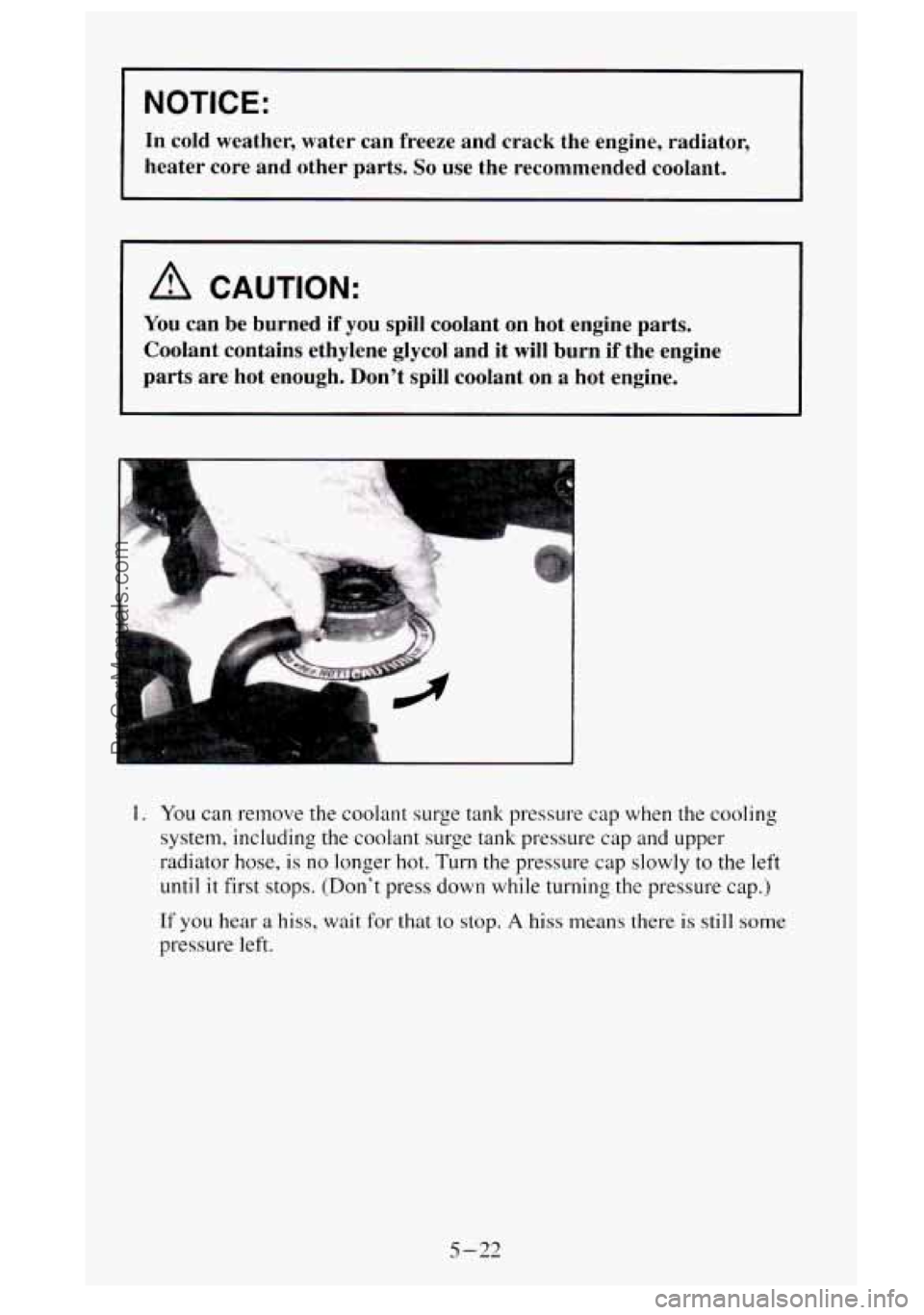
1. You can remove the coolant surge tank pressure cap when the cooling
system, including the coolant surge tank pressure cap and upper
radiator hose,
is no longer hot. Turn the pressure cap slowly to the left
until it first stops. (Don't press down while turning the pressure cap.)
If you hear a hiss, wait for that to stop. A hiss means there is still some
pressure left.
5-22
ProCarManuals.com