tow GMC SIERRA 1995 Service Manual
[x] Cancel search | Manufacturer: GMC, Model Year: 1995, Model line: SIERRA, Model: GMC SIERRA 1995Pages: 488, PDF Size: 26.01 MB
Page 250 of 488
Changing a Flat Tire
If a tire goes flat, avoid further tire and wheel damage by driving slowly to a
level place. Turn on your hazard warning flashers.
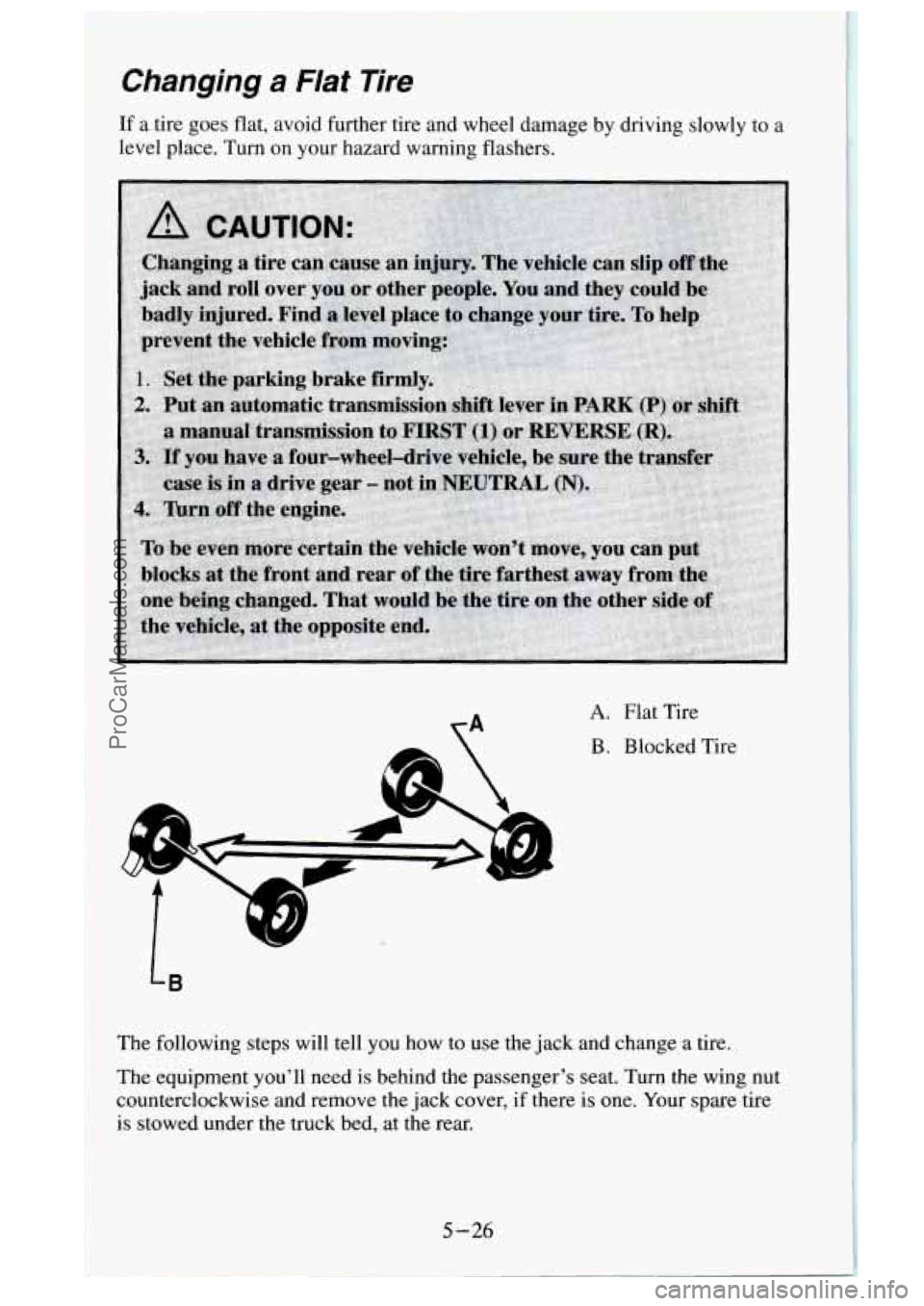
A. Flat Tire
B. Blocked Tire
The following steps will tell
you how to use the jack and change a tire.
The equipment you’ll need
is behind the passenger’s seat. Turn the wing nut
counterclockwise and remove the jack cover, if there is one.
Your spare tire
is stowed under the truck bed, at the
rear.
5-26
ProCarManuals.com
Page 253 of 488
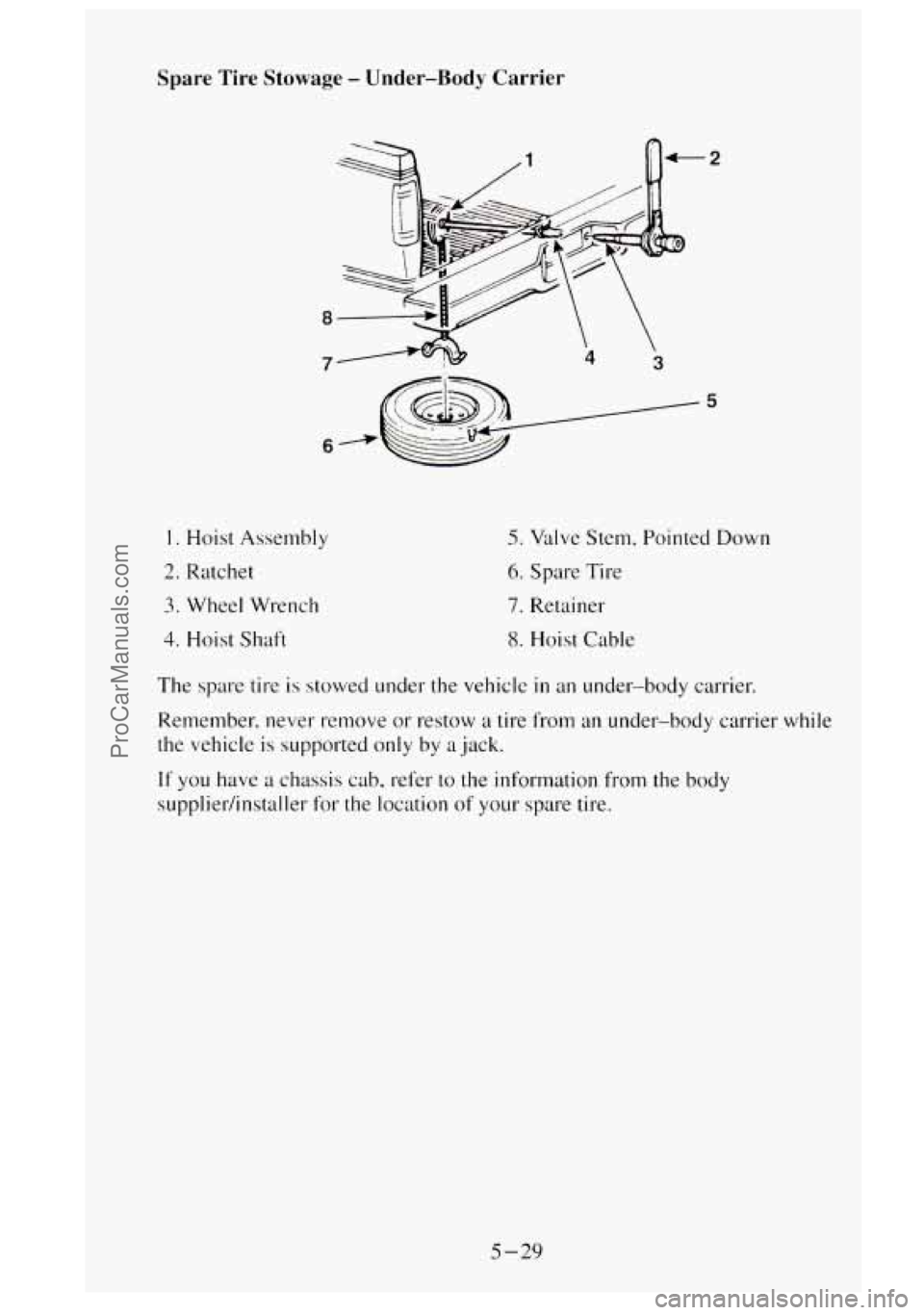
Spare Tire Stowage - Under-Body Carrier
I. Hoist Assembly
2. Ratchet
3. Wheel Wrench
4. Hoist Shaft
5. Valve Stem, Pointed Down
6. Spare Tire
7. Retainer
8. Hoist Cable
The spare tire is stowed under the vehicle
in an under-body carrier.
Remember. never remove or restow
a tire from an under-body carrier while
the vehicle is supported only by a
jack.
If you have a chassis cab, refer to the information from the body
supplier/installer for the location
of your spare tire.
5-29
ProCarManuals.com
Page 259 of 488
Front rosluon Rear Position
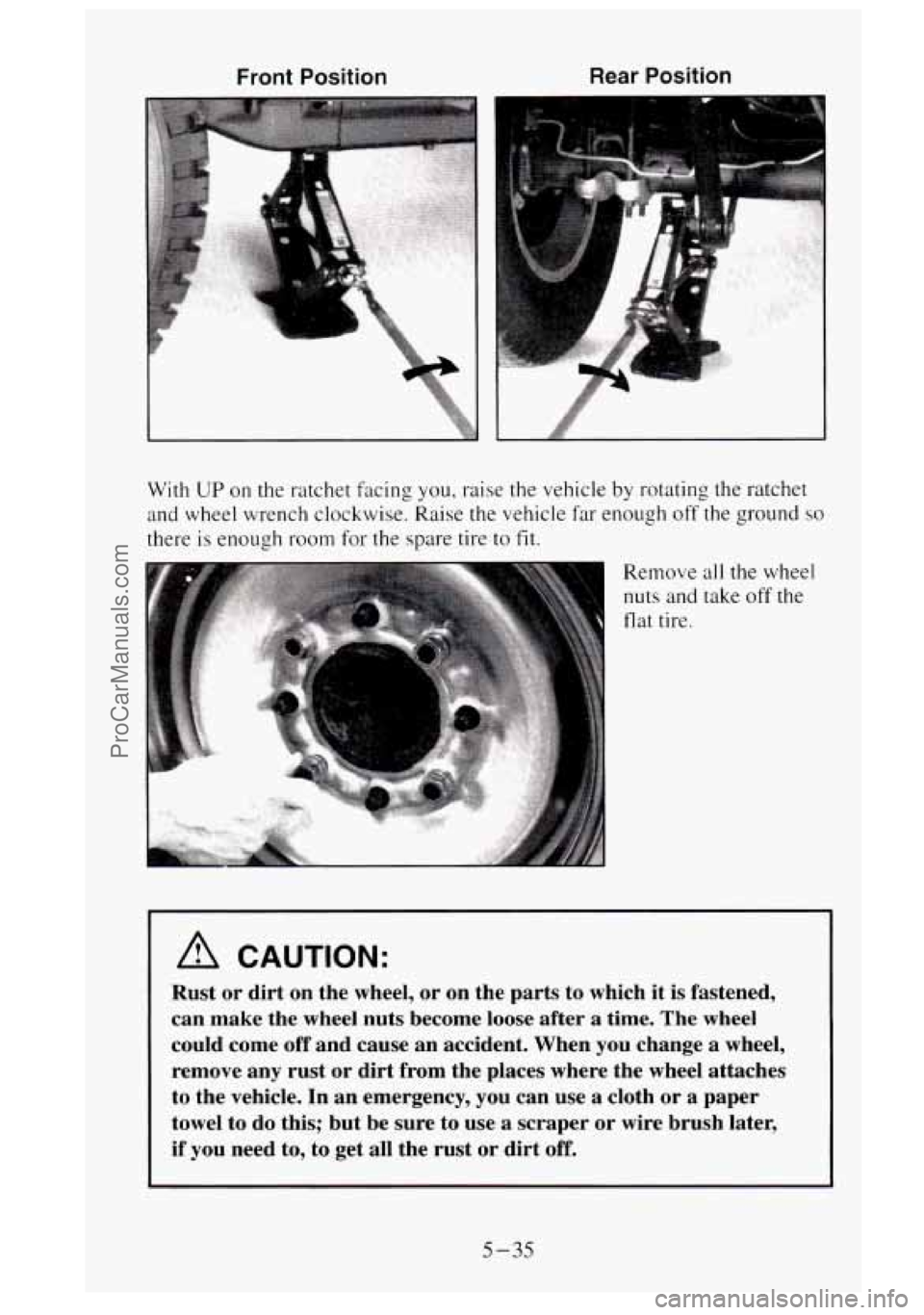
With UP on the ratchet facing you, raise the vehicle by rotating the ratchet
and wheel wrench clockwise. Raise the vehicle
far enough off the ground so
there is enough room for the spare tire to fit.
Remove
all the wheel
nuts and take
off the
flat tire,
A CAUTION:
Rust or dirt on the wheel, or on the parts to which it is fastened,
can make the wheel nuts become loose after a time. The wheel
could come
off and cause an accident. When you change a wheel,
remove any rust or dirt from the places where the wheel attaches
to the vehicle. In an emergency, you can use a cloth or a paper
towel
to do this; but be sure to use a scraper or wire brush later,
if you need to, to get all the rust or dirt off.
5-35
ProCarManuals.com
Page 260 of 488
Remove any rust or dirt from the wheel bolts, mounting surfaces and spare
wheel. Place the spare
on the wheel mounting surface.
A CAUTION:
Never use oil or grease on studs or nuts. If you do, the nuts
might come loose. Your wheel could fall
off, causing a serious
accident.
Replace the wheel
nuts with the rounded
end
of the nuts toward
the wheel.
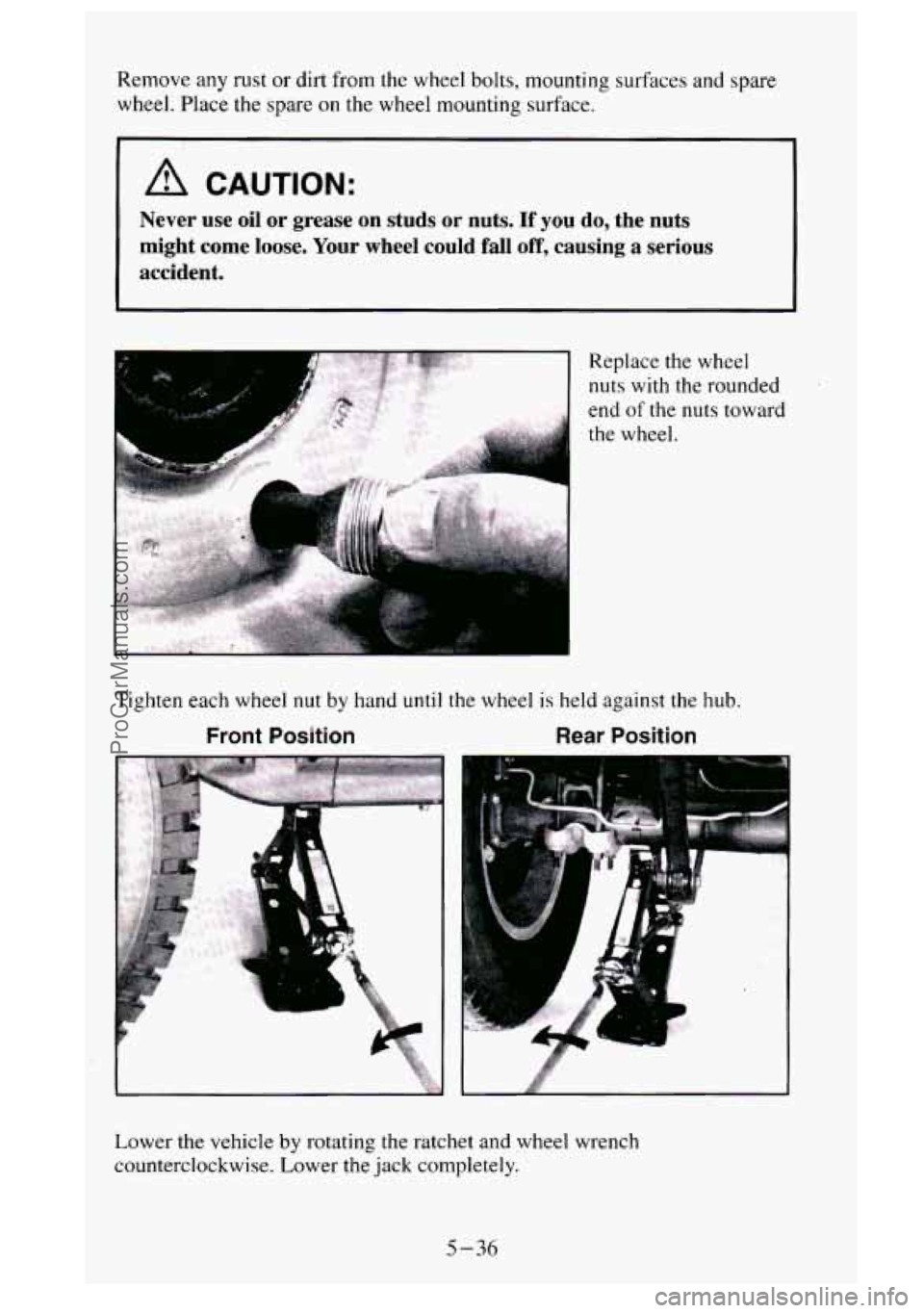
Tighten each wheel
nut by hand until the wheel is held against the hub.
Front Position Rear Position
Lower the vehicle by rotating the ratchet and wheel wrench
counterclockwise. Lower the jack completely.
5-36
ProCarManuals.com
Page 262 of 488
I
A ,CAUTION:
Storing a jack, a tire or other equipment in the passenger
compartment
of the vehicle could cause injury. In a sudden stop
or collision, loose equipment could strike someone. Store all
these
in the proper place.
Stowing the
Tire - Under-Body Carrier
Stow the flat tire under the rwr of the vehicle in spare tire carrier. To stow
the flat tire:
1.
AI 3
3.
4.
5.
Put the tire on the ground at the rear of the vehicle with the valve stern
pointed down.
Pull the wheel retainer through thc wheel opening.
Attach the ratchet
to the urheel n'rench with the UP marking Facing
you.
Put the other end of the whcel wrench through the rcar bumper access
hole, located at the passenger side edge
of the license plate. Be sure the
wheel wrench connects into the hoist
shaft.
Turn the ratchet clockwise to raise the tire. Keep turning the ratchet
until the tire is all the way up. You will hear two "clicks" when the tire
is secure. Pull on the tire to nuke sure it is tightly secured.
Stowing the Jack and Jacking Tools
Return the jack, ratchet, wheel wrench and jack extensions to their location
behind the passenger's
seat. Stow thc jack and jacking tools as shown in the
illustrations earlier
in this part. Secure the items and replace the jack cover,
if there is one.
5-38
ProCarManuals.com
Page 263 of 488
If You’re Stuck: In Sand, Mud, Ice or Snow
What you don’t want to do when your vehicle is stuck is to spin your wheels
too fast. The method known as ”rocking” can help you get out when you’re
stuck, but you nlust use caution.
A CAUTION:
If you let your tires spin at high speed, they can explode and you
or others could be injured. And, the transmission or other par\
ts
of the vehicle can overheat. That could cause an engine
compartment fire or other damage. When you’re stuck, spin th\
e wheels
as little as possible. Don’t spin the wheels above 35 mph
(55 km/h) as shown on the speedometer.
I NOTICE:
Spinning your wheels can destroy parts of your vehicle as well as
the tires. If you spin the wheels too fast while shifting your
transmission back and forth, you can destroy your transmission.
For information about using tire chains on your vehicle, see “Tire Chains”
in the Index.
Rocking
your vehicle to get it out:
First. turn your steering wheel left and right. That will clear the area around
your front wheels. Then shift back and forth between REVERSE
(R) and a
forward gear (or
with a manual transmission, between FIRST (1 ) or
SECOND (2) gear and REVERSE), spinning the wheels as little as possible.
Release
the accelerator pedal while you shift, and press lightly on the
accelerator pedal when the transmission
is in gear. If that doesn’t get you
out after a few tries, you may need
to be towed out. Or, you can use your
recovery hooks,
if your vehicle has them. If you do need to be towed out.
see “Towing Your Vehicle”
in the Index.
5-39
ProCarManuals.com
Page 265 of 488
NOTICE:
Never use the recovery hooks to tow the vehicle. Your vehicle
could be damaged and
it would not be covered by warranty.
5-41
ProCarManuals.com
Page 282 of 488
Engine Oil (Gasoline Engines)
It’s a good idea to check your engine oil every time you get fuel. In order to
get an accurate reading, the oil must be warm and the vehicle must be on
level ground.
Turn
off the engine
and give the oil
a few
minutes to drain back
into the oil pan.
If you
don’t, the
oil dipstick
might not show the
actual level.
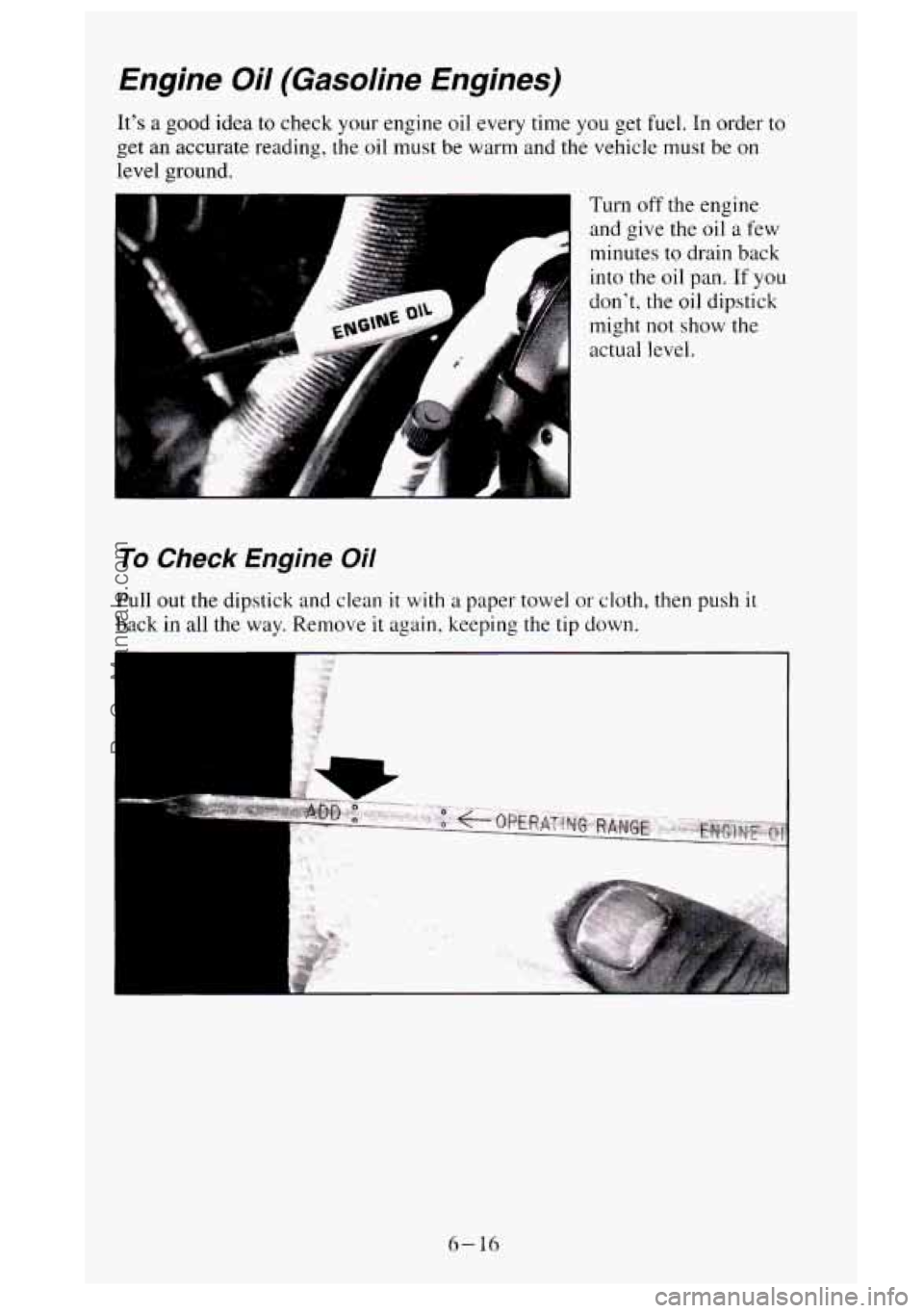
To Check Engine Oil
Pull out the dipstick and clean it with a paper towel or cloth, then push it
back in all the way. Remove it again, keeping the tip down.
I
6- 16
ProCarManuals.com
Page 286 of 488

NOTICE:
Use only engine oil with the American Petroleum Institute
Certified For Gasoline Engines “Starburst” symbol. Failure \
to
use the proper oil can result in engine damage not covered
by
your warranty.
GM Goodwrench@ oil (in Canada, GM Engine Oil) meets all the
requirements for your vehicle.
Engine Oil Additives
Don’t add anything to your oil. Your GM dealer is ready to advise if you
think something should be added.
When to Change Engine Oil
See if any one of these is true for you:
Most trips are less than 5 to 10 miles (8 to 16 km). This is particularly
important when outside temperatures are below freezing.
Most trips include extensive idling (such as frequent driving in stop and
go traffic).
Most trips are through dusty areas.
You operate your vehicle in dusty areas or off-road frequently.
You frequently tow a trailer.
If any one
of these is true for your vehicle, then you need to change your oil
and filter every
3,000 miles (5 000 km) or 3 months - whichever comes
first.
Light Duty Emissions:
If none of them is true, change the oil and filter every 7,500 miles (12 500
km) or 12 months - whichever comes first.
Heavy Duty Emissions:
If none of them is true, change the oil and filter every 6,000 miles (10 000
km) or 12 months - whichever comes first.
6-20
ProCarManuals.com
Page 288 of 488
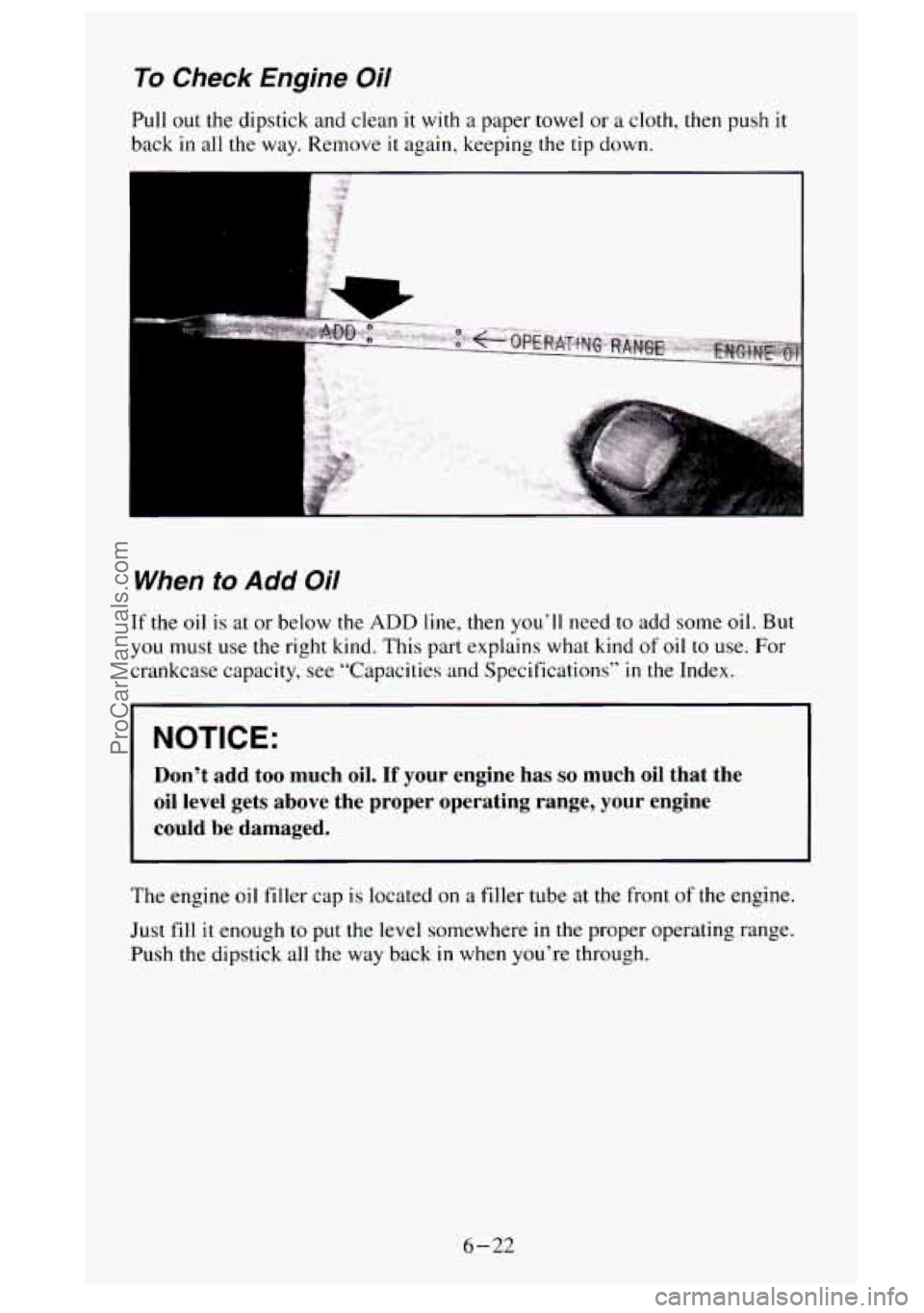
To Check Engine Oil
Pull out the dipstick and clean it with a paper towel or a cloth, then push it
back in all the way. Remove it again, keeping the tip down.
When to Add Oil
If the oil is at or below the ADD line, then you’ll need to add some oil. But
you must use the right kind. This part explains what kind of oil to use. For
crankcase capacity, see “Capacities and Specifications”
in the Index.
I I
I NOTICE: I
Don’t add too much oil. If your engine has so much oil that the
oil level gets above the proper operating range, your engine
could be damaged.
I I
The engine oil filler cap is located on a filler tube at the front of the engine.
Just fill it
enough to put the level somewhere in the proper operating range.
Push the dipstick
all the way back in when you’re through.
6-22
ProCarManuals.com