engine GMC SIERRA 1996 Workshop Manual
[x] Cancel search | Manufacturer: GMC, Model Year: 1996, Model line: SIERRA, Model: GMC SIERRA 1996Pages: 404, PDF Size: 21.57 MB
Page 202 of 404
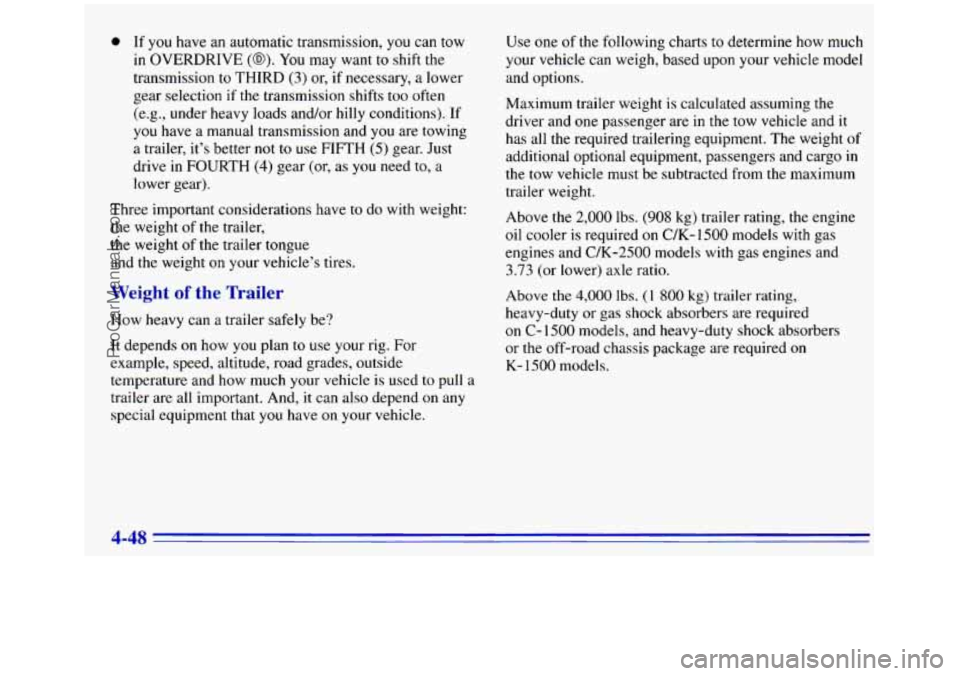
0 If you have an automatic transmission, you can tow
in OVERDRIVE
(@). You may want to shift the
transmission to THIRD (3) or, if necessary, a lower
gear selection if the transmission shifts too often
(eg, under heavy loads and/or hilly conditions). If
you have a manual transmission and you are towing
a trailer, it’s better
not to use FIFTH (5) gear. Just
drive in FOURTH
(4) gear (or, as you need to, a
lower gear).
Three important considerations have to do with weight:
the weight
of the trailer,
the weight
of the trailer tongue
and the weight
on your vehicle’s tires.
Weight of the Trailer
How heavy can a trailer safely be?
It depends on how
you plan to use your rig. For
example, speed, altitude, road grades, outside
temperature and how much your vehicle is used to pull
a
trailer are all important. And, it can also depend on any
special equipment that you have on your vehicle. Use
one
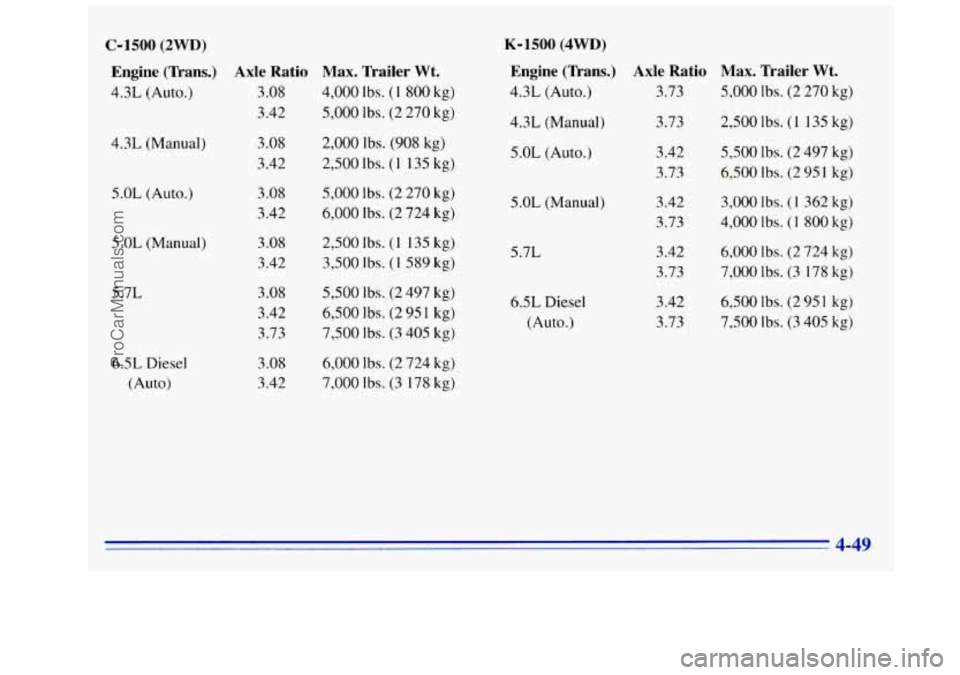
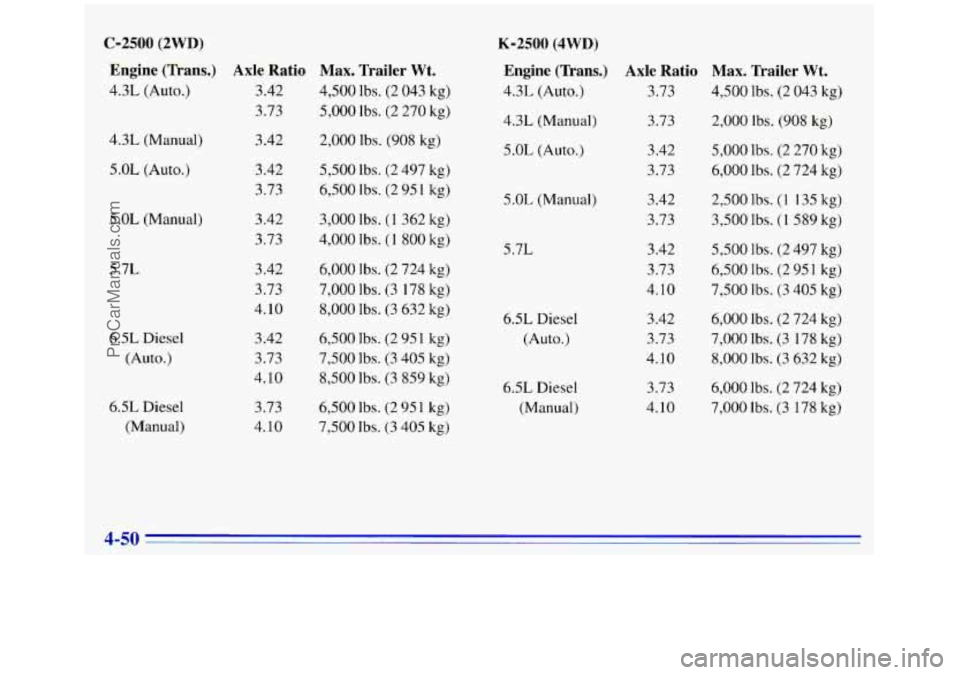
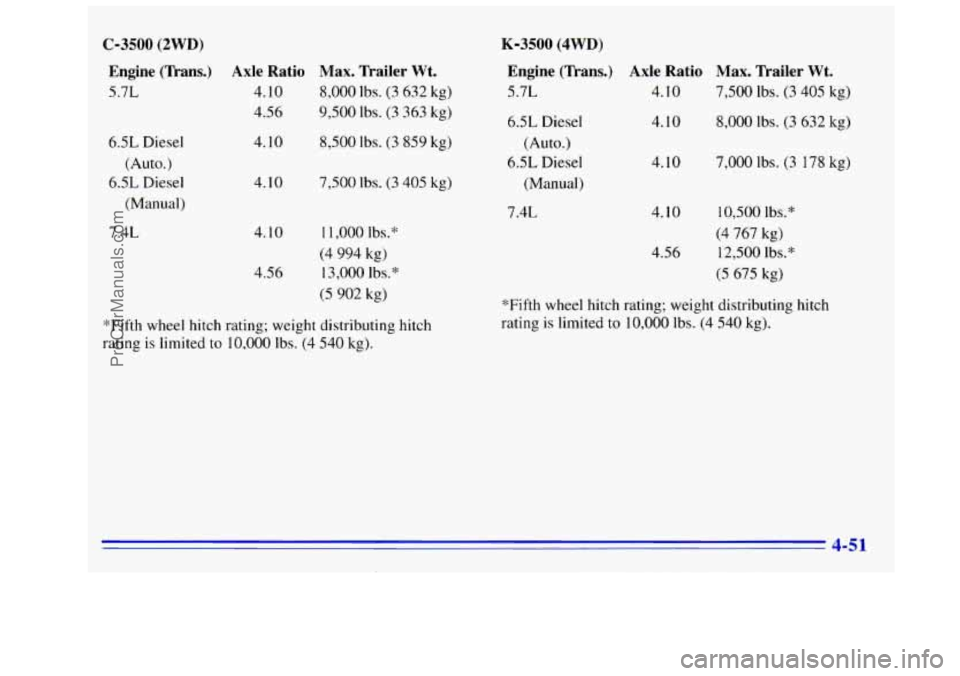
of the following charts to determine how much
your vehicle can weigh, based upon your vehicle model
and options.
Maximum trailer weight is calculated assuming the
driver and
one passenger are in the tow vehicle and it
has all the required trailering equipment. The weight
of
additional optional equipment, passengers and cargo in
the tow vehicle must be subtracted from the maximum
trailer weight.
Above
the 2,000 lbs. (908 kg) trailer rating, the engine
oil cooler is required
on C/K- 1500 models with gas
engines and
C/K-2500 models with gas engines and
3.73 (or lower) axle ratio.
Above
the 4,000 lbs. (1 800 kg) trailer rating,
heavy-duty or gas shock absorbers are required
on
C- 1500 models, and heavy-duty shock absorbers
or
the off-road chassis package are required on
K-1500 models.
4-48
ProCarManuals.com
Page 203 of 404
C-1500 (2WD)
Engine (Trans.)
Axle Ratio
4.3L (Auto.) 3 .os
3.42
4.3L
(Manual j
5.0L (Auto.)
5.0L (Manual)
5.7L
6.5L
Diesel
(Auto)
3 .os
3.42
3.08
3.42 3
.OS
3.42
3 .os
3.42
3.73
3.08
3.42
Max. Trailer Wt.
4,000 Ibs. (1 800 kg)
5,000 Ibs. (2 270 kg)
2,000 lbs. (908 kg)
2,500 lbs. (1 135 kg)
5,000 lbs. (2 270 kg)
6,000 Ibs. (2 724 kg)
2,500 Ibs. (1 135 kg)
3,500 Ibs. (1 589 kg)
5,500 lbs. (2 497 kg)
6,500 lbs. (2 95 1 kg)
7,500 Ibs. (3 405 kg)
6,000 lbs. (2 724 kg)
7,000 lbs. (3 178
kg)
K-1500 (4WD)
Engine (Trans.)
Axle Ratio
4.3L (Auto.) 3.73
4.3L
(Manual)
5.0L (Auto.)
5 .OL (Manual)
5.7L
6.5L
Diesel
(Auto.)
3.73
3.42
3.73
3.42
3.73
3.42
3.73
3.42
3.73
Max. Trailer Wt.
5,000 lbs. (2 270 kg)
2,500 lbs. (1 135 kg)
5,500 lbs. (2 497 kg)
6,500 Ibs. (2 951 kg)
3,000 Ibs. (1 362 kg)
4,000 I bs. ( 1 800 kg)
6,000
lbs. (2 724 kg)
7,000 lbs. (3 178 kg)
6,500 lbs. (2 95 1 kg)
7,500 Ibs. (3 405 kg)
ProCarManuals.com
Page 204 of 404
C-2500 (2WD) K-2500 (4WD)
Engine (Trans.) Axle Ratio
Max. Trailer Wt.
4.3L (Auto.) 3.42 4,500 lbs. (2 043 kg)
3.73
5,000 lbs. (2 270 kg)
Engine (Trans.) Axle Ratio Max. Trailer Wt.
4.3L (Auto.) 3.73 4,500 lbs. (2 043 kg)
4.3L (Manual) 3.73 2,000 lbs.
(908 kg)
4.3L (Manual)
5.0L (Auto.) 3.42
2,000 lbs. (908 kg) 5.0L (Auto.) 3.42
3.73 5,000 lbs. (2 270 kg)
6,000 lbs.
(2 724 kg)
3
-42 5,500 lbs. (2 497 kg)
3.73 6,500 lbs.
(2 951 kg) 5 .OL (Manual)
3.42
3.73 2,500 lbs. (1 135 kg)
3,500 lbs.
(1 589 kg) 5 .OL (Manual)
3.42 3,000 lbs. (1 362 kg)
3.73 4,000 lbs.
(1 800 kg)
5.7L 3.42
3.73
4.10 5,500 lbs. (2 497 kg)
6,500 lbs. (2 95
1 kg)
7,500 lbs. (3 405 kg)
5.7L 3.42 6,000 Ibs. (2 724 kg)
4.10
8,000 lbs. (3 632 kg)
3.73 7,000 lbs. (3 178 kg)
6.5L Diesel
(Auto.) 3.42
3.73
4.10 6,000
lbs. (2 724 kg)
7,000 lbs. (3 178 kg)
8,000 lbs. (3 632 kg)
6.5L Diesel
(Auto.) 3.42 6,500 lbs. (2 95 1 kg)
4.10
8,500 lbs. (3 859 kg)
3.73 7,500
lbs. (3 405 kg)
6.5L Diesel
(Manual) 3.73
4.10 6,000 lbs.
(2 724 kg)
7,000 lbs. (3 178 kg)
6.5L Diesel
(Manual) 3.73 6,500 lbs.
(2 95 1 kg)
4.10
7,500 Ibs. (3 405 kg)
ProCarManuals.com
Page 205 of 404
C-3500 (2WD)
Engine (Tkans.) Axle Ratio Max. Trailer Wt.
5.7L 4.10 8,000 lbs. (3 632 kg)
4.56 9,500 Ibs. (3 363 kg)
4.10
8,500 Ibs. (3 859 kg) 6.5L Diesel
(Auto.)
6.5L Diesel
(Manual)
7.4L 4.10
4.10
4.56 7,500 Ibs. (3 405 kg)
11,000 Ibs."
(4 994 kg)
13,000
Ibs.*
(5 902 kg)
*Fifth wheel
hitch rating; weight distributing hitch
rating
is limited to 10,000 lbs. (4 540 kg).
K-3500 (4WD)
Engine (lkans.) Axle Ratio Max. Trailer Wt.
5.7L 4.10 7,500 lbs. (3 405 kg)
6.5L Diesel
(Auto.)
6.5L Diesel
(Manual)
7.4L 4.10
4.10
4.10
4.56
8,000 lbs. (3 632 kg)
7,000 Ibs. (3 178 kg)
10,500 lbs.*
(4 767 kg)
12,500 lbs.*
(5 675 kg)
*Fifth wheel hitch rating; weight distributing hitch
rating is limited
to 10,000 lbs. (4 540 kg).
4-51
ProCarManuals.com
Page 206 of 404
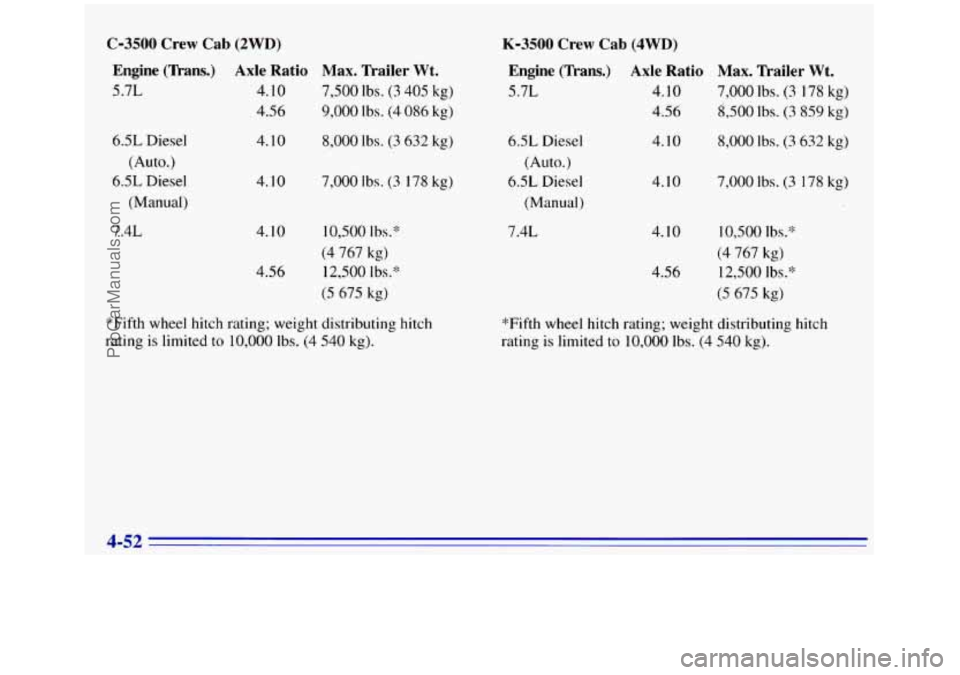
C-3500 Crew Cab (2WD)
Engine (Trans.) Axle Ratio Max. Trailer Wt.
5.7L 4.10 7,500 lbs. (3 405 kg)
4.56 9,000
Ibs. (4 086 kg)
6.5L Diesel
(Auto.)
6.5L Diesel
(Manual)
7.4L
4.10
4.10
4.10
4.56
8,000 lbs. (3 632 kg)
7,000
Ibs. (3 178 kg)
10,500 lbs.*
(4 767 kg)
12,500
Ibs.*
(5 675 kg)
*Fifth
wheel hitch rating.; weight distributing hitch
rating
is limited to 10,000 lbs. (4 540 kg).
K-3500 Crew Cab (4WD)
Engine (Tkans.) Axle Ratio Max. Trailer Wt.
5.7L 4.10 7,000 Ibs. (3 178 kg)
4.56 8,500
Ibs. (3 859 kg)
6% Diesel
(Auto.)
6.5L Diesel
(Manual)
7.4L 4.10
4.10
4.10
4.56
8,000 Ibs. (3 632 kg)
7,000
Ibs. (3 178 kg)
10,500
Ibs*
(4 767 kg)
12,500
Ibs?
(5 675 kg)
*Fifth wheel hitch rating; weight distributing hitch
rating
is limited to 10,000 Ibs. (4 540 kg).
4-52
ProCarManuals.com
Page 207 of 404
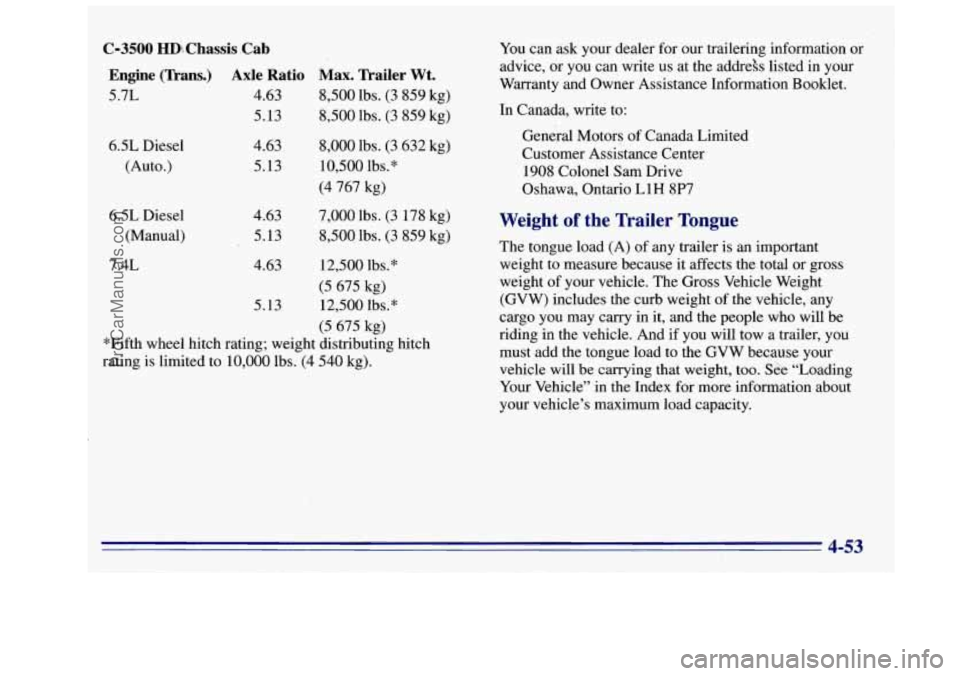
(2-3500 HDiChassis .Cab Engine (Trans.) Axle Ratio
Max. Trailer Wt.
5.7L 4.63 8,500 lbs. (3 859 kg)
5.13
8,500 lbs. (3 859 kg)
6% Diesel
(Auto.)
6.5L Diesel
(Manual)
7.4L 4.63
5.13
4.63 5.13
4.63
5.13
8,000 lbs. (3 632 kg)
10,500 lbs.*
(4 767 kg)
7,000 lbs. (3 178 kg)
8,500 lbs. (3 859 kg)
12,500 lbs.*
(5 675 kg)
12,500 lbs.*
(5 675 kg)
*Fifth wheel hitch rating; weight distributing hitch
rating is limited to 10,000 lbs. (4 540 kg). You
can ask your dealer for our trailering information or
advice, or you can write us at the addreis listed in your
Warranty and Owner Assistance Information Booklet.
In Canada, write to:
General Motors of Canada Limited
Customer Assistance Center
1908 Colonel Sam Drive
Oshawa, Ontario LlH 8P7
Weight of the Trailer Tongue
The tongue load (A) of any trailer is an important
weight to measure because it affects the total or gross
weight of your vehicle. The Gross Vehicle Weight
(GVW) includes the curb weight of the vehicle, any
cargo you may carry in it, and the people who will be
riding in the vehicle. And if you will tow a trailer, you
must add the tongue load to the GVW because your
vehicle will be carrying that weight, too. S&e “Loading
Your Vehicle” in the Index for more information about
your vehicle’s maximum load capacity.
4-53
ProCarManuals.com
Page 211 of 404
Turn Signals When Towing a Trailer
The green arrows on your instrument panel will flash
whenever
you signal a turn or lane change. Properly
hooked up, the trailer lamps will also flash, telling other
drivers you’re about to turn, change lanes or stop.
When towing a trailer, the green arrows
on your
instrument panel will flash for turns even
if the bulbs on
the trailer are burned out. Thus, you may
think drivers
behind
you are seeing your signal when they are not. It’s
important to check occasionally to be sure the trailer
bulbs are
still working.
Driving On Grades
Reduce speed and shift to a lower gear be~m you start
down
a long or steep downgrade. If you don’t shift
down,
you might have to use your brakes so much that
they would get hot and
no longer work well.
On a long uphill grade,
shift down and reduce your
speed
to around 45 mph (70 km/h) to reduce the
possibility
of engine and transmission overheating.
If you have an automatic transmission, you should use
THIRD
(3) (or, as you need to, a lower gear) when
towing a trailer. Operating your vehicle in THIRD
(3)
when towing a trailer will minimize heat build-up and
extend
the life of your transmission
If
you have a manual transmission and you are towing a
trailer,
it’s better not to use FIFTH (5) gear. Just drive in
FOURTH (4) gear (or, as you need to, a lower gear).
When towing at high altitude on steep uphill grades,
consider the following: Engine coolant will boil at a
lower temperature than at normal altitudes. If
you turn
your engine off‘ immediately after towing at high altitude
on steep uphill grades, your vehicle may show signs
similar
to engine overheating. To avoid this, let the
engine
run while parked (preferably on level ground)
with the automatic transmission
in PARK (P) (or the
manual transmission out
of gear and the parking brake
applied) for a few minutes before turning
the engine off.
If you do get the overheat warning, see “Engine
Overheating’’
in the Index.
ProCarManuals.com
Page 212 of 404
Parking on Hills
You really should not park your vehicle, with a trailer
attached,
on a hill. If something goes wrong, your rig
could start
to move. People can be injured, and both
your vehicle and the trailer can be damaged.
But if
you ever have to park your rig on a hill, here’s
how to do it:
1.
2.
3.
4.
5.
6.
Apply your regular brakes, but don’t shift into
PARK (P) yet for an automatic transmission, or into
gear for
a manual transmission.
Have someone place chocks under the trailer wheels.
When
the wheel chocks are in place, release the
regular brakes until the chocks absorb the load.
Reapply the regular brakes. Then apply your
parking brake and shift
into PARK (P) for an
automatic transmission, or REVERSE
(R) for a
manual transmission.
If you have a four-wheel-drive vehicle, be sure
the transfer case
is in a drive gear and not in
NEUTRAL
(N).
Release the regular brakes. It can
be dangerous to get out of your vehicle if
the shift lever
is not fully in PARK (P) with the
parking brake firmly set. Your vehicle can roll.
If you have left the engine running, the vehicle
can move suddenly. You or others could be
injured.
To be sure your vehicle won’t move, even
when you’re on fairly level ground, use the steps
that follow.
If you have four-wheel drive and your transfer
case is in
NEUTRAL (N), your vehicle will be free
to roll, even if your shift lever is in
PARK (P). So,
be sure the transfer case is in a drive gear -- not
in
NEUTRAL (N).
ProCarManuals.com
Page 213 of 404
When You Are Ready to Leave After
Parking on a Hill
1. Apply your regular brakes and hold the pedal down
while
you:
0 Start your engine;
Shift into a gear; and
0 Release the parking brake.
2. Let up on the brake pedal.
3. Drive slowly until the trailer is clear of the chocks.
4. Stop and have someone pick up and store the chocks.
Maintenance When Trailer Towing
Your vehicle will need service more often when you’re
pulling
a trailer. See the Maintenance Schedule for more
on this. Things
that are especially important in trailer
operation are automatic transmission fluid (don’t
overfill), engine oil, axle lubricant, belt, cooling system
and brake adjustment. Each of these is covered
in this
manual, and the Index will help you find them quickly.
If you’re trailering, it’s a good idea
to review these
sections before you start your trip.
Check periodically
to see that all hitch nuts and bolts
are tight.
Trailer Wiring Harness
A seven-wire harness is stored under the rear end of
your vehicle. between the frame rails. An electrical
connector
will need to be installed at the trailer end of
the harness, by a qualified electrical technician. For
additional trailer wiring and towing information please
consult your
GM dealer. Securely attach the harness to
the trailer, then tape or strap it to your vehicle’s frame
rail.
Be sure you leave it loose enough so the wiring
won’t bind or break when turning with the trailer, but
not so loose that it drags on the ground. Store the
harness in its original position. Wrap the harness
together and tie
it neatly so it won’t be damaged. If you
tow a trailer, your Center High-Mounted Stoplamp
(CHMSL) may not be properly visible from behind.
You should select a trailer with
a CHMSL on it or, if
one is not available, have one installed. See your GM
dealer about how to connect your vehicle’s wiring to
a trailer CHMSL.
4-59
ProCarManuals.com
Page 219 of 404
2. Get the vehicles close enough so the jumper cables
can reach, but be sure the ve.hicles aren’t touching
each other.
If they are, it could cause a ground
connection you don’t want. You wouldn’t be able to
start
your vehicle, and the bad grounding could
damage the electrical systems.
To avoid the possibility
of the vehicles rolling,
set the parking brake firmly on both vehicles
involved
in the jump start procedure. Put an
automatic transmission
in PARK (P) or a manual
transmission
in NEUTRAL (N). If you have a
four-wheel-drive vehicle, be sure the transfer
case is not in NEUTRAL
(N).
3. Turn off the ignition on both vehicles. Unplug
unnecessary accessories plugged into the cigarette
lighter or accessory power outlets,
if you have this
option. Turn
off all lamps that aren’t needed as well
as radios. This will avoid sparks and help save both
batteries.
In addition, it could save your radio!
NOTICE:
I
~~~ ~
If you leave your radio on, it could be badly
damaged. The repairs wouldn’t be covered by
your warranty.
4. Open the hoods and locate the batteries. Find
the positive
(+) and negative (-) terminals 011
each battery.
A CAUTION:
If your vehicle has air conditioning, the auxiliary
electric fan under the hood can start up even
when the engine
is not running and can injure
you. Keep hands, clothing and tools
away from
any underhood electric fan.
5-3
ProCarManuals.com